Cracking a skill-specific interview, like one for Aerial Hoop, requires understanding the nuances of the role. In this blog, we present the questions you’re most likely to encounter, along with insights into how to answer them effectively. Let’s ensure you’re ready to make a strong impression.
Questions Asked in Aerial Hoop Interview
Q 1. Describe your experience with different Aerial Hoop mounts and dismounts.
Mounting and dismounting the aerial hoop are fundamental skills, crucial for both safety and the fluidity of a routine. There’s a wide variety of techniques, each with its own advantages and challenges. A basic mount might involve a simple step-up, while more advanced techniques include a ‘drop-mount’ (dropping from a standing position onto the hoop) or a ‘fly-mount’ (swinging from a suspended position and catching the hoop). Dismounts range from a simple controlled drop to more elegant moves such as a controlled release into a supported roll or a graceful dismount using a pirouette.
- Step-up Mount: This involves using a step stool or ladder to safely access the hoop and then smoothly transitioning to a seated or standing position on the hoop.
- Drop Mount: Requires significant strength and control, involving a timed drop where the momentum carries you into the hoop; precise timing and a soft landing are crucial to avoid injury. This is better attempted only once confident.
- Controlled Dismount: This involves a slow, deliberate descent from the hoop, using your core strength to maintain control and smoothly releasing your grip at a safe height.
- Dynamic Dismounts: These are more advanced moves that incorporate flips or spins before leaving the hoop, requiring exceptional skill and coordination. These are to be undertaken only after much practice.
My experience encompasses a broad spectrum of these techniques, adapting my approach based on student skill level and the specific routine. Safety is always paramount, and I prioritize teaching students to master the basics before moving to more complex moves.
Q 2. Explain the importance of proper spotting techniques in Aerial Hoop.
Proper spotting in aerial hoop is absolutely vital for safety, especially for beginners and when attempting new skills. A spotter acts as a safety net, providing support and preventing falls. Effective spotting requires both physical strength and a keen understanding of the aerial hoop movements. It’s not just about catching someone; it’s about guiding and supporting them through the movement.
- Physical Support: The spotter should be positioned in a way that allows them to provide physical support if the student begins to lose balance or control.
- Verbal Cueing: Clear communication is essential. The spotter should provide verbal cues to guide the student, reminding them of proper technique and providing encouragement.
- Anticipation: A good spotter anticipates potential problems and adjusts their position accordingly.
- Knowing When to Let Go: A vital skill; the spotter must be able to safely release their support when the student demonstrates consistent control.
Imagine a tightrope walker. The spotter isn’t there to constantly hold them, but to provide support should they falter. Similarly, in aerial hoop, spotting is about providing a safety net, fostering confidence, and allowing students to develop their skills independently.
Q 3. What are the key safety precautions you would emphasize in an Aerial Hoop class?
Safety is my top priority in every aerial hoop class. I emphasize several key precautions:
- Proper Warm-up: A thorough warm-up is crucial to prepare muscles for the strenuous activity, reducing the risk of injury.
- Equipment Inspection: Before each class, I meticulously inspect the hoop and rigging to ensure everything is secure and in good working order. This includes checking for wear and tear, proper connections and load limits.
- Spotting: Consistent and attentive spotting is mandatory, particularly for beginners and during the learning of new skills.
- Appropriate Attire: Students should wear comfortable, form-fitting clothing that doesn’t impede their movements or get caught in the hoop. Jewelry should be removed. Long hair must be tied back.
- Clear Communication: Open communication is key. Students should be encouraged to voice any concerns or discomfort they feel.
- Progressive Skill Development: Students are taught progressively, building a foundation of skills before moving to more advanced techniques.
- Emergency Procedures: Everyone in the class needs to know and understand emergency procedures and be aware of the location of any safety equipment. First-Aid should always be on hand.
I create a safe and supportive learning environment where students feel empowered to take risks within the safe parameters established.
Q 4. How would you adapt an Aerial Hoop routine for students of varying skill levels?
Adapting an aerial hoop routine to different skill levels is a crucial aspect of effective teaching. I achieve this by creating variations in the routine that target specific skill sets.
- Beginner Level: For beginners, I focus on basic mounts, dismounts, and simple transitions. The routine incorporates static holds and basic spins, with an emphasis on body awareness and control.
- Intermediate Level: Intermediate students can incorporate more complex transitions, inversions (hanging upside down), and dynamic movements. We build strength and flexibility through more challenging sequences.
- Advanced Level: Advanced students work on high-level skills such as multiple inversions, complex drops, intricate combinations, and creative choreography.
Consider it like a climbing wall. Beginners start with easy routes; intermediates tackle more challenging climbs; and advanced climbers attempt the most difficult sections. Each level builds upon the previous, ensuring a safe and progressive learning experience.
Q 5. Describe your experience with creating and choreographing Aerial Hoop routines.
Creating and choreographing aerial hoop routines is a highly creative process. It’s a combination of artistic vision, technical skill, and an understanding of the physical capabilities of the body. I start with a concept or theme, then develop a sequence of movements that tell a story or express an emotion. The process involves several steps:
- Concept Development: This could be inspired by music, a visual image, a personal experience, or a specific feeling I want to convey.
- Movement Selection: Based on the concept, I select appropriate aerial hoop movements that fit the flow and difficulty of the routine.
- Sequencing: I arrange the movements in a logical sequence, creating transitions that are both visually appealing and physically feasible.
- Refinement: I refine the choreography through practice, constantly adjusting movements and transitions to ensure flow, efficiency, and safety.
- Music Selection: Choosing music that complements the choreography and enhances its emotional impact is vital. The music’s tempo, rhythm, and mood all play a significant role.
For example, a recent routine I choreographed was inspired by a piece of classical music. The choreography incorporated fluid movements and graceful transitions, mirroring the emotional intensity of the music. The challenge was to translate the ethereal quality of the music into physical expression using the aerial hoop.
Q 6. How do you address common injuries or physical limitations in Aerial Hoop?
Addressing injuries and physical limitations requires a sensitive and adaptable approach. It’s crucial to work within the student’s physical capabilities without compromising safety.
- Modifications: I often modify exercises to accommodate injuries or limitations. For example, a student with a wrist injury might be given modifications that lessen wrist weight.
- Alternative Movements: I introduce alternative movements that achieve the same training goals without stressing the injured area.
- Gradual Progression: A slow and gradual return to activity after an injury is essential. I prioritize rebuilding strength and flexibility before reintroducing challenging movements.
- Collaboration: If a student has a significant injury or limitation, I will collaborate with their physiotherapist or doctor to create a safe and effective training plan.
- Listening to the Body: Emphasizing that students need to listen to their bodies and stop if they feel pain is critical.
For instance, a student with a bad back might be given modifications that place less stress on their spine. Understanding the limitations and creating alternatives is central to a safe and effective practice. Open communication is key in this process.
Q 7. What are your preferred methods for teaching Aerial Hoop to beginners?
My preferred method for teaching beginners involves a gradual, step-by-step approach that focuses on building a solid foundation of strength, flexibility, and body awareness.
- Basic Skills: I start by teaching basic mounts, dismounts, and simple holds. This helps to familiarize students with the hoop and develop essential skills.
- Strength and Conditioning: I incorporate strength and conditioning exercises that focus on core strength, upper body strength, and grip strength. This will aid in successfully executing many maneuvers.
- Flexibility Training: Flexibility is important in aerial hoop, so I integrate stretching and flexibility exercises into the curriculum.
- Progressive Skill Development: Once the basics are mastered, I progress to more challenging movements, carefully building upon previously learned skills.
- Positive Reinforcement: Positive feedback and encouragement are crucial, especially for beginners who are often nervous or intimidated. Small accomplishments are celebrated.
I often use games and creative exercises to make learning fun and engaging, as well as creating a supportive and encouraging learning environment.
Q 8. Explain the biomechanics of key Aerial Hoop moves (e.g., shoulder mount, hip keyhole).
Understanding the biomechanics of Aerial Hoop is crucial for safe and efficient movement. Let’s break down two key moves: the shoulder mount and the hip keyhole.
Shoulder Mount: This involves supporting your entire body weight on your shoulders, which requires significant upper body strength and core stability. Biomechanically, it relies heavily on the glenohumeral joint (shoulder joint), the scapulothoracic articulation (shoulder blade movement), and the rotator cuff muscles for stabilization. The core muscles (abs and back) act to prevent hyperextension and maintain a straight line from the head to the hips. Imagine it like a tripod – your shoulders and core forming the three points of support.
Hip Keyhole: This move involves hanging with your legs through the hoop, your hips resting on the hoop’s edge. This engages the hip flexors, adductors, and gluteal muscles to maintain control and balance. The core again plays a vital role, stabilizing the pelvis and preventing rotation. The spine needs to remain neutral to avoid compression or injury. Think of it like balancing a cup on your hip; your muscles are working to maintain that precise balance.
Understanding these biomechanical principles allows instructors to teach proper technique, preventing injury and maximizing efficiency in the movements.
Q 9. How do you assess a student’s progress in Aerial Hoop?
Assessing student progress in Aerial Hoop is a multifaceted process. I consider several factors:
- Strength and Conditioning: I assess their ability to perform basic strength exercises (pull-ups, dips, core work) relevant to aerial hoop. Progress is tracked through repetitions, sets, and weight lifted.
- Technique: I observe their form in fundamental moves. Correct alignment, smooth transitions, and control are key indicators of progress. Video recording can aid in objective assessment.
- Creativity and Flow: As students progress, I look for increasing fluidity in their sequences and the development of their personal style. Are they able to create seamless transitions between moves?
- Problem-Solving: Their ability to independently troubleshoot difficulties and modify movements is an important sign of growth.
- Safety awareness: Consistent demonstration of safe practices and respect for equipment shows growth in self-awareness and responsibility.
Regular feedback and progress charts help both student and instructor track development. I encourage self-assessment through journaling or video review.
Q 10. What are some common mistakes students make in Aerial Hoop, and how do you correct them?
Common mistakes are often linked to muscle imbalances, lack of core strength, or poor body awareness.
- Gripping too tightly: This can lead to fatigued forearms and shoulders. The correction involves teaching efficient grip techniques, using the entire body rather than just the arms.
- Arching the back excessively: This puts undue stress on the spine. We focus on maintaining a neutral spine by engaging core muscles and utilizing proper body alignment.
- Poor spotting techniques: This can result in injury to both the student and the spotter. Proper spotting involves understanding the move and giving appropriate support, not restricting the student’s movement.
- Ignoring warm-up: Inadequate warm-ups increase the risk of injury. Students learn the importance of dynamic and static stretching to prepare muscles for aerial work.
Corrections involve personalized feedback, modifications to exercises, and the use of progressions. We break down complex movements into smaller, manageable steps.
Q 11. Describe your experience with different types of Aerial Hoop apparatus (e.g., different sizes, materials).
My experience encompasses various Aerial Hoop apparatus. The size of the hoop significantly impacts the difficulty of maneuvers; larger hoops generally allow for more dynamic movements, while smaller hoops demand increased strength and precision. The material also plays a role. Steel hoops offer durability and a firm grip, whereas some are coated for added comfort. I’ve worked with both static and spinning hoops, each presenting unique challenges and requiring specific training techniques.
For example, I’ve found that students with limited upper body strength benefit from starting with slightly larger hoops to build confidence before transitioning to smaller ones for more challenging tricks.
Q 12. How do you maintain the safety and upkeep of Aerial Hoop equipment?
Safety and upkeep are paramount. Before each class, I inspect the hoop for any signs of wear and tear, checking welds, coatings, and ensuring that all connections are secure. Regular cleaning with a suitable disinfectant prevents the build-up of sweat and grime. I keep a detailed maintenance log, recording inspections and any repairs undertaken. Additionally, the area where the hoop is installed is inspected for adequate ceiling height, structural integrity, and the absence of any potential hazards. The area should be free from any obstacles that could interfere with safe execution of moves.
Q 13. How do you incorporate strength training and conditioning into your Aerial Hoop program?
Strength training and conditioning form the bedrock of a successful Aerial Hoop program. I incorporate exercises targeting all major muscle groups. This includes:
- Upper body: Pull-ups, rows, push-ups, and shoulder presses to build strength for hanging and supporting weight.
- Core: Planks, leg raises, Russian twists to develop the crucial stability needed for balance and control.
- Lower body: Squats, lunges, and hamstring curls to build leg strength, which is important for many aerial transitions.
We also work on flexibility and mobility through stretches specific to the requirements of aerial movements. I tailor the conditioning program to individual needs and fitness levels, progressively increasing intensity and difficulty as students improve.
Q 14. What are your methods for providing constructive feedback to Aerial Hoop students?
Constructive feedback is essential for improvement. I use a combination of verbal cues, visual demonstrations, and video analysis.
- Specific and Actionable Feedback: Instead of saying “your form is bad,” I might say, “Focus on engaging your core more, and try to keep your back straight during the transition.”
- Positive Reinforcement: I always highlight students’ strengths and improvements to boost their confidence and motivation.
- Collaborative Approach: I encourage students to be active participants in the feedback process by observing themselves in the mirror and analyzing their own videos.
- Individualized Approach: Feedback is tailored to each student’s learning style, skill level, and personal goals.
I believe in creating a safe and supportive learning environment where students feel comfortable asking questions and receiving feedback without feeling judged. This approach fosters self-reflection and promotes learning.
Q 15. How would you manage a challenging or disruptive student in an Aerial Hoop class?
Managing disruptive students requires a calm and consistent approach. First, I’d identify the root cause of the disruption. Is the student struggling with a specific skill? Are they feeling overwhelmed or insecure? Once I understand the issue, I can tailor my response. For example, if a student is struggling with a particular move, I’d offer individual attention, breaking the skill down into smaller, manageable steps. I might use positive reinforcement and encouragement to boost their confidence. If the disruption stems from a lack of focus or general misbehavior, a gentle reminder of class rules and expectations, combined with a brief, private conversation, is usually effective. In severe cases, I might need to involve a parent or guardian, or even temporarily remove the student from the class to ensure the safety and well-being of everyone.
For instance, I once had a student who was consistently late and disruptive. After a private conversation, I learned they were struggling with anxiety. By adapting the class structure to be less overwhelming and offering extra support, we managed to help them feel more comfortable and engaged.
Career Expert Tips:
- Ace those interviews! Prepare effectively by reviewing the Top 50 Most Common Interview Questions on ResumeGemini.
- Navigate your job search with confidence! Explore a wide range of Career Tips on ResumeGemini. Learn about common challenges and recommendations to overcome them.
- Craft the perfect resume! Master the Art of Resume Writing with ResumeGemini’s guide. Showcase your unique qualifications and achievements effectively.
- Don’t miss out on holiday savings! Build your dream resume with ResumeGemini’s ATS optimized templates.
Q 16. Explain the importance of proper warm-up and cool-down routines in Aerial Hoop.
Proper warm-up and cool-down routines are crucial for preventing injuries and maximizing performance in Aerial Hoop. A warm-up prepares your body for the physical demands of the activity by increasing blood flow, improving flexibility, and raising your core body temperature. This might include light cardio, dynamic stretches (like arm circles and leg swings), and targeted exercises to warm up the muscles used in hoop work. Think of it like warming up a car engine before driving – you wouldn’t start driving at full speed without it!
The cool-down phase is equally important. It helps your body gradually return to a resting state, preventing muscle soreness and stiffness. This typically involves static stretches (holding each stretch for 15-30 seconds) focusing on the muscles engaged in the class. For example, we might hold stretches for the shoulders, back, hamstrings, and hips. A proper cool-down allows your body to recover and promotes long-term flexibility.
Q 17. How do you ensure the safety of students in relation to aerial apparatus rigging?
Rigging safety is paramount in Aerial Hoop. I rigorously inspect all rigging points before each class, ensuring that all hardware (carabiners, shackles, ropes) is in excellent condition, free from damage, and correctly rated for the weight of the apparatus and the students. I regularly check the structural integrity of the ceiling and the anchor points themselves. Before each class, I demonstrate proper hook-up procedures and emphasize the importance of students only using the designated rigging points and never attempting to adjust or modify the rigging themselves. Clear communication with students on safe practices and limitations is essential. Furthermore, I maintain detailed records of all inspections and maintenance performed, and I collaborate with qualified riggers for any repairs or modifications to the apparatus.
Imagine it like a pilot performing pre-flight checks on an airplane – thorough and meticulous attention to detail is critical.
Q 18. What is your experience with risk assessment and mitigation in Aerial Hoop?
Risk assessment and mitigation are deeply ingrained in my teaching methodology. Before introducing any new skill, I conduct a thorough risk assessment, considering factors such as the difficulty of the skill, the students’ skill level, and the potential hazards involved (e.g., falls, impact injuries). Based on this assessment, I develop strategies to minimize risks, including using appropriate safety equipment (e.g., mats, spotters), breaking down complex movements into simpler steps, and providing clear instructions and demonstrations. I also create a safe learning environment where students feel comfortable asking questions and expressing concerns. Regularly reviewing and updating my risk assessment process is critical to maintaining a safe learning environment.
For instance, when teaching inversions, I would start with simpler inversions on the ground before introducing them on the hoop. Spotting is essential during the transition and initial learning phases. We also utilise crash mats for an extra layer of safety.
Q 19. Describe your experience with teaching various aerial hoop techniques (e.g., wraps, transitions, inversions).
My experience encompasses a wide range of aerial hoop techniques. I’ve taught fundamental skills such as basic wraps (e.g., single leg wrap, double leg wrap), various transitions (e.g., from a seat to a knee hang, from a knee hang to an inversion), and a variety of inversions (e.g., shoulder mount, hip hang, forearm hang). I structure my classes progressively, building upon foundational skills. I begin with basic body awareness and strength training, then progress to foundational wraps and transitions. After mastering the basics, students gradually learn more complex skills and choreographic sequences, tailored to their individual progress. I focus on proper technique and body mechanics to ensure that my students execute each move safely and efficiently. I adapt my teaching approach based on the student’s skill level and learning style, providing personalized feedback and encouragement throughout the process.
For example, in teaching a shoulder mount inversion, I start with breaking down the movement into smaller components like shoulder placement and leg positioning, focusing on maintaining a straight line with the body before gradually combining these into the full inversion.
Q 20. How do you incorporate flexibility training into your Aerial Hoop program?
Flexibility is essential for achieving a wide range of movements and preventing injuries in Aerial Hoop. I integrate flexibility training into my program through a combination of static and dynamic stretches. During warm-ups, we incorporate dynamic stretches like leg swings, torso twists, and arm circles. Following each class, students perform static stretches which hold specific positions for an extended period. I also incorporate specific exercises like hamstring stretches, hip flexor stretches, and shoulder stretches that directly address the muscle groups used in Aerial Hoop. Additionally, I encourage my students to supplement their training with regular yoga or Pilates practices to further enhance their flexibility.
I emphasize proper form and controlled movements during these stretches to prevent injury. Regular and dedicated flexibility training significantly improves performance and reduces the likelihood of muscle strains or tears.
Q 21. What are some creative ways you engage students in Aerial Hoop classes?
Engaging students is key to a successful Aerial Hoop class. I employ several creative strategies. Firstly, I regularly incorporate themed classes to add excitement, for instance, a ‘Bollywood’ themed class or a class focused on a specific era’s dance styles. Secondly, I encourage student participation in choreographing short sequences, allowing them to express their creativity and build confidence. I also use varied music to enhance engagement and create a fun atmosphere. Furthermore, I set achievable goals for students and celebrate their accomplishments, providing regular positive feedback to boost their motivation. Creating a supportive and collaborative class environment also helps students feel comfortable experimenting and pushing their limits. Finally, I regularly solicit feedback from students to identify ways to improve the program and ensure it meets their needs and interests.
For instance, I recently conducted a student-created choreography showcase as part of a class finale which was highly motivating and rewarding.
Q 22. How do you adapt your teaching style to different learning styles?
Adapting my teaching style to different learning styles is crucial for effective Aerial Hoop instruction. I recognize that students learn in various ways – visual, auditory, kinesthetic, and a blend thereof. I cater to these preferences by using a multi-sensory approach.
- Visual Learners: I utilize detailed demonstrations, clear visual aids like diagrams and videos, and encourage observation of other students performing the skill.
- Auditory Learners: I provide verbal cues, explanations, and instructions. I use descriptive language to paint a picture of the movement in their minds. I might even use rhythmic cues to aid timing and flow.
- Kinesthetic Learners: Hands-on guidance and physical adjustments are key. I break down complex movements into smaller, manageable steps, allowing them to experience and feel the correct form. I also encourage trial and error in a safe environment.
- Combined Approaches: I often combine these methods. For example, I might demonstrate a move visually, explain it verbally, and then guide the student physically through each part, reinforcing the learning process.
Regularly assessing student understanding and adjusting my approach based on their responses is essential. Sometimes, a quick check-in—’Does this make sense?’—is all it takes to determine if I need to alter my technique.
Q 23. How do you deal with student anxiety or fear in Aerial Hoop?
Anxiety and fear are common, especially with a skill as physically demanding as Aerial Hoop. I address this by creating a safe, supportive, and encouraging atmosphere. My approach is multi-faceted:
- Building Trust: I start with basic exercises focusing on building confidence and comfort with the apparatus. This includes simply getting used to the feeling of the hoop and learning basic grips.
- Gradual Progression: I introduce new techniques slowly, breaking them down into small, achievable steps. Mastering each step builds confidence before moving to the next challenge. Small successes are celebrated!
- Positive Reinforcement: I constantly offer encouragement and praise, focusing on the progress made, not just the perfection of the technique. ‘That’s great progress!’ or ‘You’re getting the hang of that spin!’ goes a long way.
- Individualized Attention: I pay close attention to each student’s emotional state and adjust my teaching accordingly. Some students benefit from extra reassurance, others prefer to work through their anxieties independently. I respect these individual needs.
- Safety First: Emphasizing safety protocols and providing a secure environment reduces anxiety. Proper spotting and the use of safety mats builds trust.
If anxiety persists, I encourage students to communicate their feelings and work collaboratively to find solutions. Sometimes a short break or a different exercise can help reset their focus and confidence.
Q 24. What are your preferred methods for assessing a student’s readiness for more advanced Aerial Hoop techniques?
Assessing a student’s readiness for advanced techniques involves a holistic approach, considering both their physical and mental preparedness.
- Strength and Flexibility: I assess their core strength, upper body strength, flexibility, and overall physical fitness. Certain advanced techniques require a specific level of physical ability.
- Technique and Form: I closely evaluate their proficiency in fundamental skills. Do they maintain proper body alignment? Can they execute basic movements with control and precision? Inconsistent form is a major safety concern and indicates a need for further practice on fundamental skills.
- Understanding of Principles: Do they grasp the underlying principles of body mechanics and aerial dynamics relevant to the skill they wish to learn? This ensures they understand how to execute a technique safely and efficiently.
- Self-Awareness and Control: Are they able to self-assess their abilities? Do they recognize when they’re pushing themselves too hard and adjust accordingly? This indicates a mature understanding of their limits and safety in the air.
I use a combination of observation during classes, informal assessments during practice sessions, and sometimes more formal assessments involving specific skill checks to determine readiness. It’s never a race; I prioritize safety and progression at the student’s pace.
Q 25. How do you promote a positive and inclusive learning environment in your Aerial Hoop classes?
Creating a positive and inclusive learning environment is paramount. I achieve this through several strategies:
- Respect and Inclusivity: I foster a classroom culture where every student feels respected, valued, and comfortable expressing themselves, regardless of their skill level, body type, or background. I actively address any instances of exclusion or discrimination.
- Open Communication: I encourage open communication and feedback. Students are welcome to share their concerns, challenges, or suggestions. I strive to be approachable and create a space for honest conversations.
- Positive Language and Encouragement: I consistently use positive and supportive language. I focus on strengths and areas for improvement rather than dwelling on mistakes. Constructive feedback is delivered in a kind and supportive manner.
- Adaptive Teaching: As mentioned earlier, I adapt my teaching style to accommodate different learning preferences and physical capabilities, ensuring everyone has the opportunity to participate and succeed. Modifications are offered when necessary to make the exercises accessible to all students.
- Celebrating Successes: I create a space where we celebrate each other’s successes, fostering a sense of camaraderie and teamwork. Progress is valued over perfection.
The goal is to build a supportive community where students feel empowered to learn, grow, and express themselves within the art form.
Q 26. Describe your experience with using music and choreography to enhance the Aerial Hoop learning experience.
Music and choreography are powerful tools that significantly enhance the Aerial Hoop learning experience, transforming it from a purely physical skill into an artistic expression.
- Motivation and Rhythm: Music provides motivation, establishes rhythm and tempo for movements, and helps students to develop flow and timing in their routines.
- Emotional Connection: Selecting music that resonates emotionally with the students can deepen their connection to the movements and enhance their overall experience.
- Choreographic Structure: Choreography helps to organize and structure movements into cohesive sequences, improving flow, and enabling students to create and express unique narratives through their performances.
- Creativity and Self-Expression: Choreography encourages creativity and self-expression, allowing students to personalize their routines and develop a unique artistic voice.
- Skill Progression: Music and choreography can be used to introduce new skills and build upon existing ones in a more engaging and stimulating way.
For example, I might use upbeat, fast-paced music for high-energy routines focusing on dynamic spins and releases. Conversely, slower, more melodic music might be more appropriate for graceful, flowing sequences that emphasize flexibility and control. I frequently collaborate with students to select music relevant to their chosen routines, further personalizing their learning.
Q 27. How would you handle an emergency situation during an Aerial Hoop class?
Safety is paramount. My emergency preparedness plan includes several key components:
- Preemptive Measures: Regular safety checks of the equipment are conducted before every class. All students are briefed on safety protocols, including spotting techniques and emergency procedures.
- Spotters: Instructors and well-trained assistants provide constant supervision and spotting during more challenging maneuvers.
- First Aid and Emergency Response: I have a fully stocked first aid kit readily available and know the location of the nearest emergency phone and contact numbers for emergency medical services.
- Emergency Communication: Clear communication pathways are established with the venue management for any potential emergency situations.
- Evacuation Plan: I’m familiar with the venue’s emergency evacuation plan and have practiced it with the students, ensuring their safety in the event of an emergency.
- Risk Assessment: I conduct a risk assessment for each class, taking into account the skill level of the students and the complexity of exercises planned.
In the event of an injury, my immediate priority is to assess the situation, provide first aid if needed, and contact emergency services if necessary. Maintaining a calm and organized demeanor is vital during emergency situations, enabling a swift and effective response.
Q 28. What are your professional development plans related to Aerial Hoop?
My professional development is an ongoing process, essential for staying current with best practices and expanding my teaching capabilities.
- Continuing Education: I regularly participate in workshops, conferences, and training sessions focusing on new techniques, advanced teaching methodologies, and safety protocols. This includes both specialized aerial hoop workshops and more general movement and coaching courses.
- Mentorship and Collaboration: I actively seek mentorship from experienced instructors and engage in collaborative projects with other aerial artists to learn from their expertise and share knowledge.
- Reflective Practice: I engage in regular self-reflection on my teaching practices, analyzing my successes and areas for improvement. I use this information to refine my teaching style and curriculum to better meet the needs of my students.
- Staying Current with Research: I stay abreast of current research and advancements related to aerial arts, physical conditioning, and injury prevention.
- Certifications and Qualifications: I am continually working towards achieving higher levels of certification and professional recognition to demonstrate my dedication to quality instruction and safety.
This continuous learning ensures I maintain the highest standards of instruction and safety and provide my students with the best possible aerial hoop experience.
Key Topics to Learn for Your Aerial Hoop Interview
- Fundamentals of Aerial Hoop Technique: Understanding basic mounts, inversions, and transitions. Consider the biomechanics involved and how to explain efficient movement.
- Safety Procedures and Risk Management: Demonstrate knowledge of safe practices, spotting techniques, and emergency protocols. Be prepared to discuss risk assessment and mitigation strategies.
- Choreography and Composition: Discuss your understanding of creating sequences, transitions, and incorporating different aerial elements into a cohesive performance. Consider how you might adapt choreography to different skill levels.
- Teaching Methodology and Communication: If applicable to the role, be ready to articulate your teaching philosophy and how you communicate effectively with students of varying experience and learning styles.
- Equipment Maintenance and Care: Show your understanding of proper hoop maintenance, inspection, and storage to ensure safety and longevity of equipment.
- Troubleshooting and Problem Solving: Be prepared to discuss how you approach challenges in aerial hoop, such as correcting student form, adapting to unexpected situations, or overcoming personal technical difficulties.
- Performance and Presentation Skills: Discuss your ability to perform confidently and engage an audience. If appropriate to the role, discuss stage presence, costume design, or music selection.
Next Steps
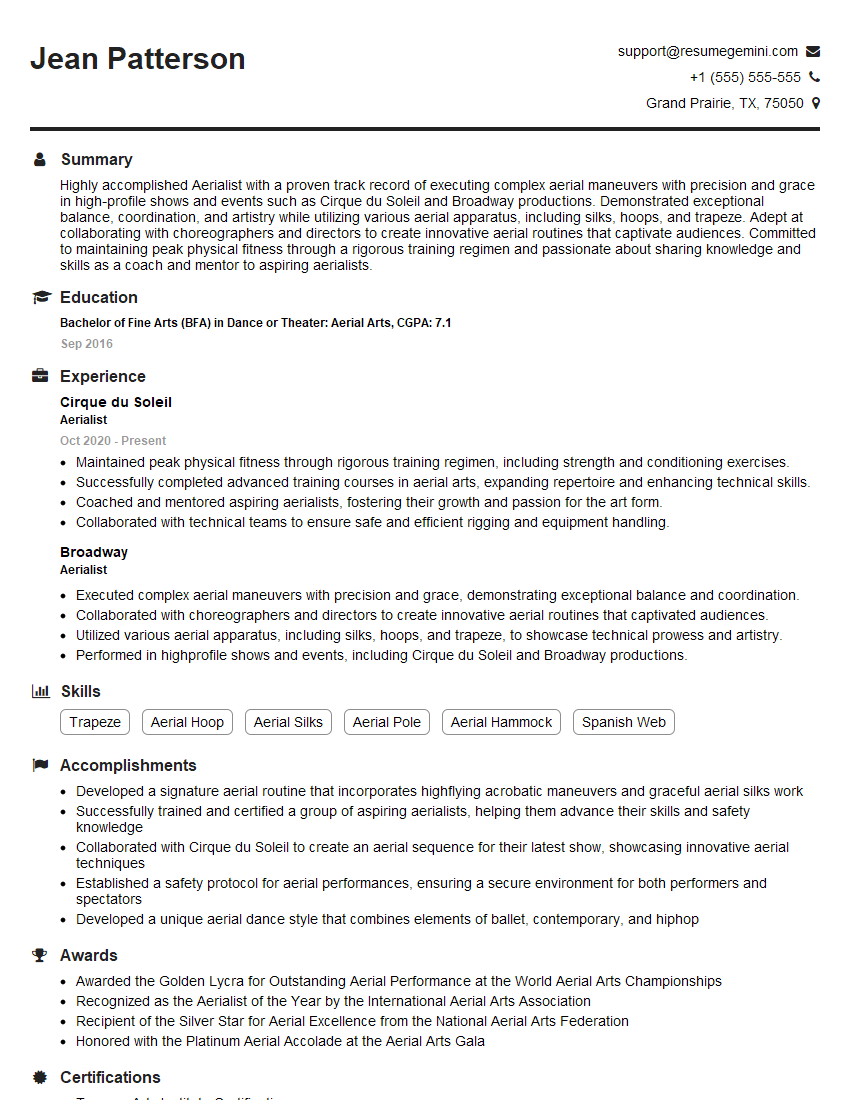
Mastering Aerial Hoop opens doors to exciting career opportunities, from professional performance to coaching and instruction. To maximize your job prospects, creating a strong, ATS-friendly resume is crucial. ResumeGemini is a trusted resource to help you build a professional and effective resume that showcases your skills and experience. We provide examples of resumes tailored to the Aerial Hoop industry to guide you. Take advantage of these resources to present yourself as the ideal candidate.
Explore more articles
Users Rating of Our Blogs
Share Your Experience
We value your feedback! Please rate our content and share your thoughts (optional).
What Readers Say About Our Blog
Very informative content, great job.
good