Feeling uncertain about what to expect in your upcoming interview? We’ve got you covered! This blog highlights the most important Aerial Utility Repair interview questions and provides actionable advice to help you stand out as the ideal candidate. Let’s pave the way for your success.
Questions Asked in Aerial Utility Repair Interview
Q 1. Describe your experience with different types of aerial lifts and their safety protocols.
My experience encompasses a wide range of aerial lifts, from bucket trucks and digger derricks to articulating boom lifts and telescopic handlers. Each type has its specific applications and safety protocols. For instance, bucket trucks are ideal for reaching overhead lines, but their stability is crucial, requiring careful positioning and load calculations. Digger derricks combine lifting capabilities with excavating functions, making them versatile but demanding operators with a solid understanding of counterweight and load distribution. Articulating boom lifts offer greater maneuverability in tight spaces, but their complex hydraulic systems demand thorough pre-operational checks. Safety protocols are paramount and involve daily pre-use inspections (checking hydraulic fluid levels, securing outriggers, testing emergency shut-offs), adherence to load limits, and the use of appropriate fall protection harnesses and lanyards, ensuring they’re always connected to a secure anchor point. We undergo rigorous training, and each lift type necessitates specialized certification to ensure competence and safety.
- Daily Inspections: Checking hydraulic fluid levels, tire pressure, outrigger functionality, and emergency shut-off mechanisms is standard procedure before any lift operation.
- Load Limits: Never exceeding the manufacturer’s specified load limits is crucial to prevent equipment failure. We use load charts and calculate weights carefully.
- Fall Protection: Harness, lanyard, and anchor point are always connected and inspected. We perform regular training in proper harness use and rescue techniques.
Q 2. Explain the process of identifying and repairing a damaged power line.
Identifying and repairing a damaged power line is a multi-step process requiring precision and safety. First, we de-energize the line, a critical step performed by qualified personnel using lockout/tagout procedures to ensure no accidental energization. Then, visual inspection using binoculars or drones identifies the damage extent, pinpointing the location and type of fault (broken conductor, insulator damage, etc.). We then use specialized tools and equipment to access the damaged section safely, utilizing the appropriate aerial lift, ensuring a stable platform. Next, the damaged section is repaired; this could involve splicing the conductor using specialized connectors, replacing damaged insulators, or removing and replacing sections of the line. After the repair, thorough testing ensures the integrity of the repaired section and the overall line before re-energizing it. Every step follows safety protocols, including maintaining a safe distance from energized lines and working under the supervision of a qualified line supervisor.
- De-energization: Lockout/Tagout procedures are mandatory to prevent accidental energization.
- Damage Assessment: Visual inspection with binoculars or drones assesses the extent of damage.
- Repair: Specialized tools and techniques are used, depending on the nature of the damage.
- Testing and Re-energization: Rigorous testing verifies the repair before restoring power.
Q 3. How do you prioritize repairs during an emergency situation?
During emergencies, prioritizing repairs is critical. Our approach follows a tiered system: First, we address life-threatening situations, such as downed lines posing an immediate risk to public safety. Second, we focus on critical infrastructure that impacts essential services like hospitals, emergency response centers, and water treatment plants. Third, we prioritize widespread outages affecting large populations. Throughout this process, we maintain open communication with emergency services and public utilities, constantly reassessing priorities as new information emerges. This system ensures the quickest restoration of power while mitigating risks effectively. Clear communication and efficient coordination with teams are vital for rapid response.
- Life Safety: Addressing immediate threats to human safety is the top priority.
- Critical Infrastructure: Restoring power to essential services takes precedence.
- Widespread Outages: Addressing large-scale power failures is next on the priority list.
- Communication: Continuous communication with stakeholders is crucial.
Q 4. What are the common causes of power outages and how are they addressed?
Power outages have various causes, broadly classified as weather-related, equipment failure, and human error. Severe weather like storms, high winds, and ice accumulation frequently causes damage to power lines and equipment, leading to outages. Equipment failures can stem from aging infrastructure, faulty components, or unexpected surges in power demand. Human error, such as accidents during maintenance or construction, can also lead to outages. Addressing these causes involves proactive measures like regular equipment maintenance and inspections, investing in weather-resistant infrastructure, and implementing robust safety protocols for all personnel. After an outage, our process involves rapid assessment of the cause, mobilizing repair crews, and restoring power safely and efficiently, ensuring thorough investigation to prevent similar incidents.
- Weather-Related: Storms, high winds, and ice are common causes.
- Equipment Failure: Aging infrastructure, faulty components, and power surges contribute to outages.
- Human Error: Accidents during maintenance or construction can cause outages.
Q 5. Describe your experience working at heights and with fall protection equipment.
Working at heights is an integral part of my job, and fall protection is non-negotiable. I’m extensively trained in various fall protection techniques, including the use of full-body harnesses, lanyards, shock-absorbing lanyards, and anchor points. We always ensure the anchor points are rated for the intended load and inspected regularly. Before any work at heights, a thorough risk assessment is conducted, identifying potential hazards and selecting the appropriate fall protection measures. Regular training and refresher courses keep our skills sharp and ensure we’re up to date on the latest safety standards and best practices. I’ve worked on various heights and structures; my experience ranges from working on small distribution poles to large transmission towers. Safety is consistently prioritized; complacency is never tolerated.
- Harness and Lanyard: Proper use and regular inspection of harnesses and lanyards.
- Anchor Points: Verifying the strength and reliability of anchor points.
- Risk Assessment: Thorough evaluation of potential hazards before starting work.
- Training: Regular training to maintain proficiency and awareness of safety standards.
Q 6. What safety measures do you follow when working near energized lines?
Working near energized lines demands extreme caution. The most crucial safety measure is maintaining a safe distance, determined by the voltage level and local safety regulations. We use specialized tools with insulated handles and wear protective equipment, including insulated gloves and protective clothing. Line workers are always aware of the potential dangers; proper communication between crew members is paramount. Prior to any work, we confirm the lines have been de-energized through lockout/tagout procedures. If de-energization is not feasible, we adhere to strict safety distances and employ specialized equipment designed for work on energized lines. We utilize specialized tools and equipment such as hot sticks and insulated tools, allowing us to work safely at a distance.
- Safe Distance: Maintaining a safe distance from energized lines based on voltage and regulations.
- Insulated Equipment: Using insulated tools, gloves, and protective clothing.
- Lockout/Tagout: Ensuring lines are de-energized before working directly on them.
- Communication: Clear communication between crew members is essential.
Q 7. How familiar are you with different types of insulators and their applications?
I am familiar with various insulator types, including porcelain, glass, polymer, and composite insulators. Porcelain insulators, known for their durability and high dielectric strength, are commonly used in high-voltage applications. Glass insulators offer excellent resistance to environmental degradation but can be more fragile. Polymer insulators are increasingly popular due to their lightweight design and resistance to various environmental factors, making them suitable for diverse applications. Composite insulators combine the strengths of different materials, providing a balance of performance and cost-effectiveness. The choice of insulator depends on factors such as voltage level, environmental conditions, and cost considerations. Understanding insulator properties and selecting the appropriate type is essential for ensuring reliable and safe power transmission.
- Porcelain: Durable, high dielectric strength, used in high-voltage applications.
- Glass: Excellent environmental resistance but can be fragile.
- Polymer: Lightweight, resistant to environmental factors, suitable for diverse applications.
- Composite: Combines strengths of different materials, offering a balance of performance and cost.
Q 8. Explain your understanding of electrical safety regulations and codes.
Electrical safety regulations and codes are paramount in aerial utility repair. They’re designed to protect both workers and the public from the inherent dangers of high-voltage electricity. My understanding encompasses a wide range of standards, including OSHA (Occupational Safety and Health Administration) regulations specific to line work, National Electrical Code (NEC) requirements for safe installation and maintenance of power lines, and the relevant industry best practices. These codes dictate everything from proper lockout/tagout procedures (ensuring power is completely de-energized before any work begins) to the use of personal protective equipment (PPE) like insulated gloves, safety harnesses, and arc flash suits. For example, OSHA 1910 Subpart V details requirements for protecting workers from electrical hazards, specifying clearances, protective equipment, and emergency procedures. Violation of these codes can lead to serious injury or death, as well as significant legal consequences.
A practical example is the use of rubber gloves and insulated tools. Even when power is seemingly off, residual voltage or capacitive coupling can still pose a lethal risk. These codes aren’t just rules; they are crucial for preventing accidents and maintaining a safe working environment.
Q 9. Describe your experience with various types of aerial cable splicing techniques.
My experience with aerial cable splicing encompasses various techniques, each suited to different cable types and situations. I’m proficient in both mechanical splicing, using compression connectors and specialized tools, and traditional methods like using solder and heat-shrink tubing. Mechanical splicing offers speed and efficiency for certain cable types, particularly when working at heights. However, I’ve also mastered more intricate soldering techniques for higher-voltage lines requiring more robust and weather-resistant connections. The choice of technique depends critically on factors such as cable size, voltage, and environmental conditions. For example, when working with smaller coaxial cables, a compression connector might be sufficient. But with large, high-voltage conductors, a carefully executed solder splice with additional weatherproofing is essential to ensure longevity and safety.
I’ve also worked extensively with different materials, including aluminum, copper, and various types of insulation. Understanding the properties of these materials and how they react during the splicing process is crucial for a successful and long-lasting repair.
Q 10. How do you diagnose and troubleshoot problems in overhead power lines?
Diagnosing and troubleshooting problems in overhead power lines begins with a thorough visual inspection. This involves looking for visible damage like broken insulators, damaged conductors, or sagging lines. Beyond visual inspection, we utilize specialized equipment. For example, infrared cameras can detect heat signatures indicating faulty connections or overloaded lines. Line testers help to pinpoint short circuits or other electrical issues. Often the diagnosis involves a process of elimination – systematically checking components to find the source of the problem. A sagging line might point to a broken support structure, while flickering lights in a nearby area may indicate a loose connection or partial failure somewhere in the system.
A specific example: If a section of line is experiencing unusual heating, an infrared scan can quickly pinpoint the exact location of the problem, even if it’s not immediately visible to the naked eye. This allows for targeted repairs, minimizing downtime and maximizing efficiency.
Q 11. What is your experience with using various testing equipment on power lines?
My experience with power line testing equipment is extensive. I’m proficient in using various types of meters and testers, including: Clamp meters to measure current, voltage testers to check for live circuits, insulation resistance testers (meggers) to assess the integrity of insulation, and fault locators to pinpoint precise locations of faults within the cable. Knowing how to correctly use these instruments, along with understanding their limitations, is crucial for accurate diagnoses and safe work practices. Incorrect usage can lead to inaccurate readings, potentially hazardous situations, or even equipment damage.
For instance, a megger test helps determine the insulation resistance of a cable. A low reading indicates potential problems in the insulation that might lead to short circuits. Knowing how to interpret this data allows for preventative maintenance and avoids potential future outages.
Q 12. How do you handle unexpected issues or challenges while working on aerial utility repair?
Handling unexpected issues is a significant part of this job. A prepared mindset is crucial. I always have a contingency plan, considering potential problems before they arise. Examples include unexpected weather changes, equipment malfunctions, or discovering more extensive damage than initially anticipated. My approach involves: 1. Assessing the situation safely. 2. Communicating clearly with my team and control center. 3. Implementing appropriate safety measures. 4. Adapting my strategy as needed. If unforeseen damage is discovered, I’ll communicate the situation and work with the team to modify the repair plan accordingly. Safety is the top priority; if a situation becomes too dangerous, the work will be stopped and reassessed.
For instance, if a storm rolls in unexpectedly, securing the work area and ensuring everyone is safe is paramount. This may involve descending from the pole and waiting for the storm to pass. Communication is key in these situations – maintaining clear channels with supervisors and colleagues is vital.
Q 13. Describe your experience with pole climbing and the associated safety procedures.
Pole climbing is a fundamental skill, and safety is paramount. I’m extensively trained in safe climbing techniques, utilizing climbing spurs, safety belts, and ropes. Before every climb, a thorough inspection of the pole and equipment is performed. A critical aspect is the three-point contact rule: always maintaining at least three points of contact with the pole at all times. This ensures stability and reduces the risk of falling. Regular training keeps my skills sharp, ensuring I can react appropriately in unexpected situations. Every climb involves pre-climb planning considering factors like weather conditions and pole condition. Additionally, there’s always a ground crew to assist and ensure safety.
A real-world example: Before climbing a pole, I inspect it for rot, cracks, or any signs of weakness. I also ensure my climbing gear is properly secured and functioning correctly. This preventative approach minimizes risk and helps ensure a safe climb.
Q 14. What are the different types of aerial equipment you are proficient in using?
I’m proficient in operating various types of aerial equipment vital for efficient and safe utility repair. This includes bucket trucks, which provide safe access to overhead lines, aerial lifts for precise positioning and movement around the power lines, and various types of specialized tools like tensioning devices, cable pullers, and hand tools designed specifically for working at heights. The choice of equipment depends on the specific task and the location. It’s critical to undergo proper training and certification on each piece of equipment to ensure safe and efficient operation. Regular inspections and maintenance of the equipment are also key to preventing accidents.
For instance, a bucket truck offers a safe platform for working on lines at height, while specialized cable pullers assist in running new conductors. Understanding the capabilities and limitations of each piece of equipment allows for efficient and safe problem-solving in diverse scenarios.
Q 15. How do you maintain aerial equipment and ensure its optimal performance?
Maintaining aerial equipment is paramount for safety and operational efficiency. It’s a multi-faceted process involving regular inspections, preventative maintenance, and timely repairs. Think of it like maintaining a high-performance vehicle – regular check-ups prevent major breakdowns.
Pre-flight Checks: Before each job, a thorough inspection is crucial. This includes checking all components for wear and tear, ensuring proper functionality of safety harnesses, inspecting ropes and pulleys for fraying or damage, and verifying the operational status of all lifting mechanisms. For instance, I always visually inspect the bucket’s hydraulic system, ensuring no leaks or damage are present.
Preventative Maintenance Schedules: We adhere to strict preventative maintenance schedules, performing routine servicing at specified intervals. This might involve lubricating moving parts, replacing worn-out components (like frayed ropes), and conducting more detailed inspections of critical systems. For example, we schedule annual inspections of the aerial lift’s electrical system and hydraulic components.
Detailed Record Keeping: Maintaining accurate records of all inspections, maintenance activities, and repairs is essential. This allows us to track the equipment’s history and identify any potential problems early. These records help predict when major servicing will be needed, preventing costly unexpected downtime.
Training and Certification: Our team undergoes regular training and certification to ensure they are proficient in handling and maintaining the equipment. This is non-negotiable for safety.
Career Expert Tips:
- Ace those interviews! Prepare effectively by reviewing the Top 50 Most Common Interview Questions on ResumeGemini.
- Navigate your job search with confidence! Explore a wide range of Career Tips on ResumeGemini. Learn about common challenges and recommendations to overcome them.
- Craft the perfect resume! Master the Art of Resume Writing with ResumeGemini’s guide. Showcase your unique qualifications and achievements effectively.
- Don’t miss out on holiday savings! Build your dream resume with ResumeGemini’s ATS optimized templates.
Q 16. Describe your experience with working in various weather conditions.
Working in various weather conditions is an integral part of this job. Safety is always the priority. We have procedures for different weather events.
Extreme Heat: In extreme heat, we schedule work for the cooler parts of the day, use appropriate hydration strategies, and take frequent breaks in shaded areas. We also ensure that all personnel are wearing appropriate sun protection.
Inclement Weather (Rain, Snow, Ice): Work is typically suspended during heavy rain, snow, or ice storms due to increased risks of slips, falls, and electrical hazards. We always refer to the weather forecast before starting any work and have contingency plans in place if weather deteriorates unexpectedly.
High Winds: High winds pose a significant hazard. We use wind speed monitoring devices and cease operations if the wind speed exceeds the safe operating limits of our equipment. Safety is always paramount.
Extreme Cold: In extreme cold, we utilize appropriate cold weather gear, including insulated clothing, gloves, and boots. We also shorten working intervals to avoid exposure to the elements for extended periods. We always have readily available warming facilities.
Q 17. How do you communicate effectively with your team and supervisors while working at heights?
Clear and concise communication is crucial for safety when working at heights. We utilize a combination of techniques.
Hand Signals: We use a pre-defined set of hand signals for communicating when verbal communication is difficult or impossible due to distance or noise. These are practiced regularly.
Two-Way Radios: Constant communication via two-way radios ensures everyone is aware of ongoing operations and potential hazards. This is particularly important in coordinating movements of the aerial lift and other ground crew.
Pre-Job Briefings: Before starting each job, we conduct thorough briefings to discuss the work plan, potential hazards, and communication protocols. This ensures everyone is on the same page.
Regular Check-Ins: Frequent check-ins during the operation ensure everyone remains aware of each other’s progress and any changing conditions.
Q 18. Explain your understanding of lockout/tagout procedures.
Lockout/Tagout (LOTO) procedures are essential for preventing accidental energization of equipment during maintenance or repair. It’s a safety protocol to prevent injuries from unexpected startup.
The process typically involves:
Identify the energy source: Determine all sources of potential energy (electrical, hydraulic, pneumatic, etc.) that need to be isolated.
Isolate the energy source: Shut off all energy sources using appropriate switches, valves, or other controls.
Lockout the energy source: Apply a lockout device (a lock) to the energy isolation device to prevent accidental re-energization.
Tagout the energy source: Affix a tag to the lockout device, clearly indicating who has the lockout, the date, and the reason for the lockout.
Verify the lockout: Before commencing work, ensure the energy source is completely de-energized by testing or verifying its isolation.
Tagout removal: Only the person who applied the lockout can remove it after verifying that the work is complete and it’s safe to re-energize the equipment.
We rigorously follow LOTO procedures for any work involving potentially hazardous energy sources, such as electrical lines or hydraulic systems on the aerial lift.
Q 19. How do you handle emergency situations involving injured colleagues or equipment failure?
Emergency response is critical in our line of work. We have established procedures for handling various scenarios.
Injured Colleagues: In case of an injury, the immediate priority is to ensure the safety of the injured person. We administer first aid if qualified, call emergency medical services (EMS), and secure the work area. We follow company protocols for accident reporting and investigation.
Equipment Failure: If equipment fails, the first step is to immediately shut down the equipment and secure the area to prevent further accidents. We then assess the extent of the damage and initiate repairs or replacement if necessary. We always have backup equipment to reduce downtime.
Emergency Communication: Clear communication with the emergency services and the ground crew is essential, so a designated person is responsible for coordinating rescue and emergency response.
Q 20. What is your experience with grounding procedures and safety measures?
Grounding procedures are critical for safety, especially when working near energized electrical lines. Grounding essentially connects the equipment to the earth, providing a path for fault currents to flow safely to ground, preventing dangerous electrical shocks.
Grounding Equipment: Before commencing work near energized lines, we ensure all equipment is properly grounded using appropriate grounding clamps and conductors. This connects the equipment’s metal parts to earth, preventing the buildup of static electricity.
Grounding Ropes: We use insulated grounding ropes to connect aerial equipment to properly grounded points on the ground. We use specialized grounding equipment on energized systems.
Safety Training: All personnel receive extensive training on grounding procedures and the importance of adhering to safety protocols.
Regular Inspections: The grounding system and its connections are checked and maintained on a regular basis to ensure their effectiveness.
Q 21. How do you interpret blueprints, schematics, and other technical documentation?
Interpreting blueprints, schematics, and technical documentation is a fundamental skill. It involves understanding the symbols, notations, and dimensions to visualize the system and plan the work accordingly.
Blueprint Interpretation: I can interpret blueprints to identify the location and configuration of power lines, poles, and other equipment. This is crucial for planning the access route and safe working procedures.
Schematic Diagrams: Schematic diagrams help me understand the electrical system’s layout, identifying voltage levels, circuit paths, and the interaction between components.
Technical Manuals: I refer to technical manuals to understand the specifications, operating procedures, and maintenance requirements of specific equipment.
Measurements and Dimensions: I accurately interpret measurements and dimensions provided in documentation to ensure the proper placement and fitting of components.
For example, using schematics, I recently located and repaired a faulty circuit breaker on a high-voltage transmission line, avoiding a potential power outage. Detailed understanding of the documentation was key.
Q 22. Explain your experience with various types of connectors and their applications.
My experience encompasses a wide range of connectors used in aerial utility repair, each suited for specific applications and voltage levels. Understanding the nuances of each is crucial for ensuring safe and reliable connections.
- Compression Connectors: These are widely used for their reliability and ease of installation. They create a strong, mechanically sound connection by compressing the conductor and the connector body together. I’ve used them extensively on lower voltage distribution lines. For example, on a recent job repairing a damaged secondary line, I used compression connectors to splice back together aluminum conductors.
- Bolt-on Connectors: These connectors are preferred for higher voltage applications and larger conductors due to their robust nature. The conductor is bolted securely within the connector, offering excellent current-carrying capacity. I’ve utilized them primarily on higher voltage transmission lines, ensuring a secure connection even under significant load.
- Crimp Connectors: These connectors use a special crimping tool to create a secure mechanical connection. They are versatile and suitable for various conductor types and sizes. However, proper crimping technique is critical to guarantee a safe connection. I regularly use crimp connectors for both smaller distribution lines and specialized applications, such as grounding wires.
- Hydrophobic Connectors: Designed for outdoor environments, these connectors repel moisture to prevent corrosion and maintain reliable connectivity in challenging weather conditions. These are essential for ensuring consistent performance in all climates.
Selecting the appropriate connector is not simply about the type; it also heavily depends on the specific conductor material (copper, aluminum, etc.), size, and the environmental factors at the repair site.
Q 23. How do you ensure the quality and safety of your work after completing a repair?
Quality and safety are paramount in aerial utility repair. After completing a repair, I follow a rigorous checklist to ensure everything meets or exceeds industry standards. This process involves:
- Visual Inspection: A thorough visual inspection of all connections, ensuring there are no loose parts, visible damage, or signs of overheating.
- Testing: Using appropriate test equipment (like a megohmmeter for insulation resistance testing and a clamp meter for current measurement), I verify the integrity of the repair and the correct functionality of the line.
- Documentation: Meticulous record-keeping is essential. I document all work performed, including the type of repair, materials used, test results, and any observations. This provides a detailed history for future reference and troubleshooting.
- Clean-up: Maintaining a clean work area is crucial for safety. I remove all debris, discarded materials, and ensure the site is left in a safe and organized state.
- Safety Briefing: Before leaving the site, I conduct a final safety check and, if working with a team, ensure everyone understands the post-repair status.
Think of it like building a bridge – after construction, rigorous inspections and load tests are done before opening it to traffic. The same principle applies to aerial utility repairs; safety is never compromised.
Q 24. What is your understanding of the different voltage levels in power distribution systems?
Power distribution systems operate at various voltage levels, each with its own safety protocols and considerations. A solid understanding is fundamental to my work.
- Low Voltage (LV): Typically up to 1000V, often found in residential and smaller commercial areas. Work at this level still requires caution but involves less extreme risks.
- Medium Voltage (MV): Ranging from 1 kV to 35 kV, this is common in larger commercial and industrial areas, as well as some substations. This voltage level poses significantly increased hazards.
- High Voltage (HV): From 35 kV to 230 kV. These lines are usually part of the main transmission network carrying bulk power across large distances. This voltage is extremely dangerous and demands specialized safety equipment and expertise.
- Extra-High Voltage (EHV): Above 230 kV, this is used for long-distance power transmission. Working at this level is highly specialized and requires extensive training and safety procedures.
I’ve worked on systems across several of these voltage levels, emphasizing the fact that safety procedures differ greatly depending on the voltage in question and appropriate safety equipment is used at all times.
Q 25. Describe your experience with using various tools and equipment for aerial utility repairs.
My experience with tools and equipment is extensive. Safety and efficiency are central to my tool selection. Here are some key examples:
- Insulated Tools: These are essential for working on energized lines and include screwdrivers, pliers, wrenches, and cutters, all with insulated handles to protect against electrical shock.
- Aerial Lifts and Buckets: Providing safe access to overhead lines. I’m proficient in operating various types, ensuring safe positioning and adherence to all safety protocols.
- Line Tools: Specialized tools such as come-alongs, tensioners, and pulling grips are used for stringing and tensioning conductors.
- Testing Equipment: Megohmmeters, clamp meters, voltage detectors, and thermal cameras are regularly used to assess the condition of the lines and ensure the repair’s integrity.
- Safety Equipment: This includes hard hats, safety glasses, gloves, harnesses, and fall protection equipment. Regular inspections and maintenance of this equipment are non-negotiable.
The choice of tools depends heavily on the specific repair. For example, while working on a high-voltage transmission line, a specialized hot-stick tool would be used instead of a standard insulated tool to further reduce the risk of electrical shock.
Q 26. How do you conduct regular inspections of power lines and identify potential hazards?
Regular inspections are proactive measures to prevent outages and ensure public safety. My inspection process includes:
- Visual Inspection: Checking for sag, broken insulators, damaged conductors, vegetation encroachment, and signs of corrosion.
- Infrared Thermography: Using thermal imaging cameras to detect overheating components that may indicate impending failures.
- Drone Inspections: Drones offer a safe and efficient way to inspect large spans of power lines, providing detailed imagery and videos of hard-to-reach areas.
- Patrol Inspections: Regular ground patrols to inspect accessible areas and identify potential hazards.
- Documentation: Thorough documentation, including photos and videos, are used to record findings and aid in prioritization of repair work.
For instance, during a routine inspection using a drone, I recently identified a weakened support structure on a high-voltage transmission line, leading to its timely repair before it could cause a major outage.
Q 27. Describe your experience with working on different types of transmission lines.
My experience spans various transmission line types, each presenting unique challenges and requiring specific techniques:
- Overhead Transmission Lines: These are the most common type, with conductors strung between towers or poles. My work involves repairs related to conductor damage, insulator replacement, and tower maintenance.
- Underground Transmission Lines: While I primarily focus on overhead lines, I have some experience with underground cable repairs, which involve different techniques and specialized equipment.
- Submarine Transmission Lines: I have limited direct experience with these lines, as they are highly specialized. However, I’m familiar with the unique challenges and safety considerations they present.
For example, on one occasion, I had to repair a section of an overhead transmission line that had been damaged by a severe storm. This involved working at height using specialized equipment and understanding the electrical risks involved at that high voltage.
Q 28. How do you maintain accurate records and documentation of your work?
Accurate record-keeping is crucial for accountability, safety, and future maintenance. I maintain detailed records using a combination of methods:
- Digital Records: Using tablets and specialized software, I record all repair details, including date, time, location, type of repair, materials used, test results, and photos/videos of the work performed.
- Paper-Based Records: While digital is preferred, paper-based forms are sometimes used as a backup or for specific situations where digital recording may not be feasible.
- Database Integration: The digital records are often integrated into a company database for easy access and analysis, allowing for efficient tracking of repairs and maintenance schedules.
This detailed system ensures traceability and allows for efficient tracking of completed work orders and parts used, crucial for management and future planning. It’s like keeping a detailed medical history – essential for continued care and problem-solving.
Key Topics to Learn for Your Aerial Utility Repair Interview
- Safety Procedures and Regulations: Understanding OSHA regulations, fall protection techniques, and lockout/tagout procedures is paramount. Practical application includes demonstrating knowledge of specific safety protocols used in various aerial repair scenarios.
- Linework and Troubleshooting: Mastering the identification and repair of damaged conductors, insulators, and transformers. Practical application involves explaining your troubleshooting methodology for common line issues and how you’d approach diagnosing a fault.
- Equipment Operation and Maintenance: Familiarity with aerial lifts, digger derricks, and other specialized equipment. This includes safe operation, preventative maintenance, and troubleshooting malfunctions. Practical application includes describing your experience with specific equipment and any maintenance tasks you’ve performed.
- Electrical Theory and Principles: A strong understanding of electrical circuits, voltage, current, and power. Practical application includes explaining how you would calculate voltage drop or apply Ohm’s Law in a real-world scenario.
- Communication and Teamwork: Effective communication with ground crew, supervisors, and customers. Practical application includes describing your approach to coordinating tasks and ensuring team safety during complex repairs.
- Emergency Response and Procedures: Knowledge of emergency protocols, including handling electrical hazards and reporting incidents. Practical application involves describing your actions in a hypothetical emergency situation involving an electrical fault.
Next Steps
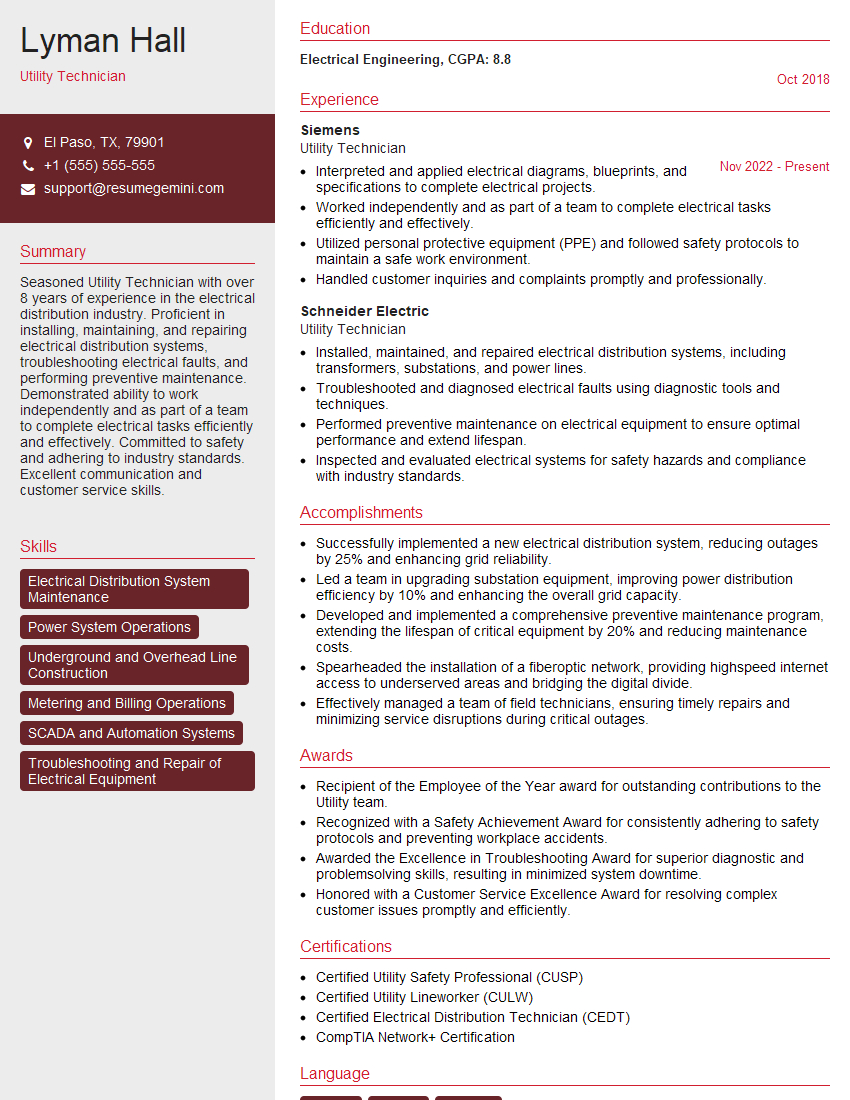
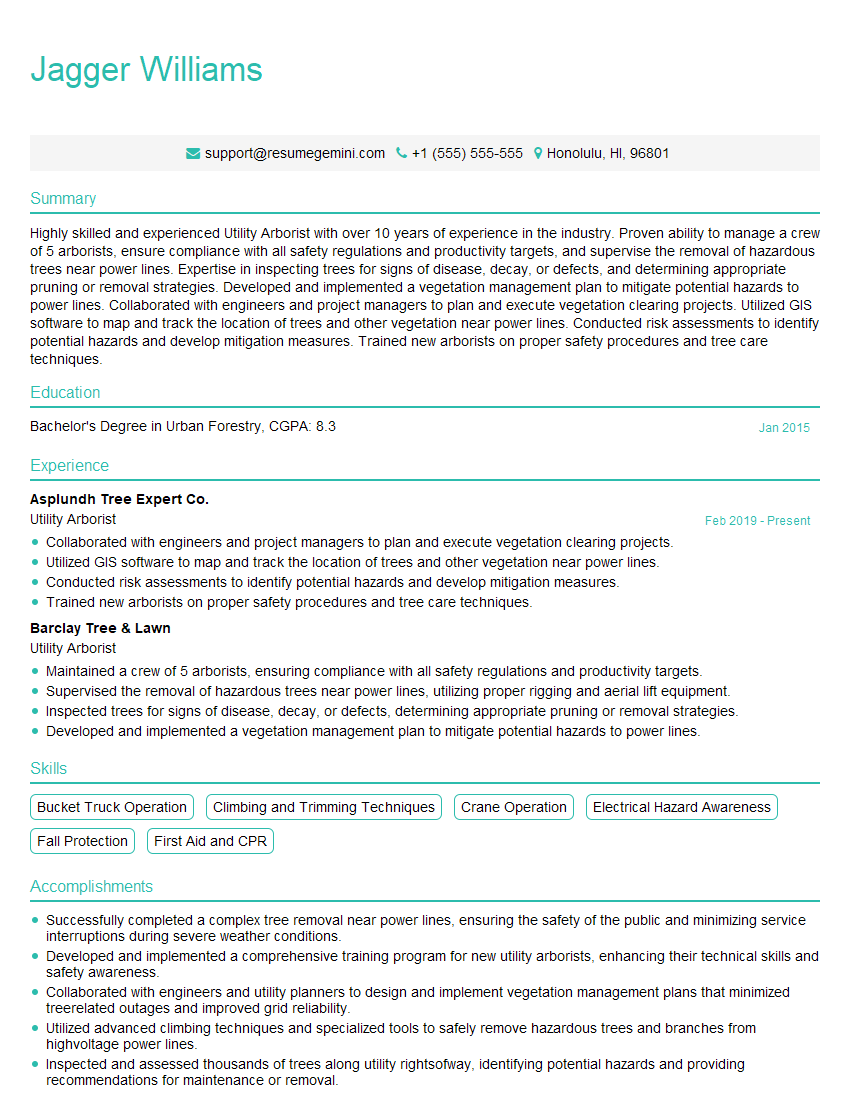
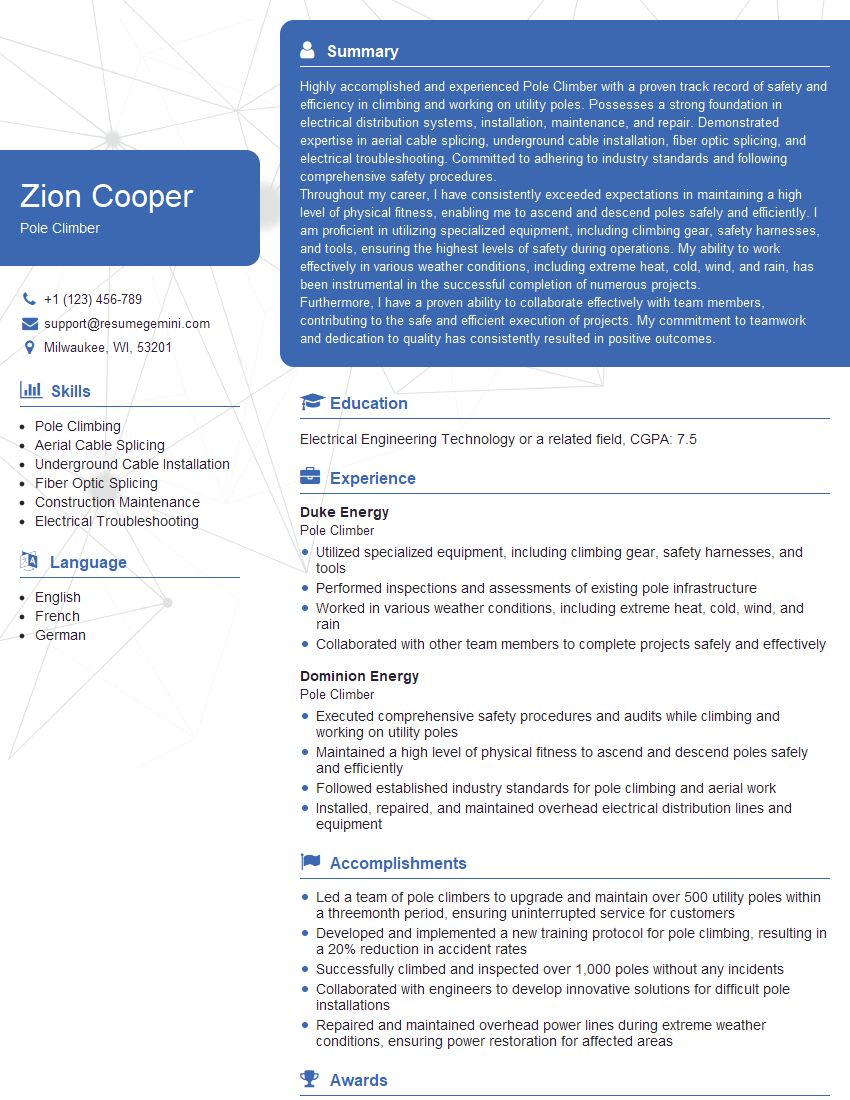
Mastering Aerial Utility Repair opens doors to a rewarding career with excellent growth potential, offering opportunities for specialization and advancement within the utility industry. To maximize your job prospects, focus on creating a professional, ATS-friendly resume that highlights your skills and experience effectively. ResumeGemini is a trusted resource that can help you craft a compelling resume tailored to the specific demands of this field. We provide examples of resumes specifically designed for Aerial Utility Repair professionals to help guide you in building yours. Take advantage of these resources to showcase your qualifications and land your dream job!




Explore more articles
Users Rating of Our Blogs
Share Your Experience
We value your feedback! Please rate our content and share your thoughts (optional).
What Readers Say About Our Blog
Very informative content, great job.
good