The right preparation can turn an interview into an opportunity to showcase your expertise. This guide to Agricultural Chemical Application interview questions is your ultimate resource, providing key insights and tips to help you ace your responses and stand out as a top candidate.
Questions Asked in Agricultural Chemical Application Interview
Q 1. Describe the different methods of agricultural chemical application.
Agricultural chemical application methods are diverse, chosen based on factors like crop type, chemical properties, and terrain. They broadly fall into these categories:
- Spraying: This is the most common method, using various equipment like boom sprayers (for large fields), airblast sprayers (for orchards and vineyards), and handheld sprayers (for smaller areas). Spraying delivers chemicals as liquids, aerosols, or mists.
- Dusting: This involves applying finely ground powders, using specialized dusters. It’s suitable for certain insecticides and fungicides but is less precise than spraying and can be affected by wind.
- Granular Application: Granular formulations, similar to small pellets, are spread using spreaders or incorporated into the soil using specialized equipment. This method is less prone to drift and generally more environmentally friendly.
- Seed Treatment: Chemicals are applied directly to seeds before planting, protecting the seedlings from pests and diseases during germination. This is highly efficient as it targets the problem directly.
- Foliar Application: This targets the leaves and other above-ground parts of the plant directly, providing quick action for things like nutrient deficiencies or fungal infections. The precise nature of the application is crucial for effectiveness
- Soil Application: This involves incorporating chemicals into the soil, usually before planting. This provides long-lasting protection from soil-borne diseases and pests.
The choice of method significantly impacts efficacy and environmental impact. For instance, using a boom sprayer for a large field is efficient but requires careful calibration to avoid over-application, while handheld sprayers offer precision for smaller areas.
Q 2. Explain the importance of calibrating application equipment.
Calibrating application equipment is crucial for accurate chemical application, ensuring optimal efficacy and minimizing environmental damage and wasted resources. Improper calibration can lead to either under-application (resulting in pest or disease control failure) or over-application (causing environmental contamination and crop damage).
Calibration involves determining the amount of chemical being delivered per unit area (e.g., gallons per acre). This is usually a multi-step process involving:
- Measuring the application rate of the equipment (e.g., gallons per minute).
- Measuring the ground speed (e.g., miles per hour).
- Measuring the nozzle output.
- Calculating the application rate per unit area.
- Adjusting the equipment to deliver the desired application rate.
Imagine trying to bake a cake without measuring ingredients – the result would be unpredictable. Similarly, inaccurate calibration leads to inconsistent results. Regularly checking calibration, especially after maintenance or changes in equipment settings, ensures consistent and accurate applications.
Q 3. What are the safety precautions necessary when handling agricultural chemicals?
Safety is paramount when handling agricultural chemicals. These precautions are essential:
- Personal Protective Equipment (PPE): Always wear appropriate PPE, including gloves, goggles or face shields, respirators, and protective clothing, as specified on the chemical label.
- Label Reading: Carefully read and understand the label before handling any chemical. Pay close attention to safety precautions, application instructions, and first aid information.
- Proper Mixing and Handling: Mix chemicals in well-ventilated areas, using the recommended mixing ratios and equipment. Avoid skin contact and inhalation of dust or fumes.
- Storage: Store chemicals in their original containers, in a secure, dry, and well-ventilated area, away from food and other materials. Clearly label containers and keep them out of reach of children and unauthorized personnel.
- Spill Response: Have a spill response plan in place. Know how to handle spills safely and dispose of contaminated materials properly.
- Emergency Preparedness: Keep a readily accessible first aid kit and know the emergency contact numbers for poison control and medical assistance. It’s also wise to inform your neighbors of your planned application.
- Disposal: Dispose of empty containers and unused chemicals according to label instructions and local regulations. Never pour chemicals down the drain or into waterways.
Failing to follow these precautions can lead to serious health consequences, ranging from skin irritation to long-term health problems. Investing in safety is an investment in your well-being.
Q 4. How do you determine the appropriate rate of application for a specific chemical and crop?
Determining the appropriate application rate involves considering several factors:
- Chemical Label: The label provides a recommended rate, but this is a starting point. Factors like pest pressure, weather conditions, and crop growth stage may require adjustments.
- Pest or Disease Pressure: A higher infestation requires a higher application rate. Regular monitoring of pest and disease levels is crucial for determining this.
- Crop Growth Stage: Application rates can differ depending on the plant’s growth stage. Young seedlings usually require less chemical than mature plants.
- Weather Conditions: Rainfall, temperature, and wind can affect the efficacy and persistence of the chemical. Hot or windy conditions may necessitate adjustments.
- Soil Type: Soil properties can influence the movement and persistence of the chemical in the soil. Sandy soils may require higher application rates than clay soils.
- Previous Applications: Prior application history and their effectiveness need to be considered, to avoid unnecessary chemical use.
For example, a farmer dealing with a severe aphid infestation might need a higher rate than someone with a minor problem. Local agricultural extension services and consultants offer guidance on appropriate application rates based on specific conditions.
Q 5. What are the potential environmental impacts of improper chemical application?
Improper chemical application can have significant environmental consequences:
- Water Contamination: Runoff from improperly applied chemicals can contaminate surface and groundwater, harming aquatic life and potentially entering the human food chain.
- Soil Degradation: Excessive chemical use can degrade soil health, reducing its fertility and ability to support plant growth. This can also lead to soil erosion.
- Air Pollution: Drift from spraying can contaminate the air, affecting human health and non-target organisms. This is particularly concerning with volatile chemicals.
- Impact on Non-target Organisms: Chemicals can harm beneficial insects, birds, and other wildlife, disrupting ecological balance.
- Resistance Development: Overuse of chemicals can lead to the development of pest resistance, making future control more difficult and requiring more intense applications.
Avoiding over-application, using targeted application methods, and adopting integrated pest management strategies are crucial for minimizing these impacts. Responsible chemical use is vital for environmental stewardship.
Q 6. Explain the concept of integrated pest management (IPM).
Integrated Pest Management (IPM) is a holistic approach to pest control that emphasizes prevention and minimizing pesticide use. It involves a combination of strategies:
- Monitoring: Regular monitoring of pest populations to determine the extent of infestation.
- Cultural Controls: Using farming practices to reduce pest susceptibility (e.g., crop rotation, proper planting density, sanitation).
- Biological Controls: Using natural enemies like predatory insects or beneficial microorganisms to control pest populations. This can include introducing natural predators.
- Mechanical Controls: Physical removal of pests (e.g., trapping, handpicking).
- Chemical Controls: Using pesticides as a last resort, only when necessary and with careful consideration of environmental impact. This should be selective and targeted.
IPM aims for long-term sustainable pest management, protecting the environment and human health while maintaining crop yields. It’s a proactive approach that relies on observation, planning, and implementing the right strategies at the right time, minimizing chemical reliance.
Q 7. Describe your experience with different types of application equipment (e.g., boom sprayers, airblast sprayers).
My experience includes extensive work with various application equipment:
- Boom Sprayers: I’ve operated and maintained self-propelled and trailed boom sprayers, handling calibration, nozzle adjustments, and troubleshooting mechanical issues. These are ideal for large-scale field applications, offering high efficiency and consistent coverage. I’m familiar with the complexities of maintaining proper spray pressure and optimizing nozzle spacing for even distribution.
- Airblast Sprayers: I’ve worked extensively with airblast sprayers in orchards and vineyards. These require precise control of air volume and spray pressure to ensure effective coverage of the plant canopy without causing excessive drift. Understanding airflow patterns and the impact of nozzle selection on penetration is critical for optimal performance.
- Handheld Sprayers: I’m proficient with various handheld sprayers, including knapsack and compressed-air sprayers. These are invaluable for smaller areas or spot treatments requiring precision. Understanding the differences between different nozzle types and pressure adjustments is key.
- Granular Spreaders: I have experience with calibrating and operating granular spreaders, understanding the importance of consistent flow rate for uniform distribution of fertilizer or pesticides. Different spreaders have varying mechanisms and calibrations and it is essential to be familiar with these differences.
My expertise extends beyond operation to include preventative maintenance, troubleshooting, and optimizing equipment for specific applications. This practical experience has provided me with a comprehensive understanding of the advantages and limitations of each type of equipment.
Q 8. How do you ensure the accuracy and uniformity of chemical application?
Ensuring accurate and uniform chemical application is paramount for effective pest control and maximizing crop yields while minimizing environmental impact. It’s a multi-faceted process involving careful calibration, precise application techniques, and regular equipment maintenance.
Calibration: Before each application, I meticulously calibrate my sprayers or other application equipment. This involves measuring the output (gallons per acre or liters per hectare) at a specific pressure and speed. I use standardized procedures and compare measurements to manufacturer specifications to ensure accuracy. Inaccurate calibration leads to either under-application (ineffective pest control) or over-application (environmental damage and potential crop injury).
Application Techniques: The choice of application method (e.g., boom sprayers, airblast sprayers, granular applicators) depends on the specific crop, target pest, and environmental conditions. For example, using a directed spray can minimize pesticide drift and optimize chemical coverage on target weeds or insects, while avoiding unnecessary contact with non-target plants. I always maintain a consistent speed and overlap between spray swaths.
Regular Maintenance: Regular maintenance of application equipment is critical. This includes cleaning nozzles to prevent clogging, checking pressure gauges, and ensuring proper functioning of all components. A malfunctioning sprayer can lead to uneven application and reduced efficacy.
GPS and Technology: Modern technology, like GPS-guided sprayers, improves accuracy and uniformity. These systems utilize GPS data to create precise application maps, enabling variable rate application based on the specific needs of different areas within a field.
For example, during a recent application of fungicide on a vineyard, careful calibration and precise boom sprayer adjustments ensured that the fungicide was applied uniformly across the entire vineyard, leading to consistent disease control and minimal fungicide waste.
Q 9. What are the common types of pesticides used in agriculture?
Pesticides encompass a broad range of chemicals used to control various pests in agriculture. They are classified based on their target organism (e.g., insecticides, herbicides, fungicides, nematicides).
Insecticides: Target insect pests. Examples include organophosphates (e.g., malathion), pyrethroids (e.g., permethrin), and neonicotinoids (e.g., imidacloprid). These differ in their mode of action (how they kill or disable insects) and persistence in the environment.
Herbicides: Control unwanted plants (weeds). These can be selective (affecting specific weed species) or non-selective (killing all vegetation). Examples include glyphosate (a non-selective herbicide) and 2,4-D (a selective herbicide).
Fungicides: Control fungal diseases. They can be contact (affecting only the fungi they come into contact with) or systemic (absorbed by the plant and transported throughout, providing broader protection). Examples include copper-based fungicides and strobilurins.
Nematicides: Control nematodes (microscopic worms) that damage plant roots. These are often used in soil applications.
The selection of a specific pesticide is based on various factors, including the target pest, the crop being protected, environmental conditions, and regulatory compliance.
Q 10. Explain the differences between pre-emergent and post-emergent herbicides.
Pre-emergent and post-emergent herbicides differ primarily in their timing of application relative to weed germination and growth.
Pre-emergent Herbicides: Applied before weed seeds germinate. They work by preventing weed seeds from sprouting or inhibiting early root development. These herbicides need to be incorporated into the soil or activated by moisture to be effective. Examples include trifluralin and dithiopyr. They’re often used for preventing broadleaf and grass weed emergence in crops like corn and soybeans.
Post-emergent Herbicides: Applied after weeds have emerged. They work by contacting and killing existing weeds. These herbicides have to contact the weed to be effective, so accurate spray application is key. Examples include glyphosate and 2,4-D. They are often used for selective weed control in established crops or for spot treatment of weeds.
The choice between pre-emergent and post-emergent herbicides depends on several factors, including the type of weeds to be controlled, the crop being protected, and the timing of planting.
Q 11. How do you identify and address pesticide drift?
Pesticide drift is the unintentional movement of pesticides from the application site to non-target areas. It’s a serious environmental concern and can cause damage to nearby crops, harm beneficial insects, contaminate water sources, and even pose health risks. Identifying and addressing drift requires a proactive approach.
Identification: Visual inspection of surrounding areas after application is crucial. Look for signs of pesticide damage on non-target plants (e.g., leaf scorching, wilting). Complaints from neighbors or environmental monitoring data can also indicate drift incidents.
Addressing Drift: Addressing drift involves identifying the source and implementing corrective measures. These measures include:
- Improving application techniques: Using appropriate nozzles, maintaining proper spray pressure and speed, and applying during periods of low wind are vital.
- Using drift-reducing additives: Adding drift-reducing agents to the spray mixture can help minimize drift.
- Choosing appropriate application timing: Applying pesticides when wind speeds are low and atmospheric conditions are stable is essential.
- Buffer zones: Establishing buffer zones around sensitive areas (e.g., water bodies, residential areas) can further mitigate drift.
- Training and education: Regular training for applicators on best practices in drift prevention and mitigation is a crucial step.
For example, if I notice unusual leaf damage in a neighbor’s garden after applying herbicide, I’ll immediately investigate to confirm if it’s pesticide drift, and we’ll discuss appropriate measures to prevent it from happening again in the future. This could involve changing application timing or adjusting nozzle settings.
Q 12. What is the role of personal protective equipment (PPE) in chemical application?
Personal Protective Equipment (PPE) is critical for safeguarding applicators’ health and safety during chemical application. It forms a crucial barrier against accidental exposure to pesticides. The type of PPE used depends on the toxicity of the pesticide being applied.
Common PPE Items: These include coveralls, gloves (nitrile or neoprene are common choices), respirators (depending on the pesticide’s volatility and formulation), eye protection (goggles or face shields), and footwear (boots with closed toes).
Importance: PPE minimizes the risk of dermal (skin) exposure, inhalation, and eye contact, all of which can lead to acute or chronic health problems. The specific type of PPE required is determined by the pesticide label instructions, and applicators should always consult the label before applying any pesticide.
Proper Use and Maintenance: It’s not enough just to have PPE; you must use it correctly. This means wearing all the appropriate gear, keeping it clean and in good condition, replacing damaged items promptly, and following all label instructions.
For instance, when applying a highly toxic insecticide, I would always wear a respirator to protect my lungs and coveralls to protect my skin, and I ensure I change gloves and clean the equipment regularly to prevent contamination. Ignoring PPE guidelines can have severe health consequences.
Q 13. Describe your experience with record-keeping and documentation related to chemical applications.
Comprehensive record-keeping is essential for compliance, traceability, and problem-solving in agricultural chemical application. My approach involves meticulous documentation of every application.
Information Recorded: My records typically include the date and time of application, the pesticide used (including the product name, active ingredient, and formulation), the application rate, the method of application, the area treated, the weather conditions (temperature, wind speed, and direction), and the name of the applicator.
Record Formats: I maintain both physical and digital records. Physical records are kept in a field notebook and filed appropriately, while digital records are kept in spreadsheets or dedicated farm management software. They are systematically organized for easy retrieval.
Importance: These records are crucial for tracking pesticide use patterns, assessing efficacy, resolving application issues, and demonstrating compliance with regulations. They are invaluable for responding to any potential incidents of pesticide drift or health problems.
For example, if there’s a sudden outbreak of a pest that was previously controlled by a specific pesticide, the records help determine if changes in application rates or methods are required to regain control.
Q 14. How do you comply with local, state, and federal regulations regarding pesticide use?
Compliance with local, state, and federal regulations regarding pesticide use is not merely a legal requirement; it’s a critical component of environmental stewardship and responsible agricultural practices. My compliance strategy is multi-pronged.
Pesticide Label: I always meticulously follow the instructions on the pesticide label. This includes application rates, safety precautions, personal protective equipment requirements, and re-entry intervals.
Licensing and Training: I maintain all necessary pesticide applicator licenses and actively participate in continuing education programs to stay updated on best practices and regulatory changes.
Record Keeping: My detailed record-keeping practices (as mentioned in the previous question) ensure that I can accurately document compliance and readily provide the necessary information to regulatory agencies upon request.
Staying Updated: I frequently consult regulatory websites and industry publications to stay abreast of changes in pesticide regulations. I attend workshops and seminars to remain informed about new regulations and best practices.
For instance, if new restrictions are placed on the use of a particular pesticide in my region, I immediately adjust my practices to comply with these changes. Ignoring regulations can lead to severe penalties and environmental damage.
Q 15. Explain your understanding of pesticide label instructions.
Pesticide labels are the single most crucial source of information for safe and effective chemical application. They’re essentially legal documents outlining everything you need to know about a particular pesticide, from its active ingredients and application rates to safety precautions and environmental considerations. Think of them as your instruction manual – failing to follow them is both dangerous and illegal.
Active Ingredients: The label clearly lists the active ingredients and their concentrations. This is vital for understanding the pesticide’s potency and choosing the right product for the target pest.
Application Rates: The label specifies the precise amount of pesticide to use per unit area (e.g., gallons per acre, ounces per gallon of water). This ensures efficacy while minimizing environmental impact and reducing the risk of pesticide residue.
Application Methods: The label details the recommended application methods (e.g., spraying, dusting, granular application) and equipment to use. Using inappropriate equipment can lead to uneven distribution or drift.
Safety Precautions: This section is paramount and outlines personal protective equipment (PPE) requirements (gloves, masks, respirators, etc.), handling instructions, and first-aid measures in case of accidental exposure. Ignoring these instructions can result in serious health consequences.
Environmental Precautions: The label includes information on preventing pesticide runoff into water bodies, protecting pollinators, and minimizing drift to non-target areas. These are crucial for environmental stewardship and regulatory compliance.
For example, a label might specify a specific application rate, such as 2 quarts per acre for a particular herbicide. It also might specify the need for protective gear like goggles and gloves while handling. Always read the entire label before each application.
Career Expert Tips:
- Ace those interviews! Prepare effectively by reviewing the Top 50 Most Common Interview Questions on ResumeGemini.
- Navigate your job search with confidence! Explore a wide range of Career Tips on ResumeGemini. Learn about common challenges and recommendations to overcome them.
- Craft the perfect resume! Master the Art of Resume Writing with ResumeGemini’s guide. Showcase your unique qualifications and achievements effectively.
- Don’t miss out on holiday savings! Build your dream resume with ResumeGemini’s ATS optimized templates.
Q 16. What is your experience with GPS technology in chemical application?
GPS technology has revolutionized agricultural chemical application, moving us from broad, imprecise spraying to highly targeted treatments. My experience includes using GPS-guided sprayers and spreaders for various crops. These systems allow for variable-rate application (VRA), where the amount of pesticide applied varies depending on the specific needs of each area of the field. This is particularly valuable in addressing areas with high weed pressure or pest infestation.
For example, we might use GPS data to create a map of the field that identifies areas with heavier weed growth. The GPS-guided sprayer can then automatically adjust the application rate, using more pesticide in these high-density areas and less in areas with less weed pressure. This reduces pesticide use, minimizes environmental impact, and improves cost-effectiveness.
Beyond VRA, GPS also allows for precise field mapping, record keeping, and overlap reduction, all of which contribute to more efficient and sustainable chemical application. We can track the exact areas treated, the amount of pesticide applied, and the date, all of which are crucial for record-keeping and regulatory compliance.
Q 17. How do you handle spills or accidental releases of agricultural chemicals?
Accidental spills or releases of agricultural chemicals are serious incidents requiring immediate and decisive action. My training emphasizes preparedness and swift response. The first step is always to ensure the safety of personnel, then we proceed based on the nature and volume of the spill.
Immediate Actions: The first step is to contain the spill, preventing further spread. This might involve using absorbent materials like spill pads or diatomaceous earth. We would immediately evacuate personnel from the affected area and inform relevant authorities like emergency services and the environmental protection agency (depending on regulations).
Containment and Cleanup: Once the spill is contained, the cleanup process begins. This involves carefully removing contaminated soil or water and disposing of it according to local regulations. Specialized equipment and trained personnel may be required for larger spills.
Reporting: We are obligated to report all spills, regardless of size, to the relevant authorities. This is crucial for environmental monitoring and preventing long-term harm.
For example, a small spill of herbicide might be cleaned up using absorbent materials and then disposed of following local guidelines. A larger spill might require professional remediation services and a more extensive environmental assessment.
Q 18. Describe your experience with different types of nozzles and their applications.
Nozzle selection is crucial for efficient and targeted chemical application. Different nozzles produce varying spray patterns, droplet sizes, and coverage, impacting pesticide efficacy and environmental impact. My experience encompasses a wide range of nozzle types:
Flat Fan Nozzles: These create a broad, flat spray pattern ideal for broadleaf weed control or even insecticide application. The flat spray provides even coverage, minimizing overlap and ensuring uniform application.
Cone Nozzles: These produce a cone-shaped spray pattern suitable for situations requiring a more focused application, such as spot spraying or treating localized infestations.
Air-Induction Nozzles: These mix air with the spray solution, producing larger droplets and reducing drift, which is extremely important for windy conditions or when protecting sensitive areas nearby.
Flood Jet Nozzles: These are high-volume nozzles providing high coverage, often used for flood irrigation applications of some chemicals.
The choice of nozzle depends on factors such as the type of pesticide, the target pest or weed, wind conditions, and the type of equipment being used. For instance, when applying a herbicide to a large field in windy conditions, air-induction nozzles are preferred to minimize drift and ensure the chemical reaches its target.
Q 19. How do you select the appropriate pesticide for a specific pest or weed?
Selecting the appropriate pesticide requires a thorough understanding of the target pest or weed, its life cycle, and the environmental conditions. It’s a multi-step process:
Identification: Accurate identification of the pest or weed is paramount. This often involves visual inspection, sometimes requiring lab analysis for difficult identification.
Pesticide Selection: Once identified, we consult resources such as pesticide labels, university extension publications, and industry databases to identify pesticides effective against the specific target. This step considers the pesticide’s mode of action (how it works) and its efficacy against the specific pest or weed.
Environmental Considerations: Factors such as weather conditions (temperature, rainfall, wind), soil type, and potential impact on non-target organisms (beneficial insects, pollinators) are carefully considered.
Legal Compliance: We must always ensure the pesticide is registered for use on the target crop and in compliance with all applicable local and national regulations.
For example, if we identify a specific type of aphid infesting a crop, we will select an insecticide effective against that specific type of aphid, keeping in mind its impact on beneficial insects and environmental concerns. It might not be the ‘most powerful’ insecticide but the one that is the ‘most appropriate’ considering all factors.
Q 20. Explain your understanding of pesticide resistance.
Pesticide resistance is a significant challenge in agriculture. It occurs when a pest population develops the ability to survive exposure to a pesticide that was previously effective. This is primarily due to the natural selection process; pests with genes providing resistance survive and reproduce, passing on those resistant genes to their offspring.
Several factors contribute to pesticide resistance: overuse of the same pesticide class, insufficient pesticide application rates, and inadequate spray coverage. The consequences are substantial: reduced pesticide efficacy, increased pesticide application costs, and potential environmental impacts due to increased chemical usage.
To manage pesticide resistance, integrated pest management (IPM) strategies are crucial. IPM emphasizes a combination of approaches, including cultural controls (crop rotation, soil health management), biological controls (beneficial insects, microbial pesticides), and judicious use of pesticides. This includes rotating pesticide classes, using pesticides at the correct rate, and avoiding unnecessary applications to prevent the evolution of resistant populations. Using non-chemical pest control approaches minimizes pesticide reliance and thereby reduces the chances of the pests developing resistance.
Q 21. Describe your experience with soil testing and its relevance to chemical application.
Soil testing is an essential component of precision agriculture and plays a critical role in optimizing chemical application. Soil tests provide vital information about nutrient levels (nitrogen, phosphorus, potassium, etc.), soil pH, and organic matter content. This knowledge helps tailor fertilizer applications, reducing unnecessary chemical inputs and environmental impact.
The relevance to chemical application is multifaceted:
Nutrient Management: Soil testing helps determine fertilizer needs, minimizing over-application and reducing nutrient runoff, which can contaminate water sources. By adjusting fertilizer based on soil test results, we optimize plant growth without excess chemicals.
Pesticide Efficacy: Soil pH can influence the effectiveness of certain pesticides. A soil test can reveal whether pH adjustments are necessary to enhance pesticide efficacy. For example, the availability of certain herbicides may be affected by soil pH, requiring adjustments to optimize application.
Environmental Protection: By optimizing nutrient and pesticide application based on soil test results, we minimize the risk of environmental contamination. This is crucial for protecting water quality and preventing soil degradation.
In practice, soil samples are collected and analyzed by a certified lab. The results are used to develop a site-specific management plan, ensuring precise and efficient chemical application while minimizing environmental impact. The same principle applies to other aspects of the soil including organic matter and microbial activity.
Q 22. How do you monitor the effectiveness of chemical applications?
Monitoring the effectiveness of chemical applications is crucial for ensuring optimal crop health and yield while minimizing environmental impact. We use a multi-pronged approach involving pre- and post-application assessments.
Pre-application assessments include careful scouting to identify pest or disease pressure, soil testing to determine nutrient levels, and weather forecasting to predict optimal application conditions. This allows us to tailor our chemical choices and application techniques for maximum efficacy.
Post-application assessments involve visual inspections of the treated area to check for efficacy. For example, after applying a herbicide, we’d look for a reduction in weed density. We also employ quantitative methods. This might involve counting the number of insects before and after insecticide application or conducting tissue analysis to measure nutrient uptake following fertilization. For more sophisticated assessments, we might use specialized equipment such as drones equipped with multispectral cameras to assess crop health across large areas, identifying areas where the chemical application has been less effective, necessitating targeted re-application.
Q 23. What is your experience with variable rate technology?
Variable rate technology (VRT) is a game-changer in precision agriculture. My experience with VRT involves utilizing GPS-guided applicators to vary the amount of chemical applied based on real-time data. For instance, a sensor might detect areas with higher weed pressure, prompting the applicator to deliver a higher concentration of herbicide to those specific spots. This reduces chemical input, protects the environment, and optimizes resource allocation. I’ve worked with various VRT systems, including those that integrate data from soil sensors, yield maps, and remote sensing technologies to create precise application maps. This allows for extremely targeted treatments, minimizing waste and maximizing effectiveness. For example, on a field with varying soil types, VRT allows for optimized fertilizer application, preventing over-fertilization in nutrient-rich areas and preventing under-fertilization in nutrient-poor zones.
Q 24. How do you manage the disposal of pesticide containers and unused chemicals?
Safe and responsible disposal of pesticide containers and unused chemicals is paramount. We adhere strictly to all local, state, and federal regulations. Empty containers are triple-rinsed before being disposed of through approved recycling programs or designated hazardous waste facilities. Unused chemicals are never dumped or disposed of improperly. Instead, they are returned to the supplier for proper disposal or, if possible, stored securely for future use following strict labeling and storage protocols. We maintain meticulous records of all pesticide purchases, applications, and disposal activities to ensure full compliance and traceability. Employee training is crucial. Our team undergoes regular training on safe handling, storage, and disposal procedures to minimize environmental risks and ensure personal safety.
Q 25. What are the key factors affecting the efficacy of chemical application?
Many factors influence the efficacy of chemical application. These include:
- Chemical selection: Choosing the right chemical for the specific pest or nutrient deficiency is paramount. Factors like the target organism’s life cycle, resistance patterns, and environmental conditions should all be considered.
- Application timing: Applying chemicals at the optimal time, considering the target organism’s growth stage and environmental conditions (temperature, humidity, rainfall), is crucial for maximum effectiveness.
- Application method: Different application methods (e.g., spraying, banding, fertigation) have different efficacies depending on the crop, chemical, and target pest or disease. Correct calibration and equipment maintenance are critical.
- Environmental factors: Weather conditions (temperature, wind, rain) significantly impact chemical efficacy. High winds can cause drift, while rain can wash away the chemicals before they have a chance to work.
- Crop factors: The crop’s growth stage, health, and density affect chemical absorption and efficacy.
- Soil conditions: Soil type, moisture content, and organic matter can affect the chemical’s movement and availability to the plant or target organism.
Q 26. Describe your experience working with different types of crops and their specific chemical requirements.
My experience spans a variety of crops, each with unique chemical requirements. For example, corn requires specific herbicides for weed control, tailored to the different weed species prevalent in the region. Soybeans need fungicide applications to manage diseases like sudden death syndrome. Fruit trees require careful consideration of pesticide use to protect against insect pests and diseases while ensuring residue levels remain within regulatory limits. Each crop has specific growth stages where chemical application is most effective. For instance, pre-emergent herbicides are applied before weed seeds germinate, while post-emergent herbicides are applied after weeds emerge. This requires understanding the timing and developmental stages of each crop and the specific pests or diseases.
Q 27. Explain your problem-solving approach when faced with challenges in chemical application.
My problem-solving approach is systematic and data-driven. When faced with challenges in chemical application, I follow a structured process:
- Identify the problem: Precisely define the issue – reduced efficacy, unexpected side effects, equipment malfunction, etc.
- Gather information: Collect data related to the chemical used, application method, environmental conditions, crop characteristics, and any visual observations. This might involve soil testing, tissue analysis, or visual inspection.
- Analyze the data: Examine the data to identify potential causes. For example, was the application timing suboptimal? Was the equipment calibrated correctly? Was there unexpected rainfall?
- Develop solutions: Based on the analysis, propose potential solutions. This may involve changing the chemical, altering the application method, or adjusting the application timing.
- Implement and monitor: Implement the chosen solution and closely monitor its effectiveness. This might involve repeat assessments using the methods discussed earlier.
- Document findings: Document the entire process, including the problem, the analysis, the solution implemented, and the results. This helps in future decision-making and continuous improvement.
This structured approach ensures a thorough investigation and allows for effective problem resolution. I always prioritize safety and environmental protection throughout the process.
Key Topics to Learn for Agricultural Chemical Application Interview
- Pest and Disease Management: Understanding integrated pest management (IPM) strategies, choosing appropriate pesticides based on target pests and environmental conditions, and calculating application rates.
- Application Equipment and Technology: Familiarity with various application methods (e.g., ground, aerial, etc.), understanding calibration procedures, and troubleshooting equipment malfunctions. Practical experience with GPS-guided sprayers and other precision agriculture technologies is highly valuable.
- Herbicide Application and Weed Control: Knowledge of different herbicide types (pre-emergent, post-emergent, selective, non-selective), understanding herbicide resistance mechanisms, and applying herbicides effectively while minimizing environmental impact.
- Fertilizer Application and Nutrient Management: Understanding soil nutrient requirements, selecting appropriate fertilizers, calculating fertilizer application rates, and applying fertilizers effectively to maximize crop yield and minimize nutrient runoff.
- Safety and Regulations: Adherence to all relevant safety regulations (PPE, handling, storage, disposal), understanding pesticide labeling, and awareness of environmental regulations concerning chemical application.
- Environmental Impact and Sustainability: Understanding the environmental impact of agricultural chemical application, implementing best management practices to minimize negative environmental effects, and exploring sustainable alternatives.
- Data Analysis and Record Keeping: Analyzing application data to optimize future applications, maintaining accurate records of chemical applications, and using data to improve efficiency and effectiveness.
Next Steps
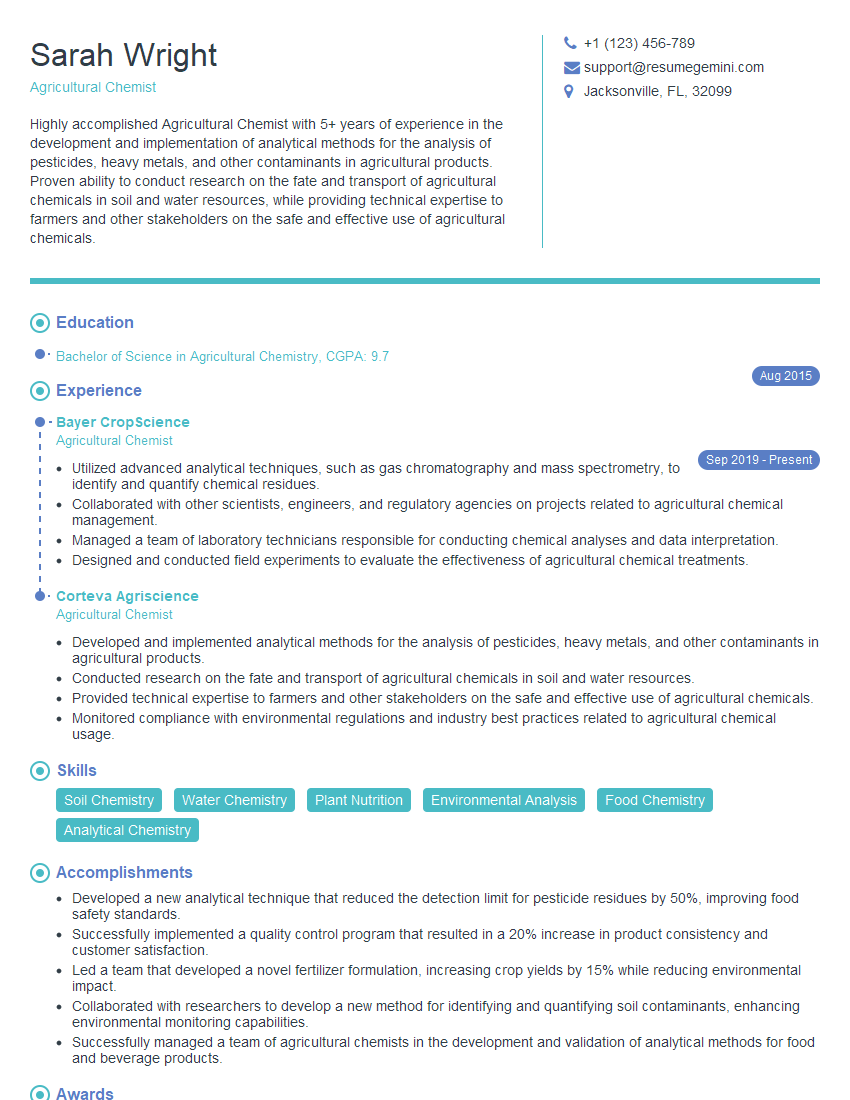
Mastering agricultural chemical application is crucial for a successful and rewarding career in agriculture. A strong understanding of these techniques demonstrates your commitment to safe, efficient, and sustainable agricultural practices, opening doors to advanced roles and higher earning potential. To enhance your job prospects, creating an ATS-friendly resume is essential. This ensures your application gets noticed by recruiters and hiring managers. We highly recommend using ResumeGemini to build a professional and effective resume. ResumeGemini provides tools and resources to create a compelling document, and we offer examples of resumes tailored to Agricultural Chemical Application to guide you.

Explore more articles
Users Rating of Our Blogs
Share Your Experience
We value your feedback! Please rate our content and share your thoughts (optional).
What Readers Say About Our Blog
Very informative content, great job.
good