Are you ready to stand out in your next interview? Understanding and preparing for Air Battle Management interview questions is a game-changer. In this blog, we’ve compiled key questions and expert advice to help you showcase your skills with confidence and precision. Let’s get started on your journey to acing the interview.
Questions Asked in Air Battle Management Interview
Q 1. Explain the concept of Air Battle Management and its key functions.
Air Battle Management (ABM) is the coordinated application of airpower to achieve military objectives. It’s essentially the brain of an air campaign, orchestrating the actions of diverse air assets – from fighters and bombers to tankers and AWACS – to maximize their effectiveness. Key functions include:
- Planning and Execution: Developing air campaign plans, tasking aircraft, and managing their execution in real-time.
- Situational Awareness: Maintaining a comprehensive understanding of the air and ground battlespace, including friendly and enemy forces, weather, and terrain.
- Decision Support: Providing commanders with the information and analysis they need to make timely and effective decisions.
- Communication and Coordination: Ensuring seamless communication and coordination between different air and ground units.
- Air Tasking Order (ATO) Management: Creating, distributing, and tracking ATOs which detail specific missions for air assets.
Think of an orchestra – the ABM system is the conductor, ensuring all the different instruments (aircraft) play together harmoniously to create a powerful symphony (achieving military objectives).
Q 2. Describe the different layers of Air Battle Management.
ABM operates across several interconnected layers:
- Strategic: This layer focuses on the overarching campaign objectives, resource allocation, and overall strategy. It involves high-level planning and coordination at the national or theater level.
- Operational: This layer translates strategic objectives into specific operational plans, assigning forces to specific tasks and coordinating their actions. It involves planning and executing major air operations.
- Tactical: This layer focuses on real-time execution of missions, managing individual aircraft and weapons systems to achieve specific tactical objectives. It involves the direct control of individual units during combat.
These layers aren’t entirely separate; they are highly interconnected and rely on a constant flow of information between them. Imagine building a house: the strategic layer is the architect’s plan, the operational layer is the construction manager’s plan, and the tactical layer is the bricklayer’s work.
Q 3. What are the key challenges in Air Battle Management in a contested environment?
Contested environments present significant challenges to ABM, including:
- Electronic Warfare (EW): Enemy jamming, spoofing, and cyberattacks can degrade or disrupt communication and sensor systems, hindering situational awareness.
- Anti-Access/Area Denial (A2/AD): Enemy air defenses, such as surface-to-air missiles (SAMs) and advanced fighter aircraft, create a high-risk environment for friendly aircraft, requiring complex route planning and risk mitigation.
- Information Superiority: Maintaining accurate and timely situational awareness is paramount. The enemy actively works to deceive and obfuscate the picture.
- Data Fusion: Effectively integrating data from multiple sensors and sources (e.g., radar, satellite, human intelligence) to create a comprehensive, accurate picture of the battlespace can be incredibly difficult in a contested environment.
- Cybersecurity: Protecting ABM systems from cyberattacks is crucial to prevent data breaches and disruption of operations.
For example, during a hypothetical strike on a heavily defended target, accurate geolocation, coordination with friendly forces to suppress enemy air defenses, and rapid adaptation to unexpected events are crucial for mission success.
Q 4. How do you prioritize multiple, conflicting air tasking orders?
Prioritizing conflicting ATOs requires a structured approach based on several factors:
- Importance of the objective: Missions critical to overall campaign success take precedence.
- Urgency: Time-sensitive missions demanding immediate action are prioritized.
- Resource availability: Missions that can be executed with available assets are favored.
- Risk assessment: Missions with higher risk to friendly forces are carefully evaluated against their potential gains.
- Commander’s intent: The commander’s overall guidance and priorities serve as the ultimate guide.
This often involves using a decision support system that incorporates these factors to generate a prioritized list. A simple example: a mission to rescue downed pilots might take precedence over a less urgent bombing run, even if the latter appears more strategically impactful at first glance.
Q 5. Explain the process of developing and executing an air campaign plan.
Developing and executing an air campaign plan is an iterative process involving:
- Defining objectives: Clearly articulating the strategic goals of the campaign.
- Assessing the threat: Analyzing enemy capabilities and vulnerabilities.
- Developing a course of action: Designing a sequence of air operations to achieve objectives.
- Force allocation: Assigning specific air assets to specific tasks.
- ATO generation: Creating detailed air tasking orders.
- Execution: Implementing the plan in real-time, making adjustments as necessary.
- Assessment: Evaluating the effectiveness of the campaign and making adjustments to the plan.
Each step involves extensive analysis, coordination, and collaboration among various stakeholders. For instance, a campaign to achieve air superiority might begin with suppression of enemy air defenses, followed by establishing control of the airspace, and then proceeding to strike ground targets.
Q 6. Describe your experience with various Air Battle Management systems.
During my career, I’ve worked extensively with several ABM systems, including (examples, adapting to your actual experience):
- (System Name 1): This system excelled in its [specific capability, e.g., data fusion capabilities], allowing for effective coordination of diverse aircraft types in complex environments. I specifically contributed to [mention a specific project or accomplishment].
- (System Name 2): My experience with this system highlighted the importance of [mention a key aspect, e.g., human-machine interface design] in facilitating effective decision-making under pressure. I led a team in improving [mention a specific improvement or project].
- (System Name 3): This system’s [mention a feature, e.g., automated threat assessment capabilities] significantly enhanced situational awareness and improved response times during crisis scenarios. I was involved in [mention your specific role and contribution].
Through these experiences, I developed a deep understanding of the strengths and weaknesses of various ABM systems and how they can be effectively integrated to support diverse operational needs.
Q 7. How do you maintain situational awareness in a dynamic air environment?
Maintaining situational awareness in a dynamic environment requires a multi-faceted approach:
- Sensor Fusion: Combining data from multiple sensors – radar, satellite imagery, electronic intelligence, and human intelligence – to create a comprehensive picture.
- Data Analysis: Employing advanced data analytics techniques to identify trends, predict threats, and support decision-making.
- Communication Networks: Relying on robust and secure communication networks to disseminate information rapidly and reliably.
- Human Expertise: Leveraging the experience and judgment of skilled operators to interpret data, identify anomalies, and respond effectively to unexpected events.
- Continuous Monitoring: Constantly monitoring the battlespace and adapting to changes in the situation.
Imagine a pilot navigating through heavy fog. Relying solely on one instrument is risky; they combine visual cues, radar data, and their experience to maintain situational awareness. Similarly, effective ABM requires integrating data from diverse sources and relying on human expertise.
Q 8. What are the key differences between offensive and defensive air operations?
Offensive air operations aim to directly inflict damage on enemy assets and infrastructure, disrupting their capabilities and achieving specific military objectives. Think of it like a surgical strike – precise and focused on destroying the target. Defensive air operations, on the other hand, focus on protecting friendly forces and assets from enemy air attacks. This is like a shield, intercepting incoming threats and safeguarding your own forces.
- Offensive: Examples include strategic bombing campaigns targeting enemy industrial centers, air superiority missions aimed at neutralizing enemy air defenses, and close air support for ground troops.
- Defensive: Examples include intercepting enemy aircraft, protecting friendly airspace, and deploying electronic warfare to disrupt enemy sensors and communications.
The key difference lies in the objective: destruction versus protection. Offensive operations are proactive and aggressive, while defensive operations are reactive and protective.
Q 9. How do you integrate air power with other domains (land, sea, space, cyber)?
Integrating air power effectively across domains requires seamless information sharing and coordinated action. It’s not just about planes in the air; it’s about a unified effort.
- Land: Air power provides close air support to ground troops, delivering precision strikes against enemy positions, suppressing enemy fire, and conducting reconnaissance. This requires real-time coordination with ground commanders to ensure accuracy and minimize collateral damage.
- Sea: Naval forces rely on air power for protection against enemy aircraft and ships, as well as for reconnaissance and strike missions. This involves coordinating air and naval operations to effectively control maritime areas.
- Space: Space-based assets provide critical intelligence, surveillance, and reconnaissance (ISR) data to air operations, enhancing situational awareness and enabling precise targeting. GPS navigation is also crucial.
- Cyber: Cyber warfare can disrupt enemy command and control systems, degrading their ability to coordinate their air defenses or launch attacks. It can also protect our own systems from enemy cyberattacks.
Successful integration necessitates robust communication networks, standardized procedures, and a shared understanding of objectives across all domains. Think of it like a well-orchestrated symphony – each instrument (domain) plays its part, but the conductor (overall commander) ensures a harmonious performance.
Q 10. Describe your experience with joint air operations.
During my time in [mention specific unit or operation, if allowed], I participated in several joint air operations, most notably [mention specific operation, if allowed, or a general type of operation]. These involved coordinating with various units including [mention specific units, e.g., fighter squadrons, AWACS aircraft, ground troops, naval ships]. A key challenge was integrating diverse communication systems and ensuring a common operational picture. We used [mention specific communication systems or platforms, e.g., Link 16] to improve interoperability.
One particularly memorable instance involved [describe a specific scenario highlighting problem-solving and teamwork]. This experience demonstrated the critical importance of clear communication, proactive risk management, and adaptability in the face of unexpected events.
Q 11. Explain the role of intelligence in Air Battle Management.
Intelligence is the lifeblood of Air Battle Management. It provides the crucial information needed for effective planning, execution, and assessment of air operations.
- Targeting: Intelligence identifies enemy targets, their location, and their defenses, enabling the selection of appropriate weapons and tactics.
- Situational Awareness: Real-time intelligence feeds provide a comprehensive picture of the battlespace, allowing commanders to make informed decisions and adapt to changing circumstances. This could involve tracking enemy movements, assessing weather conditions, and monitoring electronic emissions.
- Risk Assessment: Intelligence helps assess potential risks and threats, allowing commanders to develop mitigation strategies and protect friendly forces.
Without accurate and timely intelligence, air operations become significantly more risky and less effective. Think of it as a pilot navigating in fog without radar – incredibly dangerous.
Q 12. How do you manage communication and coordination between different units?
Managing communication and coordination between different units requires a multi-layered approach.
- Standardized Procedures: Clear, concise, and standardized communication procedures are essential for ensuring everyone understands the plan and their role. This includes using standardized terminology and formats for messages.
- Communication Systems: A robust and reliable communication network is crucial, linking all units and providing redundancy in case of system failures. Secure communication systems are crucial to maintain operational secrecy and prevent enemy interception.
- Command and Control Structures: A clear command structure establishes lines of authority and responsibility, minimizing confusion and ensuring timely decision-making. This often involves a hierarchical structure with designated roles and responsibilities.
- Data Fusion: Combining data from various sources – including radar, satellite imagery, and human intelligence – into a single, unified picture enhances situational awareness and facilitates better coordination.
Think of it like an orchestra – each section needs to be in sync with the conductor and other sections to play beautiful music, preventing a chaotic noise.
Q 13. How do you handle unexpected events or emergencies during air operations?
Handling unexpected events requires a combination of preparedness, adaptability, and effective decision-making.
- Contingency Planning: Develop plans for various potential emergencies, including equipment malfunctions, enemy actions, and unforeseen weather conditions.
- Decision-Making Frameworks: Establish clear decision-making processes and designate individuals responsible for handling emergencies. This often involves clearly defined escalation paths.
- Real-Time Adaptation: Be prepared to adapt plans on the fly based on the specific circumstances. This requires flexibility and strong leadership.
- Risk Management: Continuously assess risks and develop mitigation strategies to reduce the likelihood and impact of unexpected events.
A well-rehearsed team, utilizing robust systems and procedures, can respond effectively, minimizing damage and maintaining mission effectiveness, even under immense pressure. Think of it as a fire-drill – preparation ensures better response during a real fire.
Q 14. What are the ethical considerations in Air Battle Management?
Ethical considerations in Air Battle Management are paramount. The potential for collateral damage and civilian casualties necessitates careful consideration of the principles of proportionality, distinction, and precaution.
- Proportionality: Military actions must be proportionate to the military advantage gained, minimizing harm to civilians and civilian infrastructure.
- Distinction: A clear distinction must be made between military targets and civilian targets. This requires careful intelligence gathering and target analysis.
- Precaution: Every effort must be made to avoid civilian casualties and damage to civilian objects. This might involve using less destructive weapons, employing precision-guided munitions, and minimizing civilian presence in target areas.
- Accountability: Clear lines of accountability for decisions and actions are essential to ensure adherence to ethical standards and to hold individuals responsible for violations.
These principles are not just abstract ideals; they are fundamental to maintaining public trust and ensuring legitimacy in the conduct of air operations. Failure to adhere to these principles undermines the mission and has far-reaching consequences.
Q 15. Describe your experience with air-to-air combat scenarios.
My experience in air-to-air combat scenarios encompasses both theoretical and simulated environments. I’ve extensively studied various engagement tactics, including Beyond Visual Range (BVR) and Within Visual Range (WVR) combat. BVR engagements rely heavily on advanced sensors and weapon systems like radar and long-range missiles, requiring precise targeting and coordination. WVR combat, on the other hand, necessitates superior maneuvering skills and situational awareness. I’ve utilized sophisticated simulation tools to practice these scenarios, mastering the intricacies of energy management, target acquisition, and weapon employment in dynamic, high-threat environments. For example, I’ve worked through simulations involving multiple enemy aircraft, requiring me to prioritize targets, manage weapon loadouts, and coordinate with wingmen effectively, all while maintaining situational awareness and survivability.
One particularly challenging scenario involved a simulated engagement against a numerically superior force. Through strategic use of terrain masking and coordinated attacks with my wingman, we were able to successfully neutralize the threat, highlighting the importance of teamwork and tactical planning in air combat.
Career Expert Tips:
- Ace those interviews! Prepare effectively by reviewing the Top 50 Most Common Interview Questions on ResumeGemini.
- Navigate your job search with confidence! Explore a wide range of Career Tips on ResumeGemini. Learn about common challenges and recommendations to overcome them.
- Craft the perfect resume! Master the Art of Resume Writing with ResumeGemini’s guide. Showcase your unique qualifications and achievements effectively.
- Don’t miss out on holiday savings! Build your dream resume with ResumeGemini’s ATS optimized templates.
Q 16. Explain your understanding of air-to-ground combat operations.
Air-to-ground combat operations demand a comprehensive understanding of targeting processes, collateral damage considerations, and close air support (CAS) coordination. It involves identifying and engaging ground targets with precision, minimizing civilian casualties, and effectively integrating with ground forces. This necessitates a thorough understanding of target acquisition methods, including reconnaissance data, intelligence reports, and real-time sensor inputs. Successful air-to-ground missions require seamless communication and coordination between airborne assets, ground controllers, and other supporting elements. Detailed mission planning is crucial, considering factors such as weather conditions, enemy defenses, and the potential for civilian presence. Different weapon systems and delivery methods (e.g., bombs, missiles, rockets) have different capabilities and require careful selection based on the target and the operational environment.
For example, I’ve worked on simulations where the goal was to destroy a heavily defended enemy facility while minimizing civilian casualties. This involved utilizing a combination of standoff weapons to suppress air defenses, followed by precision-guided munitions to strike the target precisely.
Q 17. How do you ensure the safety of aircrews during missions?
Ensuring aircrew safety is paramount in all Air Battle Management operations. This is achieved through a multi-layered approach incorporating rigorous pre-flight checks, comprehensive risk assessment, continuous monitoring during missions, and robust emergency response protocols. Pre-flight checks ensure aircraft are in optimal condition, while risk assessments identify and mitigate potential hazards. Real-time monitoring of aircraft status, weather conditions, and potential threats allows for timely interventions. Furthermore, having well-defined emergency procedures, including communication protocols and emergency landing procedures, is crucial. Effective pilot training and proficiency maintenance are integral, emphasizing situational awareness, decision-making under pressure, and emergency procedures.
For instance, if a sudden weather change poses a risk, we would immediately alter flight plans or ground the aircraft, prioritizing aircrew safety above all else. Similarly, if an aircraft malfunctions mid-mission, pre-established protocols are activated to ensure safe return and recovery.
Q 18. Describe your proficiency in using relevant Air Battle Management software.
My proficiency in Air Battle Management software spans several systems, including but not limited to, Command and Control (C2) platforms, air defense systems, and mission planning tools. I am adept at utilizing these systems for tasks such as force tracking, threat assessment, mission planning, and real-time situation monitoring. I have experience with data analysis, extracting meaningful insights from large datasets to inform tactical decisions. I’m comfortable working with both graphical user interfaces (GUIs) and command-line interfaces (CLIs), depending on the specific system and operational requirements. Moreover, I’m proficient in data integration and the use of various data formats to ensure seamless interoperability between different systems. My expertise extends to troubleshooting and resolving technical issues that may arise during operations.
For example, I have used Advanced Targeting System (ATS) software to plan missions, integrating intelligence data and sensor information to identify the most optimal course of action, ultimately enhancing mission effectiveness and efficiency.
Q 19. Explain your understanding of the kill chain in Air Battle Management.
The kill chain in Air Battle Management represents the sequential steps involved in targeting and destroying an enemy asset. It typically includes:
1. Planning & Intelligence: Gathering intelligence, assessing threats, and developing mission plans.
2. Target Acquisition: Identifying and locating the target using various sensors.
3. Target Designation: Accurately pinpointing the target for weapon delivery.
4. Weapon Launch: Releasing the appropriate weapon system.
5. Weapon Guidance: Guiding the weapon to the target.
6. Target Assessment: Evaluating the effectiveness of the strike.
7. Post-Strike Analysis: Analyzing the mission results to improve future operations. Disruptions at any stage can significantly impact mission success. Understanding and effectively managing each stage is critical for achieving mission objectives.
A real-world example would be a strike against a mobile enemy missile launcher. Intelligence would pinpoint the launcher’s likely location and movement patterns. Target acquisition would involve using reconnaissance aircraft or satellites to confirm its position. Weapon selection would consider the launcher’s defenses, leading to the employment of precision-guided munitions for accurate targeting and minimal collateral damage.
Q 20. What are the key performance indicators (KPIs) for Air Battle Management?
Key Performance Indicators (KPIs) for Air Battle Management are crucial for measuring operational effectiveness and efficiency. These KPIs vary depending on the specific mission objectives but generally include:
- Mission Success Rate: Percentage of missions achieving their primary objectives.
- Target Engagement Accuracy: Precision of weapon delivery.
- Timeliness of Response: Speed of response to threats.
- Collateral Damage Minimization: Reduction of civilian casualties and infrastructure damage.
- Aircrew Safety: Number of accidents and injuries.
- System Uptime: Reliability and availability of command and control systems.
- Communication Effectiveness: Quality of communication and coordination between units.
For example, tracking mission success rate helps identify areas for improvement in mission planning or training. Similarly, monitoring collateral damage allows adjustments to targeting procedures or weapon selection.
Q 21. How do you deconflict air traffic and avoid friendly fire incidents?
Deconflicting air traffic and preventing friendly fire incidents requires a robust system of coordination and communication, leveraging both technological and procedural safeguards. This starts with detailed mission planning, incorporating real-time information about the airspace, including civilian and military traffic. Advanced air traffic control systems, coupled with sophisticated identification systems like IFF (Identification Friend or Foe), play a vital role in tracking aircraft positions and identifying potential conflicts. Strict adherence to established rules of engagement (ROE) and communication protocols is paramount. Effective communication between all participating units and controllers is essential to ensure that everyone is aware of the location and movements of all friendly and hostile forces. This may involve utilizing multiple communication channels for redundancy and ensuring clarity of information exchange. Regular training and drills focusing on crisis management and deconfliction procedures are crucial to enhance responsiveness and reduce the risk of accidents.
Think of it like a well-orchestrated symphony; each aircraft plays a specific role and must be precisely timed and positioned to avoid collisions. Effective Air Battle Management ensures this harmony, preventing potentially catastrophic accidents.
Q 22. Explain your understanding of the different types of aircraft and their capabilities.
Aircraft in air battle management are categorized based on their roles and capabilities. Think of it like a sports team – each player has a specialized function. We have fighters, bombers, transports, tankers, and reconnaissance aircraft, each with distinct characteristics.
- Fighters: Designed for air-to-air combat, these aircraft excel in speed, maneuverability, and weaponry like missiles and cannons. Examples include the F-22 Raptor and F-35 Lightning II, known for their stealth capabilities and advanced sensor suites.
- Bombers: Primarily focused on air-to-ground attacks, bombers carry a large payload of bombs and missiles, often at long ranges. The B-2 Spirit and B-52 Stratofortress are examples of strategic bombers, capable of delivering devastating strikes.
- Transports: These aircraft, like the C-17 Globemaster III and C-130 Hercules, focus on moving personnel and cargo. They are vital for logistics and troop deployment.
- Tankers: Crucial for extending the range of other aircraft, tankers refuel them mid-flight. The KC-135 Stratotanker and KC-46 Pegasus are key examples, enabling sustained air operations far from bases.
- Reconnaissance Aircraft: Equipped with advanced sensors and cameras, these aircraft, such as the RC-135 Rivet Joint and U-2 Dragon Lady, gather intelligence and surveillance data, providing crucial information for battle management decisions.
Understanding these capabilities is fundamental to effective mission planning and execution. For instance, a mission requiring deep strikes would necessitate bombers and possibly tankers, while air superiority would rely on fighter aircraft.
Q 23. How do you assess the effectiveness of air operations?
Assessing the effectiveness of air operations involves a multifaceted approach. It’s not just about the number of targets hit, but also about the overall impact on the operational objectives. We evaluate effectiveness through several key metrics.
- Achieving Operational Objectives: Did the air operation successfully contribute to the overall military campaign’s goals? This could range from gaining air superiority to disrupting enemy logistics.
- Damage Assessment: Measuring the damage inflicted on enemy assets. This requires accurate intelligence gathering and post-mission analysis to verify the effectiveness of strikes.
- Casualty Assessment (Enemy and Friendly): Minimizing friendly casualties while maximizing enemy losses is crucial. A high ratio of enemy casualties to friendly casualties is a sign of successful operational execution.
- Resource Consumption: Efficiency in resource utilization (fuel, munitions, maintenance) is vital for sustainable operations. Minimizing resource consumption for the same level of effect indicates greater effectiveness.
- Timeliness and Speed of Execution: Were objectives achieved in a timely manner? Faster execution can significantly impact the success of the overall campaign.
For example, in a counter-insurgency operation, effective air operations would involve precision strikes targeting enemy strongholds while minimizing civilian casualties, thus helping achieve the overall political and military objectives.
Q 24. Describe your experience with post-mission analysis and debriefing.
Post-mission analysis and debriefing are critical for continuous improvement in air battle management. It’s like reviewing a game film for a sports team – identifying what worked well and where improvements are needed.
My experience involves a structured approach. We typically gather all relevant data: flight data recorders, sensor data, pilot and crew reports, intelligence reports, and even combat video footage. We then analyze this data to reconstruct the mission, identify successes and failures, and pinpoint areas needing improvement.
Debriefings are interactive sessions where we discuss the mission’s execution with all involved parties. We focus on identifying factors that contributed to both successes and failures, and brainstorm solutions for future missions. This includes technical aspects, tactical decisions, and coordination challenges. We always seek to extract lessons learned, and these insights are used to refine tactics, techniques, and procedures, ultimately enhancing operational effectiveness.
One specific example involves a mission where unexpected weather conditions impacted the accuracy of our strikes. The post-mission analysis revealed the need for better weather forecasting integration and improved pilot training on low-visibility operations.
Q 25. What are the key differences between traditional and network-centric warfare in the air domain?
Traditional and network-centric warfare represent a significant shift in air battle management. Imagine traditional warfare as a series of individual battles, each fought with limited information sharing, while network-centric warfare is like a highly coordinated team, with everyone connected and sharing real-time information.
- Traditional Warfare: Relied heavily on pre-planned missions with limited real-time information exchange. Each unit operated relatively independently, with communication often delayed or unreliable.
- Network-Centric Warfare: Emphasizes real-time data sharing among all participating units. Sensors, platforms, and command centers are interconnected through a network, providing a shared operational picture. This allows for dynamic mission adaptation, improved coordination, and enhanced situational awareness.
The key difference lies in the level of connectivity and information sharing. Network-centric warfare significantly improves collaboration and decision-making by providing a common operating picture to all participants, leading to more effective and efficient air operations.
For instance, in traditional warfare, a fighter pilot might not be aware of other friendly units’ positions or enemy movements, limiting their effectiveness. In network-centric warfare, this information is readily available, allowing for coordinated attacks and better protection from enemy threats.
Q 26. How do you adapt to changing technological advancements in Air Battle Management?
Adapting to technological advancements is crucial for staying ahead in Air Battle Management. It’s an ongoing process of continuous learning and integration.
My approach involves several key strategies:
- Continuous Professional Development: Staying updated on the latest technologies through courses, conferences, and industry publications. This keeps me abreast of new sensors, communication systems, and command-and-control architectures.
- Simulation and Training: Utilizing advanced simulation tools to practice and evaluate new technologies and tactics in a safe environment. This allows us to assess their effectiveness before deployment.
- Collaboration and Knowledge Sharing: Working closely with technology developers and other experts in the field. This facilitates the early integration and evaluation of new systems.
- Agile Adaptation: Embracing flexible and adaptable strategies that can quickly integrate new technologies and respond to evolving threats. This requires a mindset of continuous improvement and learning.
For example, the advent of AI and machine learning in air defense has required a substantial shift in how we plan and execute missions. We need to adapt our tactics and training to account for the increased capabilities of these systems.
Q 27. Explain your understanding of the legal framework governing air operations.
The legal framework governing air operations is complex and multifaceted, involving international law, national laws, and rules of engagement (ROEs).
International law, primarily focused on the Law of Armed Conflict (LOAC), dictates the conduct of hostilities. Key principles include the distinction between combatants and civilians, proportionality of force, and the prohibition of indiscriminate attacks. The UN Charter and the Geneva Conventions are fundamental legal documents in this context.
National laws define the powers and responsibilities of air forces within their own jurisdictions. These laws often incorporate LOAC principles and specify legal limitations on the use of force.
Rules of Engagement (ROEs) provide specific instructions to military personnel on when, where, and how to use force in a particular operation. ROEs are usually mission-specific and tailored to the political and military context. They aim to balance operational effectiveness with adherence to legal principles and minimize civilian casualties.
Adherence to these legal frameworks is paramount. Any deviation can result in legal repercussions and undermine the credibility and legitimacy of military operations. Therefore, careful consideration of the legal implications is a fundamental part of any air operation planning process.
A practical example would be a mission targeting an enemy facility. Even though the target is legitimate, the ROE might stipulate specific measures to minimize collateral damage, such as requiring confirmation of civilian presence before engagement and employing precision-guided munitions to minimize the risk of civilian casualties.
Key Topics to Learn for Air Battle Management Interview
- Air Tasking Order (ATO) Process: Understanding the creation, dissemination, and execution of ATOs, including their role in coordinating airpower across multiple domains.
- Command and Control (C2) Systems: Familiarity with various C2 systems used in Air Battle Management, including their capabilities and limitations. Consider practical scenarios involving system failures or communication disruptions.
- Air Space Management: Deep dive into airspace control, deconfliction procedures, and the challenges of managing diverse air traffic in dynamic operational environments.
- Intelligence, Surveillance, and Reconnaissance (ISR) Integration: Explore how ISR assets contribute to the overall battle management picture, focusing on data fusion and decision-making based on real-time intelligence.
- Joint and Coalition Operations: Understanding the complexities of coordinating air operations with other military branches and international partners, including communication protocols and interoperability challenges.
- Airpower Theory and Doctrine: Demonstrate a strong understanding of the fundamental principles of airpower and how these principles are applied in modern conflict.
- Cybersecurity in Air Battle Management: Discuss the vulnerabilities of C2 systems and the importance of robust cybersecurity measures to protect sensitive information and maintain operational integrity.
- Problem-Solving and Decision-Making under Pressure: Practice applying your knowledge to simulated scenarios that require quick, effective decisions in high-stakes situations. Focus on your analytical skills and ability to think strategically.
Next Steps
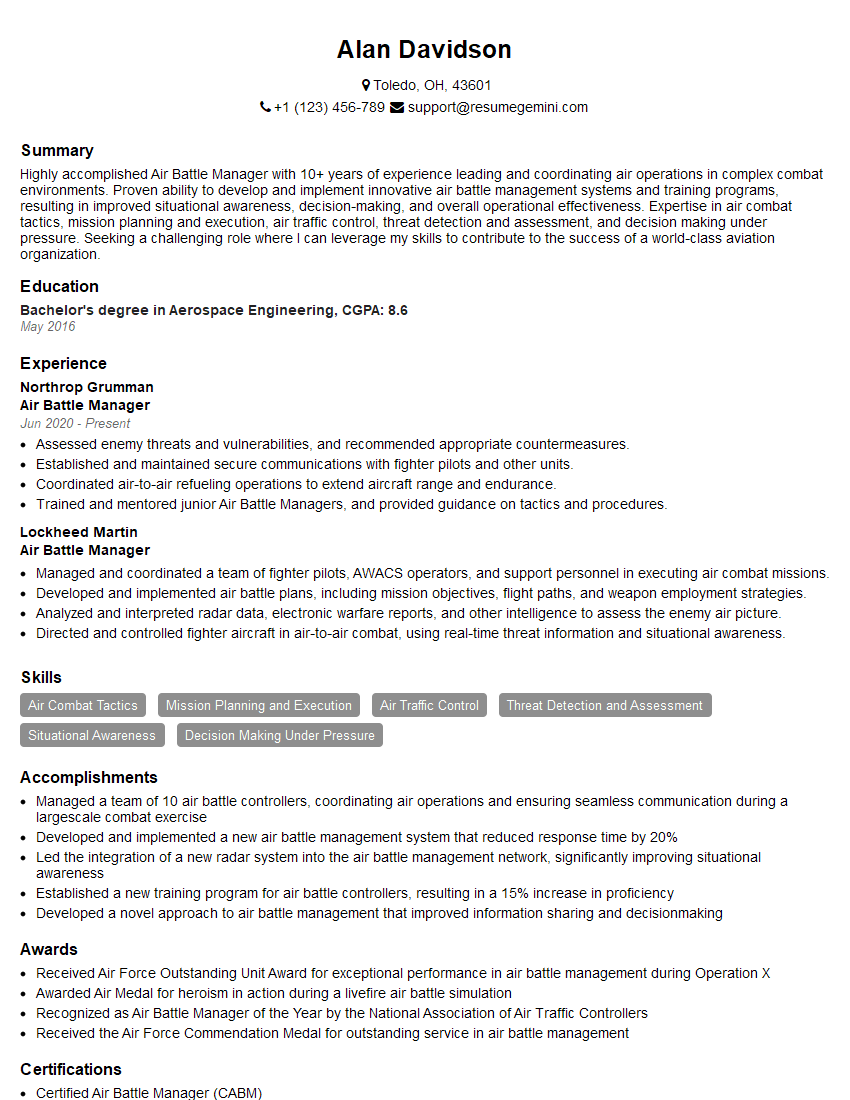
Mastering Air Battle Management opens doors to exciting and impactful careers within the defense sector. To maximize your job prospects, a well-crafted, ATS-friendly resume is crucial. This is where ResumeGemini can help. ResumeGemini provides a powerful platform for building professional resumes, ensuring your skills and experience are effectively communicated to potential employers. We offer examples of resumes tailored to Air Battle Management to guide you in creating a compelling application that highlights your expertise. Invest in your future—build a resume that reflects your potential.
Explore more articles
Users Rating of Our Blogs
Share Your Experience
We value your feedback! Please rate our content and share your thoughts (optional).
What Readers Say About Our Blog
Very informative content, great job.
good