Interviews are more than just a Q&A session—they’re a chance to prove your worth. This blog dives into essential Air Command and Control interview questions and expert tips to help you align your answers with what hiring managers are looking for. Start preparing to shine!
Questions Asked in Air Command and Control Interview
Q 1. Explain the role of a Joint Air Operations Center (JAOC) in modern warfare.
The Joint Air Operations Center (JAOC) is the central hub for planning and executing air operations in modern warfare. Think of it as the air equivalent of a general’s headquarters, but far more technologically advanced. It’s where all the different pieces of the air power puzzle come together – intelligence, surveillance, reconnaissance (ISR), targeting, and the actual execution of air strikes or other missions.
The JAOC integrates information from various sources, including AWACS (Airborne Warning and Control System), JSTARS (Joint Surveillance Target Attack Radar System), and ground-based radars, to create a comprehensive picture of the battlespace. This allows commanders to make informed decisions about the allocation of air assets, targeting priorities, and overall mission success.
For example, during a large-scale operation, the JAOC might coordinate the efforts of fighter jets, bombers, tankers, and unmanned aerial vehicles (UAVs) to achieve a specific objective, such as suppressing enemy air defenses or providing close air support to ground troops. The JAOC’s role extends beyond simply coordinating air assets; it also manages the flow of information, ensuring that all relevant parties have the necessary data to effectively execute their tasks.
Q 2. Describe the key elements of the Kill Chain in an Air C2 context.
The Kill Chain in Air C2 is a sequential process that describes the steps involved in identifying, targeting, and engaging an enemy asset. It’s crucial for efficient and effective air operations.
- Find: This involves the detection and location of the target using various sensors (radar, satellites, human intelligence).
- Fix: Precisely locating and identifying the target’s position, type, and status.
- Track: Continuously monitoring the target’s movement and behavior.
- Target: Designating the target for engagement, including selecting the appropriate weapon and assessing collateral damage risks.
- Engage: Launching the attack and assessing the effectiveness of the engagement.
- Assess: Evaluating the results of the engagement and making adjustments as needed.
Imagine a scenario where enemy tanks are detected (Find). Their location is pinpointed using various sensors (Fix). Their movement is tracked (Track) and they’re then designated as targets (Target). The appropriate air assets engage (Engage), and post-strike imagery confirms the destruction of the tanks (Assess).
Q 3. What are the primary differences between command and control in a high-intensity conflict versus a low-intensity conflict?
Command and control (C2) in high-intensity conflicts (HICs) differs significantly from that in low-intensity conflicts (LICs).
High-Intensity Conflict (HIC): In HICs, such as large-scale wars, C2 is characterized by high tempo operations, massive amounts of data, and a faster decision cycle. The focus is on rapid response and large-scale coordination of numerous air and ground units across vast distances. There’s a high risk of electronic warfare and information overload, demanding robust communication and resilient systems. Think of the Normandy landings or the initial stages of the Gulf War.
Low-Intensity Conflict (LIC): LICs, such as counter-insurgency operations or peacekeeping missions, have a slower tempo, smaller scale, and often involve more asymmetric warfare. C2 focuses on persistent surveillance, precise targeting, and minimizing civilian casualties. The decision-making process is more deliberate and relies on a deeper understanding of the local environment and political considerations. Think of counter-narcotics operations or counter-terrorism strikes.
Q 4. How do you prioritize conflicting information streams during a crisis?
Prioritizing conflicting information streams during a crisis requires a structured approach. The key is to quickly assess the credibility and relevance of each piece of information.
- Source Validation: Evaluate the reliability of the source. Is it a known entity, a trusted sensor, or a potentially biased report?
- Data Corroboration: Cross-reference information from multiple independent sources to confirm its accuracy. Does the information align with other intelligence or observations?
- Time Sensitivity: Prioritize information based on its urgency and impact on the situation. Immediate threats need immediate attention.
- Impact Assessment: Analyze the potential consequences of acting on or ignoring the information. What are the risks and rewards?
- Decision Matrix: Use a decision matrix to weigh the credibility, urgency, and impact of each piece of information. This provides a structured framework for prioritization.
Imagine receiving conflicting reports about an enemy’s troop movements. One report from an untrusted source indicates a large-scale offensive, while multiple reports from trusted satellites show only minor activity. Using this method, you would correctly prioritize the more credible satellite data.
Q 5. Describe your experience with specific Air Command and Control systems (e.g., AWACS, JSTARS).
My experience with Air Command and Control systems encompasses significant time spent working with both AWACS and JSTARS platforms. With AWACS, I’ve been involved in mission planning, real-time data analysis, and the coordination of air assets during numerous exercises and operational deployments. I’m proficient in interpreting radar data, managing air traffic in complex environments, and providing situational awareness to commanders.
My experience with JSTARS includes working with the ground-based control elements and understanding the system’s capabilities for battlefield surveillance. This includes ground moving target indicator (GMTI) data analysis for targeting and coordinating ground maneuver elements. This experience has given me a deep understanding of both airborne and ground components of Air C2.
In both cases, I’ve gained valuable experience in integrating information from multiple sources to create a cohesive picture of the battlespace. This includes managing communications and data flow, problem-solving in challenging situations, and working effectively within a multi-national team environment.
Q 6. Explain the concept of sensor fusion and its importance in Air C2.
Sensor fusion is the process of integrating data from multiple sensors to create a more complete and accurate picture of the battlespace. Think of it as combining pieces of a puzzle to reveal the entire image.
In Air C2, sensor fusion is critical because it allows us to overcome the limitations of individual sensors. For example, a radar might detect a target but not be able to identify its type, while an electro-optical sensor might identify the type but have limited range. By combining the data from both sensors, we can get a more comprehensive understanding of the target. This improved situational awareness leads to more effective decision-making and reduced risk.
For example, combining radar data showing the location and speed of a vehicle with infrared data revealing its heat signature can confirm if it is a hostile tank or a civilian vehicle, reducing the risk of friendly fire incidents.
Q 7. What are the challenges of maintaining situational awareness in a contested environment?
Maintaining situational awareness in a contested environment is extremely challenging. The enemy actively tries to degrade or deny our ability to see the battlespace. This includes active measures like electronic warfare (jamming radar) and passive measures like camouflage and deception.
- Electronic Warfare (EW): Enemy jamming can blind our sensors, making it difficult to detect and track targets.
- Cyber Attacks: Compromised communication systems can disrupt the flow of information and create gaps in our situational awareness.
- Deception: The enemy might use decoys or camouflage to mask their true intentions or locations.
- Information Overload: The sheer volume of data generated by various sensors can be overwhelming, making it difficult to discern critical information from noise.
- Limited Sensor Coverage: There are always areas where our sensors have limited coverage, creating blind spots.
Overcoming these challenges requires a multi-layered approach, including redundancy in sensors and communication systems, robust cybersecurity measures, advanced signal processing techniques to counter jamming, and sophisticated data fusion algorithms to sort through conflicting data.
Q 8. How would you handle a system failure impacting critical command and control functions?
System failures in Air Command and Control (C2) are critical events demanding immediate and decisive action. My approach involves a tiered response, prioritizing the restoration of essential functions while mitigating further damage.
Firstly, I’d activate pre-defined contingency plans. These plans, regularly reviewed and updated, detail procedures for various failure scenarios, including backup systems and alternative communication pathways. For instance, if the primary command server fails, the system automatically switches to a redundant server, minimizing downtime.
Secondly, I’d initiate a thorough diagnostic process to pinpoint the root cause of the failure. This involves utilizing system logs, network monitoring tools, and direct interaction with technical personnel. Once identified, appropriate remediation steps are taken; this might involve software patching, hardware replacement, or network reconfiguration.
Thirdly, I’d maintain continuous communication to all affected units, ensuring transparency and situational awareness. This is crucial for preventing confusion and maintaining operational effectiveness. Clear communication channels, including voice and data links, must remain operational or rapidly restored. A recent exercise simulated a primary radar failure; our established protocols allowed seamless transition to secondary radar within minutes, minimizing disruption.
Finally, a post-incident analysis is mandatory. This review identifies gaps in the system’s resilience and recommends improvements for future preparedness. This iterative process of planning, reacting, and refining ensures continuous enhancement of the Air C2 system’s robustness.
Q 9. What are the ethical considerations surrounding the use of Air C2 capabilities?
The ethical considerations surrounding Air C2 are complex and multifaceted. The potential for lethal force necessitates careful consideration of proportionality, discrimination, and accountability.
- Proportionality: Air strikes must be proportional to the military objective. Excessive force inflicting unacceptable civilian casualties is ethically unacceptable. This requires rigorous assessment of the target and potential collateral damage.
- Discrimination: Air C2 systems must distinguish between legitimate military targets and civilians. Employing inaccurate intelligence or failing to verify targets can lead to devastating consequences.
- Accountability: Clear lines of command and responsibility are critical. Individuals involved in decisions leading to the use of force must be held accountable for their actions. This includes the use of AI in targeting; humans must maintain ultimate oversight and responsibility.
Furthermore, ethical considerations extend to data privacy and cybersecurity. Protecting sensitive information and preventing unauthorized access is crucial. The use of AI in C2 must be guided by ethical frameworks ensuring transparency, fairness, and human oversight to prevent biases or unintended consequences.
Q 10. Describe your experience with data link communications in Air C2.
My experience with data link communications in Air C2 is extensive. I’ve worked with various systems, including Link 16, and have managed their integration into complex operational scenarios. Data links are essential for real-time information sharing among aircraft, ground stations, and command centers.
I understand the importance of secure communication protocols and efficient data handling. For example, I’ve been involved in optimizing Link 16 networks to handle large volumes of data during high-intensity operations. This included implementing measures to prevent network congestion and ensure message prioritization.
I’m also familiar with the challenges associated with data link interoperability—different systems often use different protocols and data formats. I’ve worked on projects to address these challenges by developing standardized procedures and adapting systems for seamless integration. In one operation, integrating legacy systems with a newer data link required careful data mapping and protocol conversion to ensure consistent communication across platforms.
Finally, I’m well-versed in the security aspects of data link communications, including encryption and authentication methods to protect against cyber threats. Security is paramount, and any weakness can have serious implications for mission success and national security.
Q 11. How do you ensure effective communication and coordination among multiple units during an operation?
Effective communication and coordination among multiple units is paramount for successful Air C2 operations. This requires a multi-pronged approach:
- Standardized Procedures: Clear, concise, and universally understood procedures for communication and data sharing are essential. This includes standardized terminology, message formats, and communication protocols.
- Common Operational Picture (COP): All units need access to a shared, real-time understanding of the operational environment. This requires integration of data from various sources—sensor systems, intelligence reports, and friendly unit reports. This COP should be easily accessible and easily updated to everyone within the command and control structure.
- Dedicated Communication Channels: Establishing dedicated, secure communication channels for different units and purposes is vital. This prevents communication congestion and ensures timely transmission of critical information.
- Regular Communication Exercises: Conducting regular communication exercises is crucial for testing procedures and identifying potential communication breakdowns. These exercises allow teams to work together and troubleshoot potential problems before real-world operations.
- Leadership and Coordination: Strong leadership is essential for coordinating the efforts of multiple units. The commander needs the necessary personnel to support the coordination of many actors in real time.
During a recent large-scale exercise, we used a combination of these approaches to successfully coordinate the actions of multiple air and ground units in a complex, simulated scenario, demonstrating a seamless operation.
Q 12. Explain your understanding of airpower doctrine.
Airpower doctrine provides a framework for employing airpower to achieve strategic and operational objectives. It outlines principles for planning, executing, and assessing air operations. A core tenet is the integration of airpower with land, sea, and space forces to achieve overall campaign aims.
Key aspects include:
- Centralized Control: A single command authority, often the Air Component Commander, directs air operations to ensure unified effort and avoid redundancy.
- Flexibility and Adaptability: Airpower’s speed and maneuverability permit rapid adaptation to changing circumstances. Doctrine must account for unforeseen events and the dynamic nature of modern warfare.
- Effects-Based Operations: Airpower is frequently employed to achieve specific effects, such as disrupting enemy communications or degrading their defenses. Doctrine guides the selection of targets and operational approaches based on intended outcomes.
- Risk Management: Given the inherent risks associated with air operations, doctrine emphasizes meticulous planning and risk mitigation. The safety of aircrew and minimizing civilian casualties are primary concerns.
Understanding airpower doctrine is crucial for effective Air C2, as it provides the context for planning, directing, and assessing air operations and allows for better decision making within the broader conflict picture.
Q 13. What are the key performance indicators (KPIs) for effective Air C2?
Key Performance Indicators (KPIs) for effective Air C2 are multifaceted and should reflect various aspects of the system’s performance. They can be broadly categorized into:
- Mission Effectiveness: Measures the success rate of missions assigned to air units, including factors like target engagement accuracy, mission completion time, and the achievement of operational objectives.
- Situational Awareness: Assesses the timeliness and accuracy of information flow within the C2 system. KPIs include the speed of information dissemination, the accuracy of data, and the completeness of the common operational picture.
- Decision-Making Speed and Accuracy: Measures the time taken to make critical decisions and the accuracy of those decisions. This is assessed by analyzing the time between information acquisition and the issuance of orders, as well as post-mission analysis of the outcomes of those decisions.
- System Availability and Reliability: Tracks the uptime of C2 systems and the frequency of failures. KPIs include system availability (percentage of time the system is operational), mean time to repair (MTTR), and mean time between failures (MTBF).
- Communication Efficiency: Evaluates the effectiveness of communication within the C2 system. KPIs might include message delivery time, message accuracy, and the absence of communication disruptions.
These KPIs, along with others tailored to specific operational contexts, provide a comprehensive picture of Air C2 effectiveness and identify areas for improvement.
Q 14. How do you integrate intelligence, surveillance, and reconnaissance (ISR) data into operational decision-making?
Integrating Intelligence, Surveillance, and Reconnaissance (ISR) data into operational decision-making is crucial for effective Air C2. This involves a structured process:
- Data Fusion: Combining data from various ISR sources (e.g., satellites, aircraft, ground sensors) to create a comprehensive and coherent picture of the battlespace. This requires utilizing sophisticated data fusion techniques to resolve inconsistencies and identify patterns.
- Information Dissemination: Efficiently disseminating relevant ISR information to decision-makers at all levels. This involves using secure communication channels and tailored reporting methods to ensure timely access to critical intelligence.
- Data Analysis and Interpretation: Analyzing ISR data to identify targets, assess threats, and support planning. This often involves employing specialized analysts to interpret complex information and make accurate assessments.
- Decision Support Systems: Utilizing decision support systems to aid in the interpretation of ISR data and the formulation of operational plans. These systems may employ advanced algorithms and simulations to predict potential outcomes based on different courses of action.
- Feedback Loop: Establishing a feedback loop to ensure that ISR efforts are aligned with operational requirements. Post-mission analysis can help identify gaps in ISR coverage and optimize future operations.
In a recent operation, integrating real-time satellite imagery with radar data allowed us to precisely identify and target enemy positions, significantly reducing civilian casualties while maximizing operational effectiveness. This successful integration is a testament to the importance of efficient ISR data integration in Air C2 operations.
Q 15. What are some common threats to Air C2 systems and how can they be mitigated?
Air Command and Control (C2) systems face numerous threats, broadly categorized as cyber, physical, and human-related. Cyber threats include denial-of-service (DoS) attacks aiming to overwhelm the system, malware infections compromising data integrity, and sophisticated intrusions seeking to steal sensitive information or manipulate data. Physically, systems are vulnerable to damage from natural disasters, sabotage, or even accidental damage. Human threats involve insider threats, human error in data entry or system management, and social engineering attempts to manipulate personnel into revealing sensitive information.
Mitigation involves a multi-layered approach. Cybersecurity measures include firewalls, intrusion detection systems, regular security audits and penetration testing, data encryption, and robust access control mechanisms. For physical security, we need redundancy and fail-safes in critical infrastructure, robust physical security measures like access control and surveillance, and disaster recovery plans. Addressing human threats requires comprehensive security awareness training, strict adherence to security protocols, and the implementation of strong authentication methods. Regular system backups and disaster recovery planning are essential for mitigating the impact of any successful attack.
- Example: A DoS attack could be mitigated by implementing rate limiting and distributed denial-of-service (DDoS) mitigation techniques.
- Example: Regular security awareness training can reduce the likelihood of successful phishing attacks.
Career Expert Tips:
- Ace those interviews! Prepare effectively by reviewing the Top 50 Most Common Interview Questions on ResumeGemini.
- Navigate your job search with confidence! Explore a wide range of Career Tips on ResumeGemini. Learn about common challenges and recommendations to overcome them.
- Craft the perfect resume! Master the Art of Resume Writing with ResumeGemini’s guide. Showcase your unique qualifications and achievements effectively.
- Don’t miss out on holiday savings! Build your dream resume with ResumeGemini’s ATS optimized templates.
Q 16. Describe your experience with cyber security within an Air C2 environment.
My experience with cybersecurity within an Air C2 environment spans over 10 years, encompassing roles from system administrator to security architect. I’ve been directly involved in designing, implementing, and maintaining security protocols for several high-profile systems. This has included managing network security, endpoint protection, and data loss prevention measures. I’ve participated in numerous security audits and penetration tests, identifying vulnerabilities and implementing corrective actions. Furthermore, I have extensive experience with incident response, leading and participating in incident response teams to investigate and remediate security breaches. One specific example involves leading the response to a sophisticated phishing attack that targeted our system. Through rigorous analysis and coordination, we successfully contained the breach, preventing significant data loss and minimizing operational disruption.
A key aspect of my role involved ensuring compliance with relevant security standards and regulations. I am intimately familiar with the intricacies of information assurance, risk management, and the importance of secure system design.
Q 17. How do you handle information overload during high-pressure situations?
Handling information overload in high-pressure situations requires a structured approach. Think of it like air traffic control – you can’t process every detail at once. My strategy focuses on prioritization and filtering. I utilize various tools to visualize and filter information, focusing on the most critical data points impacting immediate decision-making. This includes using dashboards that display key metrics and alerts, allowing me to quickly identify critical situations. I also rely on a strong team to delegate tasks and share the workload, effectively distributing the cognitive load.
Furthermore, effective communication is paramount. Clear and concise communication ensures that critical information is efficiently disseminated to the relevant personnel, preventing redundancy and information silos. This approach ensures that everyone involved has a clear understanding of the situation and their role in addressing it. Finally, maintaining situational awareness is key to making effective decisions under pressure. Regular pauses to reassess the situation and adjust strategies are crucial in high-pressure situations.
Q 18. Explain the importance of deconfliction in Air C2 operations.
Deconfliction in Air C2 is crucial for preventing friendly fire incidents and ensuring the safety of all air assets. It’s the process of resolving potential conflicts between friendly aircraft, ground forces, or other assets operating in the same airspace or area of operations. Failure to deconflict can lead to devastating consequences. The process involves careful coordination and information sharing between various entities, including air traffic controllers, mission planners, and commanders.
This often involves using sophisticated software tools that provide a real-time, common operational picture (COP). This COP allows all involved parties to see the location and status of all assets, predicting potential conflicts and resolving them proactively. For instance, if two aircraft are predicted to be in close proximity, deconfliction procedures might involve altering flight paths, altitudes, or speeds to ensure sufficient separation. Effective communication and adherence to standardized procedures are key to successful deconfliction. Regular training and exercises reinforce these procedures, ensuring that personnel are well-prepared to handle deconfliction challenges.
Q 19. What are some common challenges in coordinating with joint or coalition forces?
Coordinating with joint or coalition forces presents unique challenges due to differences in doctrine, terminology, communication systems, and technological capabilities. Differences in reporting structures and decision-making processes can slow down response times. For example, one force might use a different airspace management system or have differing priorities, leading to potential conflicts. Cultural differences and language barriers can also complicate communication and coordination.
Overcoming these challenges requires establishing clear communication protocols, standardized procedures, and using interoperable systems. Pre-mission planning and joint training exercises are crucial for developing effective working relationships and ensuring seamless integration. Utilizing common operating pictures and standardized reporting formats facilitates effective communication and coordination. Building trust and understanding between coalition partners is vital. Developing strong personal relationships between key personnel from different nations improves communication and understanding during missions.
Q 20. Describe your experience with air tasking orders (ATO).
Air Tasking Orders (ATOs) are the central planning document for air operations, detailing the tasks assigned to different air assets. My experience with ATOs encompasses the entire lifecycle, from assisting in the development and creation of the ATO, to its dissemination and execution, through to post-mission analysis and refinement. I have been involved in creating ATOs that account for various mission parameters including target selection, weapon employment, flight planning, and risk assessment. I am proficient in utilizing various tools and software for ATO development and distribution. I’ve also been responsible for coordinating with numerous stakeholders during the ATO process, ensuring that all requirements and constraints are considered, and that the ATO is effectively communicated to the personnel involved.
A critical aspect of my experience involves ensuring the ATO is executable in the field and adaptable to changing circumstances. This involves incorporating contingency plans and robust communication strategies, allowing for real-time adjustments as the situation evolves.
Q 21. How do you ensure the accuracy and reliability of information shared within the C2 system?
Ensuring the accuracy and reliability of information within the C2 system is paramount for effective decision-making. This involves implementing a multi-faceted approach that incorporates various techniques. Data validation procedures are implemented to verify the authenticity and integrity of data entering the system. Redundancy and cross-checking mechanisms are employed to ensure that critical data is verified by multiple sources.
Data fusion techniques are used to combine information from various sources, improving overall accuracy and completeness. Advanced sensor systems and data analytics provide a more comprehensive and accurate picture of the operational environment. The system utilizes rigorous quality control measures to ensure that data is consistently monitored for accuracy and reliability. Regular audits and assessments are carried out to identify and rectify any inconsistencies or errors in the system. Finally, open and transparent communication within the team promotes accuracy and reliability by encouraging the reporting and addressing of any potential discrepancies.
Q 22. What are the limitations of current Air C2 systems and how could they be improved?
Current Air Command and Control (C2) systems, while powerful, face several limitations. One major challenge is the interoperability between different platforms and nations. Different systems often use incompatible data formats and protocols, hindering seamless information sharing. Another limitation is the scalability of these systems; they can struggle to handle the massive influx of data generated during large-scale operations, leading to information overload and delays in decision-making. Furthermore, cybersecurity vulnerabilities are a growing concern. These systems are often complex and interconnected, making them susceptible to cyberattacks that could disrupt operations or compromise sensitive information. Finally, the systems might lack sufficient AI/ML capabilities for effective automation of routine tasks like threat assessment and track correlation.
Improvements can focus on several areas: developing standardized data exchange protocols to enhance interoperability; implementing advanced data fusion and analytics techniques to manage data overload effectively and provide timely insights; strengthening cybersecurity defenses through robust encryption, intrusion detection, and regular security audits; and integrating advanced artificial intelligence and machine learning algorithms to automate tasks and improve situational awareness.
For example, imagine a scenario where coalition forces from multiple countries are involved in a large-scale air operation. Lack of interoperability could mean that crucial information about enemy positions is not shared efficiently between participating nations, resulting in uncoordinated actions and potential losses. Implementing standardized protocols, such as those based on NATO standards, would significantly reduce such risks.
Q 23. Discuss your understanding of Link 16 or similar data link technology.
Link 16 is a tactical data link (TDL) that provides secure, high-bandwidth communication between military platforms such as aircraft, ships, and ground units. It allows for the near-real-time exchange of critical information, including location, track data, and sensor information. Think of it as a highly secure and robust network connecting all participating platforms in a coordinated operation. This allows for a comprehensive and shared situational awareness. Similar data link technologies include Link 11 and various national-specific systems, but Link 16 has become the defacto standard for many air forces due to its robustness and extensive capabilities.
Key features of Link 16 include its ability to transmit large quantities of data quickly, its inherent security features to protect sensitive information, and its capability to handle both point-to-point and multicast communications. This allows for efficient dissemination of data to multiple platforms simultaneously. In essence, Link 16 facilitates a collaborative environment, enabling coordinated action by a diverse set of assets.
Consider a scenario where multiple fighter jets are engaging air-to-air targets. Link 16 allows these jets to share real-time data on target locations, reducing the risk of fratricide and ensuring effective coordination during the engagement. The shared picture generated through Link 16 enables a superior understanding of the battlespace and enhances the overall effectiveness of the mission.
Q 24. Describe your familiarity with different types of air assets and their capabilities.
My familiarity with air assets encompasses a wide range, from fighter jets and bombers to transport aircraft, airborne early warning and control (AEW&C) platforms, and unmanned aerial vehicles (UAVs). Each asset plays a crucial role in the overall air operation, contributing unique capabilities.
- Fighter Jets: These provide air superiority, close air support, and precision strike capabilities. Examples include the F-22 Raptor, F-35 Lightning II, and Eurofighter Typhoon.
- Bombers: These are designed for long-range precision strikes and can carry a large payload of weapons. Examples include the B-52 Stratofortress and B-2 Spirit.
- Transport Aircraft: Used for personnel and equipment transport, offering vital logistical support. Examples include the C-17 Globemaster III and C-130 Hercules.
- AEW&C: These platforms provide long-range surveillance and command and control capabilities through airborne radars and communication systems. The E-3 Sentry is a classic example.
- UAVs: Unmanned aerial vehicles offer various capabilities, including reconnaissance, surveillance, and precision strikes, with varying levels of autonomy. Examples include the MQ-9 Reaper and the Global Hawk.
Understanding the capabilities of each asset is critical for effective C2. For example, assigning a fighter jet to a close air support mission is different from employing a bomber for a strategic strike. The C2 system must take into account the individual strengths and limitations of each platform when tasking it.
Q 25. Explain the role of modeling and simulation in Air C2 training and planning.
Modeling and simulation (M&S) plays a vital role in Air C2 training and planning. It provides a safe and cost-effective environment to practice complex scenarios and evaluate different strategies before deploying them in real-world operations. M&S can range from simple simulations of individual aircraft to large-scale exercises involving multiple platforms and forces.
In training, M&S allows operators to familiarize themselves with the Air C2 system, practice decision-making under pressure, and develop teamwork skills. This can involve simulating various operational conditions, including adversarial threats and unexpected events. It also facilitates the training of personnel on new systems or upgrades without risking real-world assets.
For planning, M&S can be used to assess the effectiveness of proposed operations, test different strategies, and identify potential vulnerabilities. By running multiple simulations with varying parameters, planners can optimize plans and mitigate risks. For example, planners can test different command structures or communication protocols to find the optimal setup for a specific mission.
Imagine planning a complex air operation involving numerous aircraft and ground units. M&S would enable the planning team to test different engagement strategies and assess the feasibility and effectiveness of the mission before execution, significantly reducing the risks and chances of failures.
Q 26. How would you evaluate the effectiveness of an Air C2 operation?
Evaluating the effectiveness of an Air C2 operation requires a multifaceted approach. Key metrics include:
- Mission Success Rate: This is the most straightforward measure; did the mission achieve its objectives?
- Timeliness of Decisions: How quickly were decisions made and communicated?
- Accuracy of Situational Awareness: How accurate was the understanding of the operational environment? Were there any significant gaps in information?
- Coordination and Collaboration: How effectively did different units and platforms collaborate?
- Resource Utilization: Were resources used efficiently? Were there any instances of unnecessary resource consumption?
- Casualties and Collateral Damage: The minimization of these factors is crucial for evaluating effectiveness.
- Cybersecurity posture: Was the C2 system resilient against cyber attacks?
A holistic evaluation involves analyzing these metrics in conjunction with post-mission debriefings and operational reports. Quantitative data, such as mission success rates and resource utilization, can be combined with qualitative feedback from participating personnel to gain a comprehensive understanding of the operation’s effectiveness. The use of statistical methods like analyzing the mean time to detection of threats, and comparing it across multiple missions offers a rigorous way to quantify certain aspects of effectiveness.
Q 27. Describe your experience with crisis action planning in an Air C2 context.
Crisis action planning (CAP) in an Air C2 context focuses on developing and executing rapid responses to unexpected events or emerging threats. This involves having pre-planned options readily available, flexible procedures that adapt to the evolving situation, and clearly defined escalation protocols to allow for timely decisions.
My experience with CAP encompasses developing contingency plans for various scenarios, including unexpected enemy actions, equipment failures, and natural disasters. These plans include clear roles and responsibilities for each unit, established communication channels, and pre-determined decision points. The plans frequently incorporate multiple iterations of wargaming exercises to refine the response actions and optimize effectiveness.
A key aspect of CAP is maintaining situational awareness and adapting plans as the situation unfolds. This might involve swiftly redirecting assets to address a new threat or adjusting priorities based on the latest information. Continuous monitoring and assessment are critical for a successful CAP response. Regular drills and exercises are conducted to test and refine the effectiveness of the plan to keep it responsive to evolving needs.
Q 28. Explain the importance of maintaining human-machine interface effectiveness within Air C2.
Maintaining human-machine interface (HMI) effectiveness within Air C2 is paramount. The HMI is the bridge between human operators and the complex systems they use to manage air operations. An effective HMI ensures that operators can quickly access the information they need, make informed decisions, and execute actions efficiently.
Ineffective HMIs can lead to errors, delays, and even mission failure. Information overload, poorly designed displays, and cumbersome control systems can overwhelm operators, reducing their effectiveness and increasing the risk of human error. A poorly designed HMI can also increase the cognitive load on operators, increasing fatigue and slowing decision-making processes.
To ensure HMI effectiveness, several factors need to be considered: intuitive design (easy to learn and use), clear and concise information presentation, efficient control layouts, and robust error handling. The system should be designed to minimize cognitive load on the operator and provide appropriate feedback to enhance situational awareness. Regular evaluations and user feedback are critical to ensure that the HMI remains effective and user-friendly. For example, a well-designed HMI might prioritize the display of critical information during high-pressure situations while suppressing less crucial data to avoid information overload.
Key Topics to Learn for Air Command and Control Interview
- Air Surveillance and Tracking: Understanding radar systems, sensor integration, and data fusion techniques. Practical application: Analyzing sensor data to identify and track airborne threats.
- Command and Control Systems: Familiarity with various C2 architectures, communication protocols, and information management systems. Practical application: Designing efficient workflows for managing multiple assets and responding to dynamic situations.
- Air Battle Management: Knowledge of decision-making processes, conflict resolution, and resource allocation strategies within a command and control environment. Practical application: Developing effective plans to achieve air superiority and mission objectives.
- Cybersecurity in Air C2: Understanding vulnerabilities and protective measures for critical C2 systems. Practical application: Implementing security protocols to safeguard sensitive data and prevent cyberattacks.
- Situational Awareness and Decision Support: Analyzing complex information to build a comprehensive picture of the operational environment and make informed decisions under pressure. Practical application: Utilizing decision support tools and techniques to optimize resource allocation and enhance mission effectiveness.
- Human-Computer Interaction (HCI) in C2: Understanding the design and usability of C2 interfaces to ensure efficient and accurate information exchange. Practical application: Evaluating the effectiveness of different user interfaces and recommending improvements for optimal performance.
- Air Command and Control Doctrine and Procedures: Understanding established protocols, regulations, and best practices within the Air Command and Control domain. Practical application: Applying these guidelines effectively to ensure mission success and safety.
Next Steps
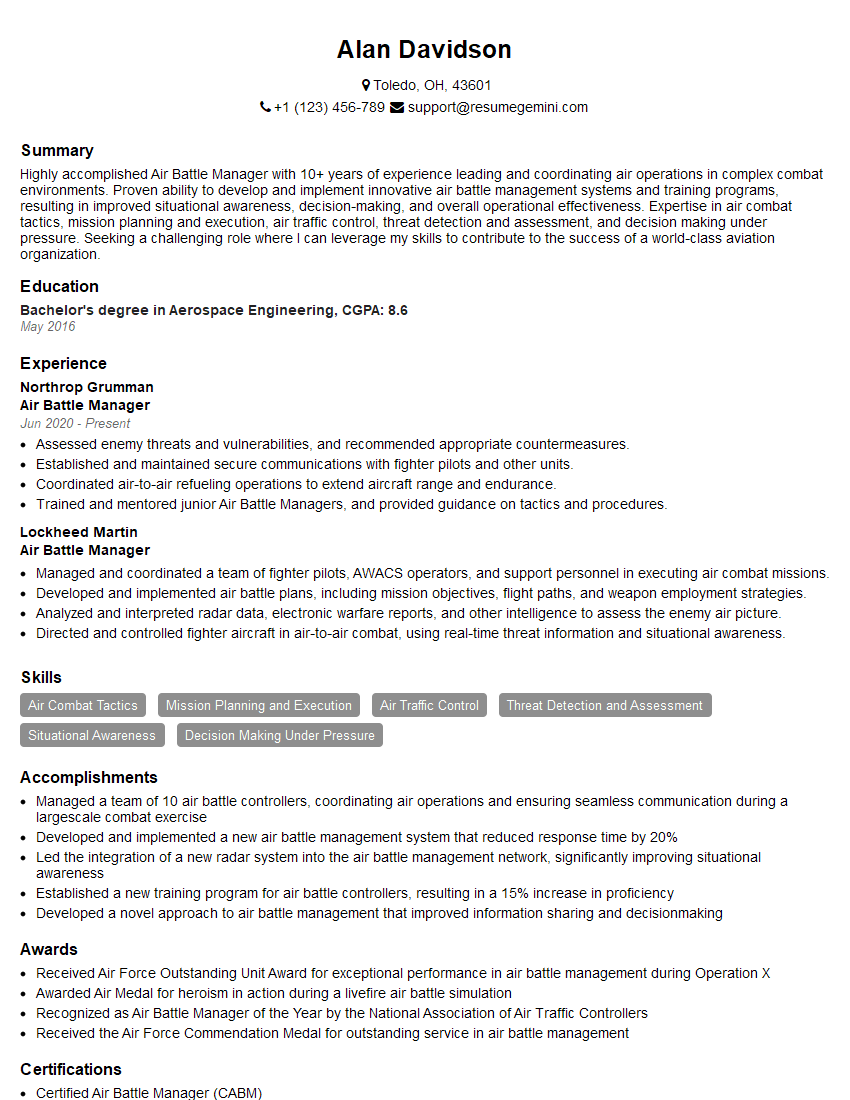
Mastering Air Command and Control principles is crucial for career advancement in this dynamic and critical field. A strong understanding of these concepts will significantly enhance your prospects and position you for leadership roles. To maximize your chances of securing your ideal position, creating an ATS-friendly resume is essential. ResumeGemini is a trusted resource to help you build a professional and impactful resume that highlights your skills and experience effectively. Examples of resumes tailored specifically to Air Command and Control roles are available through ResumeGemini to help guide you.
Explore more articles
Users Rating of Our Blogs
Share Your Experience
We value your feedback! Please rate our content and share your thoughts (optional).
What Readers Say About Our Blog
Very informative content, great job.
good