Interviews are more than just a Q&A session—they’re a chance to prove your worth. This blog dives into essential AM Transmitter Operations interview questions and expert tips to help you align your answers with what hiring managers are looking for. Start preparing to shine!
Questions Asked in AM Transmitter Operations Interview
Q 1. Explain the function of a Class C amplifier in an AM transmitter.
In an AM transmitter, the Class C amplifier serves as the final stage, responsible for amplifying the modulated radio frequency (RF) signal to the desired power level for transmission. Unlike Class A or B amplifiers, a Class C amplifier operates with a very short conduction angle (typically less than 180 degrees). This means the transistors or tubes are only ‘on’ for a small portion of each RF cycle. This seemingly inefficient approach offers significant advantages in terms of power efficiency at high power levels, which is crucial for broadcasting.
Think of it like a powerful punch: Instead of a constant, gentler push (Class A), or a smoother alternating push-pull (Class B), a Class C amplifier delivers a powerful, short burst of energy with each cycle. The resulting waveform is then shaped by tuned circuits to recreate the original modulated signal. This high efficiency is why it’s favored for high-power AM transmitters.
The key is that the tuned circuits in the output network are resonant at the carrier frequency, effectively filtering the short bursts of energy from the Class C amplifier to reconstruct the smooth AM waveform. This resonant filtering action is crucial for maintaining good signal quality.
Q 2. Describe the process of adjusting carrier frequency in an AM transmitter.
Adjusting the carrier frequency in an AM transmitter typically involves manipulating the resonant frequency of the oscillator circuit that generates the carrier wave. This is often achieved through a variable capacitor or a digitally controlled oscillator (VCO).
In older transmitters, a variable capacitor might be mechanically tuned using a dial. Changing the capacitance alters the resonant frequency, directly affecting the carrier frequency. Modern transmitters often employ a VCO controlled by a microprocessor. The microprocessor receives a digital input specifying the desired frequency, adjusts the VCO accordingly, and then precisely controls the carrier frequency.
The process often involves a calibration step to ensure the actual transmitted frequency precisely matches the desired frequency. This is crucial to avoid interference with other stations and to comply with regulatory requirements. Frequency measuring instruments such as frequency counters are essential for this task.
For example, imagine tuning a guitar string: you adjust the tension (analogous to capacitance) to achieve the desired pitch (frequency). Similarly, by carefully adjusting the capacitance or VCO control voltage, you precisely adjust the carrier frequency of the AM transmitter.
Q 3. How do you measure and adjust the modulation percentage of an AM signal?
The modulation percentage, or depth of modulation, in an AM signal represents the extent of variation in the carrier amplitude caused by the audio signal. A 100% modulation means the carrier amplitude varies between 0 and 2 times its unmodulated value. Anything above 100% is overmodulation, causing distortion and interference.
Measurement is typically done using an oscilloscope and a spectrum analyzer. The oscilloscope displays the waveform, allowing for visual assessment of the modulation depth, while the spectrum analyzer provides a precise measurement of the amplitude of the sidebands relative to the carrier. Specialized modulation meters also exist for direct measurement.
Adjustment involves altering the gain of the audio amplifier stage preceding the modulator. Increasing the audio gain increases the modulation percentage, while decreasing it reduces it. Careful monitoring of the modulation percentage using an oscilloscope or modulation meter is crucial to achieve the desired value and avoid overmodulation.
For instance, if the oscilloscope shows the carrier amplitude dipping to zero, you’re overmodulating. Reduce the audio gain until the carrier stays above zero, maintaining the peak-to-peak voltage variation within acceptable limits.
Q 4. What are the common causes of AM transmitter overmodulation?
AM transmitter overmodulation, where the modulation percentage exceeds 100%, is primarily caused by excessive audio input level to the modulator. This can stem from several sources:
- Excessive Audio Gain: The audio amplifier stage may have its gain set too high, amplifying the audio signal beyond the modulator’s capacity.
- Clipped Audio Signal: Distortion in the audio signal before modulation can lead to peaks exceeding the modulator’s linear range. This often happens if the audio signal itself is overdriven or contains transient peaks.
- Faulty Audio Processing Equipment: Malfunctioning equipment in the audio chain can introduce unintended gain or distortion, contributing to overmodulation.
- Modulator Circuit Problems: Problems within the modulator circuit itself, like component failures or misalignment, can result in incorrect modulation response.
Overmodulation generates unpleasant distortion, creates spurious emissions, and reduces transmission efficiency. This ultimately impacts the quality of the received signal and can cause interference with other services, necessitating strict monitoring and appropriate corrective action.
Q 5. Explain the purpose and function of a high-pass filter in an AM transmitter.
A high-pass filter in an AM transmitter is used to block low-frequency components from entering the RF amplifier stages. These low-frequency components, including DC bias currents and very low-frequency audio hum, can overload these stages, causing distortion or even damage. The filter prevents these unwanted signals from getting to the final amplifier.
Imagine a sieve: It lets the desired-sized particles (RF signal) through but blocks the larger particles (low-frequency components). Similarly, the high-pass filter allows the passage of frequencies above a specific cutoff frequency (typically a few hertz), effectively filtering out the unwanted low-frequency noise or DC bias.
By preventing these low-frequency components from reaching the high-power stages, the high-pass filter helps to maintain the quality and stability of the transmitted AM signal. It prevents the interference that the unwanted low frequencies would create.
Q 6. Describe the difference between direct and indirect AM modulation.
Direct and indirect AM modulation differ in how the audio signal is combined with the radio frequency carrier wave.
Direct Modulation: In direct modulation, the audio signal directly varies the amplitude of the RF carrier. This is typically done using a class C amplifier with a high-level modulation technique that varies the collector or plate voltage of the final RF amplifier. It’s simpler but less efficient for high-power transmitters and can be challenging to achieve high levels of modulation.
Indirect Modulation: Indirect modulation uses a lower-power modulating signal to change the RF carrier amplitude through an intermediary stage. Often, a low-level modulator changes the amplitude of a lower-power carrier wave, and then several stages of amplification increase the power level to the desired output. It offers better control and linearity at higher power levels. High-level modulation is a form of direct modulation.
Think of it like two ways to paint a house: directly painting the whole house at once (direct) versus painting small panels and then combining them (indirect). Indirect modulation is the typical method chosen for high-power AM broadcast transmitters because it offers greater control, linearity, and efficiency.
Q 7. How do you identify and troubleshoot a problem with AM transmitter audio quality?
Troubleshooting AM transmitter audio quality problems requires a systematic approach. The goal is to identify whether the issue originates in the audio chain (before modulation) or the RF chain (after modulation). This requires tools like oscilloscopes, spectrum analyzers, and audio signal generators.
Step 1: Isolate the Problem Area: First, determine whether the poor audio quality is evident at the transmitter’s audio input or only after transmission. This helps pinpoint the faulty section (audio chain or RF chain).
Step 2: Audio Chain Diagnostics: If the problem exists at the audio input, check for issues such as:
- Excessive distortion: Use an oscilloscope to check for clipping in the audio signal.
- Low signal level: Check the audio gain settings.
- Hum or noise: Investigate grounding issues, shielding, and potential interference sources.
- Frequency response issues: Utilize a signal generator and an oscilloscope to examine the frequency response characteristics of the audio chain.
Step 3: RF Chain Diagnostics: If the problem is evident only after transmission, focus on:
- Overmodulation: Check the modulation percentage using a modulation meter or oscilloscope.
- RF interference: Analyze the transmitted signal using a spectrum analyzer to identify any unwanted signals.
- Component failures: Inspect the RF amplifier stages for any faulty components or misadjustments.
Step 4: Systematic Troubleshooting: Use a combination of visual inspections, signal measurements, and replacement of suspect components to systematically narrow down the cause of the problem. Remember to always power down the equipment before performing any physical checks.
Q 8. What are the safety precautions when working on a high-power AM transmitter?
Working with high-power AM transmitters demands rigorous safety protocols. High voltages and currents present significant shock hazards, while RF radiation can cause burns or other health issues. Before any work begins, the transmitter must be completely shut down and the high-voltage supply disconnected. This is often done by locking out and tagging out the power source, ensuring no one can accidentally re-energize the system. Always use appropriate Personal Protective Equipment (PPE), including insulated gloves, safety glasses, and non-conductive footwear. Never work alone; have a colleague present to assist in case of an emergency. Regularly check the grounding of the transmitter and associated equipment to ensure proper earthing. If you’re dealing with internal components, consult the transmitter’s service manual for specific safety procedures and precautions. A thorough understanding of the system’s layout is crucial to avoid accidental contact with hazardous components. Remember, safety is paramount; if you are ever unsure about a procedure, stop and seek guidance from a qualified expert.
Q 9. Explain the purpose of a dummy load and its use in AM transmitter testing.
A dummy load is a non-reactive resistor designed to absorb the power output of a transmitter without radiating it. It’s an essential tool for testing and maintenance. During testing, we use a dummy load to simulate an antenna, allowing us to check the transmitter’s performance without transmitting into the actual antenna system. This prevents unwanted interference or signal bleed into other frequencies. This is especially useful when testing adjustments to the modulation or carrier power, or during initial commissioning or after significant repairs. We would connect the dummy load in place of the antenna, switch on the transmitter and perform appropriate measurements. The dummy load’s power rating must always exceed the transmitter’s output power to prevent overheating and damage. For example, if your AM transmitter outputs 10 kW, you would use a dummy load with a 12kW or higher rating. This ensures the safety of the equipment and personnel involved.
Q 10. How do you perform routine maintenance on an AM transmitter?
Routine maintenance is crucial for optimal performance and longevity. This includes regular visual inspections for signs of overheating, loose connections, or component damage. Cleaning the cooling fans and checking air filters is very important to prevent overheating problems. We’d then check all connectors for corrosion and ensure proper tightening. Regular measurement of DC voltages and currents provides insights into the health of the power supply and amplifier stages. Checking the RF output power and modulation parameters using a spectrum analyzer and modulation meter ensures signal quality. Finally, documenting all observations and measurements is crucial for ongoing preventative maintenance. The specific frequency of these checks depends on the transmitter’s design, usage intensity, and regulatory requirements, but a good rule of thumb is to have a preventative maintenance schedule. This might include daily, weekly, and monthly checks, and more thorough inspections and professional servicing annually.
Q 11. What are the regulatory requirements for AM transmitter operation?
Regulatory requirements for AM transmitter operation vary by country and often by region. Generally, these regulations cover aspects such as authorized frequency, power output limits, modulation parameters, emissions standards (harmonic and spurious emissions), and antenna height and location. Each transmitter is usually licensed by a regulatory body, with the license specifying allowed parameters of operation. Operators are responsible for maintaining detailed logs of transmitter operation, including any technical issues or maintenance performed. Regular inspections by regulatory authorities may occur to confirm compliance. Violating these regulations can result in fines, license suspension, or even legal action. For example, exceeding the maximum power output, generating excessive spurious emissions, or operating outside the allocated frequency could lead to serious consequences and pose interference problems to other radio services. Staying informed about current regulations is essential for any AM transmitter operator.
Q 12. Describe the process of tuning an AM transmitter for optimal efficiency.
Tuning an AM transmitter for optimal efficiency is a process involving careful adjustments to several parameters. It begins with checking the DC supply voltages and currents to the different stages of the transmitter, ensuring they are within the manufacturer’s specifications. Next, we’d adjust the input and output coupling circuits for maximum power transfer. Using a spectrum analyzer, we’d check for any unwanted harmonic or spurious emissions and adjust the various tuning components, like matching networks and filters, to minimize them. Accurate modulation is crucial, so we’d adjust the modulation depth and ensure minimal distortion, typically with a modulation monitor. Optimization usually involves iterative adjustments, monitoring the output power, modulation depth, harmonic distortion, and spurious emissions simultaneously. We continue tweaking until the desired output power with minimum distortion and minimal unwanted emissions is achieved. Sophisticated transmitters often use automated tuning systems that simplify this process. The goal is to maximize the ratio of useful power transmitted to the total power consumed, increasing efficiency and reducing operating costs.
Q 13. Explain the function of a low-pass filter in an AM transmitter.
A low-pass filter in an AM transmitter is a crucial component that suppresses unwanted high-frequency signals (harmonics) generated by the modulation process and the transmitter’s final amplifier. These harmonics, which are multiples of the carrier frequency, can cause interference to other radio services. The low-pass filter allows the desired AM signal (fundamental frequency) to pass through while attenuating these unwanted harmonics. It’s strategically placed after the final power amplifier and before the antenna. The filter’s design is critical; it needs to effectively attenuate the harmonics without introducing significant signal loss in the desired frequency band. The specifications of the low-pass filter are directly tied to the AM transmitter’s operating frequency and power level. An improperly designed or damaged low-pass filter could lead to harmful interference to other communication services and regulatory non-compliance.
Q 14. How do you conduct a spectrum analysis of an AM transmitter’s output?
A spectrum analyzer is the primary tool for conducting a spectrum analysis of an AM transmitter’s output. This sophisticated instrument displays the frequency content of a signal over a range of frequencies. To conduct the analysis, we connect the analyzer to the transmitter’s output, typically through a directional coupler or a suitable attenuator to prevent damage to the analyzer. The analyzer’s settings need to be appropriately configured, covering the carrier frequency and the relevant frequency ranges where harmonics and spurious emissions might be present. The resulting display shows the carrier signal, its modulation sidebands, and any unwanted signals. We then carefully measure the power levels of the carrier and its sidebands, as well as any spurious emissions. These measurements are compared against the regulatory limits to ensure compliance and identify areas needing adjustment. We can pinpoint the frequencies and levels of any harmonic distortion or spurious emissions, enabling us to understand the sources of those problems and subsequently tune the transmitter for better compliance and efficiency.
Q 15. Describe the process for replacing a transmitter tube or solid-state component.
Replacing a transmitter tube or solid-state component requires careful procedures to ensure safety and optimal performance. The process differs slightly depending on the component and transmitter design, but generally involves several key steps.
- Safety First: Always power down the transmitter completely and discharge any high-voltage capacitors before beginning any work. This is crucial to prevent electric shock.
- Component Identification: Accurately identify the faulty component using schematics and test equipment. This prevents replacing the wrong part.
- Removal: Carefully remove the old tube or component, noting its orientation and any associated wiring. Take photos if needed. For tubes, use a tube puller to avoid damage.
- Installation: Install the new component, ensuring it’s correctly oriented and securely seated. For tubes, gently push them into their sockets until they are firmly in place.
- Wiring: Reconnect all wiring, referring to the schematics. Double-check each connection to avoid shorts or incorrect wiring.
- Testing: Power up the transmitter slowly and monitor all parameters (voltage, current, power) using appropriate meters. Check for any unusual readings or behavior. Perform a full functional test to ensure proper operation.
- Documentation: Document the replacement process, including the date, component replaced, and any observations.
Example: Replacing a final amplifier tube in a 1 kW AM transmitter requires careful handling of the high-voltage connections and ensuring the correct tube type is used. Improper handling can lead to damage to the tube, sockets, or even the transmitter itself.
Career Expert Tips:
- Ace those interviews! Prepare effectively by reviewing the Top 50 Most Common Interview Questions on ResumeGemini.
- Navigate your job search with confidence! Explore a wide range of Career Tips on ResumeGemini. Learn about common challenges and recommendations to overcome them.
- Craft the perfect resume! Master the Art of Resume Writing with ResumeGemini’s guide. Showcase your unique qualifications and achievements effectively.
- Don’t miss out on holiday savings! Build your dream resume with ResumeGemini’s ATS optimized templates.
Q 16. What are the different types of AM modulation and their characteristics?
AM modulation involves varying the amplitude of a carrier wave in proportion to the instantaneous amplitude of the modulating signal (audio). There are several types:
- Amplitude Modulation (AM): This is the standard AM broadcasting method. The amplitude of the carrier wave is directly proportional to the amplitude of the modulating signal. It results in a signal with three components: the carrier, upper sideband, and lower sideband. It’s relatively simple to implement but less efficient than other methods.
- Double Sideband Suppressed Carrier (DSB-SC): This method suppresses the carrier wave, saving power. Only the sidebands are transmitted, resulting in a more efficient use of bandwidth, but it requires more complex demodulation at the receiver.
- Single Sideband Suppressed Carrier (SSB-SC): This method transmits only one of the sidebands (either upper or lower), further increasing efficiency and bandwidth conservation. It’s commonly used in long-distance communication due to its efficiency. However, it’s more complex to generate and demodulate.
- Vestigial Sideband (VSB): This method transmits most of one sideband and a small portion of the other. This is a compromise between DSB and SSB, offering a balance between efficiency and simplicity.
The choice of modulation type depends on the application. AM broadcasting typically uses standard AM for compatibility with existing receivers, while other methods are preferred for specific needs such as efficient long-distance communication or spectral efficiency.
Q 17. How do you interpret a transmitter’s operating parameters (e.g., voltage, current, power)?
Interpreting a transmitter’s operating parameters is crucial for ensuring optimal performance and identifying potential problems. Key parameters include:
- Plate Voltage (High Voltage): This represents the voltage applied to the final amplifier stage. A lower-than-expected voltage can indicate a problem with the power supply or rectifier. A high voltage could indicate a problem with the regulation circuit.
- Plate Current: This indicates the current flowing through the final amplifier stage. Excessive current suggests potential overheating or a faulty component. A low current could mean insufficient drive or a problem in the amplifier stage.
- Grid Current (for tube transmitters): The current flowing to the control grid. An excessive grid current could signal grid bias issues or tube malfunction.
- Output Power: The power being radiated by the antenna. This is a crucial parameter for ensuring the transmitter is operating at its designated power level. Variations from the expected value could indicate problems with the modulation, final amplifier, or antenna system.
Example: If the plate current is significantly higher than normal, it indicates that the final amplifier tube (or transistors) may be nearing the end of its life or there is a problem with the load impedance causing excessive current draw. It is crucial to address this to prevent damage to the component and ensure proper operation.
Q 18. Explain the function of a power amplifier in an AM transmitter.
The power amplifier (PA) in an AM transmitter is the final stage before the signal reaches the antenna. Its primary function is to amplify the modulated RF signal to the desired power level for transmission. Think of it as the last stage of amplification, taking the relatively weak modulated signal and boosting it to the power needed to reach your listeners.
It takes the modulated RF signal from the previous stages (e.g., modulator, driver amplifier) and boosts its power significantly. The design of the PA depends on the desired output power. For lower power transmitters, solid-state amplifiers may be used, while higher-power transmitters typically use tube amplifiers. The PA needs to operate efficiently and linearly to avoid distortion of the modulated signal. Linearity is important to preserve the fidelity of the original audio signal.
Q 19. What are the effects of incorrect impedance matching in an AM transmitter?
Incorrect impedance matching in an AM transmitter can have several detrimental effects:
- Reduced Power Output: A mismatch reflects a significant portion of the RF power back towards the transmitter, resulting in reduced power radiated by the antenna. Think of it like trying to push water through a pipe that’s too narrow; only part of the water makes it through.
- Overheating: The reflected power can cause components within the transmitter, particularly the final amplifier, to overheat, leading to potential damage or failure.
- Distortion: The reflected power can introduce distortions into the transmitted signal, affecting the quality of the audio.
- Damage to Transmitter Components: Severe mismatches can lead to catastrophic failure of components due to excessive voltage and current.
Example: If the antenna impedance is 50 ohms, but the output impedance of the transmitter is 75 ohms, the power transfer will be inefficient, causing a significant reduction in radiated power and potentially damaging the final amplifier stage.
Q 20. How do you troubleshoot problems related to antenna impedance mismatch?
Troubleshooting antenna impedance mismatch involves systematic checks and measurements:
- Antenna Inspection: Begin by visually inspecting the antenna for any damage or structural issues that could affect its impedance.
- SWR Measurement: Use a standing wave ratio (SWR) meter to measure the impedance mismatch. An SWR of 1:1 indicates perfect matching, while higher ratios indicate a mismatch. The closer to 1:1 the better.
- Transmission Line Check: Inspect the coaxial cable connecting the transmitter to the antenna for any damage, kinks, or water ingress. Faulty coaxial cable is a very common cause of impedance mismatch.
- Antenna Tuning: If the antenna is tunable, adjust its elements to achieve an optimal impedance match. Consult the antenna’s specifications for guidance.
- Impedance Measurement: Use an impedance analyzer to measure the actual impedance of the antenna and the transmission line to pinpoint the exact location of the mismatch.
Example: A high SWR reading suggests a significant mismatch. If the problem is not with the antenna itself, it’s likely the coaxial cable or the connections between the antenna and the transmitter. A careful examination and possible replacement of the cable should solve the problem.
Q 21. What are the common types of AM transmitter failures and their causes?
Common AM transmitter failures and their causes can be grouped into several categories:
- Final Amplifier Failures: These are often caused by overheating due to excessive current, component failures (tubes, transistors), or impedance mismatches. Symptoms could include reduced power output, distorted audio, or complete failure.
- Power Supply Problems: These can range from blown fuses and rectifier failures to problems with the voltage regulators. Symptoms can include low output power, erratic operation, or complete shutdown.
- Modulator Failures: Issues with the modulation stage can lead to distorted audio, low modulation depth, or a complete absence of modulation. This might include problems with audio amplifiers or modulation transformers.
- Driver Stage Failures: Problems in the driver amplifier stages can lead to reduced output power or distortion. These stages are less powerful than the final amplifier but are still critical for proper operation.
- Antenna System Issues: Problems with the antenna or transmission line, such as impedance mismatches, broken conductors, or lightning strikes, can severely affect operation.
Preventive Maintenance: Regular preventative maintenance, including visual inspections, component checks, and careful monitoring of operating parameters, is essential in preventing these failures.
Q 22. Describe the different types of AM transmitter monitoring systems.
AM transmitter monitoring systems are crucial for ensuring consistent broadcast quality and regulatory compliance. They range from simple analog indicators to sophisticated digital systems with remote monitoring capabilities.
- Basic Monitoring: These systems typically include analog meters displaying parameters like plate current, screen current, and RF output power. They provide a quick overview of the transmitter’s operational status.
- Advanced Monitoring Systems: These often incorporate digital displays, providing precise readings of numerous parameters. They can include features like automatic alarm systems, data logging, and remote access via networks. Some systems can even perform spectral analysis to ensure the signal remains within the allocated frequency band and meets regulatory standards for harmonic distortion.
- Remote Monitoring: Modern systems often allow for remote monitoring via internet connectivity. This enables engineers to track the transmitter’s performance from a central location, regardless of geographical distance, allowing for proactive maintenance and swift responses to issues.
For example, a smaller community radio station might use a basic system with analog meters, while a large commercial broadcaster would likely invest in a comprehensive digital system with remote monitoring and data logging capabilities.
Q 23. How do you ensure the safety of on-air transmission during maintenance?
Safety during AM transmitter maintenance is paramount. We employ a strict lockout/tagout procedure to de-energize the transmitter before any work commences. This involves physically locking out the power supply switches and attaching tags clearly indicating who is working on the equipment and when it will be made safe again.
Before accessing any high-voltage components, we use specialized high-voltage probes to verify that all power is off. We also utilize grounding straps to discharge any residual capacitance. After maintenance, thorough testing is performed to ensure the transmitter is functioning correctly and safely before it returns to the air. We follow all manufacturer’s safety guidelines and adhere strictly to all relevant safety regulations. Think of it like this: before working on any part of the transmitter, we’re essentially creating a ‘dead zone’ where there’s no risk of electrical shock.
Q 24. Explain the importance of proper grounding in AM transmitter systems.
Proper grounding in AM transmitter systems is essential for several reasons: safety, signal integrity, and regulatory compliance.
- Safety: Grounding provides a safe path for fault currents, preventing dangerous voltage buildup and minimizing the risk of electric shock. This is crucial considering the high voltages and currents involved in AM transmission.
- Signal Integrity: Grounding minimizes RF interference and noise pickup. A well-grounded system ensures a cleaner signal, reducing distortion and improving overall broadcast quality. Think of grounding as the anchor that stabilizes the entire system, preventing stray currents from causing havoc.
- Regulatory Compliance: Adequate grounding is often mandated by regulatory bodies to ensure safety and prevent interference with other radio services. Failure to comply can result in penalties or even license suspension.
Improper grounding can lead to erratic operation, equipment damage, and even serious safety hazards. A robust grounding system, using low-impedance conductors and proper bonding techniques, is therefore critical.
Q 25. What are the environmental considerations for AM transmitter operation?
Environmental considerations for AM transmitter operation are significant and can impact both performance and longevity.
- Temperature: Extreme temperatures can affect component performance and lifespan. Transmitters are often housed in climate-controlled rooms to maintain optimal operating temperatures. Overheating can lead to component failure and reduced efficiency.
- Humidity: High humidity can lead to corrosion and insulation breakdown. Proper ventilation and humidity control are necessary to prevent these issues. Moisture can create short circuits and reduce the lifespan of components.
- Ventilation: Adequate ventilation is essential to dissipate heat generated by the transmitter. Poor ventilation can lead to overheating and equipment failure. Proper airflow ensures effective heat dissipation.
- Dust and Debris: Dust and debris can accumulate on components, impacting their performance and possibly leading to short circuits or overheating. Regular cleaning and maintenance are important to mitigate these issues.
Ignoring these environmental factors can lead to costly repairs, unexpected downtime, and even equipment failure, impacting broadcast reliability.
Q 26. How do you handle emergency situations involving AM transmitter failure?
Handling AM transmitter failure requires a swift and systematic approach. Our first step is to identify the nature of the failure using monitoring systems and on-site diagnostics. This may involve checking power supply, output levels, and component temperatures.
Once the problem is identified, we initiate our troubleshooting procedures. This might involve replacing faulty components, adjusting settings, or conducting more in-depth diagnostics. Simultaneously, we implement backup systems if available to ensure uninterrupted broadcast. If the problem is extensive and requires time to solve, we utilize our pre-planned emergency broadcast procedures, which might involve switching to an auxiliary transmitter, or temporarily broadcasting from an alternate location or through a partner station, to minimize disruption for listeners. Detailed documentation of all actions taken is crucial for future reference.
Q 27. What experience do you have with different types of AM transmitter brands and models?
Throughout my career, I’ve worked extensively with various AM transmitter brands and models, including Harris, Continental, Nautel, and Gates. My experience ranges from smaller, low-power transmitters used in community radio stations to high-power transmitters used in major commercial broadcasting operations. This diverse experience has equipped me with a deep understanding of different designs, technologies, and operational characteristics.
I am familiar with various transmitter technologies including solid-state, tube-based, and hybrid systems. This background helps me approach troubleshooting and maintenance tasks with versatility and competence. I can effectively work with legacy systems alongside the latest digital technologies.
Q 28. Describe your troubleshooting methodology for resolving complex AM transmitter issues.
My troubleshooting methodology follows a structured approach. I begin by gathering information, meticulously documenting symptoms, and checking alarm logs. I then move to visual inspections, checking for obvious issues like loose connections or damaged components. Next, I use specialized test equipment like RF signal generators, spectrum analyzers, and oscilloscopes to conduct targeted measurements and identify the root cause of the problem.
I utilize a systematic process of elimination, testing various components and subsystems until I isolate the faulty element. I always refer to schematic diagrams, manufacturer’s manuals, and technical documentation to aid in diagnosis and repair. Once the problem is resolved, I conduct thorough testing to ensure correct operation before returning the transmitter to service. My experience allows me to often identify problems quickly, significantly reducing downtime and minimizing disruption to broadcasts. Documentation of the repair process is crucial for future reference and preventative maintenance.
Key Topics to Learn for AM Transmitter Operations Interview
- RF Principles: Understanding of radio frequency transmission, including frequency modulation, power amplification, and antenna theory. Practical application: Troubleshooting signal distortion and optimizing transmitter output power.
- Transmitter Components & Operation: Detailed knowledge of the various components within an AM transmitter (e.g., exciter, power amplifier, modulator, antenna tuning unit). Practical application: Diagnosing and resolving malfunctions in different transmitter subsystems.
- Maintenance & Troubleshooting: Proficiency in preventative maintenance procedures and troubleshooting techniques for common AM transmitter issues. Practical application: Performing routine checks, identifying faulty components, and executing repairs efficiently and safely.
- Regulatory Compliance: Familiarity with FCC regulations and licensing requirements related to AM broadcasting. Practical application: Ensuring the transmitter operates within legal parameters and maintaining accurate operational logs.
- Signal Monitoring & Analysis: Understanding how to monitor transmitter output using spectrum analyzers and other test equipment. Practical application: Identifying and resolving signal anomalies, such as interference or harmonic distortion.
- Safety Procedures: Adherence to safety protocols when working with high-power RF equipment. Practical application: Proper use of personal protective equipment (PPE) and safe work practices to prevent accidents and injuries.
- Digital Signal Processing (DSP): Understanding the role of DSP in modern AM broadcasting and its impact on audio quality and efficiency. Practical application: Working with digital audio processors and understanding their parameters.
Next Steps
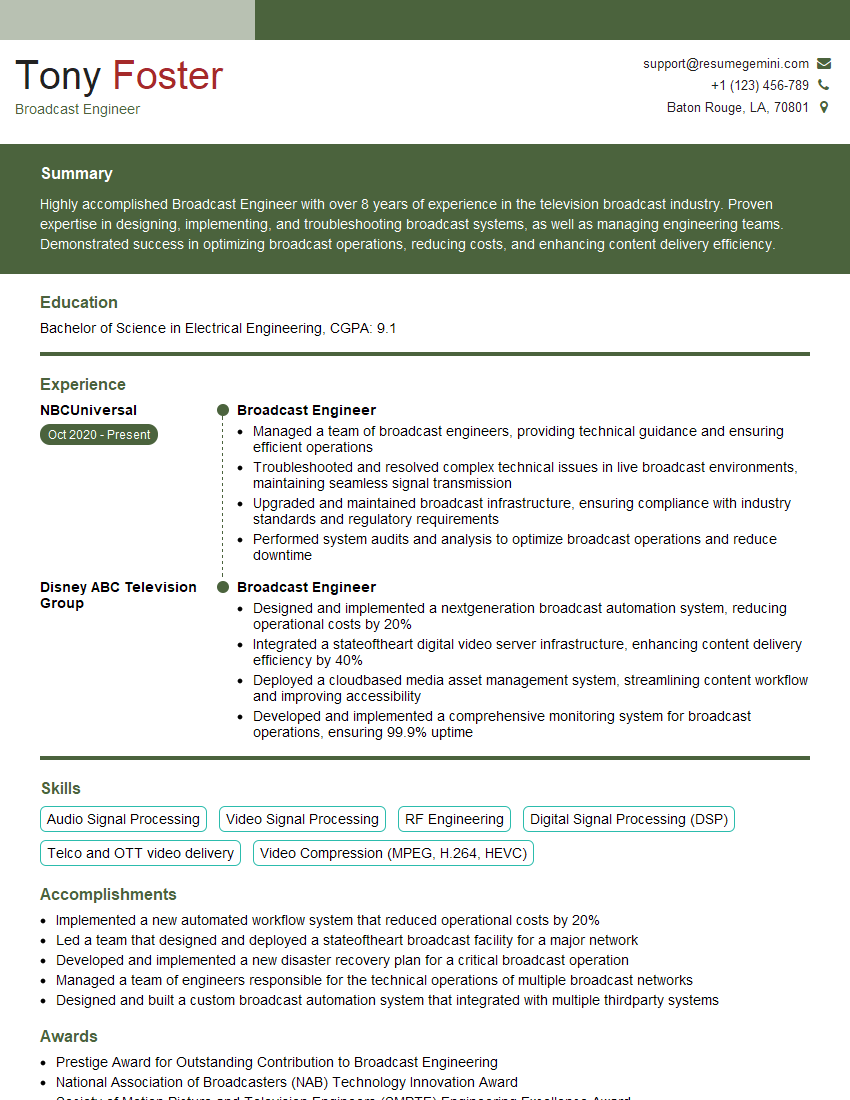
Mastering AM Transmitter Operations opens doors to rewarding careers in broadcasting, offering opportunities for advancement and specialization. To stand out, create a compelling resume that highlights your skills and experience effectively. An ATS-friendly resume is crucial for getting your application noticed by potential employers. ResumeGemini is a trusted resource that can help you build a professional, impactful resume tailored to the broadcasting industry. Examples of resumes tailored to AM Transmitter Operations are available, providing valuable templates and guidance to make your application shine.

Explore more articles
Users Rating of Our Blogs
Share Your Experience
We value your feedback! Please rate our content and share your thoughts (optional).
What Readers Say About Our Blog
Very informative content, great job.
good