Interviews are more than just a Q&A session—they’re a chance to prove your worth. This blog dives into essential Animator and Rigging interview questions and expert tips to help you align your answers with what hiring managers are looking for. Start preparing to shine!
Questions Asked in Animator and Rigging Interview
Q 1. Explain the difference between forward and inverse kinematics.
Forward kinematics (FK) and inverse kinematics (IK) are two fundamental approaches to controlling character rigs in animation. Think of it like this: FK is like controlling a marionette – you directly manipulate each joint individually. IK is more like controlling a robot arm – you specify the end goal (the hand’s position), and the system calculates the necessary joint angles to achieve it.
Forward Kinematics (FK): In FK, you animate each joint sequentially. Moving the shoulder joint affects the elbow, which in turn affects the wrist and hand. It’s straightforward and intuitive for simple poses, but it becomes cumbersome and less precise for complex poses or reaching specific targets.
Inverse Kinematics (IK): IK allows you to specify the position of the end effector (e.g., the hand) and the system automatically calculates the necessary joint angles to achieve that position. This is incredibly useful for complex movements and ensuring the character reaches a specific point naturally. However, it can sometimes lead to unintended joint twists or unnatural poses if not carefully constrained.
In short: FK is direct joint manipulation; IK is goal-oriented manipulation.
Q 2. Describe your experience with various rigging techniques (e.g., CAT, FK, IK).
My rigging experience encompasses a wide range of techniques, including forward kinematics (FK), inverse kinematics (IK), and character animation tools (CAT) rigs. I’ve worked extensively with FK for detailed control over individual body parts, particularly for facial animations where precise control is paramount. For limb animation and complex poses, IK has been my go-to method, leveraging its efficiency and natural-looking results. I am proficient in building both single-chain and multi-chain IK systems, utilizing pole vector controls for fine-tuning the movement arc. My experience also includes CAT rigs, which are particularly useful for creating highly automated and repeatable rigging processes, streamlining workflows for large projects. For example, I’ve successfully used CAT rigs to automate the creation of character rigs for crowds or large ensembles, significantly reducing the time and effort involved. Furthermore, I’ve integrated custom scripting and expressions into these rigs to enhance functionality and customization, allowing animators to tailor the rig to their specific needs.
Q 3. How do you optimize rigs for performance?
Optimizing rigs for performance is crucial for efficient animation workflows and smooth playback. My approach involves several key strategies:
- Reduce the number of nodes: Fewer nodes translate to less processing overhead. I carefully evaluate the necessity of each node and consolidate functionalities where possible.
- Use efficient constraints: Certain constraints (e.g., parent constraints) are less computationally expensive than others (e.g., point constraints). I select constraints based on both functionality and performance considerations.
- Minimize the use of expressions and complex calculations: While useful, heavy expressions can impact performance. I often pre-calculate values or use simpler alternatives when possible.
- Avoid unnecessary geometry: Complex geometry increases render time. I strive to use simpler geometry for the rig itself, relying on the main model for visual detail.
- Utilize layers and namespaces: Organizing the rig using layers and namespaces improves clarity and allows for selective freezing of unnecessary parts during animation, enhancing performance.
- Implement caching mechanisms: Depending on the software, techniques like caching can significantly reduce the computational load on the system.
For instance, in a recent project involving a highly detailed dragon character, I reduced the number of nodes in the wings by implementing a smart system of curve-based deformation, significantly boosting performance without compromising the animation’s quality.
Q 4. What software are you proficient in for animation and rigging (Maya, 3ds Max, Blender, etc.)?
I am highly proficient in Autodesk Maya and Blender. Maya is my primary software, due to its robust features and industry-standard workflow for character animation and rigging, and I’m equally adept at using Blender for its open-source nature and powerful features. I’ve also had experience with 3ds Max for specific projects, demonstrating adaptability across different platforms.
Q 5. Explain your process for creating a character rig from a 3D model.
My process for creating a character rig from a 3D model is a structured approach that prioritizes efficiency and maintainability.
- Model Preparation: I start by thoroughly inspecting the 3D model for any issues that might hinder the rigging process, such as overlapping geometry or non-manifold edges. Cleaning and optimizing the model is critical for a smooth workflow.
- Joint Placement: Next, I strategically place joints (bones) along the character’s skeleton, ensuring proper anatomical accuracy and alignment. The placement of joints significantly impacts the naturalness and expressiveness of the final animation.
- Rigging: I build the rig using a combination of FK and IK, depending on the specific needs of the character and the required level of control. Constraints and deformers are added at this stage to enhance the rig’s functionality and provide the animators with intuitive controls.
- Skinning: I then bind the character’s geometry (the skin) to the underlying skeleton using weights. Careful skinning is essential to prevent undesirable deformations and ensure smooth transitions between poses.
- Controls: I create control rigs that are easy to manipulate. These can include simple handles to move and rotate body parts or more complex controls for special poses or facial expressions.
- Testing and Iteration: Rigging is an iterative process. Throughout the entire process, I perform extensive tests to identify and resolve any issues or areas for improvement. Animating the character helps ensure natural movements.
- Documentation: Finally, the rig is thoroughly documented. Clear documentation helps prevent future issues and ensures easier collaboration on the project.
For example, when creating a quadruped character, I use a combination of FK for the legs and IK for the tail, allowing detailed control over the legs while ensuring natural movements of the tail.
Q 6. How do you handle constraints and deformers in your rigging workflow?
Constraints and deformers are essential tools in my rigging workflow. They allow me to create complex and realistic character movements with relative ease.
Constraints: Constraints are used to establish relationships between different parts of the rig. I often employ parent constraints for hierarchical relationships (e.g., the hand is a child of the forearm), point constraints to keep specific points aligned (e.g., the foot planted firmly on the ground), and orient constraints for aligning the rotation of objects. The selection of constraint type depends on the specific requirements, balancing between functionality and performance.
Deformers: Deformers, like skin clusters and blend shapes, are used to shape and control the character’s geometry. Skin clusters are crucial for binding the mesh to the skeleton, while blend shapes allow for the creation of expressions and morph targets. I often utilize multiple deformers in conjunction to achieve a seamless and natural deformation.
Example: To create a realistic elbow bend, I might use an IK constraint for the forearm and hand, a pole vector to control the bend’s arc, and blend shapes for subtle muscle bulging during movement. This combined approach ensures both functional and visually appealing animation.
Q 7. Describe your experience with skinning techniques.
Skinning is the process of binding the character’s geometry (mesh) to its underlying skeleton (rig). Effective skinning is crucial for realistic and smooth animation. I employ several techniques depending on the complexity of the model and the desired result.
- Weight Painting: This is the most common approach, allowing for manual control over how the mesh deforms according to the movement of the bones. I pay close attention to weight distribution around joints to avoid artifacts like pinching or stretching.
- Automatic Skinning: For simpler models, automated skinning tools can significantly speed up the process. However, manual adjustments are usually necessary to refine the results and address any issues.
- Advanced Skinning Techniques: For complex characters, I sometimes utilize more advanced techniques like dual quaternion skinning to prevent artifacts like twisting and other visual distortions, especially in areas with complex geometry and many bones.
My goal is always to achieve smooth transitions and natural-looking deformations, paying careful attention to detail. A poorly skinned character can easily ruin an otherwise excellent animation, and I put a high priority on getting this phase of the process right. For instance, on a recent project featuring a character with flowing hair, I needed to use advanced techniques to avoid any deformation artifacts during the hair’s movement. The result was a smooth and believable appearance throughout the animation.
Q 8. How do you troubleshoot rigging issues?
Troubleshooting rigging issues is a crucial part of the animation pipeline. It often involves a systematic approach, starting with identifying the problem’s source. This could range from unexpected joint behavior, to weighting issues, or even problems with the underlying model geometry.
My troubleshooting process typically follows these steps:
- Isolate the problem: Is it affecting a specific joint, a limb, or the entire rig? Reproducing the issue consistently is key.
- Check the rig’s structure: Examine the hierarchy of the bones, ensuring there are no unexpected parent-child relationships causing interference. Look for flipped normals or improperly oriented joints.
- Inspect weights: Weight painting is critical. Incorrect weights can lead to deformations and unnatural movements. I’ll check for gaps, overlaps, or uneven weight distribution using the visualization tools.
- Review constraints: Constraints like IK (Inverse Kinematics) or parent constraints might be conflicting or incorrectly set up. I would meticulously check their parameters and settings.
- Test with simpler animation: If the problem is complex, I’ll simplify the animation to see if the issue still occurs. This helps narrow down the cause.
- Debug using animation software tools: Most software (Maya, Blender, etc.) offer tools to display joint orientations, weight paints, and constraint information. Utilizing these can reveal hidden issues.
- Consult documentation and online resources: The software’s documentation and online forums are invaluable resources for finding solutions to common problems.
For example, I once encountered a character’s arm bending unnaturally. Through careful examination of the weight paints, I found an area where the weights weren’t smoothly distributed, causing this unexpected behavior. Reweighting that section resolved the problem.
Q 9. How familiar are you with motion capture data and its integration into a rig?
Motion capture (MoCap) data is incredibly valuable for creating realistic animations. My experience with MoCap involves both importing and cleaning the data, and then adapting it to the character rig.
The process starts with importing the MoCap data into the animation software. This often involves selecting the appropriate format and aligning the MoCap skeleton to my character rig. This alignment is crucial and requires careful consideration of bone orientations and scale.
After importing, I refine the data. This involves:
- Retargeting: This adapts the MoCap data to the specific structure of my character rig, particularly if the MoCap data is from a different character model.
- Cleaning: MoCap data often contains noise and inconsistencies. I use editing tools to smooth out jerky movements, correct unwanted rotations or translations, and generally clean up the data to make it more suitable for animation.
- Editing: Sometimes, direct manipulation is necessary. I might adjust specific keyframes to enhance the performance or address specific problems.
Finally, I often blend the MoCap data with hand-keyframed animation to achieve the desired stylistic result. This is a common practice even with highly realistic animations, allowing for artistic interpretation.
Q 10. Explain your understanding of animation principles (e.g., squash and stretch, anticipation, follow-through).
Animation principles are fundamental to creating compelling and believable animations. They guide how we move characters to make them engaging and believable, even in stylized scenarios. These principles, such as squash and stretch, anticipation, staging, pose to pose, straight ahead action, follow through and overlapping action, and arcs, work together to enhance realism and expression.
- Squash and Stretch: This principle adds dynamism and weight to movement by exaggerating the deformation of an object when it moves. Think of a bouncing ball—it squashes on impact and stretches as it flies through the air.
- Anticipation: This prepares the audience for an action. A character might wind up before throwing a ball. This makes the action more natural and engaging.
- Staging: This principle ensures that the animation is clearly understood by the viewer. The pose or action should be unambiguously communicated.
- Follow Through and Overlapping Action: These principles add realism to movement. Follow through refers to the continuation of motion beyond the main action, like hair trailing behind a moving head. Overlapping action depicts different parts of the body moving at slightly different times, adding naturalism.
- Arcs: Most natural movements follow curved paths, creating a smooth and natural feel. Linear movements often appear robotic.
For example, a simple walk cycle effectively uses many of these principles. The legs arc smoothly, with anticipation in the bending of the knees before a step, and follow-through in the trailing leg’s swing.
Q 11. How do you create realistic or stylized character animations?
Creating realistic or stylized character animations involves a blend of technical skills and artistic judgment. Realism requires meticulous attention to detail, while stylized animation permits more creative freedom.
Realistic Animation: This focuses on accurately portraying the physical properties of the character and its environment. Key aspects include:
- Accurate Anatomy: Understanding human or animal anatomy is crucial. Movements should reflect the underlying skeletal structure and muscle interaction.
- Physics-Based Simulation: Utilizing physics engines for elements like cloth, hair, or fluids adds to realism.
- Subtlety: Realistic animations often feature subtle movements and expressions rather than exaggerated ones.
Stylized Animation: This prioritizes artistic expression over strict realism. Stylization involves:
- Exaggeration: Exaggerated poses, movements, and expressions are common.
- Unique Character Designs: The design dictates how the character moves. A cartoon character will move differently than a photorealistic one.
- Specific Animation Styles: There are numerous styles, each with unique techniques. Cartoon animation, anime, and stop-motion each have their distinct characteristics.
I’ve worked on both. A recent project involved creating a realistic character for a cinematic short film. We carefully studied reference material, and employed motion capture to capture believable performances. For another project, we created stylized cartoon characters, and exaggerated movements and expressions to achieve a playful and fun feel.
Q 12. Describe your experience with different animation workflows (e.g., pre-vis, animation, post-vis).
Animation workflows often involve a series of stages, with each stage building upon the previous one. The workflow is designed to improve efficiency and allow for iterative improvements.
- Pre-visualization (Pre-vis): This early stage uses simple models and animations to plan the overall shot composition, camera movement, and character actions. This helps identify potential problems early on. It often uses simple placeholder models and might not even use a full rig yet.
- Animation: This stage involves creating the actual character animation using the final model and rig. This is where the bulk of the animation happens and it’s often broken down into smaller tasks such as animation of specific actions or scenes.
- Post-visualization (Post-vis): This is the final stage of rendering and reviewing the completed animation. This involves reviewing lighting, effects, and the overall look. Issues identified here might require going back to the animation or even earlier stages.
In a recent project, pre-vis proved incredibly valuable when we realized that a planned sequence was too complex and would have added significant time to the production. We were able to adjust it using the pre-vis stage.
Q 13. How do you approach animating complex character interactions?
Animating complex character interactions requires careful planning and execution. The key lies in understanding the dynamics between characters, their individual motivations, and the overall narrative of the scene.
My approach involves:
- Storyboarding and blocking: This outlines the main actions and poses of the characters, ensuring the interaction is clear and believable.
- Character Animation: Individual animations are created for each character, taking into account their individual actions, reactions, and personalities.
- Synchronization: The animations of the interacting characters are carefully synchronized to create a natural flow. Timing is crucial here.
- Spacing and Weight: These elements make the animation convincing. Characters should react to each other’s weight and movements.
- Secondary Actions: These add depth and realism. The reactions of one character might affect the other in subtle ways.
For example, a scene depicting a fight requires careful synchronization of each character’s movements to create believable combat. One character might anticipate an attack, creating a more realistic response.
Q 14. What is your experience with lip-sync animation?
Lip-sync animation is a crucial aspect of bringing characters to life, especially in dialogue-heavy scenes. It’s more than just matching mouth shapes; it’s about creating a believable and engaging performance.
My experience with lip-sync includes several techniques:
- Automatic lip-sync tools: Software offers tools that automatically generate lip-sync based on audio input. While convenient, these often require manual tweaking for accuracy and naturalness.
- Manual lip-sync: This approach provides maximum control over the animation. I would carefully study the audio waveform and create keyframes that accurately match the mouth movements to the sounds.
- Phonetic approach: I sometimes use a phonetic approach, where I correlate sounds with specific mouth shapes. This offers a more controlled method.
- Reference: Recording and using video reference is essential for achieving realism. Observing how people naturally speak provides invaluable insights.
In a recent project, I combined automatic tools with manual adjustments. The automated system generated a base lip-sync, and I refined it by hand, paying close attention to subtle nuances in the audio to ensure an accurate and realistic representation.
Q 15. How do you manage and organize your animation projects?
Managing animation projects effectively involves a structured approach. I typically use a project management system like Asana or Trello to track tasks, deadlines, and revisions. For file organization, I create a clear folder structure mirroring the project’s breakdown – separate folders for assets (models, textures, rigs), animation scenes, renders, and documentation. Within each folder, I maintain a logical naming convention for all files, using descriptive names and version numbers (e.g., character_walk_v02.fbx). This ensures easy accessibility and avoids confusion when working on large projects with multiple team members. I also utilize cloud storage for seamless collaboration and backup. Version control systems like Git (though less common in pure animation pipelines, more in associated software and rigging) can be valuable for tracking changes and reverting to earlier versions if needed.
Career Expert Tips:
- Ace those interviews! Prepare effectively by reviewing the Top 50 Most Common Interview Questions on ResumeGemini.
- Navigate your job search with confidence! Explore a wide range of Career Tips on ResumeGemini. Learn about common challenges and recommendations to overcome them.
- Craft the perfect resume! Master the Art of Resume Writing with ResumeGemini’s guide. Showcase your unique qualifications and achievements effectively.
- Don’t miss out on holiday savings! Build your dream resume with ResumeGemini’s ATS optimized templates.
Q 16. Describe your approach to creating believable character performances.
Creating believable character performances goes beyond just moving the limbs; it’s about conveying emotion and personality. My approach starts with a thorough understanding of the character’s backstory, motivations, and personality. I study reference material – be it live-action footage, other animations, or even observing people in real life – to learn how humans move in various emotional states. I pay close attention to subtle details: weight shift, anticipation, follow-through, and overlapping action. For instance, when a character is surprised, I might add a slight head tilt, widening of the eyes, and even a subtle intake of breath, to enhance realism. I often use the principle of ‘less is more’ – subtle movements can be more impactful than exaggerated gestures. I also iterate on my animation through playblasts and constantly check for consistency and believability. A key part of this process involves feedback from colleagues and directors.
Q 17. How do you handle feedback and revisions on your animation work?
Feedback is crucial for improving animation quality. I actively solicit feedback throughout the production process, not just at the end. I’m open to constructive criticism and see revisions as an opportunity to refine my work. When receiving feedback, I clarify any ambiguities, asking for specific examples or points of improvement. I then break down the revisions into smaller, manageable tasks, ensuring each is addressed systematically. I maintain clear communication with the director and other stakeholders, updating them on the progress of revisions and seeking confirmation once they are implemented. I also make sure to document all revisions, using version control (if applicable) to keep track of changes and the rationale behind them.
Q 18. What are your preferred methods for creating secondary animation?
Secondary animation adds life and realism to a character. My preferred methods involve a combination of techniques. I often use curves and simple keyframes for subtle body movements, like the swaying of a ponytail during a walk cycle or the gentle bobbing of a chest during breathing. For more complex secondary animations, I might utilize expressions or blendshapes (in programs like Maya or Blender) to create nuanced facial expressions. I also use techniques like squash and stretch, and anticipation and follow-through to improve the dynamism of the movement. I find that observing real-world examples is key – watching how clothes drape and react to movement or how hair flows in the wind provides inspiration and helps me to create believable secondary animation that enhances the overall performance.
Q 19. Explain your understanding of keyframing and interpolation.
Keyframing is the process of setting specific poses at key points in the animation timeline. Interpolation is how the software fills in the gaps between these keyframes, creating the smooth transition between poses. Think of it like drawing a line; keyframes are the points you explicitly mark, and interpolation is how the software draws the line connecting those points. Different interpolation methods (linear, bezier, etc.) affect the smoothness and character of the movement. Linear interpolation produces a uniform, constant speed between keyframes, while bezier curves allow for more control, enabling the creation of slower starts, faster finishes, or even pauses within the movement. Understanding different interpolation methods is key to creating natural and believable animation. Choosing the correct interpolation method depends on the type of movement – a slow, deliberate action would benefit from a smoother curve, while a quick, sharp movement might use a linear interpolation.
Q 20. How do you optimize your animation files for different platforms and pipelines?
Optimizing animation files for different platforms and pipelines is crucial for efficient workflow and rendering. This typically involves reducing polygon count in models, optimizing textures, and using appropriate compression techniques. For example, reducing the resolution of textures while maintaining visual fidelity reduces file size without compromising visual quality. I also utilize appropriate file formats (e.g., FBX for compatibility across different software), and employ techniques like baking animations into meshes to reduce the workload on the rendering engine. Understanding the specific requirements of each platform (e.g., game engines, film pipelines) is important, and I tailor my optimization strategies accordingly. This may involve adjusting levels of detail or creating different versions of assets for different targets.
Q 21. What is your experience with procedural animation?
Procedural animation involves using algorithms and code to generate animation automatically, rather than manually keyframing every pose. My experience with procedural animation includes using tools and techniques such as Houdini and Maya’s particle systems to create realistic effects like cloth simulation, hair dynamics, and crowd simulations. I’ve also experimented with scripting in Python to automate repetitive tasks or generate variations in animations, creating unique movements from base parameters. The advantage is the ability to create complex and dynamic animations with less manual effort. However, it requires a strong understanding of programming concepts and the limitations of different procedural techniques. While fully procedural animation might not be appropriate for all scenarios, I find it invaluable for creating realistic effects and adding extra detail and efficiency to a production workflow.
Q 22. How familiar are you with different types of cameras and their use in animation?
Camera choices significantly impact storytelling and visual appeal in animation. Understanding their properties is crucial. We have various camera types, each serving a unique purpose:
- Orthographic Camera: This camera projects parallel lines, maintaining consistent scale regardless of distance. It’s great for technical shots, architectural visualizations, or establishing shots where you want to avoid perspective distortion.
- Perspective Camera: This mimics the human eye, creating depth and scale variations based on distance. Almost all animation uses perspective cameras to create a sense of realism and three-dimensionality. Different focal lengths (wide, medium, telephoto) significantly alter the perspective and impact of a shot. A wide-angle lens can exaggerate depth, while a telephoto lens compresses depth.
- Virtual Camera Systems: Many animation packages use sophisticated camera systems. You can animate the camera’s position, rotation, and focal length over time, creating dynamic and compelling shots. These systems might use keyframes, curves, or even procedural techniques (like path-following).
For instance, in a chase scene, I might use a dynamic perspective camera following the characters, zooming in during intense moments to heighten the tension, and pulling back for wider shots to show the context of the chase. This allows for effective storytelling through visual pacing and emphasis.
Q 23. How do you maintain consistency in your animation style across a project?
Maintaining animation style consistency is paramount for a cohesive final product. Several strategies ensure this:
- Style Guide: Creating a visual style guide detailing character proportions, color palettes, line weights, and movement principles acts as a central reference. This guide helps maintain consistency among multiple animators.
- Reference Sheets: Detailed reference sheets for characters (showing various poses and expressions) and environments prevent inconsistencies in character design and animation.
- Shot Breakdown and Review Process: A robust workflow involving thorough shot breakdown, pre-visualization, and regular review sessions keeps everyone informed and aligned with the project’s style.
- Technical Consistency: Using consistent animation software, settings, and rigging setups helps minimize stylistic discrepancies across different shots and sequences. This includes consistent use of keyframing techniques, easing functions, and motion blur settings.
For example, I worked on a project with a distinct cartoon style. We created a style guide outlining specific exaggeration techniques for character movements, emphasizing squash and stretch principles. Regular feedback sessions ensured everyone followed these guidelines, maintaining consistency in character actions and overall look and feel.
Q 24. Describe your experience with different rendering engines and their impact on animation.
Rendering engines are the heart of the final visual output in animation. My experience includes working with:
- Arnold: Known for its physically-based rendering capabilities and excellent subsurface scattering (making skin and other materials look incredibly realistic). It’s suitable for high-quality, photorealistic renders, but can be computationally intensive.
- Redshift: A fast and versatile renderer, excellent for both photorealism and stylized projects. It offers a good balance between speed and quality.
- RenderMan: A powerful and industry-standard renderer known for its flexibility and advanced features. It’s often used in high-end animation productions requiring intricate lighting and effects.
- Cycles (Blender): This open-source renderer offers physically-based rendering with path tracing, useful for both still renders and animation, and often preferable for its accessibility.
The choice of rendering engine depends significantly on the project’s style, budget, and deadline. For instance, a stylized cartoon project might utilize Redshift for its speed and efficiency, while a photorealistic film might demand the higher quality and realism of Arnold or RenderMan. Different renderers also have varying levels of compatibility with different 3D modeling and animation software packages.
Q 25. What is your understanding of the importance of clear communication within an animation team?
Clear communication is the bedrock of any successful animation project. Misunderstandings can easily lead to inconsistencies, delays, and frustration. Effective communication includes:
- Daily Stand-Ups: Brief daily meetings to discuss progress, challenges, and coordinate tasks.
- Regular Feedback Sessions: Consistent review sessions (both informal and formal) allow for early detection and correction of potential issues. Constructive criticism and clear expectations are crucial.
- Version Control Systems: Using version control for assets ensures that everyone works with the latest versions and avoids conflicts.
- Effective Documentation: Clear technical documentation and specifications prevent confusion and ambiguity.
- Active Listening and Respectful Collaboration: The ability to actively listen to and respect the contributions of others is vital for a positive work environment and shared understanding.
In my experience, a shared online project management tool for tracking tasks, feedback, and revisions has been incredibly effective in maintaining communication flow and promoting team collaboration.
Q 26. How do you stay updated with the latest trends and technologies in animation?
Keeping up with the latest trends and technologies is vital for any animator. I utilize several strategies:
- Industry Publications and Websites: Following animation-related blogs, websites (like 80.lv), and industry publications keeps me informed about new software, techniques, and best practices.
- Conferences and Workshops: Attending SIGGRAPH and other relevant conferences and workshops provides valuable exposure to cutting-edge developments and networking opportunities.
- Online Courses and Tutorials: Platforms such as Udemy, Coursera, and Skillshare offer diverse courses that cover various animation and rigging techniques.
- Open Source Projects and Community Forums: Engaging with the open-source community and participating in online forums provides opportunities to learn from others and test new tools.
- Experimentation and Personal Projects: I dedicate time to exploring new techniques and software through personal projects. This allows me to stay ahead of the curve and actively expand my skill set.
Recently, I’ve been exploring advancements in procedural animation and AI-driven animation tools. Hands-on experience is crucial for understanding these new technologies.
Q 27. Describe a time you had to solve a challenging rigging problem. What was the solution?
I once faced a challenging rigging problem involving a character with complex, flowing cloth elements. The initial rig was unstable and prone to self-intersection and unnatural deformations during animation. The solution involved a multi-step process:
- Improved Topology: The original mesh topology wasn’t suitable for cloth simulation. I redesigned the mesh with cleaner topology, ensuring even polygon distribution and minimizing triangles.
- Advanced Rigging Techniques: I implemented a combination of techniques, including using a combination of bone-based and constraint-based rigging. This allowed for better control over the cloth’s deformation.
- Cloth Simulation Software: I incorporated a professional cloth simulation software package, which allowed me to add realistic drape and movement to the clothing. This involved adjusting parameters like stiffness, drag, and gravity to get the desired effect.
- Iterative Testing and Adjustment: Rigging and cloth simulation is an iterative process. Through repeated testing and adjustments, I refined the rig until I achieved stable and natural-looking cloth movement during character animation.
This problem highlighted the importance of having a strong understanding of both rigging techniques and cloth simulation principles. Understanding the limitations of different methods and how to combine them effectively was key to finding the solution.
Q 28. What are some common challenges you’ve encountered in animation and how did you overcome them?
Animation presents many challenges. Some common ones include:
- Maintaining Realistic Movement: Animating believable character movements requires a deep understanding of anatomy, physics, and acting principles. Addressing this involves referencing real-life movements, studying anatomy, and potentially using motion capture data as a starting point.
- Meeting Deadlines: Animation projects often have tight deadlines. Time management, prioritization, and efficient workflow processes are essential for staying on track.
- Collaborating Effectively: Working in a team demands effective communication and collaboration to maintain consistency and resolve conflicts.
- Dealing with Technical Issues: Software crashes, rendering problems, and other technical glitches can disrupt workflows. Problem-solving skills and proficiency with troubleshooting are essential.
For example, when facing a tight deadline, I prioritize essential shots first, utilizing time-saving techniques like using motion capture and leveraging pre-made assets whenever possible. Communication with the team is key to ensuring everyone is working towards the common goal and to redistribute tasks effectively if necessary. When encountering technical issues, I document the problem carefully, look for solutions in online forums or documentation, and consult colleagues if I need assistance.
Key Topics to Learn for Animator and Rigging Interview
- Animation Principles: Understanding and applying the 12 principles of animation (squash and stretch, anticipation, staging, etc.) to create believable and engaging character animation.
- Character Rigging Techniques: Discuss different rigging approaches (e.g., skeletal, spline-based), their advantages and disadvantages, and your experience with various rigging software (Maya, Blender, etc.). Be prepared to discuss your approach to creating a robust and efficient rig for various character types.
- Software Proficiency: Demonstrate a strong understanding of your chosen animation and rigging software. Be prepared to discuss your workflow, shortcuts, and problem-solving skills within the software environment.
- Weight Painting and Skinning: Explain the process of weight painting and how it affects the deformation of a mesh during animation. Be ready to discuss troubleshooting issues related to skinning and weight assignments.
- IK/FK Systems: Explain the differences between Inverse Kinematics (IK) and Forward Kinematics (FK) and when you would choose one over the other. Discuss your experience implementing and troubleshooting both systems.
- Facial Rigging: Describe your experience with facial rigging techniques, including blendshapes, and how you approach creating realistic and expressive facial animations.
- Problem-Solving and Troubleshooting: Be prepared to discuss how you approach technical challenges during the animation and rigging process. Provide examples of how you solved difficult problems related to animation or rigging.
- Collaboration and Communication: Discuss your experience working within a team environment, collaborating with animators, modelers, and other artists. Highlight your communication skills and ability to give and receive constructive feedback.
- Portfolio Presentation: Prepare to showcase your best work and articulate your design choices and technical decisions within each project. Be ready to discuss your creative process and artistic vision.
Next Steps
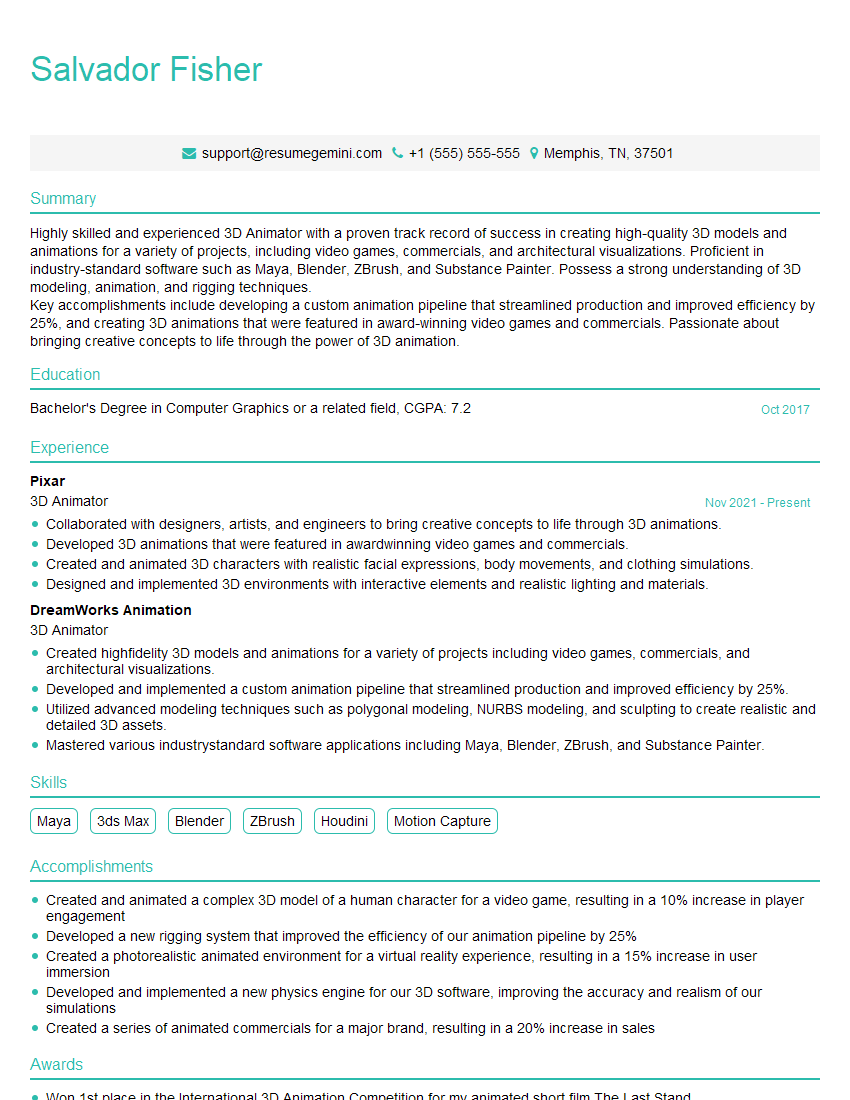
Mastering animation and rigging opens doors to exciting opportunities in film, games, and beyond! To maximize your job prospects, invest in crafting an ATS-friendly resume that highlights your skills and experience effectively. ResumeGemini is a trusted resource that can help you build a professional and impactful resume. They provide examples of resumes tailored to Animator and Rigging roles to guide you through the process. Take this opportunity to elevate your resume and showcase your talent to potential employers.
Explore more articles
Users Rating of Our Blogs
Share Your Experience
We value your feedback! Please rate our content and share your thoughts (optional).
What Readers Say About Our Blog
Very informative content, great job.
good