Preparation is the key to success in any interview. In this post, we’ll explore crucial ANSI/TIA/EIA Standards Compliance interview questions and equip you with strategies to craft impactful answers. Whether you’re a beginner or a pro, these tips will elevate your preparation.
Questions Asked in ANSI/TIA/EIA Standards Compliance Interview
Q 1. Explain the key differences between TIA-568A and TIA-568B cabling standards.
TIA-568A and TIA-568B are both cabling standards defining the wiring configuration for twisted-pair cabling in structured cabling systems. The key difference lies in the pin assignments for the transmit and receive pairs in the 8-position modular connector (RJ-45). Think of it like this: both standards use the same wires, but they plug into the connector in a slightly different order. This seemingly small difference is crucial for interoperability.
- TIA-568A: The wiring order for TIA-568A is: Orange/White, Orange, Green/White, Blue, Blue/White, Green, Brown/White, Brown.
- TIA-568B: The wiring order for TIA-568B is: Green/White, Green, Orange/White, Blue, Blue/White, Orange, Brown/White, Brown.
Using the wrong standard on both ends of a cable link won’t work. Inconsistent standards between ends lead to communication failure. The choice between A and B is generally arbitrary, as long as consistency is maintained throughout the system. Most modern installations favor TIA-568B, but choosing one and adhering to it is paramount.
Q 2. Describe the importance of grounding and bonding in telecommunications infrastructure.
Grounding and bonding are critical for safety and signal integrity in telecommunications infrastructure. They protect equipment and personnel from electrical hazards and minimize signal noise and interference. Imagine a thunderstorm: lightning could strike your building. Without proper grounding, that surge could damage expensive equipment, potentially causing a significant outage and financial loss. Bonding ensures that all metallic components within the system are at the same electrical potential, preventing voltage differences that could cause surges and damage.
Grounding: This involves connecting the telecommunications system to the earth, providing a path for electrical currents to safely dissipate. This is typically achieved using a grounding electrode system connected to the building’s main grounding system. Proper grounding is the first line of defense against electrical hazards.
Bonding: This links together metallic components, like racks, cabinets, and cable trays, to equalize their electrical potential. This prevents voltage differences that can induce noise in the cabling and protect against electrical shocks. It’s like creating a unified electrical ‘shield’ to safeguard equipment.
Failure to properly ground and bond can lead to equipment damage, data loss, fire hazards, and serious injuries.
Q 3. What are the requirements for cable labeling according to ANSI/TIA standards?
ANSI/TIA standards mandate clear and consistent cable labeling for efficient management and troubleshooting. Imagine trying to find a specific cable in a large data center without proper labels – it would be a nightmare! Labels should be permanent, legible, and provide essential information.
- Location Identification: Labels must indicate the cable’s location within the structured cabling system (e.g., room number, rack number, cabinet number).
- Cable Type: Specify the cable type (e.g., fiber optic, Cat6A, etc.).
- Port Numbers: Indicate the corresponding port numbers at both ends of the cable.
- Destination Information: Clearly state the cable’s endpoint device (e.g., server, workstation).
- Date of Installation: Record the installation date for maintenance and future upgrades.
Best practice is to use a standardized labeling system that’s easily readable, consistently applied across the entire installation, and durable enough to withstand the conditions of the environment. For example, using heat-shrink labels or laser-printed labels ensures long-term readability.
Q 4. How do you ensure compliance with ANSI/TIA standards during a cabling installation?
Ensuring compliance with ANSI/TIA standards during a cabling installation requires meticulous planning and execution. This involves a multi-step process, starting before any cable is even run.
- Design Phase: The design must adhere to the relevant TIA standards, specifying cable types, pathways, and grounding requirements.
- Material Selection: Use only approved cables and components that meet the performance criteria outlined in the chosen standards.
- Installation Process: Strictly follow the installation guidelines, including proper termination techniques and cable management practices.
- Testing and Verification: Conduct thorough testing of the installed cabling system to verify compliance with performance standards using certified testing equipment.
- Documentation: Maintain comprehensive documentation, including cable schematics, test results, and as-built drawings. This is crucial for future maintenance and troubleshooting.
- Regular Maintenance: Establish a regular maintenance schedule to inspect the cabling for any damage or degradation.
Following these steps, you can ensure that the structured cabling installation meets the standards and offers reliable operation for years to come.
Q 5. What are the common causes of signal attenuation in structured cabling?
Signal attenuation, the weakening of a signal over distance, is a common problem in structured cabling. Think of it like a whisper – the further away you are, the harder it is to hear. Several factors contribute to this:
- Cable Length: Longer cables lead to greater signal attenuation; shorter runs are more efficient.
- Cable Quality: Lower-quality cables, using inferior materials or improper manufacturing techniques, will exhibit higher attenuation.
- Bends and Kinks: Sharp bends and kinks in the cable can increase resistance and weaken the signal. Cables should be properly managed and routed. This is one of the most common culprits.
- Connectors: Poorly terminated connectors or damaged connectors introduce signal loss.
- Environmental Factors: Temperature extremes and humidity can also impact signal quality and cause attenuation.
Minimizing attenuation requires using high-quality cables, proper termination techniques, and effective cable management to ensure a consistent, strong signal reaches its destination.
Q 6. Explain the role of patch panels in a structured cabling system.
Patch panels are essential components in structured cabling systems, acting as a central point for connecting horizontal cabling to the backbone cabling. Think of them as highly organized switching centers. They provide a structured and manageable way to route cables to various destinations. They simplify the process of adding, removing, or rearranging cables, reducing complexity and improving maintainability.
Patch panels typically house multiple RJ-45 ports, each with clearly labeled connections. They allow for easy reconfiguration of the network without altering the permanent cabling. This makes upgrades and troubleshooting significantly easier. Without them, managing large networks becomes extremely complicated, inefficient, and prone to errors.
For example, if you need to change a computer’s network connection, you simply swap the patch cable at the patch panel, avoiding the need to work on the more permanent cabling.
Q 7. What is the significance of the TIA-942 standard?
TIA-942, Telecommunications Infrastructure Standard for Data Centers, provides comprehensive guidelines for designing, building, and managing data center infrastructure. It goes beyond just cabling, encompassing all aspects of a data center’s physical environment. This standard is crucial for building robust, high-performance data centers that are scalable, reliable, and maintainable.
TIA-942 outlines best practices for:
- Space Planning and Layout: Optimizing space utilization and airflow.
- Power and Cooling Infrastructure: Ensuring reliable power distribution and efficient cooling systems.
- Cabling Infrastructure: Defining standards for cabling, patch panels, and cable management systems.
- Security and Access Control: Implementing physical security measures.
- Environmental Monitoring: Establishing monitoring systems for temperature, humidity, and other critical environmental factors.
Compliance with TIA-942 is important for organizations seeking to maximize efficiency, performance, and uptime in their data centers. It provides a framework for constructing data centers that meet high standards for reliability and scalability.
Q 8. Describe different cable types (e.g., fiber optic, copper) and their applications.
Cabling systems use various media to transmit data, with copper and fiber optic being the most prevalent. Copper cabling, like Cat5e, Cat6, and Cat6A, utilizes twisted pairs of copper wires to transmit signals. These are suitable for shorter distances and lower bandwidth applications like Ethernet networks in offices or homes. The higher the category number (e.g., Cat6A), the higher the bandwidth and the longer the supported distance. Fiber optic cabling, conversely, uses strands of glass or plastic to transmit light signals. This allows for much higher bandwidth, longer distances (kilometers), and greater immunity to electromagnetic interference (EMI). It’s the backbone of long-haul telecommunications and high-speed data centers.
- Copper (Twisted Pair): Cat5e (suitable for Gigabit Ethernet over shorter distances), Cat6 (supports 10 Gigabit Ethernet over shorter distances), Cat6A (supports 10 Gigabit Ethernet over longer distances). Applications include local area networks (LANs), home networks, and connecting devices within a building.
- Fiber Optic: Single-mode fiber (used for longer distances and higher bandwidths), multi-mode fiber (used for shorter distances and lower bandwidths). Applications include long-haul telecommunications networks, data centers, and high-speed internet connections.
Choosing between copper and fiber depends on factors like distance, required bandwidth, budget, and susceptibility to EMI. For example, a small office might use Cat6 cabling, while a large data center will rely heavily on fiber optic cabling for its core infrastructure.
Q 9. How do you troubleshoot cabling issues using standard testing equipment?
Troubleshooting cabling issues requires systematic steps and specialized equipment. A cable certifier is the primary tool. It tests various aspects of the cable, including continuity, attenuation, return loss, and NEXT (Near-End Crosstalk). The process starts with identifying the problem area. Is it a single workstation, a whole segment of the network, or a widespread outage? Next, I would use a cable tester to check for connectivity at each point – from the patch panel to the wall plate and finally the end device.
For example, if a device isn’t getting a network connection, I’d:
- Check physical connections at both ends to ensure proper insertion.
- Use a cable tester to verify continuity and check for shorts or opens within the cable.
- Measure signal attenuation and return loss to identify potential signal degradation. High attenuation might indicate a bad cable, while excessive return loss points to impedance mismatches.
- Test for crosstalk, which can cause interference between cable pairs. Excessive crosstalk indicates a problem with the cable’s twisting or shielding.
- If the cable tests fine, I’d then proceed to check the network device configuration and other network components.
Documentation is crucial. I’d record all test results, along with pinouts and any other relevant information. This helps in tracing problems and preventing future issues. A structured cabling system makes troubleshooting much easier as it allows for quick isolation of potential problem areas.
Q 10. What are the safety precautions to be followed during cabling installation?
Safety is paramount during cabling installation. Several precautions must be taken to prevent injury or damage to equipment. First and foremost, always follow proper lockout/tagout procedures before working on energized equipment. Never work on live electrical circuits without proper training and safety measures.
- Personal Protective Equipment (PPE): Wear safety glasses to protect your eyes from debris and sharp objects. Safety gloves protect hands from cuts and abrasions. Use appropriate footwear to prevent slips and falls.
- Fall Protection: When working at heights, use fall protection equipment such as harnesses and lifelines.
- Working Environment: Ensure the area is properly lit and well-ventilated. Be aware of surroundings and potential hazards like overhead wires, sharp objects, or tripping hazards.
- Tools and Equipment: Use appropriate tools for the job and ensure they are in good condition. Avoid using damaged or improvised tools. Always follow manufacturer instructions for the safe operation of equipment.
- Electrical Safety: Be aware of the location of electrical circuits and avoid touching exposed wires. Never work on energized circuits without proper training and equipment.
Regular safety briefings and training are essential to instill safe working practices amongst cabling installers. Ignoring safety precautions can lead to serious accidents and injuries.
Q 11. Explain the concept of a structured cabling system.
A structured cabling system is a standardized approach to designing and installing a building’s cabling infrastructure. It follows a hierarchical arrangement that simplifies administration, maintenance, and expansion. Think of it like a well-organized road system for data, with clearly defined pathways and connections. The system is typically divided into several areas: the entrance facility, the telecommunications room, horizontal cabling, and the work area. This standardized approach promotes interoperability and simplifies troubleshooting and upgrades. ANSI/TIA-568 standards define the components and methodologies for structured cabling.
Key benefits include:
- Scalability: Easily accommodate future growth and changes.
- Flexibility: Adaptable to changing technology and applications.
- Maintainability: Simplified troubleshooting and maintenance.
- Interoperability: Equipment from various vendors seamlessly integrates.
A poorly planned cabling system can lead to increased costs, downtime, and difficulties in upgrading to new technologies. A structured cabling system is a long-term investment that pays off in terms of efficiency and scalability.
Q 12. What are the key elements of a telecommunications room?
The telecommunications room (TR) is the central point of a structured cabling system. It’s where the backbone cabling and equipment are housed. Think of it as the central hub of a building’s network. It needs to be designed to ensure proper cable management, environmental control, and security. Key elements include:
- Patch Panels: Provide a centralized point for connecting horizontal cabling to backbone cabling.
- Cable Management System: Organizes and supports cables to prevent tangling and damage.
- Network Equipment Racks: House network devices like switches, routers, and servers.
- Power Distribution Units (PDUs): Provide power to network equipment.
- Environmental Control: Adequate ventilation and temperature control to prevent overheating of equipment.
- Security: Access control to protect sensitive equipment and prevent unauthorized access.
- Grounding and Bonding: Provides protection against electrical surges and static discharge.
A well-designed TR is critical for the efficient and reliable operation of a building’s network. Insufficient space, poor cable management, and inadequate environmental control can lead to network failures and downtime.
Q 13. What are the requirements for cable management according to ANSI/TIA standards?
ANSI/TIA standards place significant emphasis on cable management. Proper cable management is crucial for maintaining a well-functioning and easily manageable network. Key requirements include:
- Proper Labeling: Each cable should be clearly labeled to identify its source, destination, and function. This aids in troubleshooting and maintenance.
- Cable Pathways: Cables should be routed through designated pathways, such as cable trays, conduits, and raceways. This protects cables from damage and keeps them organized.
- Cable Bundling: Cables should be bundled neatly and securely to prevent tangling and strain. Use appropriate cable ties and keep bundles to manageable sizes.
- Bending Radius: Minimum bending radius of cables must be adhered to to prevent damage to the cable. This radius varies depending on the type of cable.
- Sufficient Space: Adequate space should be provided within cable trays and pathways to allow for expansion and prevent overcrowding.
- Fire Safety: Cable pathways should be designed to meet fire safety requirements. This might include the use of fire-resistant materials and fire suppression systems.
Failure to adhere to cable management requirements can result in network outages, fire hazards, and difficulty in troubleshooting and maintenance. A well-managed cabling system enhances the lifespan and reliability of the entire network infrastructure.
Q 14. How do you verify the integrity of a fiber optic cable?
Verifying the integrity of a fiber optic cable involves testing its optical characteristics. Unlike copper cables, where we check for continuity and impedance, fiber requires different tools and methods. An optical time-domain reflectometer (OTDR) is the key instrument for this purpose. It sends a light pulse down the fiber and measures the time it takes for the light to return. This allows us to identify breaks, bends, or other impairments along the fiber.
The OTDR provides a visual representation of the fiber, showing its length, attenuation (signal loss), and reflections caused by faults. A power meter measures the optical power at both ends of the fiber, helping to identify loss or signal degradation. A light source is also used in conjunction to perform optical loss testing. Additionally, visual inspection of the fiber connectors should be performed to ensure they are clean and properly terminated. Poorly terminated connectors are a frequent cause of issues.
Testing should be done at the beginning and end of installation and periodically as part of preventative maintenance. Problems identified early can prevent expensive downtime. The OTDR test provides a complete picture of the health of the fiber optic cable and its components, ensuring reliable communication.
Q 15. Explain the different categories of twisted-pair cables.
Twisted-pair cables are categorized primarily by their performance capabilities, as defined by ANSI/TIA standards. These categories determine the maximum bandwidth and distance over which they can reliably transmit data. Think of it like choosing a highway – a smaller road (Category 3) will handle less traffic (data) than a multi-lane highway (Category 8).
- Category 3 (Cat3): Older standard, supporting speeds up to 16 Mbps. Rarely used in modern networks.
- Category 5 (Cat5): Supports speeds up to 100 Mbps. Still found in older installations but largely superseded.
- Category 5e (Cat5e): Enhanced Cat5, supporting up to 1 Gbps. Common in older buildings but gradually being replaced.
- Category 6 (Cat6): Supports up to 10 Gbps over shorter distances. A significant improvement over Cat5e.
- Category 6a (Cat6a): Supports 10 Gbps over longer distances than Cat6. A popular choice for high-speed networks.
- Category 7 (Cat7): Supports 10 Gbps and beyond, often used in data centers and demanding environments. Requires special connectors.
- Category 8 (Cat8): Supports up to 40 Gbps and beyond, designed for high-speed data centers and enterprise networks. Requires shielded cabling and specialized connectors.
The choice of category depends on the network’s speed requirements and the distances involved. For instance, a small office network might suffice with Cat6, while a large data center demanding high bandwidth would require Cat8.
Career Expert Tips:
- Ace those interviews! Prepare effectively by reviewing the Top 50 Most Common Interview Questions on ResumeGemini.
- Navigate your job search with confidence! Explore a wide range of Career Tips on ResumeGemini. Learn about common challenges and recommendations to overcome them.
- Craft the perfect resume! Master the Art of Resume Writing with ResumeGemini’s guide. Showcase your unique qualifications and achievements effectively.
- Don’t miss out on holiday savings! Build your dream resume with ResumeGemini’s ATS optimized templates.
Q 16. What are the key considerations for designing a data center infrastructure?
Designing a data center infrastructure requires meticulous planning and attention to detail. Key considerations include:
- Scalability: The design should accommodate future growth in network capacity and server density. This often involves modularity and flexibility in cabling and power distribution.
- Redundancy: Critical components, including power supplies, cooling systems, and network paths, must be redundant to ensure high availability and minimize downtime. Think of it as having backup routes for traffic in case one road is closed.
- Cabling Infrastructure: This is crucial! Choosing the right cable type (Cat6a or Cat8 for example) and implementing a well-organized cable management system is vital for efficient operation and future upgrades. Proper labeling and documentation is paramount.
- Cooling: Data centers generate significant heat. Effective cooling systems are essential to maintain optimal operating temperatures and prevent equipment failure. This could include raised floors, cold aisles, and hot aisles.
- Security: Physical security measures must protect equipment and data from unauthorized access. This might involve access control systems, surveillance cameras, and robust network security protocols.
- Power: Sufficient power capacity and Uninterruptible Power Supplies (UPS) are critical for reliable operation. This includes considering power distribution and load balancing.
- Compliance: The infrastructure must comply with relevant standards, including ANSI/TIA, to ensure safety and interoperability.
A well-designed data center infrastructure is a critical investment that directly impacts operational efficiency, reliability, and overall cost.
Q 17. Describe your experience with different cable testing methodologies.
My experience encompasses various cable testing methodologies, from basic continuity checks to advanced channel testing using sophisticated equipment. I’m proficient in using tools such as Time Domain Reflectometers (TDRs), Cable Certifiers, and network analyzers.
- Continuity and Short Circuit Testing: This identifies opens, shorts, and miswires in the cabling. Essential for basic verification of cable integrity.
- Time Domain Reflectometry (TDR): This powerful technique uses reflected signals to pinpoint cable faults such as breaks, water ingress, or impedance mismatches, giving precise location of faults.
- Channel Testing: This involves more comprehensive testing, typically using cable certifiers. It measures parameters such as attenuation, return loss, NEXT, and ACR, providing detailed information about cable performance against the applicable TIA standard. This ensures the cabling meets the required specifications for speed and distance.
- Near-End Crosstalk (NEXT): Measures signal interference between adjacent pairs in a cable. High NEXT indicates potential performance issues.
- Attenuation Crosstalk Ratio (ACR): The ratio of attenuation to crosstalk; a higher ACR is better for signal quality.
I’ve used these methodologies in various settings, from small office deployments to large-scale data center installations, ensuring compliance with the relevant ANSI/TIA standards.
Q 18. How do you interpret cable testing results?
Interpreting cable testing results requires a thorough understanding of the parameters being measured and their implications. A simple continuity test might show an open or short, indicating a physical fault. Channel testing results, however, provide a more detailed picture.
For instance, high attenuation indicates signal loss, potentially limiting the distance or speed at which data can be transmitted. High NEXT (Near-End Crosstalk) suggests interference between cable pairs, reducing signal quality and potentially affecting data transmission rates. I always cross-reference the test results with the specifications of the cable type and the relevant ANSI/TIA standard to determine whether the cabling meets requirements.
If a cable fails to meet the standards, I would investigate further, using TDR if necessary, to pinpoint the exact location of the fault and recommend repair or replacement. Documentation of the test results and any corrective actions is crucial.
Q 19. What is the importance of documentation in maintaining ANSI/TIA compliance?
Documentation is absolutely essential for maintaining ANSI/TIA compliance. It serves as a record of all cabling infrastructure, ensuring traceability and simplifying future maintenance, troubleshooting, and upgrades. Thorough documentation also helps in verifying compliance during audits or inspections.
Comprehensive documentation should include:
- Cable Diagrams: Detailed drawings showing the cable paths, locations of outlets, and connections between equipment.
- Cable Labels: Clearly labeled cables, using a consistent system for identification.
- Test Results: Records of all cable testing results, including dates, equipment used, and any identified faults.
- As-Built Drawings: Drawings that reflect the actual installed cabling infrastructure, which may differ slightly from the initial design.
- Maintenance Logs: Records of any maintenance activities or repairs carried out on the cabling system.
Without proper documentation, it becomes significantly more difficult to troubleshoot problems, plan upgrades, and ensure ongoing compliance with standards. It’s akin to trying to assemble furniture without instructions – incredibly challenging and potentially leading to costly mistakes.
Q 20. How familiar are you with the ANSI/TIA-232 standard?
ANSI/TIA-232 is an older standard defining the electrical characteristics of serial communication interfaces. While largely superseded by newer standards like USB and Ethernet for data communication, understanding TIA-232 is still valuable, particularly when dealing with legacy equipment or specific industrial applications. It defines the voltage levels, signal timing, and connector types used for serial data transmission.
My familiarity with TIA-232 includes recognizing its limitations in terms of speed and distance compared to modern protocols. I understand how to identify and troubleshoot problems in TIA-232 connections, including common issues such as signal integrity problems and connector faults. This knowledge is often crucial in diagnosing issues with older equipment still in use.
Q 21. Explain the concept of bandwidth and its implications in cabling design.
Bandwidth refers to the amount of data that can be transmitted over a communication channel within a specific time period, often measured in bits per second (bps) or hertz (Hz). In cabling design, bandwidth is critical because it determines the maximum speed at which data can be transmitted over a given cable.
For example, Cat5e cable has a lower bandwidth than Cat6a. This means that while Cat5e might be sufficient for a 100 Mbps network, it would be inadequate for a 10 Gbps network. The implications are clear: choosing the right cabling with sufficient bandwidth ensures that your network can handle the required data transfer rates. Selecting a cable with insufficient bandwidth will bottleneck your network, resulting in slowdowns and performance issues.
Bandwidth is also affected by cable length, with longer cables generally experiencing higher signal attenuation and reduced bandwidth. Therefore, proper cabling design considers both the required bandwidth and the distances involved, carefully selecting the appropriate cable category and ensuring that it meets the performance needs of the network.
Q 22. What are the common challenges encountered during cabling projects?
Common challenges in cabling projects stem from various sources, impacting both the design and implementation phases. Let’s explore some key areas:
- Inadequate Planning and Design: Insufficient site surveys, neglecting future scalability needs, and poor documentation can lead to costly rework and delays. For example, failing to account for future technology upgrades can render a cabling infrastructure obsolete before its intended lifespan.
- Budgetary Constraints: Balancing cost-effectiveness with high-quality materials and skilled labor is crucial. Opting for cheaper, non-compliant components can lead to performance issues and future headaches. I’ve seen projects where compromises on cable quality resulted in significant signal attenuation and connectivity problems.
- Difficult Installation Environments: Working in confined spaces, dealing with existing infrastructure, or navigating challenging environmental conditions (e.g., extreme temperatures) can increase complexity and time. One project involved running cables through a historic building with intricate ductwork – careful planning and specialized tools were essential.
- Code Compliance Issues: Ensuring adherence to standards like ANSI/TIA-568 and local building codes is vital. Non-compliance can lead to safety hazards, performance issues, and potential legal liabilities. I’ve experienced instances where projects were delayed due to disagreements over code interpretation.
- Poor Cable Management: Lack of organization can lead to signal interference, difficulty troubleshooting, and future maintenance challenges. A well-organized cabling system, on the other hand, greatly improves efficiency and longevity.
Successfully navigating these challenges requires meticulous planning, close collaboration with stakeholders, and a thorough understanding of industry best practices and standards.
Q 23. How do you handle non-compliance issues with ANSI/TIA standards?
Handling non-compliance with ANSI/TIA standards requires a systematic approach. The first step is identifying the deviation. This often involves thorough testing and documentation. Once identified, the next steps are:
- Document the Non-Compliance: Create a detailed report specifying the exact nature of the non-compliance, its location, and the affected components. Include photographic evidence.
- Assess the Impact: Determine the severity of the non-compliance. Does it affect performance, safety, or warranty? Minor discrepancies might be acceptable with proper justification, while major violations demand immediate correction.
- Develop a Corrective Action Plan: This plan should outline the necessary steps to rectify the non-compliance, including material replacements, re-termination, or rerouting. I often use a root cause analysis to prevent similar issues in future projects.
- Implement the Corrective Actions: Execute the plan, ensuring all work meets the standards. This may involve retesting and verification.
- Document the Resolution: Prepare a final report detailing the corrective actions taken and the results of subsequent testing. This serves as verification of compliance.
In cases of significant non-compliance, engaging a qualified third-party auditor may be necessary to verify compliance and provide an independent assessment.
Q 24. Describe your experience with different types of connectors (e.g., RJ-45, SC, LC).
My experience encompasses a wide range of connectors, each suited for specific applications:
- RJ-45: This is the ubiquitous connector for twisted-pair copper cabling, primarily used for Ethernet networks. I’m proficient in various termination techniques, including T568A and T568B wiring standards, ensuring reliable and compliant connections.
- SC: This is a common connector for fiber optic cables, known for its simple push-pull mechanism. I have extensive experience with SC connectors in various fiber optic network deployments, including multimode and single-mode applications.
- LC: The LC connector is another popular choice for fiber optics, offering a smaller form factor compared to SC. It’s increasingly favored in high-density applications. I’ve worked extensively with LC connectors in data centers and high-speed network environments.
Beyond these, I’m also familiar with other connectors like ST, FC, and MTRJ, each with its own characteristics and applications. Selecting the appropriate connector depends on the specific network requirements, cable type, and environment.
Q 25. What is your experience with cable management best practices?
Effective cable management is paramount for a reliable and maintainable network. My experience encompasses various best practices, including:
- Labeling and Documentation: Every cable, connector, and patch panel port should be clearly labeled for easy identification and troubleshooting. Comprehensive documentation, including cable routing diagrams, is essential.
- Cable Bundling and Tray Management: Organizing cables using appropriate bundling techniques and cable trays minimizes clutter and prevents signal interference. Proper support prevents strain and damage to cables.
- Color-Coding: Consistent color-coding helps quickly identify different cable types and their destinations, speeding up troubleshooting and maintenance.
- Space Management: Sufficient space should be allocated for cabling to allow for future expansion and easy access.
- Use of Cable Ties and Labels: Securely fastening and labeling cables prevents tangling and simplifies identification.
I strongly advocate for a proactive approach to cable management, ensuring a neat and organized cabling infrastructure from the outset. A well-managed cabling system minimizes downtime, improves network performance, and simplifies future maintenance tasks.
Q 26. Explain the difference between horizontal and backbone cabling.
The terms ‘horizontal’ and ‘backbone’ cabling refer to distinct segments within a structured cabling system, as defined by ANSI/TIA standards:
- Horizontal Cabling: This connects individual workstations, servers, and other devices to the telecommunications room (TR) or equipment room (ER). It’s the workhorse of the network, handling the majority of data traffic. Typical length is limited (typically under 100 meters) to minimize signal attenuation.
- Backbone Cabling: This interconnects telecommunication rooms (TRs) and equipment rooms (ERs), providing high-capacity pathways for data transmission between different network segments. It connects the horizontal cabling subsystems and often utilizes higher bandwidth cabling (e.g., fiber optics). It can extend across longer distances than horizontal cabling.
Think of the backbone as the main highways connecting cities, while the horizontal cabling represents the roads within each city connecting individual buildings and homes. Both are essential for a functioning and scalable network.
Q 27. How familiar are you with the latest revisions of relevant ANSI/TIA standards?
I maintain a close watch on the evolution of ANSI/TIA standards, ensuring my expertise remains current. I’m particularly aware of the recent revisions which address high-speed data transmission capabilities and the increasing demand for bandwidth. Key areas of focus include:
- TIA-568.3-D: The latest revision of this standard addresses the requirements for cabling systems supporting higher bandwidth applications, including 40G, 100G, and 400G Ethernet.
- TIA-568.0-D: This standard provides a comprehensive overview of the overall structured cabling system design, addressing the needs of modern network architectures.
- Emerging Standards: I’m also familiar with ongoing developments in areas such as fiber optic cabling technologies, power over Ethernet (PoE) standards, and data center infrastructure.
Staying current with these standards is not just about theoretical knowledge; it translates directly into practical application. The ability to design and implement cabling infrastructure that complies with the latest revisions ensures optimal performance, future-proofing, and interoperability.
Key Topics to Learn for ANSI/TIA/EIA Standards Compliance Interview
- Understanding the TIA/EIA Standard Structure: Learn how these standards are organized, categorized, and updated. Familiarize yourself with the hierarchy and interrelationships between different parts of the standard.
- Telecommunications Cabling Systems: Master the practical applications of TIA/EIA standards in designing, installing, and testing structured cabling systems. This includes understanding cable types, connectors, and testing methodologies.
- Fiber Optic Cabling: Develop a strong understanding of fiber optic cable types, connectors, testing procedures (OTDR, etc.), and the specific TIA/EIA standards governing fiber optic installations.
- Grounding and Bonding: Understand the critical role of grounding and bonding in ensuring signal integrity and safety within telecommunications infrastructure. Be prepared to discuss various grounding techniques and their applications.
- Compliance Testing and Documentation: Know the different testing procedures used to verify compliance with TIA/EIA standards. Understand the importance of thorough documentation and record-keeping.
- Troubleshooting and Problem-Solving: Develop your ability to diagnose and solve problems related to non-compliant installations or faulty components. Be ready to discuss common issues and troubleshooting strategies.
- Emerging Technologies and Standards: Stay abreast of new technologies and how they are addressed in evolving TIA/EIA standards. Showing awareness of future trends demonstrates forward-thinking.
- Safety Regulations and Practices: Understand the safety considerations associated with working with telecommunications infrastructure and the relevant safety standards that complement TIA/EIA guidelines.
Next Steps
Mastering ANSI/TIA/EIA Standards Compliance significantly enhances your career prospects in telecommunications and related fields. It demonstrates a commitment to quality, safety, and industry best practices, making you a highly valuable asset to any organization. To maximize your job search success, create an ATS-friendly resume that highlights your relevant skills and experience. ResumeGemini is a trusted resource to help you build a professional and impactful resume, ensuring your qualifications shine through. Examples of resumes tailored to ANSI/TIA/EIA Standards Compliance are available to guide you.
Data Center Manager Resume Sample
Compliance Manager Resume Sample
Regulatory Compliance Officer Resume Sample
Systems Engineer Resume Sample
Network Engineer Resume Sample

Network Security Engineer Resume Sample
Network Architect Resume Sample
Telecommunications Engineer Resume Sample
IT Manager Resume Sample
Field Service Engineer Resume Sample
Fiber Optic Technician Resume Sample
Installation Technician Resume Sample
Telecommunications Technician Resume Sample
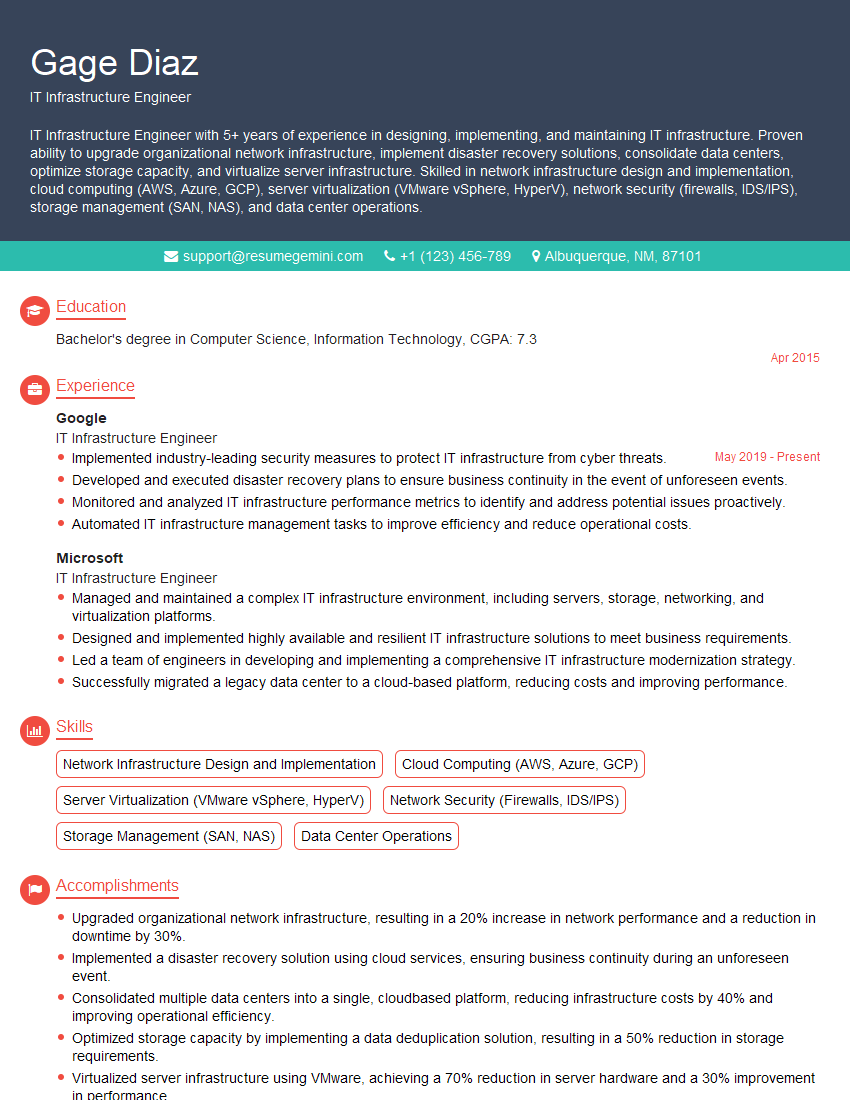
IT Infrastructure Engineer Resume Sample
- Data Center Manager
- Compliance Manager
- Regulatory Compliance Officer
- Systems Engineer
- Network Engineer
- Network Security Engineer
- Network Architect
- Telecommunications Engineer
- IT Manager
- Field Service Engineer
- Fiber Optic Technician
- Installation Technician
- Telecommunications Technician
- IT Infrastructure Engineer
Explore more articles
Users Rating of Our Blogs
Share Your Experience
We value your feedback! Please rate our content and share your thoughts (optional).
What Readers Say About Our Blog
Very informative content, great job.
good