Cracking a skill-specific interview, like one for Apparel Inspection, requires understanding the nuances of the role. In this blog, we present the questions you’re most likely to encounter, along with insights into how to answer them effectively. Let’s ensure you’re ready to make a strong impression.
Questions Asked in Apparel Inspection Interview
Q 1. Explain the AQL (Acceptable Quality Limit) system and its application in apparel inspection.
The Acceptable Quality Limit (AQL) system is a crucial part of apparel inspection. It’s a statistical sampling plan that defines the acceptable number of defective units in a batch of garments. Instead of inspecting every single garment, AQL uses a sample to assess the overall quality. This is far more efficient, especially for large production runs.
For example, an AQL of 2.5% with an inspection level II means that for a batch of garments, a sample will be inspected, and if more than 2.5% of that sample is defective, the entire batch is considered unacceptable. The AQL level is agreed upon beforehand between the buyer and the manufacturer, and is chosen based on the acceptable risk level. A lower AQL indicates a higher quality standard and a lower tolerance for defects. Different AQL levels exist depending on the criticality of the defect (critical, major, minor). This means a critical defect, such as a safety hazard, would have a much lower acceptable percentage than a minor defect like a loose thread.
Q 2. Describe your experience with different inspection methods (e.g., visual, dimensional, functional).
My experience encompasses a wide range of inspection methods. Visual inspection is the most common, involving a thorough examination of each garment for visible defects like stains, holes, mismatched colors, and loose seams. I’m adept at identifying subtle imperfections that might be overlooked. Dimensional inspection involves measuring key garment dimensions (length, width, sleeve length, etc.) to ensure they conform to specifications. Here, I use precise measuring tools and compare the measurements against the approved tech pack. Lastly, functional inspection involves testing the garment’s functionality, such as zipper operation, button strength, and overall durability. I use standardized testing methods to evaluate these aspects objectively.
For example, in one project, I used visual inspection to identify inconsistent stitching on a batch of shirts. Dimensional inspection was then used to verify if the shirt sizes accurately matched the size labels. Finally, functional inspection confirmed that the buttons were securely attached and able to withstand reasonable use.
Q 3. How do you identify and document defects in garments during inspection?
Defect identification and documentation are crucial. I use a structured approach. First, I meticulously inspect each garment, noting any defects. I categorize defects according to their severity (critical, major, minor) and type (e.g., stitching defect, fabric flaw, measurement issue). I record this information using detailed checklists and digital reporting systems. These systems often include fields for defect type, location, severity, and photographs as evidence. This structured approach ensures consistency and accuracy.
For example, if I find a hole in the fabric, I would note it as a ‘major’ defect, specifying the location (e.g., ‘left sleeve, 5cm from cuff’), and include a photograph to clarify. The use of clear descriptions and photographs is very important for effective communication with the factory and the client.
Q 4. What are the common defects found in apparel manufacturing?
Common apparel defects are widespread. Some of the most frequent include:
- Stitching defects: Loose stitches, skipped stitches, broken needles, inconsistent stitch length.
- Fabric defects: Holes, stains, discoloration, weaving irregularities, wrong fabric type.
- Measurement/Sizing defects: Inconsistent measurements, incorrect sizing, inaccurate labeling.
- Construction defects: Incorrectly sewn seams, missing components, open seams.
- Finishing defects: Loose threads, uneven hems, missing buttons, poor ironing.
- Print/Embroidery defects: Misaligned print, faded print, incorrect color, uneven embroidery.
The frequency of each defect type varies depending on the garment type and manufacturing process. For instance, knitwear might be more prone to fabric defects, while woven shirts might have more stitching problems.
Q 5. How do you prioritize defects based on severity and impact?
Defect prioritization is vital. I use a hierarchical system based on severity and potential impact. Critical defects, such as safety hazards (e.g., sharp edges, broken zippers that could cause injury), are given top priority. These halt production and require immediate rectification. Major defects significantly affect the garment’s appearance or functionality (e.g., large holes, missing parts), and are prioritized next. Minor defects are less critical (e.g., loose threads, slight color variation), but still need to be addressed to meet quality standards. I document these levels of severity on the inspection reports and communicate them clearly to management.
Imagine finding a broken zipper on a jacket. That’s a critical defect and would immediately stop the inspection process for that particular jacket. A minor defect, such as a loose button that is easily fixed, might not immediately stop the process, but it will be reported, and corrective action will be implemented to prevent further occurrences.
Q 6. Explain your experience using inspection checklists and reporting systems.
I have extensive experience using both physical and digital inspection checklists and reporting systems. Physical checklists are used for on-site inspections where I mark defects directly. I meticulously fill out these checklists to provide a record of every finding. Digital reporting systems are critical for large-scale projects and provide a more efficient and centralized approach. These systems often include features for image uploads, automated data analysis, and real-time reporting. They improve the efficiency of the inspection process and streamline communication between different parties involved in the supply chain.
For example, I’ve used a digital system where photos of each defect were automatically linked to the specific garment and location. This enabled quick and clear communication with the factory and made the review and analysis of defects much faster and easier.
Q 7. How familiar are you with different fabric types and their relevant quality characteristics?
I possess a strong understanding of various fabric types and their quality characteristics. This includes knowledge of natural fibers (cotton, wool, silk, linen), synthetic fibers (polyester, nylon, acrylic), and blends. I understand the unique properties of each, such as drape, texture, durability, breathability, and susceptibility to damage. This knowledge allows me to identify defects specific to each type, for instance, identifying pilling in a polyester garment or shrinkage in a cotton fabric. I can easily differentiate between different weave structures, such as twill, satin, and plain weave, and understand how these impact the garment’s performance and visual appeal.
For example, when inspecting a silk garment, I would be particularly attentive to signs of snags or runs, given the delicate nature of silk. Similarly, for a cotton garment, I would check for shrinkage issues after washing, a common defect of untreated cotton.
Q 8. Describe your experience with using measuring tools such as calipers and rulers.
Accurate measurements are fundamental in apparel inspection. I’m proficient in using both calipers and rulers, understanding their limitations and applications. Calipers are crucial for precise measurements of small details like button diameters or the width of stitching, providing accuracy to the nearest tenth of a millimeter. Rulers, on the other hand, are useful for measuring larger dimensions like garment length or sleeve width. My experience includes regularly using both tools to verify dimensions against specifications, ensuring consistency and accuracy throughout the production process. For instance, I might use calipers to check the diameter of buttons to ensure they meet the design specifications, or I might use a ruler to measure the overall length of a garment to ensure it conforms to the size chart. In cases where high precision is required, I always ensure that the tools are calibrated and properly maintained to guarantee the reliability of the measurements.
Q 9. How do you handle discrepancies between the production sample and the approved sample?
Discrepancies between production and approved samples are addressed systematically. First, I meticulously document the differences, using photos and detailed notes to pinpoint the exact deviations. This might involve discrepancies in fabric color, stitching quality, or garment dimensions. Then, I carefully analyze the root cause. Was there a change in the fabric batch? A misinterpretation of the design specs? Or a flaw in the production process? Once the root cause is identified, I collaborate with the production team to implement corrective actions. This might involve adjusting machine settings, replacing faulty materials, or retraining operators. For example, if the stitching on the production sample is looser than the approved sample, we’ll examine the stitch length settings on the sewing machines and possibly adjust the tension. The resolution is always documented and a new sample is produced and inspected to ensure the problem is solved. I communicate clearly throughout the process to ensure everyone understands the issues and the corrective measures.
Q 10. What is your experience with different types of stitching and seam construction?
My experience encompasses a wide range of stitching types and seam constructions, including but not limited to overlock, flatlock, topstitching, French seams, and felled seams. I understand the strengths and weaknesses of each technique, recognizing their appropriate applications and assessing their quality. For instance, an overlock stitch is ideal for finishing raw edges to prevent fraying, while a French seam is preferred for higher-end garments due to its clean, durable finish. I evaluate stitching based on factors like stitch length consistency, stitch density, thread strength, and the overall neatness of the seam. Any inconsistencies or defects are noted and flagged for immediate attention. I also recognize the importance of proper seam allowances and their impact on the garment’s fit and durability. Knowledge of these different stitch types and seam constructions allows me to identify potential quality issues early in the production process and ensure that each garment meets the required standards.
Q 11. How do you ensure consistency in inspection across multiple batches or production runs?
Maintaining consistent inspection across multiple batches requires a structured approach. Firstly, a detailed inspection checklist is crucial. This checklist outlines all aspects to be checked, including specific measurements, stitching quality, and material attributes. Secondly, standardized procedures are essential—every inspector follows the same protocol, ensuring objectivity. Thirdly, regular calibration of measuring instruments is non-negotiable to maintain accuracy. Lastly, random sampling across batches is vital; this helps identify potential issues early and provides a statistical basis for quality assessment. For example, if we’re inspecting 1000 garments, we might randomly select 50 for a thorough examination. Any significant deviation from the established standards triggers a deeper investigation into the production process. This systematic approach helps maintain quality consistency and minimize production defects across all batches.
Q 12. How do you communicate inspection findings to production teams and management?
Clear and effective communication is paramount. I use a combination of methods to report inspection findings. This typically involves a detailed inspection report, clearly outlining the identified defects, their severity, and the quantity of affected items. I use clear and concise language, avoiding technical jargon where possible. Supporting visuals—photos or videos—are essential for illustrating the defects. I also conduct regular meetings with the production teams and management to discuss the findings, and explain potential solutions collaboratively. For instance, instead of simply stating ‘faulty stitching,’ I would specify the type of stitching, location of the defect, and the likely cause (e.g., ‘The topstitching on the left sleeve, 2cm below the cuff, is inconsistent in stitch length due to a possible machine malfunction’). This level of detail helps the production team pinpoint the problem and take corrective action efficiently.
Q 13. Describe your experience with working with international quality standards (e.g., ISO 9001).
I have experience working within the framework of international quality standards, such as ISO 9001. This involves understanding and applying principles of quality management systems, including documentation control, internal audits, and continuous improvement. ISO 9001 necessitates meticulous record-keeping, documenting all inspection procedures and findings. It emphasizes preventive measures to minimize defects and a commitment to continuous improvement of the quality management system. My experience includes participating in internal audits to ensure compliance with the standard and identifying areas for improvement in our inspection processes. This ensures that our quality control measures are robust, reliable, and aligned with globally accepted best practices.
Q 14. How do you resolve conflicts with production teams regarding inspection results?
Resolving conflicts requires a collaborative and professional approach. I start by patiently listening to the production team’s perspective, understanding their constraints and challenges. Then, I present my findings objectively, using data and visual evidence to support my observations. If there’s a disagreement on the severity of a defect, we review the quality standards together, ensuring everyone is on the same page. Open communication and a willingness to find common ground are key. Sometimes, a compromise might be necessary, perhaps adjusting acceptable tolerances based on realistic production limitations. The goal is not to point fingers but to identify solutions that improve the quality of the product while acknowledging the practical realities of production. I always ensure that our discussions remain professional and respectful, focusing on collaborative problem-solving.
Q 15. What is your experience with using statistical process control (SPC) in apparel inspection?
Statistical Process Control (SPC) is crucial in apparel inspection for preventing defects and maintaining consistent quality. I’ve extensively used control charts, specifically p-charts (for proportion of defects) and c-charts (for the number of defects), to monitor key quality characteristics like stitching defects, fabric flaws, or dimensional inconsistencies. For example, in a recent project involving the production of 1000 shirts, I monitored the daily percentage of shirts with misaligned collars. By plotting this data on a p-chart, we could immediately identify days where the percentage exceeded the upper control limit, indicating a potential problem requiring immediate attention. This allowed us to proactively address the root cause, preventing a larger batch of defective shirts from being produced. We also used X-bar and R charts for continuous data like sleeve length to ensure consistent sizing.
Beyond basic charting, I’m proficient in interpreting control chart patterns – recognizing shifts, trends, and out-of-control signals – to pinpoint areas needing improvement. My experience also includes using SPC software to automate data collection and analysis, improving efficiency and accuracy.
Career Expert Tips:
- Ace those interviews! Prepare effectively by reviewing the Top 50 Most Common Interview Questions on ResumeGemini.
- Navigate your job search with confidence! Explore a wide range of Career Tips on ResumeGemini. Learn about common challenges and recommendations to overcome them.
- Craft the perfect resume! Master the Art of Resume Writing with ResumeGemini’s guide. Showcase your unique qualifications and achievements effectively.
- Don’t miss out on holiday savings! Build your dream resume with ResumeGemini’s ATS optimized templates.
Q 16. How do you maintain your objectivity during the inspection process?
Maintaining objectivity is paramount in apparel inspection. I achieve this through several strategies. First, I adhere strictly to pre-defined inspection criteria, checklists, and quality standards provided by the client. This standardized approach minimizes personal bias. Second, I use a systematic sampling approach, ensuring a representative sample of the garments is inspected, not just visually appealing or easily accessible ones. Third, I meticulously document every finding, including both defects and positive aspects, with photographic evidence where necessary. This detailed record ensures transparency and reduces the scope for subjective interpretation. Finally, I regularly cross-check my findings with another inspector, fostering a collaborative environment that promotes verification and helps to identify any potential personal bias. Think of it like a scientific experiment – the more controlled and documented the process, the less room there is for personal opinion to interfere with the results.
Q 17. Explain your familiarity with different types of garment finishing processes.
My familiarity with garment finishing processes is extensive, encompassing a wide range of techniques. I’m knowledgeable about various washing techniques (e.g., enzyme washing, stone washing, acid washing), each affecting the garment’s texture and appearance. I understand the nuances of dyeing, from the choice of dyes and methods to achieving specific colors and finishes. My expertise extends to different pressing and ironing techniques crucial for achieving the desired drape and shape of garments. I’m also familiar with embroidery, printing (screen, digital, heat transfer), and embellishment techniques, including beading, sequins, and other forms of decoration. Each process has its own potential for defects, and my understanding enables me to accurately identify issues related to these stages of production.
For example, I can identify the signs of uneven dyeing, inconsistent washing effects, or incorrect pressing techniques, enabling me to trace the problem to the specific stage in the finishing process and inform the factory about how to improve.
Q 18. What is your experience with conducting root cause analysis for recurring defects?
Root cause analysis (RCA) is a vital skill in apparel inspection. When faced with recurring defects, I typically use the 5 Whys technique. This involves repeatedly asking ‘Why?’ to drill down to the root cause of the problem. For example, if we had consistent issues with misaligned seams, the 5 Whys might go as follows:
- Why are the seams misaligned? Because the sewing machine needles are not properly calibrated.
- Why are the needles not calibrated? Because the operator did not receive proper training.
- Why was the operator not trained? Because there was a lack of resources allocated to training programs.
- Why were resources not allocated? Because of budget constraints.
- Why were there budget constraints? Because of decreased sales.
In addition to the 5 Whys, I also utilize fishbone diagrams (Ishikawa diagrams) to visually map out potential causes, categorized by factors like machinery, materials, methods, manpower, measurement, and environment. This helps to identify the most likely root causes and develop effective corrective actions. These techniques, combined with careful data analysis and observation, allow us to address the problem effectively, preventing its recurrence.
Q 19. Describe your experience in managing a team of inspectors.
I have significant experience managing teams of apparel inspectors. My approach focuses on clear communication, delegation, and fostering a positive and collaborative work environment. I begin by clearly defining roles and responsibilities, ensuring each inspector understands their tasks and the standards they need to meet. Regular training sessions are conducted to maintain consistency in inspection procedures and update on new quality standards or techniques. I use performance monitoring systems to track individual inspector performance, provide constructive feedback, and address any performance gaps. Furthermore, I actively encourage teamwork and knowledge sharing amongst the team, creating a supportive environment where everyone feels comfortable contributing and learning from each other. Team meetings serve to address issues, celebrate successes and identify areas for improvement. My management style is participative, creating a supportive and collaborative team dynamic which significantly improves the efficiency and accuracy of inspections.
Q 20. How do you ensure the accuracy and reliability of your inspection reports?
Ensuring the accuracy and reliability of inspection reports is crucial. This starts with using well-defined inspection criteria and checklists, consistent sampling techniques, and accurate record-keeping. All findings are meticulously documented, often including photographic or video evidence to support the report. The reports themselves are structured and formatted for clarity and easy interpretation, clearly detailing the number of defects found, their types, and their severity. We use standardized terminology to avoid ambiguity. Regular internal audits are conducted to verify the consistency and accuracy of the inspection process and to identify any gaps. Finally, the reports are reviewed and approved by a senior quality control manager before submission to ensure accuracy and completeness. This multi-layered approach ensures that our inspection reports are reliable and trustworthy documents, providing a clear picture of the quality of the garments inspected.
Q 21. What strategies do you employ to prevent defects during the manufacturing process?
Preventing defects begins even before the production process starts. It involves close collaboration with the manufacturer during the initial stages of design and sampling. This involves scrutinizing patterns, fabric quality, and construction techniques. Throughout the production process, regular in-line inspections are essential, focusing on catching defects early. This is far more cost-effective than discovering them only at the final inspection stage. Employee training is crucial – well-trained operators are less likely to produce defective garments. Regular maintenance of machinery is essential to prevent equipment-related errors. Using quality control tools like SPC, as mentioned earlier, helps to monitor production processes and to identify potential issues before they become widespread problems. Finally, building strong relationships with suppliers, ensuring quality raw materials are consistently delivered, is crucial for effective defect prevention. A proactive, multi-pronged approach encompassing all phases of production is the most effective strategy for minimizing defects and delivering high-quality apparel.
Q 22. How do you handle pressure and deadlines during a high-volume inspection process?
High-volume apparel inspection demands efficient time management and a cool head under pressure. My approach involves prioritizing tasks based on urgency and impact. I utilize a combination of techniques, including:
- Prioritization Matrix: Categorizing inspections by criticality (e.g., safety defects vs. minor aesthetic flaws) ensures I address the most important issues first.
- Time Blocking: Allocating specific time slots for different inspection stages (e.g., pre-inspection, main inspection, final check) helps maintain focus and prevents delays.
- Teamwork and Delegation: When feasible, I delegate less critical tasks to other team members to maximize efficiency, ensuring proper training and oversight is provided.
- Regular Breaks: Short, scheduled breaks prevent burnout and maintain accuracy throughout long inspection periods.
For example, during a rush order for 5,000 garments, I successfully completed the inspection within the deadline by prioritizing critical defects first, delegating visual checks to an assistant, and efficiently using time-blocking. This prevented any major quality issues from reaching the customer.
Q 23. Explain your proficiency in using different types of software for inspection data management.
I’m proficient in several software solutions for apparel inspection data management. My experience includes using:
- Spreadsheet Software (Excel, Google Sheets): I utilize spreadsheets for creating detailed inspection reports, tracking defect types and quantities, and generating data visualizations to identify trends and problem areas. For instance, I can easily create pivot tables to analyze the frequency of specific defects across different production batches.
- Dedicated Quality Management Systems (QMS) software: I’ve worked with systems such as [mention specific software if you have experience – e.g., ‘OptiTex’ or ‘CGS BlueCherry’]. These systems provide robust features for tracking, analyzing and reporting on quality data, ensuring complete traceability of production processes and defects.
- Database Management Systems (DBMS): I understand the fundamentals of using SQL for querying and analyzing large datasets of inspection data stored in relational databases. This skill allows for in-depth analysis of quality trends across various parameters.
My ability to seamlessly transition between these platforms ensures data consistency and accurate reporting, which significantly improves decision-making regarding quality control and corrective actions. I am also comfortable learning new software as needed.
Q 24. Describe a situation where you had to deal with a significant quality issue. How did you handle it?
In a previous role, we faced a significant issue with a large batch of t-shirts where the stitching on the collars was consistently failing. This posed a major risk to brand reputation and customer satisfaction. My response involved:
- Immediate Containment: We immediately stopped the shipment and quarantined the affected batch to prevent further distribution.
- Root Cause Analysis: We investigated the problem, collaborating with the production team and reviewing manufacturing records to identify the source of the defect. It turned out there was a machine malfunction causing inconsistent tension on the stitching thread.
- Corrective Actions: We implemented corrective actions, including machine repair and retraining of operators on proper stitching techniques. We also developed more rigorous quality control checkpoints in the stitching process.
- Preventative Measures: We implemented a preventative maintenance schedule for the sewing machines and introduced stricter quality checks throughout the production process to prevent similar issues from recurring. Regular audits ensured ongoing compliance.
- Communication: Open communication with the relevant stakeholders (production, management, and clients) was crucial in ensuring everyone understood the situation and the steps being taken to address it.
This systematic approach ensured we minimized the damage, rectified the problem, and implemented measures to prevent it from reoccurring. The client was informed promptly and was satisfied with our transparent and decisive actions.
Q 25. What are your strengths and weaknesses as an apparel inspector?
My strengths lie in my meticulous attention to detail, my ability to quickly identify and categorize defects, and my strong analytical skills for identifying trends and patterns in quality issues. I am also a highly effective communicator and team player, adept at collaborating with production teams to resolve quality problems proactively.
One area I’m working on is improving my speed in high-pressure situations while maintaining accuracy. I’m actively practicing time management techniques and focusing on improving my efficiency through process optimization to mitigate this. I believe in continuous improvement and am committed to enhancing my skills.
Q 26. What are your salary expectations for this position?
Based on my experience and the requirements of this role, my salary expectation is between $[Lower Bound] and $[Upper Bound] annually. This is a range I believe reflects my skills and the current market rate for similar positions. I am open to discussing this further and am flexible based on the overall compensation package.
Q 27. Why are you interested in this particular apparel inspection job?
I’m particularly interested in this apparel inspection job because of [Company Name]’s reputation for high-quality products and its commitment to ethical and sustainable manufacturing practices. The opportunity to contribute to a company with such strong values aligns perfectly with my professional goals. I am also excited by the prospect of working with [mention specific aspects of the role or company that appeal to you, e.g., ‘the latest technology in quality control’ or ‘a diverse and dynamic team’].
Q 28. Where do you see yourself in five years?
In five years, I see myself as a highly skilled and experienced apparel inspection professional, potentially in a leadership role. I envision myself taking on more responsibility, leading a team of inspectors, and contributing significantly to the company’s quality assurance strategies. I’m also keen to continue developing my expertise in advanced quality control technologies and techniques, possibly pursuing certifications to further enhance my professional development.
Key Topics to Learn for Apparel Inspection Interview
- Fabric Inspection: Understanding different fabric types, their properties, and common defects (e.g., weaving flaws, dyeing inconsistencies).
- Garment Construction: Knowledge of sewing techniques, seam types, and how to identify construction flaws (e.g., loose seams, uneven stitching).
- Quality Control Standards: Familiarity with industry standards (e.g., AQL, ISO) and their application in inspection processes.
- Defect Classification and Reporting: Ability to accurately identify, categorize, and document various garment defects using appropriate terminology and methods.
- Inspection Techniques and Tools: Practical experience with using measuring tools, visual inspection methods, and potentially specialized equipment.
- Problem-Solving and Decision-Making: Demonstrating the ability to analyze inspection findings, identify root causes of defects, and suggest corrective actions.
- Communication and Teamwork: Highlighting skills in clearly communicating inspection results to supervisors and collaborating effectively with production teams.
- Compliance and Regulations: Understanding relevant safety and ethical standards within the apparel industry.
- Lean Manufacturing Principles (Optional): Demonstrating knowledge of efficiency improvements and waste reduction within the inspection process (depending on the role).
Next Steps
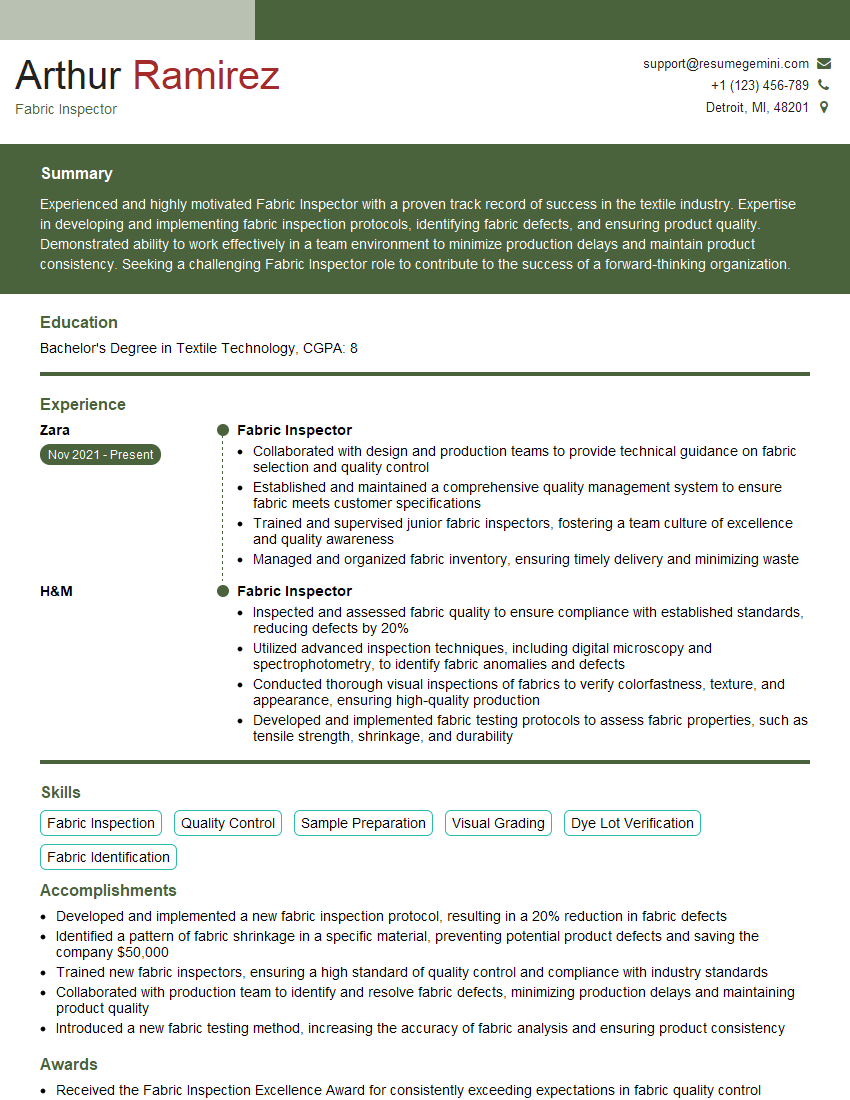
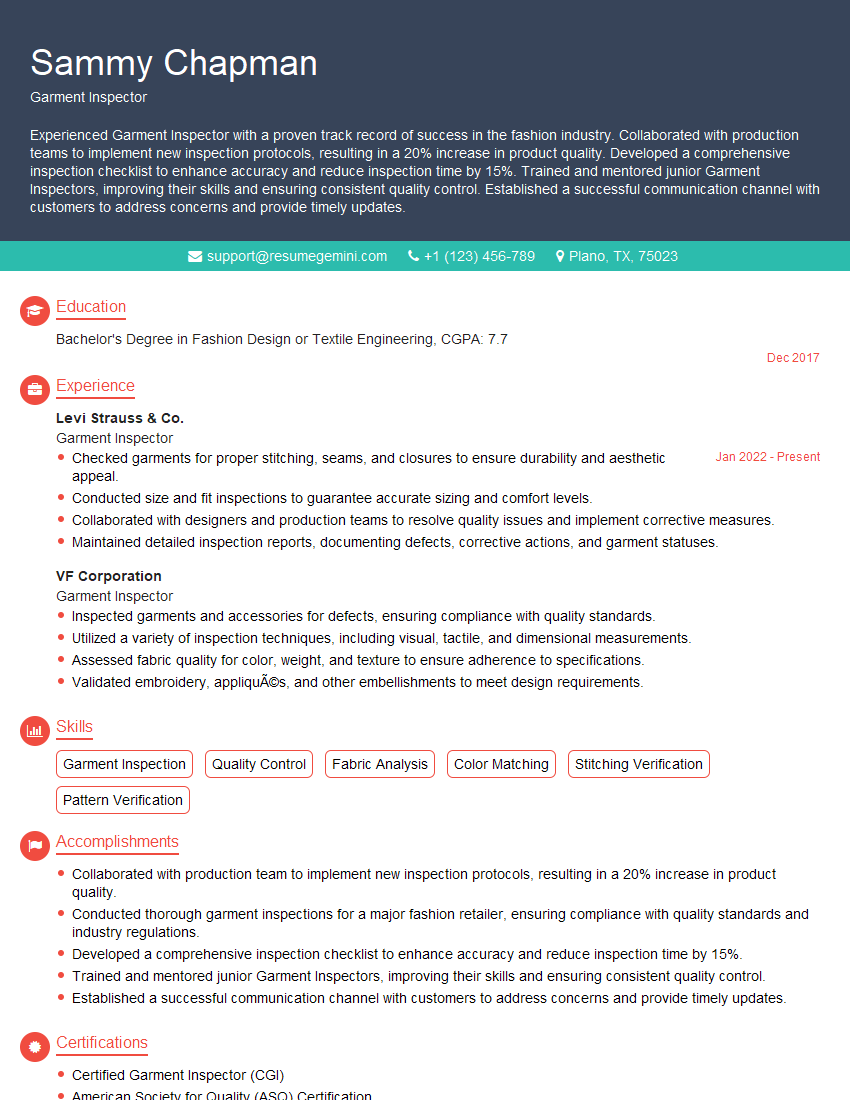
Mastering Apparel Inspection opens doors to a rewarding career with excellent growth potential in the fashion and textile industries. To maximize your job prospects, it’s crucial to have a resume that stands out and gets noticed by Applicant Tracking Systems (ATS). Building an ATS-friendly resume is key to landing your dream role. ResumeGemini is a trusted resource to help you create a professional and impactful resume. We provide examples of resumes tailored to Apparel Inspection roles to guide you. Take the next step towards your career success!
Explore more articles
Users Rating of Our Blogs
Share Your Experience
We value your feedback! Please rate our content and share your thoughts (optional).
What Readers Say About Our Blog
Very informative content, great job.
good