Feeling uncertain about what to expect in your upcoming interview? We’ve got you covered! This blog highlights the most important ArcGIS for Spatial Analysis interview questions and provides actionable advice to help you stand out as the ideal candidate. Let’s pave the way for your success.
Questions Asked in ArcGIS for Spatial Analysis Interview
Q 1. Explain the difference between raster and vector data in ArcGIS.
Raster and vector data are two fundamental ways to represent geographic features in ArcGIS. Think of it like this: raster is like a photograph, composed of a grid of pixels, each with a value representing a characteristic like temperature or elevation. Vector data, on the other hand, is like a drawing, composed of points, lines, and polygons, each with defined coordinates and attributes.
- Raster Data: Stores data as a grid of cells (pixels). Each cell has a single value representing a property, like land cover type or elevation. Examples include satellite imagery, aerial photographs, and elevation models (DEMs). Raster data is excellent for representing continuous phenomena.
- Vector Data: Stores data as points, lines, or polygons. Points represent locations (e.g., wells, cities), lines represent linear features (e.g., roads, rivers), and polygons represent areas (e.g., parcels, countries). Each feature can have associated attributes, like population or land use. Vector data is well-suited for representing discrete features.
The choice between raster and vector depends on the specific application and the nature of the data. For example, analyzing continuous changes in elevation across a landscape would benefit from using raster data (DEM), whereas mapping the distribution of different types of trees in a forest would be better suited to vector data (polygons representing tree stands).
Q 2. Describe the process of georeferencing a raster image in ArcGIS.
Georeferencing a raster image in ArcGIS is the process of aligning it to a known coordinate system. Imagine you have an old map scan – you need to tell ArcGIS where that map’s features are geographically located. This is crucial for integrating the image into a GIS environment.
The process generally involves:
- Adding the raster to ArcMap or Pro: Start by adding your image to your map document.
- Identifying Control Points: You need to find points on your image that you can identify in a reference dataset (like a map with known coordinates). These are called control points. The more control points you use, generally the more accurate your georeferencing will be. Aim for evenly distributed points across the image.
- Assigning Coordinates: For each control point, you’ll enter its coordinates from the reference data (e.g., a shapefile of known locations or an online basemap). ArcGIS will use these to mathematically transform your image to match the coordinate system.
- Transforming the Image: ArcGIS offers different transformation methods (e.g., polynomial, projective, affine) that determine how the transformation is calculated. Choose the method appropriate for your image and accuracy needs. Higher-order polynomials will generally provide more accurate results but require more control points.
- Checking the Accuracy: After the transformation, ArcGIS will show you the Root Mean Square Error (RMSE). A lower RMSE indicates better accuracy. You can adjust control points or the transformation method to improve accuracy.
- Saving the Georeferenced Image: Finally, save your georeferenced raster. It will now have geographic coordinates embedded in it.
Georeferencing is vital for integrating different datasets, analyzing spatial relationships, and creating accurate maps. Without it, your data is essentially just a picture, not a geographical representation.
Q 3. How do you perform spatial interpolation in ArcGIS? Explain different methods.
Spatial interpolation is the process of estimating values at unsampled locations based on known values at sampled locations. Imagine having temperature readings from a few weather stations; interpolation would help you estimate the temperature at all points in between.
ArcGIS Spatial Analyst offers several interpolation methods, each with strengths and weaknesses:
- Inverse Distance Weighting (IDW): This method assumes that the value at an unsampled location is influenced more strongly by nearby known values than by distant ones. It’s simple and fast but can produce artifacts near data points and is sensitive to data distribution.
- Kriging: A more sophisticated geostatistical method that considers both the spatial autocorrelation and the variance of your data. It models the spatial dependence of data and provides an estimate of uncertainty associated with the interpolation. This is a preferred method when understanding uncertainty in predictions is important, but requires more understanding of geostatistics.
- Spline: This method creates a smooth surface that passes through or near the known data points. It produces smooth surfaces but can tend to overshoot the values.
- Natural Neighbors: This method considers the spatial relationships between data points to find the ‘natural neighbors’ of an unsampled location. It tends to handle irregularly spaced data better than some other methods.
The choice of method depends on the characteristics of your data and the desired level of accuracy. For example, Kriging is often preferred when modeling environmental variables, while IDW is suitable for quick estimations when higher accuracy isn’t crucial.
Q 4. What are the different types of spatial analysis tools available in ArcGIS Spatial Analyst?
ArcGIS Spatial Analyst offers a wide array of tools for spatial analysis. These can be broadly categorized as:
- Surface Analysis: Tools for working with elevation data, such as slope, aspect, hillshade, and viewshed.
- Proximity Analysis: Tools to measure distances and create buffers, such as Euclidean Distance, Buffer, and Near.
- Overlay Analysis: Tools that combine multiple raster or vector datasets to create new datasets, such as intersect, union, and erase.
- Hydrology Tools: Tools to delineate watersheds, flow accumulation and flow direction.
- Conditional Analysis: Tools that perform calculations based on conditions, such as Reclassify and Con.
- Raster Math: Allows for mathematical calculations such as addition, subtraction, multiplication and division of raster datasets.
- Generalization Tools: Tools for simplifying raster datasets while retaining spatial patterns.
Each of these categories contains many specific tools, each designed for different tasks. Choosing the right tool is dependent on the specific task and data being used.
Q 5. Explain the concept of proximity analysis and give examples of its applications.
Proximity analysis in ArcGIS measures the distances between geographic features and analyzes spatial relationships based on these distances. It’s like asking, “What’s close to what?”
Examples of proximity analysis applications:
- Finding Nearest Facilities: Determining the closest hospital or fire station to each residence within a city.
- Site Selection: Identifying suitable locations for a new school based on proximity to residential areas and distance from highways.
- Market Analysis: Determining the area served by a particular store based on driving distances or creating trade areas.
- Environmental Impact Assessment: Assessing the potential impact of a proposed landfill on nearby water sources by calculating distances.
- Network Analysis: Calculating the travel time or distance to points using street networks.
Tools like the ‘Near’ tool, the ‘Buffer’ tool, and the ‘Euclidean Distance’ tool are crucial for performing proximity analysis. These tools can help answer questions about accessibility, service areas, and spatial interactions.
Q 6. How do you perform overlay analysis using ArcGIS Spatial Analyst?
Overlay analysis combines multiple raster or vector datasets to create a new dataset that integrates information from all the input layers. Imagine overlaying a land use map on top of a soil type map to see where different land uses occur on different soil types.
In ArcGIS Spatial Analyst, overlay analysis uses functions like:
- Intersect: Creates a new dataset containing only the areas where the input datasets overlap.
- Union: Creates a new dataset that includes all areas from the input datasets. Overlapping areas retain attributes from both inputs.
- Erase: Removes the portion of one raster that is covered by another.
Overlay analysis is widely used in land-use planning, environmental modeling, and urban studies. For instance, it can be used to identify suitable areas for development by considering factors like soil suitability, proximity to roads, and environmental regulations, or finding areas at risk of flooding by overlaying elevation and precipitation data.
Q 7. Describe the process of creating a buffer zone in ArcGIS.
Creating a buffer zone in ArcGIS involves generating a polygon that surrounds a feature at a specified distance. Think of it like drawing a circle around a point or a line around a road; the circle’s radius is your buffer distance.
The process generally involves:
- Identifying Input Features: Select the points, lines, or polygons you want to buffer.
- Specifying Buffer Distance: Define the distance you want the buffer zone to extend from the features. You can specify a single distance or a range of distances.
- Choosing Buffer Units: Select the units for your buffer distance (e.g., meters, kilometers, feet). It’s important to maintain consistent units throughout your analysis.
- Running the Buffer Tool: Use the ‘Buffer’ tool in ArcGIS to generate the buffer zones. This creates new polygons representing the buffered areas.
- Optional Parameters: The ‘Buffer’ tool allows for additional parameters, such as specifying the line side and end type for line buffers.
Buffer analysis is incredibly useful for determining areas of influence, proximity analysis, and accessibility studies. For example, you might buffer a river to analyze potential flood zones, buffer schools to find the areas easily accessible to students, or buffer protected areas to delineate areas of biodiversity conservation.
Q 8. Explain the use of the Reclassify tool in ArcGIS Spatial Analyst.
The Reclassify tool in ArcGIS Spatial Analyst is a fundamental tool for changing the values of cells in a raster dataset. Think of it like replacing the numbers on a map with new ones based on a set of rules. This is crucial for simplifying complex data, changing data types, or preparing data for further analysis. For example, you might reclassify a land cover raster where values represent different land cover types (e.g., 1=forest, 2=grassland, 3=water) into a simpler binary raster representing only forest (1) and non-forest (0).
The process involves defining a remap table which dictates how the original values are transformed. This table can be created manually or automatically using ranges. For instance, you could reclassify elevation data to create an elevation zone map: 0-100 meters becomes ‘Lowland’, 100-500 meters becomes ‘Midland’, and so on.
- Manual Reclassification: You explicitly define each input value and its corresponding output value.
- Range Reclassification: You define ranges of input values that are grouped together and assigned a single output value.
Example: Imagine a raster representing soil pH. Using Reclassify, I could reclassify the continuous pH values (e.g., 4.5, 5.2, 6.8) into categorical classes like ‘Acidic’, ‘Neutral’, and ‘Alkaline’, making the data easier to interpret and visualize.
Q 9. How do you calculate slope and aspect from a DEM in ArcGIS?
Calculating slope and aspect from a Digital Elevation Model (DEM) in ArcGIS provides crucial information about the terrain. A DEM is a raster dataset representing elevation values at various points. Slope represents the steepness of the terrain, while aspect indicates the compass direction of the steepest slope.
In ArcGIS, you can use the ‘Spatial Analyst’ toolbox. The tools ‘Slope’ and ‘Aspect’ directly calculate these parameters. These tools utilize algorithms that compute the rate of change in elevation across the DEM. The ‘Slope’ tool outputs the slope in degrees or percent rise, while ‘Aspect’ gives the direction in degrees (0° = north, 90° = east, 180° = south, 270° = west).
Process:
- Add your DEM to ArcMap or Pro.
- Open the Spatial Analyst toolbox.
- Run the ‘Slope’ and ‘Aspect’ tools, specifying your input DEM and desired output units (degrees or percent for slope).
Practical Application: This is fundamental in hydrology (modeling water flow), forestry (assessing forest fire risk based on slope), and urban planning (identifying suitable areas for construction). For example, I used this process in a project assessing landslide risk, where steep slopes were identified as high-risk areas.
Q 10. What is a hydrological analysis and how can you perform it using ArcGIS?
Hydrological analysis is the study of water movement across the landscape. It’s crucial for understanding and managing water resources, predicting flood events, and assessing drainage patterns. ArcGIS provides a comprehensive suite of tools for hydrological modeling.
Key hydrological analysis steps in ArcGIS generally involve these tools:
- Fill: This tool removes spurious sinks (depressions) in a DEM, ensuring proper water flow direction. Think of it as smoothing out the surface to prevent water from accumulating in unrealistic places.
- Flow Direction: Determines the direction of water flow from each cell in the DEM based on the steepest descent. This output is a raster where each cell shows the direction of flow.
- Flow Accumulation: Computes the total upstream contributing area for each cell, showing where water accumulates. This helps identify stream networks.
- Watershed: Defines the upstream catchment area contributing flow to a specific point or set of points. This is critical for understanding where rainfall drains to.
Example: In a recent project, I utilized these tools to model the watershed of a major river. This helped determine potential floodplains and identify areas vulnerable to flooding. Such analyses assist in creating flood maps and informing urban planning decisions.
Q 11. Explain the concept of spatial autocorrelation and its significance.
Spatial autocorrelation refers to the degree to which features that are spatially close together are more similar to each other than those that are far apart. Essentially, it measures the dependence of a variable on its spatial location. Imagine a map showing house prices; houses in the same neighborhood tend to have similar prices due to spatial autocorrelation.
Significance: Understanding spatial autocorrelation is vital because ignoring it can lead to inaccurate or misleading results in spatial analysis. For example, if you’re analyzing crime rates and don’t account for spatial autocorrelation (crimes clustered in certain areas), your analysis might falsely identify a uniform crime distribution. This is because nearby locations are not independent observations.
Measuring Spatial Autocorrelation: Tools like Moran’s I and Geary’s C are commonly used in ArcGIS to quantify spatial autocorrelation. These indices measure the degree of clustering or dispersion of a variable across space. A positive value indicates clustering (similar values clustered together), while a negative value suggests dispersion (dissimilar values clustered).
Q 12. How do you handle missing data in spatial analysis?
Missing data is a common problem in spatial analysis. It can significantly affect the accuracy and reliability of your results. Ignoring it can lead to biased or unreliable conclusions.
There are several strategies to handle missing data:
- Deletion: The simplest but often least preferred method is to remove features or cells with missing data. This however reduces your dataset significantly and potentially introduces bias if missing data is not random.
- Imputation: This involves estimating the missing values based on surrounding data. ArcGIS offers tools such as ‘Spatial Analyst’ tools (e.g., interpolation) or using the ‘Fill’ tool (for raster data) which fills NoData values based on neighboring cells.
- Data Transformation: For categorical data, you might create a new category representing ‘missing’ data.
Choosing the right method: The best approach depends on the nature of your data, the extent of missing data, and the type of analysis being performed. Understanding the reason behind the missing data helps determine the most appropriate strategy. Randomly distributed missing data might be suitable for imputation, while systematic missing data might require a more careful approach.
Q 13. What are the common data formats used in ArcGIS?
ArcGIS supports a wide variety of data formats, catering to diverse spatial data needs. Here are some common ones:
- Shapefiles (.shp): A widely used vector format for representing geographic features such as points, lines, and polygons.
- Geodatabases (.gdb): A powerful data management system that stores geographic features and related attribute data. They offer better data management and integration than shapefiles.
- Raster formats (.tif, .img, .asc): Used to store gridded spatial data like satellite imagery, DEMs, and other gridded datasets.
- CAD files (.dwg, .dxf): For incorporating data from computer-aided design software.
- GeoJSON (.geojson): A widely used open standard for representing geospatial data as JSON.
The choice of data format depends on factors such as data complexity, size, and the specific requirements of your analysis. For example, large datasets benefit from geodatabases due to their superior management capabilities.
Q 14. Describe your experience with different projection systems and coordinate systems.
Projection systems and coordinate systems are fundamental to GIS. A coordinate system defines locations on the Earth’s surface using latitude and longitude. A projection system transforms the 3D Earth onto a 2D map, which involves distortion since a perfect representation is impossible.
My experience encompasses working with various projection systems, including:
- Geographic Coordinate Systems (GCS): Use latitude and longitude to locate points on the earth’s spheroid. WGS 1984 is a commonly used GCS.
- Projected Coordinate Systems (PCS): Transform latitude and longitude into planar coordinates (x, y), suitable for area-based measurements and spatial analysis. Examples include UTM (Universal Transverse Mercator) and State Plane Coordinate Systems. The choice depends on the geographical extent of the project; UTM is better for areas spanning large longitudes, while State Plane is suitable for smaller regions.
I’ve worked on projects requiring coordinate system transformations using ArcGIS’s Project tool and data management capabilities. In a recent project, I had to reproject data from a GCS to a UTM projection to accurately perform distance calculations. Understanding the impact of different projections on distances, areas, and shapes is crucial for ensuring accurate analysis results. Incorrect projections can lead to significant errors, underscoring the importance of careful consideration and selection.
Q 15. Explain the concept of topology and its importance in GIS.
Topology in GIS refers to the spatial relationships between geographic features. Think of it like defining the rules of how features interact – how lines connect, how polygons share boundaries, and how points relate to lines or polygons. It’s not just about *where* features are located, but also *how* they relate to each other. This is crucial for data integrity and analysis.
For example, imagine a map of roads. Topology ensures that roads connect properly at intersections, preventing gaps or overlaps. This is vital for network analysis, such as calculating driving times or determining optimal routes. Without proper topological relationships, the analysis could produce inaccurate or nonsensical results.
- Importance: Topology ensures data quality, consistency, and accuracy, improving the reliability of spatial analysis. It allows for advanced spatial queries and analysis (e.g., network analysis, proximity analysis) that are impossible without well-defined relationships between features.
- Implementation: ArcGIS uses topology rules to enforce spatial relationships. For example, a rule can ensure that polygon boundaries are fully closed or that lines meet at nodes. Violations of these rules can be identified and corrected.
Career Expert Tips:
- Ace those interviews! Prepare effectively by reviewing the Top 50 Most Common Interview Questions on ResumeGemini.
- Navigate your job search with confidence! Explore a wide range of Career Tips on ResumeGemini. Learn about common challenges and recommendations to overcome them.
- Craft the perfect resume! Master the Art of Resume Writing with ResumeGemini’s guide. Showcase your unique qualifications and achievements effectively.
- Don’t miss out on holiday savings! Build your dream resume with ResumeGemini’s ATS optimized templates.
Q 16. How do you perform spatial joins in ArcGIS?
Spatial joins in ArcGIS combine attributes from two layers based on the spatial relationship between their features. Imagine you have a layer of census tracts and a layer of crime incidents. A spatial join can add the census tract information (population, income, etc.) to each crime incident based on which tract the incident occurred in.
There are several ways to perform a spatial join in ArcGIS:
- Using the Spatial Join tool: This is the most common method. You specify the target layer (e.g., crime incidents), the join layer (e.g., census tracts), the type of spatial relationship (e.g., intersects, contains), and the match option (e.g., one-to-one, one-to-many).
- Using the Join feature in ArcMap: This method involves joining tables based on a common attribute field. While not a direct spatial join, it can be used in conjunction with spatial queries to achieve similar results.
Example: Let’s say you want to know the average income of the census tracts where crimes occurred. You’d perform a spatial join, specifying ‘intersects’ as the spatial relationship, adding income data from the census tract layer to the crime incident layer. The result would be a new crime incident layer with added income information for each incident.
Q 17. How do you create a thematic map in ArcGIS?
Creating a thematic map in ArcGIS involves visually representing spatial data according to a particular theme. This could be anything from population density to soil types or election results. The key is to use map symbology to communicate the thematic data effectively.
The process typically involves:
- Choosing a basemap: Select a map background that provides context for your data.
- Selecting the data layer: Identify the layer you want to represent thematically (e.g., a point layer showing city populations).
- Choosing a symbology: This is the most crucial step. Options include:
- Graduated colors or symbols: Represents data using a color ramp or symbol size changes based on data values (e.g., darker colors for higher population).
- Unique values: Assigns a unique color or symbol to each unique value in the data (e.g., different colors for different soil types).
- Choropleth mapping: Displays data for predefined areas like counties or states using shading or colors (e.g., shading to display poverty levels across states).
- Adding a legend: This explains the symbology used on the map.
- Adding labels and a title: These enhance map readability and provide context.
Example: To create a thematic map showing population density, you’d use graduated colors, with darker colors representing areas with higher population density. The legend would explain the color scale, indicating population ranges.
Q 18. What are some common challenges in spatial analysis and how do you address them?
Spatial analysis often presents challenges. Some common ones include:
- Data quality issues: Inaccurate, incomplete, or inconsistent data can lead to flawed results. Addressing this involves rigorous data cleaning, validation, and error correction.
- Spatial autocorrelation: Nearby features often share similar characteristics (e.g., houses in the same neighborhood tend to have similar values). This needs to be accounted for in statistical analysis to avoid biased results. Techniques like spatial regression models can help.
- Scale and resolution issues: The scale of the data impacts the analysis. A large-scale map might show features too generalized to be useful for detailed analysis. Choosing the appropriate scale and resolution is crucial.
- Data projection and coordinate systems: Using incompatible projections can lead to measurement errors. Ensuring consistent projection throughout the analysis is important.
- Computational complexity: Some spatial analyses, especially those involving large datasets, can be computationally intensive, requiring optimized algorithms and potentially high-performance computing.
Addressing these challenges: Careful data preparation, selecting appropriate analysis techniques, understanding the limitations of the data, and employing efficient algorithms are key.
Q 19. Explain your understanding of geodatabases and their different types.
Geodatabases are a structured way to store and manage GIS data. They’re superior to shapefiles because they offer improved data management and the ability to store various types of spatial data in a single container. Think of it as a well-organized filing cabinet for geographic data.
There are different types of geodatabases:
- File geodatabases: These are stored as a single file (.gdb) and are ideal for smaller projects. They are easy to share and transport.
- Personal geodatabases: These are stored in a single .mdb file and have limited user access (single user). They are suitable for personal projects.
- Enterprise geodatabases: These reside in an enterprise database system like Oracle, SQL Server, or PostgreSQL, and can be accessed by multiple users concurrently. They are ideal for large projects that require collaboration and data sharing. They also offer features like versioning and data replication.
Choosing the right geodatabase type depends on the project’s size, complexity, and the number of users involved.
Q 20. Describe your experience with Python scripting in ArcGIS.
I have extensive experience using Python scripting in ArcGIS. Python’s versatility allows for automation of repetitive tasks, creation of custom geoprocessing tools, and extension of ArcGIS functionalities. I’ve used it for:
- Automating geoprocessing workflows: I’ve scripted processes involving multiple steps, such as data conversion, spatial analysis, and map creation, reducing manual effort and increasing efficiency. For example, I’ve created scripts to automatically process hundreds of raster files, applying different algorithms and saving the output in a standardized format.
- Creating custom tools: I’ve developed tools that perform specific tasks not readily available in the ArcGIS toolbox. This might involve specialized calculations, data manipulations, or visualization techniques.
- Working with data: Python allows for efficient manipulation of spatial data, accessing data attributes, and performing calculations based on spatial relationships.
arcpy, the ArcGIS Python site package, is a critical component in these tasks.
Example: A snippet of code to iterate through a feature class and calculate the area of each polygon using arcpy:
import arcpy
fc = 'path/to/your/featureclass'
with arcpy.da.UpdateCursor(fc, ['SHAPE@AREA', 'Area_Field']) as cursor:
    for row in cursor:
        row[1] = row[0]
        cursor.updateRow(row)
Q 21. How do you perform data quality control and assurance in a GIS project?
Data quality control (QC) and assurance (QA) are paramount in any GIS project. It’s about ensuring the data’s accuracy, completeness, consistency, and timeliness – the ‘fitness for purpose’. My approach involves a multi-stage process:
- Data source evaluation: Assessing the reliability and accuracy of the source data. This involves examining metadata, understanding data collection methods, and assessing potential errors.
- Data cleaning: Identifying and correcting errors in the data, such as spatial inconsistencies (gaps, overlaps), attribute errors, and inconsistencies in data formats. This might involve using ArcGIS tools like the ‘Feature Verifier’ or writing custom scripts.
- Data validation: Checking the data against known standards and constraints, using tools and techniques to identify and address data issues. This often involves both visual checks and automated data integrity checks.
- Metadata creation and maintenance: Creating comprehensive metadata to document the data’s origin, processing steps, accuracy, and limitations. This is crucial for data discoverability and reproducibility.
- Regular auditing: Periodically reviewing the data to ensure its ongoing quality. This could involve comparing the data to updated sources or performing analyses to detect potential anomalies.
Example: In a project involving cadastral data, I would perform topological checks to ensure that parcel boundaries are closed and that there are no overlaps or gaps. I would also verify attribute data (e.g., ownership information) against external sources for consistency and accuracy.
Q 22. Explain the difference between spatial and aspatial queries.
Spatial queries, unlike aspatial queries, consider the geographic location of features when selecting data. Think of it like this: aspatial queries are like searching for a specific book title in a library catalog; you only care about the title, not where the book is shelved. Spatial queries, on the other hand, are like searching for all books on a specific shelf. They involve spatial relationships like proximity, overlap, or containment.
- Aspatial Queries: These are attribute-based searches. For example, selecting all parcels with a land value greater than $1 million. This doesn’t consider the location of those parcels relative to each other. This is typically done using SQL-like syntax in ArcGIS.
- Spatial Queries: These involve the location of features. Examples include: finding all points within a certain distance of a line (proximity), selecting polygons that overlap a specific polygon (overlap), or identifying all points contained within a polygon (containment). These operations are typically performed using tools like ‘Select by Location’ or ‘Spatial Join’ within ArcGIS.
In a real-world scenario, an aspatial query might be used to identify all buildings taller than 10 stories in a city database. A spatial query, however, would be used to find all buildings within 500 meters of a proposed new highway.
Q 23. Describe your experience with raster and vector data processing and manipulation.
I have extensive experience working with both raster and vector data in ArcGIS. My work involves everything from data pre-processing and manipulation to analysis and visualization.
- Raster Data: I’m proficient in using tools for raster reclassification, overlay analysis (e.g., weighted overlay), spatial calculations (e.g., slope, aspect, etc.), and image processing techniques like filtering and enhancement. I’ve worked with satellite imagery, aerial photography, and DEMs (Digital Elevation Models). For example, I once used a weighted overlay analysis to identify optimal locations for a new wind farm, considering factors like wind speed, land ownership, and proximity to transmission lines.
- Vector Data: I’m experienced in manipulating various vector data types including points, lines, and polygons. I use tools for geometric operations (e.g., buffering, clipping, dissolving), attribute management, and spatial joins. For instance, I used a spatial join to merge census data with polygon boundaries to calculate population density for different administrative regions. I often use ModelBuilder for automating complex processing workflows to handle large and diverse datasets.
A key aspect of my workflow is understanding the strengths and limitations of each data type and choosing the right tools for the task. For instance, raster data is ideal for continuous phenomena like elevation or temperature, while vector data is better suited for discrete features like roads or buildings.
Q 24. How do you use ArcGIS to analyze patterns and trends in spatial data?
ArcGIS offers a powerful suite of tools for analyzing spatial patterns and trends. My approach involves a combination of exploratory data analysis (EDA) and more formal statistical methods.
- EDA: I start by visually exploring the data using maps and charts. This often reveals spatial clusters, outliers, and other interesting patterns. ArcGIS’s mapping capabilities, including symbology and labeling, are crucial for this stage.
- Spatial Statistics: Once I’ve identified potential patterns, I employ spatial statistics tools such as spatial autocorrelation analysis (Getis-Ord Gi* and Moran’s I), hotspot analysis (Getis-Ord Gi*), and density analysis (kernel density estimation). These tools help quantify and test the significance of observed patterns.
- Spatial Regression: To understand the relationships between variables, I use spatial regression models (e.g., Geographically Weighted Regression or GWR). GWR, for instance, allows for the identification of local variations in relationships.
For example, I used these methods to analyze crime patterns in a city. EDA revealed hotspots, and Getis-Ord Gi* confirmed their statistical significance. Finally, GWR helped model the relationships between crime rates and socioeconomic variables at the neighborhood level.
Q 25. Explain your experience with creating and managing geospatial datasets.
My experience in creating and managing geospatial datasets is extensive, encompassing data acquisition, cleaning, transformation, and management.
- Data Acquisition: I have experience acquiring data from various sources, including government agencies, commercial providers, and open-source repositories. I know how to work with different data formats (shapefiles, geodatabases, rasters).
- Data Cleaning and Preprocessing: I’m adept at identifying and correcting errors, inconsistencies, and anomalies in geospatial datasets. This involves techniques like attribute cleaning, spatial data validation, and geoprocessing tools for cleaning up geometric errors.
- Data Transformation: I’m proficient in transforming data from one coordinate system or projection to another using ArcGIS’s coordinate system management tools. I also understand data modeling and the importance of designing geodatabases for optimal performance and data integrity.
- Data Management: I use ArcGIS’s geodatabase features for managing large and complex datasets, employing versioning and archiving strategies for data control and collaboration.
For example, I managed a large project where we integrated data from multiple sources (cadastral maps, census data, satellite imagery) to create a comprehensive geospatial database for a regional planning authority. This involved significant data cleaning, transformation and validation to ensure consistency and reliability.
Q 26. How do you ensure the accuracy and reliability of spatial analysis results?
Ensuring the accuracy and reliability of spatial analysis results is paramount. My approach involves several key steps:
- Data Quality Assessment: I meticulously evaluate the quality of the input data, assessing accuracy, completeness, and consistency. Tools within ArcGIS aid in this process, allowing for the identification of spatial inconsistencies (gaps, overlaps) and attribute errors.
- Appropriate Method Selection: I select analytical methods appropriate for the data and the research question. Understanding the assumptions and limitations of each method is crucial for interpreting results.
- Validation and Verification: I validate results by comparing them against independent data sources or by using different analytical approaches. This cross-validation helps in detecting systematic errors.
- Uncertainty Assessment: Where possible, I incorporate uncertainty analysis, acknowledging limitations of input data and analytical methods. This may include propagating error estimates through the analysis or performing sensitivity analysis.
- Documentation and Reproducibility: I meticulously document my workflows, methods, and data sources. This ensures reproducibility and transparency in the analysis. This involves using model builders to create repeatable processes and detailed metadata.
For example, in a land-use change analysis, I would validate my results by comparing them with high-resolution satellite imagery and ground truth data. This helps to identify any discrepancies and improve the accuracy of my findings.
Q 27. Describe your experience working with large geospatial datasets.
I possess substantial experience in managing and analyzing large geospatial datasets. My strategies focus on efficient data processing, storage, and analysis to overcome challenges associated with scale.
- Data Partitioning: For very large datasets, I often use data partitioning techniques to break down the data into smaller, more manageable chunks for processing. This significantly reduces processing time and memory requirements.
- Geodatabase Design: Optimizing the geodatabase design, including appropriate indexing and data compression, is vital. I leverage ArcGIS’s geodatabase functionality to maximize efficiency.
- Parallel Processing: Where feasible, I utilize parallel processing capabilities to speed up computationally intensive analyses. ArcGIS Pro offers tools and workflows that support parallel processing on multi-core processors.
- Cloud Computing: For extremely large datasets, I’ve leveraged cloud-based geospatial platforms, enabling distributed processing and storage of large datasets that can’t fit on a local machine.
- Data Sampling: When necessary, I’ll employ data sampling techniques to reduce the size of the dataset while still retaining representative characteristics. This helps in managing analysis without compromising the integrity of findings.
For example, in a project analyzing land surface temperature across a large region, I used data partitioning and cloud computing services to handle the massive amount of satellite data involved. This efficient processing allowed for timely analysis and reporting.
Key Topics to Learn for ArcGIS for Spatial Analysis Interview
- Spatial Data Models: Understanding vector and raster data, their strengths and weaknesses, and when to use each. Practical application: Choosing the appropriate data model for a specific analysis task (e.g., analyzing point patterns vs. continuous surfaces).
- Spatial Analysis Tools: Proficiency in using tools like overlay analysis (union, intersect, erase), proximity analysis (buffering, nearest neighbor), and spatial statistics (clustering, spatial autocorrelation). Practical application: Solving a real-world problem using these tools, such as identifying optimal locations for new facilities or analyzing crime hotspots.
- Geoprocessing and ModelBuilder: Understanding how to automate spatial analysis workflows using ModelBuilder or scripting (Python). Practical application: Creating a repeatable workflow for processing large datasets or performing complex analyses efficiently.
- Data Management and Projections: Understanding coordinate systems, projections, and data transformations. Practical application: Ensuring data accuracy and consistency across different projects and analyses.
- Spatial Statistics and Interpretation: Understanding and interpreting the results of spatial statistical analyses, including understanding p-values, significance levels, and spatial autocorrelation. Practical application: Drawing meaningful conclusions from spatial analysis results and communicating them effectively.
- Cartography and Data Visualization: Creating clear, effective maps and visualizations to communicate spatial data effectively. Practical application: Presenting your spatial analysis results in a visually compelling and understandable manner.
- Relational Databases and Spatial Joins: Understanding how to integrate spatial data with attribute data from relational databases. Practical application: Enriching spatial analysis by incorporating non-spatial data into your analysis.
Next Steps
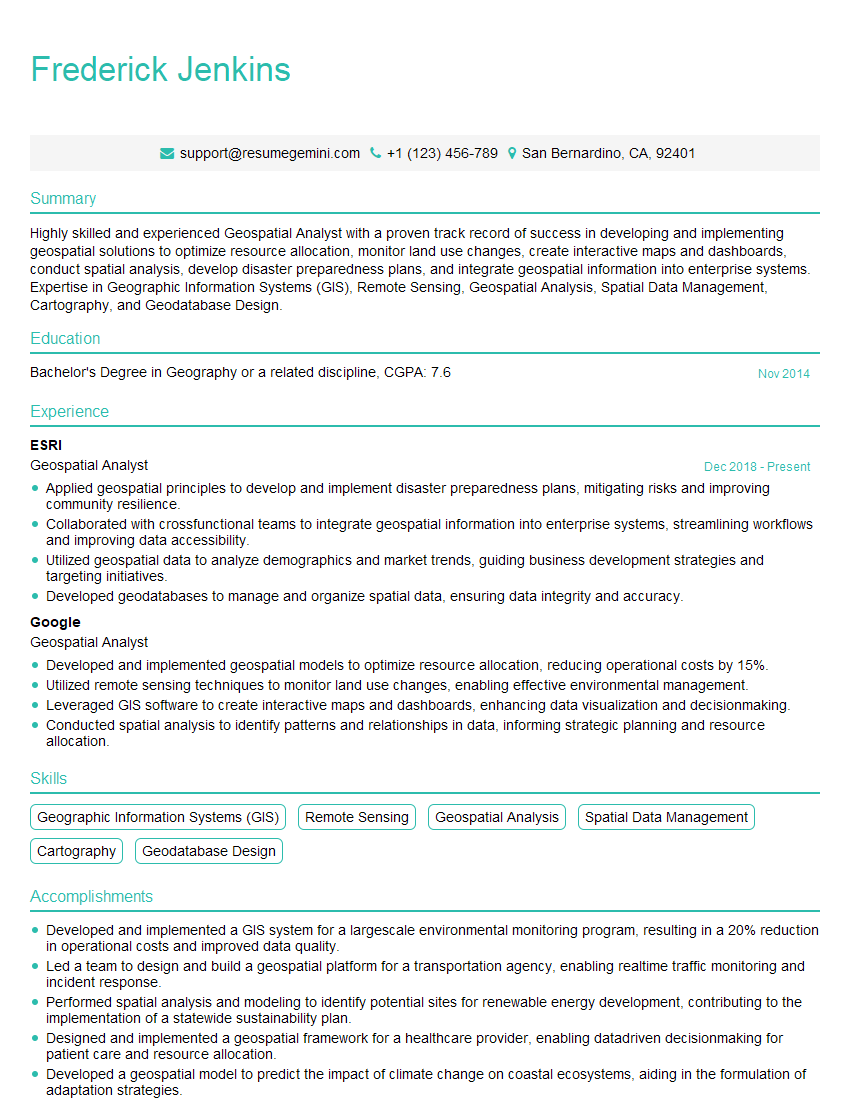
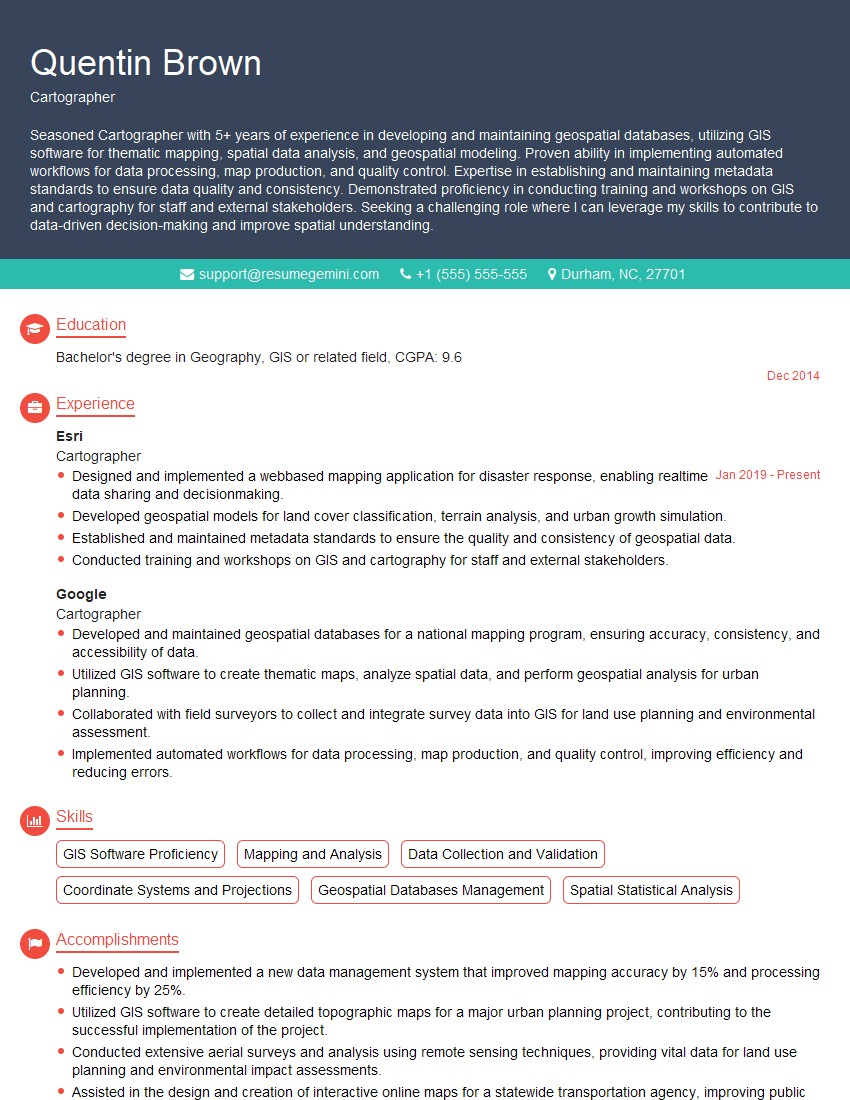
Mastering ArcGIS for Spatial Analysis significantly enhances your career prospects in fields like GIS, urban planning, environmental science, and public health. A strong understanding of these techniques makes you a highly valuable asset to any organization. To maximize your job search success, create an ATS-friendly resume that highlights your skills and experience effectively. ResumeGemini is a trusted resource that can help you build a professional and impactful resume. They provide examples of resumes tailored to ArcGIS for Spatial Analysis to guide you in showcasing your expertise. Investing time in crafting a compelling resume will significantly increase your chances of landing your dream job.
Explore more articles
Users Rating of Our Blogs
Share Your Experience
We value your feedback! Please rate our content and share your thoughts (optional).
What Readers Say About Our Blog
Very informative content, great job.
good