Interviews are opportunities to demonstrate your expertise, and this guide is here to help you shine. Explore the essential Architectural and Structural Detailing interview questions that employers frequently ask, paired with strategies for crafting responses that set you apart from the competition.
Questions Asked in Architectural and Structural Detailing Interview
Q 1. Explain the difference between architectural and structural detailing.
Architectural detailing focuses on the aesthetic and functional aspects of a building’s design, like the placement of doors, windows, finishes, and the overall look of the space. Think of it as the ‘what’ and ‘how’ the building will look and function for the occupants. Structural detailing, on the other hand, concentrates on the building’s structural integrity and safety. It’s the ‘how’ the building will stand up against loads and forces, addressing elements like beams, columns, foundations, and connections. It’s about ensuring the building won’t collapse. While seemingly separate, they are inherently intertwined; a beautiful architectural design is useless if it’s structurally unsound, and a structurally sound building is only as good as its functional design.
Example: Imagine designing a large window. Architectural detailing would determine its size, shape, material (wood, aluminum, etc.), placement relative to other elements, and how it integrates aesthetically with the façade. Structural detailing would then assess the window’s impact on the structural frame, calculating the required size and strength of the supporting lintel beam, and ensuring it can withstand wind loads and other stresses.
Q 2. What CAD software are you proficient in?
I’m highly proficient in AutoCAD, Revit, and SketchUp. AutoCAD is my go-to for precision 2D drafting and detailed drawings, while Revit and SketchUp are essential for 3D modeling, particularly in BIM workflows. My skills encompass creating detailed drawings, sections, elevations, and plans across various scales, ensuring dimensional accuracy and clarity.
Q 3. Describe your experience with BIM software (e.g., Revit, ArchiCAD).
My BIM experience is extensive, primarily using Revit. I’ve been involved in numerous projects, from initial conceptual design through construction documentation, leveraging Revit’s collaborative capabilities to create and manage accurate and coordinated models. I’m comfortable with all aspects, including family creation, detailing, clash detection, and quantity take-offs. For instance, on a recent high-rise project, I utilized Revit to coordinate the MEP (Mechanical, Electrical, and Plumbing) systems with the structural elements, resolving clashes early in the design process, thereby saving significant time and cost during construction.
In a recent project involving a complex renovation, Revit’s ability to model existing conditions allowed me to precisely detail new structural elements while minimizing disruption to the existing structure. The visualization capabilities were invaluable in communicating the design effectively to the client and the construction team.
Q 4. How do you ensure accuracy in your detailing work?
Accuracy is paramount. I use a multi-layered approach: Firstly, I meticulously review all design documents, verifying dimensions, specifications, and tolerances. I use cross-referencing and independent calculations to verify dimensions and details. Secondly, I employ rigorous quality control checks, including using automated tools within my CAD software for error detection. Finally, regular peer reviews and internal checks ensure accuracy and consistency. Think of it as building a house of cards: every piece must be meticulously placed, and any inaccuracy will cause a collapse. My workflow is designed to minimize risks.
Q 5. Explain your understanding of construction drawings and detailing standards.
My understanding of construction drawings and detailing standards is comprehensive. I adhere to industry best practices and relevant codes (e.g., IBC, ACI), ensuring drawings are clear, unambiguous, and easily understood by contractors. I am familiar with different drawing types—plans, sections, elevations, details—and understand how they interrelate to provide a complete picture of the project. I also know how to generate schedules and specifications accurately. For instance, I am proficient in using different line weights, callouts, and annotation techniques to maintain consistency across all drawings and avoid any ambiguity. The goal is to provide drawings that are unambiguous, comprehensive, and easily implemented by the construction team.
Q 6. How do you handle revisions and changes in design during the detailing process?
Handling revisions is a key aspect of the detailing process. I use version control software and maintain a meticulous record of changes. Any revision is communicated immediately to relevant stakeholders, and the impact on other aspects of the design is thoroughly assessed. This often involves updating existing drawings, creating new ones, and re-coordinating with other disciplines. On a recent project, a late change in the building’s footprint required me to meticulously update all affected drawings and coordinate with the structural engineer. This ensured a smooth transition and prevented conflicts during construction.
Q 7. Describe your experience with coordinating architectural and structural details.
Coordinating architectural and structural details is a crucial part of my role. I work closely with structural engineers, exchanging information and resolving clashes early on in the design process. This involves regular meetings, review of models and drawings, and open communication. Tools like BIM software facilitate this coordination process greatly by allowing for early clash detection. For example, I recently collaborated with a structural engineer to ensure that the placement of HVAC ducts didn’t interfere with structural beams, a common issue if not caught early enough. Effective communication and close collaboration ensure that the final product is both architecturally appealing and structurally sound.
Q 8. How do you manage large and complex detailing projects?
Managing large and complex detailing projects requires a systematic approach. Think of it like orchestrating a symphony – each instrument (detail) needs to be played at the right time and in the right place to create a harmonious whole (the completed building).
- Work Breakdown Structure (WBS): I begin by breaking down the project into smaller, manageable tasks. This creates a clear roadmap, assigning specific responsibilities and deadlines for each component. For example, structural steel detailing might be separated into tasks for columns, beams, and connections, each with its own team or individual.
- BIM Coordination: I leverage Building Information Modeling (BIM) software extensively. This allows for coordinated design, clash detection (more on this later), and efficient information sharing among different disciplines (structural, architectural, MEP).
- Teamwork and Communication: Open communication is paramount. Regular meetings, progress reports, and collaborative design reviews ensure everyone stays informed and potential problems are identified early. A shared cloud-based platform is crucial for real-time updates and document sharing.
- Quality Control Procedures: Implementing rigorous quality control checks at each stage prevents errors from cascading down the line. This includes peer reviews, model checks, and adherence to established detailing standards.
- Iterative Process: Detailing is rarely a linear process. Expect revisions and changes. Embracing iteration and establishing clear procedures for managing changes is key to success.
Q 9. What are your preferred methods for checking your detailing work for errors?
Checking detailing work for errors is crucial; even a small oversight can have significant consequences. My approach is multi-faceted, combining automated checks with manual review.
- Software Checks: BIM software offers built-in checks for geometric inconsistencies, code compliance (in some cases), and clash detection. I utilize these tools extensively.
- Manual Checks: I always perform a manual review, scrutinizing drawings for dimensional accuracy, correct material specifications, appropriate connections, and adherence to detailing standards. This is like proofreading a crucial document – a second pair of eyes catches what automated systems may miss.
- Peer Review: A second set of eyes, preferably experienced in detailing, can identify errors or potential issues I might have overlooked. This collaborative approach strengthens quality assurance.
- Checklists and Templates: I use detailed checklists to ensure nothing gets missed during reviews. Customized templates for different drawing types maintain consistency and improve efficiency.
- 3D Model Visualization: Viewing the model in 3D, even in simplified form, can reveal issues that are not apparent in 2D drawings. Think of it like assembling a complex jigsaw puzzle; 3D visualization helps you see the big picture.
Q 10. How familiar are you with building codes and regulations?
Familiarity with building codes and regulations is not just important; it’s essential for producing safe and legally compliant designs. I possess a thorough understanding of IBC (International Building Code), relevant local codes, and accessibility guidelines (ADA).
Staying up-to-date is crucial. I regularly consult code books, attend relevant workshops, and utilize online resources to ensure my knowledge remains current. This includes understanding specific requirements for different building types and occupancy classifications.
In practice, this knowledge directly informs my detailing decisions, ensuring that every element complies with the necessary regulations. For example, I ensure proper fire-rated separations, correct load-bearing capacities, and appropriate accessibility features are incorporated into my detailing.
Q 11. Describe your experience with detailing different building materials (e.g., steel, concrete, wood).
I have extensive experience detailing various building materials, each presenting its unique challenges and detailing conventions.
- Steel: I’m proficient in detailing structural steel members, connections (welds, bolts), and bracing systems, using software like Tekla Structures or Advance Steel. This includes understanding steel grades, connection design based on load requirements, and detailing for fabrication and erection.
- Concrete: My experience includes detailing reinforced concrete structures, encompassing formwork design, reinforcement detailing (rebar), and creating accurate shop drawings for contractors. This involves familiarity with concrete mix designs, strength calculations, and detailing for proper concrete placement and curing.
- Wood: I have experience detailing wood structures, including timber framing, glulam beams, and connections. Understanding wood species, moisture content, and appropriate joinery techniques is crucial for safe and durable structures. Software like Revit can be helpful in modeling and documenting wood framing.
My experience extends beyond these materials; I’m also familiar with detailing masonry, precast concrete, and composite materials.
Q 12. How do you manage clash detection and resolution in a BIM environment?
Clash detection and resolution are critical in a BIM environment. Think of it like preventing a traffic jam before it occurs. BIM software allows us to identify conflicts between different disciplines (structural, architectural, MEP) early in the design process, preventing costly rework later.
- Clash Detection Software: I use the clash detection tools within BIM software (like Revit or Navisworks) to identify conflicts. These tools compare models from different disciplines, highlighting areas where elements intersect or interfere.
- Clash Resolution Process: Once clashes are identified, a systematic resolution process is crucial. This often involves communication and collaboration between the different disciplines to determine the best course of action. This may involve adjusting the position of elements, modifying design details, or even redesigning a specific area.
- Regular Clash Detection: I recommend scheduling regular clash detection sessions throughout the design process, not just at the end. Early detection is key to cost-effective resolution.
- Documentation: Careful documentation of clashes and their resolutions is necessary, providing a clear audit trail and facilitating communication within the design team.
Q 13. Explain your understanding of detailing for accessibility requirements.
Detailing for accessibility requirements is crucial for ensuring buildings are usable by everyone. This goes beyond mere compliance; it’s about designing inclusive spaces.
My understanding includes familiarity with ADA (Americans with Disabilities Act) guidelines and other relevant accessibility standards. This translates to detailing elements such as:
- Ramps and Elevators: Detailing compliant ramps with appropriate slopes, landings, and handrails. Ensuring proper elevator dimensions and accessibility features.
- Accessible Restrooms: Detailing restrooms with adequate clearances, grab bars, and accessible fixtures.
- Clear Floor Space: Ensuring sufficient maneuvering space for wheelchairs and other mobility devices.
- Accessible Signage and Controls: Detailing appropriate signage and placement of controls at accessible heights.
- Doorways and Thresholds: Detailing doorways with appropriate clearances and thresholds that are easily navigable.
I prioritize these elements throughout the detailing process, working collaboratively with architects and other designers to ensure a fully accessible design.
Q 14. How do you prioritize tasks and meet deadlines in a fast-paced environment?
Prioritizing tasks and meeting deadlines in a fast-paced environment requires a strategic approach. It’s like managing a marathon; pacing yourself and focusing on the finish line is essential.
- Prioritization Matrix: I use a prioritization matrix to rank tasks based on urgency and importance (Eisenhower Matrix). This helps me focus on the most critical tasks first.
- Task Scheduling: I utilize project management tools (like MS Project or similar software) to schedule tasks, assign deadlines, and track progress. This creates a clear timeline and allows for proactive monitoring.
- Time Management Techniques: I employ time management techniques such as the Pomodoro Technique, breaking down tasks into smaller, manageable chunks to maintain focus and prevent burnout.
- Communication and Collaboration: Open communication with team members and stakeholders is crucial for identifying potential delays and finding solutions proactively.
- Flexibility and Adaptability: Unexpected issues arise. Maintaining flexibility and adapting to changing priorities is essential for successful project delivery.
Q 15. Describe your experience with working within a team environment.
Throughout my career, I’ve consistently thrived in collaborative team environments. I believe effective teamwork hinges on clear communication, mutual respect, and a shared commitment to project goals. For instance, on a recent high-rise project, I was part of a team comprising architects, structural engineers, MEP engineers, and contractors. We utilized a collaborative BIM (Building Information Modeling) platform, enabling real-time coordination and conflict resolution. My role involved detailed modeling of structural elements, ensuring seamless integration with architectural designs and other disciplines. I actively participated in regular team meetings, offering technical expertise and proactively addressing potential clashes. Open communication and a willingness to compromise were crucial in navigating disagreements and ensuring a unified vision for the project’s successful completion.
Furthermore, I’ve found that proactively anticipating potential issues and proactively sharing my findings with the team enhances collaborative efficiency. For example, spotting a potential conflict early in the design phase, and proposing a solution before it became a major issue, significantly reduced project delays and cost overruns.
Career Expert Tips:
- Ace those interviews! Prepare effectively by reviewing the Top 50 Most Common Interview Questions on ResumeGemini.
- Navigate your job search with confidence! Explore a wide range of Career Tips on ResumeGemini. Learn about common challenges and recommendations to overcome them.
- Craft the perfect resume! Master the Art of Resume Writing with ResumeGemini’s guide. Showcase your unique qualifications and achievements effectively.
- Don’t miss out on holiday savings! Build your dream resume with ResumeGemini’s ATS optimized templates.
Q 16. How do you communicate effectively with architects, engineers, and contractors?
Effective communication is paramount in architectural and structural detailing. I prioritize clear, concise communication, tailoring my approach to the audience. With architects, I focus on the aesthetic and functional aspects of the design, ensuring the structural detailing complements the architectural vision. This often involves using clear visual aids like diagrams and 3D models alongside written specifications.
When communicating with engineers, I focus on technical accuracy and compliance with codes and standards. This includes providing detailed calculations, specifications, and drawings that clearly convey the structural intent and performance requirements. I leverage engineering software such as Revit or Tekla Structures to ensure seamless data exchange.
With contractors, the emphasis is on constructability. I ensure drawings are clear, concise, and unambiguous, using industry-standard symbols and notations. I actively participate in pre-construction meetings to clarify any ambiguities and address potential construction challenges. This proactive approach minimizes misunderstandings and delays on site.
Q 17. What are some common challenges in architectural detailing?
Architectural detailing presents several common challenges. One major hurdle is balancing aesthetics with functionality and constructability. Architects often prioritize design aesthetics, which may pose difficulties for practical construction. For example, a complex curved wall may look stunning in renderings but prove extremely difficult and expensive to construct. This requires close collaboration between architects and detailers to find practical solutions that maintain the design intent.
Another challenge is the management of tolerances and detailing for connections. Small discrepancies in measurements can accumulate and lead to significant issues on site. This necessitates meticulous attention to detail and precise coordination with other disciplines. Similarly, detailing connections between different materials and systems – such as curtain walls and structural frames – requires thorough understanding of material properties and potential compatibility issues.
Finally, integrating different building systems, such as HVAC and plumbing, within the architectural design and structural framework often presents complex detailing challenges. Coordination and clash detection become crucial to ensure seamless integration and avoid costly rework.
Q 18. What are some common challenges in structural detailing?
Structural detailing presents unique challenges. Ensuring structural integrity and compliance with building codes is paramount. This requires a deep understanding of structural mechanics, material properties, and relevant building codes. Overlooking even minor details can compromise structural safety, leading to potential catastrophic failures.
Another common challenge is managing complex connections. Detailing robust and efficient connections between different structural elements – beams, columns, foundations – requires considerable expertise. This often involves complex calculations and the selection of appropriate fasteners and connection methods to withstand anticipated loads and environmental factors.
Furthermore, the coordination of structural details with other building services (MEP) presents significant challenges. Ensuring sufficient space for pipes, ducts, and other services without compromising structural integrity requires meticulous planning and coordination. Clash detection using BIM software is critical for mitigating these challenges.
Q 19. How do you stay up-to-date with the latest industry standards and software?
Staying updated with industry standards and software is crucial for any detailer. I achieve this through a multifaceted approach. I actively participate in industry conferences, workshops, and webinars to stay abreast of the latest advancements in building codes, materials, and software. I also subscribe to relevant industry journals and online publications, and engage with professional organizations like the AIA (American Institute of Architects) and ASCE (American Society of Civil Engineers).
Moreover, I prioritize continuous learning through online courses and training programs offered by software vendors. I actively seek opportunities to expand my proficiency in BIM software such as Revit, Tekla Structures, and AutoCAD, as well as other relevant design and analysis tools. This ensures I am well-equipped to handle the most complex projects using industry-standard methodologies.
Q 20. Describe your experience with creating shop drawings.
Creating shop drawings is a significant part of my work, bridging the gap between design and construction. I have extensive experience preparing accurate and detailed shop drawings for various structural elements and building systems. This involves taking the design intent from architectural and structural drawings and translating it into clear and concise fabrication instructions for contractors. I meticulously review the design documents, conduct necessary calculations, and ensure the drawings comply with all applicable building codes and specifications.
For example, I’ve produced shop drawings for steel fabricators, detailing precise dimensions, connection details, and material specifications. Similarly, I’ve created shop drawings for precast concrete elements, including detailed embedment plans and reinforcement layouts. I always ensure that dimensions are clearly indicated, annotations are precise and unambiguous, and the drawings are formatted according to industry standards.
Furthermore, I actively participate in review meetings with fabricators and contractors to discuss the shop drawings and address any potential issues or ambiguities. This collaborative approach ensures that the final product meets both design and construction requirements.
Q 21. Explain your understanding of detailing for different construction methods.
My understanding of detailing for different construction methods is comprehensive. I have experience detailing for various methods, including traditional stick-built construction, prefabricated modular construction, and cast-in-place concrete construction.
In traditional stick-built construction, the detailing focuses on individual components and connections. This necessitates a keen understanding of wood framing techniques and the interaction of different building materials. Detailing for prefabricated modular construction requires a higher level of coordination and precision, as components are fabricated offsite and assembled on-site. This requires careful planning of connections and tolerances to ensure accurate and seamless assembly. Finally, cast-in-place concrete construction requires detailed formwork drawings and reinforcement layouts to achieve the desired structural form and strength. I am proficient in all these methods and can tailor my detailing approach to best suit the chosen construction techniques.
For instance, in a recent project involving prefabricated steel components, I prepared detailed shop drawings indicating precise weld locations, bolt patterns, and surface treatments. For a project utilizing cast-in-place concrete, I meticulously documented formwork layouts and reinforcement patterns to meet the specified structural requirements.
Q 22. How do you handle ambiguity or incomplete information in design documents?
Ambiguity in design documents is unfortunately common. My approach involves a multi-step process to ensure clarity and prevent errors. First, I meticulously review all available documentation, including architectural plans, structural calculations, and specifications. I identify areas of uncertainty and prioritize them based on their potential impact on the design. Then, I utilize effective communication strategies. I actively engage with the design team (architects, engineers, and contractors) to clarify any unclear aspects. This often involves creating concise lists of questions for clarification, following up on emails, and attending relevant meetings. Finally, I document all assumptions and decisions made to address ambiguous information. This documentation is crucial for project transparency and avoids misunderstandings down the line. For instance, if a wall’s thickness is unspecified, I’d document my assumed thickness based on typical construction practices for that building type, ensuring it’s noted in the details and communicated to the team.
- Active Communication: Directly reaching out to architects and engineers to clarify uncertain design aspects.
- Assumption Documentation: Clearly recording any assumptions made in the details, referencing the source of the information (or lack thereof).
- Detailed Notes: Maintaining a comprehensive log of all communications and decisions related to resolving ambiguity.
Q 23. Describe your experience with detailing sustainable design features.
Sustainable design is a core focus in my detailing work. My experience encompasses detailing various features, including:
- High-Performance Building Envelopes: Detailing intricate connections for high-insulation wall systems, ensuring airtightness and minimizing thermal bridging. This involves specifying appropriate flashing details, sealants, and insulation types. For example, I’ve detailed complex connections for triple-glazed windows in high-rise buildings, meticulously specifying the necessary drainage and weatherproofing measures.
- Renewable Energy Systems: I have experience detailing solar panel integration, ensuring proper structural support, electrical connections, and fire safety. This includes creating detailed drawings of mounting systems, ensuring compatibility with the building’s aesthetic and structural integrity.
- Passive Design Strategies: Detailing shading devices (e.g., overhangs, louvers) to optimize natural light and reduce solar heat gain. This often requires coordination with architectural design to ensure aesthetic consistency while maximizing energy efficiency. For instance, I developed detailed drawings for custom-designed brise-soleil, incorporating specific dimensions and materials to achieve optimal shading performance.
- Water Conservation Systems: Detailing low-flow plumbing fixtures and rainwater harvesting systems, ensuring proper drainage and preventing leaks. I’ve worked on projects incorporating greywater recycling systems, requiring detailed coordination with the plumbing engineer to ensure system integrity and compliance with local regulations.
I always consider the embodied carbon of materials when selecting detailing solutions, opting for sustainable alternatives whenever possible. I also ensure my detailing facilitates ease of maintenance and repair of the sustainable features, maximizing their lifespan and minimizing waste.
Q 24. How do you use annotation and labeling effectively in your details?
Effective annotation and labeling are crucial for creating clear and understandable details. My approach focuses on consistency, clarity, and precision. I use a standardized system of annotations, utilizing consistent abbreviations, symbols, and callouts. For example, I consistently use “Ø” for diameter, “x” for thickness, and specify units (mm or inches) clearly. I strategically place labels to avoid cluttering the drawing while ensuring all essential information is easily accessible. This often means using leader lines to direct the reader to specific elements and annotating directly on the component being detailed. I also incorporate a detailed legend or key on each sheet to explain abbreviations, symbols, and material specifications. For instance, I’d use a legend to define abbreviations like “GWB” (gypsum wallboard) or “SS” (stainless steel), and I would consistently apply these throughout the document. This consistency is vital for ensuring that the documents are easily understood and used by fabricators and contractors. Finally, I use layers and colors effectively in CAD software to separate different aspects of the detailing, enhancing readability and organization.
Q 25. Explain your understanding of section details and elevation details.
Section details and elevation details are two crucial types of construction drawings that provide different perspectives of a building’s design. Section details are essentially “slices” through a building, showing the construction elements at a specific plane. They often reveal the layering and relationships between different building components like walls, floors, and roofs. A section detail might show how a wall system is assembled, revealing the order of materials (insulation, sheathing, cladding) and their connection points. Think of it like cutting a cake—you see the internal layers and how they’re structured. Elevation details, on the other hand, provide a vertical view of the exterior or interior surfaces of a building. They detail the height, profile, and construction methods for walls, facades, and other exterior features. An elevation detail might show the specific method of cladding installation, including the type of fasteners and spacing between panels. Think of it like a photograph of a building’s exterior wall – showing what you’d see from the front.
Both are crucial for precise construction. Section details focus on the internal workings, while elevation details show the external appearance and how it is achieved. They work together to provide a comprehensive understanding of the design.
Q 26. How do you create and maintain a clear and organized detailing process?
Maintaining a clear and organized detailing process is paramount for efficiency and accuracy. I begin by establishing a robust filing system, both digital and physical, for all project documents. This ensures easy access to relevant information. Next, I use a standardized template for my details, maintaining consistency across all projects. This template includes sections for title blocks, legends, revision history, and the detail itself. For digital files, I utilize layering within CAD software and a naming convention that ensures easy identification. Finally, I implement a rigorous quality control process. This includes regular self-checking and peer review to ensure accuracy and consistency, and utilizing checklists to ensure key information is included in each detail. For instance, I use a checklist that verifies each detail includes appropriate dimensions, materials, notes, and references. Regularly backing up files and maintaining version control are critical for preventing data loss and managing revisions.
Q 27. How do you ensure your details are compatible with fabrication and construction processes?
Ensuring detail compatibility with fabrication and construction is crucial. My approach involves a multi-pronged strategy. Firstly, I collaborate closely with fabricators and contractors from the early stages of the project. This includes regularly scheduled meetings and discussions to address any potential issues. I incorporate their input into the design to ensure the details are practical and feasible. Secondly, I specify materials and construction methods that are readily available and commonly used in the region. This minimizes delays and costs. Thirdly, I provide comprehensive and clear details, including dimensions, tolerances, and material specifications. This leaves minimal room for misinterpretations. For example, instead of just writing ‘install flashing’, I would specify the type of flashing, its dimensions, and the overlap requirements. Finally, I produce shop drawings for complex components. Shop drawings provide a visual representation of the fabrication process, allowing for early identification and resolution of any problems. This collaborative approach, combined with precise detailing, significantly minimizes construction challenges and ensures smooth project execution.
Q 28. Describe a time you had to solve a complex detailing problem. What was your approach?
During a recent high-rise project, we encountered a complex detailing challenge at the intersection of a curved curtain wall and a sloped roofline. The conventional methods produced a design that was both structurally unsound and aesthetically unappealing. My approach involved a systematic problem-solving strategy:
- Problem Definition: Clearly defined the problem as designing a structurally sound and aesthetically pleasing connection between the curved curtain wall and the sloped roof while minimizing material waste and installation complexity.
- Research and Brainstorming: We researched various connection methods, considering different materials and detailing techniques. This involved discussions with structural engineers and the curtain wall fabricator.
- Solution Development: We developed several design solutions using parametric modeling in CAD software. This allowed us to explore various design options and analyze their structural performance and aesthetic impact quickly.
- Analysis and Refinement: We rigorously analyzed the proposed solutions, using finite element analysis (FEA) software to verify their structural integrity and identify potential weaknesses. Based on the analysis results, we refined the design to optimize performance and minimize material usage.
- Documentation and Communication: We documented the final design with detailed drawings, including all dimensions, material specifications, and assembly instructions. We clearly communicated the solution to the entire design and construction team, ensuring everyone understood the design intent and implementation process.
Through this iterative process, we successfully developed a solution that met all design requirements and resolved the initial complexity. The collaborative approach and utilization of advanced software tools were key to achieving a successful outcome.
Key Topics to Learn for Architectural and Structural Detailing Interview
- Building Codes and Regulations: Understanding and applying relevant building codes (IBC, local codes) to ensure design compliance and safety. Practical application includes analyzing code requirements and incorporating them into detailing processes.
- Material Properties and Selection: Knowledge of various construction materials (concrete, steel, timber, masonry) and their properties (strength, durability, cost). Practical application involves selecting appropriate materials based on project requirements and budget constraints.
- Connection Design: Mastering the principles of structural connections, including beam-column joints, base plates, and other critical elements. Understanding different connection types and their suitability for various structural systems.
- Detailing Software Proficiency: Demonstrating expertise in relevant software such as AutoCAD, Revit, or other industry-standard detailing programs. Practical application includes showcasing your ability to create clear, accurate, and constructible drawings.
- Construction Sequencing and Methodology: Understanding the practical implications of detailing decisions on construction processes. This includes anticipating potential construction challenges and designing details to mitigate them.
- Dimensioning and Tolerances: Precision in drafting and attention to detail in dimensioning and tolerances to ensure accurate construction. Understanding the impact of dimensional errors on the final structure.
- Collaboration and Communication: Effectively communicating design intent through clear and concise drawings and documentation. Ability to work collaboratively with architects, engineers, and contractors.
- Sustainability and Energy Efficiency: Incorporating sustainable design principles and energy-efficient strategies into detailing. Understanding how material selection and design can contribute to environmental responsibility.
- Problem-Solving and Critical Thinking: Demonstrating the ability to identify and resolve design conflicts, and proactively anticipate and address potential issues during the construction phase.
Next Steps
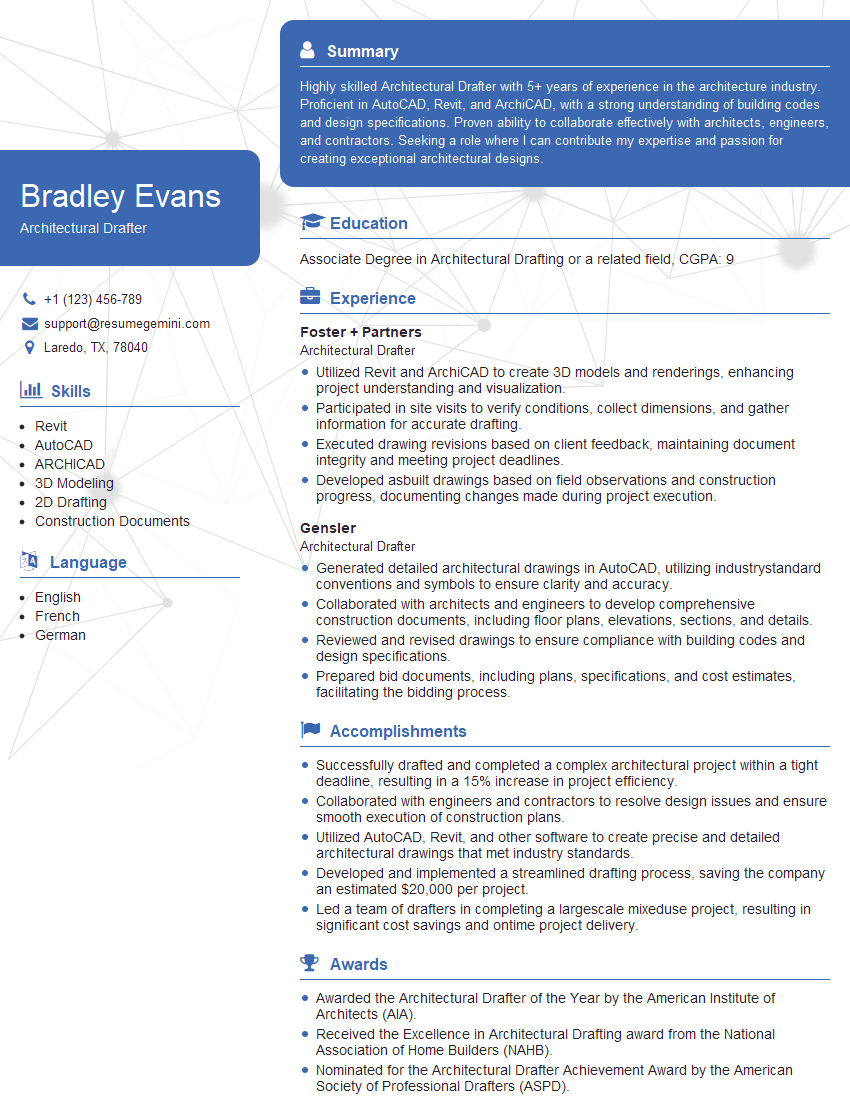
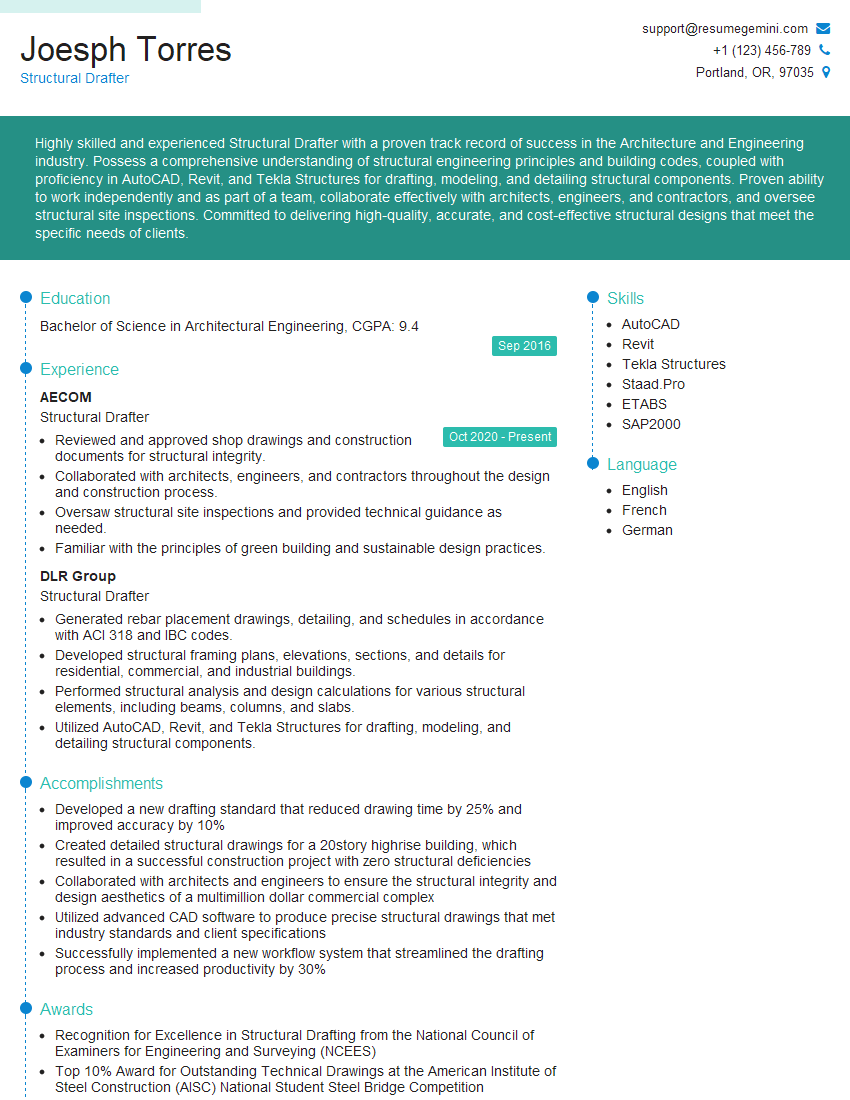
Mastering Architectural and Structural Detailing is crucial for career advancement in the AEC industry, leading to increased responsibility and higher earning potential. An ATS-friendly resume is your key to unlocking these opportunities. To significantly improve your job prospects, invest time in crafting a compelling and effective resume that highlights your skills and experience. ResumeGemini is a trusted resource that can help you build a professional resume tailored to the specific demands of this field. Examples of resumes tailored to Architectural and Structural Detailing are available to further guide your efforts.
Explore more articles
Users Rating of Our Blogs
Share Your Experience
We value your feedback! Please rate our content and share your thoughts (optional).
What Readers Say About Our Blog
Very informative content, great job.
good