Unlock your full potential by mastering the most common Architectural Blockwork interview questions. This blog offers a deep dive into the critical topics, ensuring you’re not only prepared to answer but to excel. With these insights, you’ll approach your interview with clarity and confidence.
Questions Asked in Architectural Blockwork Interview
Q 1. Explain the different types of concrete blocks used in architectural blockwork.
Concrete blocks used in architectural blockwork vary significantly in their properties and applications. The choice depends on factors like structural requirements, aesthetic preferences, and budget. Here are some common types:
- Standard Concrete Blocks (CMUs): These are the most common, offering a good balance of strength, cost-effectiveness, and ease of installation. They come in various sizes and strengths, often denoted by their compressive strength (e.g., 15 MPa).
- Lightweight Concrete Blocks: Manufactured using lightweight aggregates like expanded clay or shale, these blocks reduce the overall weight of the structure, which is advantageous in seismic zones or where foundation load is a concern. They generally offer lower compressive strength compared to standard blocks.
- High-Strength Concrete Blocks: These blocks possess a much higher compressive strength (often above 20 MPa), making them suitable for load-bearing applications in taller structures or where heavier loads are anticipated. They’re often used in commercial projects.
- Insulating Concrete Blocks (ICBs): Designed with internal voids or insulation cores, these blocks provide excellent thermal performance, leading to energy-efficient buildings. They are particularly beneficial in climates with extreme temperature variations.
- Facing Blocks: These blocks have a textured or patterned face, providing an improved aesthetic finish, often eliminating the need for external cladding. They come in various colors and textures.
The selection process involves carefully considering the project’s specific needs and consulting relevant building codes and standards to ensure compliance.
Q 2. Describe the process of laying concrete blocks, including tooling and mortar selection.
Laying concrete blocks is a precise process requiring skill and attention to detail. It starts with establishing a level and straight foundation. Here’s a breakdown:
- Laying the Foundation: A solid, level foundation (e.g., concrete slab or reinforced concrete footing) is crucial. Any unevenness will propagate through the entire wall.
- Mortar Preparation: The right mortar mix is essential. It should be of consistent consistency, neither too wet nor too dry. The type of mortar (e.g., M5, M10, etc.) is determined based on the project requirements and the block’s compressive strength. Using a mortar mixer is highly recommended for consistency.
- Block Laying: Blocks are laid using a trowel, ensuring that each block is placed accurately and with full bed joints (mortar between blocks). A spirit level is used constantly to maintain plumb and level alignment.
- Bonding Patterns: Various bonding patterns (e.g., running bond, stretcher bond, English bond) are used to maximize strength and aesthetic appeal. The pattern affects the structural properties of the wall.
- Tooling: Essential tools include a trowel, spirit level, plumb bob, measuring tape, bricklayer’s hammer, and a pointing tool for finishing the mortar joints.
- Curing: After construction, the blockwork needs to cure properly to develop its full strength. This often involves keeping the blocks moist for a certain period.
Example: A common mistake is using too much or too little mortar. Too much mortar weakens the wall, while too little leads to instability. Experience and careful attention to detail are vital.
Q 3. How do you ensure the structural integrity of a blockwork wall?
Ensuring structural integrity in blockwork construction involves several key aspects:
- Proper Foundation: A strong and level foundation is paramount. Settlement or unevenness in the foundation will lead to cracks and structural failure.
- Correct Block Laying: Accurate placement of blocks with full bed joints and adherence to the chosen bonding pattern is crucial for load distribution.
- Reinforcement: In load-bearing walls, especially taller ones, steel reinforcement (usually bars) is embedded within the mortar joints to increase the wall’s tensile strength and prevent cracking.
- Lintels and Bond Beams: Over openings like doors and windows, lintel blocks or reinforced concrete bond beams are used to distribute the load effectively.
- Regular Inspection and Quality Control: Regular checks during construction are essential to identify and rectify any issues early on.
- Compliance with Building Codes: Adhering to all relevant building codes and standards is mandatory to guarantee structural safety.
Imagine a poorly constructed wall like a poorly stacked deck of cards – one slight shift and the whole thing collapses. A well-constructed wall distributes the load evenly, preventing such failures.
Q 4. What are the common defects found in blockwork construction, and how are they rectified?
Common defects in blockwork construction include:
- Cracks: These can be due to foundation issues, poor mortar mix, inadequate reinforcement, or shrinkage. Rectification depends on the severity – small cracks might need simple patching, while larger cracks may require more extensive repairs, including reinforcement.
- Leaning Walls: Uneven foundation, improper block laying, or inadequate compaction of backfill can cause leaning. This often necessitates dismantling and rebuilding sections of the wall.
- Hollow Joints: Insufficient mortar in joints reduces strength and allows moisture penetration. This requires careful repointing of the affected areas.
- Uneven Mortar Joints: Inconsistent mortar thickness weakens the structure. This needs correction during construction or careful repointing.
- Efflorescence: White, powdery deposits on the surface caused by salt migration. This is often a cosmetic issue but might indicate moisture problems, needing investigation of the source and appropriate waterproofing measures.
Rectification strategies often involve removing the defective sections and rebuilding them correctly, paying attention to the root cause of the defect to prevent recurrence.
Q 5. Explain the importance of using proper damp-proofing techniques in blockwork.
Damp-proofing is critical in blockwork to prevent moisture penetration, which can lead to mold growth, structural damage, and reduced lifespan of the building. Techniques include:
- Damp-Proof Course (DPC): A layer of impermeable material (e.g., bitumen, polyethylene membrane) placed at the base of the wall prevents ground moisture from rising.
- Cavity Wall Construction: Creating an air gap between two walls with a suitable breathable membrane improves ventilation and prevents moisture build-up.
- External Waterproofing: Applying a waterproof render or coating on the exterior surface of the wall protects it from rain and other external moisture sources.
- Internal Waterproofing: This is less effective but can be used in conjunction with other techniques. It involves applying a waterproof coating to the interior face of the wall.
- Flashing: Using flashing (impermeable material) around openings like windows and doors prevents water from penetrating at these vulnerable points.
Think of it as protecting your house from getting a cold. Proper damp-proofing prevents moisture from damaging the structure, just like a good coat keeps you warm and dry.
Q 6. Describe different methods for bonding concrete blocks for enhanced strength.
Several methods enhance the bonding of concrete blocks for increased strength:
- Proper Mortar Selection: Using mortar with appropriate compressive strength and workability ensures good bonding between blocks.
- Full Bed Joints: Ensuring complete coverage of the block faces with mortar strengthens the connection.
- Reinforcement: Incorporating steel reinforcement within the mortar joints significantly boosts tensile strength.
- Bonding Patterns: Strategic block laying patterns (e.g., running bond, English bond) improve load distribution and overall structural integrity.
- Grouting: Filling the cores of hollow blocks with grout after construction further strengthens the wall and improves its overall stiffness.
- Header Blocks: Strategically placing header blocks (blocks laid on their ends) increases the wall’s strength, especially in load-bearing sections.
Consider a brick wall: The interlock and mortar create a strong structure. The same principle applies to blockwork; careful bonding techniques are crucial for its strength and longevity.
Q 7. How do you handle variations in block dimensions during construction?
Variations in block dimensions are unavoidable. Here’s how to handle them:
- Careful Block Selection: Choose blocks from the same batch to minimize dimensional variations.
- Adjusting Mortar Joints: Varying the thickness of mortar joints can compensate for slight differences in block size.
- Using Shims: Thin pieces of material (shims) can be inserted to adjust the position of blocks and maintain alignment.
- Regular Monitoring and Adjustment: Frequent checking during construction allows for early detection and rectification of any misalignment.
- Careful Planning: Planning ahead, considering the likely dimensional variations, and using appropriate techniques minimizes the impact of these variations.
Think of it like building with LEGOs – sometimes the bricks aren’t perfectly uniform, so you need to adjust your building technique to account for the variations.
Q 8. Explain the process of constructing a cavity wall using concrete blocks.
Constructing a cavity wall with concrete blocks involves building two separate leaf walls with a cavity between them. This cavity acts as insulation and prevents dampness from penetrating the inner leaf. Let’s break down the process:
- Foundation: The process starts with a solid foundation, ensuring a level base for the entire wall.
- First Course: The first layer of blocks (called a course) is laid on the foundation, ensuring accurate alignment and level using a spirit level and builder’s line. Mortar is applied to the bed joint (the horizontal joint between blocks).
- Inner and Outer Leaves: The inner and outer leaves are built simultaneously, but independently. Mortar is applied to the bed and the perpendicular joints (vertical joints).
- Cavity Ties: At regular intervals, usually every 450-600mm vertically and horizontally, cavity ties are inserted into the mortar joints to connect the inner and outer leaves and prevent collapse of the wall, offering stability.
- Lintels and Sills: Openings for doors and windows require lintels (horizontal beams spanning openings) and sills (horizontal supports at the base of openings), which are installed as the wall is built to support the weight above.
- Bonding: The blocks are arranged in a pattern (bond) for strength. Common bonds include the English Bond and the Flemish Bond.
- Finishing: Once the wall reaches the desired height, the top course is laid, ensuring a level and straight finish. The cavity is then left unfilled. Appropriate damp-proof course (DPC) is installed above the foundation to prevent dampness from rising.
Think of it like building two separate brick walls side by side, but connected with ties and a gap in between for insulation and ventilation.
Q 9. What are the different types of mortar used in blockwork, and what are their respective applications?
Different mortars offer varied properties, influencing the blockwork’s strength, durability, and workability. Here are some common types:
- Standard Mortar: A general-purpose mortar suitable for most blockwork applications. It offers a balance of strength, workability, and cost-effectiveness.
- High-Strength Mortar: Used where greater compressive strength is required, such as in load-bearing walls or areas subject to high stress. It’s a more expensive option.
- Modified Mortar: Contains additives to improve workability, water retention, or other specific properties. For example, a polymer-modified mortar is easier to work with and exhibits superior strength.
- Lime Mortar: A traditional mortar made with lime, sand, and water. It is breathable and allows moisture to escape, ideal for older buildings or in situations where breathability is desired. However, it is generally weaker than cement-based mortars.
The choice of mortar depends on the project requirements, the type of block, and the anticipated stresses. A structural engineer’s specification usually dictates the required mortar type.
Q 10. Describe the process of installing lintels and sills in blockwork construction.
Installing lintels and sills is critical for supporting the weight of the blockwork above openings. Here’s the process:
- Accurate Measurement: The lintel or sill must precisely fit the opening, and its length should extend slightly beyond the opening’s width on either side for proper support.
- Support: Temporary supports (e.g., wooden blocks) are placed under the opening to support the weight of the blocks above before the lintel is installed. These are carefully removed once the lintel is securely in place.
- Mortar Bed: A bed of mortar is laid on top of the wall to receive the lintel or sill. This bed needs to be of sufficient depth to ensure adequate support.
- Positioning: The lintel or sill is carefully placed into position on the mortar bed, ensuring it’s level and properly aligned. A spirit level is used to check levelness.
- Grouting: The gaps between the lintel/sill and the surrounding blocks are filled with mortar (grouting) to secure it fully in place. This involves packing mortar carefully into any gaps and ensuring no voids are left.
- Support Removal (Lintel): If temporary supports were used under the opening for lintels, these are cautiously removed after the mortar has sufficiently set.
Failing to install lintels and sills correctly could lead to structural problems such as cracking or even collapse of the wall above the opening.
Q 11. How do you ensure the alignment and plumbness of blockwork walls?
Maintaining alignment and plumbness (vertical straightness) is vital for structural integrity. Here’s how it’s achieved:
- Accurate Laying: Each block is carefully laid, using a spirit level to ensure it’s level horizontally and plumb vertically. A plumb bob or laser level can also help with vertical alignment.
- Builder’s Line: A string line is stretched between the ends of the wall to provide a visual guide for maintaining alignment. Blocks are laid according to this line.
- Regular Checks: Frequent checks are carried out throughout the construction process using a spirit level and plumb bob to ensure the wall remains true and in line.
- Blockwork Levelling: Minor adjustments might be necessary during the construction. If a slight unevenness occurs, it might be rectified by tapping blocks gently into their correct position.
- Corner Blocks: Extra care is taken with corner blocks, as they set the foundation for the entire wall’s alignment.
Imagine building a wall of cards; precise alignment and careful placement are essential to prevent it from collapsing.
Q 12. What safety precautions are essential when working with blockwork?
Safety is paramount in blockwork construction. Key precautions include:
- Personal Protective Equipment (PPE): This includes safety helmets, safety glasses, gloves, and steel-toe boots to protect against falling objects, dust, and injuries.
- Manual Handling: Concrete blocks are heavy. Proper lifting techniques and mechanical aids (e.g., block hoists) should be used to prevent back injuries.
- Working at Heights: If working at height, appropriate scaffolding and fall-arrest systems are mandatory to prevent falls.
- Risk Assessment: Before work commences, a thorough risk assessment should be carried out identifying hazards and implementing control measures.
- First Aid: Ensure that a well-stocked first-aid kit is available on-site.
- Supervision: Competent supervision is essential to ensure that all safety procedures are followed.
Safety isn’t just a guideline; it’s a non-negotiable requirement to prevent accidents and injuries. It’s vital to remember that even the most experienced professionals should follow safety rules.
Q 13. How do you read and interpret architectural drawings related to blockwork?
Architectural drawings for blockwork typically include:
- Wall Elevations: These show the height, length, and thickness of the walls, and the locations of openings like doors and windows.
- Sections: These provide cross-sections of the walls showing details like the type and size of blocks, the type of mortar, and the presence of insulation or cavity ties.
- Details: These provide enlarged views of specific components, such as the construction of corners, or the method of installing lintels.
- Schedules: Tables outlining the quantities and types of materials required for the project.
Interpreting these drawings requires a clear understanding of architectural symbols and conventions. Experience and understanding of construction practices are essential for accurate interpretation. For instance, you’ll often see symbols representing different block types and patterns to indicate the bonding method used.
Q 14. Explain the importance of quality control measures in blockwork construction.
Quality control is crucial for ensuring the structural integrity and longevity of blockwork construction. Key measures include:
- Material Inspection: Regular checks on the quality of blocks, mortar, and other materials to ensure they meet specifications. Defective materials should be immediately rejected.
- Workmanship Checks: Regular inspection of the work carried out by the construction team to ensure proper alignment, plumbness, and bonding.
- Dimensional Accuracy: Verifying that the walls are constructed to the correct dimensions as specified in the architectural drawings.
- Moisture Control: Implementing appropriate measures to prevent moisture ingress, such as using damp-proof courses and ensuring proper ventilation.
- Documentation: Maintaining detailed records of the construction process, including material details, inspections, and any modifications made.
Ignoring quality control can lead to structural defects, moisture problems, and increased long-term maintenance costs. Proactive quality control ensures the building is sound and durable.
Q 15. How do you calculate the quantity of blocks and mortar needed for a given project?
Calculating block and mortar quantities requires careful planning and accurate measurements. It’s a multi-step process that begins with the architectural drawings. First, you determine the total wall area by calculating the length and height of each wall section and summing them. Remember to deduct areas for openings like doors and windows.
Next, you need to know the dimensions of the blocks you’ll be using. This typically includes the length, height, and width. Let’s say you’re using standard 215mm x 100mm x 100mm blocks. You calculate the number of blocks needed per square meter by dividing the area of one block into 1 square meter. For our example: 1m²/ (0.215m x 0.1m) ≈ 46.5 blocks/m². Multiply this by your total wall area to get an overall block estimate. Always add an extra 5-10% to account for wastage and breakage.
Mortar quantity is calculated based on the block’s dimensions and the joint thickness. A typical joint thickness is 10mm. The volume of mortar per block is approximately the area of the block’s face multiplied by the joint thickness. We need to consider this for all four sides (including vertical joints) A rule of thumb is to estimate mortar at around 0.003 cubic meters per square meter of wall, but this can vary based on block type and joint size. Multiply this figure by your total wall area to get your overall mortar requirement.
Example: For a wall 10m long and 2.5m high, the area is 25m². Using our example block, you’d need approximately 25m² * 46.5 blocks/m² = 1162.5 blocks. Round this up to 1200 blocks to account for wastage. Mortar: 25m² * 0.003m³/m² = 0.075 m³. Remember to always double-check your calculations and adjust for any variations in the project.
Career Expert Tips:
- Ace those interviews! Prepare effectively by reviewing the Top 50 Most Common Interview Questions on ResumeGemini.
- Navigate your job search with confidence! Explore a wide range of Career Tips on ResumeGemini. Learn about common challenges and recommendations to overcome them.
- Craft the perfect resume! Master the Art of Resume Writing with ResumeGemini’s guide. Showcase your unique qualifications and achievements effectively.
- Don’t miss out on holiday savings! Build your dream resume with ResumeGemini’s ATS optimized templates.
Q 16. Describe the process of constructing a reinforced blockwork wall.
Constructing a reinforced blockwork wall involves several key steps ensuring structural integrity. It starts with laying a solid foundation, usually concrete, to provide a stable base. Next, you begin the blockwork, ensuring each block is laid accurately and evenly using a level and plumb bob.
Reinforcement is crucial for strength. This typically involves placing steel reinforcement bars (rebar) within the blockwork at specific intervals, often determined by structural calculations. The rebar is typically placed within the mortar bed and/or within chases formed within the blocks. The concrete infill poured into these chases then firmly holds the rebar in place, forming a composite structure.
The blocks are bonded using mortar, which needs to be mixed and applied correctly for good adhesion. Mortar needs to be applied evenly to ensure strength and prevent voids. It’s essential to check for plumb and level regularly during the construction process to ensure the stability and alignment of the wall.
Once the wall reaches its desired height, it’s capped with another layer of reinforcement to maintain integrity. This often involves placing rebar at the top of the wall before capping with a concrete lintel or beam. Regular inspections are important to identify and address any potential issues promptly.
Q 17. What are the different types of blockwork finishes?
Blockwork finishes can significantly impact the aesthetic appeal and durability of a structure. There are various options available, each with its own characteristics and application methods.
- Rendering: Applying a layer of cement-based render provides a smooth, weather-resistant surface, offering a wide range of color and texture options. It’s relatively economical and versatile.
- Cladding: Attaching external materials like brick slips, stone, or timber provides a visually appealing and protective layer. It offers design flexibility but can increase construction costs.
- Paint: Painting blockwork, after appropriate preparation, provides a cost-effective way to enhance appearance and protection. Paints need to be specifically designed for external use.
- Brick-faced blockwork: This combines the cost-effectiveness of blockwork with the aesthetic appeal of brick. The brick facing can be pre-manufactured or added during the build.
- Exposed Blockwork: This option leaves the blockwork visible. Requires carefully selected blocks with an aesthetic finish and requires sealing to protect against moisture.
The choice of finish depends on the project’s design, budget, and environmental considerations.
Q 18. Explain the principles of thermal performance in blockwork construction.
Thermal performance in blockwork construction focuses on minimizing heat transfer through the walls, maximizing energy efficiency, and reducing reliance on heating and cooling systems. It depends on several factors.
- Block Material: Blocks with high thermal resistance (low thermal conductivity) are preferred. Materials such as aerated concrete blocks offer superior insulation compared to traditional concrete blocks. The higher the R-value, the better the insulation.
- Wall Thickness: Thicker walls generally provide better insulation as they offer more resistance to heat flow.
- Cavity Walls: Incorporating a cavity filled with insulation material significantly improves thermal performance. This air gap acts as a barrier reducing heat transfer.
- Mortar type: The thermal conductivity of the mortar used also influences the overall performance of the blockwork wall.
- Thermal Bridging: This is where heat transfers rapidly through elements like steel reinforcement or window frames. Minimizing these bridges is vital for efficient insulation.
Incorporating energy-efficient design considerations right from the planning stage will result in substantial energy savings and reduced environmental impact. Often building regulations specify minimum U-values or insulation requirements for external walls.
Q 19. How do you address potential issues related to shrinkage and cracking in blockwork?
Shrinkage and cracking in blockwork are common issues. Careful planning and execution can minimize these problems. Shrinkage is caused by the drying of the mortar and blocks, leading to contraction. Cracking can be caused by various factors such as settlement, thermal expansion, and inadequate reinforcement.
Prevention Strategies:
- Proper Curing: Ensuring adequate curing of the mortar by keeping it moist for an extended period prevents rapid drying and reduces shrinkage cracking.
- Controlled Construction: Building the wall in stages and allowing for each section to settle before continuing reduces stress and minimizes cracking.
- Reinforcement: Incorporating sufficient reinforcement prevents cracks due to settlement and other stresses.
- Expansion Joints: Including expansion joints at regular intervals allows for movement without causing cracks, especially in long walls.
- Using appropriate mortar: Choosing a mortar mix with low shrinkage properties is essential.
- Proper block laying techniques: Ensuring proper bonding and avoiding excessive pressure on individual blocks.
If cracks do appear, early detection and repair are crucial to prevent further damage. Professional assessment is often necessary to determine the cause and implement the appropriate repair method.
Q 20. Describe the use of different types of blockwork tools and equipment.
A range of tools and equipment are used in blockwork construction. These can be broadly categorized into:
- Measuring and Marking Tools: These include measuring tapes, spirit levels, plumb bobs, chalk lines, and marking pencils. Accuracy in measurement is critical for straight and level walls.
- Block Handling Equipment: This includes forklift trucks, block handling clamps, and wheelbarrows. Efficient handling prevents damage to the blocks and speeds up the process.
- Cutting and Shaping Tools: These are critical for creating precise cuts and shapes. They range from hand saws and masonry knives for smaller adjustments to power tools like angle grinders with diamond blades for larger jobs.
- Mixing and Application Tools: This includes cement mixers, buckets, shovels, trowels, and pointing tools. Proper mixing and consistent application of mortar are essential for a strong and even wall.
- Safety Equipment: Safety should be paramount. Appropriate personal protective equipment (PPE) includes safety glasses, gloves, hard hats, and steel-toe boots.
Choosing the right tools depends on the project’s size and complexity, with larger projects often requiring specialized equipment and tools. The choice of tools should align with the standards set by the safety regulations in place.
Q 21. How do you manage a blockwork team effectively?
Effectively managing a blockwork team requires a blend of planning, communication, and leadership skills. It’s essential to start with a well-defined project plan that outlines tasks, timelines, and responsibilities. This ensures everyone is on the same page.
Clear communication is essential. Regular team briefings and one-on-one discussions keep the team informed and address concerns promptly. Fostering a collaborative and positive work environment boosts morale and productivity.
Effective leadership involves providing guidance, training, and support. This includes demonstrating best practices, ensuring the team has the necessary resources, and promoting safety awareness. Regular quality checks and monitoring of progress are essential to maintain quality and address any issues before they escalate.
Finally, recognizing good work and addressing issues professionally are critical to motivating the team and maintaining high standards. A well-managed team is a productive and efficient team which is key to delivering successful projects.
Q 22. Explain the process of preparing a blockwork construction schedule.
Preparing a blockwork construction schedule involves a meticulous breakdown of the project into manageable tasks, assigning resources, and setting realistic timelines. It’s akin to creating a recipe for a complex dish – each step needs precise measurement and timing.
- Project Initiation: This stage involves defining the project scope, reviewing architectural drawings, and understanding the client’s requirements. We need to identify the type of blocks, mortar, and reinforcement needed.
- Task Breakdown: We segment the work into phases such as site preparation, foundation work, block laying, reinforcement placement (if required), and finishing. Each phase is further sub-divided into smaller, manageable tasks. For instance, ‘block laying’ can be broken down into laying foundation blocks, laying wall blocks, constructing piers and columns.
- Resource Allocation: This involves determining the number of skilled laborers (block layers, masons), equipment (cranes, mixers), and materials needed for each task. We often use software to optimize resource allocation and minimize downtime.
- Timeline Development: We establish realistic durations for each task, considering factors such as weather conditions, material availability, and the complexity of the design. Gantt charts or critical path methods are often used to visualize the schedule and identify potential bottlenecks. For instance, if we’re awaiting a specific type of block, this delay will impact subsequent tasks.
- Schedule Monitoring and Adjustment: Throughout the project, regular monitoring of progress is crucial. We compare actual progress against the scheduled timeline and make necessary adjustments based on unexpected issues (e.g., material delays, weather disruptions). This is crucial for keeping the project on track and within budget.
A well-structured schedule is vital for efficient project execution, cost control, and on-time delivery. In a recent project involving a multi-story building, using a detailed schedule allowed us to proactively manage material deliveries and prevent costly delays.
Q 23. What are the common challenges in architectural blockwork, and how can they be overcome?
Common challenges in architectural blockwork include material inconsistencies, poor site conditions, skilled labor shortages, and design complexities. Let’s look at some solutions:
- Material Inconsistencies: Variations in block dimensions or quality can lead to inaccurate laying and structural weakness. The solution is to carefully inspect materials upon delivery and reject any substandard blocks. Using a single supplier helps maintain consistency.
- Poor Site Conditions: Uneven ground, inadequate drainage, or unstable soil can compromise the foundation and the whole structure’s stability. Thorough site preparation, including ground leveling and compaction, is essential. We might need to install geotechnical solutions depending on site conditions.
- Skilled Labor Shortages: A shortage of experienced block layers can lead to slow progress and poor workmanship. Investing in training programs for local workers and employing skilled supervisors can mitigate this issue. We can also utilize prefabricated block panels in parts of the construction to speed up the process.
- Design Complexities: Intricate designs, curved walls, or complex openings can increase construction time and labor costs. Careful planning, use of specialized tools, and potentially incorporating prefabricated components can ease these challenges. Detailed design reviews are essential to proactively identify and address potential issues.
Proactive planning, quality control measures, and effective communication are crucial for overcoming these challenges and ensuring a successful project outcome. For instance, in a project with intricate curves, we used 3D modeling to guide the block laying process and minimize wastage.
Q 24. Describe your experience working with different types of blockwork materials.
My experience encompasses a wide range of blockwork materials, each with its unique properties and applications:
- Clay Bricks: These are traditional, durable, and relatively inexpensive. They offer good thermal mass and are suitable for various applications. However, they can be heavy and require more precise laying.
- Concrete Blocks: These are widely used due to their strength, durability, and versatility. They come in various sizes and densities, allowing for flexibility in design and construction. Different types include lightweight concrete blocks for reduced structural load and high-strength blocks for load-bearing walls.
- Aerated Concrete Blocks (AAC): These are lightweight, energy-efficient, and easy to handle. They offer excellent insulation properties, making them ideal for environmentally conscious projects. However, they require careful handling to avoid damage.
- Autoclaved Aerated Concrete (AAC): AAC blocks are pre-cast and require precise cutting and fitting. They offer great thermal insulation but need a skilled workforce to handle them properly.
Selecting the appropriate material depends on factors such as budget, project requirements, environmental considerations, and the desired aesthetic outcome. In a recent project, we opted for AAC blocks for their superior insulation properties, contributing to the building’s overall energy efficiency.
Q 25. Explain your experience with the use of CAD or BIM software in blockwork design and construction.
I have extensive experience using both CAD (Computer-Aided Design) and BIM (Building Information Modeling) software in blockwork design and construction. CAD software is excellent for creating 2D drawings, while BIM allows for comprehensive 3D modeling, including structural analysis, quantity take-offs, and clash detection.
- CAD Applications: I utilize CAD software to generate detailed shop drawings, including block layouts, reinforcement details, and section views. This ensures accurate planning and minimizes on-site errors.
Example: AutoCAD for creating precise 2D drawings of blockwork walls. - BIM Applications: BIM allows for collaborative design and coordination among various stakeholders. It’s particularly useful for complex projects where coordination among different trades is crucial. I use BIM software to create 3D models of blockwork structures, allowing for better visualization and detection of potential clashes between different building systems.
Example: Revit for creating 3D models and generating detailed schedules.
The use of CAD and BIM significantly improves design efficiency, reduces errors, facilitates better communication, and ultimately leads to more cost-effective and efficient construction. In a recent project, BIM helped identify a potential clash between blockwork walls and MEP (Mechanical, Electrical, and Plumbing) systems, saving us significant rework during construction.
Q 26. How do you maintain accurate cost control in blockwork projects?
Maintaining accurate cost control in blockwork projects requires a multi-faceted approach:
- Detailed Budgeting: This involves a comprehensive breakdown of all costs, including materials, labor, equipment, transportation, and permits. We often use cost estimation software to help with this.
- Regular Monitoring: Tracking actual expenditures against the budget is crucial. Regular progress reports help in identifying cost overruns or potential savings.
- Value Engineering: Exploring alternative materials or construction methods to reduce costs without compromising quality is vital. For example, using more efficient block laying techniques can reduce labor costs.
- Material Procurement: Strategic sourcing and timely purchasing of materials can help in securing better prices and avoiding delays. We often negotiate with suppliers to secure favorable pricing and terms.
- Waste Management: Minimizing material waste through careful planning and precise cutting techniques can significantly impact the overall cost.
In a recent project, by implementing a rigorous cost monitoring system and employing value engineering techniques, we managed to complete the project within the allocated budget, despite unexpected material price increases.
Q 27. Explain your experience in working within building regulations and codes concerning blockwork.
Compliance with building regulations and codes is paramount in blockwork construction. My experience includes a thorough understanding of relevant codes and standards, ensuring all projects meet the required safety and performance criteria.
- Structural Integrity: Ensuring the blockwork meets structural load requirements, considering factors such as wall thickness, block type, and reinforcement, is crucial. Calculations based on relevant building codes (such as IBC or Eurocodes) are vital.
- Fire Safety: Meeting fire resistance requirements, considering factors such as wall thickness and the use of fire-rated blocks or cavity barriers, is crucial for structural safety.
- Thermal Performance: Meeting energy efficiency requirements, considering the thermal properties of the chosen blocks and ensuring proper insulation, is critical for sustainable construction.
- Moisture Control: Preventing moisture ingress and ensuring proper drainage to prevent dampness and mold growth. This includes the correct use of damp-proof courses and appropriate detailing.
- Accessibility Requirements: Ensuring the design and construction meet accessibility standards for people with disabilities, as per local building codes.
I always prioritize compliance with building codes and regularly consult relevant regulatory documents to ensure our designs and construction methods meet the required standards. In one instance, we identified a potential code violation in the original design and proposed modifications to ensure compliance, ultimately preventing potential legal and safety issues.
Key Topics to Learn for Architectural Blockwork Interview
- Material Properties: Understanding the strengths, weaknesses, and characteristics of different block types (concrete, clay, etc.) and their suitability for various applications.
- Design Principles: Applying principles of structural design, load-bearing capacity, and thermal performance to blockwork construction. This includes understanding cavity walls, bonding patterns, and reinforcement techniques.
- Construction Techniques: Familiarity with practical aspects such as laying techniques, mortar selection, quality control, and the use of specialized tools and equipment.
- Building Codes and Regulations: Knowledge of relevant building codes, safety regulations, and best practices related to blockwork construction.
- Sustainability and Energy Efficiency: Understanding the environmental impact of blockwork and its contribution to sustainable building design, including thermal mass and insulation considerations.
- Problem-Solving & Troubleshooting: Ability to identify and resolve common issues encountered during blockwork construction, such as cracking, efflorescence, and uneven surfaces. This includes understanding diagnostic techniques and remedial actions.
- Cost Estimation and Budgeting: Experience in calculating material quantities, labor costs, and overall project budgets for blockwork projects.
- Health and Safety: Demonstrating a strong understanding of health and safety procedures related to blockwork construction, including risk assessment and personal protective equipment (PPE).
Next Steps
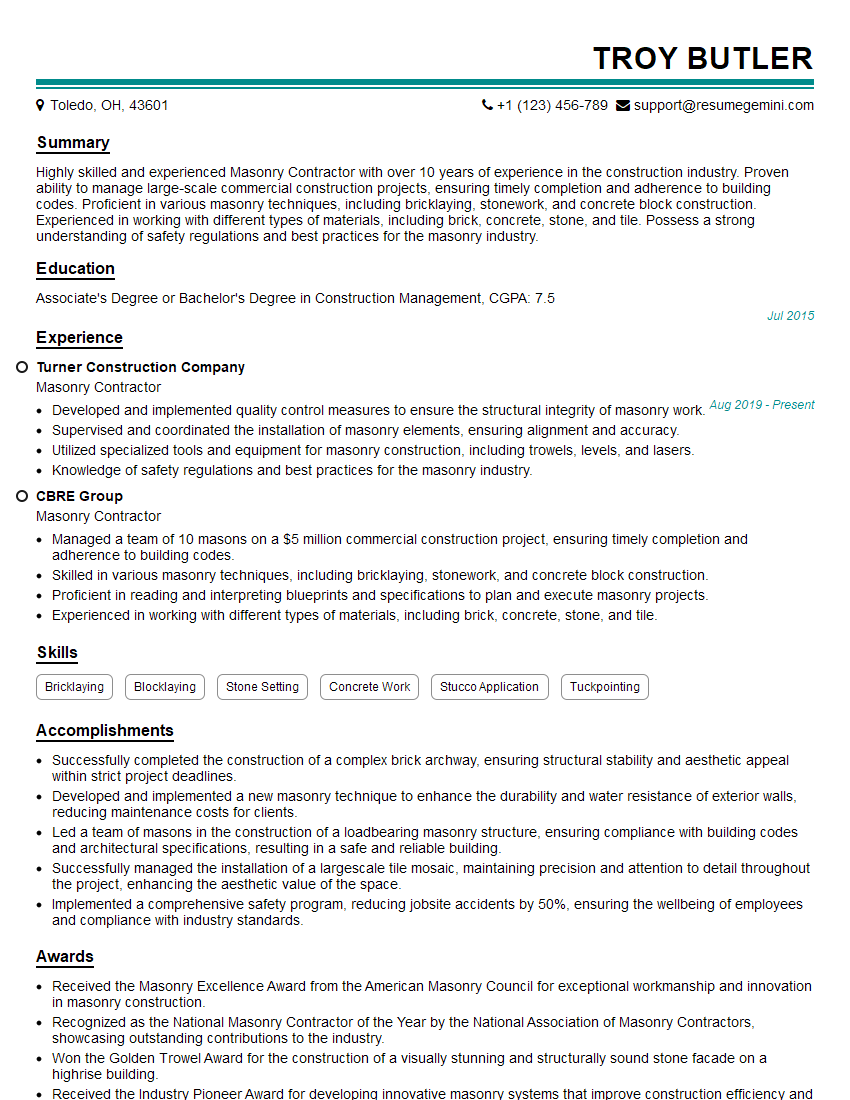
Mastering Architectural Blockwork opens doors to exciting career opportunities in the construction and design industries. A strong understanding of this crucial building technique is highly valued by employers and demonstrates a commitment to quality and expertise. To maximize your job prospects, creating a professional and ATS-friendly resume is essential. ResumeGemini is a trusted resource to help you build a compelling resume that highlights your skills and experience. Examples of resumes tailored to Architectural Blockwork are available to guide you through the process.
Explore more articles
Users Rating of Our Blogs
Share Your Experience
We value your feedback! Please rate our content and share your thoughts (optional).
What Readers Say About Our Blog
Very informative content, great job.
good