The thought of an interview can be nerve-wracking, but the right preparation can make all the difference. Explore this comprehensive guide to Art Auction Participation interview questions and gain the confidence you need to showcase your abilities and secure the role.
Questions Asked in Art Auction Participation Interview
Q 1. Describe the different types of art auctions.
Art auctions come in various formats, each with its own nuances. The most common types are live auctions and online auctions, but there are also hybrid models combining both.
- Live Auctions: These are the traditional auctions you might picture, where bidders gather in a physical location and participate in real-time bidding. The energy and atmosphere are palpable, often leading to competitive bidding and higher prices. A skilled auctioneer guides the process, managing the bids and creating excitement.
- Online Auctions: These auctions take place entirely online, allowing bidders worldwide to participate. Bidding typically happens over a set period, often with a timed system where bids are placed and surpassed until the closing time. They offer greater convenience and access but might lack the immediacy and atmosphere of a live auction.
- Hybrid Auctions: These blend live and online elements. The auction might be held in a physical location, but online bidders can participate remotely through a dedicated online platform. This method increases accessibility while maintaining some of the live auction experience.
Choosing the right auction type depends on the artwork, its estimated value, and the target audience. High-value, iconic pieces often attract live auction settings, while more accessible artworks may find a suitable home in online auctions.
Q 2. Explain the process of art appraisal for auction purposes.
Art appraisal for auction is a rigorous process determining an artwork’s fair market value. It involves several steps:
- Authentication and Provenance Research: Experts verify the artwork’s authenticity and trace its history (provenance) through documentation like previous sales records, exhibition catalogs, and artist’s studio records. This step is crucial as it establishes the artwork’s legitimacy and significantly impacts its value.
- Condition Report: A detailed assessment of the artwork’s physical condition is made, noting any damage, restoration, or wear and tear. This directly affects the value, as damaged pieces command lower prices.
- Market Research: Appraisers research comparable artworks sold at auction to establish a benchmark. Factors like artist, style, size, date, and condition are carefully considered. Auction records, online databases, and expert knowledge play vital roles here.
- Valuation: Based on all the collected data, the appraiser arrives at an estimated value range, reflecting the uncertainties inherent in the art market. The range reflects a conservative low estimate and an optimistic high estimate.
For instance, a damaged Picasso might receive a lower valuation than a pristine one, even if both are from a similar period. The process requires expertise in art history, market trends, and materials science.
Q 3. How do you determine the reserve price for an artwork?
The reserve price is the minimum price the seller is willing to accept for an artwork. It’s confidential and known only to the auction house and the seller. It’s set strategically based on the appraisal, market conditions, and the seller’s expectations.
Determining the reserve requires careful consideration of several factors:
- Appraisal Value: The appraised value provides a starting point, although the reserve might be set slightly below, at, or slightly above this valuation to encourage bidding.
- Market Conditions: Current market trends for similar artworks significantly influence the reserve. A strong market might justify a higher reserve, while a weak market might necessitate a lower one.
- Seller’s Expectations: The seller’s goals and financial needs play a role. They might be willing to accept a lower price if they need to sell quickly or have a lower reserve if they are less concerned about the sale price.
Setting the reserve too high can lead to the artwork not selling, while setting it too low might undervalue the piece and leave the seller disappointed. The goal is to find a balance that maximizes the chances of a sale while securing a satisfactory price for the seller.
Q 4. What are the key factors influencing the price of an artwork at auction?
Many factors influence an artwork’s price at auction, making it a complex interplay of objective and subjective elements.
- Artist’s Reputation and Recognition: Established artists command higher prices than lesser-known ones. The artist’s historical significance, critical acclaim, and market popularity all contribute.
- Rarity and Uniqueness: Limited-edition prints, unique pieces, or works from significant periods in an artist’s career are generally more valuable.
- Subject Matter and Style: Certain subjects and artistic styles are more in demand than others, reflecting current market trends and collector preferences.
- Artwork’s Condition: A well-preserved artwork in excellent condition will fetch a higher price compared to a damaged or heavily restored one.
- Provenance and History: A documented history of ownership, especially if it includes notable collectors, adds value and credibility.
- Market Demand and Speculation: The overall market interest in a specific artist or style at the time of the auction can significantly impact prices. Speculation also plays a role; if investors anticipate future price increases, they might bid more aggressively.
For instance, a renowned Impressionist painting in perfect condition with a well-documented provenance is likely to command a significantly higher price than a lesser-known artist’s work in poor condition.
Q 5. Describe your experience with online art auctions.
My experience with online art auctions has been extensive, spanning various platforms and auction houses. The online format has revolutionized the art market, expanding access and participation globally.
I’ve observed that:
- Increased Accessibility: Online auctions allow individuals from anywhere in the world to participate, increasing competition and expanding the market.
- Transparency: Detailed information on artworks, including images, condition reports, and provenance details, is generally readily available.
- Competitive Bidding: While lacking the palpable energy of a live auction, online platforms often see strong competitive bidding, driven by the global reach and convenience.
- Technological Advancements: High-resolution images, virtual tours, and even augmented reality features enhance the viewing experience, allowing detailed examination of artwork.
However, challenges remain such as the lack of physical inspection of the artwork, concerns about authenticity verification and fraud, and potential technological glitches.
Q 6. How do you handle bidder disputes or irregularities?
Bidder disputes or irregularities are handled promptly and fairly, following established procedures to ensure integrity.
Steps typically include:
- Review of Auction Records: The auction house reviews all bidding records, timestamps, and communication logs to establish the sequence of events.
- Communication with Involved Parties: The auction house contacts the involved bidders to understand their perspectives and gather further information.
- Mediation if Necessary: In some instances, mediation might be offered to resolve the dispute amicably between the parties involved.
- Application of Auction House Rules: The auction house’s terms and conditions, outlining rules and dispute resolution processes, are strictly followed.
- Legal Action (if necessary): In extreme cases, where a resolution cannot be reached, legal action may be pursued to protect the auction house and its clients.
Transparency and fairness are paramount in resolving such issues. The goal is to ensure a positive experience for all participants and maintain the integrity of the auction process.
Q 7. Explain the role of a cataloguer in an art auction.
The cataloguer plays a vital role in an art auction, acting as a bridge between the artwork and the potential buyers. Their expertise is crucial in ensuring the accurate representation and successful sale of the pieces.
Key responsibilities include:
- Research and Authentication: Cataloguers conduct thorough research on each artwork, verifying its authenticity, researching its provenance, and identifying the artist and its stylistic period.
- Condition Assessment: They assess the condition of the artwork, noting any damage, restoration, or imperfections, ensuring accurate descriptions for the catalog.
- Writing Catalog Entries: They write detailed and informative catalog entries, providing a comprehensive description of each artwork, including its history, dimensions, materials, and any notable features.
- Photography and Imaging: They work closely with photographers and imaging specialists to ensure that high-quality images accurately represent the artwork.
- Pre-Sale Estimation: They contribute to the pre-sale estimation process, helping to determine the likely sale price range based on their research and expertise.
The cataloguer’s expertise directly influences how the artwork is perceived and presented to potential buyers, ultimately impacting the final sale price. Accuracy and attention to detail are paramount in this role.
Q 8. What are the ethical considerations in art auction participation?
Ethical considerations in art auction participation are paramount, encompassing transparency, fairness, and legality. They touch upon all aspects, from the handling of provenance (a work’s history of ownership) to the prevention of fraud and the avoidance of conflicts of interest.
- Transparency in Provenance: It’s crucial to provide a clear and accurate history of the artwork’s ownership, including any known restorations or alterations. Omitting or misrepresenting this information is unethical and potentially illegal.
- Fair Dealing and Pricing: Auction houses and bidders should act fairly, avoiding collusion or manipulating prices to benefit specific parties. Transparency in bidding processes is key.
- Conflict of Interest Avoidance: Auctioneers and their staff must avoid situations where personal interests conflict with their professional responsibilities. For example, an auctioneer should not bid on an item they’re responsible for selling.
- Authenticity and Due Diligence: Participants have an ethical responsibility to ensure the authenticity of the works they handle or bid on. This involves thorough research and, when necessary, engaging professional authentication services. Selling knowingly fake artwork is a serious ethical and legal violation.
- Environmental Responsibility: Ethical considerations now also extend to the environmental impact of transportation and storage of artworks, encouraging sustainable practices whenever possible.
For example, failing to disclose a significant restoration to a painting could severely impact its value and mislead potential buyers, creating an unethical situation.
Q 9. Describe your experience with art authentication procedures.
My experience with art authentication involves collaborating with leading experts in various fields, from art historians to conservators and scientists. The process isn’t always straightforward and often requires a multidisciplinary approach.
We begin with a thorough examination of the artwork itself, looking for stylistic consistency, material analysis, and any signs of alteration or forgery. This might involve visual inspection, using magnifying glasses and UV light to detect inconsistencies in paint layers or materials.
Next, we delve into archival research: examining auction records, exhibition catalogues, and scholarly publications to establish provenance and compare the artwork to the artist’s known oeuvre. Scientific techniques like X-ray fluorescence spectroscopy or pigment analysis might be used to pinpoint the materials and techniques employed, comparing them to the artist’s known practices.
For instance, in one case, we used infrared reflectography to detect an underdrawing on a painting, which confirmed its authenticity and revealed the artist’s original composition, ultimately increasing its value considerably. Another case involved carbon dating of the canvas and pigment analysis to verify a work’s historical context.
The process is rigorous and demands a meticulous approach, requiring close collaboration between the auction house, experts, and potentially the seller and buyer.
Q 10. How do you manage the logistics of an art auction?
Managing the logistics of an art auction is a complex undertaking, demanding meticulous planning and execution. It’s akin to orchestrating a large-scale, high-stakes event.
- Pre-Auction: This phase involves receiving, cataloging, and meticulously documenting each artwork, creating high-quality images and descriptions for the catalogue and online platforms. We also handle insurance appraisals, coordinate marketing and publicity, and manage the registration of potential bidders.
- Auction Day: On auction day, we handle artwork transport to the venue, set up display areas, coordinate with security personnel, manage registration and bidding processes (online and in-person), and ensure smooth transitions between lots. Staff must be knowledgeable and professional, adept at handling sensitive communication with bidders and potential buyers.
- Post-Auction: Post-auction, we manage the transfer of ownership, handle payment processing, arrange for secure shipping and handling of artworks to buyers, and coordinate with insurance providers. We also address any disputes or issues that may arise.
Effective logistics management relies on robust systems and technology. We utilize specialized databases for inventory management, auction software for bidding, secure online platforms for communication, and established relationships with reputable shippers and insurance brokers.
Q 11. How do you handle high-value artwork during transport and storage?
Handling high-value artwork during transport and storage requires exceptional care and security measures. It’s a matter of safeguarding significant financial assets and protecting cultural heritage.
- Specialized Packaging: Artworks are custom-packaged using acid-free materials, climate-controlled containers, and protective barriers to minimize the risk of damage during transit. Fragile pieces receive additional cushioning and support.
- Secure Transportation: Transportation is handled by specialized art handlers and reputable couriers with experience in handling valuable and delicate objects. Secure vehicles with GPS tracking and climate control are often used.
- Climate-Controlled Storage: Storage facilities are climate-controlled to maintain stable temperature and humidity levels, preventing damage from fluctuations. High-security systems, including alarm systems and surveillance, are essential.
- Insurance: Comprehensive insurance coverage is crucial to protect against loss, damage, or theft during transport and storage. The value of insurance is determined through professional appraisal.
Think of it like transporting a priceless diamond – multiple layers of security and meticulous planning are involved. One wrong move can result in catastrophic financial and cultural losses.
Q 12. What is your understanding of art market trends?
The art market is dynamic, influenced by various factors, including economic conditions, evolving tastes, and technological advancements. Current trends reveal a growing interest in specific artistic movements (e.g., increased demand for works from the 20th century) and a surge in online art sales.
We observe fluctuations in prices across different mediums and artistic styles. The market for contemporary art is particularly volatile, while established masters maintain a more stable, although not always predictable, value.
Furthermore, the art market shows growing interest in provenance research and sustainability considerations. Collectors are increasingly seeking verifiable histories of the artworks and are showing greater interest in artists committed to ethical and sustainable practices. This demand influences prices and market trends.
For instance, the rise of NFTs (non-fungible tokens) has introduced a new layer of complexity and opportunity into the art market, raising interesting questions about ownership and authenticity in the digital realm. The increasing interest in socially conscious art further modifies market trends.
Q 13. What are the risks associated with art auctions?
Art auctions, while exciting, carry several inherent risks:
- Authenticity Disputes: The risk of purchasing a forged or misattributed artwork is significant. This can lead to substantial financial losses and reputational damage.
- Market Volatility: Art prices are susceptible to market fluctuations, and the value of an artwork can decrease after purchase. Economic downturns can significantly impact the art market.
- Fraud and Deception: Auction participants can face fraudulent activities, such as collusion among bidders or misrepresentation of artwork condition or provenance.
- Damage or Loss During Transit: Artwork can be damaged or lost during shipping, leading to financial and emotional losses.
- Legal Disputes: Disputes may arise over ownership, authenticity, or payment, leading to costly legal battles.
Understanding these risks is critical for all participants – buyers, sellers, and auction houses alike.
Q 14. How do you mitigate those risks?
Risk mitigation in art auctions involves a multi-pronged approach emphasizing due diligence, transparency, and robust procedures:
- Thorough Due Diligence: Buyers should conduct extensive research on the artwork’s authenticity, provenance, and condition before bidding. Engaging independent experts for authentication is highly recommended.
- Transparency and Disclosure: Auction houses have a responsibility to provide accurate and complete information about each artwork, including any known defects or restoration work.
- Secure Transportation and Storage: Utilizing specialized handlers and climate-controlled storage and transport facilities minimizes the risk of damage or loss during transit.
- Insurance: Comprehensive insurance coverage protects against potential losses due to damage, theft, or authenticity disputes.
- Legal Counsel: Engaging legal counsel can provide guidance and protection in case of disputes or legal challenges.
- Reputation Management: Auction houses must maintain a strong reputation for ethical conduct and transparency to build trust with buyers and sellers.
By implementing these measures, the risks associated with art auctions can be significantly reduced, creating a more secure and reliable marketplace for participants.
Q 15. What software or technology are you familiar with for managing art auctions?
Managing art auctions efficiently requires robust software solutions. I’m proficient in several systems, including dedicated auction management platforms like AuctionNinja and Invaluable. These platforms manage the entire auction lifecycle: from cataloging and lot creation, to bidder registration, bidding processes (both live and online), and post-auction invoicing and payment processing. I also utilize CRM (Customer Relationship Management) software like Salesforce or HubSpot to track client interactions, preferences, and bidding history, allowing for personalized communication and targeted marketing. Furthermore, I’m comfortable using specialized database software for inventory management, ensuring accurate records of provenance and condition reports. For online auctions, familiarity with e-commerce platforms such as Shopify or Magento, when integrated with auction software, is crucial for expanding reach and managing online bidding.
Beyond specialized software, proficiency in spreadsheet software like Microsoft Excel or Google Sheets is essential for data analysis, financial reporting, and commission calculations. My expertise spans these technologies, ensuring seamless management of complex auctions.
Career Expert Tips:
- Ace those interviews! Prepare effectively by reviewing the Top 50 Most Common Interview Questions on ResumeGemini.
- Navigate your job search with confidence! Explore a wide range of Career Tips on ResumeGemini. Learn about common challenges and recommendations to overcome them.
- Craft the perfect resume! Master the Art of Resume Writing with ResumeGemini’s guide. Showcase your unique qualifications and achievements effectively.
- Don’t miss out on holiday savings! Build your dream resume with ResumeGemini’s ATS optimized templates.
Q 16. How do you build relationships with clients and potential buyers?
Building strong client relationships is the cornerstone of success in the art auction world. It’s a process that demands consistent effort and genuine connection. I begin by actively listening to clients’ needs and preferences, understanding their collecting goals and price points. This allows me to proactively suggest works that align with their tastes. I often host private viewings and offer personalized consultations, allowing for deeper engagement and trust-building. Regular communication, whether through email newsletters highlighting upcoming auctions or personalized updates on relevant lots, keeps clients informed and engaged.
Networking plays a crucial role. I actively participate in industry events, gallery openings, and art fairs, connecting with collectors, dealers, and other professionals. Building these relationships opens doors to new opportunities and potential buyers. Maintaining meticulous records of client interactions in my CRM allows me to tailor my approach and offer the most relevant and valuable service. For example, remembering a client’s preference for Impressionist landscapes allows me to proactively notify them of relevant pieces in upcoming auctions, demonstrating my attentiveness and commitment to their collecting goals.
Q 17. Describe your experience with marketing and promoting art auctions.
Marketing and promotion are vital for a successful auction. My approach is multifaceted and leverages both digital and traditional strategies. For digital marketing, I utilize targeted online advertising campaigns on platforms like Google Ads and social media channels such as Instagram and Facebook. These campaigns are customized based on demographic and interest data to reach the most relevant potential bidders. High-quality photography and professional videography are essential for showcasing the artworks effectively. I also utilize email marketing to nurture leads and keep clients updated on upcoming auctions and important information.
Traditional methods remain important. Press releases are distributed to relevant art publications and media outlets, generating buzz and raising awareness. Collaborations with art critics and influencers further amplify reach. Print catalogs, beautifully designed and meticulously curated, are produced for both physical distribution and online access. Invites to exclusive preview events for VIP clients create a sense of exclusivity and cultivate relationships. The effectiveness of each campaign is meticulously tracked and analyzed to inform future strategies, ensuring a data-driven approach to maximize reach and results.
Q 18. How do you handle client expectations regarding auction results?
Managing client expectations is paramount. Before the auction, I provide realistic estimations of the value range for each lot, based on market analysis and comparable sales. Transparency is key – I clearly explain the auction process and any potential factors that might influence the final price. I emphasize that auction results are dynamic and influenced by various factors, including the competitive bidding environment and the prevailing market trends on that specific day. For example, if a piece is highly sought after, it could surpass initial estimations. Conversely, if there is less competition, the final price might fall within the lower end of the estimate.
Post-auction, I maintain open communication with clients, providing prompt feedback on the results, regardless of whether they were successful in acquiring a lot. If their bids were unsuccessful, I provide insights into why and offer to keep them updated on similar pieces in future auctions. This approach demonstrates professionalism and strengthens client relationships, even if the immediate outcome isn’t as desired. Building trust and loyalty is more important than a single sale.
Q 19. Explain your experience with different auction formats (live, online, etc.)
My experience encompasses various auction formats, each presenting unique challenges and opportunities. Live auctions provide a vibrant, energetic atmosphere conducive to high bidding. They foster direct interaction with bidders and create a sense of excitement and immediacy. However, they are geographically limited. Online auctions, on the other hand, offer global reach and increased convenience for bidders. They often incorporate features such as timed bidding and proxy bidding to facilitate participation. Hybrid auctions, which combine live and online bidding, offer the best of both worlds, maximizing bidder participation while maintaining the energy of a live event.
Each format requires a different approach to marketing and communication. Live auctions benefit from more emphasis on physical previews and exclusive events. Online auctions rely heavily on high-quality digital cataloging and interactive online platforms. I adapt my strategy to suit the chosen format, ensuring effective reach and maximum results irrespective of the auction method.
Q 20. How do you deal with counterfeit artwork in an auction setting?
Counterfeit artwork poses a significant threat to the art market’s integrity. My approach to dealing with this involves a multi-layered strategy. Firstly, rigorous due diligence is crucial. I work closely with art experts, conservators, and authentication specialists to verify the authenticity of every artwork before it’s listed. This includes reviewing provenance documentation, examining the artwork for signs of forgery, and potentially conducting scientific analysis if necessary. A thorough examination also includes researching the artist’s known techniques and stylistic developments, ensuring consistency.
Secondly, transparent communication is essential. All potential buyers are informed about the authentication process and any uncertainties that may exist. I always clearly disclose any known doubts about authenticity. If any doubt remains after thorough examination, the artwork is not included in the auction. By prioritizing transparency and rigorous authentication, I protect both buyers and sellers, upholding the auction’s reputation and the overall integrity of the art market. This approach fosters trust and establishes a reputation of high standards.
Q 21. Describe your understanding of different legal frameworks surrounding art sales.
A solid understanding of the legal frameworks surrounding art sales is critical. I’m familiar with various laws and regulations concerning art ownership, transfer of title, import/export restrictions, and taxation. These regulations vary significantly depending on the jurisdiction. For instance, understanding the nuances of the Visual Artists Rights Act (VARA) in the US, or the relevant copyright laws in Europe, is crucial. Furthermore, I’m well-versed in contract law, as auction contracts define the terms of the sale, including buyer and seller responsibilities and payment terms. I’m also aware of the legal requirements for handling disputes or claims of fraud or misrepresentation.
Compliance is paramount. I ensure all auction procedures adhere to relevant regulations, protecting both the auction house and all parties involved. Consultation with legal counsel is sought whenever necessary to ensure that all aspects of the auction are legally sound and transparent. Maintaining accurate records and documentation throughout the entire auction process is crucial for accountability and compliance with legal requirements.
Q 22. How do you ensure the security of artwork during an auction?
Securing artwork during an auction is paramount. It’s a multi-layered process involving meticulous planning and execution from the moment a piece enters our facility until it’s delivered to the buyer. We begin with robust security protocols at the receiving stage, including detailed cataloging, high-resolution photography, and condition reporting. This documentation serves as a baseline for any potential claims.
During the auction itself, the artwork is often displayed in secure, climate-controlled environments with 24/7 surveillance. We utilize advanced technologies like CCTV cameras, motion detectors, and even specialized environmental monitoring systems to ensure optimal conditions and protect against theft or damage. High-value pieces might even have dedicated security personnel assigned to them. Finally, transportation to and from the auction is handled by insured, vetted specialists with rigorous procedures for handling and secure transit.
For example, a particularly valuable painting might be transported in a climate-controlled armored vehicle with GPS tracking and accompanied by two armed guards. This comprehensive approach ensures the artwork’s safety throughout the entire auction process.
Q 23. What are your strategies for attracting new consignors?
Attracting new consignors requires a multifaceted strategy focused on building trust and demonstrating our expertise. We actively network within the art community, attending prestigious art fairs and exhibitions to connect with artists, galleries, and private collectors. We also leverage online platforms and targeted advertising to reach a broader audience. Crucially, we emphasize our track record of successful sales and our commitment to achieving the best possible price for our consignors.
- Direct Outreach: We personally reach out to potential consignors, highlighting our successful sales and specialized expertise in their area of interest.
- Building Relationships: Attending industry events and building personal relationships is key to gaining trust and attracting high-quality consignments.
- Transparency and Communication: We maintain open communication throughout the process, providing regular updates and clear explanations of our strategies.
- Marketing and Promotion: We leverage online and offline marketing channels to highlight our expertise and attract potential consignors.
For instance, we recently secured a significant collection of Impressionist paintings after building a relationship with the collector over several years, demonstrating our expertise and reliability through successful sales of smaller pieces from their collection.
Q 24. Explain your experience with financial aspects of art auctions (payment processing, etc.)
The financial aspects of art auctions are intricate and require specialized knowledge. We utilize secure payment processing systems to ensure swift and safe transactions. This includes working with reputable banks and financial institutions to handle the transfer of large sums of money securely and efficiently. We also carefully manage accounts payable and receivable, ensuring timely payments to consignors after accounting for fees and taxes.
We use sophisticated software for invoicing, payment tracking, and financial reporting, ensuring complete transparency with both buyers and sellers. We comply with all relevant financial regulations and employ robust anti-money laundering (AML) procedures. For international transactions, we work with specialized financial institutions to navigate currency exchange and international transfer regulations.
For example, we might use a secure online payment portal for smaller purchases, but for high-value transactions, we will often utilize wire transfers through trusted banking partners to ensure maximum security and trackability.
Q 25. Describe a challenging situation you faced in an art auction and how you resolved it.
One challenging situation involved a dispute over the authenticity of a piece shortly before the auction. A potential buyer raised concerns about the provenance of a significant artwork, which created uncertainty and potential reputational damage. We immediately launched a thorough investigation, involving independent art experts and consulting archival records and documentation. We worked transparently with both the consignor and the potential buyer, communicating every step of the investigation process.
Ultimately, the investigation confirmed the artwork’s authenticity, alleviating the concerns and allowing the auction to proceed as planned. This situation highlighted the importance of meticulous due diligence and transparent communication in resolving disputes and maintaining the integrity of the auction process. It also emphasized the value of having a strong network of experts to call upon when facing such challenges.
Q 26. How do you stay up-to-date on current trends in the art market?
Staying current in the dynamic art market is crucial. We achieve this through a multi-pronged approach. We regularly attend major art fairs and auctions globally, providing firsthand insights into market trends and emerging artists. We subscribe to leading art market publications and online resources, staying abreast of auction results, market analyses, and expert commentary.
Additionally, we actively engage with art critics, curators, and other industry professionals, leveraging their insights and perspectives. We also analyze auction data and market trends using specialized software to identify patterns and predict future movements. This comprehensive approach allows us to remain informed and adapt our strategies accordingly.
Q 27. What is your experience with international art auction regulations?
International art auction regulations are complex and vary significantly by country. We have extensive experience navigating these complexities, working with legal counsel and customs brokers to ensure compliance with all relevant laws and regulations. This includes understanding import/export laws, taxation regulations, and sanctions compliance. We work diligently to ensure accurate documentation and transparent reporting for all international transactions.
For example, shipping a piece to a buyer in Switzerland requires meticulous attention to Swiss import duties and tax regulations, as well as adherence to any export restrictions in the artwork’s country of origin. We have a dedicated team with expertise in international law and logistics to manage these complexities effectively.
Q 28. Describe your understanding of art insurance and risk management in auctions.
Art insurance and risk management are critical components of any successful art auction. We work with specialized art insurers to provide comprehensive coverage for artworks during transit, storage, and display. This includes coverage for loss, theft, damage, and even authenticity disputes. Our risk management strategy involves careful evaluation of potential risks, implementing security measures to mitigate those risks, and securing appropriate insurance to transfer remaining risk.
We establish clear terms and conditions that outline the responsibilities of both the buyer and seller, minimizing potential disputes. We maintain detailed records of artwork provenance and condition, serving as important documentation in case of a claim. Our risk assessment is an ongoing process, adapting as new vulnerabilities emerge or as market conditions change.
Key Topics to Learn for Art Auction Participation Interview
- Understanding Auction Dynamics: Comprehending the different types of auctions (live, online, silent), bidding strategies, and the role of auctioneers and specialists.
- Art Market Knowledge: Demonstrating familiarity with current market trends, artist values, and the factors influencing artwork prices. This includes understanding provenance and authentication processes.
- Client Relationship Management: Explaining how to build rapport with clients, understand their collecting goals, and provide expert advice on acquisitions and sales.
- Legal and Ethical Considerations: Discussing the legal framework surrounding art auctions, including contracts, regulations, and ethical responsibilities in handling valuable artworks.
- Auction House Operations: Understanding the logistical aspects of auction preparation, cataloging, shipping, and post-auction procedures.
- Financial Aspects of Auctions: Demonstrating knowledge of commission structures, payment processing, and risk management related to auction transactions.
- Digital Auction Platforms & Technologies: Familiarity with online bidding systems, digital cataloging, and online auction strategies.
- Problem-Solving Scenarios: Being prepared to discuss how you would handle situations such as disputed bids, damaged artwork, or unexpected market fluctuations.
Next Steps
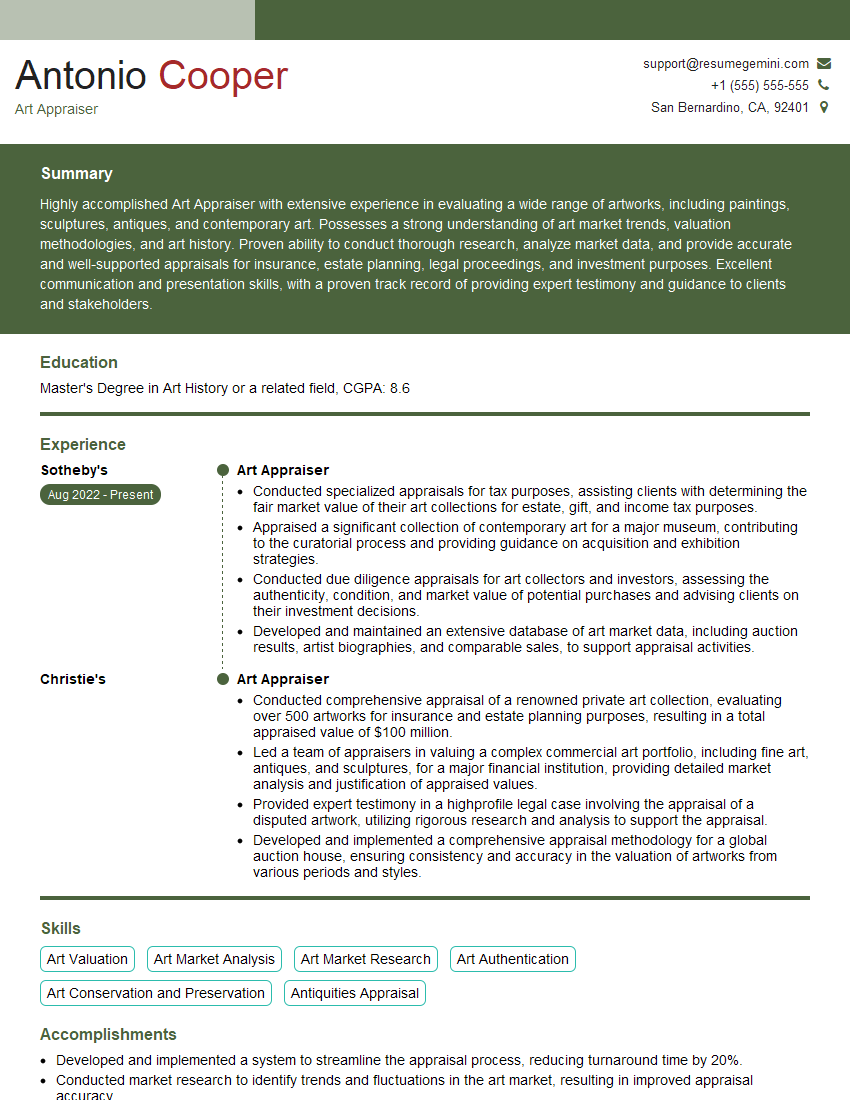
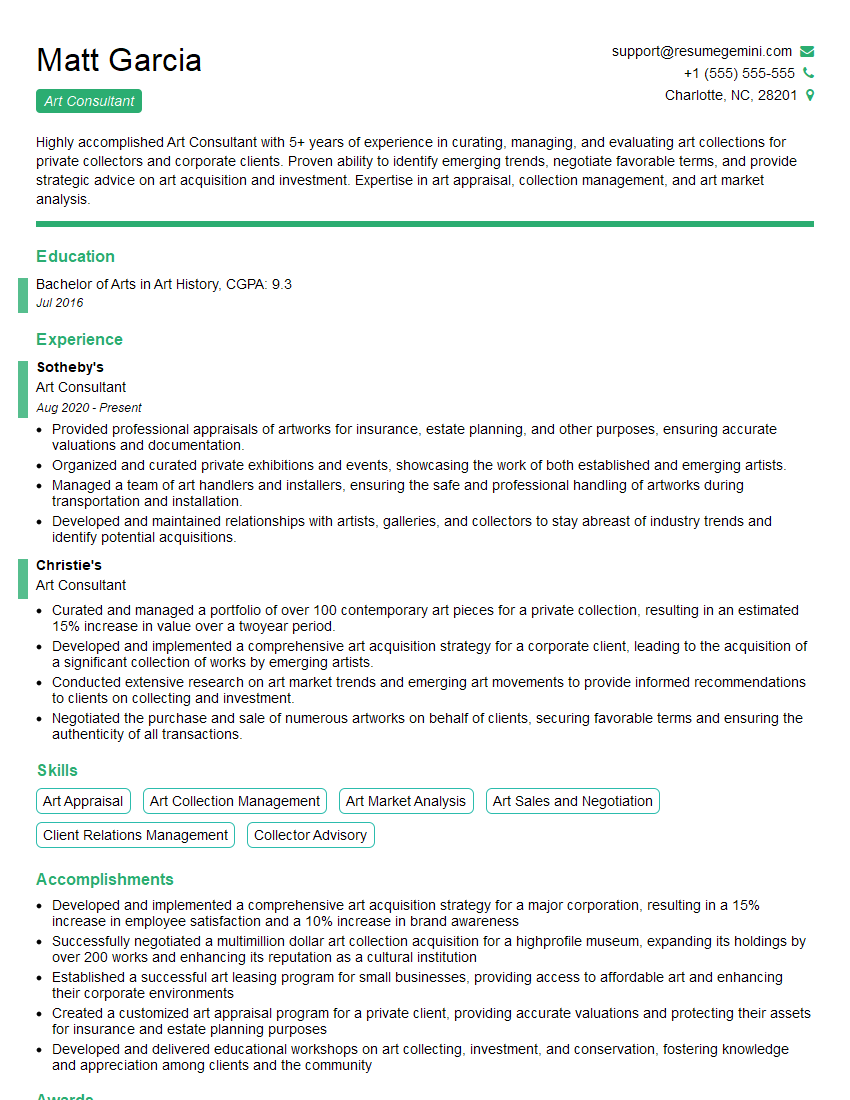
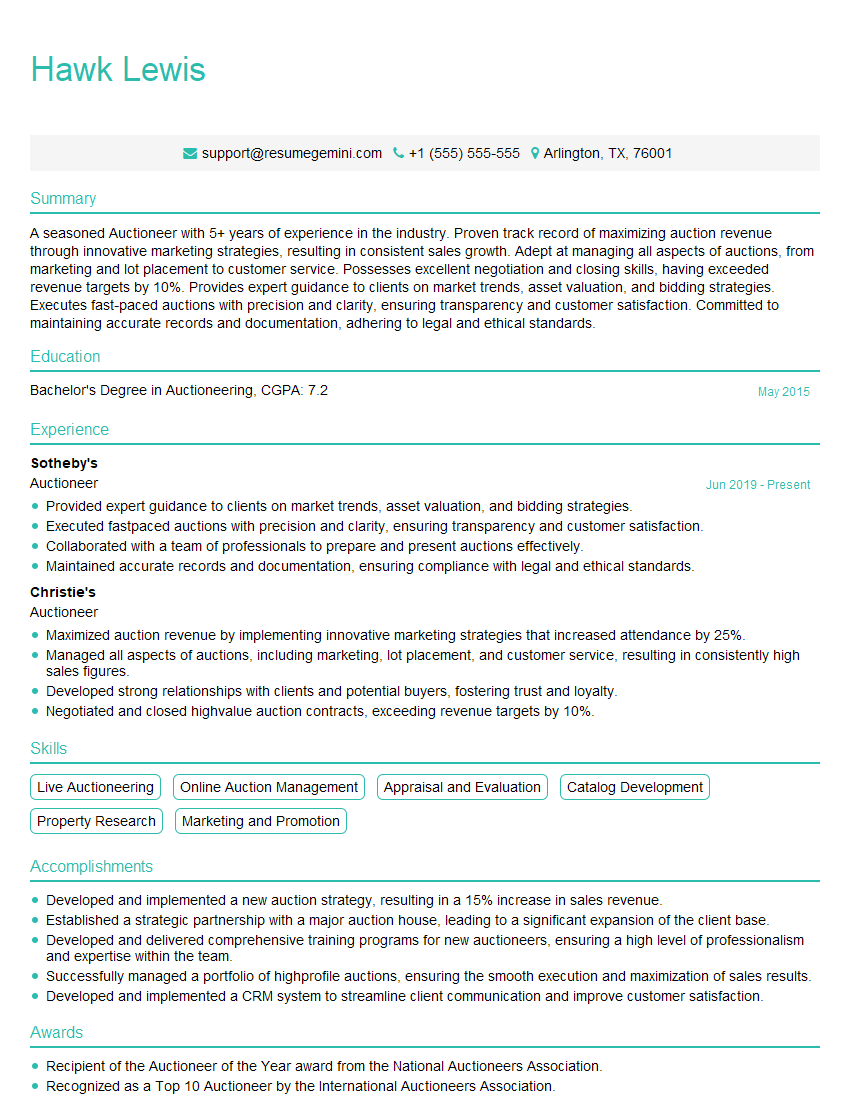
Mastering Art Auction Participation opens doors to exciting career opportunities within the dynamic art world, offering diverse roles with significant growth potential. To significantly increase your chances of landing your dream job, focus on creating a compelling and ATS-friendly resume that showcases your skills and experience effectively. ResumeGemini is a trusted resource that can help you build a professional and impactful resume tailored to the specifics of Art Auction Participation. Examples of resumes tailored to this field are available to guide you.
Explore more articles
Users Rating of Our Blogs
Share Your Experience
We value your feedback! Please rate our content and share your thoughts (optional).
What Readers Say About Our Blog
Very informative content, great job.
good