Interviews are opportunities to demonstrate your expertise, and this guide is here to help you shine. Explore the essential Artillery Battery Operations interview questions that employers frequently ask, paired with strategies for crafting responses that set you apart from the competition.
Questions Asked in Artillery Battery Operations Interview
Q 1. Describe the process of conducting a fire mission.
Conducting a fire mission is a precise, multi-step process that ensures accurate and effective artillery fire. Think of it like a highly coordinated, long-range shot in a game, but with far greater consequences. It begins with a request from a Forward Observer (FO) and culminates in the destruction of a target.
- Target Acquisition and Location: The FO pinpoints the enemy target’s location using GPS coordinates, grid references, or other methods. Accuracy is paramount here; a slight error can result in significant inaccuracy.
- Mission Request: The FO transmits the target information (location, type of target, desired effect) to the Fire Direction Center (FDC) via secure communication channels. This usually includes the priority of the target and the type of ammunition required.
- Firing Data Calculation: The FDC computes the firing data, considering factors like target location, weapon characteristics, ammunition type, meteorological conditions (wind speed, temperature, air pressure), and terrain. This often involves complex calculations using sophisticated fire control systems.
- Data Transmission: The FDC transmits the firing data (elevation, azimuth, fuse setting, etc.) to the individual artillery pieces.
- Firing: The artillery crews load and fire the rounds according to the received data. They monitor the firing process for any anomalies.
- Observation and Adjustment: The FO observes the impact of the rounds and reports back to the FDC, providing feedback for adjustments. This iterative process continues until the target is engaged effectively. Think of this as calibrating the shot until it hits its mark.
- Cease Fire: Once the mission is complete or the target is neutralized, the FDC sends a cease-fire command to all artillery units.
Q 2. Explain the different types of artillery fire missions.
Artillery fire missions can be categorized into several types, each designed for specific tactical situations.
- Suppression: Aims to reduce or neutralize enemy fire by placing accurate fire on their positions without necessarily destroying them. It’s like disrupting an enemy’s ability to attack effectively.
- Destruction: Focused on destroying enemy personnel, equipment, or fortifications. This is the most direct type of fire, aimed at complete neutralization of the target.
- Neutralization: Aims to render a target incapable of fulfilling its intended purpose, without necessarily destroying it. This might involve disabling a critical piece of infrastructure or disrupting communications.
- Interdiction: Targets enemy forces moving along lines of communication, aiming to disrupt their movements and supply lines.
- Harassment: Employs smaller amounts of fire to annoy, demoralize, or distract enemy troops. This is generally used to keep the enemy occupied and disoriented.
- Illumination: Uses illuminating rounds to light up a battlefield at night, supporting ground operations. Think of this as providing essential nighttime visibility.
Q 3. How do you calculate firing data, considering meteorological conditions?
Calculating firing data involves considering numerous factors, including meteorological conditions which significantly impact projectile trajectory. Imagine shooting a basketball—wind and temperature would affect how far and where it goes. It’s similar with artillery. Advanced fire control systems handle this with complex algorithms, but the key factors include:
- Temperature: Affects air density, influencing projectile drag.
- Air Pressure: Also affects air density, further impacting drag.
- Wind Speed and Direction: A strong headwind will slow the projectile down, while a tailwind will speed it up, altering its range and point of impact.
- Humidity: Although less significant than others, high humidity can slightly alter air density.
These meteorological factors are fed into ballistic equations—complex mathematical formulas—to adjust the firing solution. These calculations are commonly automated but a basic understanding of the principles is vital for effective artillery operations. For instance, a strong crosswind would necessitate adjustments in the aiming angle, often done through the fire control system.
Q 4. What are the safety procedures for handling artillery ammunition?
Handling artillery ammunition demands stringent safety procedures to prevent accidents. The potential consequences of a misfire are catastrophic. Safety protocols include:
- Storage: Ammunition must be stored in designated, climate-controlled areas to prevent degradation and maintain stability.
- Transportation: Special vehicles and procedures are used during transport to minimize the risk of damage or accidental detonation. Speed limits are usually reduced significantly.
- Handling: Personnel must receive comprehensive training on safe handling techniques, including proper lifting, carrying, and loading procedures. Protective equipment is crucial.
- Inspection: Regular inspections are vital to detect any defects or damage before handling or firing. This is a critical preventative measure.
- Emergency Procedures: Clear protocols for dealing with misfires, accidental detonations, or fires are essential and regularly rehearsed.
Failure to comply with these protocols can lead to serious injuries or fatalities. Safety is paramount in all aspects of artillery operations.
Q 5. Explain the role of a Forward Observer in artillery operations.
The Forward Observer (FO) acts as the eyes and ears of the artillery battery, operating near the front lines. They are vital for accurate targeting and effective fire missions. Their role is multifaceted:
- Target Acquisition: The FO identifies and locates enemy targets using various observation methods, including visual, electronic, and reconnaissance assets. They are the initial link in the chain, determining who or what is being targeted.
- Target Designation: They precisely designate target coordinates using map references, grid systems, or GPS, ensuring accurate targeting by the artillery battery.
- Mission Coordination: The FO acts as the liaison between ground troops and the artillery battery, relaying target information and mission requests. They constantly communicate to adjust the targeting.
- Fire Adjustment: After the initial salvo, the FO observes the impact and makes adjustments to the fire based on observation feedback, guiding the accuracy of fire.
- Damage Assessment: Post-mission, the FO assesses the effectiveness of the artillery fire in neutralizing the enemy target. This helps to measure the overall success of the mission and inform future tactics.
The FO’s ability to communicate clearly, accurately assess the battlefield, and understand artillery capabilities is crucial for mission success.
Q 6. How do you ensure accurate communication during a fire mission?
Accurate communication is critical for a successful fire mission, avoiding friendly fire incidents and ensuring effective targeting. Multiple methods are employed to guarantee reliable communication:
- Secure Radios: Encrypted radios are used to transmit sensitive information, preventing enemy interception.
- Redundant Communication Systems: Multiple communication channels are utilized as backup systems in case of failures. This could include different radio frequencies, satellite links, or even runners.
- Standardized Procedures: Clear, concise communication protocols are used to minimize ambiguity and ensure everyone understands the messages. This involves using precise terminology and reporting formats.
- Verification and Confirmation: Messages are always verified and confirmed to prevent errors. This might involve repeating the information or sending a message back to the source to confirm correct reception.
- Digital Communication Systems: Advanced artillery units utilize digital communication systems integrating targeting data and information sharing between all elements of the mission.
The emphasis on clear and redundant communication ensures effective coordination and prevents mishaps during intense and potentially chaotic combat scenarios.
Q 7. Describe the different types of artillery systems.
Artillery systems vary widely in caliber, range, mobility, and purpose. Some examples include:
- Towed Artillery: These are relatively lightweight and mobile, easily transported by trucks or other vehicles. They provide excellent flexibility in deployment.
- Self-Propelled Artillery: These are mounted on a tracked or wheeled chassis, offering greater mobility and protection. They combine the advantages of speed and firepower.
- Rocket Artillery (MLRS): These systems launch multiple rockets simultaneously over long ranges, providing area saturation fire. They are excellent for covering wide areas in a short time.
- Mortars: These shorter-range, high-angle weapons are often used for close-range support, particularly in infantry operations. Their trajectory allows fire over obstacles.
- Howitzers: Highly versatile artillery pieces capable of both direct and indirect fire, these provide a balance between range and accuracy.
The choice of artillery system depends on the specific tactical situation, mission objectives, and available resources. Each type offers unique advantages and disadvantages.
Q 8. What are the key elements of artillery maintenance?
Artillery maintenance is crucial for ensuring the readiness and effectiveness of our weapon systems. It’s a multifaceted process encompassing preventative measures, corrective actions, and ongoing system checks. Think of it like maintaining a high-performance race car – regular upkeep is essential for peak performance and safety.
- Preventative Maintenance (PM): This involves routine inspections, lubrication, cleaning, and minor repairs to prevent major breakdowns. This is scheduled at regular intervals and follows strict checklists. For example, daily PM might involve checking fluid levels, while monthly PM might include a more thorough inspection of critical components.
- Corrective Maintenance (CM): This addresses malfunctions and breakdowns that occur during operation. It requires skilled technicians to diagnose the problem and repair or replace faulty parts. A broken firing mechanism, for instance, would necessitate corrective maintenance.
- Calibration and Testing: Regular calibration of sighting systems and firing mechanisms is paramount to ensure accuracy. This involves using specialized equipment to verify that the system is functioning within acceptable tolerances. Firing test rounds allows for validation of the system’s accuracy and performance.
Effective artillery maintenance requires a highly trained team, well-equipped workshops, and a robust supply chain for parts. A failure in any of these areas can significantly impact operational readiness.
Q 9. How do you address equipment malfunctions during a fire mission?
Equipment malfunctions during a fire mission are serious, potentially jeopardizing the mission and crew safety. Our response follows a well-defined protocol:
- Immediate Action: The first step is to immediately cease fire and assess the situation. This includes identifying the malfunctioning equipment and determining the nature of the failure.
- Troubleshooting and Repair: Based on the nature of the malfunction, the crew will attempt to troubleshoot and repair the problem using available resources. This may involve simple fixes or require more extensive repairs, potentially necessitating the assistance of specialized maintenance personnel.
- Damage Control: If the malfunction cannot be quickly resolved, we prioritize damage control. This might involve securing the faulty equipment to prevent further damage or injury, and re-allocating tasks to maintain operational capability with remaining systems.
- Reporting and Documentation: All malfunctions are meticulously documented, including the nature of the problem, the actions taken, and the outcome. This information feeds into preventative maintenance schedules and aids in identifying recurring issues.
- Evacuation (if necessary): In situations where the malfunction poses a significant risk to personnel, the crew will follow established evacuation procedures.
Example: If a breech malfunction occurs, the immediate action is to cease fire and secure the breech. Troubleshooting might involve checking for obstructions or damaged parts. If the repair is complex, a request for maintenance support will be made while other guns maintain the mission.
Q 10. Explain the concept of ‘danger close’ and safety protocols.
‘Danger close’ signifies that friendly troops are in very close proximity to the area where artillery rounds will land. This requires extreme caution and adherence to stringent safety protocols. It’s a critical situation where even a slight deviation could cause friendly fire casualties.
- Clear Communication: Absolutely clear and unambiguous communication between the fire direction center (FDC), the artillery battery, and the forward observer (FO) is essential. This includes precise coordinates, target descriptions, and an explicit declaration of ‘danger close’.
- Detailed Target Confirmation: The target must be meticulously confirmed before firing. This includes using multiple means of observation to ensure accuracy and reduce the risk of friendly fire. This may involve using drones or other surveillance equipment to confirm the target’s location.
- Reduced Charge/Adjusted Fuzes: Artillery rounds may be fired with reduced charges to limit the range and impact area. Similarly, adjusting fuzes to allow for air burst rather than ground burst might be considered to minimize collateral damage.
- Emergency Procedures: Well-defined emergency procedures must be in place to handle unforeseen circumstances, such as a sudden shift in wind direction or unexpected enemy activity. This might involve halting the mission and shifting resources.
Danger close situations necessitate a high level of coordination, precise calculations, and a rigorous adherence to safety regulations. A single mistake can have devastating consequences.
Q 11. How do you interpret meteorological data for artillery calculations?
Meteorological data is absolutely critical for accurate artillery calculations. Wind speed and direction, temperature, and air density all affect the trajectory of a projectile. Think of throwing a ball – a strong headwind will make it land short, and a tailwind will take it further.
We use meteorological data obtained from various sources, including weather stations, weather balloons, and even sophisticated weather prediction models. This data is input into fire control computers, which calculate the necessary adjustments to compensate for environmental factors. Ignoring this data can result in significant misses, rendering our fire missions ineffective.
For example, a strong crosswind will cause the projectile to drift sideways, requiring adjustments to the aiming point. High air density will increase air resistance, reducing the projectile’s range. These calculations are complex, often involving intricate ballistic equations and sophisticated algorithms, which the fire control computer handles with great precision.
Q 12. Describe the process of target acquisition and confirmation.
Target acquisition and confirmation are crucial steps ensuring we hit the intended target, not something else. It’s a two-part process:
- Target Acquisition: This involves locating the target using various methods, including:
- Forward Observers (FOs): These personnel are positioned close to the target and use spotting scopes, binoculars, or even drones to identify and locate the target, transmitting the coordinates to the fire direction center.
- Intelligence: Intelligence gathered from various sources, such as aerial reconnaissance or ground surveillance, can also provide target locations.
- Radar: Radar systems can be used to detect and locate enemy positions, providing target data for artillery fire.
- Target Confirmation: Once a target is acquired, it must be confirmed to avoid hitting unintended objectives. This involves:
- Multiple Spotters: Employing multiple observers to confirm the target location from different vantage points to reduce errors.
- Reconnaissance/Surveillance: Using imagery or surveillance data to verify the target’s identity and location before firing.
- Laser Rangefinders: These devices are used to precisely measure the distance to the target.
A rigorous confirmation process minimizes the risk of friendly fire incidents and ensures the effective utilization of artillery resources.
Q 13. What are the challenges of conducting artillery operations in varied terrain?
Varied terrain presents numerous challenges to artillery operations. The type of terrain directly impacts the trajectory of the projectile, making accurate fire missions more complex.
- Obstructions: Mountains, hills, and forests can obstruct the line of sight and affect the projectile’s trajectory. This requires careful calculations to compensate for the elevation and distance to the target.
- Concealment: Terrain provides concealment for both friendly and enemy forces. This necessitates the use of advanced techniques and technology to locate targets and maintain situational awareness. The use of drones or other surveillance platforms may be necessary.
- Accessibility: Difficult terrain can restrict the mobility of artillery systems. This means that careful planning and route selection are vital for deploying and repositioning artillery units effectively.
- Weather Effects: Terrain can amplify the effects of weather conditions. For example, winds channeled through valleys can drastically alter projectile trajectories.
Overcoming these challenges requires careful planning, advanced technology, and experienced personnel who can adapt to varied conditions.
Q 14. Explain the importance of communication coordination with other units.
Communication coordination with other units is paramount for successful artillery operations. It’s the backbone of effective teamwork and mission success. Think of it like a well-orchestrated symphony – every instrument must play its part in harmony.
- Forward Observers (FOs): Maintaining constant communication with FOs is vital for target acquisition, confirmation, and adjustments throughout the fire mission. This communication often involves radio transmission, using secure channels.
- Maneuver Units: Coordinating with maneuver units ensures that artillery fire supports their objectives and does not endanger friendly forces. This coordination helps prevent friendly fire incidents.
- Air Support: Close coordination with air support units prevents fratricide and ensures the effective integration of both air and ground assets. This requires adherence to strict protocols and secure communication channels.
- Intelligence Units: Collaborating with intelligence units provides vital information about enemy positions, allowing for more effective targeting. The information may be used to adjust plans as conditions change.
Effective communication relies on well-established procedures, secure communication channels, and well-trained personnel. A breakdown in communication can lead to mission failure and serious casualties.
Q 15. How do you manage ammunition resupply during sustained fire missions?
Ammunition resupply during sustained fire missions is a critical logistical operation demanding meticulous planning and efficient execution. It’s not just about moving shells; it’s about maintaining a continuous flow of ordnance to the firing batteries without disrupting the mission. We employ a tiered approach. First, we have pre-positioned ammunition dumps strategically located to minimize transit times. These dumps are stocked according to anticipated consumption rates, factoring in mission duration and fire intensity. Second, we use a robust communication system to constantly monitor ammunition levels and predict resupply needs. This typically involves real-time updates from the firing batteries to a central logistics hub. Third, we utilize a variety of resupply methods, including trucks, helicopters (in suitable terrain), and even armored personnel carriers, depending on the urgency and the environment. For instance, during a particularly intense engagement, we might prioritize air resupply to ensure a quick turnaround. Finally, we employ strict inventory control procedures – everything is meticulously tracked to avoid shortages or wastage. A breakdown in any part of this system can lead to a significant disruption of fire support, so maintaining its efficacy is paramount.
For example, in one operation, we faced a sudden surge in demand due to an unexpected enemy counterattack. Our pre-positioned dumps were almost depleted, but through coordinated use of helicopters and quick decision-making, we managed to resupply the batteries within an hour, preventing any significant disruption in fire support. This underscored the importance of having multiple resupply options and a flexible, responsive logistics chain.
Career Expert Tips:
- Ace those interviews! Prepare effectively by reviewing the Top 50 Most Common Interview Questions on ResumeGemini.
- Navigate your job search with confidence! Explore a wide range of Career Tips on ResumeGemini. Learn about common challenges and recommendations to overcome them.
- Craft the perfect resume! Master the Art of Resume Writing with ResumeGemini’s guide. Showcase your unique qualifications and achievements effectively.
- Don’t miss out on holiday savings! Build your dream resume with ResumeGemini’s ATS optimized templates.
Q 16. What are the different types of artillery projectiles and their applications?
Artillery projectiles are highly varied, each designed for a specific purpose. We broadly categorize them into several types. High-explosive (HE) rounds are the workhorses, used for general-purpose attacks on enemy personnel, equipment, and fortifications. Their blast and fragmentation effects are highly effective against soft targets. High-explosive incendiary (HEI) rounds add a fire component, making them useful for igniting flammable materials and causing widespread disruption. Smoke rounds create obscuring screens to mask troop movements or provide cover for friendly forces. Illumination rounds provide light at night, essential for observation and targeting. Finally, we have precision-guided munitions (PGMs), such as GPS-guided or laser-guided projectiles, which significantly improve accuracy, allowing us to engage specific, high-value targets with minimal collateral damage. The choice of projectile depends entirely on the tactical situation. For example, HE rounds might be used for suppressing enemy fire, while PGMs would be reserved for high-value targets like enemy command centers or artillery positions. Smoke would be employed to mask a maneuver, and illumination would aid nighttime operations.
Q 17. Describe your experience with artillery fire control systems.
My experience with artillery fire control systems spans a range of advanced systems, including both older analog systems and modern digital platforms. I’m proficient in operating and maintaining various fire direction centers (FDCs), and understand the intricacies of coordinating fire missions across multiple batteries. I’ve worked extensively with systems that use advanced ballistic calculations, considering factors like wind speed, temperature, and atmospheric pressure, to ensure accuracy. I am also familiar with digital mapping systems and their integration with fire control, allowing for real-time adjustments based on changing battlefield conditions. My experience includes both manual data input and the use of automated systems for data processing and transmission. Furthermore, I’m experienced in troubleshooting system malfunctions, identifying the source of errors, and implementing solutions quickly and efficiently, even under pressure.
One example involved a malfunction in the digital map system during a live-fire exercise. By systematically checking the system’s components and using diagnostic tools, we quickly isolated the fault to a faulty data cable. Replacing the cable restored functionality, ensuring the mission continued without significant interruption. This highlights the importance of not only knowing the system but also the ability to effectively troubleshoot and repair it in challenging situations.
Q 18. How do you ensure the accuracy of firing data using different systems?
Ensuring accuracy involves a multi-faceted approach. First, we rely on accurate target location data. This is often obtained through forward observers, unmanned aerial vehicles (UAVs), or other intelligence sources. We then use sophisticated fire control systems to process this data, factoring in environmental conditions. Regular calibration and maintenance of the equipment are vital. We use both internal checks (system self-diagnostics) and external checks (comparison against known reference points) to verify the accuracy of our systems. In addition, we employ techniques like surveying and GPS to verify the position of our own batteries. The data from multiple sources is cross-referenced and compared to enhance accuracy and identify any discrepancies. Finally, we constantly evaluate the results of our fire missions using observation and feedback, making adjustments to our firing data as needed. The process is iterative: we fire, observe, adjust, and repeat until the desired accuracy is achieved.
Q 19. Explain the concept of artillery dispersion and its impact on accuracy.
Artillery dispersion refers to the spread or scatter of projectiles around the mean point of impact. It’s essentially the inaccuracy inherent in any artillery system, even when all the calculations are perfect. Various factors contribute to dispersion, including variations in propellant charge, projectile imperfections, and environmental influences like wind and atmospheric pressure. A larger dispersion means a wider spread of impacts, reducing the probability of hitting the target. Conversely, smaller dispersion indicates higher accuracy. The impact on accuracy is significant. A large dispersion can render artillery fire ineffective against point targets, requiring a larger volume of fire to achieve the desired effect. Minimizing dispersion is a constant goal, achieved through meticulous attention to detail in ammunition handling, equipment maintenance, and the quality of meteorological data used in fire control calculations.
Imagine throwing darts at a dartboard. Even the best darts player will have some scatter in their throws. This scatter is analogous to artillery dispersion. The goal is to minimize that scatter, making the group of dart impacts as small as possible (high accuracy) – and similarly with our artillery.
Q 20. How do you troubleshoot problems with artillery aiming systems?
Troubleshooting artillery aiming systems requires a systematic approach. We start with a thorough visual inspection, looking for any obvious physical damage or loose connections. Then, we move on to diagnostic tests, using built-in system checks and external verification tools to pinpoint the source of the problem. This could involve checking sensor readings, verifying data transmissions, and examining the output of various system components. Software glitches can be addressed through system resets or software updates. Hardware problems might require component replacement or repairs. We utilize technical manuals and troubleshooting guides, and also consult with specialists when necessary. The troubleshooting process is documented, ensuring that lessons learned are retained for future reference. The ability to quickly and effectively troubleshoot aiming system problems is critical to maintaining mission effectiveness. A swift resolution to a malfunction can prevent delays, ensuring timely fire support is available when needed.
Q 21. What is your experience with artillery simulations and training exercises?
I have extensive experience with artillery simulations and training exercises, utilizing both live-fire and computer-based simulations. These exercises are crucial for enhancing crew proficiency, developing tactical skills, and testing new procedures. Live-fire exercises provide realistic training in a controlled environment, allowing crews to practice their skills under pressure and to refine their coordination. Computer-based simulations offer flexibility and cost-effectiveness, allowing crews to run through numerous scenarios without expending ammunition. They can also model complex battlefield environments and simulate various threats. In both types of exercises, I’ve focused on developing and refining crew skills, from gunnery and communications to logistics and battlefield coordination. Data gathered during simulations and exercises is analyzed to identify areas for improvement and to develop better tactics and procedures. This feedback loop is essential for continuous improvement in artillery operations.
For example, one training exercise involved a complex scenario with multiple batteries coordinating their fire to support a simulated ground offensive. The exercise revealed communication bottlenecks and the need for refined procedures to ensure timely coordination between batteries. Analysis of the simulation data allowed us to develop new protocols to mitigate these issues and improve overall mission effectiveness.
Q 22. Describe the process of conducting a post-mission analysis.
Post-mission analysis is crucial for continuous improvement in artillery operations. It’s a systematic review of the entire mission, identifying successes, failures, and areas for enhancement. Think of it as a post-game review for a sports team, only with much higher stakes.
Data Gathering: We start by collecting all relevant data. This includes fire mission logs, weather reports, communication records, targeting data, and any after-action reports from individual crews. This phase is meticulous; even seemingly minor details can be vital.
Performance Evaluation: Next, we analyze the data. Did we achieve our objectives? Were there any significant deviations from the plan? We look at things like accuracy, timeliness, ammunition expenditure, and communication efficiency. For example, if we experienced excessive dispersion, we’d scrutinize factors like meteorological data input, gunnery procedures, and ammunition quality.
Identifying Strengths and Weaknesses: This is where we dissect both successes and failures. What worked well? What could be improved? This involves honest self-assessment and collaborative discussion. Perhaps a particular crew consistently demonstrated superior accuracy – we’d explore their techniques to share best practices. Conversely, if there were communication breakdowns, we’d investigate solutions, maybe implementing new protocols or refresher training.
Corrective Actions: Based on our analysis, we develop and implement corrective actions. This might involve refining targeting procedures, updating standard operating procedures (SOPs), conducting additional training, or requesting specific equipment upgrades.
Documentation and Reporting: Finally, we document all findings, recommendations, and implemented changes. This comprehensive report helps to ensure continuous learning and improvement within the battery.
Q 23. How do you maintain situational awareness during artillery operations?
Maintaining situational awareness (SA) in artillery operations is paramount for mission success and personnel safety. It’s about having a clear, real-time understanding of everything happening around the battery, both friendly and enemy.
Intelligence Gathering: We rely heavily on intelligence reports and reconnaissance to anticipate enemy actions and adjust our operations accordingly. This includes understanding enemy capabilities, likely avenues of approach, and potential threats.
Communication Networks: Robust and reliable communication is fundamental. We utilize various communication systems, including radios, satellite links, and command and control systems to maintain constant communication with higher headquarters, adjacent units, and our own fire direction center (FDC).
Observation and Reporting: Forward observers (FOs) play a critical role. They provide crucial real-time updates on enemy movements, target locations, and the effects of our fire. Their reports, often relayed through sophisticated communication systems, are vital to maintaining SA.
Technological Aids: Modern artillery relies heavily on technology. We use automated systems to process targeting data, track ammunition expenditure, and monitor the battlefield environment. This includes advanced fire control systems and geographical information systems (GIS).
Continuous Monitoring: SA isn’t a one-time thing; it’s a continuous process requiring constant vigilance and information updating. We regularly review intelligence reports, monitor communication channels, and analyze data from various sources to maintain a comprehensive understanding of the evolving battlefield.
Q 24. How do you handle unexpected changes or delays during a fire mission?
Unexpected changes and delays are common in artillery operations. Adaptability is key. We use a combination of pre-planned contingencies and real-time decision-making to handle them effectively.
Contingency Planning: Before any mission, we develop contingency plans for various scenarios, including equipment malfunctions, communication failures, and changes in weather conditions. This ensures we have a roadmap to follow if things go awry.
Flexible SOPs: Our standard operating procedures (SOPs) are designed to be flexible. They provide a framework but allow for adaptation based on the specific circumstances. Rigid adherence to SOPs in a dynamic environment can be disastrous.
Communication and Coordination: Clear, concise, and timely communication is crucial. We keep higher headquarters and all relevant units informed of any changes or delays. Coordination is vital to avoid conflicts and ensure everyone is on the same page.
Real-time Decision-Making: When faced with unforeseen events, we rely on sound judgment and experience to make quick, informed decisions. This often involves evaluating the impact of the delay or change on the mission objectives and making adjustments to maintain operational effectiveness.
Post-Mission Review: Even after successfully navigating unexpected challenges, a post-mission review helps identify areas where our response could have been improved. This continuous learning process is vital for optimizing our ability to adapt to future unforeseen events.
Q 25. What are your methods for ensuring the safety of your personnel?
Ensuring personnel safety is the top priority in artillery operations. It’s not just a matter of following procedures; it’s a constant mindset.
Safety Training: All personnel undergo rigorous safety training, covering topics such as weapon handling, ammunition safety, hazard recognition, and emergency procedures. This training is regularly refreshed and updated.
Risk Assessment: Before every mission, we conduct a thorough risk assessment, identifying potential hazards and implementing mitigating measures. This includes assessing the environment, equipment condition, and potential enemy threats.
Protective Equipment: We ensure personnel are equipped with appropriate personal protective equipment (PPE), including hearing protection, eye protection, and body armor as needed.
Emergency Procedures: We have clearly defined and regularly practiced emergency procedures for various scenarios, including accidents, fires, and chemical attacks. This includes emergency evacuation plans and medical response protocols.
Disciplined Procedures: Strict adherence to established procedures is non-negotiable. Every step, from weapon handling to ammunition storage, is governed by detailed procedures designed to minimize risk.
Continuous Monitoring: We constantly monitor the environment and the condition of equipment to detect potential hazards early and take corrective action. Safety is a continuous process, not a one-time event.
Q 26. Explain the principles of effective leadership in an artillery battery.
Effective leadership in an artillery battery demands a combination of technical competence, strong communication skills, and a commitment to personnel welfare. It’s about leading from the front and inspiring trust and confidence.
Technical Expertise: Leaders must possess a deep understanding of artillery systems, tactics, and procedures. This expertise instills confidence in the team and ensures sound decision-making.
Communication: Clear, concise, and timely communication is paramount. Leaders must effectively convey orders, provide feedback, and foster open communication among the team. This includes actively listening to and valuing the input of subordinates.
Decision-Making: Artillery operations often involve high-pressure situations that demand rapid and sound decision-making. Leaders must be able to quickly assess situations, weigh options, and make informed choices, even under stress.
Motivation and Mentoring: Leaders must motivate and inspire their teams, fostering a sense of purpose and shared responsibility. They should mentor and develop their personnel, providing opportunities for growth and advancement.
Safety Emphasis: A leader’s unwavering commitment to personnel safety is crucial. This involves setting a safety culture, enforcing safety regulations, and addressing safety concerns promptly.
Accountability: Leaders are accountable for the performance and safety of their unit. They must take ownership of successes and failures and learn from both.
Q 27. Describe your experience working with different types of artillery software.
Throughout my career, I’ve worked with a variety of artillery software systems, from legacy systems to the latest advanced technologies. This experience encompasses both tactical and logistical applications.
Fire Control Systems: I’m proficient in several advanced fire control systems, including those that automate target acquisition, calculation of firing solutions, and ammunition management. These systems significantly increase accuracy and speed of fire.
Command and Control Systems: I have experience using various command and control systems that facilitate communication and coordination among different units and echelons. These systems improve situational awareness and enhance decision-making.
Logistics Software: I’ve utilized software packages for managing ammunition supply, tracking maintenance schedules, and optimizing resource allocation. These are essential for maintaining operational readiness.
Simulation Software: I’m familiar with artillery simulation software used for training and planning purposes. These programs allow us to test different tactics, evaluate performance, and identify potential weaknesses before real-world deployment.
My experience spans different platforms and interfaces, ensuring I can adapt quickly to new systems and leverage their capabilities to improve battery effectiveness.
Q 28. How do you use technology to improve artillery operations efficiency?
Technology is revolutionizing artillery operations, enhancing efficiency and effectiveness in numerous ways.
Automated Fire Control: Modern fire control systems automate many tasks, reducing the time required to engage targets and improving accuracy. This is particularly crucial in fast-paced combat situations.
Precision-Guided Munitions (PGMs): PGMs significantly improve the accuracy of artillery fire, reducing collateral damage and increasing the effectiveness of engagements. This enhances mission success and reduces civilian casualties.
Unmanned Aerial Vehicles (UAVs): UAVs provide real-time reconnaissance and target acquisition, improving situational awareness and enhancing the effectiveness of artillery fire. They can also be used to assess the effects of fire missions.
Data Analytics: By analyzing vast amounts of data from various sources, including fire mission logs, weather reports, and intelligence, we can identify trends, optimize tactics, and improve overall performance. This data-driven approach ensures continuous improvement.
Communication Networks: Advanced communication networks ensure secure and reliable communication among different units and echelons, enhancing coordination and situational awareness. Real-time information sharing is critical for effective artillery operations.
By embracing and effectively utilizing these technologies, we can significantly improve the efficiency, effectiveness, and safety of artillery operations.
Key Topics to Learn for Artillery Battery Operations Interview
- Fire Mission Processing: Understand the complete fire mission cycle, from receiving target coordinates to impact assessment. This includes calculations, communication protocols, and potential error sources.
- Gunnery Fundamentals: Master the principles of ballistics, including trajectory calculations, factors affecting accuracy (e.g., wind, temperature, spin drift), and the adjustment of firing solutions.
- Weapon Systems Knowledge: Demonstrate familiarity with various artillery systems, their capabilities, limitations, and operational procedures. Be prepared to discuss specific weapon systems you have experience with.
- Safety Procedures: Articulate a deep understanding of safety protocols in artillery operations, including ammunition handling, range safety, and emergency procedures. Highlight your commitment to safe practices.
- Communication & Coordination: Emphasize your ability to effectively communicate within a team, coordinate fire missions, and maintain clear and concise reporting procedures under pressure.
- Data Analysis & Problem Solving: Showcase your ability to analyze data from firing missions, identify potential problems (e.g., missed targets, malfunctions), and develop effective solutions. Use examples from your experience to illustrate this.
- Meteorological Influences: Discuss how weather conditions impact firing solutions and how adjustments are made to account for these factors. This demonstrates a comprehensive understanding of the field.
- Logistics & Maintenance: Demonstrate your understanding of the logistical requirements of artillery operations, including ammunition supply, maintenance of equipment, and resource management.
Next Steps
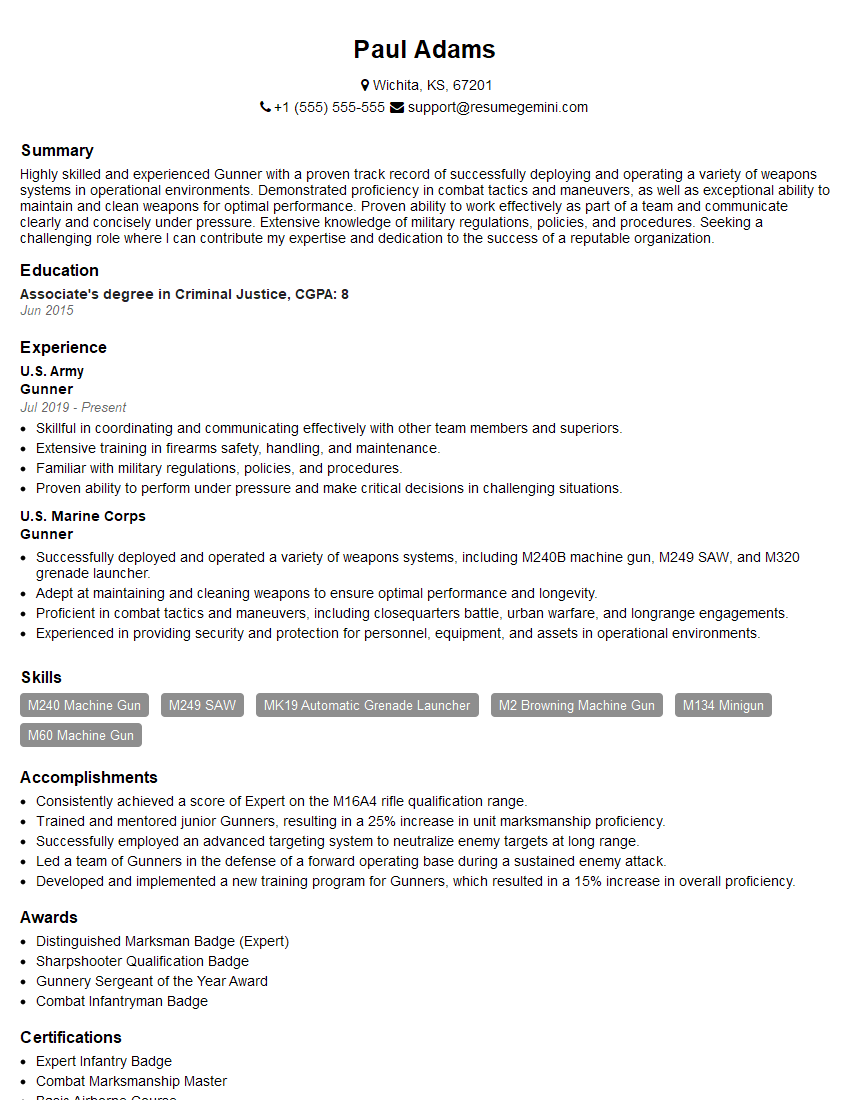
Mastering Artillery Battery Operations is crucial for career advancement in this demanding and rewarding field. A strong understanding of these principles will significantly enhance your job prospects and open doors to exciting opportunities. To increase your chances of success, creating an ATS-friendly resume is paramount. This ensures your application gets noticed by potential employers. We highly recommend using ResumeGemini to craft a compelling and effective resume that highlights your skills and experience. ResumeGemini offers valuable tools and resources to help you build a professional resume, and examples of resumes tailored to Artillery Battery Operations are available to guide you.
Explore more articles
Users Rating of Our Blogs
Share Your Experience
We value your feedback! Please rate our content and share your thoughts (optional).
What Readers Say About Our Blog
Very informative content, great job.
good