The right preparation can turn an interview into an opportunity to showcase your expertise. This guide to Arts Advocacy and Policy interview questions is your ultimate resource, providing key insights and tips to help you ace your responses and stand out as a top candidate.
Questions Asked in Arts Advocacy and Policy Interview
Q 1. Describe your experience developing and implementing arts advocacy campaigns.
Developing and implementing successful arts advocacy campaigns requires a multifaceted approach. It begins with identifying a clear objective, such as increased funding for a specific arts program or the passage of supportive legislation. Then, I conduct thorough research to understand the current political landscape, identify key stakeholders (legislators, community leaders, funders), and gauge public opinion.
For example, in a recent campaign advocating for increased arts education funding in a particular school district, I developed a multi-pronged strategy. This included creating compelling data visualizations demonstrating the positive correlation between arts education and improved academic performance and student well-being. I then organized community events showcasing student artwork and performances, which allowed community members to experience firsthand the value of arts education. Simultaneously, I lobbied local officials directly, providing them with the research data and community support garnered through the events. This resulted in a significant increase in funding allocation for the program.
Another key element is crafting a persuasive narrative that resonates with the target audience. Effective campaigns utilize various communication channels – social media, press releases, public forums – to amplify this narrative and build momentum. Measuring the impact, as discussed in a later answer, is critical to informing future campaigns and demonstrating the effectiveness of the advocacy efforts.
Q 2. Explain your understanding of current arts funding models and their limitations.
Current arts funding models are diverse, ranging from government grants (national, regional, local) and private philanthropy (foundations, individual donors, corporate sponsorships) to earned income (ticket sales, merchandise, workshops). However, these models have inherent limitations.
- Government funding: Often subject to political fluctuations, budgetary constraints, and competing priorities. Funding cycles can be unpredictable, making long-term planning difficult for arts organizations.
- Private philanthropy: While crucial, it can be highly competitive, with a focus on projects with a clear impact or those aligned with the funder’s specific interests. This can exclude smaller or more experimental arts initiatives.
- Earned income: Reliant on audience attendance and consumer behavior. This model can be unreliable, particularly for smaller arts organizations or niche artistic expressions that may not have a large, guaranteed audience.
Another limitation is the lack of equity in distribution. Some communities have significantly less access to funding opportunities, leading to disparities in arts participation and development. Many arts organizations struggle to balance artistic vision with the need to demonstrate impact using metrics that funders prefer, often resulting in a compromising of artistic risk-taking.
Q 3. How would you measure the success of an arts advocacy initiative?
Measuring the success of an arts advocacy initiative requires a balanced approach combining quantitative and qualitative data. It’s not just about dollars and cents, but also about the broader societal impact.
- Quantitative metrics: These include tracking increases in funding, audience attendance, program participation, media coverage, and changes in relevant legislation. For example, we can quantify the increase in government funding secured for arts programs or the number of new attendees at community events after the launch of an advocacy campaign.
- Qualitative metrics: Gathering qualitative data through surveys, focus groups, interviews, and case studies to understand the campaign’s impact on community engagement, artistic expression, and social change. We may measure improvements in community cohesion or the positive impacts on youth development via qualitative research methods like interviews with stakeholders and community members.
A comprehensive evaluation should also consider the long-term sustainability of the initiative and its contribution to the overall arts ecosystem. The combination of these quantitative and qualitative data allows for a well-rounded assessment of the initiative’s overall effectiveness and informs future strategies.
Q 4. What strategies would you employ to build coalitions and partnerships in support of arts initiatives?
Building effective coalitions requires a collaborative and inclusive approach. It starts with identifying key partners who share common goals. These could include other arts organizations, community groups, businesses, educational institutions, and government agencies.
My strategy involves:
- Needs assessment and shared vision: Understanding each partner’s interests and motivations to build a shared vision and identify common ground. This requires open communication and a willingness to compromise.
- Strategic communication: Creating a clear communication plan to keep partners informed and engaged. Regular meetings, shared documents, and email updates are crucial.
- Shared leadership and decision-making: Distributing leadership roles and responsibilities among coalition members to foster a sense of ownership and collaboration. This avoids creating power imbalances and promotes mutual respect.
- Resource sharing and mutual support: Facilitating the sharing of resources (financial, human, material) among partners to maximize impact and sustain the coalition’s efforts.
For instance, in advocating for the creation of a new community arts center, I successfully forged a partnership between local artists, the Chamber of Commerce, the city council, and a private foundation, each contributing unique resources and expertise to the project. The collaboration resulted in securing funding, gaining political support, and ensuring the community’s involvement in the design and operation of the center.
Q 5. Describe your experience working with diverse stakeholders (artists, community members, government officials).
Working with diverse stakeholders is fundamental to successful arts advocacy. It requires strong communication skills, cultural sensitivity, and a commitment to inclusivity.
My experience involves:
- Active listening and empathy: Creating a safe space for all stakeholders to share their perspectives and concerns. This involves actively listening to understand different viewpoints, even those that differ from my own.
- Culturally sensitive communication: Tailoring communication strategies to resonate with different cultural groups. This might involve translating materials, using culturally appropriate visuals, or selecting appropriate communication channels.
- Building trust and rapport: Developing relationships based on mutual respect and trust, recognizing that collaboration requires time and effort to cultivate.
- Conflict resolution: Addressing conflicts constructively and fairly, finding common ground, and ensuring that all voices are heard.
For example, when working with a community to develop a public art project, I engaged residents through community workshops and forums, ensuring their voices were central to shaping the project. This led to a final project that reflected the community’s unique cultural heritage and strengthened the community bonds.
Q 6. How familiar are you with relevant legislation affecting the arts sector?
I am very familiar with relevant legislation affecting the arts sector, including laws related to arts funding, copyright, intellectual property, accessibility, and non-profit status. I understand the intricacies of the National Endowment for the Arts (NEA) and other federal, state, and local arts councils. I am also knowledgeable of legislation impacting artists’ rights and the tax implications for arts organizations and donors. Staying updated on these legal frameworks is crucial for effectively advocating for the arts, ensuring compliance, and leveraging opportunities for increased support.
For instance, understanding the Americans with Disabilities Act (ADA) is crucial to advocating for accessible arts venues and programs. Similarly, being familiar with copyright law is essential when advocating for artists’ rights and fair compensation for their work.
Q 7. Explain your understanding of the role of arts in community development.
The arts play a vital role in community development, contributing to economic growth, social cohesion, and individual well-being. This extends beyond simply providing entertainment.
- Economic impact: The arts sector generates jobs, attracts tourism, and stimulates local economies. Arts districts often become centers of economic activity, attracting businesses and residents.
- Social cohesion: Arts events and programs create opportunities for community members to interact, build relationships, and share experiences, strengthening social bonds and fostering a sense of belonging. Public art installations can become focal points for community interaction and identity.
- Individual well-being: Participation in the arts enhances creativity, self-expression, and emotional intelligence. Arts programs can provide therapeutic benefits, supporting mental and physical health.
- Placemaking and identity: Public art and cultural spaces contribute to a community’s identity and create a sense of place, making areas more attractive and livable.
For example, a revitalized downtown area featuring public art installations, a community theater, and regular street performances can transform a neglected space into a vibrant cultural hub, boosting local businesses and fostering a stronger sense of community pride and identity.
Q 8. How would you address opposition to an arts project in a community setting?
Addressing community opposition to an arts project requires a proactive and empathetic approach. It’s crucial to understand the root of the opposition – is it concern over cost, noise levels, aesthetic preferences, or something else entirely? My strategy involves:
- Open Dialogue and Community Engagement: Holding town hall meetings, focus groups, and informal conversations to directly address concerns and gather feedback. This helps build trust and demonstrates a commitment to inclusivity.
- Transparency and Education: Clearly communicating the project’s goals, benefits (economic, social, cultural), and the process involved. Providing detailed information about budget allocation, anticipated impact, and risk mitigation plans is crucial.
- Collaboration and Compromise: Working with community leaders, stakeholders, and potentially even opponents to find common ground and negotiate solutions. This may involve adjustments to the project’s scope, timeline, or location.
- Highlighting the Positive Impact: Emphasizing the arts’ role in community revitalization, tourism, economic development, and social cohesion. Sharing success stories from similar projects can be very effective.
- Data-driven Advocacy: If concerns are based on misinformation or speculation, presenting relevant data and research can counteract negative perceptions. For example, demonstrating the economic benefits of a public art installation through projected tourism revenue or increased property values.
For example, in one project where there was opposition to a mural project due to concerns about graffiti, we engaged local artists to collaborate with residents in designing the mural, thereby directly addressing the ‘graffiti’ concern and building community ownership.
Q 9. What experience do you have with grant writing and fundraising for arts organizations?
My grant writing experience spans over ten years, encompassing various funding sources, from private foundations and corporate sponsorships to local, state, and national arts councils. I’ve successfully secured funding for a wide range of arts projects, including theatrical productions, community arts education programs, and public art installations. My approach involves:
- Thorough Research: Identifying potential funding sources that align with the project’s goals and objectives.
- Compelling Narrative: Crafting compelling grant proposals that clearly articulate the project’s vision, impact, and need. This requires a strong understanding of the funder’s priorities and a narrative that resonates with their values.
- Strong Budget Justification: Developing detailed and justifiable budgets that demonstrate fiscal responsibility and demonstrate how funds will be used effectively.
- Data-driven Approach: Incorporating data and evaluation metrics to demonstrate the project’s past success or potential impact. This strengthens the case for funding.
- Relationship Building: Cultivating relationships with grant officers and foundation representatives to enhance the proposal’s chances of success.
For instance, in securing a grant for a youth theatre program, I highlighted the program’s positive impact on youth development, including improved self-esteem, communication skills, and academic performance, supported by relevant statistical data.
Q 10. Describe your approach to budgeting and financial management in an arts context.
Budgeting and financial management in the arts require a nuanced approach, balancing artistic vision with fiscal responsibility. My approach emphasizes:
- Detailed Budgeting: Creating comprehensive budgets that account for all anticipated income and expenses, including contingencies for unforeseen circumstances.
- Transparent Accounting: Maintaining accurate and transparent financial records, ensuring compliance with all relevant regulations and guidelines.
- Financial Forecasting: Projecting future financial performance to help inform strategic decision-making and resource allocation.
- Diversified Funding: Seeking diverse funding streams – grants, sponsorships, ticket sales, memberships – to mitigate financial risks.
- Regular Monitoring and Evaluation: Tracking financial performance against the budget, identifying any variances, and taking corrective actions as needed.
I often use spreadsheet software like Excel or dedicated accounting software for arts organizations to manage financial data. Regular financial reports are key to ensuring accountability and allowing for timely adjustments to the budget.
Q 11. How have you used data and research to inform arts advocacy strategies?
Data and research are essential components of effective arts advocacy. I utilize data to:
- Demonstrate the Economic Impact: Quantifying the economic contributions of arts organizations and events, including job creation, tourism revenue, and property value increases.
- Assess Community Needs: Conducting surveys and focus groups to understand community preferences and needs related to arts and culture programming.
- Measure Program Effectiveness: Using evaluation metrics to assess the impact of arts programs on participants and communities, demonstrating return on investment for funders.
- Inform Policy Recommendations: Using data to support policy recommendations that promote access to arts and culture for all.
For example, in advocating for increased arts funding, I presented data demonstrating the significant economic impact of the arts sector in our region, showcasing job creation figures, tourism data and tax revenue generated by arts-related activities.
Q 12. Explain your experience with arts policy analysis and evaluation.
My experience in arts policy analysis and evaluation involves critically examining existing arts policies and assessing their effectiveness in achieving their stated goals. This includes:
- Policy Research and Analysis: Studying arts policies at local, state, and national levels, identifying their strengths, weaknesses, and potential impact.
- Program Evaluation: Evaluating the effectiveness of arts programs and initiatives by measuring their outcomes and impact on various stakeholders.
- Data Collection and Analysis: Utilizing qualitative and quantitative data collection methods, such as surveys, interviews, and statistical analysis, to inform policy recommendations.
- Stakeholder Engagement: Collaborating with arts organizations, government agencies, and community members to gather input and develop evidence-based policy recommendations.
In one instance, I conducted an evaluation of a city’s public art program, analyzing data on program participation, community engagement, and the economic impact of the program, leading to recommendations for program improvements and expansion.
Q 13. Describe your understanding of the challenges faced by the arts sector.
The arts sector faces numerous challenges, including:
- Funding Instability: Securing consistent and adequate funding remains a constant struggle for many arts organizations.
- Limited Access and Equity: Ensuring equitable access to arts and culture for all members of society, regardless of socioeconomic status or geographic location, is a major challenge.
- Competition for Attention: The arts compete with other forms of entertainment and leisure activities for audiences’ time and attention in an increasingly saturated media landscape.
- Technological Disruption: The digital revolution presents both opportunities and challenges for the arts sector, requiring adaptation to new technologies and business models.
- Political and Social Factors: Arts funding and policies are often influenced by political priorities and social values, making them vulnerable to shifts in public opinion and government support.
Addressing these requires creative solutions, strategic partnerships, and a commitment to innovation and adaptation.
Q 14. What are your perspectives on the role of technology in promoting the arts?
Technology plays a multifaceted role in promoting the arts. It offers unprecedented opportunities for:
- Increased Accessibility: Online platforms, streaming services, and virtual reality experiences allow artists to reach wider audiences, transcending geographical limitations.
- Enhanced Creativity and Collaboration: Digital tools and technologies provide artists with new means of expression and collaboration, fostering innovation and experimentation.
- Improved Audience Engagement: Interactive technologies and social media platforms can enhance audience engagement, creating a more immersive and participatory experience.
- Data-driven Decision Making: Digital analytics provide valuable insights into audience behavior and preferences, informing artistic and programming decisions.
- Fundraising and Marketing: Digital platforms provide effective tools for fundraising, marketing, and outreach, enabling artists and organizations to reach potential donors and supporters more effectively.
However, it is crucial to ensure equitable access to technology and digital literacy, as the digital divide can exacerbate existing inequalities within the arts sector. A balanced approach that leverages technology’s potential while addressing its limitations is essential.
Q 15. How would you communicate the value of the arts to a skeptical audience?
Communicating the value of the arts to a skeptical audience requires moving beyond the purely aesthetic and demonstrating its tangible benefits. Instead of focusing solely on artistic merit, I would highlight the arts’ contribution to economic growth, social cohesion, and individual well-being.
Economic Impact: I would cite studies showing the arts’ contribution to tourism, job creation (artists, technicians, administrators), and property values. For example, I might point to the economic boom experienced by cities that have invested heavily in arts districts.
Social Cohesion: I’d emphasize how arts initiatives foster community engagement, bridging divides, and promoting dialogue. Examples might include community murals, collaborative theatre projects, or intergenerational music programs that unite diverse populations.
Individual Well-being: I would discuss the arts’ role in enhancing creativity, critical thinking, emotional intelligence, and stress reduction. Research on the cognitive benefits of music education or the therapeutic value of art therapy can provide strong supporting evidence.
Data-driven Approach: Presenting concrete data, statistics, and case studies demonstrating the return on investment in the arts is crucial to overcoming skepticism. This data-driven approach resonates powerfully with those seeking measurable outcomes.
Career Expert Tips:
- Ace those interviews! Prepare effectively by reviewing the Top 50 Most Common Interview Questions on ResumeGemini.
- Navigate your job search with confidence! Explore a wide range of Career Tips on ResumeGemini. Learn about common challenges and recommendations to overcome them.
- Craft the perfect resume! Master the Art of Resume Writing with ResumeGemini’s guide. Showcase your unique qualifications and achievements effectively.
- Don’t miss out on holiday savings! Build your dream resume with ResumeGemini’s ATS optimized templates.
Q 16. How would you adapt advocacy strategies to different communities and audiences?
Adapting advocacy strategies requires understanding the specific needs and values of different communities. A ‘one-size-fits-all’ approach is ineffective. My strategy would involve:
Community Engagement: Initiating conversations and actively listening to the community’s concerns and priorities. This involves attending community events, conducting surveys, and holding focus groups to understand their perspectives on the arts and their needs.
Tailored Messaging: Framing arguments and using language that resonates with each specific group. For example, I might emphasize the economic benefits of the arts to business leaders, the educational value to educators, and the social impact to community organizers.
Partnerships: Collaborating with community leaders, local organizations, and influencers to build trust and leverage existing networks. This fosters a sense of shared ownership and increases the reach and impact of advocacy efforts.
Multilingual and Multi-cultural Approaches: Ensuring materials and outreach are available in multiple languages and are culturally sensitive. This is vital for reaching diverse populations effectively.
For example, advocating for funding for a community theatre program might involve different approaches depending on the audience: I’d emphasize job creation and tourism revenue to the local council, educational opportunities to school boards, and social cohesion to community groups.
Q 17. Describe your experience with media relations and public outreach in an arts setting.
My experience in media relations and public outreach involves crafting compelling narratives and leveraging various media channels to promote the arts. This includes:
Press Releases and Media Kits: Developing engaging press releases and media kits containing high-quality images, artist biographies, and event details to attract media coverage.
Social Media Management: Utilizing social media platforms (e.g., Facebook, Instagram, Twitter) to share updates, engage with followers, and build online communities around arts initiatives. I’m proficient in using analytics to track engagement and refine strategies.
Media Pitching: Developing targeted media pitches tailored to specific publications or journalists to secure interviews, features, and reviews.
Publicity Events and Press Conferences: Organizing and managing publicity events and press conferences to raise awareness and generate excitement around major art projects or festivals.
Building Relationships with Journalists: Cultivating strong working relationships with journalists and editors to ensure consistent and positive media coverage.
In one project, I successfully secured coverage in a national newspaper for a local arts festival by emphasizing its unique cultural significance and economic impact on the local community.
Q 18. What skills do you possess in negotiation and conflict resolution?
Negotiation and conflict resolution are essential skills in arts advocacy. My approach combines active listening, collaborative problem-solving, and strategic compromise:
Active Listening: I carefully listen to all perspectives, identifying common ground and areas of disagreement.
Collaborative Problem-Solving: I work with stakeholders to identify creative solutions that meet the needs of all parties involved. This often involves brainstorming and exploring alternative options.
Strategic Compromise: I’m adept at finding mutually acceptable solutions, even when there are significant differences in opinion. This requires flexibility and a willingness to compromise while still upholding core principles.
Mediation Techniques: I am familiar with various mediation techniques to facilitate productive dialogue and resolution during conflicts.
For instance, I once successfully mediated a dispute between a local arts council and a community group regarding the use of a public space for an art installation by finding a compromise that allowed both parties to achieve their goals without compromising the integrity of either project.
Q 19. Explain your understanding of intellectual property rights within the arts sector.
Understanding intellectual property rights (IPR) in the arts sector is vital for protecting artists’ work and ensuring fair compensation. This includes knowledge of:
Copyright: This protects original works of authorship, including visual arts, music, literature, and performing arts. It grants artists exclusive rights to reproduce, distribute, display, and perform their work.
Trademark: This protects brand names, logos, and other identifying marks associated with artists or art organizations.
Moral Rights: These rights (which vary by jurisdiction) grant artists certain control over how their work is used and presented, even after transferring copyright. This often includes the right of attribution and the right to object to distortion or mutilation of the work.
Licensing and Contracts: Understanding how to license artwork for various uses and negotiating fair contracts that protect artists’ rights and compensation.
My experience includes advising artists on copyright registration, negotiating licensing agreements, and advocating for stronger IPR protection in arts policy.
Q 20. Describe your experience building relationships with government agencies.
Building relationships with government agencies is crucial for securing funding, navigating regulations, and influencing arts policy. My approach involves:
Identifying Key Contacts: Researching and identifying the relevant government departments, agencies, and individuals responsible for arts funding and policy.
Data-driven Proposals: Developing well-researched grant proposals that clearly articulate the project’s goals, impact, and budget. This often involves showcasing the project’s alignment with government priorities.
Networking and Relationship Building: Attending relevant events, meetings, and conferences to network with government officials and build rapport.
Regular Communication: Maintaining consistent communication with government officials to provide updates, address concerns, and build trust.
Advocacy and Lobbying (when appropriate): Advocating for policies that support the arts through lobbying efforts, either directly or through arts advocacy organizations.
For example, I successfully secured a significant grant from a state arts council for a community arts program by demonstrating its alignment with the council’s priorities of promoting cultural diversity and community engagement.
Q 21. How familiar are you with the National Endowment for the Arts (or equivalent in your country)?
I am very familiar with the National Endowment for the Arts (NEA) in the United States, and its equivalent funding bodies in other countries. I understand its role in supporting arts organizations, artists, and arts education programs through grants and initiatives. I’m aware of the NEA’s funding criteria, application processes, and its influence on national arts policy. I also understand the ongoing debates surrounding its funding levels and its impact on the broader arts ecosystem. My knowledge extends to similar organizations internationally, allowing me to tailor my approaches based on the specific funding landscape and regulations of various countries.
This understanding enables me to effectively guide artists and organizations in navigating the grant application process and advocating for increased arts funding at both the national and local levels.
Q 22. Describe your knowledge of different arts funding bodies and their priorities.
Arts funding bodies are diverse, each with its own priorities. Understanding these nuances is crucial for effective advocacy. For instance, National Endowment for the Arts (NEA) in the US prioritizes artistic excellence, accessibility, and often focuses on national impact. State Arts Councils, conversely, tend to prioritize local arts organizations and community engagement, often reflecting regional cultural needs. Private foundations, like the Ford Foundation or Andrew W. Mellon Foundation, often support specific artistic disciplines or social justice initiatives within the arts. Corporate sponsorships typically aim for brand alignment and community goodwill. Finally, individual donors contribute based on their personal passions and the perceived impact of the work.
- NEA: Focuses on grants for large-scale projects and national initiatives.
- State Arts Councils: Prioritize local organizations and community-based projects.
- Private Foundations: Often support specific artistic disciplines or thematic areas.
- Corporate Sponsorships: Driven by brand visibility and social responsibility.
- Individual Donors: Passion-driven, often targeting smaller organizations or specific artists.
Knowing the funding priorities of different bodies allows advocates to tailor their grant proposals and lobbying efforts for maximum effectiveness.
Q 23. What is your approach to assessing the impact of arts programs?
Assessing the impact of arts programs requires a multifaceted approach, going beyond simple attendance numbers. I utilize a mixed-methods approach, combining quantitative and qualitative data. Quantitative data might include attendance figures, website traffic, survey responses, and economic impact studies (e.g., tourism generated by an arts festival). Qualitative data comes from artist interviews, audience feedback, focus groups, and observations of program engagement. This helps gauge the program’s influence on individual participants, community engagement, and broader social outcomes.
For example, in evaluating a youth theater program, I’d track participant attendance, assess improvements in their creative skills (through teacher evaluations and student work samples), and measure changes in their self-confidence (through pre- and post-program surveys). I’d also collect feedback from parents and community members to understand the program’s broader impact.
Ultimately, successful impact assessment is about telling a compelling story that shows how the program has made a difference – demonstrably, meaningfully, and convincingly to various stakeholders.
Q 24. How would you prioritize competing demands on limited resources in the arts sector?
Prioritizing competing demands on limited resources in the arts requires a strategic and transparent process. I’d begin by establishing clear criteria, possibly involving stakeholders through community consultations and surveys. This might involve scoring proposals based on artistic merit, community impact, financial sustainability, and alignment with broader strategic goals. A weighted scoring system can provide a clear and objective way to rank projects.
Next, I’d explore opportunities for collaboration and synergy. Combining smaller projects into larger, more impactful initiatives can sometimes increase efficiency and access to funding. This might involve consolidating resources or securing joint sponsorships. Finally, transparency in decision-making is key. Clearly communicating the criteria and the rationale behind funding decisions will build trust and foster better relationships with stakeholders.
Imagine a scenario with three competing projects: a youth orchestra, a community art center renovation, and a public art installation. By using a weighted scoring system considering artistic merit, community impact, and sustainability, we can objectively assess and prioritize, even if some projects are more emotionally compelling than others.
Q 25. Explain your understanding of the relationship between arts and social justice.
Arts and social justice are deeply intertwined. Art can be a powerful tool for social change, giving voice to marginalized communities, challenging injustice, and fostering empathy. Artists can use their work to raise awareness about social issues, promote dialogue, and inspire action. For example, street art can revitalize neglected neighborhoods and express the concerns of the community. Theatre productions can challenge social norms and promote discussions around complex issues. Museums can create exhibitions that explore the histories and experiences of marginalized communities. Conversely, access to the arts is itself a matter of social justice; equitable access ensures everyone has the opportunity to participate in and benefit from the arts.
Advocating for social justice within the arts sector means ensuring equitable representation, access, and opportunities for artists and audiences from all backgrounds. This includes addressing systemic inequities in funding, employment, and programming. It also means supporting artists who are using their work to address important social issues.
Q 26. How would you utilize social media for arts advocacy?
Social media is an indispensable tool for arts advocacy. I’d employ a multi-platform strategy, using platforms like Twitter, Instagram, Facebook, and potentially TikTok, depending on the target audience and the nature of the artistic project or cause.
Strategies:
- Storytelling: Share compelling narratives about artists, their work, and its impact on the community.
- Visual Content: Utilize high-quality photos and videos to showcase artwork and artistic processes.
- Behind-the-Scenes Access: Offer exclusive insights into rehearsals, performances, and artistic creation.
- Engagement: Encourage interaction by asking questions, running polls, and responding to comments.
- Strategic Hashtags: Use relevant hashtags to increase visibility and reach a broader audience.
- Paid Advertising: Consider using targeted ads to reach specific demographic groups.
- Live Streaming: Broadcast events or artist talks to build community and reach a wider audience.
By consistently sharing engaging content and fostering a strong online presence, we can build a passionate community around the arts, thereby promoting understanding and support.
Q 27. What are your long-term goals within the field of Arts Advocacy and Policy?
My long-term goals involve creating sustainable and equitable systems within the arts. This includes advocating for policies that increase public funding for the arts, improve access to arts education for all, and support diverse artistic voices. I aim to build bridges between the arts sector and other community stakeholders, demonstrating the arts’ vital role in community development and social wellbeing. Specifically, I aspire to contribute to national and international dialogues on arts policy, shaping future frameworks that better serve the needs of artists and communities alike.
This involves a blend of direct advocacy, research, and capacity building, working with artists, community organizations, and policy makers to achieve systemic change.
Q 28. Describe a time you had to advocate for a challenging arts project or initiative.
I once advocated for a challenging arts project: a community theatre production exploring the complex and sensitive issue of gentrification in a rapidly changing neighborhood. The project faced initial resistance from some community members who felt it would be divisive, reopening old wounds. My approach involved extensive community engagement. I organized several meetings, facilitating open discussions to address concerns and build consensus. I actively listened to different viewpoints, acknowledging the validity of their anxieties. We developed a participatory approach, incorporating community members’ stories and perspectives into the play itself. We also partnered with local community organizations to offer post-show discussions and workshops, transforming the theatre into a platform for community dialogue and reconciliation. Ultimately, this collaborative approach turned resistance into support, demonstrating the power of participatory art in bridging divides and fostering understanding.
Key Topics to Learn for Arts Advocacy and Policy Interview
- Understanding the Arts Ecosystem: Explore the interconnectedness of artists, organizations, funders, and audiences. Consider the various funding models and their implications.
- Policy Analysis & Advocacy Strategies: Learn to analyze existing arts policies, identify areas for improvement, and develop effective advocacy strategies, including lobbying and public awareness campaigns.
- Grant Writing & Fundraising: Understand the principles of successful grant writing, including needs assessment, budget development, and impact measurement. Familiarize yourself with different funding sources.
- Arts & Community Development: Explore the role of the arts in community building, economic development, and social justice initiatives. Consider case studies of successful arts-based community projects.
- Data Analysis & Evaluation: Learn to collect, analyze, and interpret data to demonstrate the impact of arts programs and inform policy decisions. This includes understanding key performance indicators (KPIs).
- Ethical Considerations in Arts Advocacy: Discuss the ethical responsibilities of arts advocates, including issues of diversity, equity, inclusion, and accessibility.
- Communication & Public Speaking: Practice clearly and persuasively communicating complex ideas to diverse audiences, both verbally and in writing. This includes crafting compelling narratives and presentations.
- Legislative Processes & Government Structures: Develop an understanding of the legislative process at local, state, and national levels, and how to effectively engage with policymakers.
Next Steps
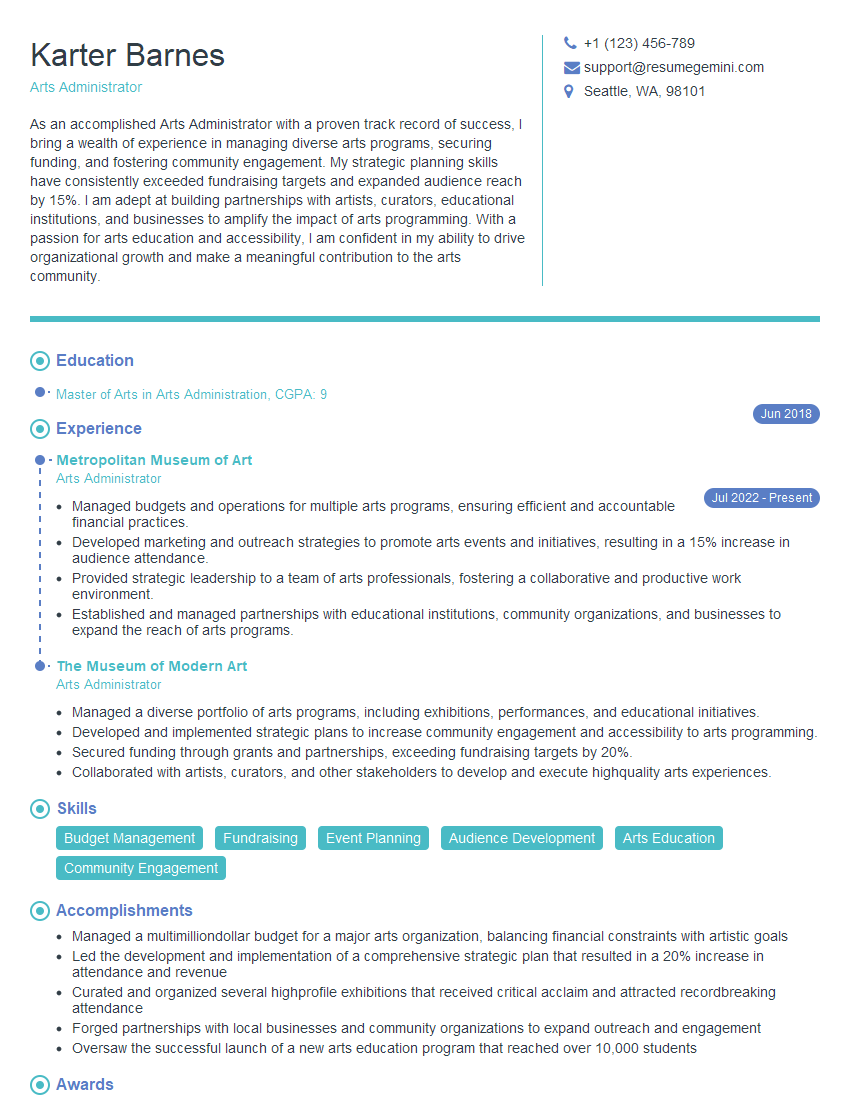
Mastering Arts Advocacy and Policy opens doors to impactful and fulfilling careers, allowing you to champion the arts and shape cultural landscapes. A strong resume is crucial for showcasing your skills and experience to potential employers. Creating an ATS-friendly resume significantly increases your chances of getting your application noticed. We recommend leveraging ResumeGemini, a trusted resource, to build a professional and effective resume. ResumeGemini provides examples of resumes specifically tailored to Arts Advocacy and Policy roles, guiding you through the process of highlighting your unique qualifications. Take the next step in your career journey – build a compelling resume that showcases your passion and expertise.
Explore more articles
Users Rating of Our Blogs
Share Your Experience
We value your feedback! Please rate our content and share your thoughts (optional).
What Readers Say About Our Blog
Very informative content, great job.
good