Interviews are opportunities to demonstrate your expertise, and this guide is here to help you shine. Explore the essential ASME B31.1 Power Piping interview questions that employers frequently ask, paired with strategies for crafting responses that set you apart from the competition.
Questions Asked in ASME B31.1 Power Piping Interview
Q 1. Explain the scope of ASME B31.1.
ASME B31.1, Power Piping, covers the design, materials, fabrication, erection, test, and inspection of power piping systems. Think of it as the bible for ensuring the safety and reliability of piping used in power plants, refineries, and other high-pressure, high-temperature applications. Its scope explicitly excludes piping covered by other ASME B31 codes, like those for chemical plants or refrigeration systems. It dictates everything from the minimum wall thickness of a pipe to the proper design of supports, encompassing a vast range of considerations crucial for preventing failures and ensuring operational safety.
In essence, it sets the industry standard for safe and reliable power piping design and construction, ensuring these vital systems operate without risk of catastrophic failure. For example, a power plant relies heavily on B31.1 compliant piping to safely transport high-pressure steam. Any deviation from these standards could lead to serious consequences.
Q 2. Describe the different classes of piping in ASME B31.1.
ASME B31.1 categorizes piping into different classes based on design temperature and pressure. These classes aren’t arbitrary; they directly influence the materials used, the required wall thickness, and the overall design considerations. Higher classes represent more demanding service conditions.
- Class 1: This is for the most severe service conditions, typically involving high temperatures and pressures, demanding robust materials and stringent design considerations. Think of the main steam lines in a power plant.
- Class 2: Represents moderate service conditions, less demanding than Class 1, but still requiring careful design and material selection. Examples could include auxiliary steam lines.
- Class 3: The least stringent class, often used for lower pressure and temperature systems. An example would be non-critical service water lines.
The selection of the appropriate piping class is crucial for ensuring the long-term integrity and reliability of the system. Improper classification could lead to premature failure or even catastrophic accidents.
Q 3. How do you determine the minimum wall thickness of a pipe according to ASME B31.1?
Determining the minimum wall thickness in ASME B31.1 is a multi-step process, involving several factors. It’s not just about the internal pressure; temperature, corrosion allowance, and the pipe material’s properties all play a crucial role.
The basic formula involves calculating the minimum required thickness based on internal pressure (using the Barlow’s formula, modified for ASME B31.1 considerations), then adding corrosion allowance and any other necessary allowances. The formula might seem daunting, but engineering software significantly simplifies the calculation process. Experienced engineers use software to account for all the variables accurately. A simplified representation looks like this:
tm = (PiR)/(SeE - 0.6Pi) + CAWhere:
tm= Minimum required thicknessPi= Internal design pressureR= Pipe inside radiusSe= Allowable stress of the material at design temperatureE= Weld joint efficiencyCA= Corrosion allowance
Remember, this is a simplified representation. The actual calculation in accordance with ASME B31.1 is more complex and depends on various factors, including the specific material, welding type, and operating conditions. Ignoring any of these aspects can compromise the integrity of the pipe.
Q 4. What are the different types of pipe supports, and how are they selected?
Pipe supports are critical for preventing excessive stress and vibration in piping systems. The wrong support can lead to premature failure. Several types exist, each with its own advantages and disadvantages:
- Rigid Supports: These firmly restrain the pipe in all directions, offering excellent stability but potentially concentrating stress at the support point.
- Flexible Supports: Allow for some movement of the pipe, reducing stress concentrations but requiring careful design to prevent excessive movement.
- Guides: Restrict movement in one direction only, providing directional control while allowing movement in other directions.
- Anchors: Fix the pipe’s position, usually used as a reference point for stress calculations.
Support selection is driven by several factors: pipe size, operating temperature and pressure, the piping system’s layout, and the expected thermal expansion. Proper support design reduces stress and vibration, maximizing the lifespan and safety of the system. A poorly designed support system is akin to a poorly built bridge – it could collapse under pressure.
Q 5. Explain the importance of stress analysis in power piping systems.
Stress analysis is crucial for ensuring the safe and reliable operation of power piping systems. It determines the stresses induced in the pipes due to internal pressure, weight, thermal expansion, and other external loads. Without stress analysis, you’re essentially flying blind, potentially leading to unexpected and potentially catastrophic failures.
A thorough stress analysis ensures that the stresses remain within the allowable limits for the pipe material, preventing issues like fatigue cracking, creep, or other forms of failure. This is particularly critical in high-pressure, high-temperature systems where even minor oversights can have disastrous consequences. Imagine a steam line failing in a power plant—the safety implications are severe.
Q 6. What are the common methods for stress analysis of piping systems?
Several methods exist for performing stress analysis on piping systems, ranging from simplified hand calculations to sophisticated computer-aided engineering (CAE) techniques:
- Simplified Hand Calculations: Suitable for basic systems, but limited in accuracy and applicability.
- Equivalent Static Method (ESM): A simplified method that considers the static loads on the pipe. Less accurate for complex systems.
- Finite Element Analysis (FEA): The most comprehensive and accurate approach, employing sophisticated software to simulate the behavior of the piping system under various loading conditions.
The choice of method depends on the complexity of the piping system and the level of accuracy required. FEA is the preferred method for complex systems where high accuracy is paramount.
Q 7. How do you handle flexibility analysis in ASME B31.1?
Flexibility analysis in ASME B31.1 ensures that the piping system can accommodate thermal expansion and contraction without inducing excessive stresses. It’s about ensuring the system can ‘breathe’ without self-destructing. This is vital because the temperature of fluids within pipes constantly changes, causing the pipe to expand and contract.
The analysis involves calculating the flexibility of the piping system using various methods. The goal is to determine if the system’s flexibility is sufficient to accommodate the expected thermal movements. If not, adjustments to the support system or pipe routing may be necessary. This might involve adding expansion joints or flexible supports to absorb the movement and prevent stress buildup.
This process, often done in conjunction with stress analysis, prevents the creation of points of high stress concentration in the piping due to thermal expansion. Ignoring flexibility could lead to pipe failure due to fatigue.
Q 8. Describe the different types of pipe bends and their applications.
ASME B31.1 covers several types of pipe bends, each designed for specific applications based on their ability to absorb stress and change direction. The choice depends on factors like space constraints, pressure, temperature, and the fluid being transported.
- Standard Bends (or Long Radius Bends): These bends have a radius of curvature that’s typically at least 1.5 times the pipe’s nominal diameter. They are the most common type, offering a good balance between stress mitigation and space efficiency. They’re ideal for many general applications in power plants where space is not severely limited.
- Short Radius Bends: As the name suggests, these have a smaller radius of curvature (often less than 1.5 times the pipe diameter). They’re space-saving, but because of the tighter bend, they experience higher stress. Therefore, they’re used less frequently and might require thicker pipe walls or stress analysis to ensure safety, particularly at higher pressures and temperatures.
- Mitre Bends: These are constructed from multiple short pipe sections joined at angles to create the bend. While very compact, they generate significant stress concentrations at the joints and are generally avoided unless absolutely necessary due to space limitations. They often require reinforcement and rigorous stress analysis.
- Fabricated Bends: These are custom-made bends, often created using specialized bending equipment to meet very specific requirements of a project. They offer design flexibility but come with higher costs.
For example, a long-radius bend might be used for a large-diameter steam line in a power plant, where space is available. A short-radius bend might be necessary in a crowded area of a refinery’s piping network. Mitre bends are rarely seen in major power piping systems due to their stress concentration issues.
Q 9. Explain the concept of allowable stress in ASME B31.1.
Allowable stress in ASME B31.1 represents the maximum stress a pipe can withstand under operating conditions while maintaining its integrity and safety. It’s not a material property but rather a design limit. The allowable stress is determined by considering several factors:
- Material Properties: The material’s yield strength, ultimate tensile strength, and temperature are crucial. ASME B31.1 provides tables with allowable stresses for various materials at different temperatures.
- Design Factors: These factors account for uncertainties in manufacturing, material properties, and loading conditions. They provide a safety margin, ensuring that the actual stress remains well below the material’s yield strength.
- Stress Categories: ASME B31.1 categorizes stresses into different types (e.g., bending, axial, thermal). Each category may have different allowable stress values to account for their effects on the pipe.
- Weld Joint Efficiency: The quality of welds affects the overall strength of the piping system. Weld efficiency factors are applied to account for potential weld imperfections.
Imagine a pipe carrying high-pressure steam. The allowable stress ensures the pipe won’t deform or fail under the combined pressures and temperatures. If the calculated stress exceeds the allowable stress, the pipe’s diameter, wall thickness, or material must be increased to meet code requirements.
Q 10. How do you select appropriate materials for power piping systems?
Material selection for power piping is a critical decision based on a complex interplay of factors. ASME B31.1 provides guidance, but the final choice depends on the specific service conditions.
- Fluid Properties: The temperature, pressure, and chemical composition of the fluid dictate the material’s corrosion resistance and ability to withstand the thermal stresses.
- Operating Temperature: High temperatures can significantly reduce material strength. The selected material must have the necessary creep strength at the operating temperature. Creep is the slow deformation of a material under constant load and high temperature.
- Operating Pressure: Higher pressures necessitate materials with higher yield strength.
- Corrosion Considerations: The fluid’s aggressiveness (its tendency to corrode) is critical. If the fluid is corrosive, materials like stainless steel or special alloys resistant to that particular type of corrosion must be chosen.
- Weldability: The chosen material needs to be weldable using appropriate welding processes that comply with ASME Section IX requirements.
For example, carbon steel is a common choice for lower temperature and pressure applications, while stainless steel alloys are preferred for corrosive or high-temperature services. More exotic alloys like Inconel or Monel may be necessary for highly corrosive or extreme-temperature environments.
Q 11. What are the requirements for welding and inspection of power piping?
Welding and inspection in power piping are strictly regulated by ASME B31.1 and ASME Section IX. The quality of welds is paramount to the safety and reliability of the system. These requirements involve:
- Qualified Welders and Procedures: Welders must be qualified according to ASME Section IX, demonstrating their proficiency in welding the specific materials and processes used in the project. Welding procedures must also be qualified to ensure consistent weld quality.
- Welding Processes: ASME B31.1 dictates acceptable welding processes for various materials and pipe sizes. These processes might include shielded metal arc welding (SMAW), gas metal arc welding (GMAW), or gas tungsten arc welding (GTAW).
- Non-Destructive Examination (NDE): After welding, NDE methods are used to detect any internal defects that might compromise the weld’s integrity. Common methods include radiographic testing (RT), ultrasonic testing (UT), and liquid penetrant testing (PT).
- Documentation: Detailed records of all welding procedures, welder qualifications, and NDE results must be maintained.
Failing to comply with these requirements can result in costly rework, project delays, and severe safety risks. A robust welding and inspection program is crucial to the longevity and safety of a power piping system.
Q 12. Explain the importance of hydro testing in power piping systems.
Hydrostatic testing is a crucial step in verifying the integrity of a power piping system before it goes into operation. It involves pressurizing the piping system with water to a specified test pressure to detect any leaks or weaknesses.
- Leak Detection: Hydro testing identifies leaks, which are a significant safety hazard in power piping systems. Leaks can cause fluid loss, damage to equipment, and environmental contamination.
- Strength Verification: The test pressure is typically higher than the system’s operating pressure, ensuring that the piping can withstand the expected stresses. This verifies the adequacy of design, material selection, and construction.
- Compliance with Codes: ASME B31.1 specifies the requirements for hydrostatic testing, including test pressure, duration, and acceptance criteria.
- Pre-Commissioning Step: Hydrostatic testing is a critical pre-commissioning activity, allowing for the identification and correction of flaws before the system is put into service.
Imagine a flaw in a weld. A hydro test will reveal this flaw, preventing a catastrophic failure during operation. The water pressure simulates operating conditions, exposing potential weaknesses that visual inspection alone might miss.
Q 13. Describe the procedures for preparing a piping isometric drawing.
A piping isometric drawing is a 2D representation of a piping system’s layout, presented in an isometric projection to show all the components and their spatial relationships clearly. It’s a crucial document used for fabrication, installation, and maintenance.
- Gathering Data: Information needed includes piping specifications (size, material, schedule), component details (valves, fittings, equipment connections), and the overall system layout.
- Isometric Projection: The drawing is created using an isometric projection to show the three dimensions of the piping system on a 2D plane. This avoids distortion and allows accurate representation of angles and distances.
- Component Placement: Piping components, such as valves and fittings, are accurately positioned and labeled.
- Line Identification: Unique line numbers and designations are assigned to each pipe run for clear identification.
- Dimensions and Specifications: Precise dimensions and technical specifications (pipe size, material, etc.) are indicated.
- Bill of Materials: A bill of materials (BOM) is often included, listing all components and quantities.
Preparing an isometric is meticulous work requiring attention to detail. Errors can lead to costly rework during fabrication or installation. Specialized software is often used to generate these drawings, which are crucial for efficient coordination and construction of complex piping systems.
Q 14. How do you identify and address potential piping system failures?
Identifying and addressing potential piping system failures requires a proactive approach, blending engineering knowledge, risk assessment, and routine maintenance.
- Regular Inspections: Visual inspections, coupled with non-destructive examination (NDE) techniques, allow for the detection of corrosion, erosion, or other defects.
- Stress Analysis: Finite element analysis (FEA) or other methods can assess stress levels within the piping system under different operating conditions, helping predict potential failure points.
- Vibration Analysis: High levels of vibration can cause fatigue failures. Vibration analysis helps identify the sources of vibration and implement mitigation strategies.
- Fluid Analysis: Regular analysis of the fluid can reveal the presence of corrosive chemicals or other factors that might lead to degradation of the piping.
- Predictive Maintenance: Utilizing data from sensors and monitoring systems, predictive maintenance allows for proactive repairs before failures occur. This technique requires investment in the right tools, but it yields significant returns by reducing downtime and preventing catastrophic failures.
- Root Cause Analysis: When failures occur, a thorough root cause analysis must be done to prevent similar failures in the future.
Think of a pressure vessel failing due to fatigue. Regular inspections, coupled with stress analysis, could have identified the high-stress area and allowed for the implementation of a mitigation strategy – possibly by strengthening the vessel or modifying its operating parameters. Ignoring potential failures can lead to costly repairs or even plant shutdown.
Q 15. What are the considerations for designing piping systems for seismic loads?
Designing piping systems to withstand seismic loads is crucial for safety and preventing catastrophic failures. ASME B31.1 provides guidance on how to account for these dynamic forces. The process involves analyzing the expected ground motion at the plant’s location and applying appropriate seismic response spectra to determine the forces and moments acting on the piping system. This is typically done using engineering analysis software.
Considerations include:
- Seismic Zone: The location’s seismic zone dictates the design basis earthquake (DBE) and operating basis earthquake (OBE) parameters. A higher seismic zone requires more robust design.
- Piping Material and Configuration: The flexibility of the piping material and the system’s overall geometry significantly influence its response to seismic events. Rigid systems are more susceptible to damage.
- Support System Design: Supports must be designed to withstand both static and dynamic loads. Properly designed supports, including restraints, can significantly mitigate seismic damage.
- Stress Analysis: Detailed stress analysis is performed to ensure that stresses in the piping system remain within allowable limits under seismic loads. This often involves Finite Element Analysis (FEA).
- Dynamic Analysis: A dynamic analysis is used to model the piping system’s behavior under seismic excitation, accurately predicting stresses and displacements.
Example: Imagine a power plant located in a high seismic zone. The piping system would need to incorporate features like flexible restraints, strategically placed supports, and potentially incorporate snubbers (energy-absorbing devices) to limit excessive movement during an earthquake. Without proper seismic design, even a relatively small earthquake could cause significant damage to the piping, leading to leaks or even ruptures, resulting in costly repairs and potential environmental hazards.
Career Expert Tips:
- Ace those interviews! Prepare effectively by reviewing the Top 50 Most Common Interview Questions on ResumeGemini.
- Navigate your job search with confidence! Explore a wide range of Career Tips on ResumeGemini. Learn about common challenges and recommendations to overcome them.
- Craft the perfect resume! Master the Art of Resume Writing with ResumeGemini’s guide. Showcase your unique qualifications and achievements effectively.
- Don’t miss out on holiday savings! Build your dream resume with ResumeGemini’s ATS optimized templates.
Q 16. Explain the role of pressure relief devices in power piping systems.
Pressure relief devices (PRDs) are safety critical components in power piping systems. Their primary role is to protect the system from overpressure situations that can arise from various causes, such as equipment malfunction, fire, or external events. They act as a last line of defense to prevent catastrophic failures.
Types of PRDs include:
- Safety Relief Valves (SRVs): Automatically open when a predetermined pressure is exceeded, relieving excess pressure to the atmosphere or a safe disposal system.
- Safety Valves: Similar to SRVs but are typically spring-loaded and open quickly to relieve excess pressure.
- Rupture Discs: A thin membrane designed to burst at a predetermined pressure. They are typically used for single-use applications.
ASME B31.1 specifies requirements for the sizing, selection, and installation of PRDs. This involves considering factors such as the system’s operating pressure, fluid properties, and the potential for pressure surges. Proper maintenance and testing of PRDs are crucial to ensure their effectiveness.
Example: In a boiler system, an SRV might be installed to protect the boiler from overpressure caused by a malfunctioning burner or excessive heat input. Should the pressure exceed the setpoint, the SRV would automatically open, relieving the excess pressure and preventing a potentially dangerous explosion.
Q 17. What are the requirements for pipe insulation and fire protection?
Pipe insulation and fire protection are vital for maintaining operational efficiency, energy conservation, and ensuring personnel safety. ASME B31.1 doesn’t directly cover insulation design details; however, it implies the need for considerations for pipe support design and thermal expansion in relation to insulation. Fire protection is more explicitly addressed through referencing other codes and standards.
Pipe Insulation:
- Energy Conservation: Insulation reduces heat loss (or gain) from hot (or cold) piping, minimizing energy consumption and operating costs. Insulation material selection is guided by operating temperature and environmental factors.
- Personnel Safety: Insulation protects personnel from burns or frostbite by reducing surface temperature of the pipes to safe levels.
- Corrosion Prevention: In certain applications, insulation can aid in preventing corrosion by providing a barrier against moisture.
Fire Protection:
- Fireproofing Materials: Fireproofing materials are applied to pipes to prevent or delay the spread of fire, thus providing crucial time for evacuation and emergency response.
- Fire Protection Systems: Fire suppression systems, such as sprinklers, may need to be integrated with the piping system design to ensure their effectiveness. The piping system design must accommodate sprinkler lines and other fire safety equipment without compromising structural integrity.
- Fire-resistant Insulation: Some insulation materials are specifically designed for fire resistance, further enhancing the protection of the piping system and surrounding areas.
Example: In a refinery, pipes carrying hot oil would require significant insulation to reduce heat loss and to protect workers from burns. Additionally, fire-rated insulation and passive fire protection systems would be needed to mitigate the risk of fire spreading in the event of a fire.
Q 18. How do you manage piping systems’ thermal expansion and contraction?
Thermal expansion and contraction of piping systems due to temperature changes can cause significant stresses, leading to fatigue failure if not properly managed. ASME B31.1 addresses this by requiring consideration of thermal expansion when designing and supporting the piping.
Methods for managing thermal expansion and contraction include:
- Expansion Joints: These flexible components accommodate axial, lateral, or angular movement caused by temperature changes. Different types of expansion joints are available, including bellows, U-bends, and loops.
- Pipe Supports and Restraints: Strategic placement of supports and restraints helps to guide the piping’s movement, controlling expansion and contraction and preventing excessive stresses. Careful design of the support system is critical.
- Flexibility Analysis: Software-based flexibility analyses are employed to predict the piping system’s behavior under various temperature conditions, helping to identify potential stress concentrations and areas requiring additional support.
Example: A long pipeline carrying high-temperature steam would require expansion joints to accommodate the significant thermal expansion. A loop in the piping might also be used to accommodate expansion, in place of an expansion joint. Without proper design, this thermal expansion could lead to excessive stress on the pipe, potentially causing leaks or ruptures.
Q 19. Describe different types of pipe hangers and their applications.
Pipe hangers are crucial components for supporting piping systems, ensuring their stability and preventing excessive stresses. The choice of hanger depends on the pipe’s size, weight, operating conditions, and the level of movement allowed.
Different types of pipe hangers include:
- Rigid Hangers: Provide fixed support and prevent any movement. These are mainly used for short spans of piping and vertical runs.
- Variable Spring Hangers: Compensate for variations in pipe weight and temperature-induced changes. They provide a constant support force, which varies with the movement of the piping.
- Constant Support Hangers: Provide a constant support force regardless of pipe weight and temperature variations. They allow for some movement.
- Snubbers: Restrict excessive movement due to seismic events or other dynamic loads, protecting the piping from damage while allowing for normal thermal expansion.
- Hydraulic Snubbers: Employ hydraulic cylinders to dampen movement while allowing for normal operation.
- Mechanical Snubbers: Use mechanical devices, such as friction, to restrict excessive movement.
Example: A long horizontal pipeline might utilize variable spring hangers to accommodate thermal expansion and changes in pipe fill, ensuring that the piping is always adequately supported.
Q 20. How are pipe supports designed to withstand dynamic loads?
Pipe supports must be robust enough to withstand dynamic loads, such as those caused by earthquakes, pressure surges, or equipment vibration. Improperly designed supports can lead to failure during these events, potentially causing significant damage and downtime.
Designing supports for dynamic loads involves:
- Seismic Analysis: A seismic analysis is conducted to determine the forces and moments on the piping system during an earthquake. This analysis considers the seismic zone, soil conditions, and the piping system’s characteristics.
- Dynamic Load Calculations: Calculations are performed to determine dynamic loads from sources other than seismic events, such as equipment vibration or fluid hammer.
- Support Selection and Design: Supports are selected that can adequately resist both static and dynamic loads. This often involves using specialized supports, such as snubbers or energy absorbers.
- Detailed Drawings: Detailed drawings clearly show the location, type, and specifications of all supports, ensuring proper installation and functionality.
Example: In a power plant located in a high seismic zone, pipe supports would need to be designed to withstand significant seismic forces. This might involve using robust anchors, seismic restraints, and snubbers to control pipe movement during an earthquake.
Q 21. Explain the concept of piping flexibility and its importance.
Piping flexibility refers to the ability of a piping system to accommodate thermal expansion, pressure changes, and other forces without excessive stress. A flexible system can adapt to changes in its environment, reducing the likelihood of failure. ASME B31.1 uses flexibility analysis to design a system that is capable of tolerating stresses and deformations that are within acceptable limits.
Importance of piping flexibility:
- Preventing Failures: A flexible system is less prone to fatigue failure due to cyclic loading from temperature changes or pressure fluctuations.
- Reducing Stress Concentrations: Proper flexibility helps distribute stresses evenly, minimizing stress concentrations that can lead to cracks or leaks.
- Maintaining System Integrity: A flexible piping system maintains its integrity under various operating conditions, ensuring continuous and safe operation.
- Minimizing Support Requirements: A well-designed flexible system may reduce the number of supports required, simplifying installation and reducing costs.
Example: A rigid piping system is more likely to fail under thermal expansion because it can’t easily accommodate the movement. A flexible system, on the other hand, can absorb the expansion, reducing stress levels and preventing potential failures.
Q 22. Describe different types of pipe fittings and their applications.
Pipe fittings are essential components connecting pipes of different sizes, changing direction, or branching the flow. They come in various types, each suited for specific applications. Let’s look at some common examples:
- Elbows: Used to change the direction of the pipe. They can be 45-degree, 90-degree, or even longer radius elbows to minimize pressure drop. The choice depends on the space constraints and the desired pressure loss. For instance, a long radius elbow is preferred in high-pressure applications to reduce stress concentration.
- Tees: Allow for branching the flow in three directions. They come in different configurations: run tees (main flow continues through the run), and side outlet tees (flow branches off to the side). Selection depends on the flow distribution requirements.
- Reducers/Enlargers: Used to connect pipes of different diameters, gradually changing the flow area to minimize turbulence and pressure loss. Concentric reducers connect pipe centers directly whereas eccentric reducers offset the centers, helpful when maintaining a constant flow elevation.
- Crosses: Allow for flow to go in four directions, facilitating complex piping networks.
- Couplings: Join two pipes of the same size, often used for repairs or extending existing lines.
- Unions: Allow for easy disconnection of pipe sections for maintenance or replacement. This is crucial for accessibility and simplifies repair in critical situations.
- Valves: (Although often categorized separately, they are a critical type of fitting) Control and regulate the flow of fluids, including gate valves, globe valves, ball valves, etc. The choice depends on the specific application – for instance, a gate valve is best for throttling large-diameter high-pressure lines, whereas a globe valve is usually better for frequent on/off operations.
The selection of fitting type and material depends on factors like pressure, temperature, fluid properties (corrosiveness, viscosity), and the specific application requirements outlined in ASME B31.1.
Q 23. How do you handle fluid dynamic effects in pipe design?
Handling fluid dynamic effects is crucial for efficient and safe pipe design. ASME B31.1 acknowledges this by requiring consideration of factors like velocity, pressure drop, and flow regime. Here’s how we address these:
- Velocity Control: Excessive velocity can lead to erosion, noise, and cavitation. ASME B31.1 provides guidelines for maximum allowable velocities for different fluids and pipe materials. We ensure designs stay within these limits by carefully calculating pipe diameters and flow rates. For example, we might increase the pipe diameter to decrease the flow velocity in a corrosive liquid line to extend the pipe’s lifespan.
- Pressure Drop Calculation: We use equations like the Darcy-Weisbach equation or Hazen-Williams equation to calculate pressure drop along the pipe length and through fittings. This pressure drop must be accounted for to ensure adequate pump capacity and system performance. Software tools significantly aid in these calculations and in visualizing potential issues.
- Flow Regime Analysis: For some fluids, especially those with high viscosity, understanding the flow regime (laminar or turbulent) is crucial. The flow regime influences the pressure drop calculation method. We use appropriate correlations and software to determine the flow regime and apply the correct calculation method.
- Surge Analysis: Sudden changes in flow, such as valve closure, can cause pressure surges (water hammer). We perform surge analysis to design the system to withstand these transient pressures, potentially incorporating surge protection devices like air chambers or surge tanks.
Ignoring fluid dynamics can result in inadequate pump sizing, premature pipe failure, excessive noise, and system instability, therefore a thorough analysis is always warranted.
Q 24. What is the significance of the B31.1 code in ensuring safety and reliability?
ASME B31.1, Power Piping, is the cornerstone of safety and reliability in power plant piping systems. It provides comprehensive rules for design, fabrication, assembly, erection, testing, and inspection of piping systems carrying gases, steam, liquids, and other fluids. Its significance lies in:
- Standardized Design Practices: It establishes consistent design methodologies, preventing design flaws that could lead to failures. This standardization ensures uniformity across different projects and organizations.
- Material Selection: The code specifies allowable materials based on pressure, temperature, and fluid properties, thus reducing the risk of material incompatibility or failure due to corrosion or other environmental factors. We select materials per ASME B31.1 section 9, considering factors like pressure temperature rating and corrosion allowance.
- Stress Analysis Requirements: ASME B31.1 mandates stress analysis to ensure the piping system can withstand operating and accidental loads (such as seismic events) without exceeding allowable stresses. This prevents fatigue failures and catastrophic events.
- Testing and Inspection Procedures: The code specifies rigorous testing and inspection procedures at various stages of the project, from material inspection to hydrostatic testing and final inspection, minimizing the risk of undetected defects.
- Safety Factor: Inherent safety factors are built into the design codes to account for uncertainties and potential variations in material properties or operating conditions.
Adherence to ASME B31.1 minimizes risks associated with piping system failures such as leaks, ruptures, and fires – protecting personnel, equipment, and the environment. Non-compliance can lead to significant financial losses and legal consequences.
Q 25. How do you perform a pressure drop calculation for a piping system?
Calculating pressure drop in a piping system involves a methodical approach. It’s not a single equation but a series of calculations accounting for various factors. Here’s a simplified outline:
- Define System Parameters: Identify the fluid properties (density, viscosity), flow rate, pipe diameter, pipe length, and all fittings (elbows, tees, valves etc.).
- Calculate Friction Losses: Use the Darcy-Weisbach equation or similar methods to estimate the frictional pressure drop in the straight pipe sections. This requires determining the friction factor (f), which depends on the pipe roughness and the Reynolds number (a dimensionless number indicating flow regime).
- Calculate Fitting Losses: Each fitting contributes to pressure drop due to flow restrictions. Equivalent length methods or K-factor methods are used to calculate the pressure drop associated with each fitting. These values can be found in manufacturers’ catalogs or handbooks.
- Sum Individual Pressure Drops: Add all frictional losses and fitting losses along the pipeline to determine the total pressure drop.
- Verify Results: Compare the calculated pressure drop to the available pump head to ensure the system can operate effectively. Iteration may be needed to adjust pipe diameter or pump capacity if needed.
Example: ΔP = f * (L/D) * (ρV²/2) + Σ(K * (ρV²/2)) Where: ΔP = pressure drop, f = friction factor, L = pipe length, D = pipe diameter, ρ = fluid density, V = fluid velocity, K = fitting loss coefficient, and Σ represents the summation of losses for all fittings.
Software tools significantly simplify this process, often providing automated calculations and graphical representations of pressure profiles along the piping system.
Q 26. What are the common causes of piping system leaks and failures?
Piping system leaks and failures can stem from various sources. A thorough understanding of these causes is critical for preventive maintenance and robust design.
- Corrosion: Chemical attack on pipe materials is a major culprit. This can be exacerbated by environmental factors like soil conditions or the presence of aggressive chemicals in the fluid. Proper material selection (as per ASME B31.1) and corrosion protection measures are essential.
- Erosion: High fluid velocities or the presence of solids in the fluid can erode pipe walls, especially at bends and fittings. This necessitates careful velocity control during the design phase. The use of erosion-resistant materials is important in such applications.
- Stress Corrosion Cracking (SCC): A combination of tensile stress and a corrosive environment can cause cracking. This often happens in high-stress areas or in the presence of specific chemical species in the fluid.
- Fatigue: Cyclic loading from pressure fluctuations or vibrations can lead to fatigue cracks. Proper design and selection of materials with high fatigue strength help mitigate this risk.
- Improper Installation: Incorrect welding, insufficient support, or poor alignment during installation can significantly weaken the piping system and lead to leaks or failures. Proper welding procedures and quality control are paramount.
- Thermal Stress: Rapid temperature changes can induce significant thermal stresses, leading to cracks or leaks. Proper expansion joints and thermal stress analysis are crucial in applications with significant temperature variations.
- External Loads: Unforeseen events such as earthquakes or vehicle impacts can create stresses exceeding the design limits, leading to failures. Therefore appropriate seismic analysis needs to be conducted in seismically active zones.
Regular inspections, proper maintenance, and adherence to ASME B31.1 guidelines throughout the piping system lifecycle are vital to prevent these failures.
Q 27. Describe your experience with piping design software.
I possess extensive experience using various piping design software packages, including CAESAR II, AutoPIPE, and PV Elite. These tools are invaluable for efficient and accurate design and analysis.
- CAESAR II: Primarily used for stress analysis, CAESAR II helps determine if piping systems meet ASME B31.1 requirements under various loading conditions, including operating loads, thermal expansion, wind, seismic, and other potential events.
- AutoPIPE: This software excels in performing detailed fluid dynamic calculations, including pressure drop, velocity, and surge analysis. It allows for efficient optimization of pipe networks.
- PV Elite: This software is powerful for pressure vessel and piping component design and analysis. It facilitates design and ensures that the pressure rating of components are within the allowable limits per ASME codes.
My expertise extends beyond simply using these tools. I understand the underlying engineering principles and can interpret the software outputs critically, ensuring the results accurately reflect the real-world behavior of the piping system. I can also effectively use the software to create detailed isometric drawings and other documentation required for fabrication and construction.
Q 28. How do you ensure compliance with ASME B31.1 throughout the project lifecycle?
Ensuring ASME B31.1 compliance throughout a project lifecycle requires a proactive and multi-faceted approach. It’s not a one-time effort but an integrated process.
- Design Phase: We begin by thoroughly reviewing the project requirements and defining all relevant parameters to meet the code’s design criteria. We perform thorough stress analysis, fluid dynamic calculations, and material selection according to ASME B31.1.
- Procurement Phase: All materials, fittings, and components must meet the code’s specifications. We ensure proper documentation and traceability of materials. This might involve checking manufacturer’s certifications and test reports.
- Fabrication and Construction Phase: Strict adherence to welding procedures (per ASME Section IX) is vital. We perform quality control inspections during fabrication and installation, documenting everything meticulously. This involves visual inspections, non-destructive testing, and ensuring proper alignment and support.
- Testing Phase: Hydrostatic testing is crucial to verify the system’s integrity. We conduct tests according to ASME B31.1 procedures and document all test results.
- Commissioning Phase: Finally, we ensure the piping system operates as designed and within code limits. This may involve observing and recording system performance data.
- Ongoing Maintenance: After project completion, we follow a defined maintenance and inspection plan to detect and address potential issues early on. We utilize the documentation created during construction phases to aid in maintenance and repairs.
By systematically integrating ASME B31.1 requirements throughout these phases, we minimize risks, enhance safety, and ensure the long-term reliability of the piping system.
Key Topics to Learn for ASME B31.1 Power Piping Interview
- Code Structure and Scope: Understand the organization of ASME B31.1, its applications, and limitations. Be prepared to discuss its relationship to other ASME codes and standards.
- Material Specifications: Familiarize yourself with allowable stresses, material selection criteria, and the impact of material properties on pipe design. Practice identifying appropriate materials for various operating conditions.
- Design of Piping Systems: Master the calculations for pipe stress analysis, including thermal expansion, pressure forces, and support requirements. Understand different types of pipe supports and their applications.
- Pressure Testing and Examination: Know the procedures for hydrostatic testing, leak testing, and non-destructive examination (NDE) methods. Be able to explain the rationale behind these procedures.
- Welding and Fabrication: Understand welding procedures, qualifications, and inspection requirements as specified in ASME B31.1. Be prepared to discuss different welding techniques and their suitability for various applications.
- Flexibility Analysis: Be comfortable with methods to determine the flexibility of piping systems and how to address potential stress concentrations.
- Corrosion and Erosion: Understand the factors contributing to corrosion and erosion in piping systems and mitigation strategies. Be able to discuss material selection and design considerations to minimize these issues.
- Insulation and Fire Protection: Familiarize yourself with requirements for pipe insulation, fireproofing, and their importance in safety and operational efficiency.
- Practical Problem Solving: Develop your ability to apply theoretical knowledge to real-world scenarios. Practice identifying potential problems and proposing effective solutions based on ASME B31.1 guidelines.
Next Steps
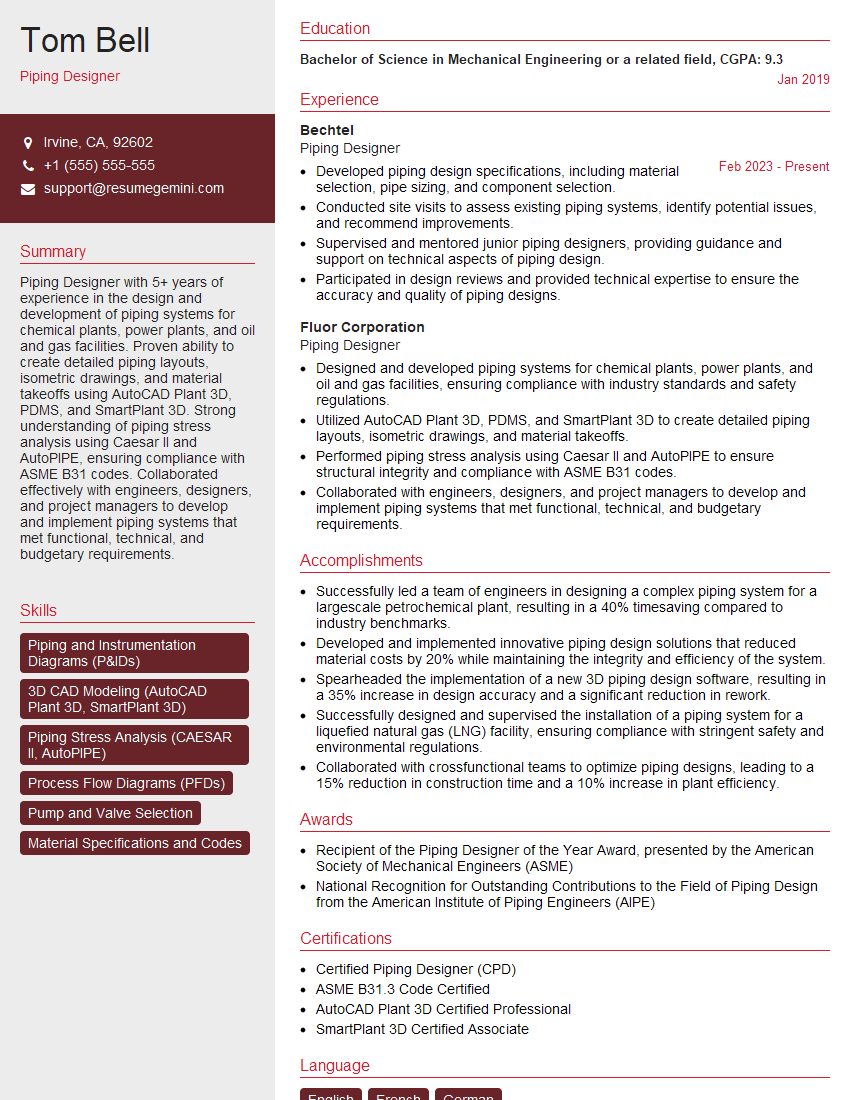
Mastering ASME B31.1 Power Piping opens doors to exciting career opportunities in the energy and process industries, offering significant growth potential and higher earning capacity. To maximize your chances of landing your dream role, invest time in creating a compelling, ATS-friendly resume that effectively highlights your skills and experience. ResumeGemini is a trusted resource that can help you build a professional and impactful resume, tailored to the specific requirements of ASME B31.1 Power Piping roles. Examples of resumes tailored to this specific field are available within ResumeGemini to guide you.
Explore more articles
Users Rating of Our Blogs
Share Your Experience
We value your feedback! Please rate our content and share your thoughts (optional).
What Readers Say About Our Blog
Very informative content, great job.
good