Cracking a skill-specific interview, like one for Assessing Rider Performance, requires understanding the nuances of the role. In this blog, we present the questions you’re most likely to encounter, along with insights into how to answer them effectively. Let’s ensure you’re ready to make a strong impression.
Questions Asked in Assessing Rider Performance Interview
Q 1. Describe your experience in assessing rider skills.
My experience in assessing rider skills spans over 15 years, encompassing various riding disciplines from novice to advanced levels. I’ve worked with riders of all ages and skill sets, including motorcycle riders, cyclists, and equestrians. My assessment methods are tailored to the specific discipline and the rider’s experience level. This experience has provided me with a deep understanding of the nuances of rider behavior, the common pitfalls, and how to effectively identify and address areas for improvement. I’ve worked in both formal training environments and informal assessment settings, always prioritizing safety and effective communication.
Q 2. What methods do you use to evaluate rider competency?
My evaluation methods are multifaceted and include a combination of:
- Observation: I meticulously observe riders in controlled environments, noting their posture, speed control, lane positioning, signal use, and overall awareness. This includes both on-road and off-road scenarios as appropriate.
- Practical Skills Tests: These tests are specifically designed to assess core skills such as braking, cornering, maneuvering in traffic, and emergency response techniques. The difficulty is adjusted to the rider’s experience level.
- Written Assessments: Knowledge tests cover road rules, safety procedures, and vehicle mechanics. These ensure that riders understand the theoretical underpinnings of safe riding.
- Simulated Scenarios: I use realistic scenarios, sometimes through video simulations, to evaluate a rider’s response to unexpected events like sudden braking from a lead vehicle or a pedestrian stepping into the road.
- Feedback Review: A crucial step involves reviewing the performance observation with the rider, providing real-time and post-assessment feedback.
The specific methods used are determined by the context and the goals of the assessment. For instance, a licensing test will differ significantly from a performance evaluation for an experienced racer.
Q 3. How do you identify areas for improvement in a rider’s performance?
Identifying areas for improvement involves careful analysis of the data collected during the assessment. I look for patterns in behavior that deviate from safe riding practices. For example:
- Consistent braking errors: This could indicate issues with braking technique, anticipation, or reaction time.
- Poor lane positioning: This might suggest problems with spatial awareness or risk perception.
- Lack of smooth transitions: Hesitation or abrupt changes in speed and direction indicate a need to improve coordination and control.
- Inconsistent signal use: This highlights a lack of communication or an inadequate understanding of traffic laws.
- Delayed reactions to hazards: This points towards deficiencies in hazard perception and risk assessment.
By breaking down performance into smaller, more manageable components, I can pinpoint specific areas needing attention. The feedback then focuses on these specific weaknesses.
Q 4. Explain your approach to providing constructive feedback to riders.
My approach to providing constructive feedback emphasizes a positive and supportive environment. I use the SBI (Situation-Behavior-Impact) model:
- Situation: I clearly describe the specific situation where the issue occurred.
- Behavior: I objectively describe the rider’s behavior in that situation, without judgment.
- Impact: I explain the potential consequences of that behavior, emphasizing safety and efficiency.
For example, instead of saying “Your cornering was terrible,” I would say, “In the last corner, I noticed your lean angle was shallow, causing you to widen your line. This could have resulted in a wider turning radius, potentially making it difficult to navigate the next turn safely and efficiently.” I always focus on observable behaviors and their impact, rather than making personal criticisms. I also encourage questions and discussion to ensure the rider understands the feedback and agrees with the next steps.
Q 5. How do you assess a rider’s risk assessment skills?
Assessing risk assessment skills involves observing a rider’s ability to anticipate and react to potential hazards. This is evaluated through:
- Hazard Perception Tests: These tests involve presenting the rider with various scenarios, both real and simulated, requiring them to identify and respond to potential risks.
- Observation during riding: I observe how they scan their surroundings, their speed adjustments in varying conditions, and their responses to unexpected events.
- Verbal questioning: Post-ride discussions explore their thought processes during specific maneuvers or hazard encounters.
A rider with strong risk assessment skills will demonstrate proactive hazard identification, appropriate speed management, and effective decision-making under pressure. For instance, a skilled rider will reduce speed and adjust their position proactively when approaching an intersection, even if there is no immediate threat.
Q 6. How do you handle situations where a rider refuses feedback?
When a rider refuses feedback, I try to understand their perspective. It could stem from defensiveness, frustration, or a feeling that the feedback is unhelpful. I’d first acknowledge their feelings and validate their perspective. I might say, “I understand you’re feeling frustrated right now. Let’s take a break, and then we can revisit this later.”
If they remain resistant, I might adjust my approach, focusing on positive reinforcement of aspects they did well. I may also frame the feedback differently, focusing on safety rather than performance. However, ultimately, if they consistently refuse to engage, I may have to conclude the assessment, perhaps suggesting seeking additional instruction from another instructor.
Q 7. What are the key indicators of safe riding practices?
Key indicators of safe riding practices include:
- Smooth and controlled maneuvers: Avoiding sudden acceleration, braking, or steering inputs.
- Appropriate speed for conditions: Adapting speed to weather, traffic, and road conditions.
- Maintaining a safe following distance: Providing adequate space between the rider and other vehicles.
- Effective use of signals: Communicating intentions clearly to other road users.
- Proper lane positioning: Maintaining a safe and predictable position in the lane.
- Constant scanning of surroundings: Maintaining awareness of other vehicles, pedestrians, and potential hazards.
- Defensive riding techniques: Anticipating potential problems and reacting appropriately.
Observing these indicators allows for a comprehensive evaluation of a rider’s safety awareness and overall riding competency. A rider demonstrating these consistently is likely exhibiting safe riding practices.
Q 8. How do you adapt your assessment methods for different skill levels?
Adapting assessment methods to different skill levels is crucial for effective rider training. My approach involves a tiered system, adjusting the complexity and focus of the assessment based on the rider’s experience and proficiency.
For novice riders, the assessment prioritizes fundamental skills like clutch control, gear shifting, and basic maneuvering. We use simple exercises in a controlled environment, focusing on safety and building a solid foundation. For example, I might assess their ability to perform slow-speed maneuvers in a large, empty parking lot.
Intermediate riders are assessed on more advanced skills such as cornering techniques, hazard perception, and overtaking maneuvers. The assessment environment might incorporate more challenging road conditions, such as slight inclines or gentle curves. We might incorporate a simulated emergency stop exercise.
Expert riders are evaluated on their ability to handle high-speed situations, advanced riding techniques, and quick reactions to unpredictable events. Assessments for this group might involve simulations of more complex scenarios such as highway driving or riding in challenging weather conditions. We might use a professional riding track to challenge their skills further. The assessment metrics also become more nuanced, focusing on efficiency and advanced techniques.
Q 9. Describe your experience using assessment tools or checklists.
I have extensive experience using a variety of assessment tools and checklists, tailored to different rider skill levels and the specific assessment goals. These range from simple observation checklists focusing on specific maneuvers, to more complex scoring systems that consider multiple aspects of riding performance.
For example, I utilize a checklist for novice riders focusing on basic controls and safety: Does the rider maintain a safe following distance? Do they use proper signaling? Do they check their mirrors regularly? For intermediate and advanced riders, the checklist expands to include more advanced techniques and scenarios. I also use video recording and review to provide detailed feedback and assess areas needing improvement. This allows for a thorough and objective review of their performance, even providing frame-by-frame analysis of critical moments.
Quantitative scoring systems are also employed for advanced assessments. These systems assign points to different skills based on predefined criteria, providing a more objective measurement of the rider’s overall performance. For instance, a specific maneuver might be awarded points based on speed, smoothness, and safety. The quantitative results are then supplemented with qualitative observations and feedback, providing a comprehensive assessment.
Q 10. What are the most common rider errors you encounter?
The most common rider errors I encounter fall into several categories:
- Poor hazard perception: Failing to anticipate potential hazards such as pedestrians, other vehicles, or road imperfections.
- Inadequate speed management: Driving too fast for conditions or failing to adjust speed appropriately for curves, intersections, or adverse weather.
- Incorrect lane positioning: Failing to maintain a safe position within the lane or making improper lane changes.
- Insufficient braking control: Inconsistent or delayed braking, leading to longer stopping distances.
- Ineffective cornering techniques: Incorrect line selection, speed, and body positioning while negotiating curves.
- Lack of spatial awareness: Failure to accurately judge distances and clearances from other vehicles and objects.
These errors often stem from a lack of training, poor habits, or insufficient experience. Addressing these errors through targeted training and feedback is key to improving rider safety and skill.
Q 11. How do you ensure the objectivity and fairness of your assessments?
Ensuring objectivity and fairness is paramount in rider assessments. I achieve this through several key strategies:
- Standardized assessment procedures: I use pre-defined assessment criteria and methodologies to ensure consistent evaluation across all riders. This eliminates personal bias and ensures all riders are evaluated on the same basis.
- Multiple assessment methods: I use a combination of observation checklists, video recordings, and potentially quantitative scoring systems to capture a comprehensive view of the rider’s performance. This approach reduces reliance on any single method, increasing overall objectivity.
- Calibration and training: I regularly calibrate my assessment skills with other qualified assessors to ensure consistency in my evaluations. This helps avoid any subjective biases that might creep into individual judgments.
- Clear communication of criteria: Before the assessment, I clearly explain the assessment criteria, procedures, and scoring systems to the rider. This ensures transparency and builds trust in the process.
By implementing these strategies, I strive to create an assessment environment that is both objective and fair for all participants.
Q 12. How do you document your assessment findings?
Documentation of assessment findings is crucial for both the rider and the assessor. I maintain detailed records using a combination of digital and physical methods.
Each assessment is documented in a standardized report. This report typically includes:
- Rider’s identifying information (confidentiality maintained as per policy).
- Date and time of the assessment.
- Assessment method(s) used.
- Detailed description of the rider’s performance, including both strengths and weaknesses.
- Specific examples of observed behaviors and errors.
- Quantitative scores (if applicable).
- Recommendations for improvement.
- Digital recordings (video and audio, if used) linked to the report.
These reports serve as valuable records for tracking progress, identifying training needs, and providing feedback to the rider. The reports are stored securely in accordance with data protection guidelines.
Q 13. How do you maintain confidentiality during rider assessments?
Maintaining confidentiality during rider assessments is crucial. I adhere strictly to data protection policies and regulations.
Rider information is only accessed by authorized personnel involved in the assessment process. All assessment records are securely stored and access is controlled through password protection and other security measures. All identifiable information is anonymized when shared for training or research purposes unless explicit consent is obtained.
I always obtain informed consent from riders before the assessment begins. This consent clarifies what information will be collected, how it will be used, and who will have access to it. Riders are informed of their rights to access and correct their assessment records.
Q 14. How do you deal with aggressive or defensive riding behaviors?
Dealing with aggressive or defensive riding behaviors requires a calm and professional approach. Safety is paramount.
The first step is to address the behavior immediately, intervening if necessary to prevent any dangerous situations. This might involve politely but firmly requesting the rider to adjust their behavior or stopping the assessment if it becomes unsafe.
Once the immediate safety concern is addressed, I take the opportunity to discuss the observed behaviors with the rider. I would explain the risks associated with aggressive or defensive riding and outline the consequences. The conversation focuses on understanding the underlying reasons for the behavior and providing constructive feedback and suggestions for improvement. I may refer the rider for further professional guidance if necessary. Documentation of the incident is crucial, highlighting the safety concerns and actions taken.
In some cases, further training on defensive driving or anger management techniques may be recommended. The aim is to help the rider understand the importance of responsible and safe riding practices and to develop skills to manage challenging situations effectively.
Q 15. Describe a time you had to make a difficult decision during a rider assessment.
One of the toughest decisions I faced involved a rider who demonstrated excellent technical skills but exhibited concerning risk-taking behavior. During a hazard avoidance exercise, they executed the maneuver correctly but took unnecessary risks by cutting corners and exceeding the safe speed limit. Passing meant potentially exposing them to further risk, while failing could discourage a talented rider. I chose to fail them on the exercise, focusing on the risk-assessment aspect. This decision was difficult because they had clearly mastered the core skills, but ignoring the reckless behaviour would have been irresponsible. Subsequently, I spent extra time explaining the importance of risk assessment and providing corrective feedback, focusing on safer driving techniques and decision-making. Following this, they showed significant improvement in their subsequent assessment.
Career Expert Tips:
- Ace those interviews! Prepare effectively by reviewing the Top 50 Most Common Interview Questions on ResumeGemini.
- Navigate your job search with confidence! Explore a wide range of Career Tips on ResumeGemini. Learn about common challenges and recommendations to overcome them.
- Craft the perfect resume! Master the Art of Resume Writing with ResumeGemini’s guide. Showcase your unique qualifications and achievements effectively.
- Don’t miss out on holiday savings! Build your dream resume with ResumeGemini’s ATS optimized templates.
Q 16. How do you ensure the safety of both the rider and yourself during assessments?
Rider and assessor safety is paramount. My approach is multifaceted. First, a thorough pre-ride inspection is mandatory, ensuring the motorcycle is mechanically sound. I wear appropriate protective gear, including a helmet, high-visibility jacket, and sturdy boots. I also ensure the assessment environment is safe and free of potential hazards. Assessments are conducted in controlled environments whenever possible, like closed training areas. During the assessment, I maintain a safe distance, observing the rider’s performance without interfering unless an immediate safety concern arises. Clear communication is key; I use hand signals and verbal cues to guide the rider and make my intentions obvious. I frequently check my surroundings and maintain awareness of traffic and other potential hazards. Finally, I always have a clear escape plan and an emergency communication system accessible.
Q 17. What are the legal and regulatory requirements related to rider assessments in your area?
Legal and regulatory requirements vary by location, but some common elements include adhering to licensing standards and guidelines set by the relevant transportation authority. This might include specific requirements for assessment methodology, the qualifications of the assessor, the use of standardized testing protocols, and the documentation of assessment results. It’s crucial to be familiar with the legal framework regarding data privacy, handling rider information responsibly, and ensuring compliance with all relevant safety standards and regulations. Furthermore, the legal aspects concerning liability in case of accidents during assessment need careful attention. Staying updated through official publications and attending professional development courses ensures continued compliance.
Q 18. How do you stay up-to-date on best practices in rider assessment?
Staying current is crucial in this dynamic field. I engage in several strategies: I actively participate in professional organizations related to rider training and assessment, attending conferences and workshops to learn about the latest research and best practices. I subscribe to relevant journals and publications, keeping abreast of emerging trends and regulatory changes. I also actively network with other assessors, exchanging experiences and best practices, and I regularly review and update my training materials to reflect current knowledge. Online courses and webinars provide another avenue for continuous professional development, complementing in-person training.
Q 19. Explain the importance of proper pre-ride inspection in rider assessment.
A proper pre-ride inspection is not just a formality; it’s a crucial safety check forming the foundation of a safe and effective assessment. It ensures the motorcycle’s mechanical integrity, identifying any potential hazards before the assessment begins. I assess tires, brakes, lights, controls, and steering mechanisms. This helps prevent accidents during the assessment by ensuring the motorcycle is roadworthy. The inspection also teaches the rider about motorcycle maintenance and the importance of preventative care, building a habit vital for safe and independent riding.
Q 20. How do you assess a rider’s understanding of traffic laws and regulations?
Assessing a rider’s understanding of traffic laws involves a combination of methods. I use a mix of theoretical questions, practical observations during the riding assessment, and scenario-based discussions. The theoretical part involves quizzes or discussions covering road signs, rules of the road, right-of-way principles, and speed limits. During the practical assessment, I observe their actions on the road, noting their responses to various traffic situations, such as approaching intersections, overtaking maneuvers, and interactions with other road users. Finally, I incorporate scenario-based questions to assess their judgment in hypothetical situations, enabling evaluation of their understanding beyond mere rote memorization.
Q 21. How do you measure a rider’s ability to handle emergency situations?
Evaluating a rider’s emergency response involves controlled exercises that simulate real-world scenarios. These might include emergency braking, swerving to avoid obstacles, and reacting to sudden hazards. I carefully observe their actions: Are their reactions timely and appropriate? Do they maintain control of the motorcycle during these maneuvers? I also assess their decision-making under pressure. Did they make safe choices? Were they able to avoid conflicts effectively? The assessments include debriefing sessions where the rider explains their actions and thought processes, allowing for constructive feedback and improvement. The scoring system balances technical skill with judgment and the ability to make safe decisions in stressful situations.
Q 22. What are some common biases to avoid during rider assessments?
Avoiding bias in rider assessments is crucial for objective evaluation. Common biases include confirmation bias (looking for evidence to confirm pre-existing beliefs about a rider), halo effect (letting one positive trait overshadow others), and recency effect (overemphasizing recent performance over overall skill). To mitigate these, I use structured assessment checklists, multiple observers to compare notes, and video recordings for later review, allowing for a detached analysis free from immediate impressions.
For instance, if I believe a rider is inexperienced, I might unconsciously focus on their mistakes rather than their strengths. Using a checklist ensures I systematically assess all aspects of their riding, preventing such bias. Similarly, comparing notes with other assessors helps identify discrepancies and promotes a more objective evaluation.
Q 23. How do you use technology (e.g., video recording) to enhance assessments?
Technology plays a vital role in enhancing rider assessments. Video recording, specifically, is invaluable. I use high-definition cameras mounted on the motorcycle and helmet to capture the rider’s perspective and overall performance. This allows for detailed review of techniques, reactions to hazards, and adherence to safety procedures. Software can then analyze speed, braking distance, lean angles, and other key metrics, offering quantitative data to support qualitative observations.
For example, reviewing a slow-motion video can reveal subtle errors in cornering technique or emergency braking that might be missed during a live assessment. The objective data provided by the technology helps create a comprehensive and defensible assessment report.
Q 24. Describe your experience with different types of motorcycles and their unique handling characteristics.
My experience encompasses a wide range of motorcycles, from lightweight scooters and sportbikes to heavy touring bikes and off-road dual-sports. Each type presents unique handling characteristics. Sportbikes, for example, are highly responsive and require precise inputs, while touring bikes demand more deliberate control due to their weight and size. Off-road bikes require a completely different skill set, emphasizing balance and throttle control in unpredictable terrain.
Understanding these differences is key. Assessing a rider’s proficiency on a sportbike shouldn’t use the same criteria as assessing them on a cruiser. I adjust my assessment methodology based on the specific motorcycle type, considering factors like weight, power delivery, suspension, and braking characteristics. This ensures a fair and accurate evaluation of the rider’s skills relative to the machine they are operating.
Q 25. How do you assess a rider’s ability to maintain control in various weather conditions?
Assessing a rider’s ability to maintain control in various weather conditions requires a structured approach. I conduct assessments in controlled environments that simulate different conditions – wet surfaces, reduced visibility (fog, rain), and slippery conditions. I observe their speed management, braking techniques, lane positioning, and overall awareness in these challenging situations. I also evaluate their decision-making abilities – whether they choose to reduce speed proactively, adjust their riding style appropriately, and avoid risky maneuvers.
For example, in wet conditions, I would assess their ability to maintain a safe following distance and their smooth application of brakes to prevent skidding. In reduced visibility, I evaluate their use of lights and awareness of surroundings. This comprehensive approach ensures a holistic evaluation of their capabilities across diverse weather conditions.
Q 26. How do you differentiate between skill deficits and deliberate unsafe practices?
Differentiating between skill deficits and deliberate unsafe practices requires careful observation and judgment. A skill deficit is a lack of knowledge or proficiency in a specific area, while a deliberate unsafe practice is a conscious disregard for safety rules and procedures. Repeated mistakes despite instruction or coaching point towards a skill deficit. Conversely, a rider knowingly performing dangerous maneuvers (e.g., excessive speeding, tailgating) indicates deliberate unsafe practices.
For example, a rider consistently struggling with smooth braking might have a skill deficit that needs to be addressed through training. However, a rider constantly overtaking on blind corners, despite being explicitly warned, demonstrates a deliberate disregard for safety. I use a combination of observation, questioning, and review of past performance to distinguish between these two.
Q 27. Describe your experience in developing rider training programs.
My experience in developing rider training programs involves a phased approach starting with needs assessment and ending with thorough evaluation. I begin by identifying the specific needs of the target audience (beginner riders, experienced riders needing specific skill enhancement, etc.). Then, I design a curriculum incorporating theoretical knowledge, practical exercises, and simulated scenarios. The exercises are carefully sequenced to build skills progressively.
I incorporate elements like risk management, hazard perception, and emergency response techniques. The programs are regularly updated based on rider feedback and analysis of accident data. A strong emphasis is placed on providing clear, concise instructions and individualized feedback during training sessions to ensure learning is effective and safe.
Q 28. How do you ensure the assessments align with company safety policies?
Aligning assessments with company safety policies is paramount. I ensure that assessment criteria reflect company safety standards and legal requirements. The assessment environment is meticulously designed to minimize risk while still providing a realistic testing scenario. All assessments are documented thoroughly, including any observed safety violations, and the reports are reviewed by supervisors to ensure consistency with company policies.
For instance, if the company has a policy regarding minimum following distances, I ensure that this is explicitly assessed and reported on. Any violations would be clearly documented and recommendations for improvement would be made, ensuring the rider receives the appropriate training or remediation needed to meet the required safety standards.
Key Topics to Learn for Assessing Rider Performance Interview
- Rider Skill Evaluation Metrics: Understanding and applying various methods for objectively measuring rider proficiency, including speed, accuracy, safety adherence, and efficiency.
- Performance Data Analysis: Interpreting data from different sources (e.g., GPS tracking, video analysis, performance reports) to identify areas for improvement in rider performance and training needs.
- Developing Performance Improvement Plans: Creating tailored plans to address identified skill gaps, focusing on practical training methods and measurable goals.
- Safety and Risk Assessment: Evaluating rider behavior and identifying potential safety hazards. Implementing strategies to mitigate risks and improve overall safety.
- Communication and Feedback Techniques: Effectively communicating performance assessments and improvement plans to riders in a constructive and supportive manner. Mastering active listening and providing specific, actionable feedback.
- Regulatory Compliance and Best Practices: Understanding and adhering to industry regulations and best practices related to rider performance evaluation and training.
- Technology Integration in Rider Performance Assessment: Familiarity with relevant technologies (e.g., telematics, wearable sensors) used in monitoring and analyzing rider performance.
- Coaching and Mentoring Riders: Developing strategies to motivate riders and help them reach their full potential. Understanding different learning styles and adapting coaching techniques accordingly.
Next Steps
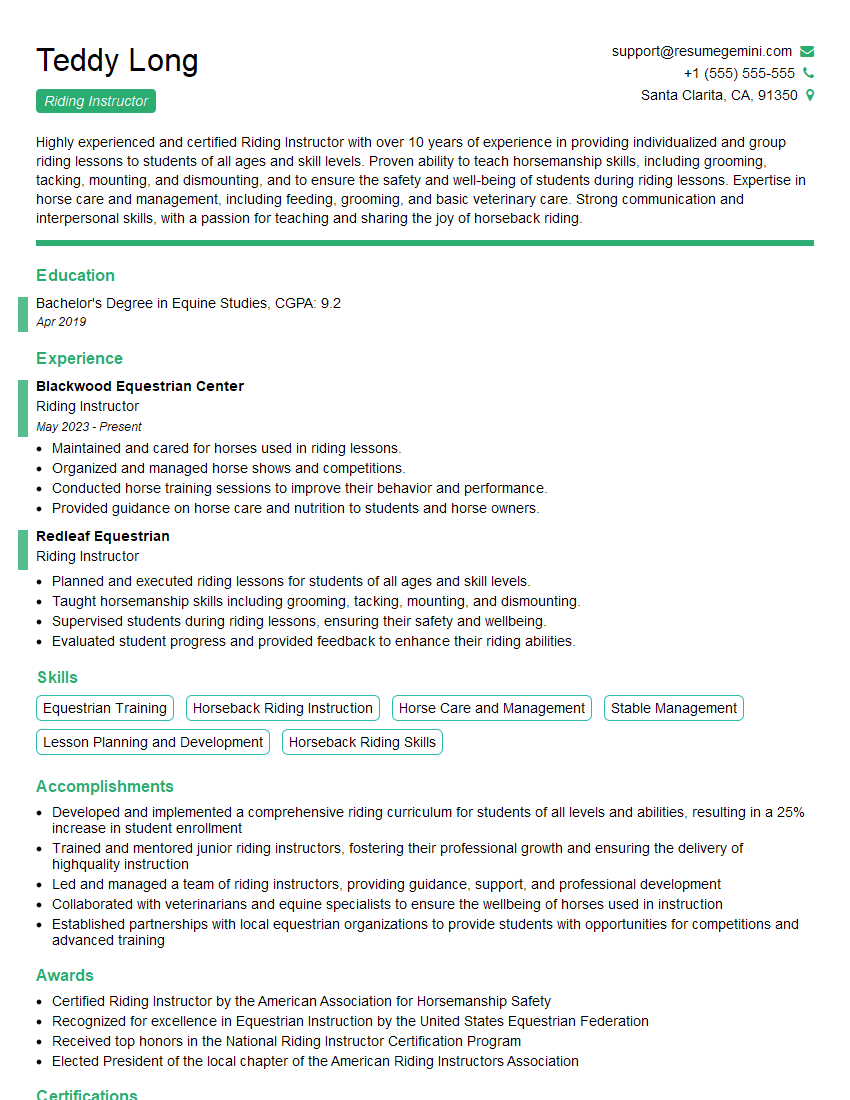
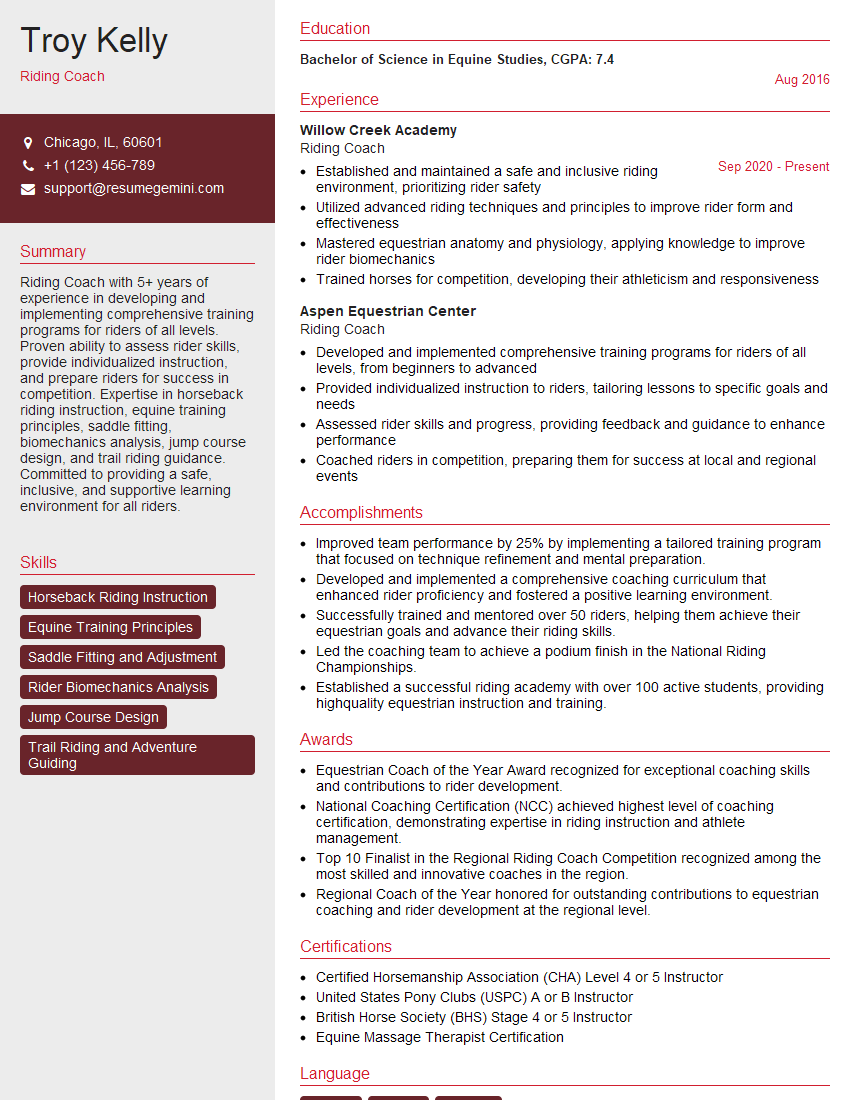
Mastering the art of assessing rider performance is crucial for career advancement in logistics, transportation, and delivery sectors. Proficiency in this area demonstrates valuable skills in data analysis, performance improvement, and safety management, making you a highly sought-after candidate. To increase your chances of landing your dream job, focus on crafting an ATS-friendly resume that highlights your relevant skills and experience. ResumeGemini is a trusted resource that can significantly enhance your resume-building experience. We provide examples of resumes tailored to Assessing Rider Performance to help you present your qualifications effectively. Take the next step towards your career goals and leverage the power of a well-crafted resume.
Explore more articles
Users Rating of Our Blogs
Share Your Experience
We value your feedback! Please rate our content and share your thoughts (optional).
What Readers Say About Our Blog
Hello,
we currently offer a complimentary backlink and URL indexing test for search engine optimization professionals.
You can get complimentary indexing credits to test how link discovery works in practice.
No credit card is required and there is no recurring fee.
You can find details here:
https://wikipedia-backlinks.com/indexing/
Regards
NICE RESPONSE TO Q & A
hi
The aim of this message is regarding an unclaimed deposit of a deceased nationale that bears the same name as you. You are not relate to him as there are millions of people answering the names across around the world. But i will use my position to influence the release of the deposit to you for our mutual benefit.
Respond for full details and how to claim the deposit. This is 100% risk free. Send hello to my email id: [email protected]
Luka Chachibaialuka
Hey interviewgemini.com, just wanted to follow up on my last email.
We just launched Call the Monster, an parenting app that lets you summon friendly ‘monsters’ kids actually listen to.
We’re also running a giveaway for everyone who downloads the app. Since it’s brand new, there aren’t many users yet, which means you’ve got a much better chance of winning some great prizes.
You can check it out here: https://bit.ly/callamonsterapp
Or follow us on Instagram: https://www.instagram.com/callamonsterapp
Thanks,
Ryan
CEO – Call the Monster App
Hey interviewgemini.com, I saw your website and love your approach.
I just want this to look like spam email, but want to share something important to you. We just launched Call the Monster, a parenting app that lets you summon friendly ‘monsters’ kids actually listen to.
Parents are loving it for calming chaos before bedtime. Thought you might want to try it: https://bit.ly/callamonsterapp or just follow our fun monster lore on Instagram: https://www.instagram.com/callamonsterapp
Thanks,
Ryan
CEO – Call A Monster APP
To the interviewgemini.com Owner.
Dear interviewgemini.com Webmaster!
Hi interviewgemini.com Webmaster!
Dear interviewgemini.com Webmaster!
excellent
Hello,
We found issues with your domain’s email setup that may be sending your messages to spam or blocking them completely. InboxShield Mini shows you how to fix it in minutes — no tech skills required.
Scan your domain now for details: https://inboxshield-mini.com/
— Adam @ InboxShield Mini
Reply STOP to unsubscribe
Hi, are you owner of interviewgemini.com? What if I told you I could help you find extra time in your schedule, reconnect with leads you didn’t even realize you missed, and bring in more “I want to work with you” conversations, without increasing your ad spend or hiring a full-time employee?
All with a flexible, budget-friendly service that could easily pay for itself. Sounds good?
Would it be nice to jump on a quick 10-minute call so I can show you exactly how we make this work?
Best,
Hapei
Marketing Director
Hey, I know you’re the owner of interviewgemini.com. I’ll be quick.
Fundraising for your business is tough and time-consuming. We make it easier by guaranteeing two private investor meetings each month, for six months. No demos, no pitch events – just direct introductions to active investors matched to your startup.
If youR17;re raising, this could help you build real momentum. Want me to send more info?
Hi, I represent an SEO company that specialises in getting you AI citations and higher rankings on Google. I’d like to offer you a 100% free SEO audit for your website. Would you be interested?
Hi, I represent an SEO company that specialises in getting you AI citations and higher rankings on Google. I’d like to offer you a 100% free SEO audit for your website. Would you be interested?
good