The thought of an interview can be nerve-wracking, but the right preparation can make all the difference. Explore this comprehensive guide to Attendance interview questions and gain the confidence you need to showcase your abilities and secure the role.
Questions Asked in Attendance Interview
Q 1. Explain the importance of accurate attendance tracking.
Accurate attendance tracking is the cornerstone of efficient workforce management. It’s crucial for numerous reasons, impacting everything from payroll accuracy to productivity analysis and even employee morale. Without it, businesses risk financial losses, legal complications, and a breakdown in operational efficiency.
- Payroll Accuracy: Accurate attendance data ensures employees are paid correctly for the hours worked, preventing underpayment or overpayment disputes.
- Compliance & Legal Requirements: Many jurisdictions have specific regulations regarding record-keeping of employee work hours. Accurate tracking helps organizations avoid penalties for non-compliance.
- Productivity & Performance Measurement: Attendance data can be analyzed to identify trends, such as absenteeism patterns, and pinpoint potential issues affecting productivity. This allows for proactive intervention.
- Resource Allocation: Understanding attendance helps businesses optimize staffing levels and allocate resources effectively, ensuring appropriate coverage during peak times.
- Employee Morale: Fair and accurate attendance tracking builds trust and transparency, contributing to a positive work environment.
Q 2. Describe your experience with different attendance tracking systems.
Throughout my career, I’ve worked with a variety of attendance tracking systems, ranging from simple manual methods to sophisticated, integrated software solutions. My experience encompasses:
- Manual Timesheets: These are traditional paper-based systems where employees record their hours worked. While simple, they are prone to errors and are less efficient for larger organizations.
- Biometric Systems: These use fingerprint or facial recognition to verify employee presence, minimizing buddy punching and enhancing accuracy. I’ve worked extensively with systems like these, particularly in high-security environments.
- Clock-in/Clock-out Systems: These systems, often using keypads or cards, offer a relatively simple and cost-effective way to record employee attendance. I’ve implemented and managed these systems in various settings, addressing issues with malfunctioning hardware and user training.
- Integrated HR & Payroll Systems: These sophisticated platforms integrate attendance tracking seamlessly with other HR functions such as payroll and performance management. I’m adept at configuring and utilizing these systems for reporting and analysis. For instance, I worked with one company to integrate their existing attendance system with their payroll software, streamlining the entire process and reducing manual data entry significantly. This project saved the company considerable time and minimized the risk of payroll errors.
Q 3. How do you handle discrepancies in employee attendance records?
Discrepancies in attendance records require a systematic approach to ensure fairness and accuracy. My process involves:
- Identification & Documentation: The first step is to clearly identify the discrepancy. This involves comparing employee-reported hours with system records and identifying any significant differences.
- Investigation: I then conduct a thorough investigation. This might involve reviewing security footage from biometric systems, interviewing the employee and their colleagues, or examining time-off requests and other relevant documentation.
- Resolution: Based on the investigation findings, I work to resolve the discrepancy. This may involve correcting the record, adjusting payroll, or initiating disciplinary action if necessary. Fairness and transparency are key throughout this process. For example, in one case, we discovered a system malfunction that was causing inaccuracies. By identifying and rectifying the issue, we were able to avoid mischaracterizations of employee attendance and maintain workplace trust.
- Prevention: Once the immediate issue is resolved, I focus on preventing similar problems in the future. This might include improving system maintenance, clarifying attendance policies, or providing additional training to employees.
Q 4. What methods do you use to ensure data integrity in attendance systems?
Maintaining data integrity in attendance systems is paramount. My approach involves a multi-faceted strategy:
- Regular System Audits: Performing regular audits helps identify any inconsistencies or errors in the data. This includes verifying data accuracy against payroll records and other sources.
- Access Control: Implementing robust access control measures restricts access to attendance data to authorized personnel only, preventing unauthorized modifications or deletions.
- Data Backups: Regular data backups are essential to protect against data loss due to system failures or other unforeseen events.
- System Maintenance: Regular system maintenance and upgrades ensure optimal functionality and reduce the likelihood of errors.
- Employee Training: Providing adequate training to employees on the proper use of attendance systems minimizes errors caused by user negligence. I regularly incorporate user training modules covering the specifics of the particular system used, including clock-in/clock-out procedures and reporting errors.
- Data Validation: Implementing data validation rules within the system helps prevent inaccurate data entry. This could include checks for inconsistencies or impossible values.
Q 5. How do you calculate employee overtime based on attendance data?
Calculating employee overtime relies heavily on accurate attendance data and a clearly defined policy. The process typically involves:
- Identify Regular Hours: Determine the employee’s standard working hours per day or week as defined in their contract or employment agreement.
- Identify Overtime Hours: Compare the total hours worked (as recorded by the attendance system) with the regular hours. Any hours exceeding the regular hours constitute overtime.
- Apply Overtime Rate: Apply the appropriate overtime rate (e.g., 1.5x or 2x the regular hourly rate) as stipulated by law or company policy. This rate depends on local labor laws.
- Calculate Overtime Pay: Multiply the overtime hours by the overtime rate to determine the total overtime pay.
For example, if an employee’s regular hours are 40 per week and they worked 45 hours, the 5 extra hours would be considered overtime. If their regular hourly rate is $20, and the overtime rate is 1.5x, their overtime pay would be 5 hours * $20 * 1.5 = $150.
Q 6. What are the common challenges in managing employee attendance?
Managing employee attendance presents several common challenges:
- Data Accuracy: Ensuring the accuracy and consistency of attendance data across various systems and sources can be challenging. Inconsistent data can lead to incorrect payroll and inaccurate performance evaluations.
- Buddy Punching: Employees might clock in or out for each other, leading to inaccurate records and potential payroll issues. Biometric systems can mitigate this.
- Policy Enforcement: Consistently enforcing attendance policies and addressing violations fairly and consistently can be tricky. Clear guidelines and transparent processes are essential.
- Absenteeism and Tardiness: Managing high rates of absenteeism and tardiness requires identifying underlying causes and implementing appropriate interventions.
- Integration Challenges: Integrating attendance data with other HR systems (like payroll and performance management) requires careful planning and coordination.
Q 7. How do you address attendance issues with employees?
Addressing attendance issues with employees requires a sensitive yet firm approach. My strategy involves:
- Initial Consultation: I begin by having a private conversation with the employee to understand the reasons behind their attendance issues. This conversation should be focused on understanding the root cause of the issue, rather than assigning blame.
- Documentation: Maintaining a detailed record of the conversation and any agreements reached is crucial. This includes the reasons for the attendance problem, any support offered, and the plan to rectify the situation.
- Performance Improvement Plan (PIP): For recurring attendance problems, a formal PIP might be necessary. This document outlines specific expectations, goals, and timelines for improvement. This process involves clearly defining expectations, outlining the steps needed for improvement, establishing a timeline, and providing regular check-ins to monitor progress.
- Support and Resources: Offering support and resources, such as employee assistance programs (EAPs) or flexible work arrangements, can help address underlying issues that contribute to attendance problems.
- Progressive Discipline: If the employee fails to improve despite support and interventions, progressive disciplinary action may be necessary, following company policy and legal requirements.
- Regular Check-ins: Regular follow-up meetings are essential to monitor progress, provide additional support, and adjust strategies as needed.
Throughout this process, maintaining open communication, empathy, and fairness is critical to achieving a positive outcome. It’s important to remember that consistent and timely intervention is key to preventing minor issues from escalating into significant problems.
Q 8. Describe your experience with generating attendance reports.
Generating attendance reports is a crucial aspect of my role, ensuring accurate tracking of employee work hours and adherence to company policies. I’m proficient in using various software and tools to create comprehensive reports, tailored to specific needs. This includes generating reports on daily attendance, absenteeism rates, tardiness, overtime hours, and leave balances.
For instance, in my previous role, I used a system that allowed me to filter reports based on department, team, individual employees, or date ranges. I could easily export these reports in different formats such as CSV, PDF, or Excel for further analysis and distribution. I also developed customized reports to highlight trends, such as identifying patterns of absenteeism among specific teams, allowing for proactive intervention and management.
Another example involves using pivot tables in Excel to analyze attendance data across different dimensions and identify key performance indicators (KPIs). This allows for a more in-depth understanding of attendance patterns and their potential impact on productivity.
Q 9. What metrics do you track to monitor attendance performance?
Monitoring attendance performance involves tracking several key metrics to identify trends and areas for improvement. These metrics provide a holistic view of employee attendance and its impact on the organization.
- Absence Rate: The percentage of scheduled workdays missed by employees. This helps identify patterns of absenteeism and potential causes.
- Tardiness Rate: The percentage of instances where employees arrive late to work. This highlights potential issues with punctuality and time management.
- Overtime Hours: The number of hours worked beyond regular scheduled hours. This helps manage workload distribution and potential burnout.
- Average Daily Attendance: Provides a general overview of daily attendance levels. Significant deviations could indicate underlying issues.
- Employee Turnover Related to Attendance Issues: Tracking the number of employees who leave due to attendance-related conflicts or disciplinary actions.
Analyzing these metrics together gives a comprehensive picture of attendance health and helps in devising targeted strategies to address issues, whether it be implementing wellness programs to reduce absenteeism or adjusting work schedules to minimize overtime.
Q 10. How familiar are you with relevant labor laws related to attendance and timekeeping?
I possess a strong understanding of relevant labor laws concerning attendance and timekeeping, including the Fair Labor Standards Act (FLSA) in the US and similar legislation in other jurisdictions. This understanding is crucial for ensuring compliance and avoiding potential legal issues.
My knowledge encompasses regulations on:
- Overtime pay calculations: Ensuring accurate calculation of overtime pay based on employee classification and applicable regulations.
- Meal and break periods: Understanding and adhering to regulations regarding paid and unpaid breaks.
- Record-keeping requirements: Maintaining accurate and compliant attendance records, including start and end times, breaks, and overtime.
- Leave policies and entitlements: Understanding employee rights regarding sick leave, vacation leave, and other forms of leave.
- Wage and hour laws: Ensuring compliance with minimum wage, overtime pay, and other aspects of wage and hour laws.
I regularly stay updated on changes in legislation through professional development and resources to maintain my expertise in this area.
Q 11. Explain your experience with integrating attendance data with payroll systems.
Integrating attendance data with payroll systems is essential for accurate and efficient payroll processing. My experience involves using various methods to seamlessly transfer attendance data for payroll calculations.
In my previous role, we used a time and attendance system that directly integrated with our payroll software. This automated the process of transferring employee hours worked, including regular hours, overtime, and any adjustments needed. The system calculated gross pay, deductions, and net pay based on the attendance data. This eliminated manual data entry, reducing errors and saving considerable time.
In situations where direct integration wasn’t available, I’ve utilized data export functions to transfer data into spreadsheets or other compatible formats that could be imported into the payroll system. In this case, rigorous data validation and quality control checks were implemented to maintain accuracy and prevent errors from affecting payroll calculations.
Q 12. How do you handle employee requests for time-off?
Handling employee time-off requests involves a structured process to ensure fairness and compliance with company policy. This includes using a centralized system for tracking and managing leave requests.
The process usually begins with the employee submitting a request through an approved channel, such as an online portal or a dedicated form. I then review the request, verifying the information provided and ensuring that it aligns with company policies and existing schedules. Approvals or denials are communicated promptly, along with any necessary explanations. For planned time off, I work with the employee and their manager to ensure adequate coverage during their absence. If a conflict arises, I work to find a solution that addresses both the employee’s needs and the business needs.
Examples include managing vacation requests, approving sick leave according to company policies, and processing bereavement leave requests based on established guidelines.
Q 13. How do you ensure compliance with company attendance policies?
Ensuring compliance with company attendance policies requires a proactive and multifaceted approach. This starts with clearly communicating the policies to all employees and providing regular training to ensure everyone understands their responsibilities. I am responsible for developing and maintaining comprehensive attendance policies and procedures that are regularly reviewed and updated as needed.
Regular monitoring of attendance data through reports and dashboards allows for timely identification of any deviations from policy. This proactive approach enables me to address potential issues early. Regular communication with employees and management helps address any concerns or questions regarding the policies and promotes a culture of understanding and compliance.
I would also conduct regular audits to ensure data accuracy and adherence to procedures. For example, I might randomly check time cards against actual work hours or review the approval process for leave requests to ensure consistency and compliance.
Q 14. How do you handle attendance exceptions and irregularities?
Handling attendance exceptions and irregularities requires a fair and consistent approach. This involves carefully investigating each instance to determine the cause and appropriate action.
The process typically begins with identifying the exception – be it a missing punch, unexplained absence, or discrepancies in reported hours. I then investigate the cause. This may involve reviewing security footage, contacting the employee, speaking to their manager, or reviewing supporting documentation. Depending on the findings, appropriate actions are taken, which could include:
- Addressing minor discrepancies: For minor errors, a simple correction might suffice.
- Investigating unexplained absences: For unexplained absences, further investigation is needed to determine the reason and if disciplinary action is warranted.
- Disciplinary actions: This might involve verbal warnings, written warnings, or more serious actions depending on company policy and the severity of the infraction.
- Documentation: Meticulous documentation of all investigations, actions taken, and communications is crucial.
Throughout this process, fairness and consistency are paramount. All employees should be treated equitably, and decisions should be made based on established policies and procedures.
Q 15. What is your experience with auditing attendance data?
Auditing attendance data is crucial for ensuring accuracy, identifying discrepancies, and maintaining compliance. My experience involves a multi-step process. First, I verify data integrity by comparing attendance records from various sources – biometric systems, time clocks, and employee self-service portals – to identify any inconsistencies. Then, I analyze trends and patterns, looking for unusual absences, late arrivals, or early departures. This often involves using data visualization tools to highlight potential issues. For example, I might create charts showing absenteeism rates by department or by individual employee. Finally, I document my findings and recommend corrective actions, which might include policy adjustments or individual employee interventions.
In one particular instance, I discovered a significant discrepancy between the reported hours worked and the actual hours recorded by the biometric system. This led to an investigation that uncovered a procedural flaw in the system’s time entry process. Implementing a revised procedure significantly improved data accuracy.
Career Expert Tips:
- Ace those interviews! Prepare effectively by reviewing the Top 50 Most Common Interview Questions on ResumeGemini.
- Navigate your job search with confidence! Explore a wide range of Career Tips on ResumeGemini. Learn about common challenges and recommendations to overcome them.
- Craft the perfect resume! Master the Art of Resume Writing with ResumeGemini’s guide. Showcase your unique qualifications and achievements effectively.
- Don’t miss out on holiday savings! Build your dream resume with ResumeGemini’s ATS optimized templates.
Q 16. What software or tools have you used for attendance management?
Throughout my career, I’ve utilized a variety of attendance management software and tools. These include cloud-based solutions like BambooHR and Workday, which offer robust features for tracking attendance, generating reports, and managing PTO. I’ve also worked with on-premise systems, such as Kronos, requiring more manual configuration and maintenance. In smaller organizations, I’ve even used simpler spreadsheet-based systems. My experience encompasses using these tools to manage employee scheduling, track time off requests, generate payroll data, and produce reports for management. Familiarity with different systems allows me to adapt quickly to new environments and select the most appropriate tool for a specific organization’s needs.
Q 17. Describe your experience with employee self-service attendance portals.
Employee self-service attendance portals are invaluable for improving efficiency and employee engagement. My experience includes working with portals that allow employees to view their attendance records, request time off, submit absence notifications, and view their PTO balances. I understand the importance of user-friendly interfaces and clear communication in these systems. For example, I’ve been involved in implementing portals that provide instant feedback to employees on their time-off requests, reducing delays and improving transparency. I also have experience addressing technical issues and training employees on the effective use of these portals.
One successful implementation involved integrating the self-service portal with our payroll system, automating much of the manual data entry previously required. This saved significant time and reduced the likelihood of errors.
Q 18. How do you identify and address patterns of absenteeism?
Identifying and addressing patterns of absenteeism requires a systematic approach. I begin by analyzing attendance data, looking for trends such as increased absences on specific days of the week, during particular times of the year, or among specific employee groups. This might involve using statistical methods to identify significant deviations from the norm. Then, I investigate the underlying causes. This could involve reviewing employee files, conducting interviews, and potentially consulting with HR or management to understand the context of the absences. For instance, are there consistent issues in a particular department? Are employees struggling with burnout, personal issues, or lack of work-life balance? Addressing the root cause is vital. Solutions might include implementing flexible work arrangements, offering employee assistance programs, or providing additional training or support.
Q 19. Explain your approach to improving employee attendance.
Improving employee attendance is a multi-faceted approach requiring a combination of proactive and reactive strategies. Proactive measures include creating a positive work environment, offering competitive benefits packages, including flexible work options, and providing regular opportunities for employee feedback. I firmly believe in open communication. Regular check-ins with employees can help identify potential issues before they escalate into absenteeism. Reactive measures include addressing identified patterns of absenteeism through targeted interventions, such as performance improvement plans or counseling. It’s essential to maintain a balance between accountability and support, recognizing that individual circumstances can significantly impact attendance.
For example, a company I worked with implemented a wellness program that included gym memberships and mindfulness workshops. This initiative resulted in a significant decrease in absenteeism due to stress-related illnesses.
Q 20. How do you deal with attendance-related disciplinary actions?
Dealing with attendance-related disciplinary actions requires careful consideration and adherence to company policies and legal regulations. My approach is to follow a progressive discipline process, starting with verbal warnings, followed by written warnings, and ultimately, potential termination if the issues persist. Each step involves clearly documenting the infraction and the steps taken. It’s vital to ensure fairness and consistency in applying disciplinary actions across the board. I strive to maintain open communication with the employee, providing opportunities for improvement and support. However, consistent disregard for attendance policies must be addressed decisively to uphold workplace standards.
I always consult with HR to ensure adherence to legal and company guidelines throughout this process.
Q 21. Describe your experience with troubleshooting attendance system issues.
Troubleshooting attendance system issues requires a methodical approach. My experience involves identifying the problem’s source – whether it’s a software glitch, hardware malfunction, or user error. I begin by gathering information: error messages, affected users, and any recent changes made to the system. Then, I systematically check potential causes, such as network connectivity, system configurations, and data integrity. If the problem is software-related, I may need to consult documentation, contact technical support, or analyze system logs. Hardware issues might necessitate replacement or repair. User errors often require training or process clarification. Thorough documentation of the troubleshooting process and its resolution is essential for future reference and problem prevention.
In one case, a widespread system outage was traced back to a faulty network switch. Replacing the switch quickly restored functionality, minimizing disruption to operations.
Q 22. What is your experience with data analysis related to attendance?
My experience with attendance data analysis involves leveraging various tools and techniques to extract meaningful insights from attendance records. This goes beyond simply tracking presence; it’s about identifying trends, patterns, and anomalies that can inform strategic decision-making. For example, I’ve used spreadsheet software like Excel and dedicated HRIS systems to analyze absenteeism rates, identify peak absence periods (like flu season), and compare attendance data across different departments or teams. I also have experience with data visualization, creating charts and graphs to clearly present complex attendance data to both management and employees. This helps pinpoint areas needing attention, like potential issues with workload, employee well-being, or even potential policy gaps. I’ve used this data to advocate for changes that improved overall employee attendance and productivity.
In one instance, I analyzed attendance data showing a significant increase in tardiness among a specific team during a particular project phase. This led to a review of the project’s timeline and workflow, ultimately resulting in adjustments that reduced tardiness and improved overall project efficiency.
Q 23. How do you communicate attendance-related information to employees and management?
Communicating attendance-related information requires a multi-faceted approach, tailored to the audience. For employees, I focus on clear, concise, and easily accessible communication. This might involve regular email updates summarizing key attendance policies, automated notifications for attendance discrepancies, and readily available resources, like an FAQ section on the company intranet. For management, I provide more detailed reports, including key performance indicators (KPIs) like absenteeism rates, punctuality metrics, and trends over time. This involves presenting data visually using charts and graphs to highlight areas of concern and potential areas for improvement. I always ensure that the communication is both timely and relevant to the recipient’s role and responsibilities.
For instance, I might communicate a team’s high absenteeism rate to management by highlighting potential causes in a concise report with supporting data, suggesting solutions like reviewing workloads or offering wellness programs. For employees, the communication would focus on reinforcing attendance policies and available support resources.
Q 24. How do you maintain confidentiality of employee attendance information?
Maintaining the confidentiality of employee attendance information is paramount. This involves adhering to strict data privacy policies and regulations, such as GDPR or CCPA (depending on location). Access to sensitive attendance data is strictly limited to authorized personnel on a need-to-know basis. I ensure all electronic systems storing this data are secured with robust password protection and encryption. Physical records, if any, are stored in locked cabinets and only accessible by authorized individuals. Regular audits are conducted to ensure compliance and identify any potential vulnerabilities. Employees are also educated about the importance of data privacy and their responsibilities in protecting sensitive information. Any breaches are reported immediately and dealt with according to established protocols.
For example, I would never share an individual employee’s absence record with anyone outside the HR department unless legally required or with the employee’s explicit consent.
Q 25. Describe your experience with training employees on attendance policies.
Training employees on attendance policies requires a comprehensive and engaging approach. I typically start by clearly outlining the company’s attendance policies and procedures, emphasizing their importance for overall workplace productivity and team cohesion. I use a variety of methods to enhance understanding, including interactive workshops, presentations, and easily accessible online resources, like FAQs and video tutorials. I always ensure that the training is relevant and applicable to the employees’ roles and responsibilities. Open forums for questions and clarification are crucial to ensure everyone understands their obligations and the consequences of non-compliance. I also include real-world examples and scenarios to make the training more relatable and memorable.
For instance, I would use case studies to illustrate the impact of consistent tardiness on team projects or the process for requesting leave appropriately.
Q 26. How do you stay up-to-date on changes in attendance regulations?
Staying up-to-date on changes in attendance regulations is a continuous process. I actively monitor relevant legislation and legal updates, utilizing online resources such as government websites, professional associations, and legal publications. I attend industry conferences and webinars to gain insights from experts and network with peers. I subscribe to relevant newsletters and alerts to receive timely notifications about changes. I also collaborate with legal counsel to ensure compliance with all applicable regulations and best practices. This proactive approach helps me to avoid legal pitfalls and ensure that our attendance policies remain current and compliant.
For example, changes in legislation regarding sick leave or family leave would require immediate review and updates to our company’s policies.
Q 27. Explain your experience with implementing new attendance systems.
Implementing a new attendance system requires careful planning and execution. The process begins with a thorough assessment of the organization’s needs and requirements, considering factors like scalability, integration with existing HR systems, user-friendliness, and cost-effectiveness. I then research and evaluate different systems, considering various vendors and their offerings. Once a system is chosen, I develop a comprehensive implementation plan that includes data migration strategies, training programs for employees and managers, and change management processes. A phased rollout approach is often employed to minimize disruption and allow for continuous feedback and adjustment. Post-implementation, ongoing monitoring and evaluation are critical to identify any issues and optimize the system’s performance.
For example, in one implementation, I prioritized employee training to ensure a smooth transition and alleviate anxieties. We provided multiple training sessions, including one-on-one support for those who needed extra help.
Q 28. How do you handle attendance issues in a remote work environment?
Handling attendance issues in a remote work environment requires a different approach than in a traditional office setting. Trust and open communication are essential. I rely heavily on technology, using time-tracking software, project management tools, and regular check-ins to monitor employee productivity and attendance. While direct observation is limited, I focus on results and outcomes, establishing clear expectations for work completion and availability. When attendance issues arise, I prioritize addressing them promptly through direct, empathetic communication, seeking to understand the underlying causes before implementing any disciplinary actions. Flexibility and understanding are key in this context, while still maintaining clear accountability.
For example, instead of focusing solely on clock-in/clock-out times, I might use project completion deadlines and communication responsiveness as indicators of employee engagement and work ethic.
Key Topics to Learn for Attendance Interview
- Attendance Tracking Systems: Understanding different types of attendance tracking systems (manual, automated, biometric), their advantages and disadvantages, and best practices for implementation and maintenance.
- Data Analysis and Reporting: Analyzing attendance data to identify trends, patterns, and potential issues. Creating clear and concise reports to communicate findings to stakeholders. Practical application: interpreting absenteeism rates and suggesting solutions based on data insights.
- Attendance Policies and Procedures: Knowledge of legal compliance regarding attendance policies, creating and implementing fair and consistent attendance policies, and effectively communicating those policies to employees.
- Problem-Solving and Conflict Resolution: Addressing attendance-related issues, such as unexcused absences or tardiness, in a fair and professional manner. Developing strategies to improve employee attendance and engagement.
- Technological Proficiency: Familiarity with relevant software and technologies used in attendance management, including HRIS systems, time and attendance software, and reporting tools.
- Employee Relations and Communication: Understanding the importance of open communication with employees regarding attendance policies and expectations. Effectively addressing concerns and fostering a positive work environment.
Next Steps
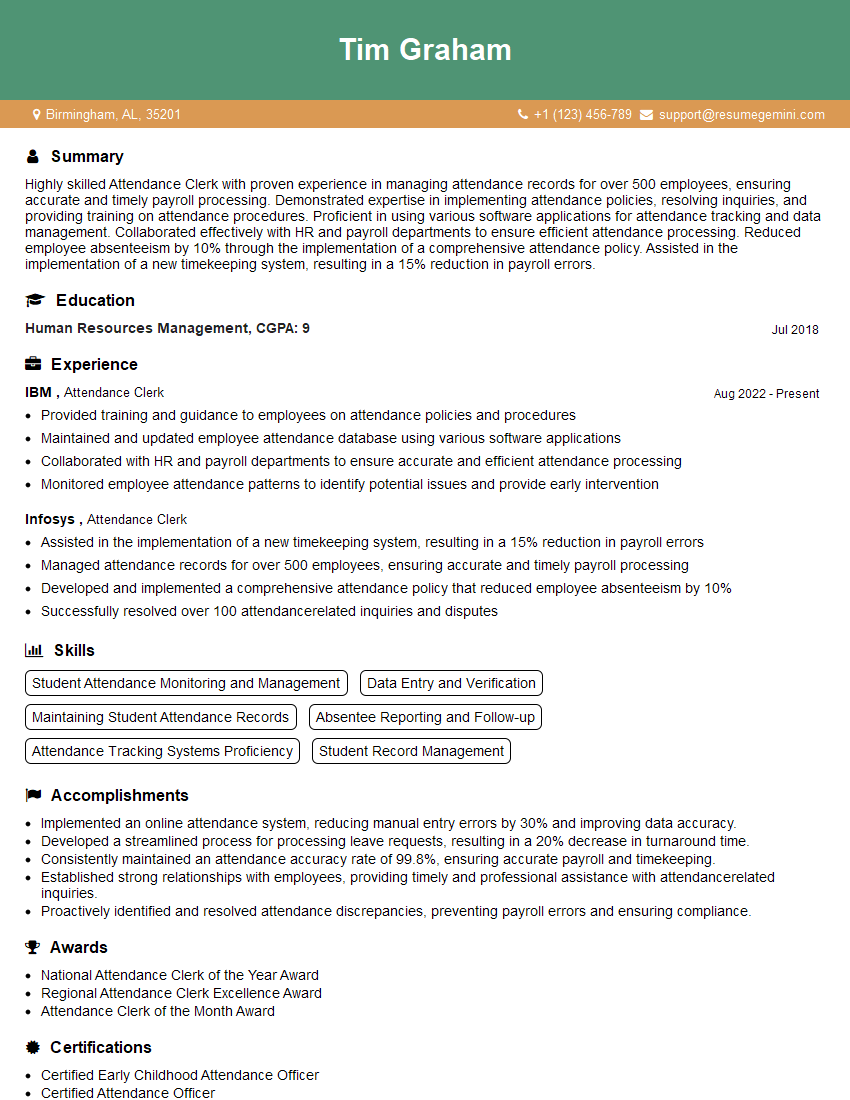
Mastering attendance management is crucial for career growth in HR and related fields. Proficiency in this area demonstrates organizational skills, attention to detail, and the ability to contribute to a productive and efficient workplace. To significantly enhance your job prospects, create a compelling, ATS-friendly resume that highlights your relevant skills and experience. We strongly recommend using ResumeGemini, a trusted resource, to build a professional resume that stands out. Examples of resumes tailored to Attendance roles are available to help guide your resume creation process.
Explore more articles
Users Rating of Our Blogs
Share Your Experience
We value your feedback! Please rate our content and share your thoughts (optional).
What Readers Say About Our Blog
Very informative content, great job.
good