The thought of an interview can be nerve-wracking, but the right preparation can make all the difference. Explore this comprehensive guide to Automated Configuration Management interview questions and gain the confidence you need to showcase your abilities and secure the role.
Questions Asked in Automated Configuration Management Interview
Q 1. Explain the difference between imperative and declarative configuration management.
Imperative and declarative configuration management represent two distinct approaches to managing infrastructure and application settings. Think of it like giving directions: imperative is like providing step-by-step instructions, while declarative is like describing the desired end state.
Imperative Configuration Management: This approach focuses on *how* to achieve a desired state. You explicitly define the steps needed to configure a system. Scripts detail each action, and the order is crucial. For instance, you might have a script that first installs a package, then configures a service, and finally restarts it. Changes are made sequentially, potentially leading to issues if steps are missed or the order is incorrect.
Declarative Configuration Management: This approach describes the *desired state* of the system. You define what you want the system to look like, and the tool figures out how to get there. It manages the entire process, ensuring consistency even if multiple paths lead to the same outcome. For example, instead of specifying installation steps, you would declare “package X should be installed and running.” The tool will handle the installation, configuration, and service management automatically.
Example: Let’s say we want to install Apache web server. An imperative approach would involve commands like sudo apt-get update, sudo apt-get install apache2, sudo systemctl start apache2, and so on. A declarative approach would simply state: “Apache2 should be installed and enabled.”
- Imperative Advantages: Fine-grained control, potential for optimization
- Imperative Disadvantages: Complex, error-prone, difficult to maintain and debug
- Declarative Advantages: Easier to read, maintain, and understand; idempotent (can be run multiple times without side effects); less error-prone
- Declarative Disadvantages: Less fine-grained control, might require more sophisticated tools
Q 2. Describe your experience with Infrastructure as Code (IaC) tools like Terraform or Ansible.
I have extensive experience with Infrastructure as Code (IaC) tools, primarily Terraform and Ansible. I’ve used them in various projects, ranging from simple deployments to complex, multi-region infrastructures.
Terraform: I’ve utilized Terraform extensively for managing cloud infrastructure. Its declarative nature allows for creating and managing resources across multiple cloud providers (AWS, Azure, GCP) through consistent configuration files (HCL). For instance, I’ve used it to provision entire networks, virtual machines, databases, and load balancers, ensuring consistency and reproducibility across different environments. Version control is crucial with Terraform, allowing for easy tracking of infrastructure changes and rollback capabilities. A recent project involved deploying a highly available Kubernetes cluster across three availability zones using Terraform, including automated scaling and self-healing mechanisms.
Ansible: I’ve employed Ansible for configuration management and application deployment on existing servers. Its agentless architecture simplifies deployment and simplifies managing configurations across numerous servers. I’ve leveraged its playbooks and modules to automate tasks such as installing software packages, configuring services, and deploying applications. One project involved using Ansible to deploy and configure a large number of web servers, ensuring consistent configurations across all nodes. I often used Ansible roles to promote reusability and modularity in my Ansible playbooks.
I prefer Terraform for infrastructure provisioning and Ansible for configuration management of existing servers; they often work well together in a unified infrastructure deployment pipeline.
Q 3. How do you handle configuration drift in a production environment?
Configuration drift is a serious concern in production environments, where configurations diverge from the intended state. It can lead to inconsistencies, security vulnerabilities, and application failures. To handle this, I employ a multi-pronged approach:
- Regular Configuration Audits: I use automated tools to regularly compare the desired state (defined in my IaC code) with the actual state of the infrastructure. Tools often provide reporting on drifts.
- Automated Remediation: Where possible, I automate the process of correcting detected drift. This might involve automatically re-applying configurations, or triggering alerts for manual intervention, depending on severity.
- Version Control for Infrastructure Code: This is essential for tracking changes and providing a reliable way to roll back to a known good configuration state if drift occurs.
- Immutable Infrastructure: Where feasible, building and deploying infrastructure using immutable infrastructure patterns minimizes the risk of drift, making it easier to rebuild servers rather than attempt to modify them.
- Continuous Monitoring: Implement robust monitoring solutions to quickly detect anomalous behaviors, which might be an early indicator of configuration drift.
Combining these strategies allows for proactive detection and resolution of configuration drift before it results in significant issues.
Q 4. What are the benefits of using version control for infrastructure code?
Version control, like Git, is absolutely critical for managing infrastructure code. It offers several key benefits:
- Tracking Changes: It provides a complete history of all changes made to the infrastructure code, enabling easy auditing and identification of the source of problems.
- Collaboration: Multiple team members can work on the code simultaneously, merging their changes effectively.
- Rollback Capabilities: In case of errors or unintended changes, we can easily revert to previous versions of the code, restoring the infrastructure to a working state.
- Reproducibility: The version-controlled code ensures that the infrastructure can be consistently recreated across different environments.
- Improved Security: By controlling and tracking changes, you can limit unauthorized access and protect sensitive configuration data.
- Code Review: Version control facilitates code reviews, enabling improved code quality and early detection of potential issues.
By using a version control system for infrastructure code, it becomes significantly easier to manage complex projects, reduce deployment risks, and promote team collaboration.
Q 5. Explain your experience with different configuration management tools (e.g., Puppet, Chef, Ansible, SaltStack).
My experience encompasses several popular configuration management tools. Each has its strengths and weaknesses, making them suitable for different scenarios:
- Puppet: A robust and powerful tool, particularly well-suited for large-scale deployments. Its declarative nature makes it easy to manage complex configurations. However, it can have a steeper learning curve than some other tools. I’ve used Puppet primarily in projects requiring extensive network automation and system management.
- Chef: Similar to Puppet in its capabilities, Chef offers a strong focus on infrastructure automation, with a wide range of community-supported cookbooks. Its Ruby-based DSL can be a significant benefit for developers already familiar with Ruby, however, it may not be as intuitive for others. In past projects, Chef proved ideal for managing servers and applications across diverse cloud environments.
- Ansible: My preferred choice for its simplicity and agentless architecture, it is exceptional for automating tasks and deploying applications across existing servers. Its YAML-based configuration is easy to read and write, but it might not scale as smoothly as Puppet or Chef for extremely large, complex environments. I’ve successfully used Ansible for configuration management, application deployment and automated testing.
- SaltStack (Salt): A powerful tool known for its speed and scalability, especially when managing a large number of servers. Its ability to handle event-driven configurations is significant. However, it might have a more complex setup and administration compared to Ansible.
The choice of tool often depends on the specific project requirements, team expertise, and infrastructure complexity. In many projects, a combination of tools is most effective. For example, I might use Terraform for provisioning, and then Ansible to configure the servers created by Terraform.
Q 6. How do you ensure idempotency in your configuration management scripts?
Idempotency is a crucial property in configuration management, ensuring that applying a configuration multiple times produces the same result without unintended side effects. This prevents accidental modifications and ensures consistency. I achieve idempotency by focusing on the desired state:
- Declarative Approach: Using a declarative configuration management tool allows me to describe the desired state, leaving the tool to figure out how to achieve it. If the system is already in the desired state, the tool will do nothing.
- Conditional Logic: I incorporate conditional statements (e.g., `if` statements) in my scripts to check the current state before making any changes. This avoids unnecessary actions if the desired state is already met.
- Resource Management: When creating resources, always use identifiers to specify whether a resource already exists. Tools like Terraform and Ansible often provide features for checking if a resource already exists before creating a new one.
- Testing: Thorough testing is critical to ensure idempotency. This involves running the configuration scripts multiple times to validate that they produce the same result.
Example (Ansible): Instead of using a command like apt-get install packageX, which is not idempotent (it’ll fail on subsequent runs), we might use the Ansible apt module with the state: present parameter. This ensures that the package is installed, but does nothing if it’s already present.
- name: Install packageX apt: name: packageX state: present
Q 7. Describe your experience with continuous integration and continuous delivery (CI/CD) pipelines.
I have significant experience with CI/CD pipelines, integrating configuration management tools into the process to automate infrastructure provisioning, application deployment, and testing. A typical pipeline might involve these stages:
- Code Commit: Developers commit changes to the version-controlled infrastructure code (Terraform, Ansible playbooks, etc.)
- Build: The code is validated (linters, formatters), and any necessary build steps are performed.
- Test: Automated tests are run to verify the correctness of the infrastructure code and the application. Unit and integration tests are crucial here.
- Provisioning: The infrastructure is provisioned using tools like Terraform, based on the code changes.
- Deployment: The application is deployed to the newly provisioned or existing infrastructure using tools like Ansible or other deployment mechanisms.
- Testing (Post-Deployment): End-to-end testing is performed to validate the complete system in its deployed state.
- Monitoring: Continuous monitoring is implemented to track the health and performance of the deployed infrastructure and application.
Tools like Jenkins, GitLab CI, and CircleCI are commonly used to orchestrate these stages. Integrating configuration management tools into the pipeline ensures that the infrastructure is consistently managed, reducing errors and improving efficiency. In recent projects, I’ve leveraged this to implement blue/green deployments or canary deployments for risk mitigation.
Q 8. How do you manage dependencies between different components in your infrastructure?
Managing dependencies between infrastructure components is crucial for reliable automation. Think of it like building with LEGOs – you can’t just randomly throw pieces together; you need to assemble them in a specific order. We achieve this primarily through declarative configuration management tools like Terraform or Ansible.
Terraform uses a graph-based dependency resolution. You define resources and their relationships in a configuration file (typically HCL). Terraform analyzes these dependencies and executes them in the correct order. For instance, a database needs to be created before an application that uses it can be deployed. Terraform ensures this sequence automatically.
Ansible manages dependencies through roles and tasks. Roles are logical groupings of tasks. You can define dependencies between roles or even within a single role using include_role or dependencies attributes. This allows for modularity and clear dependency definition. For example, a web server role might depend on a networking role to configure the necessary network interfaces before the web server is installed and configured.
In both cases, version control is critical. Tracking changes in infrastructure code and dependencies is essential for reproducibility and auditing. Tools like Git allow for collaborative work and rollback capabilities. Automated testing (discussed in the next question) also plays a crucial role in verifying that dependencies are managed correctly.
Q 9. Explain your approach to testing your infrastructure code.
Testing infrastructure code is as vital as testing application code. We employ a multi-layered approach involving unit, integration, and end-to-end tests. The goal is to catch errors early and ensure the infrastructure behaves as expected.
- Unit Tests: These focus on individual modules or components. For example, in Ansible, we might test a task that configures a specific service independently. We often use tools like
pytestorunittestto write and run these tests. - Integration Tests: These verify interactions between different components. We use tools like Test Kitchen (with Ansible) or Terratest (with Terraform) to simulate the infrastructure environment and test the interactions between various services.
- End-to-End Tests: These tests cover the entire infrastructure. This often involves deploying a small-scale version of the production environment and verifying overall functionality. We might use tools like Selenium or Cypress to simulate user interactions and ensure everything works correctly.
Example (Ansible with pytest):
import pytest

def test_service_enabled():
    # Check if a specific service is enabled using Ansible facts
    assert ansible_facts['service_status']['nginx'] == 'running'
Continuous Integration/Continuous Delivery (CI/CD) pipelines automate these tests as part of the deployment process. This ensures that any code changes go through a thorough testing process before making it into production.
Q 10. How do you troubleshoot configuration management issues in a production environment?
Troubleshooting in a production environment requires a systematic and careful approach. Panicking won’t solve anything!
- Gather Logs: The first step is always to examine logs from all relevant services. Centralized logging systems (like ELK stack or Splunk) greatly assist in this. Look for error messages, unexpected behaviour, or performance issues.
- Check Monitoring: Monitoring tools provide a real-time view of the infrastructure’s health. Look for any anomalies or metrics that deviate from the norm, such as high CPU utilization or network latency. Tools like Prometheus, Grafana, or Datadog can be invaluable.
- Rollback (if possible): If the problem is a recent configuration change, rolling back to the previous state is often the quickest solution. This emphasizes the importance of version control and automated rollback capabilities.
- Reproduce the issue (if possible): If you cannot immediately identify the root cause, try to reproduce the issue in a staging environment. This allows you to perform more thorough debugging without impacting production systems.
- Isolate the problem: Once you’ve narrowed down the potential problem area, isolate the affected components and try to understand the interaction between them.
- Use debugging tools: Remote debugging tools or SSH access can aid in diagnosing problems within individual servers or services.
Example: If a web application is unresponsive, first check the web server logs, then the application logs, followed by metrics such as CPU usage and network traffic. If the problem stems from a recent configuration change, a quick rollback may solve the issue. Otherwise, a more in-depth debugging process would be required.
Q 11. What are some common security considerations when automating infrastructure?
Security is paramount in automated infrastructure. A breach in your infrastructure can have far-reaching consequences.
- Least Privilege: Configure all infrastructure components with the principle of least privilege. This means granting only the necessary permissions to each component. Avoid using root or administrator accounts for routine tasks.
- Secure Credentials Management: Never hardcode credentials in your infrastructure code. Use secure secrets management tools like HashiCorp Vault or AWS Secrets Manager to store and access sensitive information.
- Infrastructure as Code (IaC) Security Scanning: Use tools to scan IaC code for security vulnerabilities. These tools check for common misconfigurations and potential security risks before deploying to production. Examples include Checkov or tfsec.
- Network Security: Implement strong network security measures, such as firewalls, intrusion detection systems, and virtual private networks (VPNs). Secure your infrastructure network through appropriate security groups and access control lists.
- Regular Security Audits: Conduct regular security audits to identify and address potential weaknesses in the infrastructure. Employ penetration testing to identify vulnerabilities and security gaps.
- Compliance: Adhere to relevant industry standards and compliance regulations (e.g., PCI DSS, HIPAA, SOC 2).
Ignoring these considerations can lead to significant vulnerabilities that could be exploited by malicious actors.
Q 12. Describe your experience with monitoring and logging in an automated infrastructure.
Monitoring and logging are inseparable parts of a well-managed automated infrastructure. They provide crucial insights into system health, performance, and security.
Monitoring: We leverage tools that collect metrics (CPU utilization, memory usage, network traffic, disk I/O) and system events. These tools can trigger alerts when thresholds are exceeded, enabling proactive responses to potential issues. Examples include Prometheus, Grafana, Datadog, and Nagios.
Logging: We employ centralized logging solutions (ELK stack, Splunk) to collect logs from various services. These logs are then analyzed to identify problems, track events, and troubleshoot issues. Effective logging requires structured data and meaningful logging levels (DEBUG, INFO, WARNING, ERROR, CRITICAL) to help in filtering and analyzing relevant information.
Integration: Monitoring and logging are often integrated. For example, monitoring tools can trigger alerts based on specific log patterns or events. This creates a holistic view of the infrastructure’s health and activity.
Example: In a typical setup, we would configure applications and services to send logs to a centralized logging system. Monitoring tools would continuously collect performance metrics and alert us if CPU usage exceeds 80% or response times exceed a defined threshold. This combined approach provides a comprehensive overview of our infrastructure’s status.
Q 13. How do you handle rollbacks in case of configuration failures?
Handling rollbacks is crucial for minimizing downtime and mitigating the impact of configuration failures. This is where version control and infrastructure-as-code truly shine.
Version Control: Git, or a similar version control system, is essential. Each configuration change is tracked, allowing us to easily revert to previous versions. This forms the basis of our rollback strategy.
Automated Rollbacks: CI/CD pipelines often incorporate automated rollback mechanisms. If a deployment fails or if monitoring tools detect an issue, the pipeline can automatically revert the configuration to a known good state. This can be achieved through tools like Terraform’s state management or Ansible’s idempotency.
Manual Rollbacks: In cases where automated rollbacks aren’t feasible or appropriate, we can manually revert to a previous configuration using version control history. This requires careful execution to avoid introducing further issues. Detailed documentation and a methodical approach are key.
Testing Rollbacks: We thoroughly test our rollback procedures to ensure they function correctly in various scenarios. This helps build confidence that our rollback strategy is effective.
Example: If a new configuration causes a production outage, we can use Git to retrieve the previous, working configuration and redeploy it. If the deployment system has an automated rollback feature, it might handle this process automatically, minimizing downtime.
Q 14. Explain your experience with different cloud platforms (e.g., AWS, Azure, GCP) and their automation capabilities.
I have extensive experience with AWS, Azure, and GCP, leveraging their automation capabilities. Each platform offers unique strengths and tools for infrastructure automation.
- AWS: AWS offers a comprehensive suite of services for automation, including CloudFormation (for declarative infrastructure provisioning), AWS Lambda (for serverless functions), and various SDKs and APIs. I’ve used CloudFormation extensively to create and manage complex infrastructure stacks, incorporating custom resources and nested stacks for modularity. I’ve also worked with AWS CodePipeline for CI/CD pipeline creation.
- Azure: Azure’s automation capabilities center around Azure Resource Manager (ARM) templates, which are similar to CloudFormation. I’ve used ARM templates for creating and managing Azure resources, and have experience with Azure DevOps for CI/CD workflows. Azure Automation allows for managing runbooks for automating repetitive tasks.
- GCP: GCP offers Deployment Manager for declarative infrastructure as code, and various tools within Google Cloud Platform Console. I’ve also used Terraform extensively with GCP, as it provides a consistent approach across multiple cloud providers. I have experience with integrating various GCP services such as Google Kubernetes Engine (GKE) and Cloud SQL for building and managing application deployments.
The choice of platform often depends on the specific requirements of the project and existing infrastructure. However, the underlying principles of Infrastructure as Code, version control, and testing remain consistent regardless of the cloud provider used.
Q 15. How do you manage secrets and sensitive information in your automation scripts?
Managing secrets and sensitive information in automation scripts is paramount for security. We absolutely cannot hardcode passwords, API keys, or other credentials directly into our scripts. Think of it like leaving your house key under the welcome mat – incredibly risky! Instead, we leverage secure methods like dedicated secrets management tools. These tools provide features like encryption at rest and in transit, access control, and auditing capabilities.
For example, I’ve extensively used HashiCorp Vault. Vault allows us to store secrets in a centralized, highly secure location. My scripts then retrieve these secrets only when needed, using appropriate authentication and authorization mechanisms. This ensures that even if a script is compromised, the actual secrets remain protected.
Another approach I use is leveraging environment variables. Sensitive data is stored securely outside the script itself, and the script retrieves these values at runtime. This improves security, especially when scripts are version-controlled.
In addition to these tools and techniques, regular security audits and penetration testing are crucial to identify and address any vulnerabilities in our secret management practices. This ensures that our secrets remain safeguarded.
Career Expert Tips:
- Ace those interviews! Prepare effectively by reviewing the Top 50 Most Common Interview Questions on ResumeGemini.
- Navigate your job search with confidence! Explore a wide range of Career Tips on ResumeGemini. Learn about common challenges and recommendations to overcome them.
- Craft the perfect resume! Master the Art of Resume Writing with ResumeGemini’s guide. Showcase your unique qualifications and achievements effectively.
- Don’t miss out on holiday savings! Build your dream resume with ResumeGemini’s ATS optimized templates.
Q 16. Describe your experience with containerization technologies like Docker and Kubernetes.
Containerization technologies like Docker and Kubernetes are fundamental to modern infrastructure automation. Docker allows us to package applications and their dependencies into isolated containers, ensuring consistent execution across different environments. This ‘build once, run anywhere’ capability simplifies deployment and reduces configuration discrepancies. Think of Docker as a standardized shipping container for your software.
Kubernetes takes this a step further by providing orchestration and management for these containers. It automates deployment, scaling, and management of containerized applications across clusters of machines. This allows for improved scalability, resilience, and efficient resource utilization. I’ve used Kubernetes extensively for deploying and managing complex microservices architectures.
For example, I’ve built CI/CD pipelines that automatically build Docker images, push them to a container registry, and deploy them to a Kubernetes cluster using tools like Helm. This streamlines the entire process and allows for quick and reliable deployments of applications. This helps maintain consistency across different environments, from development to production.
Q 17. How do you ensure scalability and maintainability of your automated infrastructure?
Ensuring scalability and maintainability of automated infrastructure relies heavily on several key strategies. First and foremost, modularity is crucial. We break down our infrastructure into smaller, manageable components. This allows for independent scaling and easier maintenance, similar to building with LEGOs – you can easily replace or upgrade individual pieces without impacting the entire structure.
Secondly, Infrastructure as Code (IaC) is essential. Tools like Terraform or Ansible allow us to define and manage our infrastructure in a declarative manner, enabling version control, reproducibility, and automation. Changes are tracked, auditable, and easily reversible.
Thirdly, we utilize monitoring and logging tools to track the health and performance of our systems. Tools such as Prometheus and Grafana provide real-time visibility and allow us to proactively address potential issues before they escalate. This also helps in capacity planning, letting us scale resources as demand changes.
Finally, following consistent naming conventions, documentation, and automated testing are crucial for maintainability in the long run. Think of it like writing well-organized and commented code – it makes the system easier to understand and maintain.
Q 18. Explain your understanding of different automation patterns (e.g., event-driven architecture).
Automation patterns provide a structured approach to building automated systems. One prominent pattern is event-driven architecture (EDA). In EDA, systems react to events rather than following a predefined sequence of steps. This is very flexible and allows for loose coupling between components.
Imagine a system where a new user registration triggers an email welcome message. This is an event. In EDA, the user registration event triggers a series of actions (sending an email, updating a database, etc.), decoupling the different components. Each component reacts independently to the event.
Other patterns include imperative automation (e.g., Ansible playbooks), declarative automation (e.g., Terraform configurations), and pipeline automation (CI/CD). The choice of pattern depends on the specific needs of the project. I’ve used a combination of these patterns depending on the complexity and requirements of the systems I’ve automated.
Q 19. How do you measure the effectiveness of your automated configuration management processes?
Measuring the effectiveness of automated configuration management involves several key metrics. Firstly, we track deployment frequency and speed. Faster and more frequent deployments indicate improved efficiency. Secondly, we monitor system uptime and stability. Reduced downtime reflects improved system reliability.
Thirdly, we analyze mean time to recovery (MTTR). A lower MTTR signifies faster resolution of incidents. Fourthly, we look at the success rate of automated deployments. A high success rate indicates robustness and effectiveness of the process.
Finally, we track the cost savings achieved through automation. This can involve reduced manual effort, improved resource utilization, and lower infrastructure costs. These metrics combined give us a comprehensive picture of the impact and success of our automated configuration management efforts.
Q 20. What are the challenges of automating complex legacy systems?
Automating complex legacy systems presents unique challenges. Often, these systems lack proper documentation, are tightly coupled, and use outdated technologies. This makes it difficult to understand the system’s behavior and dependencies.
One major challenge is identifying potential side effects of automation. A seemingly small change can have unforeseen consequences due to the intricate dependencies within the legacy system. Therefore, a phased and iterative approach is crucial. We start with small, well-defined automation tasks, thoroughly testing each step before proceeding to more complex ones.
Another challenge lies in the lack of standardized interfaces. Integrating automation tools with legacy systems might require custom scripts and integrations. Careful planning, thorough testing, and a willingness to adapt are essential in successfully automating complex legacy systems.
Q 21. Describe your experience with module development and reuse in configuration management tools.
Module development and reuse are central to efficient configuration management. Instead of writing the same code repeatedly, we create reusable modules that encapsulate specific functionalities. Think of it as creating functions in programming – it promotes code reusability and maintainability.
In Ansible, for instance, I routinely develop modules for common tasks such as user management, package installation, or service configuration. These modules can then be included in multiple playbooks, drastically reducing redundancy. This simplifies maintenance, as changes need only be made in one place.
Similarly, in Terraform, I leverage modules to manage infrastructure components like virtual networks, databases, or load balancers. This allows for consistent deployment of these components across different environments. Well-structured modules significantly improve scalability and reduces the risk of errors, leading to more efficient and reliable automation.
Q 22. How do you manage and resolve conflicts when multiple developers are working on the same infrastructure code?
Managing conflicts when multiple developers work on infrastructure code requires a robust version control system and a well-defined workflow. Think of it like a collaborative writing project – you wouldn’t all edit the same document simultaneously! We use Git, a distributed version control system, extensively. Its branching capabilities allow developers to work independently on features or bug fixes without interfering with each other. Each developer works on their own branch, making changes and committing them. When they’re ready, they create a merge request (or pull request). This triggers a code review process, where others scrutinize the changes for correctness, adherence to style guides, and potential conflicts. If conflicts arise – for example, two developers modified the same line of code – Git highlights these discrepancies. We resolve them collaboratively, either by choosing one version, merging the changes manually, or discussing the best approach before merging. Using a clear branching strategy, such as Gitflow, further enhances conflict management by structuring development phases and release cycles.
For instance, imagine two developers working on a Terraform configuration for a web server. One updates the server’s RAM allocation, while the other modifies the security group rules. Git will identify the conflict when merging their branches. They would then resolve it by comparing their changes and deciding on the best configuration, possibly incorporating both changes in a way that is consistent and works properly.
Q 23. What are your preferred practices for collaboration and code review in configuration management?
Collaboration and code review are paramount. We utilize a combination of Git’s pull request system and regular team meetings to ensure code quality and consistency. Pull requests provide a platform for thorough review; each change is scrutinized by at least one peer before being merged into the main branch. This helps catch errors early, promotes knowledge sharing, and enforces coding standards. Our code review process isn’t just about finding bugs; it’s about learning from each other, improving our code quality, and maintaining a shared understanding of the infrastructure.
We use a checklist during code review to ensure consistency: Does the code follow our coding standards? Does it adhere to security best practices? Is the documentation clear and up to date? Is the change well-tested? Regular team meetings provide a space to discuss ongoing projects, address challenges, and share best practices. Tools like Slack or Microsoft Teams are used for quick questions and instant communication to improve our workflow.
Q 24. Describe your experience with implementing compliance and auditing in automated infrastructure.
Compliance and auditing are critical aspects of infrastructure management. We achieve this through a multi-faceted approach. First, our configuration management tools allow for version control and tracking of every change made to the infrastructure. This detailed audit trail provides comprehensive accountability and aids in incident investigation. Second, we utilize tools that integrate with compliance frameworks such as SOC 2, HIPAA, or PCI DSS. These tools regularly scan our infrastructure for vulnerabilities and misconfigurations, generating reports that demonstrate our compliance efforts. Third, we automate compliance checks as part of our CI/CD pipeline. This ensures compliance is evaluated before changes are deployed to production environments. Finally, regular security audits by external experts are essential to maintain a high security posture.
For example, if we’re working with a system handling sensitive health information (HIPAA compliant), the automation will include checks for proper encryption, data masking, and access controls. Any deviation will trigger alerts and halt the deployment, preventing non-compliant configurations from reaching production.
Q 25. How do you stay updated on the latest trends and best practices in automated configuration management?
Staying updated in this rapidly evolving field requires a proactive approach. I regularly attend conferences such as DevOpsDays and AWS re:Invent to learn from industry experts and engage with other professionals. I actively participate in online communities like Reddit’s r/devops and subscribe to newsletters from leading cloud providers (AWS, Azure, Google Cloud). I read technical blogs and follow influential figures on Twitter and LinkedIn to stay abreast of emerging technologies and best practices. Reading relevant books and white papers is also essential. Moreover, hands-on experimentation with new tools and techniques is vital – learning by doing is the best way to truly grasp the nuances of new methodologies.
Q 26. What are the limitations of your preferred configuration management tool?
While Terraform is a powerful tool, it’s not without its limitations. One key limitation is the reliance on the state file. If this file is corrupted or lost, restoring the infrastructure can be challenging, although strategies like remote state storage mitigate this. Another limitation is the potential complexity associated with managing large, intricate infrastructures. The code base can become unwieldy, requiring careful planning and modularization. Additionally, debugging Terraform code can be more involved compared to simpler scripting languages. The declarative nature of Terraform means understanding exactly how the tool interprets and executes plans is crucial for debugging effectively. Finally, while Terraform supports many providers, it might not have full coverage for every technology or service.
Q 27. Describe a time you had to debug a complex configuration management issue. What was the solution?
During a recent project, we experienced a perplexing issue where a Terraform deployment failed consistently, leaving a portion of the infrastructure in an inconsistent state. The error messages were vague, offering little insight into the root cause. We started by meticulously reviewing the Terraform configuration, paying close attention to dependencies and resource ordering. However, this initial investigation yielded no clear cause. Then, we utilized Terraform’s `plan` command to visualize the changes, but this didn’t pinpoint the problem. The solution was found by utilizing Terraform’s `debug` mode and carefully examining the log files generated during deployment. We discovered that a network configuration setting was conflicting with a security group rule implemented by a different part of the infrastructure. The conflict wasn’t immediately obvious in the code. The solution was a minor alteration in the timing of the creation of the network interface and the security group to resolve the dependency issue and ensure a successful deployment. The process reinforced the importance of carefully logging, detailed understanding of infrastructure dependencies, and the use of effective debugging tools.
Key Topics to Learn for Automated Configuration Management Interview
- Infrastructure as Code (IaC): Understand the principles and benefits of IaC, including popular tools like Terraform, Ansible, Chef, Puppet, and CloudFormation. Explore practical application in deploying and managing cloud infrastructure.
- Configuration Management Tools: Deeply understand at least one major configuration management tool. Focus on its practical application in automating tasks, managing dependencies, and ensuring consistency across environments. Be prepared to discuss its strengths and weaknesses compared to others.
- Version Control (Git): Master Git for managing infrastructure code. Demonstrate knowledge of branching strategies, merging, conflict resolution, and best practices for collaborative development.
- Continuous Integration/Continuous Delivery (CI/CD): Understand how IaC integrates with CI/CD pipelines for automated testing, deployment, and rollback processes. Discuss practical examples of implementing CI/CD for configuration management.
- Security Best Practices: Discuss security considerations within automated configuration management, including access control, secrets management, and compliance with security standards.
- Module Design and Reusability: Explain the importance of modularity in IaC and how to design reusable modules for efficient and maintainable infrastructure.
- Troubleshooting and Debugging: Be prepared to discuss approaches to diagnosing and resolving issues related to automated configuration management, such as failed deployments or inconsistencies in configurations.
- Cloud Platforms (AWS, Azure, GCP): Familiarize yourself with the IaC capabilities of at least one major cloud provider. Understand how to automate the provisioning and management of resources within that cloud environment.
Next Steps
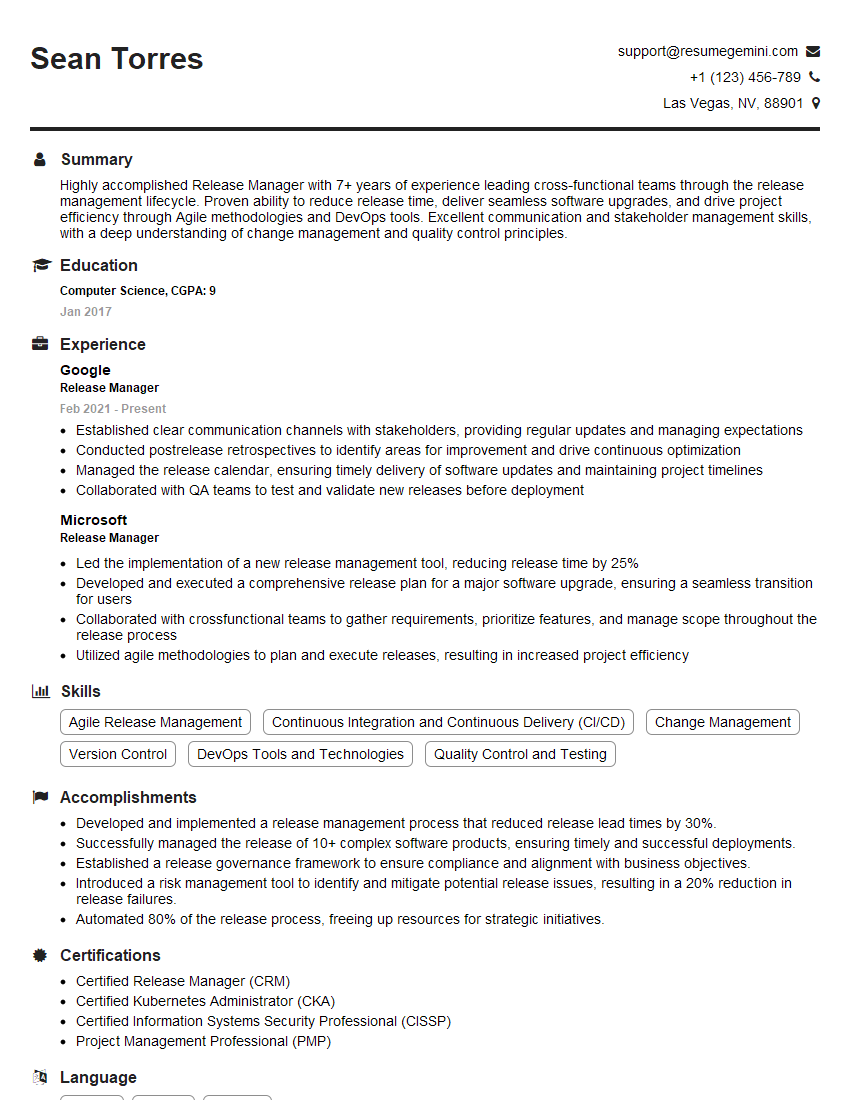
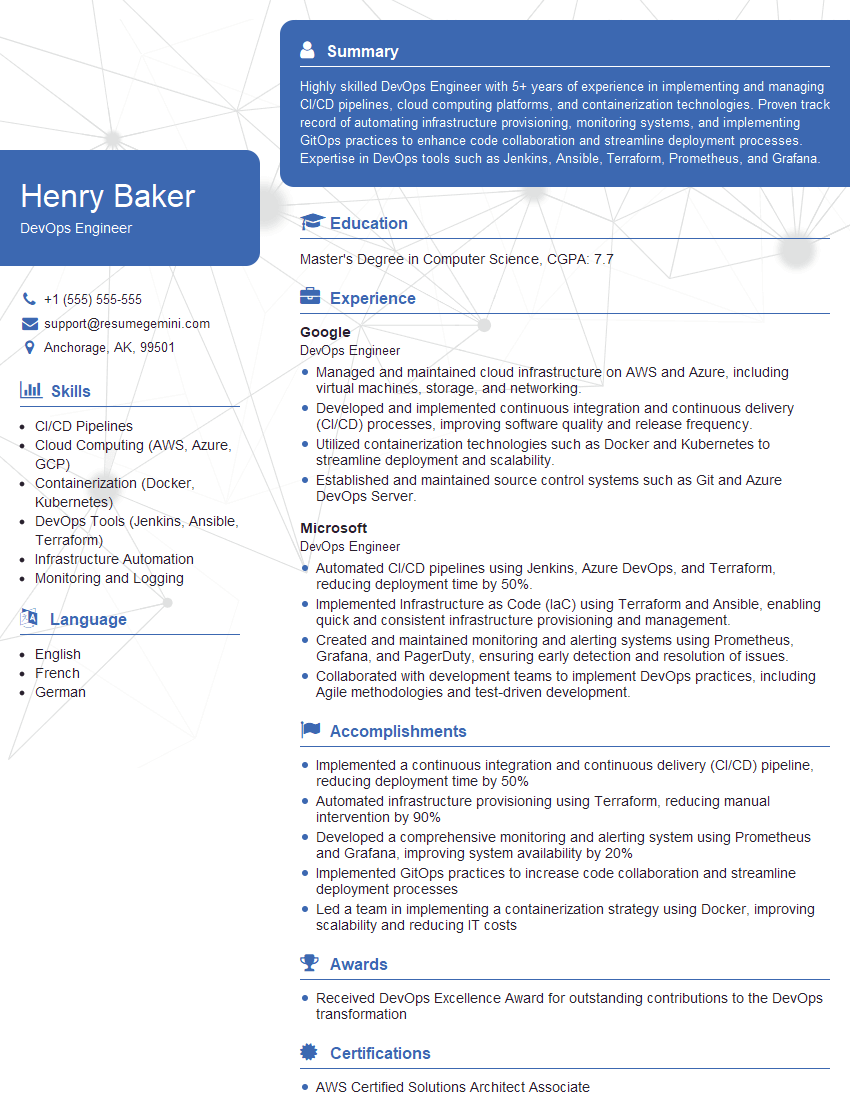
Mastering Automated Configuration Management is crucial for career advancement in DevOps and IT operations, opening doors to high-demand roles with excellent compensation. An ATS-friendly resume is your key to unlocking these opportunities. To make a strong impression on recruiters and hiring managers, invest time in crafting a compelling resume that highlights your skills and experience effectively. ResumeGemini is a trusted resource to help you build a professional and impactful resume. We provide examples of resumes tailored to Automated Configuration Management to guide you in showcasing your expertise.
Explore more articles
Users Rating of Our Blogs
Share Your Experience
We value your feedback! Please rate our content and share your thoughts (optional).
What Readers Say About Our Blog
Very informative content, great job.
good