The right preparation can turn an interview into an opportunity to showcase your expertise. This guide to Automating Infrastructure Management interview questions is your ultimate resource, providing key insights and tips to help you ace your responses and stand out as a top candidate.
Questions Asked in Automating Infrastructure Management Interview
Q 1. Explain Infrastructure as Code (IaC) and its benefits.
Infrastructure as Code (IaC) is the practice of managing and provisioning computer data centers through machine-readable definition files, rather than physical hardware configuration or interactive configuration tools. Think of it like a recipe for your infrastructure: you define the ingredients (servers, networks, databases) and the steps (how they connect and interact), and the IaC tool automatically prepares it for you.
The benefits are numerous:
- Automation: Reduces manual effort, increasing speed and efficiency in deploying and managing infrastructure.
- Consistency: Ensures consistent environments across different deployments, reducing inconsistencies and errors.
- Version Control: Allows tracking changes to infrastructure configurations, facilitating rollbacks and audits.
- Reproducibility: Enables easy replication of environments, crucial for testing, development, and disaster recovery.
- Collaboration: Improves teamwork by providing a common language and workflow for managing infrastructure.
- Cost Savings: Automates tasks that would otherwise require manual intervention, saving time and money.
For instance, instead of manually creating a virtual machine, configuring its network, and installing software, you define it in a configuration file, and your IaC tool does the work, consistently and reliably.
Q 2. Describe your experience with Terraform or Ansible.
I have extensive experience with both Terraform and Ansible. Terraform is my go-to tool for managing infrastructure as code, particularly for multi-cloud environments and complex deployments. I’ve used it to provision entire cloud networks, including virtual machines, load balancers, and databases, across AWS, Azure, and GCP. For example, I recently used Terraform to automate the setup of a highly available web application across three availability zones in AWS, significantly reducing deployment time and improving resilience.
Ansible, on the other hand, excels at configuration management and application deployment. I’ve employed Ansible to automate the configuration of servers, install and configure software packages, and manage user accounts. One recent project involved using Ansible to automate the deployment of a microservices architecture, ensuring consistent configurations across multiple servers and simplifying updates. I find that Ansible’s agentless architecture simplifies deployment and management, especially on large clusters.
Q 3. How do you manage configurations using tools like Puppet or Chef?
Puppet and Chef are both powerful configuration management tools, but they differ in their approaches. Puppet uses a declarative approach, where you define the desired state of your system, and Puppet figures out how to get there. Chef, while also supporting declarative approaches, leans more towards an imperative approach, allowing for more fine-grained control over the configuration process.
My experience includes using both. I’ve found Puppet particularly useful for managing large, complex infrastructure where ensuring consistency across many servers is paramount. Its declarative nature simplifies managing changes and ensures that the system remains in the desired state. I’ve used it to manage configurations for large server farms, enforcing security policies and ensuring consistent software versions.
Chef, with its more imperative style, offers greater flexibility for complex tasks. I’ve used it in situations where I needed very granular control over the configuration process, such as orchestrating complex application deployments or handling intricate system upgrades. I prefer Chef when dealing with custom scripting and advanced automation needs.
Regardless of the tool, I always prioritize modularity and maintainability, breaking down configurations into reusable modules to simplify management and improve code readability.
Q 4. What are the key differences between declarative and imperative automation?
Declarative and imperative automation differ fundamentally in how they specify the desired outcome.
- Declarative automation defines the *what* – the desired end state – without specifying the *how*. The tool figures out the steps needed to achieve that state. Think of it like giving instructions to a chef: “I want a chocolate cake.” The chef decides how to bake it. Examples include Terraform and Puppet.
- Imperative automation defines both the *what* and the *how* – specifying the exact steps to reach the desired state. This is like giving the chef precise instructions: “First, melt the chocolate, then add the eggs, bake at 350 degrees for 30 minutes.” Examples include Ansible and Chef (when using its imperative capabilities).
The choice depends on the complexity of the task and the level of control needed. Declarative approaches are generally simpler for managing larger, more complex systems, whereas imperative approaches offer greater control over the process but can become more complex to maintain for large deployments.
Q 5. Explain your experience with containerization technologies like Docker and Kubernetes.
I have significant experience with Docker and Kubernetes, two cornerstone technologies in modern containerization. Docker provides a consistent way to package and run applications in containers, ensuring they run the same way regardless of the underlying infrastructure. I’ve used Docker extensively for developing, testing, and deploying applications, leveraging its image-based approach to create reproducible and portable environments.
Kubernetes is an orchestration platform that manages containers at scale. I’ve used Kubernetes to deploy and manage containerized applications across multiple nodes, automating tasks such as scaling, load balancing, and self-healing. For example, I recently used Kubernetes to deploy a microservices application to a production environment, automating the deployment process, handling scaling based on demand, and ensuring high availability. I leverage Kubernetes features like deployments, services, and ingress controllers to create robust and scalable applications.
Q 6. How do you handle version control for infrastructure code?
Version control is essential for managing infrastructure code. I consistently use Git, along with a platform like GitHub or GitLab, to track changes to my infrastructure configuration files. This allows me to:
- Track Changes: Maintain a detailed history of all modifications, enabling easy rollbacks to previous versions if needed.
- Collaborate Effectively: Work collaboratively with others on infrastructure projects, merging changes and resolving conflicts smoothly.
- Improve Code Quality: Implement code reviews and utilize branching strategies to enhance the quality and reliability of the infrastructure code.
- Automate Deployment: Integrate Git with CI/CD pipelines to automate the deployment process, triggered by code commits.
A critical aspect is following a consistent branching strategy (e.g., Gitflow) to manage different versions and features and utilize pull requests to review changes before merging them into the main branch. This structured approach promotes a collaborative and reliable process for managing changes to the infrastructure code.
Q 7. Describe your experience with CI/CD pipelines for infrastructure.
CI/CD pipelines for infrastructure are crucial for automating the deployment process and ensuring faster release cycles. My experience involves setting up and managing CI/CD pipelines using tools like Jenkins, GitLab CI, or GitHub Actions. These pipelines typically include stages such as:
- Code Commit: Triggering the pipeline upon a code commit to the version control system.
- Build: Building any necessary artifacts (e.g., Docker images) and running tests.
- Testing: Running unit and integration tests to validate changes.
- Deployment: Deploying the infrastructure changes to a staging or production environment, often using IaC tools like Terraform or Ansible.
- Verification: Verifying the deployment is successful and the infrastructure functions correctly.
I prioritize creating automated tests to validate infrastructure configurations and application deployments, ensuring reliability and reducing the risk of errors in production. Implementing robust rollback strategies is crucial to mitigating potential issues. For instance, in one project, we implemented canary deployments using Kubernetes to roll out changes gradually, allowing for quick rollback if any issues arose. This approach minimized disruption and enhanced reliability.
Q 8. How do you monitor and log infrastructure automation processes?
Monitoring and logging are crucial for the success of any infrastructure automation process. Think of it like having a dashboard for your automated infrastructure – it tells you what’s working, what’s failing, and where things might go wrong in the future. We achieve this through a multi-layered approach.
- Centralized Logging: I typically leverage tools like Elasticsearch, Fluentd, and Kibana (EFK stack) or the more modern and cloud-native solutions like Splunk or the cloud provider’s own logging services (e.g., CloudWatch for AWS, Log Analytics for Azure). These tools aggregate logs from various sources – servers, applications, and automation tools – providing a unified view.
- Monitoring Tools: For real-time monitoring, I use tools like Prometheus and Grafana, which allow me to define metrics related to infrastructure health, automation job execution times, resource utilization, and more. These tools provide dashboards and alerts, enabling proactive identification of issues.
- Automation Tool Logging: The automation tools themselves (Ansible, Terraform, Chef, etc.) provide robust logging capabilities. I configure them to log detailed information, including execution steps, errors, and timestamps. This is essential for debugging and post-mortem analysis.
- Custom Scripts and Alerts: Often, I write custom scripts to monitor specific metrics or events and trigger alerts through email, PagerDuty, or other notification systems. This allows for immediate notification of critical issues.
For example, if an Ansible playbook fails to deploy a new server, the centralized logging system will record the error, the monitoring tools will show a spike in error metrics, and the automation tool itself will provide detailed error messages in its logs. This layered approach ensures that I can quickly identify and resolve any issues.
Q 9. Explain your experience with scripting languages like Python or Bash for automation.
I’m highly proficient in both Python and Bash scripting for infrastructure automation. My experience spans from simple shell scripts for automating repetitive tasks to complex Python programs managing entire cloud environments. The choice of language often depends on the task.
- Bash: Excellent for quick, system-level tasks, interacting directly with the operating system, and managing processes. It’s often the first choice for simple automation scripts or for tasks involving command-line tools.
- Python: A more powerful and versatile language, well-suited for complex logic, data processing, interacting with APIs, and building more sophisticated automation frameworks. Python’s libraries like
boto3(for AWS),azure-mgmt(for Azure), and the rich ecosystem of automation tools make it ideal for managing cloud infrastructure.
For example, I’ve used Python with boto3 to create an automated script that deploys a new EC2 instance on AWS, configures it with security groups, installs necessary software, and registers it with a load balancer. In contrast, a simple Bash script might be sufficient to automate the backup of server logs on a regular basis.
# Example Python snippet (boto3) import boto3 ec2 = boto3.resource('ec2') instance = ec2.create_instances(...)Q 10. How do you troubleshoot infrastructure automation failures?
Troubleshooting infrastructure automation failures requires a methodical approach. Think of it as detective work; you need to gather clues and systematically eliminate possibilities.
- Review Logs: Start by examining the logs from the automation tool, the infrastructure components, and the monitoring systems. Look for error messages, unusual behavior, and timestamps to pinpoint the failure point.
- Check Infrastructure Status: Verify the health of the infrastructure components involved in the automation process. Are servers running? Are networks connected? Are databases accessible?
- Isolate the Problem: Try to narrow down the scope of the problem. Is it a configuration issue, a code bug, a network connectivity problem, or a resource constraint? Consider running smaller, isolated parts of the automation process to identify the exact point of failure.
- Reproduce the Issue: If possible, try to reproduce the failure in a test environment. This controlled setting allows you to experiment with different approaches and pinpoint the cause more easily.
- Use Debugging Tools: Utilize debugging tools within your scripting languages to step through the code and examine variables and state at various points of execution.
- Seek External Help: Don’t hesitate to consult documentation, online forums, or colleagues for assistance if you’re stuck. Many common issues have known solutions.
For instance, if an Ansible playbook fails to update a server’s software, I’d first check the Ansible logs for specific errors. Then I’d verify the server’s network connectivity and ensure that the necessary repositories are accessible. If the issue persists, I’d run a smaller subset of the playbook’s tasks to determine exactly where it fails. This systematic process helps me to solve the problem efficiently.
Q 11. Describe your experience with different cloud providers (AWS, Azure, GCP).
I have extensive experience with all three major cloud providers: AWS, Azure, and GCP. My experience goes beyond simply using their services; I’ve worked on automating the deployment, management, and scaling of resources on all three platforms. Each has its own strengths and weaknesses, and my approach is tailored to the specific needs of the project.
- AWS: Proficient in using services like EC2, S3, RDS, Lambda, CloudFormation, and other services. I’ve built automation pipelines using tools like AWS CodePipeline, CodeBuild, and CodeDeploy.
- Azure: Experienced in using Azure Virtual Machines, Azure Storage, Azure SQL Database, Azure Functions, Azure Resource Manager (ARM) templates, and Azure DevOps. I’ve created automated deployments using ARM templates and Azure DevOps pipelines.
- GCP: Familiar with Compute Engine, Cloud Storage, Cloud SQL, Cloud Functions, Deployment Manager, and other services. I’ve automated deployments using Deployment Manager and other tools.
The key difference lies in the specific tools and APIs used for each provider. While the underlying principles of automation remain consistent, the implementation details differ significantly. My expertise lies in adapting my approach to the specifics of each platform to optimize efficiency and cost-effectiveness.
Q 12. How do you ensure security in your infrastructure automation practices?
Security is paramount in infrastructure automation. A compromised automated system can have catastrophic consequences. My approach to security is based on several key principles:
- Least Privilege: Automation scripts should only have the minimum necessary permissions to perform their tasks. Avoid using root or administrator accounts unless absolutely necessary.
- Secret Management: Never hardcode sensitive information, like passwords or API keys, directly into scripts. Use secure secret management solutions like HashiCorp Vault, AWS Secrets Manager, or Azure Key Vault. These tools provide secure storage and retrieval of sensitive data.
- Infrastructure as Code (IaC) Security: When using tools like Terraform or CloudFormation, adhere to security best practices when defining infrastructure. Use security groups, network access control lists (ACLs), and other security measures to restrict access to resources.
- Regular Security Audits and Penetration Testing: Conduct regular security audits and penetration testing to identify and address potential vulnerabilities in your automated systems and infrastructure.
- Input Validation: Always validate user inputs and configuration data to prevent injection attacks and other vulnerabilities.
- Compliance: Ensure your automation processes adhere to relevant security and compliance standards (e.g., SOC 2, ISO 27001).
For example, instead of embedding an AWS access key directly in a Python script, I use the AWS SDK’s credential profiles or integrate with AWS Secrets Manager to securely access the credentials.
Q 13. Explain your approach to testing infrastructure automation code.
Testing infrastructure automation code is crucial to ensure reliability and prevent errors in production. My testing strategy is comprehensive and includes multiple layers:
- Unit Tests: Test individual functions or modules within the automation scripts to ensure they work correctly in isolation. This uses standard testing frameworks in Python (
unittest,pytest) or Bash (using assertions and exit codes). - Integration Tests: Test the interaction between different components of the automation system. This involves testing the entire process flow, ensuring that different parts work together seamlessly.
- End-to-End Tests: Test the entire automation process from start to finish, verifying that it correctly deploys and configures the infrastructure. This might involve deploying to a test environment and validating the outcome.
- Infrastructure-as-Code (IaC) Linting: Using linters like
terraform fmtor similar tools for your IaC tool can help prevent common errors and improve code readability and maintainability. - Chaos Engineering: Injecting controlled failures into the system (e.g., simulating network outages or server failures) helps to identify weaknesses and improve resilience. Tools like Chaos Mesh or Gremlin can aid in this process.
For example, in a Python-based automation script, I’d write unit tests to verify that individual functions correctly parse configuration files, make API calls, and handle errors. I’d then perform integration tests to check the interaction between these functions and finally, end-to-end tests to deploy a test environment and validate its configuration.
Q 14. How do you handle infrastructure changes in a production environment using automation?
Handling infrastructure changes in production using automation requires a cautious and controlled approach. The key is to minimize disruption and ensure reversibility. My strategy typically involves:
- Version Control: All infrastructure automation code should be managed in a version control system like Git. This allows for tracking changes, rollbacks, and collaboration.
- Automated Testing: Before deploying any changes to production, run a comprehensive suite of tests in a staging or pre-production environment that closely mirrors production.
- Continuous Integration/Continuous Delivery (CI/CD): Use a CI/CD pipeline to automate the building, testing, and deployment of changes. This ensures a consistent and reliable process.
- Canary Deployments: Gradually roll out changes to a small subset of users or servers first. This allows for early detection of any issues before a full deployment.
- Rollback Plan: Have a clear rollback plan in place. This plan should detail how to quickly revert to a previous working state if something goes wrong.
- Monitoring and Alerting: Closely monitor the system after deploying changes. Have appropriate alerting set up to notify you of any problems.
- Immutable Infrastructure: Where possible, adopt immutable infrastructure practices. Instead of modifying existing servers, create new ones with the desired changes and replace the old ones.
For example, when updating the software on production servers, I’d use a CI/CD pipeline to build a new image, deploy it to a small subset of servers (canary deployment), monitor the performance, and then roll it out to the remaining servers only if the canary deployment is successful. If any issues arise, I can easily revert to the previous version thanks to version control and the rollback plan.
Q 15. What are some common challenges in infrastructure automation, and how have you overcome them?
Automating infrastructure management, while offering immense benefits like speed and consistency, presents several challenges. One common hurdle is the complexity of existing infrastructure. Legacy systems often lack the standardized APIs or documentation needed for seamless automation. Another is the potential for configuration drift – where the actual state of the infrastructure deviates from the desired state defined in the automation scripts. Finally, managing dependencies and ensuring smooth integration across different tools and platforms can be quite challenging.
In my experience, I’ve overcome these challenges through a multi-pronged approach. For legacy systems, I’ve employed a phased automation strategy, starting with simpler, less critical components and gradually expanding automation coverage. This minimizes disruption and allows for iterative improvements. To address configuration drift, I’ve implemented robust monitoring and validation mechanisms, leveraging tools like Puppet or Chef to detect and correct deviations. This ensures that the actual state consistently mirrors the intended configuration. Finally, I’ve focused on creating modular and reusable automation scripts, leveraging infrastructure-as-code (IaC) principles, to facilitate better integration and dependency management across different tools and cloud providers.
Career Expert Tips:
- Ace those interviews! Prepare effectively by reviewing the Top 50 Most Common Interview Questions on ResumeGemini.
- Navigate your job search with confidence! Explore a wide range of Career Tips on ResumeGemini. Learn about common challenges and recommendations to overcome them.
- Craft the perfect resume! Master the Art of Resume Writing with ResumeGemini’s guide. Showcase your unique qualifications and achievements effectively.
- Don’t miss out on holiday savings! Build your dream resume with ResumeGemini’s ATS optimized templates.
Q 16. Describe your experience with implementing rollback strategies in infrastructure automation.
Rollback strategies are crucial in infrastructure automation to mitigate the risk of deployments failing or causing unexpected issues. Think of it like having an ‘undo’ button for your infrastructure changes. Without a reliable rollback mechanism, a faulty deployment could lead to significant downtime and operational chaos.
My approach involves a combination of techniques. Firstly, I always utilize version control (like Git) for all infrastructure-as-code (IaC) scripts, enabling me to easily revert to previous known-good configurations. Secondly, I implement automated snapshots or backups of critical infrastructure components before any major deployment. These snapshots act as safety nets, allowing a quick recovery in case of failures. Finally, I leverage tools like Terraform or Ansible that offer built-in rollback capabilities or allow for the creation of custom rollback scripts. For instance, if a Terraform deployment fails, its built-in mechanisms will usually roll back the changes automatically. If using a different approach, I might create a separate script that mirrors the deployment steps, but in reverse, to undo the changes.
Q 17. How do you ensure scalability and maintainability in your automated infrastructure?
Scalability and maintainability are paramount in automated infrastructure. Scalability means your infrastructure can handle increasing workloads without significant performance degradation, while maintainability ensures your automation scripts are easy to understand, modify, and extend over time.
To achieve scalability, I employ several strategies. I utilize cloud-native services where possible, leveraging the elasticity and scalability offered by cloud providers. I design my infrastructure with modularity in mind, separating components into independently scalable units. This allows scaling specific parts of the infrastructure as needed, rather than scaling the entire system. For maintainability, I adhere to best practices like writing well-documented, modular, and idempotent scripts. Idempotent scripts ensure that running the same script multiple times produces the same result, preventing unintended side effects. I also employ code reviews and continuous integration/continuous delivery (CI/CD) pipelines to ensure code quality and facilitate smooth updates and changes.
Q 18. Explain your understanding of immutable infrastructure.
Immutable infrastructure is a paradigm where servers and other infrastructure components are treated as disposable. Instead of updating existing instances, new ones are created with the desired configuration, and the old ones are discarded. Think of it like throwing away a broken appliance and getting a new one, rather than trying to repair the old one.
This approach offers several benefits. It simplifies troubleshooting and rollback processes because you’re always working with a known good state. It enhances security by minimizing the cumulative effects of patch management and configuration changes, and reduces the risk of inconsistencies. I often employ immutable infrastructure by leveraging containerization technologies like Docker and orchestration platforms like Kubernetes. This allows me to easily build, deploy, and manage consistent and repeatable infrastructure components across various environments.
Q 19. How do you use monitoring and logging tools to improve infrastructure automation?
Monitoring and logging are essential for effective infrastructure automation. Monitoring provides real-time visibility into the health and performance of your infrastructure, allowing you to proactively identify and address issues, while logging provides detailed records of events and actions within the system, assisting in troubleshooting and auditing.
I typically integrate monitoring and logging tools directly into my automation pipelines. Tools like Prometheus and Grafana for monitoring, and tools like the ELK stack (Elasticsearch, Logstash, Kibana) or Splunk for logging are regularly used. These tools enable me to create dashboards that visualize key metrics like CPU usage, memory consumption, and network latency. Furthermore, I incorporate logging into my automation scripts to track deployments, configurations, and any errors encountered. The combined monitoring and logging data provides valuable insights for continuous improvement of the automation process itself, helping me refine scripts and identify areas for optimization.
Q 20. Describe your experience with implementing Infrastructure as Code (IaC) in a multi-cloud environment.
Implementing Infrastructure as Code (IaC) in a multi-cloud environment requires careful planning and a consistent approach. The challenge lies in managing the differences between cloud providers’ APIs and services while maintaining a unified, easily manageable infrastructure.
My experience involves leveraging IaC tools that support multiple cloud providers, such as Terraform or Pulumi. These tools abstract away some of the underlying differences, allowing me to define infrastructure in a declarative manner that is relatively cloud-agnostic. I create reusable modules to encapsulate common infrastructure components, promoting consistency across clouds. For example, a module defining a virtual machine could be used across AWS, Azure, and Google Cloud with minimal modifications. However, it is important to maintain separate state files for each cloud environment to avoid conflicts. To ensure efficient management, I use a Git-based version control system to manage all IaC code across different cloud environments, enabling consistent revision management and collaboration.
Q 21. What are your preferred methods for managing secrets in infrastructure automation?
Managing secrets – such as API keys, database passwords, and SSH keys – is crucial for security in infrastructure automation. Hardcoding secrets into scripts is a major security risk.
My preferred methods rely heavily on dedicated secrets management tools like HashiCorp Vault or AWS Secrets Manager. These tools offer features like encryption at rest and in transit, access control lists, and auditing capabilities. Instead of embedding secrets directly into IaC scripts, I use these tools to store and retrieve them securely. The scripts then access the secrets through the dedicated APIs provided by the secrets management tools, ensuring the secrets are never exposed directly in the code or logs. Another strategy I employ is using environment variables, injecting the secrets at runtime through secure methods, avoiding any direct exposure of these credentials in the code repository. This approach promotes secure and maintainable code.
Q 22. How do you approach integrating security best practices into your automation workflows?
Integrating security best practices into automation workflows is paramount. It’s not enough to just automate; we must automate securely. My approach involves a multi-layered strategy focusing on prevention, detection, and response.
- Least Privilege: Automation scripts should operate with the principle of least privilege. This means granting only the necessary permissions to the automated processes, limiting potential damage from breaches. For example, instead of running a script as root, I’d create a dedicated user with only the required access rights.
- Secret Management: Never hardcode sensitive information like API keys or passwords directly into scripts. I leverage tools like HashiCorp Vault or AWS Secrets Manager to securely store and manage secrets, accessed by the automation tools through appropriate APIs. This prevents secrets from being exposed in version control or logs.
- Input Validation: Rigorous input validation is crucial to prevent injection attacks (e.g., SQL injection). Automated scripts should thoroughly sanitize all inputs before using them in commands or queries. This involves validating data types, length, and format.
- Continuous Monitoring and Logging: Comprehensive logging is essential for auditing and incident response. I integrate logging into all automation scripts, capturing actions, timestamps, and relevant data. This data can then be analyzed to detect anomalies and investigate security incidents. Centralized logging and monitoring platforms further enhance this capability.
- Infrastructure as Code (IaC) Security Scanning: When using IaC tools like Terraform or CloudFormation, I incorporate security scanning tools to identify potential vulnerabilities in the infrastructure-as-code definitions *before* deployment. This proactive approach helps prevent security misconfigurations from reaching production.
Think of it like building a house – you wouldn’t just slap up walls and hope for the best; you’d meticulously plan, inspect each step, and implement security measures like locks and alarms. Automation security is just as critical.
Q 23. Describe your experience with automating database deployments and management.
Automating database deployments and management is a crucial aspect of efficient infrastructure management. My experience spans various database systems, including PostgreSQL, MySQL, and Oracle, utilizing both proprietary tools and open-source solutions.
I’ve extensively used tools like Liquibase and Flyway for managing database migrations. These tools track changes to the database schema, ensuring consistency and repeatability across different environments (development, testing, production). This eliminates the risk of manual errors during deployments.
For automating database administration tasks, I’ve employed scripting languages such as Python and Ansible. This allows me to automate tasks like creating backups, monitoring performance metrics, and scaling database instances based on demand. For example, I’ve automated the process of creating daily database backups, uploading them to cloud storage and deleting old backups based on retention policy – a task previously done manually and prone to human error.
# Example Python snippet for database backup (Illustrative):
import psycopg2
# ...connection details...
conn = psycopg2.connect(...)
cur = conn.cursor()
cur.execute("BACKUP DATABASE ...")
#...rest of the code...
The key is to ensure version control of database scripts and configurations, just like with application code. This allows for rollback and tracking of changes, maintaining auditability and facilitating disaster recovery.
Q 24. How do you use automation to improve the efficiency of your team?
Automation significantly enhances team efficiency by freeing up engineers from repetitive tasks, allowing them to focus on higher-value activities. This has been demonstrated time and again in my experience.
- Reduced Manual Effort: Automation eliminates the need for manual provisioning, configuration, and deployment of infrastructure components. This saves a significant amount of time and reduces the risk of human error.
- Faster Deployments: Automated deployments are faster and more reliable than manual processes, leading to quicker delivery of new features and updates. Imagine deploying a new microservice – with automation, this can be done in minutes, whereas manual deployment might take hours.
- Improved Collaboration: Infrastructure-as-code (IaC) promotes better collaboration within the team, as infrastructure configurations are version-controlled and accessible to all members. This facilitates code reviews and prevents conflicting changes.
- Increased Reliability: Automation helps reduce human error, leading to a more reliable and consistent infrastructure. Automated tests ensure that systems function correctly after changes.
- Enhanced Self-Service Capabilities: Automation can empower developers with self-service capabilities for provisioning resources, accelerating the development lifecycle.
In a previous role, we automated our entire deployment pipeline, reducing deployment time from several hours to just minutes. This allowed the team to focus on developing new features instead of wrestling with deployments.
Q 25. What is your experience with serverless computing and its automation?
Serverless computing, with its inherent scalability and cost-effectiveness, lends itself beautifully to automation. I have significant experience automating various aspects of serverless architectures.
My experience includes automating the deployment of serverless functions using tools like AWS SAM, Azure Functions, and Serverless Framework. These tools allow for defining and deploying functions through IaC, ensuring consistency and repeatability.
I’ve automated the monitoring and logging of serverless functions using tools like CloudWatch and Application Insights, enabling proactive identification and resolution of issues. This involves setting up alerts for key metrics and integrating with incident management systems.
Furthermore, I’ve automated the scaling of serverless functions based on demand, using the built-in autoscaling features of cloud providers. This ensures that applications can handle fluctuating workloads efficiently without requiring manual intervention.
The automation of serverless environments focuses on efficiently managing functions, event triggers, and the underlying infrastructure, eliminating the need for manual configuration and reducing operational overhead. The reduced operational burden is one of the key advantages of serverless, and automation enhances that benefit significantly.
Q 26. How do you measure the success of your infrastructure automation efforts?
Measuring the success of infrastructure automation efforts requires a multi-faceted approach, combining qualitative and quantitative metrics.
- Deployment Frequency: How often can we deploy changes to the infrastructure? Higher frequency indicates greater agility and efficiency.
- Deployment Time: How long does it take to deploy changes? Reduced deployment time means faster feedback cycles and quicker delivery.
- Mean Time To Recovery (MTTR): How long does it take to recover from failures? A lower MTTR showcases improved resilience.
- Change Failure Rate: How frequently do deployments result in failures? A lower failure rate signifies improved reliability.
- Cost Savings: Has automation reduced infrastructure costs? This could be through reduced human effort or optimized resource utilization.
- Team Satisfaction: How has automation impacted team morale and productivity? This is a crucial qualitative factor.
We use dashboards and reporting tools to track these metrics, providing visibility into the effectiveness of our automation efforts. Regular reviews help identify areas for improvement and ensure alignment with business objectives.
Q 27. Explain your experience with implementing compliance and auditability in your automation processes.
Implementing compliance and auditability in automation processes is crucial for maintaining security and meeting regulatory requirements. My approach involves several key steps:
- Version Control: All infrastructure-as-code (IaC) and automation scripts are stored in version control systems (e.g., Git), enabling tracking of changes and facilitating rollbacks. This ensures that all modifications are auditable.
- Configuration Management: Employing configuration management tools allows for maintaining a consistent and auditable state of the infrastructure. Changes are tracked and reported, adhering to the principle of immutable infrastructure where possible.
- Access Control: Strict access control mechanisms are implemented to ensure only authorized personnel can modify the infrastructure and automation scripts. Role-based access control (RBAC) is a critical component.
- Auditing and Logging: Detailed logs of all automation activities are maintained, providing a complete audit trail. These logs are analyzed regularly to identify any anomalies or security breaches.
- Compliance Checks: Automated compliance checks are performed regularly to ensure the infrastructure adheres to relevant regulations and standards (e.g., SOC 2, HIPAA, PCI DSS). This might involve integrating with security scanning tools or custom scripts.
For example, in a recent project involving HIPAA compliance, we integrated our automation scripts with a security information and event management (SIEM) system, providing real-time monitoring and alerting for any potential violations.
Q 28. Describe a complex infrastructure automation project you worked on and the challenges you faced.
One complex project involved migrating a legacy on-premises infrastructure to a cloud-native architecture. The challenge was multifaceted:
- Legacy System Complexity: The existing system was a monolithic application with tightly coupled components, making migration challenging.
- Data Migration: Migrating large volumes of data to the cloud required careful planning and execution to minimize downtime and ensure data integrity.
- Application Refactoring: Some application components needed refactoring to leverage cloud-native services.
- Security Concerns: Ensuring security and compliance throughout the migration was paramount.
- Integration with Existing Systems: The migrated system needed to seamlessly integrate with existing on-premises and cloud-based systems.
To overcome these challenges, we adopted a phased approach, starting with a proof-of-concept to validate our migration strategy. We used a combination of tools including Terraform for infrastructure provisioning, Ansible for configuration management, and Docker and Kubernetes for containerization and orchestration. Continuous integration and continuous delivery (CI/CD) pipelines were implemented to automate the deployment process.
Careful planning, meticulous execution, and consistent communication were critical to the project’s success. While challenges emerged throughout the process, the use of automation and a well-defined migration plan enabled us to successfully complete the project on time and within budget.
Key Topics to Learn for Automating Infrastructure Management Interview
- Infrastructure as Code (IaC): Understand the principles behind IaC, its benefits, and popular tools like Terraform, Ansible, and CloudFormation. Be prepared to discuss practical examples of automating infrastructure provisioning and configuration.
- Configuration Management: Explore tools like Puppet, Chef, and SaltStack. Discuss how these tools are used to manage and maintain the consistency of systems across an infrastructure. Be ready to explain the differences between these approaches and when each might be most appropriate.
- Containerization and Orchestration: Master concepts related to Docker and Kubernetes. Discuss how containers improve application deployment and management. Understand how Kubernetes orchestrates containerized applications across a cluster.
- Cloud Computing Platforms (AWS, Azure, GCP): Familiarize yourself with at least one major cloud provider and its services relevant to infrastructure automation. Be able to discuss relevant services like cloud provisioning, scaling, and monitoring.
- Scripting and Automation Languages: Demonstrate proficiency in at least one scripting language like Python or Bash. Be ready to discuss how these languages facilitate automation tasks and integrate with other infrastructure management tools.
- Monitoring and Logging: Understand the importance of monitoring and logging for infrastructure health and troubleshooting. Discuss tools and best practices for effective monitoring and log analysis.
- Security Best Practices in Automation: Discuss security considerations within automation processes, including access control, secrets management, and vulnerability scanning.
- CI/CD Pipelines: Understand the principles of Continuous Integration and Continuous Delivery and how automation plays a critical role in these pipelines.
- Problem-Solving and Troubleshooting: Be prepared to discuss your approach to troubleshooting infrastructure issues and how automation can help prevent and resolve them efficiently. Showcase your analytical and debugging skills.
Next Steps
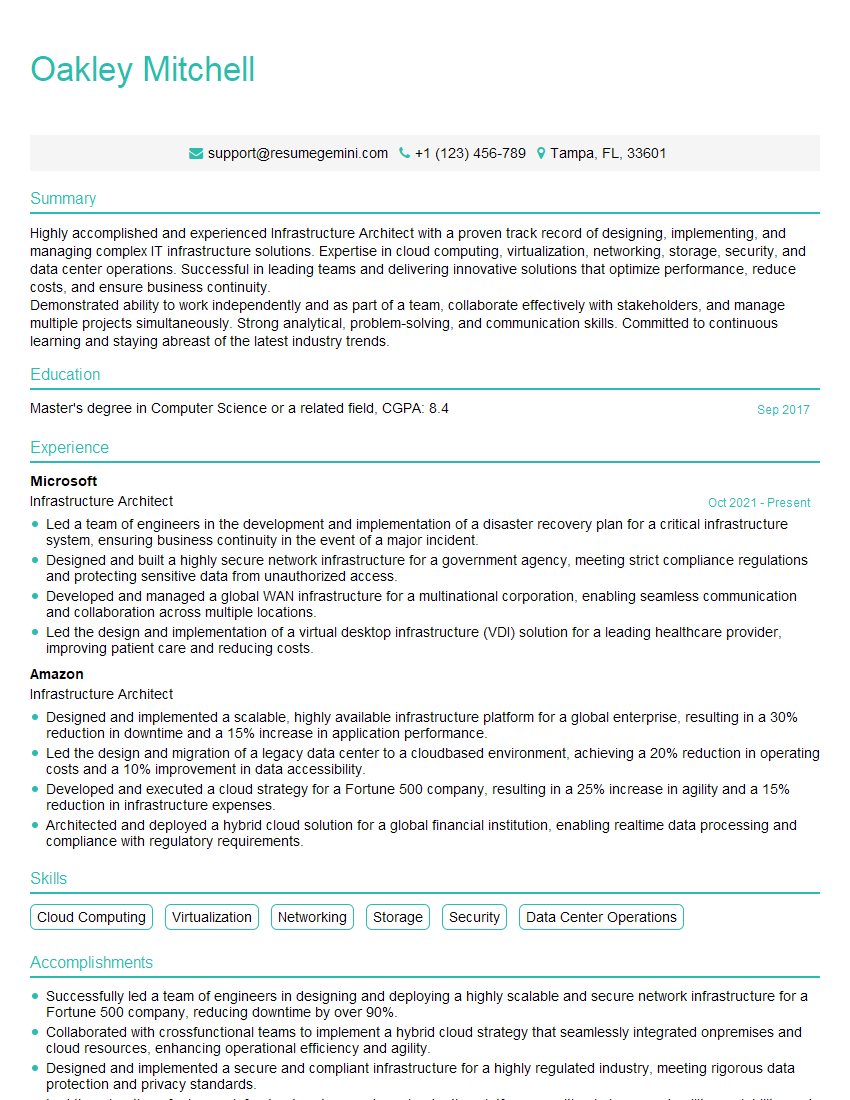
Mastering Automating Infrastructure Management opens doors to exciting and high-demand roles, significantly boosting your career prospects. A strong resume is crucial to showcasing your skills effectively. Crafting an ATS-friendly resume is key to getting your application noticed. ResumeGemini is a trusted resource to help you build a professional and impactful resume that highlights your expertise. Examples of resumes tailored to Automating Infrastructure Management are available to guide you.
Explore more articles
Users Rating of Our Blogs
Share Your Experience
We value your feedback! Please rate our content and share your thoughts (optional).
What Readers Say About Our Blog
Very informative content, great job.
good