Interviews are opportunities to demonstrate your expertise, and this guide is here to help you shine. Explore the essential Automating processes interview questions that employers frequently ask, paired with strategies for crafting responses that set you apart from the competition.
Questions Asked in Automating processes Interview
Q 1. Explain the difference between Robotic Process Automation (RPA) and Business Process Automation (BPA).
While both Robotic Process Automation (RPA) and Business Process Automation (BPA) aim to improve efficiency, they differ significantly in their approach. Think of it like this: BPA is the architect designing the entire blueprint of a house, while RPA is the construction robot focusing on specific, repetitive tasks within that house.
RPA automates repetitive, rule-based tasks typically performed by humans interacting with applications through their user interface (UI). It’s like a software robot mimicking human actions, such as copying data from one system to another. RPA doesn’t fundamentally change the underlying processes; it simply automates existing ones.
BPA encompasses a broader scope, focusing on optimizing and improving entire business processes. This includes analyzing workflows, identifying areas for improvement, redesigning processes, and then potentially implementing automation tools like RPA. BPA might involve changing how data flows, reorganizing departments, or even adopting new technologies. It’s about achieving strategic business goals, while RPA is a tactical tool within that strategy.
In short: RPA is a subset of BPA. RPA automates individual tasks, while BPA optimizes entire processes, which might or might not involve RPA.
Q 2. Describe your experience with different RPA tools (e.g., UiPath, Automation Anywhere, Blue Prism).
I have extensive experience with UiPath, Automation Anywhere, and Blue Prism, each with its strengths and weaknesses.
- UiPath: I’ve used UiPath extensively for its robust Studio environment, ease of integration with other systems, and its large community support. I’ve successfully deployed several UiPath bots for tasks like invoice processing, data entry, and report generation. One project involved automating a previously manual process that took 10 hours a day; UiPath reduced it to under 2 hours with increased accuracy.
- Automation Anywhere: I’ve found Automation Anywhere to be particularly strong in handling complex, multi-system interactions, and its control room features are excellent for monitoring and managing large-scale deployments. I used this platform to automate a client’s supply chain management process, improving delivery times and reducing errors.
- Blue Prism: My experience with Blue Prism has shown it to excel in highly secure and regulated environments. Its focus on security and governance is unmatched. I employed Blue Prism to automate a financial reconciliation process, requiring strict auditability and data security.
My choice of RPA tool depends on the specific project requirements, considering factors like scalability, security needs, integration capabilities, and the client’s existing infrastructure.
Q 3. How do you handle errors and exceptions in automation workflows?
Robust error handling is paramount in automation. Failing to account for exceptions can lead to process failures, data inconsistencies, and even system crashes.
My approach is multifaceted:
- Exception Handling Mechanisms: I use built-in features of the RPA tool (like
try-catchblocks in UiPath or similar constructs in other tools) to anticipate and manage errors. For example,try { // Code that might fail } catch (Exception e) { // Handle the exception }. This allows the bot to gracefully handle problems without halting the entire process. - Retry Logic: If an error is temporary (e.g., a network hiccup), I implement retry mechanisms with exponential backoff – increasing the wait time between retries to avoid overwhelming the system.
- Logging and Monitoring: Comprehensive logging is crucial. I capture all relevant information – successful actions, errors, exceptions, and timestamps – providing a detailed audit trail. This data feeds into centralized monitoring dashboards, allowing proactive identification and resolution of issues.
- Alerts and Notifications: Automated alerts notify the appropriate team members of critical errors or exceptions, ensuring timely intervention.
- Error Recovery Strategies: I design recovery mechanisms to resume the process from the point of failure, minimizing downtime. This might involve using checkpoints, storing intermediate results, or automatically re-attempting failed tasks.
This layered approach minimizes disruptions and ensures process reliability.
Q 4. Explain your approach to designing and implementing an automation solution.
My approach to designing and implementing an automation solution follows a structured methodology:
- Requirements Gathering and Analysis: Thoroughly understand the business problem, identify the processes to be automated, and define clear objectives, including KPIs (discussed later).
- Process Mapping and Design: Visually map the current process using tools like BPMN (Business Process Model and Notation) to pinpoint pain points and areas for automation. This helps refine the scope and create a detailed automation blueprint.
- Technology Selection: Choose the appropriate RPA tool and technologies based on factors such as scalability, security, and integration requirements.
- Development and Testing: Develop the automation solution iteratively, employing continuous integration and continuous delivery (CI/CD) practices. This includes rigorous unit testing, integration testing, and user acceptance testing (UAT).
- Deployment and Monitoring: Deploy the solution to the production environment, implement monitoring tools to track performance and identify potential issues, and establish a support mechanism.
- Maintenance and Optimization: Continuously monitor and optimize the automation solution to address emerging challenges and maximize its effectiveness.
Throughout this process, close collaboration with stakeholders is crucial to ensure alignment and successful implementation. I emphasize clear communication and documentation at each stage.
Q 5. What are the key performance indicators (KPIs) you would use to measure the success of an automation project?
Key Performance Indicators (KPIs) are critical for measuring automation project success. I typically focus on a combination of:
- Cost Savings: Quantify the reduction in labor costs, resource consumption, and operational expenses achieved through automation.
- Efficiency Gains: Measure the improvement in process speed, cycle time reduction, and throughput.
- Error Reduction: Track the decrease in manual errors and data inaccuracies resulting from automation.
- Throughput: Measure the number of transactions or processes handled per unit of time.
- Compliance and Security: Monitor adherence to regulatory requirements and security standards.
- Employee Satisfaction: Assess the impact of automation on employee morale and productivity. Are employees freed from mundane tasks, allowing them to focus on more strategic activities?
The specific KPIs will be tailored to the project’s objectives. For instance, in a customer service automation project, we might prioritize customer satisfaction scores and resolution times. In a financial process, compliance metrics would be paramount.
Q 6. How do you ensure the security and compliance of automated processes?
Security and compliance are paramount. My approach includes:
- Access Control: Implementing strict access control mechanisms to restrict access to sensitive data and automation components. This includes role-based access control (RBAC) and multi-factor authentication (MFA).
- Data Encryption: Encrypting sensitive data both in transit and at rest to protect against unauthorized access.
- Regular Security Audits: Conducting regular security assessments and vulnerability scans to identify and address potential security risks.
- Compliance Frameworks: Ensuring compliance with relevant regulations and industry standards, such as GDPR, HIPAA, or SOX, as appropriate. This involves designing and implementing controls to meet specific regulatory requirements.
- Change Management: Establishing a robust change management process to control and track changes to the automation solution, ensuring that security and compliance are maintained.
- Security Monitoring: Continuously monitoring the automation environment for suspicious activity and intrusion attempts.
Security isn’t an afterthought; it’s integrated into every stage of the automation lifecycle.
Q 7. Describe your experience with integrating automation solutions with existing systems.
Integrating automation solutions with existing systems is a common requirement, and my experience spans various integration methods:
- APIs: Using APIs (Application Programming Interfaces) for seamless data exchange between the RPA tool and existing systems. This is a preferred approach for its efficiency and robustness.
- Database Connections: Directly connecting to databases (e.g., SQL Server, Oracle) to retrieve and update data. This approach is particularly useful when dealing with structured data.
- File-Based Integration: Using files (e.g., CSV, XML) for data transfer when APIs are not available. However, this is generally less efficient than API-based integration.
- Screen Scraping: Employing screen scraping as a last resort when other methods are not feasible. This method is less reliable and more prone to errors due to UI changes.
I carefully select the most suitable integration method depending on the specific system architecture, data format, and the security and performance requirements. Thorough testing is conducted to ensure reliable data exchange and avoid data inconsistencies. A well-designed integration strategy minimizes disruption to existing systems and ensures smooth operation of the automated processes.
Q 8. How do you prioritize automation projects?
Prioritizing automation projects requires a strategic approach balancing business value, feasibility, and risk. I typically use a multi-criteria decision analysis (MCDA) approach, considering factors like:
- Return on Investment (ROI): How much will automation save in terms of time, cost, and resources? I’d quantify this with concrete metrics, projecting savings against implementation costs.
- Business Impact: How critical is the process to the business? High-impact processes with significant bottlenecks are prioritized.
- Feasibility: How technically achievable is the automation? This considers factors like data availability, system compatibility, and the complexity of the process. A simple, well-defined process is easier to automate than a complex one with many dependencies.
- Risk: What are the potential risks associated with the automation, such as data loss or system downtime? Projects with lower risk are generally prioritized.
I often use a scoring system to weigh these factors. For example, ROI might be weighted at 40%, business impact at 30%, feasibility at 20%, and risk at 10%. Each project gets a score, and those with higher scores are prioritized. This helps make the selection process objective and transparent.
For instance, automating a highly error-prone manual data entry process with a high ROI would rank higher than automating a process that only marginally improves efficiency.
Q 9. What are some common challenges in implementing automation, and how do you overcome them?
Common challenges in automation implementation include:
- Data quality issues: Inconsistent or incomplete data can hinder automation efforts. The solution is to implement robust data cleansing and validation procedures before automation.
- Lack of standardization: Inconsistent processes across different departments or systems make automation complex and more costly. The solution involves standardization of processes before automation.
- Integration challenges: Integrating automation tools with existing systems can be challenging. A phased approach, starting with simpler integrations, is useful. The use of APIs and middleware can resolve such issues.
- Resistance to change: Employees may resist automation due to fear of job displacement or change in workflow. Addressing these concerns proactively, involving employees in the process, and providing training are crucial.
- Technical limitations: Certain processes may be too complex or require specialized skills to automate, requiring breaking down a large process into smaller, manageable ones.
Overcoming these challenges involves careful planning, stakeholder engagement, and a phased approach. It’s essential to manage expectations and build consensus among team members and stakeholders. For example, I’ve successfully overcome data quality issues by implementing a data quality monitoring system that flags errors and triggers alerts before they impact automated processes. This proactive approach minimizes disruptions and allows for timely corrections.
Q 10. Explain your experience with different automation frameworks.
I have extensive experience with various automation frameworks, including:
- Selenium: For web UI automation, Selenium provides a robust and versatile framework. I’ve used Selenium WebDriver with various programming languages like Java and Python to automate browser interactions, test web applications, and scrape data from websites. For example, I used Selenium to automate a repetitive report generation task, reducing manual effort by over 70%.
- UiPath/Automation Anywhere/Blue Prism (RPA): These Robotic Process Automation (RPA) tools are excellent for automating repetitive tasks involving desktop applications and data entry. I have used them to automate tasks such as invoice processing, customer onboarding, and data migration. The visual workflow design in these tools makes them easy to understand and maintain.
- Cypress: This framework is particularly well-suited for end-to-end testing of web applications, providing fast feedback and easy debugging capabilities.
- Robot Framework: A generic test automation framework that is easily extendable. It is particularly useful when integrating with other tools and using a keyword-driven approach.
My choice of framework depends on the specific requirements of the project. For example, when automating a complex business process involving multiple systems, an RPA tool like UiPath is often preferable due to its ease of integration and user-friendly interface. When testing a web application, Cypress might be a better fit because of its speed and developer-friendly features.
Q 11. How do you ensure the scalability and maintainability of automated processes?
Ensuring scalability and maintainability is crucial for long-term success in automation. I achieve this through:
- Modular Design: Breaking down the automation process into smaller, independent modules makes it easier to scale and maintain. Changes or additions can be made to individual modules without affecting the entire system.
- Version Control: Utilizing tools like Git for version control allows for tracking changes, collaboration, and easy rollback if needed. This is fundamental for maintaining a clean code base and promoting collaboration.
- Documentation: Comprehensive documentation is essential for understanding the automation process, troubleshooting issues, and facilitating future modifications. This includes clear explanations of the process, code comments, and diagrams.
- Centralized Configuration: Storing configuration settings in a central location (e.g., a configuration file) allows for easy modification without altering the core code. This is vital for environment-specific changes.
- Use of Design Patterns: Employing design patterns like the Factory pattern and Strategy pattern promotes flexibility and maintainability by abstracting specific implementations.
For instance, in a recent project, we used a modular design to automate a customer onboarding process. Each module handled a specific task like data validation, system integration, and email notification. This allowed us to scale the automation by adding new modules as needed without disrupting existing functionality.
Q 12. Describe your experience with Agile methodologies in automation projects.
I have significant experience integrating Agile methodologies into automation projects. The iterative and collaborative nature of Agile aligns perfectly with automation development. I typically use Scrum or Kanban:
- Sprint Planning: We define specific automation tasks within short sprints (e.g., 2 weeks), allowing for frequent feedback and adaptation.
- Daily Stand-ups: Daily meetings keep the team synchronized and identify any roadblocks promptly.
- Sprint Reviews: Demonstrations of completed automation features at the end of each sprint provide valuable feedback.
- Retrospectives: Regular retrospectives allow the team to reflect on the process and identify areas for improvement.
- Continuous Integration/Continuous Deployment (CI/CD): CI/CD pipelines automate the build, testing, and deployment of automation scripts, accelerating the development process and ensuring high quality.
For example, in a recent project automating a data warehousing process, we used Scrum to manage the development of the automation scripts. The iterative nature of Scrum enabled us to adapt to changing requirements and deliver working software incrementally. This helped us avoid building large, monolithic automation solutions which are more difficult to manage and maintain.
Q 13. How do you involve stakeholders in the automation process?
Involving stakeholders is critical for successful automation. I employ several strategies:
- Early Engagement: Stakeholders (business users, IT, management) are involved from the initial stages of project planning, ensuring alignment on goals and expectations.
- Workshops and Presentations: Workshops help gather requirements and address concerns, while presentations keep stakeholders informed about progress.
- Feedback Mechanisms: Regular feedback sessions, surveys, and demos ensure that the automation meets the stakeholders’ needs.
- Communication Plan: A well-defined communication plan ensures timely and relevant information reaches all stakeholders.
- Demonstrations and Proof of Concepts (PoCs): Showcasing working prototypes helps manage expectations and build confidence.
In one project, we held a series of workshops with business users to understand their processes and identify areas for automation. This resulted in a more accurate understanding of requirements and minimized disruptions during implementation. Transparency and clear communication are keys to building trust.
Q 14. How do you handle changes in requirements during an automation project?
Handling changes in requirements is a common challenge in any project, and automation is no exception. My approach focuses on flexibility and adaptability:
- Agile Methodologies: The iterative nature of Agile allows for incorporating changes in later stages of development. Regular sprint reviews and retrospectives facilitate this.
- Change Management Process: A formal process for evaluating and incorporating changes, including impact assessments and prioritization, is essential.
- Version Control: Version control systems enable tracking changes and rolling back to previous versions if needed.
- Modular Design: Modular architecture makes it easier to modify parts of the automation without affecting the entire system.
- Communication: Open and transparent communication keeps all stakeholders informed about changes and their impact.
If a significant requirement change emerges, we evaluate its impact on the project timeline and budget. We prioritize changes based on their business value and urgency. We use the version control system to manage the changes and ensure that the modified automation scripts are thoroughly tested before deployment. Transparency and open communication are crucial during this process to ensure everyone remains informed and understands the reason for modifications. For instance, a recent project required adding support for a new data source midway through the development. The modular design enabled us to add a new module to handle the new data source without affecting other parts of the automation.
Q 15. What are some best practices for testing automated processes?
Testing automated processes is crucial for ensuring reliability and accuracy. Think of it like rigorously testing a new car before release – you wouldn’t want it to malfunction on the highway! A robust testing strategy involves several key phases:
- Unit Testing: This focuses on individual components or modules of the automated process. For example, if you have an automation that pulls data from a database, you’d test that the database connection, query, and data extraction work correctly in isolation.
- Integration Testing: This verifies the interaction between different components. If your automation involves multiple systems (e.g., database, API, application), integration testing ensures they work together seamlessly.
- System Testing: This tests the entire automated process end-to-end, mimicking real-world scenarios. It verifies that the process performs as expected from start to finish.
- Regression Testing: After making changes or updates to the automation, regression testing ensures that these changes haven’t introduced new bugs or broken existing functionality. This is like double-checking your work after making edits.
- Performance Testing: This assesses the speed, stability, and scalability of the automation under various load conditions. It helps identify bottlenecks and optimize performance.
Choosing the right testing methods and tools depends on the complexity of the automation. For example, using a framework like Selenium for UI automation or JUnit for unit testing in Java is essential for thorough testing.
Career Expert Tips:
- Ace those interviews! Prepare effectively by reviewing the Top 50 Most Common Interview Questions on ResumeGemini.
- Navigate your job search with confidence! Explore a wide range of Career Tips on ResumeGemini. Learn about common challenges and recommendations to overcome them.
- Craft the perfect resume! Master the Art of Resume Writing with ResumeGemini’s guide. Showcase your unique qualifications and achievements effectively.
- Don’t miss out on holiday savings! Build your dream resume with ResumeGemini’s ATS optimized templates.
Q 16. Explain your experience with different automation testing tools.
My experience spans various automation testing tools, categorized by their application:
- UI Automation: I’ve extensively used Selenium WebDriver with various programming languages like Java and Python. Selenium excels at automating browser interactions, making it ideal for testing web applications. I’ve also worked with Cypress, known for its ease of use and speed, especially for end-to-end testing.
- API Testing: Postman and REST-assured are my go-to tools for testing APIs. Postman offers a user-friendly interface for manual and automated testing, while REST-assured provides a robust framework for integrating API tests into Java-based automation projects.
- Test Management: I’ve used tools like TestRail and Jira for managing test cases, tracking progress, and reporting results. These tools are essential for organizing and collaborating on testing efforts in a team environment.
The choice of tool always depends on the specific needs of the project. For instance, if the project is heavily reliant on APIs, focusing expertise on Postman or REST-assured is key. For large-scale UI testing projects, the comprehensive capabilities of Selenium become essential.
Q 17. How do you document and maintain automated processes?
Documentation and maintenance are paramount for the longevity and success of automated processes. Think of it as creating a well-organized instruction manual for the automation. Effective documentation includes:
- Process Flow Diagrams: Visual representations of the automation steps, helping others understand the workflow easily.
- Code Comments and Documentation: Clear and concise comments within the code explaining the purpose and functionality of each section.
- Test Cases and Results: A record of all test cases executed, their expected and actual results, and any issues encountered.
- Configuration Management: Centralized management of all configuration settings, ensuring consistency across different environments.
- Version Control: Using tools like Git to track changes to the automation code and configurations, allowing easy rollback if necessary.
Regular maintenance involves updating the documentation as the automation evolves and addressing any bugs or performance issues identified during testing. This proactive approach helps avoid costly downtime and ensures the automation remains effective and reliable.
Q 18. How do you measure the return on investment (ROI) of automation projects?
Measuring the ROI of automation projects requires a clear understanding of costs and benefits. It’s not just about the initial investment; it’s about the long-term return.
- Cost Calculation: This includes the cost of tools, development time, training, and ongoing maintenance.
- Benefit Identification: Quantifiable benefits include reduced labor costs, increased efficiency, improved accuracy, faster turnaround times, and reduced error rates. For example, if automation reduces manual data entry time by 50%, calculate the saved labor cost over time.
- ROI Calculation: A simple ROI calculation is:
(Total Benefits - Total Costs) / Total Costs. This gives a percentage representing the return on the initial investment. More sophisticated calculations might incorporate the time value of money.
It’s important to set clear, measurable goals before initiating an automation project. This allows for accurate tracking of progress and the assessment of ROI against predefined metrics.
Q 19. Describe a time you had to troubleshoot a complex automation issue.
I once encountered a complex issue with an automation that processed large datasets from multiple sources. The automation intermittently failed, and the error logs were not providing clear clues. I tackled it systematically:
- Reproduce the Issue: I meticulously recreated the conditions under which the error occurred. This helped eliminate random factors.
- Isolate the Problem: Through debugging and logging, I narrowed down the problem to a specific component that interacted with an external API.
- Analyze the Logs: I carefully reviewed detailed logs from the API interactions. This revealed timing issues; the API response was sometimes too slow, causing the automation to time out.
- Implement a Solution: I added retry mechanisms with exponential backoff to handle transient API failures. This ensured that the automation would try again after a short delay, increasing the delay exponentially if the failure persisted.
- Thorough Testing: After implementing the solution, I conducted extensive testing to ensure it resolved the issue without introducing new problems.
This experience highlighted the importance of comprehensive logging, debugging skills, and a methodical approach to troubleshooting complex automation issues. The ability to break down a complex problem into smaller, manageable parts is key.
Q 20. What are the ethical considerations of automation?
Ethical considerations in automation are crucial. We must always consider the impact of automation on:
- Job Displacement: Automation can lead to job losses. Careful planning and retraining programs are necessary to mitigate this impact. Often, automation frees humans from repetitive tasks, allowing them to focus on more creative and strategic work.
- Bias and Discrimination: Automated systems can perpetuate or even amplify existing biases present in the data they are trained on. It’s essential to ensure fairness and equity in algorithms and data selection.
- Privacy and Security: Automated systems often process sensitive data. Robust security measures and adherence to privacy regulations are vital.
- Transparency and Accountability: It’s crucial to understand how automated systems make decisions. Transparency and accountability mechanisms are necessary to address errors and biases.
Responsible automation involves careful consideration of these ethical aspects throughout the design, development, and deployment process. This is not just a technical challenge but also a social responsibility.
Q 21. How do you ensure data integrity in automated processes?
Ensuring data integrity in automated processes is paramount. Think of it as guarding the heart of your automation – without accurate data, your entire process is compromised.
- Data Validation: Implementing checks and validations at every stage of the process to ensure data accuracy and consistency. This could involve data type checks, range checks, and format validations.
- Error Handling: Robust error handling mechanisms to gracefully manage exceptions and avoid data corruption. Logging errors effectively aids in troubleshooting and debugging.
- Data Transformation and Cleaning: Using data transformation techniques to clean, standardize, and normalize data before processing. This improves data quality and reduces errors.
- Version Control for Data: Tracking changes to data over time helps identify sources of errors and enables rollback if necessary.
- Security Measures: Employing strong security protocols to protect data from unauthorized access, modification, or deletion. Encryption and access control are vital elements.
A layered approach to data integrity, combining various techniques and tools, is crucial for maintaining high data quality and preventing errors in automated processes.
Q 22. Explain your experience with different types of automation (e.g., attended, unattended).
Automation comes in various flavors, primarily categorized as attended and unattended. Attended automation requires a human user to initiate and sometimes monitor the process. Think of it like a powerful assistant – you start the automation, it handles repetitive tasks, and you might need to intervene occasionally. Unattended automation, on the other hand, runs completely independently, often scheduled to execute tasks without any human interaction. It’s like setting a robot to work overnight; it completes its assigned tasks without needing supervision.
In my experience, I’ve extensively used both. For instance, I built an attended automation solution using UiPath to streamline a client’s data entry process. The system would pre-fill forms based on existing data, but a human operator still verified the information before final submission. This blend of human oversight and automation ensured accuracy while greatly increasing efficiency. Conversely, I developed an unattended process using Python and schedule libraries to automatically back up critical server data every night. This significantly reduced the risk of data loss and freed up IT staff from manual backups.
- Attended: Data entry, customer service tasks, invoice processing (with human verification).
- Unattended: Data backups, report generation, system monitoring, scheduled email campaigns.
Q 23. How do you choose the appropriate automation technology for a given project?
Selecting the right automation technology depends heavily on several factors: the complexity of the task, the existing infrastructure, the budget, and the required level of integration with other systems.
My approach involves a structured evaluation. First, I thoroughly analyze the processes to be automated, identifying the various steps, data sources, and outputs. Next, I evaluate available tools based on their capabilities and compatibility. For simple tasks with limited data interaction, a scripting language like Python or PowerShell might suffice. For complex enterprise applications needing Robotic Process Automation (RPA), tools like UiPath, Automation Anywhere, or Blue Prism would be more appropriate. For integration with cloud services, platforms like AWS Lambda or Azure Functions might be ideal.
For example, if we need to automate a simple file transfer between two servers, a simple shell script might be enough. However, automating a complex order fulfillment process involving interactions with multiple internal systems (CRM, ERP, warehouse management systems) necessitates a more robust RPA solution.
Q 24. What are the benefits and limitations of using cloud-based automation platforms?
Cloud-based automation platforms offer significant benefits, including scalability, cost-effectiveness, and accessibility. Scalability allows you to easily adjust the automation resources based on demand; you pay only for what you use. Cloud solutions reduce the need for on-premise infrastructure, lowering capital expenditure. They’re also accessible from anywhere with an internet connection, fostering collaboration and remote management.
However, cloud solutions have limitations. Security concerns are paramount; robust security measures are crucial to protect sensitive data. Dependency on internet connectivity can disrupt operations during outages. Furthermore, vendor lock-in is a potential risk; migrating to a different provider can be complex and costly. For instance, we recently migrated an automation project from one cloud provider to another, a process that required significant planning and testing.
Q 25. Describe your experience with different scripting languages used in automation.
I have extensive experience with various scripting languages frequently used in automation. Python is my go-to for its versatility, extensive libraries (like requests for HTTP requests and selenium for web automation), and readability. I’ve used it to create robust unattended automations, including data scraping, API interactions, and system administration tasks. PowerShell excels for automating tasks within the Windows environment; it offers excellent integration with Active Directory and other Windows components. I’ve employed JavaScript for front-end automation and browser-based tasks, especially when interacting with web applications using tools like Selenium. Finally, I have worked with VBA (Visual Basic for Applications) for automating tasks within Microsoft Office applications.
For example, I used Python to automate a process that extracted data from multiple websites and consolidated it into a central database. The use of requests and BeautifulSoup ensured efficient web scraping, while pandas provided the necessary data manipulation capabilities.
# Python example: Simple web scraping import requests from bs4 import BeautifulSoup url = 'https://www.example.com' response = requests.get(url) soup = BeautifulSoup(response.content, 'html.parser') title = soup.title.string print(title)Q 26. How do you handle version control in automation projects?
Version control is essential for managing changes and collaborating effectively on automation projects. I always use Git, a distributed version control system, to track changes in code, configurations, and automation workflows. This allows multiple developers to collaborate seamlessly, manage different versions, and revert to previous states if needed.
We typically use a platform like GitHub or GitLab to host our repositories. A well-defined branching strategy is vital; we often use feature branches for developing new features and merge them into the main branch after thorough testing. Pull requests and code reviews are mandatory, ensuring code quality and identifying potential issues before deployment. Commit messages are concise and descriptive, facilitating easy tracking of modifications.
Q 27. How do you stay up-to-date with the latest advancements in automation technology?
Staying current with the rapid advancements in automation technology requires a multi-pronged approach. I regularly follow industry blogs, publications, and newsletters dedicated to automation. Attending webinars, conferences, and workshops provides invaluable insights into the latest trends and innovations. Hands-on experimentation with new tools and technologies is crucial; I set aside time to explore and learn about emerging platforms and techniques. Participating in online communities and forums allows me to engage with fellow professionals and learn from their experiences. Finally, pursuing relevant certifications and advanced training ensures my skills remain sharp and competitive.
Q 28. Describe your experience with AI and machine learning in automation.
AI and machine learning are revolutionizing automation, enabling more intelligent and adaptive solutions. My experience includes using machine learning models for tasks like predictive maintenance, anomaly detection in system logs, and intelligent process routing. For example, I developed a system that used machine learning to predict equipment failures based on sensor data, allowing for proactive maintenance and minimizing downtime. This significantly reduced maintenance costs and improved operational efficiency.
In another project, I used AI-powered natural language processing (NLP) to automate customer service inquiries. The system could understand and respond to customer questions in natural language, improving response times and customer satisfaction. The integration of AI and machine learning adds a layer of intelligence and adaptability to automation, making it more powerful and efficient.
Key Topics to Learn for Automating Processes Interview
- Workflow Analysis & Design: Understanding current processes, identifying bottlenecks, and designing efficient automated workflows. Practical application: Mapping out a manual process and identifying areas for automation using tools like BPMN.
- Automation Technologies: Familiarity with various automation tools and technologies (e.g., RPA, scripting languages like Python, workflow engines). Practical application: Choosing the right tool for a specific automation task based on factors like cost, scalability, and complexity.
- Data Integration & Management: Understanding how data flows through automated systems and how to ensure data integrity and security. Practical application: Designing a data pipeline to integrate data from multiple sources into a central repository for processing.
- Testing & Debugging: Implementing robust testing strategies to ensure the reliability and accuracy of automated processes. Practical application: Developing test cases to cover various scenarios and edge cases in an automated workflow.
- Security Considerations: Implementing security measures to protect sensitive data and prevent unauthorized access within automated systems. Practical application: Understanding and implementing best practices for securing APIs and data transfers in automated workflows.
- Scalability & Maintainability: Designing automated processes that can scale efficiently to handle increasing workloads and are easily maintainable over time. Practical application: Implementing modular design principles and using version control for automated processes.
- Cloud-Based Automation: Understanding cloud platforms and services relevant to automation (e.g., AWS, Azure, GCP). Practical application: Deploying and managing automated workflows in a cloud environment.
Next Steps
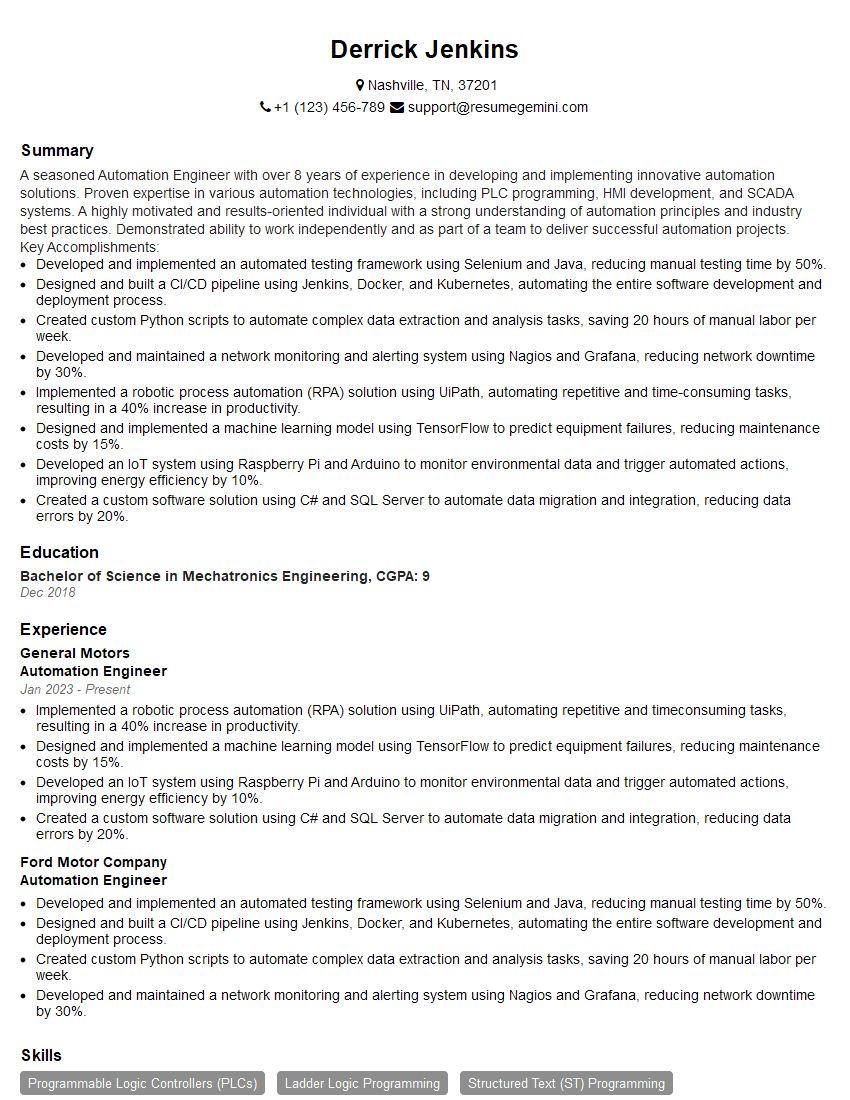
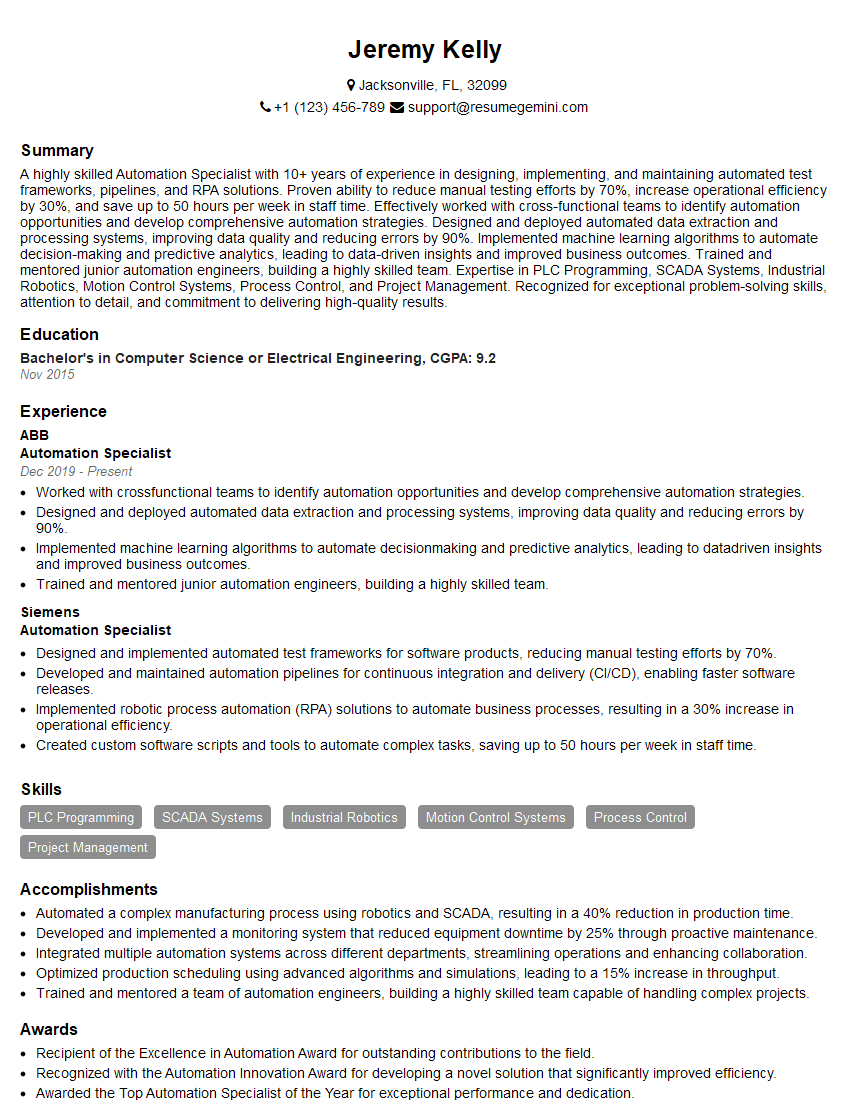
Mastering the art of automating processes is crucial for career advancement in today’s rapidly evolving technological landscape. This skillset is highly sought after across diverse industries, opening doors to exciting opportunities and higher earning potential. To maximize your job prospects, it’s essential to create a compelling and ATS-friendly resume that highlights your automation expertise. We strongly encourage you to leverage ResumeGemini, a trusted resource for building professional resumes. ResumeGemini offers a streamlined process and provides examples of resumes tailored to roles focusing on Automating processes, ensuring your application stands out from the competition.
Explore more articles
Users Rating of Our Blogs
Share Your Experience
We value your feedback! Please rate our content and share your thoughts (optional).
What Readers Say About Our Blog
Hello,
we currently offer a complimentary backlink and URL indexing test for search engine optimization professionals.
You can get complimentary indexing credits to test how link discovery works in practice.
No credit card is required and there is no recurring fee.
You can find details here:
https://wikipedia-backlinks.com/indexing/
Regards
NICE RESPONSE TO Q & A
hi
The aim of this message is regarding an unclaimed deposit of a deceased nationale that bears the same name as you. You are not relate to him as there are millions of people answering the names across around the world. But i will use my position to influence the release of the deposit to you for our mutual benefit.
Respond for full details and how to claim the deposit. This is 100% risk free. Send hello to my email id: [email protected]
Luka Chachibaialuka
Hey interviewgemini.com, just wanted to follow up on my last email.
We just launched Call the Monster, an parenting app that lets you summon friendly ‘monsters’ kids actually listen to.
We’re also running a giveaway for everyone who downloads the app. Since it’s brand new, there aren’t many users yet, which means you’ve got a much better chance of winning some great prizes.
You can check it out here: https://bit.ly/callamonsterapp
Or follow us on Instagram: https://www.instagram.com/callamonsterapp
Thanks,
Ryan
CEO – Call the Monster App
Hey interviewgemini.com, I saw your website and love your approach.
I just want this to look like spam email, but want to share something important to you. We just launched Call the Monster, a parenting app that lets you summon friendly ‘monsters’ kids actually listen to.
Parents are loving it for calming chaos before bedtime. Thought you might want to try it: https://bit.ly/callamonsterapp or just follow our fun monster lore on Instagram: https://www.instagram.com/callamonsterapp
Thanks,
Ryan
CEO – Call A Monster APP
To the interviewgemini.com Owner.
Dear interviewgemini.com Webmaster!
Hi interviewgemini.com Webmaster!
Dear interviewgemini.com Webmaster!
excellent
Hello,
We found issues with your domain’s email setup that may be sending your messages to spam or blocking them completely. InboxShield Mini shows you how to fix it in minutes — no tech skills required.
Scan your domain now for details: https://inboxshield-mini.com/
— Adam @ InboxShield Mini
Reply STOP to unsubscribe
Hi, are you owner of interviewgemini.com? What if I told you I could help you find extra time in your schedule, reconnect with leads you didn’t even realize you missed, and bring in more “I want to work with you” conversations, without increasing your ad spend or hiring a full-time employee?
All with a flexible, budget-friendly service that could easily pay for itself. Sounds good?
Would it be nice to jump on a quick 10-minute call so I can show you exactly how we make this work?
Best,
Hapei
Marketing Director
Hey, I know you’re the owner of interviewgemini.com. I’ll be quick.
Fundraising for your business is tough and time-consuming. We make it easier by guaranteeing two private investor meetings each month, for six months. No demos, no pitch events – just direct introductions to active investors matched to your startup.
If youR17;re raising, this could help you build real momentum. Want me to send more info?
Hi, I represent an SEO company that specialises in getting you AI citations and higher rankings on Google. I’d like to offer you a 100% free SEO audit for your website. Would you be interested?
Hi, I represent an SEO company that specialises in getting you AI citations and higher rankings on Google. I’d like to offer you a 100% free SEO audit for your website. Would you be interested?
good