Preparation is the key to success in any interview. In this post, we’ll explore crucial Deterministic Neutron Transport Methods interview questions and equip you with strategies to craft impactful answers. Whether you’re a beginner or a pro, these tips will elevate your preparation.
Questions Asked in Deterministic Neutron Transport Methods Interview
Q 1. Explain the difference between deterministic and stochastic neutron transport methods.
Deterministic and stochastic methods represent fundamentally different approaches to solving the neutron transport equation, which describes how neutrons move through a material. Deterministic methods, like the discrete ordinates (SN) and spherical harmonics (PN) methods, solve the equation directly using numerical techniques. Think of it like meticulously mapping out every possible path a neutron could take. These methods yield a solution at every point in space and angle. Stochastic methods, on the other hand, use Monte Carlo simulation. They simulate individual neutron histories, statistically sampling the possible paths. It’s like observing many neutrons, each randomly following its own path, and then inferring the overall behavior from the aggregate data. Deterministic methods are generally more computationally efficient for simple geometries, while stochastic methods excel in handling complex geometries and highly heterogeneous systems.
Q 2. Describe the discrete ordinates (SN) method and its limitations.
The discrete ordinates (SN) method is a deterministic method that discretizes the angular variable of the neutron transport equation. Imagine dividing the unit sphere into a finite number of discrete directions (ordinates), ‘N’, represented by angles (θ, φ). The equation is then solved for the neutron flux along each of these discrete directions. The higher the ‘N’ value, the finer the angular discretization and, generally, the more accurate the solution, but also the greater the computational cost. This method is powerful and widely used in reactor physics calculations due to its relative efficiency for many problems.
However, SN has limitations. Ray effects, spurious oscillations in the solution, can occur, especially in optically thin regions, where few neutron collisions happen, causing artifacts in the flux solution. Another limitation is the difficulty in accurately representing highly anisotropic scattering. Finally, handling complex geometries can be computationally expensive, especially in three dimensions.
Q 3. What are the advantages and disadvantages of using the PN method?
The PN method, or spherical harmonics method, approximates the angular dependence of the neutron flux using spherical harmonics. Instead of discrete directions, it expands the angular flux in a series of orthogonal spherical harmonic functions. This approach naturally handles anisotropic scattering efficiently and doesn’t suffer from ray effects. It’s often preferred for problems involving highly anisotropic scattering or when smooth solutions are crucial.
However, PN methods have their drawbacks. They are more computationally expensive than SN methods for the same level of accuracy, especially in higher-order approximations. Furthermore, the accuracy of the solution is limited by the order of the expansion (PN), and higher-order approximations are computationally more demanding. They also struggle with modeling problems having complex geometries, often requiring significant computational resources.
Q 4. How does angular quadrature affect the accuracy of SN calculations?
Angular quadrature significantly impacts the accuracy of SN calculations. The quadrature scheme determines how the directions (ordinates) are selected and weighted on the unit sphere. A good quadrature set ensures accurate representation of the angular flux integral, which is essential for accurate neutron transport solutions. Poor quadrature can lead to significant errors, particularly when dealing with highly anisotropic scattering or strongly forward-peaked scattering. The choice of quadrature, such as Level Symmetric, Equal-Weight, or Gauss-Legendre, directly influences solution accuracy. Higher-order quadratures (more directions) generally improve accuracy, but they also increase computational costs.
For instance, using a low-order quadrature might inadequately resolve the angular dependence in a problem with significant scattering anisotropy, leading to an underestimation of the neutron flux in certain directions. Conversely, a high-order quadrature will generally provide a more accurate solution, but at a higher computational cost, perhaps unnecessarily in a problem that is not highly sensitive to angular detail.
Q 5. Explain the concept of scattering cross sections in neutron transport.
Scattering cross sections are crucial in neutron transport because they describe the probability of a neutron changing direction and energy after colliding with a nucleus in the material. They are functions of both the incoming and outgoing neutron energies and angles. Imagine a billiard ball (neutron) striking another ball (nucleus). The scattering cross section quantifies the probability of the neutron scattering at various angles and energy transfers after the collision. The total scattering cross section represents the overall probability of scattering, irrespective of the final angle and energy. Differential scattering cross sections provide a more detailed description, defining the probability of scattering into a particular solid angle and energy range. This information is essential for accurately modeling neutron transport, especially in cases of anisotropic scattering (where scattering is more likely in certain directions).
Q 6. Describe different numerical techniques for solving the neutron transport equation.
Several numerical techniques are employed to solve the neutron transport equation. For deterministic methods, we have already discussed SN and PN. Beyond these, the method of characteristics can be utilized to solve along the neutron trajectories, offering a very direct and accurate approach for some problems. Finite element methods are suitable for complex geometries and can offer high-order accuracy, albeit with increased computational burden. For stochastic methods, Monte Carlo techniques are dominant, simulating individual neutron histories and using statistical analysis to obtain results.
The choice of technique depends heavily on factors like geometry complexity, desired accuracy, and available computational resources. For instance, a simple, homogeneous reactor core might be efficiently modeled using SN, while a complex reactor configuration with intricate fuel assemblies and control rods might require Monte Carlo simulation. The selection involves carefully balancing accuracy, computational efficiency, and the specific challenges of the problem.
Q 7. How do you handle boundary conditions in deterministic neutron transport calculations?
Handling boundary conditions is essential for realistic neutron transport calculations. Boundary conditions specify the neutron behavior at the edges of the computational domain. Common boundary conditions include:
- Vacuum boundary: No neutrons enter from outside the system. All neutrons reaching the boundary are lost.
- Reflective boundary: Neutrons are perfectly reflected back into the system. This simulates a symmetry plane.
- Periodic boundary: The boundary conditions on opposite faces are identical. This models infinite repetition of a structure.
- Albedo boundary: A fraction of the incoming neutrons are reflected, while the rest are absorbed. This allows modeling partial reflection.
The specific boundary condition employed depends on the problem being solved. A reactor core might use reflective boundaries to simulate symmetry, while a shielding problem might utilize vacuum boundaries to model the absence of neutrons outside the shield. Incorrectly modeling boundary conditions can lead to significant errors, and careful consideration is always crucial.
Q 8. What are the common types of boundary conditions used in neutron transport?
Boundary conditions in neutron transport define how neutrons interact at the edges of our computational domain, mirroring real-world scenarios like a reactor’s physical boundaries. Incorrect boundary conditions can significantly alter simulation results.
- Vacuum Boundary: Represents a void where neutrons escaping the domain are lost. Think of neutrons leaving a reactor core and escaping into the air—they’re gone. This is often modeled as zero incoming neutron flux.
- Reflective Boundary: Simulates perfect reflection. Neutrons striking the boundary are reflected back into the domain with the same angle and energy. This can be useful for modeling symmetry in a reactor.
- Periodic Boundary: Opposite boundaries are connected; what leaves one side enters the opposite. This is helpful for modeling infinite lattices or repeating structures, such as fuel assemblies in a reactor core.
- Albedo Boundary: Represents partial reflection and absorption. A fraction of the neutrons are reflected back, while the rest are absorbed. The albedo (reflection coefficient) defines this fraction. It’s used to represent a complex boundary, such as a partially reflecting material.
Q 9. Explain the concept of criticality and its importance in reactor physics.
Criticality refers to the balance between neutron production and neutron loss in a nuclear reactor. It’s absolutely crucial for safe and efficient reactor operation.
A subcritical reactor has more neutron loss than production; the chain reaction dies out. Think of it like a fire needing fuel – not enough fission events occur to sustain the reaction.
A critical reactor has an equal balance – the number of neutrons produced equals the number lost. The chain reaction is self-sustaining at a steady power level. This is the desired operating state for most reactors.
A supercritical reactor produces more neutrons than are lost; the chain reaction accelerates, rapidly increasing power. This is dangerous and must be carefully controlled, as it can lead to a meltdown.
Understanding and controlling criticality ensures a reactor operates safely and predictably, generating power without causing accidents.
Q 10. How is the effective multiplication factor (keff) calculated using deterministic methods?
The effective multiplication factor (keff) quantifies the criticality of a nuclear system. Deterministic methods calculate keff by solving the neutron transport equation as an eigenvalue problem.
In essence, keff is the ratio of neutrons in one generation to the neutrons in the previous generation. keff < 1 indicates subcriticality, keff = 1 indicates criticality, and keff > 1 indicates supercriticality.
Deterministic methods, such as the discrete ordinates (SN) method or the finite element method, solve this eigenvalue problem iteratively. The iterative process refines the neutron flux distribution until the keff converges to a stable value. Sophisticated algorithms are used to accelerate the convergence and ensure the accuracy of the result.
Q 11. Describe the process of solving eigenvalue problems in neutron transport.
Solving eigenvalue problems in neutron transport involves finding both the neutron flux distribution (eigenvector) and the effective multiplication factor (eigenvalue). It’s an iterative process.
Typically, a power iteration method or a more advanced method like Krylov subspace iteration is used. The process begins with an initial guess for the neutron flux distribution. The transport equation is then solved to find the neutron flux distribution produced by this initial distribution. This new distribution is then normalized, and used to repeat the process, iteratively refining the flux distribution until the eigenvalue (keff) converges to a stable value within a specified tolerance.
The power iteration method can be expressed simply as:
Φ(i+1) = (1/k(i)) * M * Φ(i)where:
- Φ(i) is the neutron flux at iteration i.
- M is the transport operator.
- k(i) is an estimate of keff at iteration i (often calculated from the change in neutron production).
The process continues until the change in keff between successive iterations is below a predefined threshold. Sophisticated acceleration techniques like Chebyshev acceleration are often employed to speed up the convergence process.
Q 12. What are some common numerical challenges in deterministic neutron transport?
Deterministic neutron transport methods face several numerical challenges:
- Ray Effects: In discrete ordinates methods (SN), using a limited number of angular directions can lead to artificial ray-like structures in the flux solution. These are not physical but a numerical artifact.
- Spatial Discretization Errors: Approximating the continuous spatial domain with a discrete mesh introduces errors. Finer meshes reduce this error, but increase computational cost.
- Angular Discretization Errors: Similarly, representing the angular distribution of neutrons with a finite number of directions introduces errors. Increasing the number of angles improves accuracy but increases computational cost.
- Computational Cost: Solving the neutron transport equation is computationally expensive, especially for 3D problems with fine meshes and many angles. This computational cost needs to be carefully managed depending on the accuracy level desired.
- Treatment of Highly Heterogeneous Systems: Accurately modeling systems with complex geometries and materials requires careful consideration of the numerical method employed, and often involves advanced techniques to deal with discontinuities and sharp material interfaces.
Q 13. How do you address ray effects in SN calculations?
Ray effects in SN calculations manifest as artificial streaking or discontinuities in the neutron flux, particularly in highly scattering media. Several strategies can mitigate these:
- Increased Number of Angles: Using a larger number of discrete directions in the angular quadrature improves the representation of the angular flux, reducing ray effects. However, this significantly increases computational cost.
- Higher-Order Angular Quadrature Sets: Employing higher-order quadrature sets leads to a more accurate approximation of the angular integral, thus minimizing ray effects more effectively than simply increasing the number of angles.
- Spatial Refinement: Refining the spatial mesh, particularly in regions where ray effects are prominent, can help smooth out the discontinuities.
- Flux Limiters: These methods constrain the flux solution to prevent unphysical oscillations and reduce ray effects.
- Adaptive Mesh Refinement (AMR): AMR refines the mesh dynamically in regions where greater accuracy is needed, focusing computational effort where it’s most effective in reducing ray effects.
- Diffusion Synthetic Acceleration (DSA): DSA methods combine SN calculations with a diffusion approximation to speed up convergence and reduce oscillations, indirectly improving ray effect mitigation.
Q 14. What is the role of spatial discretization in neutron transport simulations?
Spatial discretization is the process of dividing the continuous physical space of the reactor into a finite set of discrete regions or cells. This is essential because deterministic neutron transport methods solve the transport equation numerically within these discrete cells.
The choice of spatial discretization significantly impacts the accuracy and efficiency of the simulation. Common methods include:
- Finite Difference Method: Approximates the derivatives of the neutron flux using difference quotients between neighboring cells. Simple to implement but can struggle with complex geometries.
- Finite Element Method: Divides the spatial domain into elements, approximating the flux within each element using basis functions. More versatile and can handle complex geometries effectively.
- Finite Volume Method: Conserves the neutron balance within each control volume (cell), ensuring a more accurate representation of the neutron transport. This often provides more robust solutions for complex problems.
Finer spatial meshes result in greater accuracy but lead to increased computational cost. The optimal mesh size is a trade-off between accuracy and computational efficiency. It’s important to strategically refine the mesh in regions of high flux gradient or significant material heterogeneity to minimize errors without undue increases in computational demands.
Q 15. Discuss the use of acceleration techniques in deterministic transport codes.
Deterministic neutron transport calculations, while powerful, can be computationally expensive, especially for large and complex geometries. Acceleration techniques are crucial for making these calculations feasible. They aim to significantly reduce the computational time without compromising accuracy. These techniques work by cleverly approximating or skipping over less important parts of the calculation.
Source Iteration Acceleration: This is a common technique used to accelerate the convergence of the iterative process used to solve the neutron transport equation. Methods like Chebyshev acceleration or Krylov subspace methods are often employed. Imagine it like taking shortcuts through a maze instead of systematically exploring every path.
Spatial Acceleration: Techniques like diffusion synthetic acceleration (DSA) and coarse mesh finite difference (CMFD) methods use simpler, faster diffusion calculations to predict the solution and guide the more accurate, but slower, transport calculation. It’s like using a map to quickly navigate to your destination instead of only relying on walking.
Angular Acceleration: This involves techniques to reduce the number of angular directions needed to represent the neutron angular flux. This can significantly speed up calculations, especially in problems with highly anisotropic scattering.
The choice of acceleration technique depends on the specific problem and the characteristics of the neutron transport code being used. Often, a combination of different techniques is employed to achieve optimal performance.
Career Expert Tips:
- Ace those interviews! Prepare effectively by reviewing the Top 50 Most Common Interview Questions on ResumeGemini.
- Navigate your job search with confidence! Explore a wide range of Career Tips on ResumeGemini. Learn about common challenges and recommendations to overcome them.
- Craft the perfect resume! Master the Art of Resume Writing with ResumeGemini’s guide. Showcase your unique qualifications and achievements effectively.
- Don’t miss out on holiday savings! Build your dream resume with ResumeGemini’s ATS optimized templates.
Q 16. What are some popular deterministic neutron transport codes?
Many deterministic neutron transport codes are available, each with its strengths and weaknesses. Popular choices include:
PARTISN: A widely used, highly capable code known for its accuracy and efficiency in solving problems in various geometries.
MOC: Method of Characteristics codes are excellent for handling complex geometries accurately. They’re often coupled with other methods to further improve computational speed.
SERPENT: A versatile code particularly popular in the reactor physics community, featuring various solvers and capabilities.
OpenMC: An open-source code that offers great flexibility and extensibility, enabling users to customize and expand its functionalities.
DANTSYS: A sophisticated code often used in shielding and criticality calculations. It is known for its rigorous treatment of boundary conditions.
The choice of code often depends on the specific application, available computational resources, and the desired level of accuracy.
Q 17. Compare and contrast the accuracy and efficiency of different deterministic methods.
Different deterministic methods vary significantly in their accuracy and efficiency. The choice depends on factors like geometry complexity, material properties, and computational resources.
Discrete Ordinates (SN): Relatively simple to implement, but accuracy increases with the order of approximation (N), which rapidly increases computational cost. It can struggle with highly forward-peaked scattering.
Method of Characteristics (MOC): Extremely accurate for complex geometries, especially those with detailed features and strong material heterogeneities. It’s computationally expensive but can provide very high-fidelity solutions.
Finite Element Method (FEM): Offers flexibility in meshing and handling complex geometries but can be computationally intensive for large problems. Adaptability to different geometries is a significant advantage.
In general, higher-order methods (like high-order SN or MOC) offer greater accuracy but at the cost of increased computational expense. Lower-order methods (like low-order SN or diffusion theory) are faster but may be less accurate, especially in regions with strong gradients in the neutron flux.
Q 18. How do you validate the results of a deterministic neutron transport calculation?
Validating the results of a deterministic neutron transport calculation is crucial for ensuring reliability. This involves comparing the results with:
Benchmark solutions: Comparing results against established benchmark problems with known solutions allows for an assessment of code accuracy and implementation.
Experimental data: Comparing calculated quantities (like reaction rates or criticality) with experimental measurements from similar systems provides confidence in the model’s predictive capability.
Independent calculations: Running the same problem with a different code or using different numerical methods helps identify potential errors and assess the robustness of the results. It’s like having a second opinion from a trusted expert.
Convergence studies: Investigating the convergence of the solution with respect to parameters like spatial mesh size, angular quadrature order, and energy group structure ensures that the calculation is adequately converged.
Systematic validation procedures are essential for maintaining confidence in the simulation results and identifying potential issues with the modelling or the code itself.
Q 19. Describe the importance of cross-section data in neutron transport simulations.
Cross-section data are absolutely fundamental to neutron transport simulations. They describe the probability of different nuclear reactions (scattering, absorption, fission) occurring when neutrons interact with specific isotopes. Think of them as a detailed instruction manual for how neutrons behave within a material.
The accuracy of the cross-section data directly impacts the accuracy of the simulation. Inaccurate or incomplete data can lead to significant errors in the predicted neutron flux and other important quantities. The use of high-quality, evaluated nuclear data libraries (like ENDF/B or JEFF) is essential for reliable simulations. For example, an inaccurate fission cross-section can lead to a wrong estimate of the reactor’s power output.
Q 20. How does the choice of energy group structure impact the accuracy of results?
The energy group structure significantly affects the accuracy of results. The neutron energy spectrum is continuous, but for computational reasons, we often divide it into energy groups. A finer energy group structure (more groups) provides a better representation of the energy spectrum, leading to increased accuracy, but at a higher computational cost.
A coarser group structure (fewer groups) can smooth out important spectral details and introduce errors, especially in problems with strong resonance effects. Choosing the appropriate group structure involves a trade-off between accuracy and computational feasibility. The choice is often guided by the specific application and the expected importance of spectral effects.
For example, accurate calculation of resonance absorption in a nuclear reactor requires a finer energy group structure in the relevant energy range.
Q 21. Explain the concept of neutron leakage in reactor analysis.
Neutron leakage refers to neutrons escaping from the system being modeled, such as a nuclear reactor core or a shielding configuration. This is a crucial aspect of reactor analysis because it affects the overall neutron balance and the reactor’s criticality. Neutrons that leak out don’t contribute to fission and therefore don’t contribute to the chain reaction maintaining the reactor’s power.
Understanding neutron leakage is important for several reasons:
Criticality calculations: Leakage is a critical factor determining whether a reactor is subcritical, critical, or supercritical. High leakage reduces the effective multiplication factor, making the reactor less likely to achieve criticality.
Reactor design: Designers must carefully consider leakage to ensure adequate neutron confinement and efficient power production. Reflector materials are often used to reduce leakage.
Shielding design: In shielding calculations, leakage represents the neutrons that penetrate the shield. Accurate prediction of leakage is vital for designing effective shields that protect personnel and equipment.
Accurate modeling of neutron leakage requires careful consideration of boundary conditions in the neutron transport calculation. In many codes, various boundary conditions are available to model leakage, such as vacuum boundaries, reflective boundaries, or periodic boundaries.
Q 22. How is neutron absorption modeled in deterministic transport calculations?
Neutron absorption is modeled in deterministic transport calculations by incorporating the macroscopic absorption cross-section, Σa, into the transport equation. This cross-section represents the probability per unit distance that a neutron will be absorbed by the material. Think of it like this: if you’re throwing darts at a dartboard (the material), Σa represents the fraction of darts that will stick to the board (get absorbed) rather than bounce off (scatter).
The absorption term appears as a sink term in the Boltzmann transport equation, reducing the neutron flux. For example, in a simplified one-speed equation, the absorption term would be -ΣaΦ(r,Ω), where Φ(r,Ω) is the angular flux at position r and direction Ω. This term directly subtracts from the neutron population at that point and direction. Different isotopes within a material contribute additively to the macroscopic absorption cross-section, weighted by their respective number densities.
In practice, detailed nuclear data libraries (like ENDF) provide the microscopic absorption cross-sections for each isotope, which are then used to calculate the macroscopic cross-section for a given material composition. Accurate modeling of absorption is crucial for predicting reactor criticality and shielding effectiveness.
Q 23. Describe the role of fission in neutron transport.
Fission plays a central role in neutron transport, especially in nuclear reactors. It’s the process where a heavy nucleus (like Uranium-235 or Plutonium-239) absorbs a neutron, becomes unstable, and splits into lighter nuclei, releasing energy and, crucially, more neutrons. These newly released neutrons can then initiate further fission events, creating a chain reaction.
In neutron transport calculations, fission is modeled by a source term in the transport equation. This source term is proportional to the neutron flux and the macroscopic fission cross-section, Σf, and accounts for the number of neutrons produced per fission. The number of neutrons emitted per fission is represented by ν, the average number of neutrons produced per fission event. The fission source term ensures the self-sustaining nature of the chain reaction in a reactor is accurately simulated. Accurate representation of fission is essential for reactor design, safety analysis and criticality calculations.
The strength of the fission source term directly influences the reactor’s criticality: a higher source term leads to a faster multiplication of neutrons, while a lower term can lead to a subcritical reactor where the chain reaction dies out.
Q 24. How are different types of nuclear reactions (e.g., scattering, absorption, fission) handled in the transport equation?
The Boltzmann transport equation elegantly handles different nuclear reactions through various terms. Each reaction type contributes a specific term to the equation. Imagine it as a ledger tracking neutrons:
- Scattering: Represented by an integral term involving the scattering cross-section and the angular flux. This term describes the change in neutron direction and energy after a scattering event. Different scattering models (e.g., isotropic, anisotropic) exist, affecting the complexity of this term.
- Absorption: As discussed earlier, modeled by a sink term proportional to the macroscopic absorption cross-section and the neutron flux. This removes neutrons from the system.
- Fission: Modeled by a source term proportional to the macroscopic fission cross-section and the neutron flux, accounting for the neutrons produced during fission.
The equation considers all these reactions simultaneously, providing a comprehensive picture of neutron behavior. The overall balance between these terms determines the neutron population’s evolution within the system. The complexity arises from the integral nature of scattering term, requiring sophisticated numerical techniques to solve the equation.
Q 25. Explain the concept of adjoint transport and its applications.
Adjoint transport solves the adjoint Boltzmann transport equation, which is mathematically related to the forward Boltzmann equation. While the forward equation calculates the neutron flux given a source, the adjoint equation calculates the importance of neutrons at each position and energy. Imagine it as determining the ‘value’ of a neutron at a given location: how much it contributes to a specific response. This response could be the reaction rate at a detector, the total fission rate in a reactor core, or any other quantity of interest.
Applications of adjoint transport are extensive:
- Sensitivity analysis: Determining how changes in cross-sections or material properties affect a specific response. This is extremely valuable in uncertainty quantification.
- Perturbation theory: Efficiently calculating the change in a response due to small perturbations in the system. This saves significant computational effort compared to recalculating the forward solution directly.
- Optimization: Finding the optimal design parameters (e.g., fuel enrichment) to maximize a desired response while minimizing others (e.g., power peaking).
Essentially, the adjoint solution provides valuable information on the importance of different spatial and energy regions for a given response, allowing for targeted optimization and efficient sensitivity studies.
Q 26. How are multigroup methods used in deterministic neutron transport?
Multigroup methods simplify the neutron transport equation by grouping neutrons into energy bins (groups). Instead of tracking the continuous energy spectrum, we treat neutrons within each group as having a single representative energy. This significantly reduces the computational cost, making it feasible to solve large-scale problems.
The process involves collapsing the detailed energy-dependent cross-sections into group-wise constants. This requires averaging the cross-sections over the energy range of each group, often using weighting functions based on the neutron flux. Once the group cross-sections are generated, the transport equation can be solved for each energy group independently (or coupled for scattering between groups).
While simplifying the problem, multigroup methods introduce some approximations due to the energy-averaging process. The accuracy depends on the number of energy groups used: more groups generally lead to more accuracy but higher computational cost. A balance needs to be struck between accuracy and computational feasibility. The selection of appropriate weighting functions is crucial to minimizing errors introduced by multigroup treatment.
Q 27. Discuss the role of parallel computing in solving large-scale neutron transport problems.
Solving large-scale neutron transport problems, especially in three dimensions, demands significant computational power. Parallel computing is essential to handle the vast number of calculations involved. Modern deterministic neutron transport codes leverage parallel architectures (like MPI or OpenMP) to distribute the computational workload across multiple processors.
Strategies include:
- Domain decomposition: Dividing the spatial domain into subdomains, each processed by a different processor.
- Energy group parallelization: Assigning different energy groups to different processors.
- Angular parallelization: Distributing the angular discretization among processors.
These parallel strategies significantly reduce computation time, making it possible to solve problems that would be intractable on a single processor. The efficiency of parallel implementation heavily depends on the code’s design and the choice of parallel algorithms. Efficient load balancing is critical to minimize idle time and maximize the utilization of all processors.
Q 28. How can you improve the computational efficiency of a deterministic neutron transport code?
Improving the computational efficiency of deterministic neutron transport codes involves several strategies:
- Advanced numerical methods: Employing higher-order spatial and angular discretization schemes can reduce the number of unknowns needed for a given accuracy. Methods like the discontinuous Galerkin method offer improved accuracy and efficiency compared to traditional methods.
- Adaptive mesh refinement: Focusing computational resources on regions where the neutron flux varies significantly, while using coarser meshes in regions of smooth flux. This strategy reduces the overall number of unknowns without sacrificing accuracy.
- Source iteration acceleration: Techniques like Chebyshev acceleration or diffusion synthetic acceleration can significantly speed up the convergence of iterative solvers, reducing the overall computation time.
- Preconditioning: Using preconditioners to improve the convergence rate of iterative solvers, which are commonly used in neutron transport calculations.
- Code optimization: Fine-tuning the code for specific hardware architectures to minimize memory access time and maximize processor utilization.
The choice of optimal strategies depends on the specific problem and the desired accuracy. Often, a combination of these techniques is used to achieve the best computational efficiency. Continuous research and development are crucial in refining these methods and developing new ones for even faster and more efficient neutron transport calculations.
Key Topics to Learn for Deterministic Neutron Transport Methods Interview
- Fundamentals of Neutron Transport: Understanding the Boltzmann Transport Equation and its various forms (e.g., multigroup, energy-dependent). This forms the bedrock of all deterministic methods.
- Discretization Techniques: Mastering different spatial discretization methods such as Finite Difference, Finite Element, and Discrete Ordinates (SN) methods. Know their strengths and weaknesses in different scenarios.
- Angular Discretization (SN Method): Deep understanding of the SN method, including quadrature sets, ray tracing, and its limitations. Be prepared to discuss specific quadrature schemes and their impact on accuracy.
- Numerical Solution Techniques: Familiarity with iterative solvers (e.g., source iteration, diffusion synthetic acceleration) and their convergence properties is crucial. Understanding their computational efficiency is key.
- Advanced Methods and Applications: Explore more advanced techniques like the method of characteristics or higher-order methods. Be ready to discuss their applications in specific reactor physics problems.
- Reactor Physics Applications: Understand how deterministic methods are applied to criticality calculations, shielding analysis, and fuel cycle simulations. Be prepared to discuss practical examples.
- Error Analysis and Validation: Demonstrate understanding of how to assess the accuracy and reliability of results obtained from deterministic methods, including convergence studies and benchmark comparisons.
- Software and Codes: Familiarity with commonly used neutron transport codes (mentioning specific names is optional, focusing on general principles is better). This demonstrates practical experience.
Next Steps
Mastering Deterministic Neutron Transport Methods significantly enhances your prospects in nuclear engineering, opening doors to exciting research and development opportunities within the industry. A strong foundation in these methods demonstrates a high level of technical competency and problem-solving skills highly valued by employers.
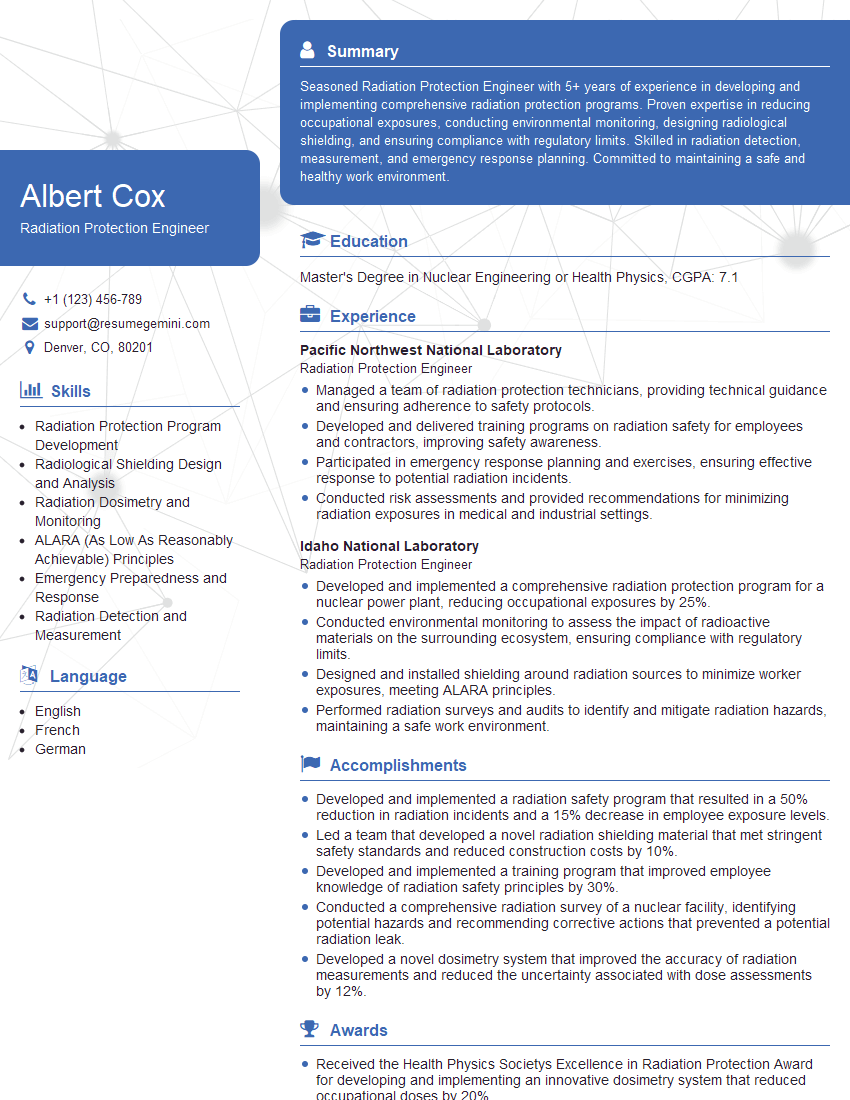
To maximize your chances of landing your dream role, focus on creating an ATS-friendly resume that effectively highlights your skills and experience. ResumeGemini is a trusted resource that can help you build a professional and impactful resume tailored to the specific requirements of the job market. Examples of resumes tailored to highlight expertise in Deterministic Neutron Transport Methods are available within ResumeGemini to help you showcase your capabilities effectively.



Explore more articles
Users Rating of Our Blogs
Share Your Experience
We value your feedback! Please rate our content and share your thoughts (optional).
What Readers Say About Our Blog
Very informative content, great job.
good