Unlock your full potential by mastering the most common Automation Engineering interview questions. This blog offers a deep dive into the critical topics, ensuring you’re not only prepared to answer but to excel. With these insights, you’ll approach your interview with clarity and confidence.
Questions Asked in Automation Engineering Interview
Q 1. Explain the difference between UI and API automation.
UI (User Interface) automation and API (Application Programming Interface) automation are both crucial aspects of software testing, but they target different layers of an application.
UI automation interacts directly with the application’s user interface, mimicking user actions like clicks, typing, and navigation. Think of it like a real user interacting with the software. Tools like Selenium and Cypress are used for this. For example, a UI test might verify that clicking a ‘Submit’ button correctly saves data to a database.
API automation, on the other hand, interacts with the application’s backend directly, bypassing the UI. It tests the functionality of the API itself, focusing on data exchange and business logic. Tools like RestAssured or Postman are commonly used. An example would be verifying that an API endpoint returns the correct data format and status code when a specific request is made.
The key difference lies in their interaction point: UI automation tests the visual aspects and user experience, while API automation tests the underlying functionality and data integrity. Often, a combination of both approaches is used for comprehensive testing.
Q 2. Describe your experience with Selenium or Cypress.
I have extensive experience with both Selenium and Cypress, having used them in various projects across different domains. Selenium, with its cross-browser compatibility and mature ecosystem, has been my go-to for projects requiring broad browser support and complex interactions. I’ve utilized its WebDriver API to create robust and scalable test suites, incorporating page object models for maintainability.
For projects emphasizing speed and developer experience, Cypress has proven invaluable. Its ease of use, real-time reloading, and debugging capabilities have significantly reduced development time. I’ve particularly appreciated Cypress’s ability to easily test asynchronous operations and its built-in features for handling network requests.
For example, in a recent e-commerce project, I used Selenium to test the checkout flow across Chrome, Firefox, and Safari, ensuring compatibility and functionality. For a smaller internal tool, I chose Cypress for its rapid development cycle and excellent debugging capabilities, significantly speeding up the automated testing process.
Q 3. What are the benefits and drawbacks of using different automation frameworks (e.g., Keyword-driven, Data-driven, Hybrid)?
Different automation frameworks cater to varying needs and project complexities. Let’s explore some common ones:
Keyword-driven framework: This framework uses keywords to represent test steps, making tests easy to understand and maintain. It promotes reusability and reduces the need for coding expertise. However, creating and maintaining the keyword library can be time-consuming.
Data-driven framework: This approach separates test logic from test data, allowing testers to run the same test with multiple data sets. This improves test coverage and efficiency but requires robust data management strategies.
Hybrid framework: This combines the benefits of multiple frameworks, often combining keyword-driven and data-driven approaches. It provides flexibility and scalability but increases initial setup complexity.
Benefits: Improved code reusability, reduced maintenance, increased test coverage, simplified test creation, better reporting.
Drawbacks: Increased initial setup time (especially for hybrid frameworks), higher learning curve for some frameworks, dependency on specific tools or libraries.
Choosing the right framework depends heavily on project size, team expertise, and maintenance requirements. For small, simple projects, a keyword-driven approach may suffice. Large, complex projects might benefit from a hybrid framework offering better scalability and maintainability.
Q 4. How do you handle test data management in automation?
Effective test data management is crucial for reliable automation. Poorly managed data can lead to inaccurate results and unreliable tests. My approach involves a multi-faceted strategy:
Data separation: Test data is stored separately from the application code, usually in external files (CSV, Excel, databases) or specialized data management tools.
Data generation: For sensitive or large datasets, I use tools and techniques to generate realistic test data, ensuring data privacy and compliance.
Data masking: Sensitive data is masked or anonymized to protect sensitive information. This is crucial for security and regulatory compliance.
Data version control: Changes to test data are tracked and managed, using version control systems to ensure data integrity and traceability.
Data cleanup: After each test run, I ensure that the test environment is clean, removing any data created during the test execution.
For example, in a banking application, I would use data masking to protect customer account numbers while still using realistic data to test various transactions. Data generation tools would be used to create a large volume of realistic, yet anonymized, transaction data for performance testing.
Q 5. Explain your approach to designing and implementing automated tests.
Designing and implementing automated tests is an iterative process that requires careful planning and execution. My approach follows these steps:
Requirements analysis: Understand the application’s functionality and identify testable features.
Test case design: Create comprehensive test cases covering various scenarios and edge cases.
Framework selection: Choose an appropriate automation framework based on project needs and team expertise.
Test script development: Write automated test scripts using the chosen framework, incorporating best practices for code readability, maintainability, and reusability.
Test execution: Run the automated tests, utilizing continuous integration and continuous deployment (CI/CD) pipelines for efficient execution.
Test result analysis: Analyze test results, identify failures, and debug issues.
Test maintenance: Regularly maintain and update test scripts to reflect changes in the application.
I strongly advocate for the use of Page Object Models (POM) to enhance maintainability and reduce code duplication. POM encapsulates UI elements into reusable objects, simplifying test script maintenance when UI changes occur. This makes the automated tests more resilient to changes in the application.
Q 6. What are some common challenges in test automation, and how have you overcome them?
Test automation presents several challenges:
Test maintenance: Frequent application changes require constant updates to automated tests, making maintenance a significant undertaking. To address this, I emphasize using robust frameworks and design patterns (like POM) to minimize the impact of application changes.
Test flakiness: Environmental issues or application instability can lead to unreliable test results. Employing robust waiting mechanisms, proper synchronization techniques, and comprehensive logging significantly improves test stability.
UI changes: Frequent updates to the UI can break automated tests. Using selectors that are less prone to change (e.g., IDs over classes) and incorporating error handling mechanisms can mitigate this.
Initial investment: Setting up automation requires a significant upfront investment in tools, training, and framework development.
I’ve overcome these challenges by prioritizing maintainable code, thorough test design, and robust error handling. I also collaborate closely with developers to anticipate UI changes and implement preventative measures. For example, by using data-driven tests, I can quickly adapt to UI changes without modifying the core test logic.
Q 7. Describe your experience with CI/CD pipelines and their integration with automation.
CI/CD pipelines are essential for automating the software development lifecycle. My experience involves integrating automated tests within these pipelines to enable continuous testing and faster feedback loops.
I’ve used various CI/CD tools like Jenkins, GitLab CI, and Azure DevOps to integrate automated tests. This integration typically involves:
Triggering tests: Automated tests are triggered automatically whenever code changes are committed or merged.
Test execution: Tests are run on a dedicated test environment, ensuring consistency and isolation.
Result reporting: Test results are reported back to the pipeline, often with detailed logs and reports for quick identification of issues.
Integration with other tools: The CI/CD pipeline is integrated with other tools like test management systems and defect tracking systems for improved collaboration and workflow.
This approach ensures that automated tests are run regularly and consistently, providing quick feedback on code quality and identifying issues early in the development process. It significantly reduces the time it takes to identify and resolve bugs and allows for faster release cycles.
Q 8. Explain your understanding of different automation testing levels (unit, integration, system, acceptance).
Automation testing levels represent a hierarchical approach to verifying software functionality, ensuring quality at different granularities. Think of it like building a house: you wouldn’t start painting before laying the foundation.
- Unit Testing: This is the foundation. We test individual units of code, such as functions or methods, in isolation. For example, a unit test for a function calculating the area of a circle would verify it returns the correct value for various inputs. This helps isolate bugs early.
- Integration Testing: Once the individual units are working, we integrate them and test their interaction. Imagine testing how the plumbing (one unit) connects to the electrical system (another unit). Here, we check if different modules work together correctly.
- System Testing: This is a broader test of the entire system as a whole. We assess the system’s behavior as a unified entity, simulating real-world scenarios and interactions. For example, end-to-end testing of an e-commerce website from adding items to the cart to completing the purchase.
- Acceptance Testing (UAT): This final stage involves validating the system meets the user’s requirements and business needs. Real users or representatives test the system to ensure it’s fit for purpose. For example, conducting user acceptance testing for a new mobile banking app before launch.
Each level builds upon the previous one, ensuring comprehensive testing and reducing the risk of integration issues or unexpected behavior in later stages.
Q 9. How do you choose the right automation tool for a given project?
Selecting the right automation tool depends on various factors. It’s not a one-size-fits-all solution. Think of it like choosing the right tool for a specific job; you wouldn’t use a hammer to screw in a screw.
- Project Requirements: What are we testing? Web applications, mobile apps, APIs? The tool must support the technologies used in the project.
- Budget: Open-source tools like Selenium are free, while commercial tools like TestComplete offer more features but come with a price tag.
- Team Expertise: What skills do my team members possess? Choosing a tool that aligns with the team’s existing programming language knowledge and expertise is crucial to ensure efficient implementation and maintenance.
- Scalability and Maintainability: Can the tool handle the expected growth of the project? A well-structured framework, supported by the chosen tool, is essential for maintainability.
- Reporting and Integration: Does it integrate well with existing CI/CD pipelines and reporting tools? This ensures smooth workflow integration.
For example, Selenium is ideal for web application testing due to its browser compatibility and community support, whereas Appium excels in mobile app testing. Careful consideration of these factors is essential for selecting the best tool to achieve project goals efficiently and effectively.
Q 10. What experience do you have with scripting languages (e.g., Python, JavaScript, Java)?
I have extensive experience in Python, JavaScript, and Java for automation scripting. Each language has its strengths and weaknesses in the context of automation.
- Python: I often use Python for its readability and extensive libraries like `pytest` for testing frameworks and `requests` for API testing. Its versatility makes it well-suited for various automation tasks, from web scraping to API interaction and data analysis. For example, I built a robust framework using Python’s `Selenium` library to automate regression testing for a large e-commerce platform.
- JavaScript: For web UI automation, JavaScript with frameworks like Cypress or Puppeteer provides direct access to the browser’s DOM (Document Object Model), enabling efficient and elegant test implementation. It’s a natural fit for front-end testing.
- Java: Java is a robust language, often used in enterprise projects for its stability and performance. Its mature testing frameworks, like JUnit and TestNG, make it a reliable option for large-scale projects.
My choice of language depends on the specific project requirements and the team’s familiarity with different languages. Prioritizing efficiency and maintainability is key in my decision-making process.
Q 11. How do you approach debugging and troubleshooting automated tests?
Debugging automated tests involves a systematic approach. Think of it as detective work; you need to identify the clues to find the root cause.
- Reproduce the Error: First, consistently reproduce the error to confirm its validity. Detailed error messages and logs are invaluable here.
- Examine Logs and Reports: Analyze the test logs and reports for clues. Look for stack traces, error messages, and any unusual behavior.
- Step-by-Step Debugging: Use the debugger in your IDE to step through the code line by line to pinpoint the exact location of the issue. Set breakpoints and inspect variables to understand the program’s state at each stage.
- Test Data Analysis: Check if the test data is correct and relevant. Incorrect or incomplete data can lead to unexpected test failures.
- Environment Verification: Ensure the test environment (browser version, operating system, dependencies) matches the expected configuration. Inconsistent environments can cause subtle yet critical failures.
For example, if a test fails because of a missing element on the web page, I’d use the browser’s developer tools to examine the HTML structure and identify the reason for its absence. This might be due to a timing issue, a change in the website’s layout, or a problem in the test script itself.
Q 12. Describe your experience with version control systems (e.g., Git).
Git is my primary version control system. I use it for managing automation scripts, test data, and related assets. Think of Git as a collaborative document editor on steroids.
- Branching Strategy: I typically use feature branches for developing new features or fixing bugs, ensuring that changes are isolated and do not impact the main codebase. This allows for parallel development without conflicts.
- Commit Messages: Clear and concise commit messages are crucial for tracking changes effectively. A detailed description of each modification enables traceability and collaboration.
- Pull Requests (PRs): Pull requests provide a mechanism for code review, ensuring code quality and consistency before merging into the main branch. This process facilitates teamwork and knowledge sharing.
- Conflict Resolution: When conflicts arise, I carefully review the changes and resolve them by choosing the most appropriate version or by combining different versions to achieve a harmonious solution.
Using Git ensures code quality, facilitates collaboration among team members, and allows for easy rollback in case of unforeseen issues. It’s an integral part of my workflow for any automation project.
Q 13. What are your preferred reporting methods for automation results?
My preferred reporting methods depend on the project context and audience. Different stakeholders have different needs.
- Automated Reports: For developers, detailed test logs, error messages, and stack traces are crucial for troubleshooting and debugging. These are often generated automatically by the testing framework.
- Summary Reports: For project managers and stakeholders, concise summary reports highlighting the overall success rate, number of failed tests, and key performance indicators (KPIs) are more suitable. Visualizations like charts and graphs effectively convey this information.
- Test Management Tools: Tools like TestRail or Jira provide a centralized platform to manage test cases, track execution results, and generate custom reports.
I often combine these methods to cater to a broad audience. For example, developers would receive detailed logs, while management receives a concise summary highlighting any critical issues found during testing.
Q 14. How do you ensure maintainability and scalability of your automation scripts?
Maintainability and scalability of automation scripts are paramount for long-term success. Neglecting these aspects leads to brittle and hard-to-maintain scripts.
- Modular Design: Break down complex scripts into smaller, independent modules (functions or classes). This improves readability, reusability, and ease of maintenance. Changes in one module do not necessarily affect other parts of the script.
- Well-Defined Naming Conventions: Use consistent and descriptive names for variables, functions, and files. Clear naming enhances readability and reduces ambiguity.
- Code Comments and Documentation: Add clear and concise comments explaining the purpose and logic of code sections. Maintain comprehensive documentation describing the overall architecture and usage of the scripts. This is crucial for future modifications and collaboration.
- Use of Configuration Files: Store configurable parameters (e.g., URLs, usernames, passwords) in separate configuration files. This allows for easy modification without changing the code, making the scripts adaptable to different environments.
- Data-Driven Testing: Separate test data from the script logic. Using external data files or databases makes it easy to update test data without modifying the code. This ensures the test suite remains effective as the application evolves.
For example, instead of embedding the URL directly into the script, I would store it in a configuration file. This approach simplifies modifications when switching between test and production environments. Adopting a well-defined structure greatly contributes to the scripts’ maintainability and scalability over time.
Q 15. Explain your experience with performance testing and automation.
Performance testing automation is crucial for ensuring applications can handle expected workloads. My experience encompasses designing and implementing automated performance tests using tools like JMeter and LoadRunner. This involves defining test scenarios, simulating various user loads, monitoring key performance indicators (KPIs) like response times, throughput, and resource utilization, and analyzing the results to identify bottlenecks and areas for improvement. For example, in a recent project for an e-commerce platform, I automated performance tests to simulate a Black Friday-level surge in traffic. This allowed us to identify a database query that was causing significant delays and optimize it proactively, preventing a potential system crash during peak demand. The automation also allowed for repeatable testing across different environments and configurations, saving significant time and resources compared to manual testing.
I’ve also worked extensively on integrating performance testing into the Continuous Integration/Continuous Delivery (CI/CD) pipeline, enabling faster feedback loops and ensuring performance is consistently validated throughout the development lifecycle.
Career Expert Tips:
- Ace those interviews! Prepare effectively by reviewing the Top 50 Most Common Interview Questions on ResumeGemini.
- Navigate your job search with confidence! Explore a wide range of Career Tips on ResumeGemini. Learn about common challenges and recommendations to overcome them.
- Craft the perfect resume! Master the Art of Resume Writing with ResumeGemini’s guide. Showcase your unique qualifications and achievements effectively.
- Don’t miss out on holiday savings! Build your dream resume with ResumeGemini’s ATS optimized templates.
Q 16. Describe your experience with mobile test automation.
My experience with mobile test automation spans both iOS and Android platforms. I’ve used Appium extensively, leveraging its cross-platform capabilities to create automated UI tests. This involved creating test scripts using programming languages like Java or Python, identifying and interacting with UI elements using Appium locators (e.g., ID, XPath, Accessibility ID), and validating application functionality. For example, I automated tests to verify the user registration process, ensuring data validation, successful account creation, and proper error handling. Beyond UI testing, I have experience with instrumentation-based testing using frameworks like Espresso (Android) and XCTest (iOS) for more granular testing closer to the application’s code. This approach is often useful for unit and integration testing, enabling quicker feedback loops and more robust test coverage.
A key aspect of mobile test automation is handling the diverse range of devices and screen sizes. I have experience using cloud-based testing platforms such as Sauce Labs and BrowserStack, allowing me to execute tests on a wide range of devices and operating system versions without managing a large physical device lab.
Q 17. Explain the concept of continuous testing and its benefits.
Continuous testing is the process of executing automated tests as part of the software delivery pipeline, providing continuous feedback on the quality of the software. It’s a crucial component of CI/CD, allowing for early detection of defects and reducing the risk of releasing faulty software. The benefits are numerous: Early defect detection significantly reduces the cost of fixing bugs; Faster feedback loops allow developers to address issues promptly; Improved collaboration between development and testing teams fosters a shared responsibility for quality; Increased efficiency through automated test execution and reporting; Reduced risk of release failures and improved software quality.
Imagine building a house without regular inspections – continuous testing is like having a continuous inspection process that reveals problems early, allowing for timely adjustments before it’s too late and costly to fix.
Q 18. How do you measure the effectiveness of your automation efforts?
Measuring the effectiveness of automation efforts requires a multi-faceted approach. Key metrics include: Reduction in testing time: How much time has been saved compared to manual testing? Increased test coverage: How much more of the application is now being tested? Defect detection rate: How many more defects are being found through automated testing? Improved software quality: A reduction in production defects or customer-reported issues. Cost savings: Reduction in manual labor costs, infrastructure costs, etc. Return on Investment (ROI): A comprehensive calculation comparing the cost of automation with the benefits achieved. Automated test stability: Tracking the percentage of tests that pass consistently, reducing flaky tests.
Regular monitoring and analysis of these metrics are crucial to understand the effectiveness of automation and identify areas for improvement. Dashboards and reporting tools help visualize this data and facilitate informed decision-making.
Q 19. Explain your experience with different types of automated testing (functional, regression, performance, security).
My experience encompasses a broad range of automated testing types:
- Functional testing: Verifying that the application functions as specified in the requirements. This often involves UI testing, API testing, and integration testing using tools like Selenium, RestAssured, and Postman.
- Regression testing: Ensuring that new code changes haven’t introduced regressions (unexpected issues) into existing functionalities. This is highly automated to ensure that every code change undergoes regression testing.
- Performance testing: As discussed earlier, I have extensive experience in performance testing using tools like JMeter and LoadRunner.
- Security testing: I have experience integrating security testing into the automation pipeline. This includes using tools to scan for vulnerabilities, such as OWASP ZAP, and incorporating security checks into the automated tests, verifying data encryption, authentication mechanisms, and authorization checks.
Each test type plays a critical role in ensuring a high-quality software product, and automating them is essential for faster feedback and efficient testing processes.
Q 20. What is your experience with cloud-based automation platforms (e.g., AWS, Azure, GCP)?
I have significant experience utilizing cloud-based automation platforms like AWS, Azure, and GCP. I have used AWS services like EC2 for running automated tests in scalable environments and S3 for storing test artifacts. Azure DevOps has been used for CI/CD pipeline orchestration, and GCP’s cloud functions for running lightweight automated tasks. These platforms offer scalability, flexibility, and cost-effectiveness for running automated tests, especially during peak demand or for distributed testing across different geographical locations. The ability to leverage cloud infrastructure eliminates the need for managing on-premise testing infrastructure and greatly simplifies the testing process.
Furthermore, I am proficient in using cloud-based testing platforms (like Sauce Labs and BrowserStack) that run on cloud infrastructure, providing access to a vast range of browsers, devices, and operating systems for broader test coverage.
Q 21. How do you handle flaky tests and improve test stability?
Flaky tests are a significant challenge in automation, representing tests that sometimes pass and sometimes fail without actual code changes. Addressing flakiness is crucial for maintaining test stability and confidence in the test results. My approach involves a multi-pronged strategy:
- Root Cause Analysis: Thoroughly investigate the reason for the flakiness. This might involve examining logs, screen recordings, and network traces to pinpoint the issue. Is it timing issues, race conditions, environment inconsistencies, or test data problems?
- Improved Test Design: Refine the test to reduce external dependencies. Use more robust locators in UI tests, handle exceptions gracefully, and explicitly manage test data to avoid conflicts. For example, instead of relying on the order of elements on a page, utilize unique attributes to locate elements.
- Explicit Waits: Implement explicit waits (e.g., Selenium’s WebDriverWait) instead of implicit waits to ensure that the application is ready before interacting with elements. This helps mitigate timing issues.
- Retry Mechanisms: Incorporate mechanisms to retry failed tests a limited number of times, with appropriate delays, to handle transient issues such as network hiccups. However, use retry logic judiciously – too much retrying can mask underlying problems.
- Test Data Management: Proper test data management is crucial. Using a separate, well-defined test database and data generation mechanisms helps avoid data-related flakiness.
- Monitoring and Reporting: Track flaky tests and their frequency, using dashboards and reports to identify problematic areas and track improvement over time.
By systematically addressing these aspects, we significantly enhance test stability and reduce the occurrence of flaky tests. A consistent approach towards root-cause analysis and proactive preventative measures is key to success.
Q 22. Describe your experience with Agile methodologies and their impact on automation.
Agile methodologies, such as Scrum and Kanban, emphasize iterative development and close collaboration. In automation, this translates to frequent releases of automated tests, continuous integration/continuous delivery (CI/CD) pipelines, and a focus on delivering value quickly. Instead of building a massive automation suite upfront, we develop smaller, more manageable automation scripts in short sprints, allowing for faster feedback and adaptation to changing requirements. This iterative approach minimizes the risk of building the wrong thing and allows for course correction along the way. For instance, in a recent project using Scrum, we automated critical test cases each sprint, prioritizing based on user stories, and integrating the automated tests into our CI/CD pipeline. This allowed us to catch bugs early and rapidly respond to feedback from the development team and stakeholders.
Q 23. How do you prioritize automation efforts in a project?
Prioritizing automation efforts requires a strategic approach. I typically use a risk-based prioritization method, focusing on automating tests for high-risk areas first. This includes functionalities with a high probability of failure and a significant impact on the business. For example, critical payment processing features would be prioritized over less critical UI elements. I also consider the test case’s frequency of execution and maintenance effort. Frequently executed tests with minimal maintenance are high candidates for automation. Finally, I utilize a scoring system based on business impact, likelihood of failure, and automation effort to rank each test case and establish a clear roadmap for automation initiatives. A simple scoring system could be: Business Impact (1-5), Likelihood of Failure (1-5), Automation Effort (1-5). The highest scores are prioritized first.
Q 24. What is your experience with risk-based testing and how does it relate to automation?
Risk-based testing focuses on identifying and mitigating potential risks in a software system. This aligns perfectly with automation because automation allows for efficient and repetitive execution of tests for high-risk areas. By automating tests for critical functionalities and areas identified as having high business impact and likelihood of failure, we can achieve higher test coverage and earlier detection of critical defects. This improves the overall quality and reliability of the software. For example, in a recent project involving a financial application, we identified transaction processing as the highest risk area due to financial implications. We automated the transaction processing tests using Selenium and JUnit, which allowed us to quickly identify and resolve any potential issues before they impacted end-users.
Q 25. Describe a situation where automation failed and how you addressed it.
In one project, we implemented an automated UI testing suite using Selenium. The automation failed due to unexpected changes in the application’s UI elements without proper communication to the automation team. Specifically, the ‘id’ attributes of certain buttons were changed, causing the automated tests to fail. We addressed this by implementing a robust framework for handling dynamic UI elements, incorporating techniques like XPath and CSS selectors that are less susceptible to UI changes. We also implemented a more structured communication protocol between the development and testing teams by using a centralized issue tracker and regular sprint reviews to ensure the automation scripts stay up to date with changes. This improved collaboration and prevented similar issues from occurring in the future. We also added more comprehensive logging and reporting to our automation framework for better debugging.
Q 26. How do you ensure the security of your automated tests?
Securing automated tests involves several key practices. First, we avoid hardcoding sensitive information like passwords and API keys directly in the test scripts. Instead, we use secure configuration management tools like HashiCorp Vault to store and manage credentials. Access to these tools is restricted to authorized personnel only. Second, we leverage code repositories with access control mechanisms (like Git with appropriate permissions) to control access to test scripts and prevent unauthorized modifications. Third, we regularly scan the code for vulnerabilities using static analysis tools to identify and address potential security weaknesses. Fourth, we employ secure coding practices to prevent SQL injection, cross-site scripting, and other common vulnerabilities. Finally, the test environments should be isolated from the production environment and should be secured using appropriate network controls and access management policies.
Q 27. What are your future goals regarding automation and testing?
My future goals in automation and testing involve expanding my expertise in AI-driven test automation. I am interested in exploring the use of machine learning techniques for self-healing tests and intelligent test case generation. I also aim to delve deeper into performance testing and security testing automation. Additionally, I want to contribute to the development of more robust and maintainable automation frameworks that can adapt to ever-changing technological landscapes. Finally, I wish to mentor junior automation engineers and share my knowledge to cultivate a thriving automation community.
Q 28. Explain your understanding of Object-Oriented Programming (OOP) principles and their application in automation.
Object-Oriented Programming (OOP) principles are fundamental to building maintainable and scalable automation frameworks. The four core principles are Abstraction, Encapsulation, Inheritance, and Polymorphism. In automation, we use OOP to model real-world objects and their interactions. For example, in testing a web application, we could create classes representing a ‘WebPage’ object, a ‘Button’ object, and a ‘TextBox’ object. Abstraction hides implementation details, while Encapsulation bundles data and methods together. Inheritance allows us to create specialized objects from more general ones (e.g., a ‘LoginButton’ inheriting from ‘Button’). Polymorphism enables us to use the same method name on different objects, handling them in context-specific ways. //Example Java Code snippet illustrating inheritance
public class Button {
public void click() {
System.out.println("Button clicked");
}
}
public class LoginButton extends Button {
@Override
public void click() {
System.out.println("Login button clicked");
}
} This OOP approach improves code organization, reusability, and maintainability, making it much easier to manage complex automation frameworks.
Key Topics to Learn for Automation Engineering Interview
- PLC Programming (Programmable Logic Controllers): Understanding PLC architecture, ladder logic programming, troubleshooting techniques, and common industrial communication protocols (e.g., Ethernet/IP, Profibus).
- SCADA Systems (Supervisory Control and Data Acquisition): Familiarize yourself with SCADA system architecture, HMI (Human Machine Interface) design, data logging and reporting, and alarm management. Practical application: Designing a SCADA system for a water treatment plant.
- Robotics and Industrial Automation: Explore robotic arm kinematics, path planning, programming languages (e.g., RAPID, KRL), vision systems integration, and safety considerations. Practical application: Troubleshooting a robotic welding cell.
- Industrial Networking and Communication: Master industrial communication protocols (e.g., Modbus, EtherCAT), network topologies, and cybersecurity best practices within industrial automation environments. Practical application: Designing a secure industrial network for a manufacturing facility.
- Control Systems Engineering: Understand feedback control systems, PID controllers, process control strategies, and system modeling techniques. Practical application: Tuning a PID controller for optimal performance in a temperature control application.
- Motion Control: Grasp servo motors, stepper motors, motion profiles (trapezoidal, S-curve), and their applications in precise motion control systems. Practical application: Designing a high-precision pick-and-place robotic system.
- Troubleshooting and Problem-solving: Develop strong analytical and problem-solving skills to diagnose and resolve issues in complex automation systems. This involves understanding root cause analysis and preventive maintenance techniques.
- Automation Project Management: Understand project lifecycle phases, risk management, cost estimation, and scheduling in an automation project context.
Next Steps
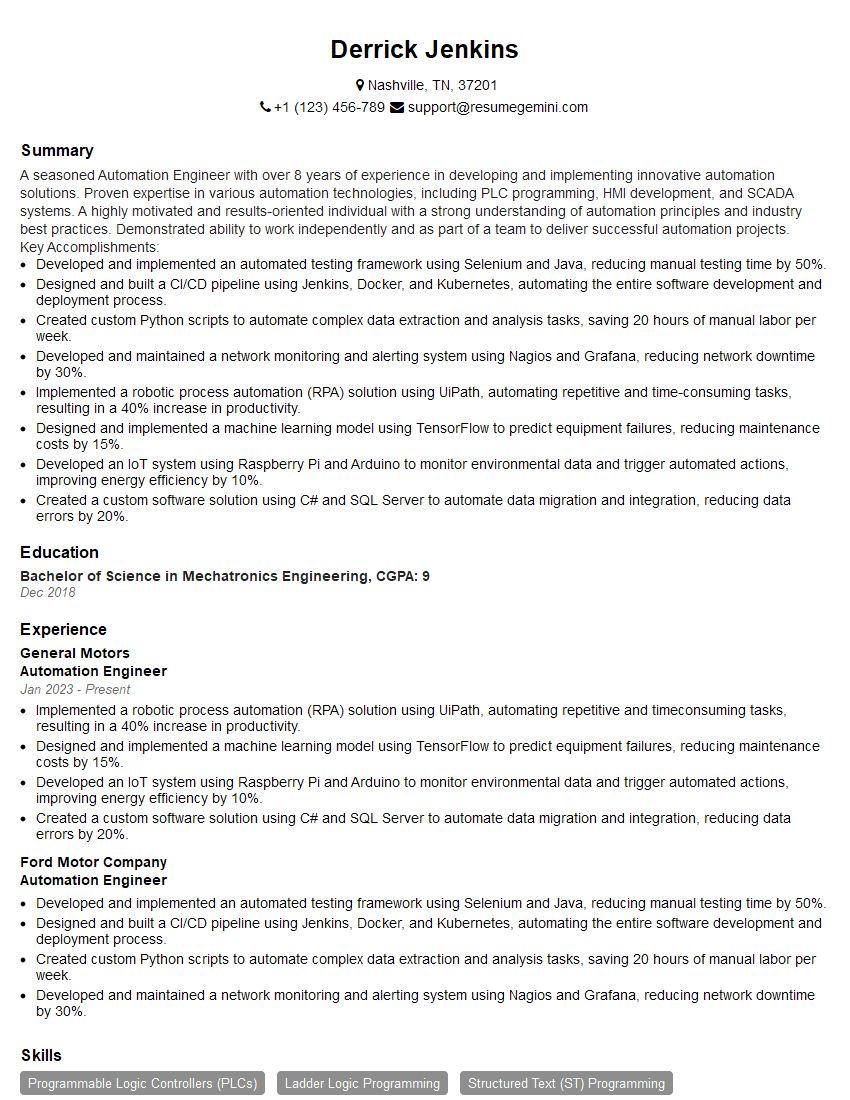
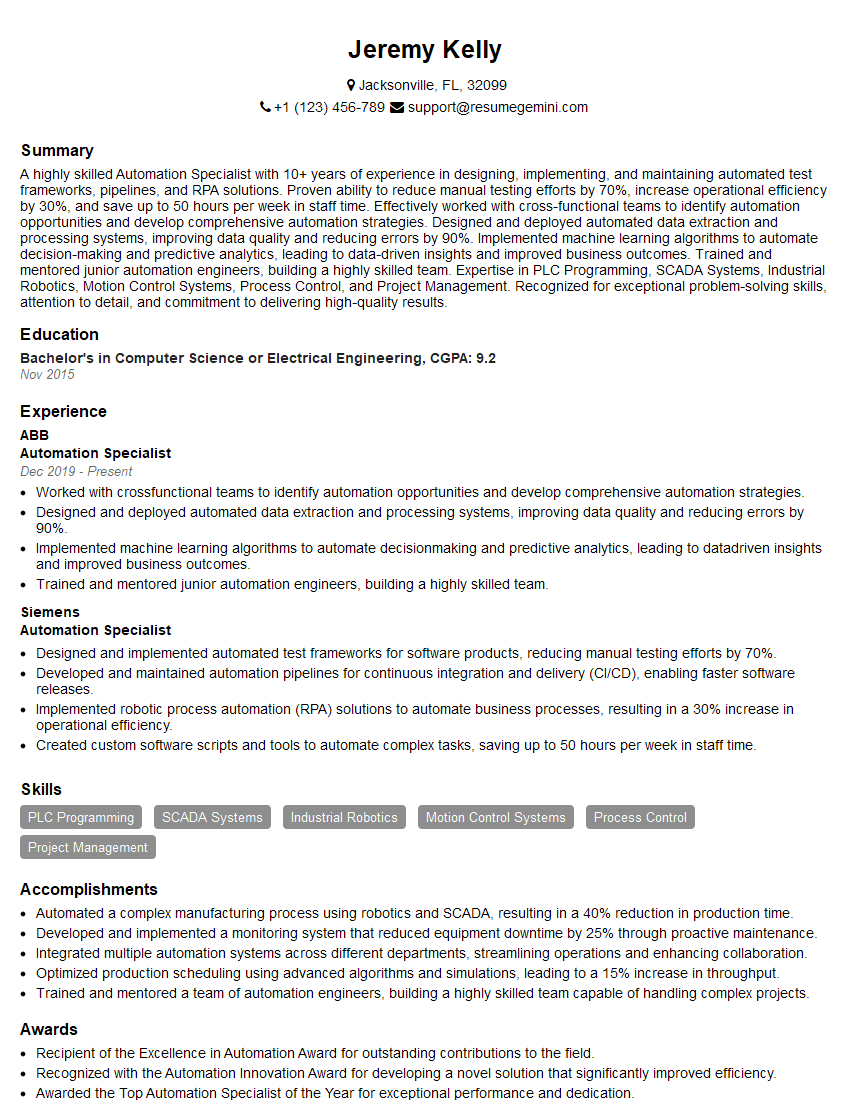
Mastering Automation Engineering opens doors to a rewarding and dynamic career with excellent growth potential in various industries. To maximize your job prospects, creating a strong, ATS-friendly resume is crucial. ResumeGemini is a trusted resource that can help you build a professional and impactful resume tailored to the specific demands of the Automation Engineering field. Examples of resumes tailored to Automation Engineering are available to guide you. Invest time in crafting a compelling resume; it’s your first impression on potential employers.
Explore more articles
Users Rating of Our Blogs
Share Your Experience
We value your feedback! Please rate our content and share your thoughts (optional).
What Readers Say About Our Blog
Very informative content, great job.
good