Are you ready to stand out in your next interview? Understanding and preparing for Avionics Design and Development interview questions is a game-changer. In this blog, we’ve compiled key questions and expert advice to help you showcase your skills with confidence and precision. Let’s get started on your journey to acing the interview.
Questions Asked in Avionics Design and Development Interview
Q 1. Explain the difference between ARINC 429 and ARINC 629 data buses.
ARINC 429 and ARINC 629 are both digital data buses used in avionics, but they differ significantly in their architecture and capabilities. Think of them as two different types of roads connecting different parts of an airplane.
ARINC 429 is a high-speed, unidirectional, data bus. ‘Unidirectional’ means data flows in only one direction – from a transmitter to a receiver. Imagine a one-way street. It uses a word-oriented protocol, meaning data is transmitted in discrete words (32 bits). Each word has a specific label indicating its meaning (e.g., airspeed, altitude). It’s relatively simple and reliable, making it suitable for transmitting critical, time-sensitive data like flight parameters. However, its limited capacity makes it less ideal for high-bandwidth applications.
ARINC 629, on the other hand, is a more flexible, high-speed, and bidirectional data bus. ‘Bidirectional’ means data can travel in both directions. Think of a two-way highway! It uses a message-oriented protocol, meaning it transmits messages of varying lengths. It’s more efficient and offers higher bandwidth than ARINC 429, supporting complex data transfer. It’s often used for integrating multiple systems and transmitting larger data sets. Its higher complexity, however, comes with increased implementation costs and potential challenges in fault detection and isolation.
In essence, ARINC 429 is a streamlined, reliable system for high-priority data, while ARINC 629 offers greater flexibility and capacity for more complex applications.
Q 2. Describe your experience with DO-178C software development.
My experience with DO-178C spans over [Number] years, encompassing various roles from software architect to verification and validation engineer. I’ve been actively involved in all phases of the DO-178C lifecycle, from requirements capture and design to code generation, testing, and certification. I have a deep understanding of the different levels of criticality (Levels A through E) and the associated rigor in development and verification.
For instance, on a recent project involving the development of a flight control software component (Level A), I spearheaded the development of a comprehensive verification plan that included unit testing, integration testing, and system testing. We utilized model-based design, static analysis tools, and formal methods to ensure the software met all the specified requirements and safety objectives. The rigorous adherence to DO-178C standards resulted in successful certification of the software, demonstrating our commitment to airworthiness.
I’m proficient in using various DO-178C compliant tools and methodologies and am well-versed in creating and managing the necessary documentation, including software requirements specification, design documentation, test plans, and certification evidence. I have experience in addressing the challenges associated with formal methods and integrating them into the development lifecycle, significantly improving the reliability and safety of the software.
Q 3. How do you ensure the safety and reliability of avionics systems?
Ensuring the safety and reliability of avionics systems is paramount. It’s not just about meeting standards, it’s about protecting lives. We achieve this through a multi-layered approach:
- Redundancy: Implementing multiple independent systems performing the same function. If one fails, the others take over – like having backup power generators.
- Fault Tolerance: Designing systems to withstand failures without compromising safety. This involves detecting errors and implementing appropriate recovery mechanisms.
- Formal Methods: Using mathematical techniques to rigorously verify the correctness of software and hardware.
- Rigorous Testing: Extensive testing at all levels, from unit testing to system integration testing, simulating various operational scenarios and fault conditions.
- Certification: Adhering to regulatory standards like DO-178C (software) and DO-254 (hardware) to demonstrate compliance and airworthiness.
- Continuous Monitoring and Improvement: Regular health checks and analysis of in-flight data to detect potential issues and proactively address them.
This holistic approach ensures that even in the event of failures, the system remains safe and reliable. Think of it as building a safety net with multiple layers—one failure doesn’t bring down the entire system.
Q 4. What are the key challenges in integrating new avionics systems into existing aircraft?
Integrating new avionics systems into existing aircraft presents several key challenges:
- Interface Compatibility: New systems must seamlessly communicate with existing ones, often requiring careful consideration of various data buses and communication protocols.
- Weight and Space Constraints: Aircraft have limited space and weight capacity, demanding careful consideration of the physical dimensions and weight of new systems.
- Certification: Integrating a new system requires demonstrating compliance with all relevant airworthiness standards, potentially leading to significant certification efforts.
- Cost: The cost of integration, including design, testing, and certification, can be significant.
- Retrofitting Challenges: Integrating into older aircraft may require significant modifications to the existing infrastructure, presenting both technical and logistical challenges.
- Legacy Systems: Integrating new technology with older, less standardized systems can be complicated and requires careful planning and design.
Addressing these challenges requires meticulous planning, a thorough understanding of the existing system, and a commitment to rigorous testing and validation. In practice, this often involves careful system architecture design, employing software and hardware interfaces that are compatible with existing infrastructure and conducting extensive flight tests to validate integration.
Q 5. Explain your understanding of different avionics communication protocols.
My understanding of avionics communication protocols encompasses a wide range, from the legacy systems like ARINC 429 and 629 (as discussed earlier) to more modern protocols.
- ARINC 429 & 629: These are the workhorses of legacy avionics, providing various levels of data transmission capabilities.
- AFDX (Avionics Full Duplex Switched Ethernet): A high-speed, Ethernet-based network offering deterministic performance and high bandwidth, crucial for modern, integrated avionics architectures.
- Ethernet: The standard for many modern avionics networks. There are various forms like 100BASE-T1 for short-reach and 1000BASE-T1 for long-reach applications.
- CAN (Controller Area Network): A widely used protocol for lower-speed communication, often employed in various subsystems.
- Discrete Signals: These are simple, on/off signals used for control and monitoring of critical functions.
The choice of protocol depends on the specific application, considering factors like bandwidth requirements, reliability, latency, and cost. For example, AFDX is chosen for applications needing high bandwidth and deterministic performance while CAN might be sufficient for low-speed sensor data transmission.
Q 6. Describe your experience with flight testing and data analysis in an avionics context.
My flight testing and data analysis experience has been pivotal in validating the performance and safety of avionics systems. I’ve been involved in numerous flight test campaigns, ranging from initial test flights to certification flights. My roles have included planning and executing flight tests, collecting and analyzing flight data, and generating reports.
A typical process involves defining the test objectives, developing test procedures, configuring data acquisition systems, executing the flights, and meticulously analyzing the collected data using specialized tools. We’d typically validate system performance against requirements, analyze data for anomalies or unexpected behavior, and identify areas for improvement. I’m proficient in using various data analysis tools, often incorporating signal processing and statistical analysis techniques to interpret the flight data. For example, I’ve used MATLAB and other software to analyze sensor data, identify trends, and verify the performance of different functionalities.
Data analysis from flight testing isn’t merely about verifying design; it’s about continually refining and improving the system. The insights gained from analyzing flight data have frequently led to critical design modifications and improvements in software and hardware, ultimately enhancing the safety and reliability of the avionics.
Q 7. How do you handle conflicts between different avionics system requirements?
Conflicts between avionics system requirements are inevitable in complex projects. The key is to have a structured process for resolving them. This often involves a collaborative approach involving different engineering teams and stakeholders.
My approach typically follows these steps:
- Identify and Document the Conflict: Clearly define the conflicting requirements, identifying the systems and stakeholders involved.
- Analyze the Root Cause: Understand why the conflict exists. Is it due to conflicting priorities, incomplete specifications, or differing interpretations?
- Prioritize Requirements: Determine the relative importance of each requirement based on safety criticality, operational impact, and cost. This often involves a trade-off analysis, weighing the benefits and drawbacks of different solutions.
- Develop and Evaluate Solutions: Explore multiple solutions, considering factors like technical feasibility, cost, and schedule impacts. This might involve modifying one or more requirements, finding compromises, or re-architecting parts of the system.
- Document the Resolution: Clearly document the chosen resolution, including the rationale behind the decision, and ensure all stakeholders are informed.
- Verify the Solution: After implementing the solution, verify that it addresses the conflict without introducing new issues.
A critical aspect is maintaining clear communication and collaboration among stakeholders throughout the entire process. This ensures that all parties are informed, their concerns are addressed, and a consensus is reached that prioritizes safety and system integrity.
Q 8. Explain your experience with avionics hardware design, including component selection and PCB layout.
Avionics hardware design is a meticulous process demanding a deep understanding of both electrical engineering and aerospace principles. My experience encompasses the entire lifecycle, from initial requirements analysis to final testing and certification. Component selection involves careful consideration of factors like radiation hardness, temperature range, weight, power consumption, and reliability—all crucial for airborne applications. For example, when designing a flight control system, we might choose components with higher radiation tolerance than those used in a less critical subsystem like cabin lighting. This choice is driven by the potential consequences of failure—a malfunction in the flight control system could be catastrophic, while a cabin light failure is relatively minor.
PCB layout is equally critical; it directly impacts signal integrity, electromagnetic compatibility (EMC), and thermal management. I utilize advanced CAD tools like Altium Designer or Eagle to create robust designs, employing techniques such as controlled impedance routing for high-speed signals and careful placement of heat-sensitive components to ensure efficient heat dissipation. For instance, I’ve designed PCBs for a high-speed data acquisition system that required precise control of impedance to minimize signal reflections and maintain data integrity during flight maneuvers.
My work also involves rigorous testing and validation, ensuring all hardware components and the PCB meet stringent aerospace standards like DO-254 and DO-160. This involves environmental testing to simulate extreme temperatures, vibration, and humidity—conditions commonly encountered in flight.
Q 9. What are your experiences with different types of sensors used in avionics systems?
My experience includes working with a wide range of sensors crucial for various avionic functions. These sensors provide essential data for navigation, flight control, weather monitoring, and engine performance analysis. Some common examples include:
- Inertial Measurement Units (IMUs): These are fundamental to navigation and flight control, combining accelerometers and gyroscopes to measure aircraft attitude and motion. I’ve worked extensively with high-precision IMUs capable of detecting minute changes in acceleration and rotation rate, crucial for accurate navigation and autopilot functions.
- GPS Receivers: Essential for precise position determination. I’ve used various GPS receivers, often incorporating techniques to mitigate signal interference and enhance accuracy in challenging environments.
- Air Data Systems (ADS): These measure airspeed, altitude, and temperature, providing critical inputs for flight management and safety systems. I’ve dealt with various ADS technologies, including pitot-static systems and modern pressure sensors.
- Environmental Sensors: These measure parameters like temperature, humidity, and pressure within the aircraft cabin and other systems. I’ve integrated these sensors into cabin environmental control systems and aircraft health monitoring systems.
Each sensor selection depends on specific needs and constraints. Factors considered include accuracy, precision, power consumption, weight, size, and environmental robustness.
Q 10. How do you ensure electromagnetic compatibility (EMC) in avionics systems?
Electromagnetic compatibility (EMC) is paramount in avionics design. It ensures that systems operate without interfering with each other or emitting electromagnetic radiation that could cause interference with other systems or equipment. My approach involves a multi-faceted strategy:
- Careful PCB design: This involves techniques like controlled impedance routing, shielding, and grounding to minimize EMI emissions and susceptibility.
- Component selection: Choosing components with low EMI emissions is crucial. I often select components that meet specific EMC standards.
- Shielding and filtering: Using conductive enclosures and filters to prevent unwanted electromagnetic radiation from entering or leaving the system.
- Testing and verification: Rigorous EMC testing is performed according to industry standards like DO-160 to verify compliance. This testing typically includes radiated emission testing, conducted emission testing, susceptibility testing, and more.
For example, in one project, I identified and resolved significant EMC issues caused by high-frequency switching power supplies by implementing appropriate filtering and shielding techniques. This prevented unwanted interference with critical navigation and communication systems.
Q 11. Describe your experience with avionics simulation and modeling tools.
Simulation and modeling are indispensable in avionics development, allowing us to test and verify system performance in a safe and controlled environment before physical prototyping. I’m proficient in various tools, including MATLAB/Simulink, which are widely used for simulating flight control systems, navigation algorithms, and other critical avionics functions. I’ve used these tools to model the dynamics of aircraft, sensors, and actuators, allowing for detailed analysis of system behavior under various conditions. Furthermore, I have experience with specialized avionics simulation software that accurately replicates the operational environment of various aircraft systems.
These tools enable us to identify potential design flaws early in the development cycle, saving time and resources. For instance, using Simulink, I’ve simulated the response of a flight control system to various turbulence scenarios, optimizing the controller parameters to ensure stability and robustness.
Q 12. How do you troubleshoot avionics system failures?
Troubleshooting avionics system failures requires a systematic and methodical approach. My process typically involves the following steps:
- Gather information: This involves collecting data from various sources, including fault logs, sensor readings, and pilot reports.
- Analyze the data: Identify patterns and correlations to isolate the root cause of the failure. This may involve using diagnostic tools and software.
- Verify the hypothesis: Conduct tests and experiments to confirm the suspected cause.
- Implement a solution: Repair or replace faulty components or update software as needed.
- Document the findings: Maintain accurate records of the troubleshooting process and the implemented solutions for future reference and to improve the system design.
For example, I once successfully resolved an intermittent GPS signal loss by identifying a faulty connection in the antenna system through careful analysis of fault logs and signal strength data. This process highlights the importance of proper documentation and tracing of signals within the system.
Q 13. Explain your understanding of fault tolerance and redundancy in avionics systems.
Fault tolerance and redundancy are critical in avionics systems to ensure safety and reliability. These techniques aim to prevent complete system failure even if individual components or subsystems malfunction. Fault tolerance involves designing systems that can continue operating despite failures, while redundancy uses duplicate or backup components to provide immediate replacement in case of failure.
Examples of redundancy include having dual GPS receivers or triple-redundant flight control computers. Fault tolerance techniques often involve sophisticated error detection and correction mechanisms within software and hardware. I’ve worked on systems employing various redundancy levels, from simple backup components to complex voting algorithms that compare outputs from multiple sources to identify and correct discrepancies. The level of redundancy and fault tolerance implemented depends on the criticality of the system.
For instance, flight control systems often employ triple modular redundancy (TMR), with three independent computers performing the same calculations, and a voting mechanism deciding on the correct output. This setup ensures that a single computer failure doesn’t compromise the entire system’s functionality.
Q 14. What are your experiences with different avionics software architectures?
My experience encompasses several avionics software architectures. The choice of architecture depends on factors like system complexity, performance requirements, and safety certification standards. Some common architectures I’ve worked with include:
- Data-centric architecture: This architecture emphasizes data sharing and communication between various system components. Data is centrally managed and distributed to different subsystems as needed. I’ve worked on projects that use this architecture to facilitate information sharing among various flight management and navigation systems.
- Event-driven architecture: This architecture is based on events or triggers, allowing components to react to changes in the system or external events. It is particularly useful for real-time applications requiring rapid responses to external stimuli, such as flight control systems.
- Modular architecture: This approach breaks down the software into independent modules, improving maintainability, testability, and reusability. I find this approach very beneficial for managing complex systems and improving design traceability.
In practice, many systems employ a hybrid approach, combining elements of various architectures to optimize performance and reliability. Selecting and implementing the appropriate architecture is a critical design decision that needs to consider many factors.
Q 15. Describe your experience with avionics certification processes.
Avionics certification is a rigorous process ensuring safety and reliability. It involves complying with regulations like DO-178C (for software) and DO-254 (for hardware), depending on the criticality of the system. My experience spans several projects, from initial design documentation and hazard analysis through to testing and certification with authorities like the FAA or EASA. This includes generating evidence packages demonstrating compliance with all applicable standards, managing the certification process, and working with certification authorities to address any discrepancies. For example, on a recent project involving a new flight control system, we meticulously documented every aspect of the software development lifecycle, from requirements traceability to verification and validation testing, to meet DO-178C Level A requirements. This meticulous approach ensured a smooth certification process and minimized delays.
- DOA (Design of Assurance): Defining the certification objectives early in the lifecycle.
- Verification & Validation: Employing rigorous testing methods like unit, integration, and system tests.
- Configuration Management: Stringent control over design documents and software code.
- Independent Verification & Validation (IV&V): Utilizing an independent team to assess the certification artifacts.
Career Expert Tips:
- Ace those interviews! Prepare effectively by reviewing the Top 50 Most Common Interview Questions on ResumeGemini.
- Navigate your job search with confidence! Explore a wide range of Career Tips on ResumeGemini. Learn about common challenges and recommendations to overcome them.
- Craft the perfect resume! Master the Art of Resume Writing with ResumeGemini’s guide. Showcase your unique qualifications and achievements effectively.
- Don’t miss out on holiday savings! Build your dream resume with ResumeGemini’s ATS optimized templates.
Q 16. Explain your understanding of the impact of environmental factors on avionics systems.
Environmental factors significantly impact avionics systems’ performance and longevity. Extreme temperatures, humidity, pressure variations, and radiation can cause malfunctions, component degradation, and even system failures. For instance, high temperatures can lead to decreased component lifespan and increased power consumption. Conversely, extremely low temperatures can cause material brittleness and reduced efficiency. Humidity can cause corrosion and degradation of electronic components. My experience includes designing systems that accommodate these challenges through specialized materials, robust thermal management techniques (like heat pipes and radiation shielding), and rigorous environmental testing. We simulate extreme conditions in controlled environments to verify our system’s resilience. We also use specialized coatings and seals to protect sensitive components from moisture and corrosion. A specific project involved designing an avionics system for a high-altitude UAV, requiring us to account for the extreme temperature variations and reduced air pressure at such altitudes.
Q 17. What are the key considerations when designing for low power consumption in avionics systems?
Low power consumption is crucial in avionics, particularly for battery-powered systems or those seeking to maximize fuel efficiency. Key considerations include:
- Component Selection: Choosing low-power microprocessors, memory chips, and other components.
- Power Management ICs (PMICs): Utilizing PMICs to optimize power distribution and regulate voltages efficiently.
- Software Optimization: Writing efficient software that minimizes processing power and memory access.
- Sleep Modes: Incorporating low-power sleep modes for components when not actively needed.
- System Architecture: Designing a modular architecture that allows selective activation of subsystems to reduce overall power draw.
For example, in a recent project involving a small UAV, we used a low-power ARM processor and implemented sophisticated power management techniques, resulting in a 30% reduction in power consumption compared to the initial design. This extended the flight time significantly.
Q 18. How do you manage technical risks in avionics projects?
Managing technical risks in avionics projects requires a proactive and structured approach. We employ a combination of techniques including:
- Hazard Analysis and Risk Assessment (HARA): Identifying potential hazards and assessing their associated risks.
- Fault Tree Analysis (FTA): Modeling potential system failures and their contributing factors.
- Failure Modes and Effects Analysis (FMEA): Identifying potential failure modes and their effects on the system.
- Redundancy and Fail-Safe Mechanisms: Designing systems with redundant components and fail-safe mechanisms to mitigate the impact of failures.
- Rigorous Testing and Verification: Performing extensive testing to identify and address potential issues early in the development lifecycle.
A risk register is maintained, tracking identified risks, their mitigation strategies, and the responsible parties. Regular risk reviews are conducted throughout the project to monitor the effectiveness of mitigation strategies and to address emerging risks. For instance, during a project involving a new sensor system, we identified a risk associated with sensor failure. We mitigated this risk by implementing sensor redundancy and incorporating algorithms for fault detection and isolation.
Q 19. Describe your experience with version control systems for avionics software.
Version control systems are fundamental for managing avionics software. We consistently use Git, a distributed version control system, to track changes, manage different code branches (e.g., for development, testing, and certification), and collaborate effectively among team members. This allows for easy rollback to previous versions if necessary, which is crucial in a safety-critical industry. We maintain a detailed history of all code changes, including comments explaining the purpose of each modification. Branching strategies like Gitflow are employed to ensure a controlled and organized development process. This rigorous approach to version control helps meet the traceability requirements of DO-178C and ensures the integrity of the software throughout its lifecycle. The use of a robust system like Git minimizes the risk of errors and facilitates collaboration.
Q 20. Explain your understanding of different avionics display technologies.
Avionics display technologies have evolved significantly. Common technologies include:
- Electro-mechanical indicators: Traditional analog instruments relying on mechanical movements.
- Electroluminescent displays (ELDs): Offer high brightness and wide viewing angles, typically used in older systems.
- Liquid Crystal Displays (LCDs): Widely used due to their low power consumption, light weight, and relatively low cost.
- Light Emitting Diodes (LEDs): Provide high brightness, durability, and long lifespan, often used in backlighting for LCDs.
- Organic Light Emitting Diodes (OLEDs): Offering high contrast ratios and improved viewing angles. They are becoming more prominent.
- Projected Displays: Used in Head-Up Displays (HUDs) and other systems requiring image projection.
The choice of technology depends on factors like cost, power consumption, brightness requirements, environmental robustness, and size constraints. For example, HUDs typically utilize projected displays, while cockpit primary flight displays often use LCDs or increasingly, OLEDs.
Q 21. How do you ensure the maintainability of avionics systems?
Maintainability of avionics systems is paramount for safety and cost-effectiveness. We ensure maintainability through:
- Modular Design: Designing the system with replaceable modules to simplify repairs and reduce downtime.
- Diagnostics and Fault Isolation: Implementing built-in test equipment (BITE) and self-diagnostic capabilities to aid in fault detection and isolation.
- Comprehensive Documentation: Providing detailed maintenance manuals, schematics, and troubleshooting guides.
- Accessibility: Designing the system for easy access to components for maintenance and repair.
- Standardization: Using standardized components and interfaces to simplify repair and replacement.
For instance, on a recent project involving an aircraft’s communication system, we implemented a modular design, allowing for quick replacement of failed modules without needing to replace the entire system. We also included extensive diagnostic capabilities, which significantly reduced the downtime needed for repairs.
Q 22. Describe your experience working with different avionics hardware platforms.
My experience spans a wide range of avionics hardware platforms, encompassing both legacy and modern systems. I’ve worked extensively with ARINC 429 and ARINC 664 data buses, crucial for communication between various avionics components. I’m proficient with processors like PowerPC and ARM architectures commonly used in flight control systems and integrated modular avionics (IMA). My experience also includes working with various sensor interfaces, including GPS receivers, inertial measurement units (IMUs), air data computers (ADCs), and communication systems like VHF/UHF radios. For example, on a recent project involving a helicopter upgrade, I was responsible for integrating a new GPS system onto a legacy platform, requiring careful consideration of data bus compatibility and signal integrity. This involved careful analysis of the existing hardware, protocol conversion, and rigorous testing to ensure seamless integration and performance.
Furthermore, I have hands-on experience with specialized hardware like flight management system (FMS) components, display systems (both CRT and LCD), and data acquisition units (DAUs) used for flight data recording and analysis. This broad hardware experience provides me with a solid foundation for understanding the complexities of avionics system design and integration.
Q 23. How do you balance performance, cost, and weight considerations in avionics design?
Balancing performance, cost, and weight is a critical aspect of avionics design, often requiring difficult trade-offs. Imagine designing a new autopilot system – higher performance, with faster response times and more sophisticated algorithms, is desirable for enhanced safety and efficiency. However, increased performance typically translates to higher processing power, more memory, and potentially larger, heavier components, thus increasing both cost and weight. Weight is particularly crucial in aerospace, as it directly impacts fuel consumption and overall aircraft performance.
We address this using a structured approach. We start with defining clear performance requirements based on safety regulations and operational needs. Then, we explore different hardware and software options, creating a cost-performance matrix. This helps to visually compare options and identify potential areas for optimization. For instance, we might choose a less powerful but energy-efficient processor to reduce weight and power consumption, sacrificing a bit of performance if the overall requirements allow. Similarly, software optimization techniques can be employed to improve performance without requiring more powerful hardware. Weight reduction is often achieved through careful component selection and by optimizing the system’s physical layout. This iterative process, involving continuous evaluation and adjustments, ensures an optimized solution that meets all the critical requirements.
Q 24. Explain your understanding of the impact of airworthiness regulations on avionics design.
Airworthiness regulations, such as those defined by the FAA (Federal Aviation Administration) and EASA (European Union Aviation Safety Agency), are paramount in avionics design. These regulations dictate stringent safety standards, ensuring that the systems are reliable, safe, and function correctly under all expected operating conditions. Compliance necessitates rigorous design processes, extensive testing, and meticulous documentation. For instance, DO-178C (Software Considerations in Airborne Systems and Equipment Certification) outlines a comprehensive software development lifecycle, emphasizing the importance of verification and validation throughout each stage.
Understanding these regulations guides every design decision. We need to select components certified to the appropriate standards, develop robust software using formally verifiable techniques, and implement rigorous testing procedures to demonstrate compliance. Failure to comply can lead to significant delays, costly rework, and even prevent the aircraft from receiving certification. A key part of my role is ensuring that all aspects of our design, from hardware selection to software development and testing, adheres to the applicable airworthiness standards. This frequently involves collaborating with certification authorities and maintaining meticulous records to demonstrate compliance.
Q 25. Describe your experience with real-time operating systems (RTOS) in avionics.
Real-time operating systems (RTOS) are fundamental in avionics, providing a predictable and deterministic environment for the execution of critical tasks. Unlike general-purpose operating systems, RTOSes guarantee timely responses to events, ensuring that tasks are completed within strict deadlines. This is crucial in flight control systems, where delays could have catastrophic consequences. I have substantial experience with various RTOSes, including VxWorks and INTEGRITY. These systems offer features like priority-based scheduling, real-time interrupts, and memory protection mechanisms that are essential for safety-critical applications.
In a recent project involving the development of a flight control algorithm, we used VxWorks to ensure that the algorithm executed within the required timing constraints. We carefully analyzed the task scheduling and prioritized the critical tasks to guarantee timely responses. The selection of the RTOS, its configuration, and the task scheduling were rigorously tested and verified to ensure that the system met its safety requirements. Understanding the nuances of RTOS scheduling, resource management, and the inter-process communication mechanisms are essential for successful development and integration.
Q 26. How do you ensure data integrity and security in avionics systems?
Ensuring data integrity and security is crucial in avionics systems, protecting against both accidental errors and malicious attacks. Data integrity refers to the accuracy and consistency of data throughout its lifecycle, while security safeguards against unauthorized access, modification, or disruption. We employ several strategies to achieve this, including:
- Redundancy and fault tolerance: Implementing redundant systems and utilizing error detection and correction codes help to mitigate the impact of hardware or software failures.
- Data encryption: Sensitive data, such as flight control parameters, is encrypted to prevent unauthorized access.
- Secure boot processes: Implementing secure boot mechanisms prevents the execution of unauthorized software.
- Firewall and intrusion detection systems: Implementing firewalls and intrusion detection systems to protect against malicious attacks.
- Regular security audits and penetration testing: Performing regular security audits and penetration testing to identify and address vulnerabilities.
For example, in a project involving a communication system, we used encryption to protect sensitive data transmitted between aircraft and ground stations. We also implemented rigorous authentication protocols to verify the identity of communicating entities, ensuring that only authorized devices could access and transmit data.
Q 27. Explain your experience with the use of model-based design in avionics.
Model-based design (MBD) is a crucial methodology in modern avionics development. It involves using models to design, simulate, and verify systems before implementation. This allows for early detection of errors, reducing development time and costs. I have extensive experience using tools like MATLAB/Simulink for MBD in avionics. These tools allow us to create detailed system models, simulate their behavior, and generate code for implementation. The use of formal methods and model checking enhances the reliability and safety of the developed systems.
In a recent project, we used Simulink to model a new flight control system. This allowed us to simulate various flight scenarios and verify the performance of the control algorithms before implementing them on the actual hardware. The generated code from Simulink was then integrated into the target RTOS, minimizing the risk of errors and ensuring that the system met its performance and safety requirements. MBD streamlines the development process and improves the overall quality and safety of the avionics systems.
Q 28. Describe your experience with avionics system testing methodologies (e.g., unit testing, integration testing, system testing).
Rigorous testing is paramount in avionics. We employ a multi-layered approach that encompasses unit, integration, and system testing. Unit testing verifies the functionality of individual software modules or hardware components. Integration testing focuses on verifying the interaction between different modules or components. System testing evaluates the overall performance and functionality of the complete system.
Unit testing often involves writing automated tests to check individual functions and ensure they meet their specifications. Integration testing might involve simulating interactions between different modules using test harnesses. System testing typically involves extensive testing in a simulated environment and finally, in real-world conditions (flight tests where applicable). We utilize a variety of testing techniques such as: requirements-based testing, fault injection testing, and stress testing. Traceability between test cases and requirements is meticulously maintained to ensure complete coverage. This layered approach helps identify and resolve defects early in the development cycle, significantly reducing the risk of failures in the final system.
Key Topics to Learn for Avionics Design and Development Interview
- System Architecture: Understanding the overall architecture of avionics systems, including communication buses (e.g., ARINC 429, AFDX), and data flow management. Consider practical application in designing a new system component and its integration.
- Sensor Integration and Data Fusion: Explore the principles of integrating various sensors (GPS, INS, altimeters, etc.) and fusing their data for accurate and reliable navigation and situational awareness. Think about how to address sensor failures and maintain system integrity.
- Software Development for Avionics: Familiarize yourself with real-time operating systems (RTOS) and programming languages commonly used in avionics (e.g., Ada, C, C++). Focus on practical coding examples and debugging strategies within a safety-critical environment.
- DO-178C/ED-12C Compliance: Understand the software development lifecycle and certification processes required to meet stringent safety standards in avionics. Consider the practical implications of these standards on design and testing phases.
- Hardware Design and Selection: Gain a working knowledge of selecting and integrating hardware components, considering factors such as power consumption, weight, reliability, and electromagnetic compatibility (EMC). Explore case studies of hardware failure analysis and mitigation techniques.
- Communication Protocols and Networking: Master various communication protocols used in avionics and understand the principles of network design and management. Consider real-world applications and potential challenges in network security and reliability.
- Testing and Verification: Understand different testing methodologies (unit, integration, system) and verification techniques to ensure the safety and reliability of avionics systems. Consider the challenges of testing in a simulated flight environment.
- Airworthiness Regulations: Familiarize yourself with relevant airworthiness regulations and certification processes. Understand how these regulations impact the design and development of avionics systems.
Next Steps
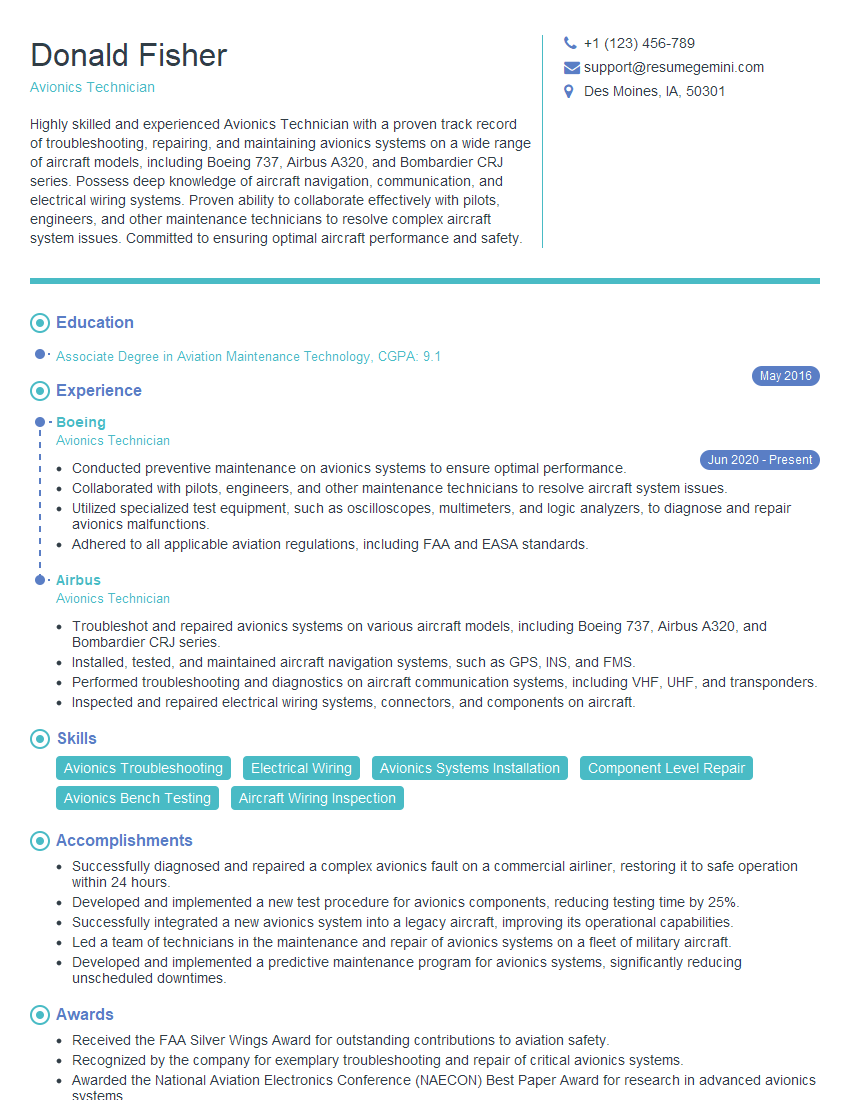
Mastering Avionics Design and Development opens doors to a rewarding and challenging career with significant growth potential in a rapidly evolving industry. A strong resume is crucial for showcasing your skills and experience to potential employers. Creating an ATS-friendly resume significantly increases your chances of getting noticed by recruiters. ResumeGemini is a trusted resource to help you build a professional and impactful resume, tailored to the specific requirements of the Avionics industry. Examples of resumes tailored to Avionics Design and Development roles are available to guide you.
Explore more articles
Users Rating of Our Blogs
Share Your Experience
We value your feedback! Please rate our content and share your thoughts (optional).
What Readers Say About Our Blog
Very informative content, great job.
good