Unlock your full potential by mastering the most common Backdrops and Props interview questions. This blog offers a deep dive into the critical topics, ensuring you’re not only prepared to answer but to excel. With these insights, you’ll approach your interview with clarity and confidence.
Questions Asked in Backdrops and Props Interview
Q 1. Describe your experience with various backdrop materials (muslin, paper, vinyl).
My experience spans a wide range of backdrop materials, each with its own unique properties and applications. Muslin backdrops, for instance, are incredibly versatile. Their soft, drapable nature makes them ideal for creating subtle, textured backgrounds, perfect for portrait photography or intimate scenes. They’re also easily dyed or painted to achieve specific colors and effects. Think of a romantic scene requiring a soft, sunset-colored backdrop – muslin is perfect for that. However, they can be prone to wrinkles and require careful ironing or steaming.
Paper backdrops offer a vibrant, clean look. They come in a huge variety of colors and patterns, making them quick and easy to set up for many shoots. The downside is their disposability; once creased or damaged, they’re often unusable. I’ve found them particularly useful for fast-paced projects where quick changes are essential, such as product photography or headshots.
Finally, vinyl backdrops provide durability and longevity. Their wrinkle-resistant properties make them ideal for frequent use and transport. They’re also easily cleaned, a significant advantage in messy environments. I often choose vinyl for outdoor shoots or events where the backdrop might get exposed to the elements. The slightly more plastic look might be a drawback for some artistic projects, though, where a softer texture is desired.
Q 2. How do you choose the appropriate backdrop for a specific scene or shoot?
Choosing the right backdrop is crucial for establishing the mood and setting of a scene. My process involves careful consideration of several factors. Firstly, I assess the narrative and visual style of the shoot. A gritty, urban scene might call for a textured, weathered backdrop, while a whimsical fairy tale setting would benefit from a soft, painted backdrop.
Secondly, I consider the lighting conditions. A dark, moody scene might require a dark backdrop to enhance the shadows and contrast. Conversely, a bright, airy scene might require a lighter-colored backdrop to avoid washing out the image.
Thirdly, I consider the subject matter. A portrait shoot might require a plain backdrop to keep the focus on the subject, while a product shoot might require a backdrop that complements the product’s color and texture. Finally, budget and practicality play a role. While a custom-painted backdrop might be ideal, a pre-made backdrop might be more cost-effective for a smaller production.
Q 3. Explain your process for sourcing and acquiring props for a production.
Sourcing props is a multifaceted process that begins with a thorough review of the script or storyboard. I create a detailed prop list, specifying each item’s description, quantity, and desired condition.
Next, I explore various sourcing options. This often includes searching online marketplaces like eBay and Etsy for vintage or unique items. Local antique shops and thrift stores are also excellent resources for finding one-of-a-kind pieces. For specific or custom-made props, I’ll contact prop houses or skilled artisans.
Once I’ve identified potential sources, I carefully evaluate each item’s cost, availability, and condition. I negotiate prices, secure contracts (when necessary), and arrange for shipping or pickup. Finally, I meticulously catalog and label each prop for easy retrieval and tracking during the production.
Q 4. How do you manage a prop budget effectively?
Effective prop budget management is crucial for any production. I begin by establishing a realistic budget based on the production’s scope and scale. I prioritize items based on their importance to the narrative and visual storytelling.
I explore cost-effective options such as renting props instead of buying them, especially for items that will only be used once. I also leverage my network of contacts and suppliers to negotiate favorable prices and explore bulk discounts. Throughout the process, I meticulously track all expenses, comparing them against the allocated budget to ensure that we remain on track.
For example, if the script calls for numerous antique books, instead of purchasing expensive first editions, I might source similar-looking books from a secondhand bookstore or even use cleverly printed images within inexpensive books. This allows me to meet the visual requirements without exceeding the budget.
Q 5. What safety precautions do you take when handling props?
Safety is paramount when handling props. I establish clear safety protocols on set, including regular inspections of all props before, during, and after use. Props with potential hazards, such as sharp objects, flammable materials, or replicas of weaponry, are handled with extra care, often with designated handlers and safety precautions in place.
I provide training to the production team on the safe handling of props. For example, any prop that requires special handling is clearly labeled with its hazards and usage instructions. We ensure that all props are stored securely when not in use, and any damaged or unsafe props are immediately removed from the set.
Q 6. How do you maintain and store props to ensure their longevity?
Proper maintenance and storage are vital for preserving props and extending their lifespan. After each use, I clean and inspect each prop, carefully repairing any minor damage.
For storage, I utilize a well-organized system that categorizes and labels props. Fragile items are stored in protective cases or containers, while larger items are stored in a climate-controlled environment to prevent damage from temperature fluctuations or humidity. Props are carefully cataloged and inventoried to ensure easy access and prevent loss or misplacement. For example, delicate costumes are stored in acid-free boxes with tissue paper to prevent discoloration and deterioration.
Q 7. Describe your experience with prop fabrication and repair.
I have extensive experience in both prop fabrication and repair. Fabrication often involves working with various materials such as wood, metal, plastics, and fabrics to create custom props that meet the specific needs of a production.
This might involve creating detailed models using 3D printing, sculpting intricate designs using clay, or building complex structures using woodworking techniques. Repair often requires a blend of artistic skill and technical expertise, involving patching, repainting, and restoring damaged props to their original condition. For example, I once had to repair a vintage gramophone that had a damaged arm; this involved careful restoration of the wood and the precise reassembly of the delicate internal mechanism.
Q 8. How do you handle last-minute prop requests or changes?
Handling last-minute prop requests requires a calm, efficient approach and a strong network. My first step is to assess the request: feasibility, budget implications, and potential sourcing challenges. For example, if it’s a simple item like a specific type of book, I can often source it quickly from a local bookstore or online retailer. If it’s more complex, like a custom-made antique-looking clock, I’d immediately contact my trusted prop makers and discuss expedited production, prioritizing quality while managing time constraints. I’d also evaluate whether a similar prop could substitute, perhaps something already in our inventory that can be adapted with minimal effort. Open communication with the director and art director is crucial. Transparency regarding potential delays and cost increases ensures everyone is on the same page.
If a major change to an existing prop is required, I’d prioritize understanding the artistic reasoning behind it. A quick sketch or reference image from the director often helps me quickly assess the necessary alterations. I might utilize existing resources or suggest cost-effective solutions that meet the artistic vision.
Q 9. What software are you proficient in for creating or modifying digital props?
My proficiency extends across several industry-standard software packages. I’m highly skilled in Blender for 3D modeling, texturing, and rendering, allowing me to create realistic digital props from scratch, or modify existing ones. I also utilize Photoshop extensively for detailed texture editing, creating realistic wear and tear effects, or adding intricate details to props. For more complex tasks, especially integrating digital props into live-action footage, I have experience working with compositing software like Nuke and After Effects.
For instance, I recently used Blender to create a series of hyper-realistic futuristic weapons for a science fiction film. The process involved detailed modeling, UV unwrapping, texture painting in Photoshop, and finally, rendering high-resolution images that were seamlessly integrated using After Effects.
Example Blender code (simplified): # Create a cube object bpy.ops.mesh.primitive_cube_add()Q 10. How do you collaborate effectively with other art department members?
Effective collaboration is the backbone of any successful production. I believe in open communication, proactive problem-solving, and mutual respect. I consistently maintain clear lines of communication with the set designer, costume designer, and other art department members. I participate in regular meetings, providing updates on prop progress, addressing any potential conflicts, and offering creative solutions. I often use shared online platforms like Google Drive or Dropbox to share files, making sure everyone has the most updated versions of prop designs, schedules, and budgets.
For example, when working on a historical drama, I collaborated closely with the costume designer to ensure that all props were period-appropriate and consistent with the overall aesthetic. This involved regular brainstorming sessions and sharing sketches and mood boards to ensure a cohesive design language across all aspects of the production.
Q 11. Describe your experience working with different prop rental companies.
I have extensive experience working with various prop rental companies, ranging from small, local businesses to large, international firms. My approach is always to establish a clear understanding of their inventory, rental policies, and delivery options. I carefully review contracts to ensure accurate descriptions of the props, rental fees, and insurance coverage. I always request high-resolution images and detailed specifications before committing to a rental. Prioritizing communication is key; I always confirm pick-up and delivery schedules, and ensure all props are in excellent condition both upon arrival and departure. I maintain strong working relationships with several reliable companies, based on consistent positive experiences and trust.
For instance, I recently utilized a specialized antique prop company to source props for a period piece. Their expertise and vast inventory proved invaluable. They offered a detailed online catalog and provided expert consultation during the selection process.
Q 12. Explain your understanding of copyright and intellectual property related to props.
Understanding copyright and intellectual property is paramount in my work. I always obtain proper licenses or permissions before using any copyrighted material, including designs, images, and brands. When sourcing props, I make sure to verify their provenance and avoid infringing on any trademarks or copyrights. If a prop needs to be replicated, I ensure it’s done ethically and legally, respecting the intellectual property rights of the original creator. I’m well-versed in the legal ramifications of copyright infringement and am always careful to act responsibly. I often consult with legal counsel on complex cases to ensure full compliance.
For example, I recently worked on a project that involved replicating a famous artwork. To avoid any legal issues, I consulted the artist’s estate and secured the necessary rights to reproduce the artwork as a prop. This ensured the production avoided any copyright claims.
Q 13. How do you ensure the authenticity and historical accuracy of props?
Ensuring authenticity and historical accuracy is crucial, especially in period pieces. My approach involves extensive research, utilizing historical references, museum archives, and expert consultation. I meticulously verify the details of each prop against reliable sources to guarantee accuracy. If any doubts arise, I consult historians, archaeologists, or other relevant experts to ensure that the prop is not just visually convincing but also historically sound.
For example, while working on a film set in 18th-century England, I consulted several historical resources to ascertain the exact design and construction details of period furniture. This involved studying antique catalogs, examining museum collections, and consulting with a historical furniture expert to ensure accuracy in both material and style.
Q 14. Describe your experience with creating miniature props.
Creating miniature props requires exceptional attention to detail and precision. I utilize various techniques depending on the complexity of the prop. This might involve 3D printing for intricate designs, sculpting using clay or resin for organic shapes, or carefully assembling miniature components from scratch. Precise scaling is critical, using calipers and rulers to ensure accuracy. I often use techniques like weathering and aging to add realism. The same principles of material selection, historical accuracy, and attention to detail apply to miniature props as they do to full-scale ones. The level of detail is simply magnified.
For instance, I recently created a miniature replica of a medieval castle for a fantasy film. This involved meticulous sculpting of the castle walls and towers from clay, followed by painting and weathering to create a realistic effect. The process involved precise measurement and scaling to create a miniature that was both accurate and visually stunning.
Q 15. How do you create believable textures and weathering effects on props?
Creating believable textures and weathering effects on props is crucial for realism. It’s all about understanding the aging process of materials and mimicking it effectively. We use a multi-layered approach.
Layering Techniques: We start with a base layer, perhaps a simple paint job, then build upon it. For rust, we might use a base coat of brown, then add reddish-orange highlights, followed by subtle streaks of black to create depth and variation. For wood, we might use stains and washes to achieve different tones and highlight the grain.
Material Application: Specific materials help. For example, applying a thin layer of plaster and then scratching it away can simulate aged stone. Dry brushing techniques using different shades of paint add texture and highlights. We might use sandpaper for controlled wear, or even apply real dirt or grime for authenticity.
Chemical Processes: Certain chemical reactions can create realistic weathering. For instance, we can use acids to create a corroded metal effect. This requires careful control and proper safety measures, of course.
Advanced Techniques: Advanced methods such as airbrushing allow for precise control of weathering effects, particularly for creating subtle nuances. Digital techniques like texture mapping can be used to create complex effects for digital assets, then printed onto physical props for a hyperrealistic result.
For instance, on a recent project involving a vintage car, we used a combination of rust-effect paints, strategically placed scratches, and even a little carefully applied dirt to make it look like it had spent decades in a barn. The result was incredibly convincing.
Career Expert Tips:
- Ace those interviews! Prepare effectively by reviewing the Top 50 Most Common Interview Questions on ResumeGemini.
- Navigate your job search with confidence! Explore a wide range of Career Tips on ResumeGemini. Learn about common challenges and recommendations to overcome them.
- Craft the perfect resume! Master the Art of Resume Writing with ResumeGemini’s guide. Showcase your unique qualifications and achievements effectively.
- Don’t miss out on holiday savings! Build your dream resume with ResumeGemini’s ATS optimized templates.
Q 16. What methods do you use to track and organize props on a large-scale production?
On large-scale productions, prop tracking is paramount. We utilize a combination of digital and physical methods.
Database Software: We use dedicated database software, often custom-built for the production, to list each prop, its condition, location, and assigned personnel. This includes photos for easy identification.
Barcoding/RFID: Each prop is barcoded or tagged with an RFID chip, allowing for easy tracking with handheld scanners. This ensures quick inventory and reduces the chance of misplacing items.
Physical Organization: Props are stored in clearly labeled bins or containers, organized by set, scene, or type. This makes finding specific items straightforward.
Dedicated Prop Team: A dedicated prop team with assigned responsibilities oversees the entire process, ensuring meticulous tracking and accountability. Regular inventory checks are conducted to maintain accuracy.
Imagine a production with thousands of props. Without a robust tracking system, the chaos would be unimaginable. Our system ensures that every prop is accounted for, from the smallest detail to the most significant piece.
Q 17. Describe a time you had to solve a problem related to a missing or damaged prop.
During a historical drama, a crucial prop—a highly detailed antique clock—was reported missing just hours before the scheduled scene. Panic set in, as recreating it in time was practically impossible.
Immediate Search: We immediately initiated a thorough search of the set, storage areas, and even nearby locations.
Inventory Review: A meticulous review of our database and recent prop movement logs was conducted, hoping to trace its last known location.
Backup Plan: Simultaneously, we developed a backup plan. We considered using a similar prop from our archive, but it lacked the specific detail required for the close-up shot. As a last resort, we started exploring digital replacement options which could be overlaid onto the video footage.
Discovery: Fortunately, during the review, we discovered the clock had been mistakenly transported to the wrong set location, a common issue. It was retrieved promptly, saving the shoot.
This experience highlighted the importance of meticulous inventory control and the value of having a contingency plan. While a digital replacement could have potentially saved the day, having the prop itself ensured a far superior outcome.
Q 18. How do you handle prop logistics and transportation?
Prop logistics and transportation are vital, especially with delicate or oversized items. We meticulously plan every aspect.
Specialized Transportation: We utilize appropriate transportation methods based on the nature of the prop. Fragile items require climate-controlled vehicles, oversized props may need specialized trucks or cranes.
Custom Crating: Delicate props are carefully crated with custom padding and bracing to prevent damage during transit. We often use climate-controlled containers for long-distance transport.
Route Planning: Careful route planning accounts for weather, traffic, and accessibility to the set location. We often use GPS tracking to monitor shipments in real-time.
Insurance: We always secure adequate insurance coverage to protect against loss or damage during transport.
The safe arrival of props is crucial to the success of any production. A single instance of damage can cause major delays and setbacks. Our well-defined transportation procedures are designed to minimize the risk of incidents and guarantee the integrity of every prop.
Q 19. What is your experience with creating custom backdrops?
My experience with creating custom backdrops is extensive. We utilize various techniques depending on the desired look and budget.
Hand-Painted Backdrops: For highly detailed and unique backdrops, we use hand-painting techniques. This allows for maximum creative control, enabling us to achieve specific textures and effects.
Printed Backdrops: Large-scale printing offers speed and affordability, especially for photographic backdrops. High-resolution images can be printed on various materials, such as canvas or vinyl.
3D Backdrops: For immersive sets, we use 3D modeling and construction. This allows us to create realistic structures, adding another dimension of depth and detail to the backdrop. This can involve using fabrics, foam core, and other materials to create texture and depth.
Digital Backdrops: For post-production, creating virtual backdrops using digital tools gives maximum flexibility and allows for a seamless integration into the final shot. We can even manipulate the lighting and atmosphere in post-production.
Recently, we created a custom backdrop for a fantasy film, depicting a sprawling, ancient city. This involved a combination of hand-painting and 3D modeling, resulting in a breathtaking and incredibly realistic set piece. We used specialized paints to give the backdrop an ancient, weathered look, and built 3D elements to add depth and texture.
Q 20. How do you deal with the challenges of working in tight spaces with props?
Working in tight spaces with props requires careful planning and execution. It’s all about efficient spatial management.
Pre-planning and Measurement: Beforehand, we meticulously measure the space and plan the placement of props, ensuring sufficient clearance for actors and camera movement.
Modular Prop Design: Where possible, we design props in modular sections for easier assembly and disassembly within limited space.
Lightweight Materials: We opt for lightweight materials whenever feasible to minimize strain on the crew and to make moving the props simpler.
Organized Storage: We implement a well-organized storage system for props not currently in use, keeping walkways clear and preventing accidents.
Efficient Crew Coordination: Effective communication within the team is crucial. A clear understanding of each individual’s responsibilities minimizes any accidental collisions and ensures smooth workflow.
In a recent television series, we had to work within a very confined studio space. By meticulously planning the prop placement and using a modular design, we successfully managed the limited space without compromising the visual appeal.
Q 21. Explain your understanding of prop scaling and perspective.
Prop scaling and perspective are crucial for creating realistic and believable sets. They are interconnected elements.
Accurate Scaling: Props must be scaled accurately relative to the other elements in the scene and the human characters. Inaccurate scaling can immediately disrupt the viewer’s sense of reality.
Forced Perspective: We often use forced perspective techniques, strategically placing props of varying sizes to create the illusion of depth and distance. Smaller props placed further away can appear larger than they actually are, thus expanding the apparent scale of the setting.
Digital Tools: Digital tools like 3D modeling software provide excellent aids in accurately scaling and placing props relative to each other and to the camera’s perspective.
Understanding Camera Angles: The camera’s angle significantly influences how the scale and perspective of a prop is perceived. Careful consideration of the camera’s viewpoint is essential for achieving the desired visual effect.
For example, in a scene requiring a vast, imposing castle, we might use forced perspective by placing smaller models of towers further away, creating the illusion of immense scale within the constrained space of a soundstage.
Q 22. Describe your experience working with both practical and digital props.
My experience encompasses both practical and digital prop creation, offering a versatile skillset for diverse projects. With practical props, I’m proficient in sourcing, constructing, modifying, and aging items to achieve the desired aesthetic. This ranges from simple modifications like distressing a wooden chair to create a period look, to more complex builds involving woodworking, metalworking, and upholstery. For example, I once built a fully functional, period-accurate grandfather clock for a historical drama. Digital prop creation, on the other hand, involves utilizing software like Blender or ZBrush to model, texture, and render props for visual effects or pre-visualization. I have experience creating high-resolution 3D models of fantastical weapons for a science fiction film, which were then integrated into the CGI sequences. This dual expertise allows me to seamlessly blend practical and digital elements, optimizing resources and achieving the best possible results.
Q 23. How familiar are you with different prop construction techniques (e.g., sculpting, molding)?
My familiarity with prop construction techniques is extensive. I’m skilled in sculpting with various materials like clay, foam, and epoxy putty, using techniques like armature construction and surface detailing to achieve realistic forms. Mold making and casting is another area of expertise, allowing me to create multiple copies of intricate designs efficiently, using materials like silicone rubber and polyurethane resin. I’ve used lost wax casting for metal props and rotational molding for creating hollow props. My experience extends to woodworking techniques like carving, joinery, and finishing, as well as metalworking using techniques such as welding, soldering, and forging. Furthermore, I’m adept at working with plastics, fabrics, and other materials to craft props appropriate to the project’s needs. Understanding these diverse techniques is critical for creating durable, safe, and aesthetically pleasing props.
Q 24. How do you ensure props are safe for actors to handle?
Safety is paramount in prop creation. Every prop’s safety is assessed before it goes on set. For sharp objects, I ensure appropriate sheathing or blunting, and for fragile items, I employ reinforcement techniques or utilize safer alternatives. I meticulously examine each prop for potential hazards such as loose parts, sharp edges, or toxic materials. I use appropriate safety equipment during construction, and I provide clear instructions to the actors on the safe handling of each prop. Documentation is key, specifying potential risks and providing handling instructions. For example, a replica sword might have a blunt edge and a clear warning label, while a fragile antique needs to be handled with gloves and extra care. Regular inspections before and during filming help prevent accidents.
Q 25. Describe your experience with maintaining a clean and organized prop workspace.
Maintaining a clean and organized workspace is essential for efficiency and safety. I employ a system of clearly labeled storage containers and shelves to categorize and store props based on material, project, and type. Regular cleaning ensures that the workspace remains free of debris and hazards. This includes proper disposal of hazardous materials and cleaning of tools. A well-organized space allows for easy retrieval of props, preventing delays during filming. This system also ensures that props are protected from damage and that inventory management is streamlined. This organized approach reflects professionalism and enhances safety for all working in the prop department.
Q 26. How do you prioritize prop needs based on budget and schedule constraints?
Prioritizing prop needs within budget and schedule constraints requires careful planning and resource management. I begin by assessing the script, identifying key props, and categorizing them based on importance to the narrative. I then develop a budget breakdown for each prop, exploring cost-effective options without compromising quality or safety. This involves sourcing materials efficiently, employing appropriate construction techniques, and potentially utilizing reusable elements. Scheduling considerations involve prioritizing props required for early scenes and ensuring timely completion of complex builds. This often necessitates a phased approach where less critical props are constructed after higher-priority items. Clear communication with the production team is crucial to manage expectations and maintain efficiency.
Q 27. What is your experience with prop design for specific genres (e.g., period dramas, sci-fi)?
My prop design experience spans various genres. For period dramas, I meticulously research and recreate historically accurate props, paying close attention to detail and using appropriate materials. For example, creating a historically accurate Victorian-era writing desk involved sourcing period-correct wood, researching joinery techniques, and replicating the finish. For science fiction, I approach design with creativity and innovation. This might involve creating futuristic weapons from scratch, working with innovative materials, and utilizing advanced techniques like 3D printing and digital sculpting. I consider the world-building aspects of each genre, ensuring that the props align with the established aesthetic and technology. Understanding these genre-specific nuances is fundamental for creating props that enhance the narrative and immersion.
Q 28. Describe a challenging prop-related project you worked on and how you overcame the challenges.
One challenging project involved creating a functioning, life-sized animatronic dragon for a fantasy film. The challenges included the complex mechanics required for movement, the intricate sculpting and detailing of the scales and features, and the integration of animatronics and special effects. The initial budget was constrained, and the deadline was very tight. To overcome these challenges, I employed a collaborative approach, working closely with engineers, animators, and special effects artists. We used a modular design approach to construct the dragon in sections, which streamlined the construction process. For cost efficiency, we sourced recycled materials where possible and used readily available, cost-effective technologies while maintaining high standards of safety and functionality. Through meticulous planning, team collaboration, and creative problem-solving, we successfully delivered a stunning and functional animatronic dragon on time and within budget.
Key Topics to Learn for Backdrops and Props Interview
- Backdrop Selection & Design: Understanding the principles of visual storytelling through backdrop choices, considering factors like color palettes, texture, and scale in relation to the overall production.
- Prop Sourcing & Acquisition: Strategies for finding, acquiring, and managing props, including budgeting, sourcing from various vendors, and prop maintenance.
- Prop Design & Construction: Knowledge of basic prop making techniques, understanding material properties, and the ability to adapt designs based on project needs and budget limitations.
- Safety & Handling Procedures: Implementing safe practices for handling and storing props, including awareness of potential hazards and appropriate safety measures.
- Budgeting & Resource Management: Developing and sticking to a prop budget, effectively managing resources, and making informed decisions based on cost-effectiveness and project requirements.
- Collaboration & Communication: Effective teamwork and communication with designers, directors, and other team members to ensure seamless integration of backdrops and props into the production.
- Troubleshooting & Problem-Solving: Practical approaches to solving unexpected issues, such as damaged props, unexpected logistical challenges, or last-minute changes.
- Style & Aesthetics: Demonstrating an understanding of different artistic styles and how backdrops and props can be used to create specific moods and atmospheres.
Next Steps
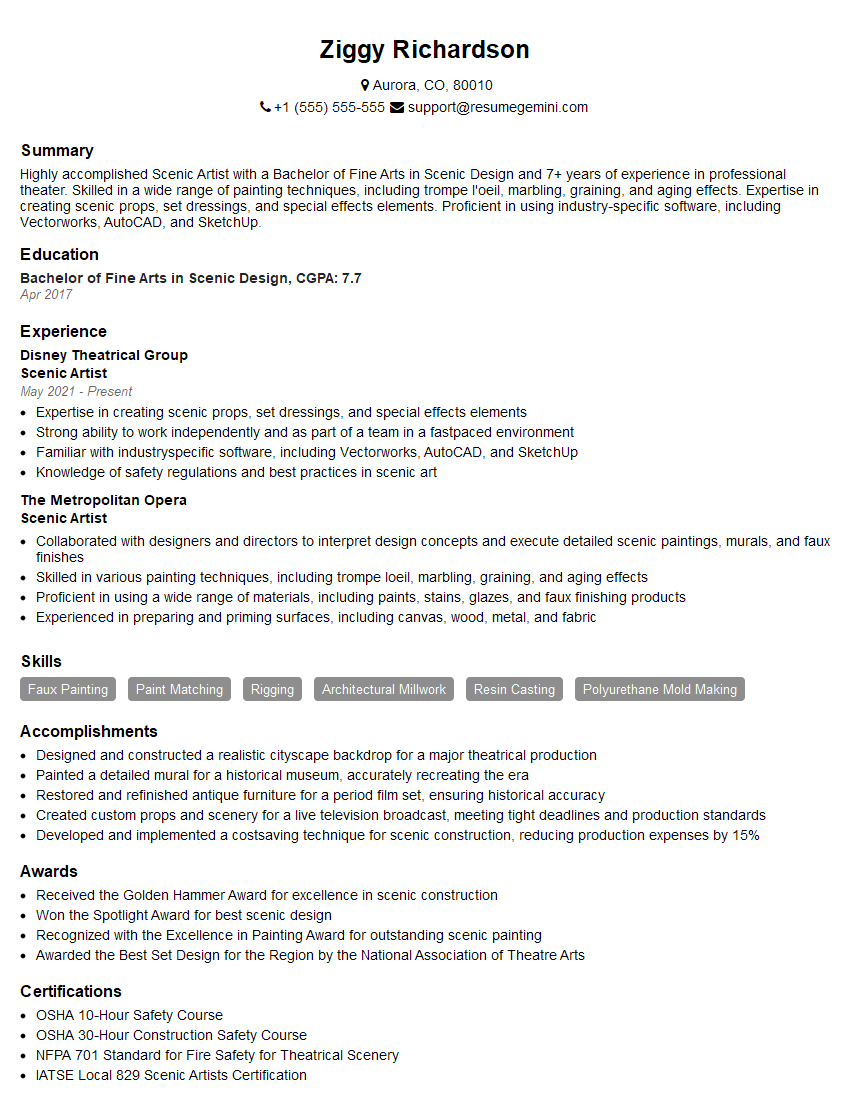
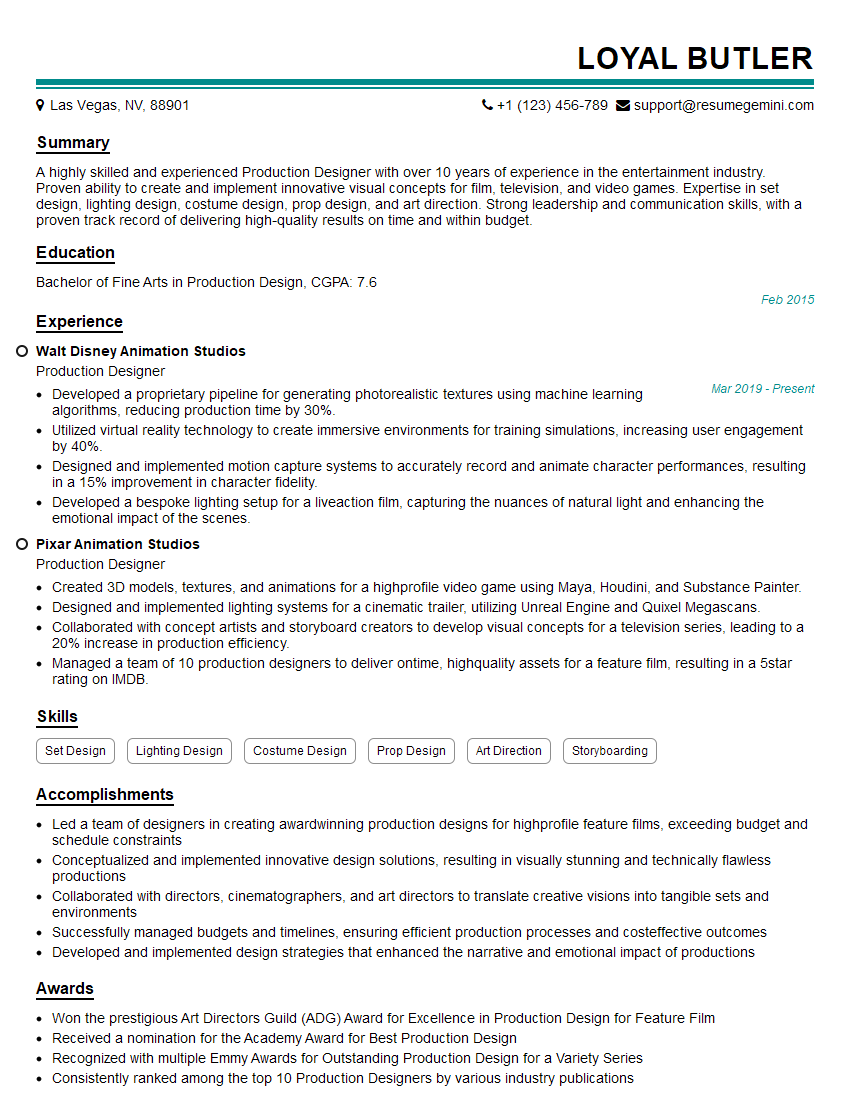
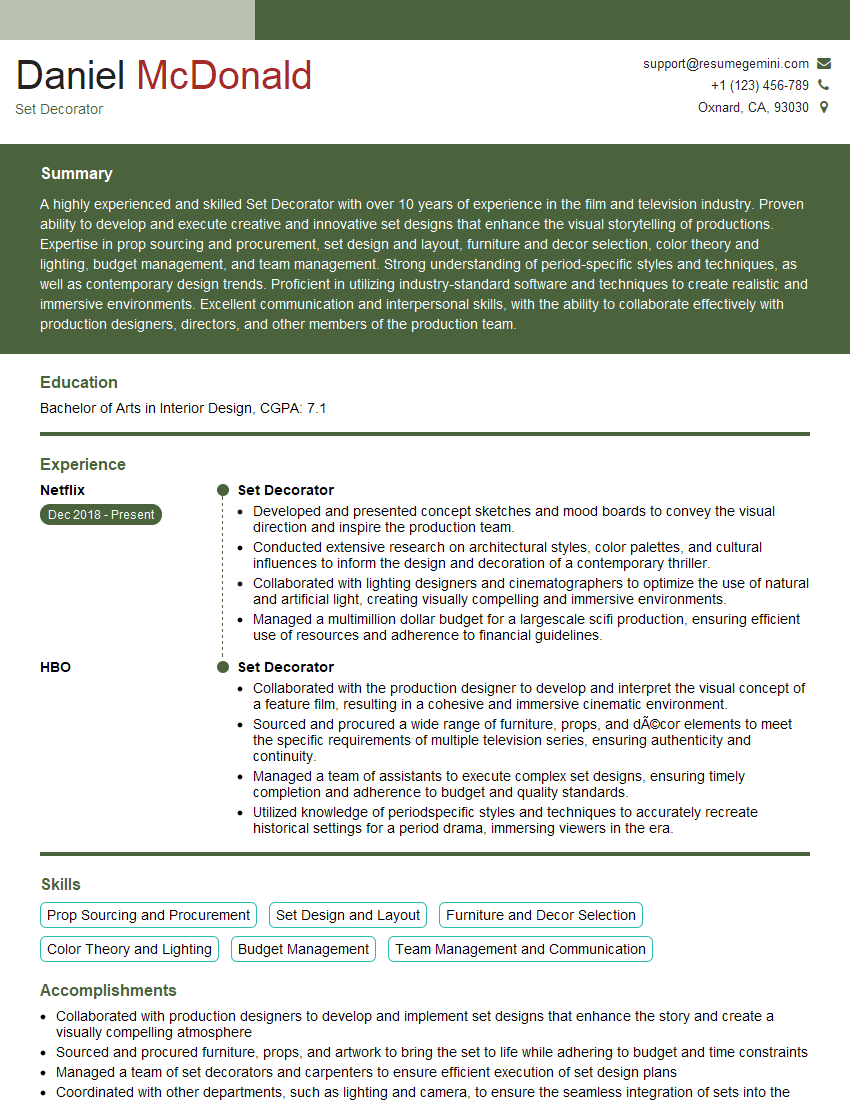
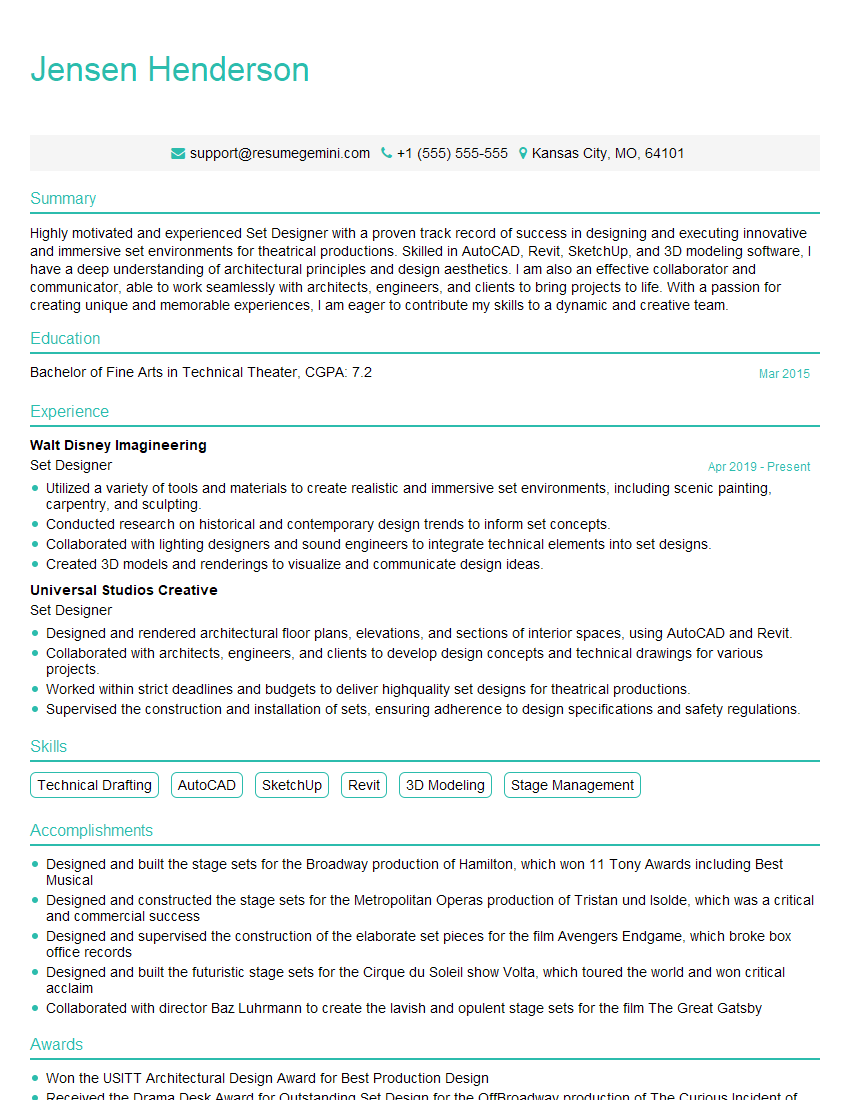
Mastering Backdrops and Props is crucial for career advancement in film, theatre, events, and other creative industries. A strong understanding of these areas demonstrates your practical skills and artistic vision, making you a highly sought-after candidate. To boost your job prospects, create an ATS-friendly resume that showcases your talents effectively. We recommend using ResumeGemini, a trusted resource for crafting professional resumes. Examples of resumes tailored to Backdrops and Props roles are provided to help you get started.
Explore more articles
Users Rating of Our Blogs
Share Your Experience
We value your feedback! Please rate our content and share your thoughts (optional).
What Readers Say About Our Blog
Very informative content, great job.
good