Feeling uncertain about what to expect in your upcoming interview? We’ve got you covered! This blog highlights the most important Basic Surveying and Navigation interview questions and provides actionable advice to help you stand out as the ideal candidate. Let’s pave the way for your success.
Questions Asked in Basic Surveying and Navigation Interview
Q 1. Explain the difference between plane surveying and geodetic surveying.
The key difference between plane surveying and geodetic surveying lies in how they account for the Earth’s curvature. Plane surveying assumes the Earth is flat within the survey area, a reasonable simplification for smaller areas. Calculations are performed using plane geometry. Geodetic surveying, however, explicitly considers the Earth’s curvature, using an ellipsoidal model (like the WGS84 ellipsoid) for accurate calculations. This is crucial for large-scale projects covering significant distances where the Earth’s curvature becomes significant. Imagine trying to measure the distance between two cities – plane surveying would introduce considerable error, while geodetic surveying provides accurate results.
In simple terms: Plane surveying is like drawing on a flat piece of paper; geodetic surveying is like drawing on a globe.
Q 2. What are the different types of surveying equipment and their applications?
Surveying relies on a variety of equipment, each serving a specific purpose:
- Total Stations: These electronic instruments measure distances, angles (horizontally and vertically), and even collect data for 3D modeling. They are workhorses for many surveying tasks, from setting out building foundations to creating topographic maps. Think of them as sophisticated, computerized transits (the older optical instruments).
- GPS (Global Positioning System) Receivers: Using signals from satellites, GPS receivers determine precise coordinates. Different types of receivers offer varying levels of accuracy. Real-time kinematic (RTK) GPS provides centimeter-level accuracy, vital for high-precision applications like construction layout. Imagine using GPS to pinpoint the exact location of a utility pipe.
- Levels and Leveling Rods: These are used for determining elevations, often employing the principle of creating level lines of sight. Levels provide precise height differences, critical for establishing benchmarks and creating contour maps for site planning.
- Theodolites: Primarily used for measuring angles precisely, theodolites are less common with the advent of total stations but remain valuable for specific tasks.
- EDM (Electronic Distance Measurement) Instruments: These standalone instruments or those integrated within total stations measure distances accurately using electromagnetic waves. They are essential for determining distances between points in a survey.
- Data Collectors: Handheld devices that record and store survey data. They’re used with total stations and GPS receivers, streamlining data management and reducing human error.
Q 3. Describe the process of establishing a control network.
Establishing a control network is fundamental in surveying. It’s like creating a strong foundation for a building. The network consists of precisely located points (control points) that serve as a reference for all subsequent measurements. The process involves:
- Planning and Reconnaissance: Identifying suitable locations for control points based on accessibility, visibility, and stability.
- Monumentation: Permanently marking the control points, usually with concrete markers or bolts. This ensures the points can be located accurately in the future.
- Measurement: Using precise instruments (total stations or GPS), the horizontal and vertical positions of the control points are determined relative to each other or to a known coordinate system.
- Adjustment: Because measurements contain inherent errors, the measured data is adjusted mathematically (using least squares adjustment) to obtain the most probable coordinates for all control points. This ensures consistency across the network.
- Verification: Checking the accuracy of the adjusted coordinates through independent measurements or comparisons to existing data.
The network provides a framework for all further surveying work in the area. All subsequent measurements are referenced to these control points ensuring accuracy and consistency throughout the project.
Q 4. How do you perform a traverse survey?
A traverse survey involves measuring a series of connected lines (legs) to determine the relative positions of points. Imagine walking a path and meticulously measuring both the distances and directions of each step. The process typically includes:
- Reconnaissance: Planning the route of the traverse, selecting suitable points and considering obstructions.
- Setting up the Instrument: Precisely positioning the total station or theodolite at each point.
- Measuring Angles and Distances: Accurately measuring the horizontal angles between successive lines and the distances between points.
- Recording Data: Carefully documenting all measurements, including instrument height and other relevant details.
- Computation: Using coordinate geometry principles, the coordinates of each point are computed based on the measured angles and distances. Software is commonly used for this.
- Adjustment: Similar to control networks, the computed coordinates are often adjusted to minimize errors.
Traverse surveys are common for mapping roads, boundaries, and other linear features. A closed traverse returns to the starting point, allowing for error detection through a mathematical closure check.
Q 5. Explain the concept of triangulation and its uses in surveying.
Triangulation is a surveying technique where a network of triangles is established to determine the relative positions of points. The lengths of one or more baselines are accurately measured, and angles in each triangle are measured using a theodolite or total station. Using trigonometry, the lengths of all sides of the triangles are calculated, providing the relative positions of all points within the network. It’s like building a framework of interconnected triangles to map out an area.
Uses: Triangulation was historically crucial for large-scale mapping, determining the positions of widely spaced points such as mountain peaks. While GPS has largely superseded triangulation for many applications, it remains useful in areas with poor satellite coverage or when very high accuracy is required in specific applications, such as precise engineering surveys.
Q 6. What are the sources of error in surveying and how can they be minimized?
Several sources of error can affect surveying measurements:
- Instrumental Errors: Imperfections in the instruments themselves, such as miscalibration of measuring tapes or total stations.
- Natural Errors: Effects of environmental conditions, such as temperature variations affecting measuring tape lengths or atmospheric refraction affecting optical measurements.
- Personal Errors: Mistakes made by the surveyor, such as inaccurate reading of instruments or incorrect recording of data. These are often the most significant source of error.
- Systematic Errors: Errors that follow a predictable pattern, such as the effect of gravity on leveling measurements.
Minimization Strategies:
- Calibration and Maintenance: Regularly calibrating and maintaining instruments to ensure accuracy.
- Careful Measurement Techniques: Employing proper surveying techniques and using appropriate instruments.
- Redundant Measurements: Taking multiple measurements of the same quantity and using statistical methods to determine the most probable value.
- Environmental Considerations: Taking measurements under favorable environmental conditions and correcting for known effects like temperature or refraction.
- Quality Control: Implementing strict quality control procedures throughout the survey process.
Q 7. How do you calculate the area of a land parcel using surveying data?
Calculating the area of a land parcel from surveying data can be done using several methods:
- Trapezoidal Rule: This method approximates the area by dividing the parcel into a series of trapezoids. The area of each trapezoid is calculated, and the sum of these areas gives an approximation of the total area. This is suitable for parcels with irregular boundaries.
- Coordinate Geometry Method: If the coordinates of the parcel’s boundary points are known, the area can be calculated using the coordinate geometry formula. This is a more precise method than the trapezoidal rule.
- Planimeter: A mechanical or digital instrument used to measure area directly from a map or plan. This method relies on the quality of the drawing or scan.
Example (Coordinate Geometry): Suppose a parcel has the following coordinates (x, y): (10, 20), (30, 20), (30, 40), (10, 40). The area can be calculated as:
Area = 0.5 * |(x1y2 + x2y3 + x3y4 + x4y1) - (y1x2 + y2x3 + y3x4 + y4x1)|Substituting the coordinates:
Area = 0.5 * |(10*20 + 30*40 + 30*40 + 10*20) - (20*30 + 20*30 + 40*10 + 40*10)| = 400 square unitsSoftware packages are commonly used in practice for more complex polygons and automate area calculations.
Q 8. Explain the principles of GPS surveying.
GPS surveying relies on the principles of trilateration and satellite signals. Imagine three friends, each holding a tape measure, trying to find a treasure. They each measure their distance to the treasure, and where those three distances intersect, there’s the treasure! GPS satellites act like those friends. They transmit signals indicating their precise positions in space. A GPS receiver on the ground receives these signals, measures the time it takes for the signals to arrive, and calculates the distance to each satellite. Using the distances from at least four satellites (to account for errors and get 3D position), the receiver uses trilateration to pinpoint its location on Earth. The more satellites available, the more accurate the position.
Each satellite’s precise location is known incredibly accurately, thanks to atomic clocks on board. The time signals from these clocks are used for distance calculation. Sophisticated algorithms then process this data to determine the latitude, longitude, and elevation of the receiver.
Q 9. What are the different types of GPS errors and how are they corrected?
Several errors can affect GPS accuracy. These include:
- Atmospheric Delays: Signals travel slower through the atmosphere, causing positioning errors. The ionosphere and troposphere can both create these delays.
- Multipath Errors: Signals can bounce off buildings, trees, or the ground before reaching the receiver, creating inaccurate distance measurements.
- Satellite Clock Errors: While atomic clocks are highly accurate, minor discrepancies can still accumulate.
- Orbital Errors: Slight variations in the satellites’ orbits can influence their reported positions.
- Receiver Noise: Electronic noise within the receiver can also lead to errors.
These errors are corrected using various techniques:
- Differential GPS (DGPS): Uses a known reference station to correct for atmospheric and satellite errors (explained in more detail below).
- Real-Time Kinematic (RTK) GPS: Provides centimeter-level accuracy by incorporating carrier-phase measurements and constantly resolving ambiguities.
- Post-Processed Kinematic (PPK) GPS: Similar to RTK, but processing happens after data collection, offering high accuracy with more data handling capabilities.
- Precise Point Positioning (PPP): Uses precise satellite orbit and clock information to achieve high accuracy without a base station.
The correction methods often involve mathematical models that account for the expected errors, or by using a reference point with a known location to calculate differences.
Q 10. Describe the process of differential GPS (DGPS).
Differential GPS (DGPS) enhances GPS accuracy by using a known reference station. Think of it like having a ‘perfect’ GPS receiver at a location with precisely surveyed coordinates. This reference station receives the same satellite signals as your roving GPS receiver. The reference station knows its exact location, allowing it to calculate the difference between its measured position and its known position. These differences, which are mostly caused by atmospheric and satellite errors, are then broadcast to the roving receiver.
The roving receiver uses these corrections to adjust its own position calculation. Because the errors affecting both receivers are very similar, the corrections substantially improve the accuracy of the roving receiver’s position. DGPS can improve accuracy to within a few meters, making it suitable for many surveying applications.
DGPS systems often rely on radio signals to transmit the corrections from the reference station to the rover. The range is limited by the power of the broadcast and interference from other signals. However, networks of reference stations exist, providing coverage over larger areas.
Q 11. What is a coordinate system and why is it important in surveying?
A coordinate system is a framework for defining the location of points on the Earth’s surface or a map. It’s essentially a grid system that allows us to accurately measure distances and directions. Without a coordinate system, describing a location would be impossible beyond vague descriptions like “near the big oak tree”.
In surveying, coordinate systems are crucial because they provide a common reference for all measurements. This enables us to:
- Relate different survey points: Calculating distances and angles between survey points needs a common system.
- Create accurate maps and plans: Coordinate systems form the foundation for mapping.
- Combine data from multiple surveys: Different surveys can be integrated if using the same coordinate system.
- Perform calculations accurately: Area calculations, volume estimations, and other computations require consistent positional data.
Common coordinate systems include geographic coordinates (latitude and longitude) and projected coordinate systems (like UTM or State Plane). The choice of coordinate system depends on the area being surveyed and the desired accuracy.
Q 12. Explain the concept of map projections.
Map projections are mathematical methods used to represent the three-dimensional surface of the Earth on a two-dimensional map. This is a challenging task, as it’s impossible to accurately represent a sphere on a flat surface without some distortion. Think of trying to flatten an orange peel; it inevitably stretches or tears.
Different map projections minimize different types of distortion. Some projections preserve shapes (conformal projections), others preserve areas (equal-area projections), and some try to strike a balance between these two (compromise projections). The choice of projection depends on the intended use of the map. For example, a Mercator projection is conformal, preserving shape, but distorts areas near the poles. This is suitable for navigation but is inappropriate if accurate area measurement is required.
Understanding the properties of different map projections is crucial for interpreting maps accurately, as the distortion can significantly impact measurements and calculations made on the map.
Q 13. What are the different types of maps and their applications?
Many types of maps serve different purposes:
- Topographic Maps: Show elevation using contour lines, providing three-dimensional information about the terrain. Used for land planning, engineering, and hiking.
- Cadastral Maps: Illustrate land ownership boundaries. Essential for property surveys and legal issues.
- Planimetric Maps: Show only horizontal features such as roads, buildings, and rivers, omitting elevation. Useful for city planning, navigation, and route planning.
- Thematic Maps: Display a specific theme or attribute, such as population density, rainfall, or temperature. Used for analysis and visualization.
- Nautical Charts: Specialized maps for marine navigation, showing water depths, hazards, and aids to navigation.
- Aerial Photographs/Orthophotos: Images of the Earth’s surface taken from above, often used in conjunction with map data.
The application of a particular map type depends heavily on the information needed for the task. For instance, a topographic map is necessary for determining the gradient of a proposed road, while a cadastral map is crucial for settling a land dispute.
Q 14. How do you interpret topographic maps?
Interpreting topographic maps requires understanding their key elements. These maps represent the Earth’s surface using contour lines, which connect points of equal elevation. The closer the contour lines are together, the steeper the slope; widely spaced contour lines indicate a gentle slope. Index contours, usually thicker lines, are labeled with their elevation, providing reference points.
Other elements to look for include:
- Spot elevations: Precise elevations marked at specific points.
- Relief shading: Creates a three-dimensional effect, making it easier to visualize the terrain.
- Symbols: Represent various features like buildings, roads, water bodies, and vegetation.
- Scale: Indicates the relationship between the map distance and the real-world distance.
By analyzing contour lines and other map elements, you can determine elevation changes, calculate slope gradients, understand drainage patterns, and gain a comprehensive understanding of the terrain’s characteristics. This understanding is crucial for planning various activities, from construction to hiking trail design.
Q 15. Describe the process of creating a contour map.
Creating a contour map involves representing the three-dimensional shape of the land surface on a two-dimensional map using contour lines. Contour lines connect points of equal elevation. Imagine slicing a loaf of bread horizontally – each slice represents a contour line. The closer the lines are together, the steeper the slope; the farther apart, the gentler the slope.
The process generally follows these steps:
- Survey: Precise elevations are measured at numerous points across the area using techniques like leveling or total station surveying. GPS can also play a role, although accuracy needs careful consideration.
- Data Processing: The collected elevation data is processed and organized, often using specialized software.
- Contouring: This is the core step. The software interpolates the elevation data to create smooth, continuous contour lines. The interval between contour lines (the vertical distance between them) is chosen based on the terrain’s characteristics and the map’s purpose. A smaller contour interval is used for areas with significant relief (changes in elevation).
- Map Creation: The contour lines are overlaid onto a base map, along with other relevant features like roads, buildings, and water bodies. Labels indicating elevations and contour intervals are added for clarity.
Example: Imagine surveying a hill. You measure elevations every 10 meters. You might then create a contour map with 5-meter contour intervals, depicting lines connecting points of 10m, 15m, 20m, etc. This clearly illustrates the hill’s shape and slope.
Career Expert Tips:
- Ace those interviews! Prepare effectively by reviewing the Top 50 Most Common Interview Questions on ResumeGemini.
- Navigate your job search with confidence! Explore a wide range of Career Tips on ResumeGemini. Learn about common challenges and recommendations to overcome them.
- Craft the perfect resume! Master the Art of Resume Writing with ResumeGemini’s guide. Showcase your unique qualifications and achievements effectively.
- Don’t miss out on holiday savings! Build your dream resume with ResumeGemini’s ATS optimized templates.
Q 16. What are the principles of navigation?
Navigation principles revolve around determining your position, planning a route, and following that route to reach your destination. This involves understanding and applying concepts from geometry, trigonometry, and physics. Key principles include:
- Determining Position: Accurately establishing your current location using tools like GPS, celestial navigation, or dead reckoning.
- Planning a Route: Choosing a safe and efficient path considering factors like weather, obstacles, and available resources.
- Following the Route: Maintaining course and making necessary adjustments based on real-time observations and conditions.
- Piloting: Safe and efficient maneuvering of a vessel or aircraft. This considers factors such as currents, winds, and traffic.
- Dead Reckoning: Estimating your position based on your last known position, speed, course, and time elapsed.
These principles are fundamental for all types of navigation, whether at sea, in the air, or on land.
Q 17. Explain the difference between celestial navigation and terrestrial navigation.
Celestial navigation and terrestrial navigation differ significantly in their methods for determining position.
- Celestial Navigation: This ancient technique uses the positions of celestial bodies (sun, moon, stars) to determine latitude and longitude. It requires knowledge of astronomy, precise timekeeping, and specialized tools like a sextant and nautical almanac. It’s primarily used at sea when other methods (like GPS) are unavailable or unreliable.
- Terrestrial Navigation: This uses features on the Earth’s surface for positioning. It encompasses various methods, including compass navigation, map reading, GPS, triangulation, and piloting using landmarks and charts. Terrestrial navigation is more commonly used on land and is applicable to land-based vehicles, hikers, and even aircraft relying on visual cues and radio aids.
In essence: Celestial navigation ‘looks up’ to the heavens for position, while terrestrial navigation ‘looks down’ or ‘looks around’ at the Earth’s surface.
Q 18. How do you use a compass for navigation?
Using a compass for navigation involves understanding its basic function and some simple techniques.
- Orientation: Hold the compass level and allow the magnetic needle to settle. The needle’s north-seeking end points towards magnetic north (which is slightly different from true north).
- Determining Direction: Align the compass bezel (the rotating ring) with the desired bearing (direction). This involves understanding compass directions and translating them into degrees (0-360 degrees).
- Following a Bearing: Walk in the direction indicated by the compass needle, regularly checking your bearing to correct for any drift. Note that magnetic declination (the difference between magnetic north and true north) needs to be accounted for for precise navigation.
- Landmark Navigation: Combine compass use with identifying landmarks to maintain your route. The compass helps you move in a specific direction towards a visible landmark.
Example: If you need to travel 30 degrees east of north, you’d align the compass bezel to 30 degrees, ensuring the needle points to north. Walking in the direction indicated by the compass bezel’s 30-degree mark keeps you on course.
Q 19. Describe the different types of charts used in navigation.
Various charts are used in navigation, each designed for specific purposes and environments. Some common types include:
- Nautical Charts: Used for marine navigation, these charts show depths, shorelines, hazards, and other crucial features for safe sea travel. They’re often detailed and precise.
- Aeronautical Charts: Used in aviation, these show airways, airports, terrain elevations, navigational aids, and other relevant information for safe flight.
- Topographic Maps: These land-based maps depict the Earth’s surface features, including elevation, through contour lines, and other geographical details.
- Electronic Charts (ENCs): Digital versions of nautical charts that offer interactive features and dynamic updates, such as real-time positioning.
The choice of chart depends on the mode of transport and the specific navigational requirements. For instance, a pilot would use an aeronautical chart, while a sailor relies on a nautical chart.
Q 20. Explain the concept of dead reckoning.
Dead reckoning (DR) is a method of estimating your current position based on your last known position, speed, course, and the time elapsed since your last known position. It’s essentially an educated guess, and its accuracy depends on the accuracy of your inputs. Errors accumulate over time, making it less reliable for longer journeys without external verification.
Example: If a ship is at position 30°N, 150°W and travels at 15 knots (nautical miles per hour) due north for 3 hours, dead reckoning estimates the ship to be at approximately 30.75°N, 150°W (15 knots x 3 hours = 45 nautical miles traveled north).
Dead reckoning is often used as a backup or interim method when more accurate position fixes are unavailable, or to provide a rough estimate between more precise position determinations. It’s rarely used in isolation due to its potential error accumulation.
Q 21. What are the different methods of determining latitude and longitude?
Latitude and longitude are determined using various methods, depending on the era and the available technology:
- Celestial Navigation: Using the positions of celestial bodies (as described earlier), sextants measure the angle between the horizon and a celestial body. This angle, combined with the time and data from a nautical almanac, allows calculation of latitude and longitude.
- GPS (Global Positioning System): GPS receivers use signals from orbiting satellites to pinpoint a location on Earth with high accuracy. This provides both latitude and longitude coordinates.
- Triangulation: This surveying technique uses measurements of angles to determine the location of a point relative to known points. It’s useful for mapping and establishing geodetic control points.
- Map and Compass: While not precise for determining exact latitude and longitude, maps and compasses can provide an estimated position by identifying landmarks and bearings.
- Terrestrial Navigation Systems: LORAN (Long Range Navigation) and other radio navigation systems utilize radio signals from fixed transmitters to calculate position. These have largely been replaced by GPS, but offer a historical significance.
The most common and accurate method today is GPS, but understanding the historical methods is crucial to appreciating the evolution of navigation.
Q 22. How do you calculate distance and bearing using surveying data?
Calculating distance and bearing from surveying data relies on fundamental trigonometry and coordinate geometry. We typically use data collected from instruments like total stations or GPS receivers, which provide coordinates (Easting, Northing) and sometimes elevations for points. Let’s consider two points, A and B.
Distance Calculation: The distance between A and B is calculated using the Pythagorean theorem, given their coordinates (EastingA, NorthingA) and (EastingB, NorthingB). The formula is:
Distance = √[(EastingB - EastingA)² + (NorthingB - NorthingA)²]Bearing Calculation: The bearing represents the direction from point A to point B, typically measured clockwise from north. It’s calculated using the arctangent function:
Bearing = arctan[(EastingB - EastingA) / (NorthingB - NorthingA)]This gives you a preliminary bearing. You then need to adjust this bearing based on the quadrant in which point B lies relative to point A to ensure the bearing is correctly represented between 0° and 360°.
Example: If A has coordinates (100, 200) and B has coordinates (150, 230), the distance would be √[(150-100)² + (230-200)²] = √(2500 + 900) ≈ 58.3 units. The preliminary bearing would be arctan(50/30) ≈ 59°. Since B is in the northeast quadrant, this is the correct bearing.
In practice, we use surveying software to automate these calculations, but understanding the underlying principles is crucial for quality control and troubleshooting.
Q 23. Describe the process of setting out a building using surveying techniques.
Setting out a building involves accurately transferring the design plan onto the ground. This process starts with establishing a control network, typically using precise GPS or total station measurements to define key points. From these control points, we set out the building’s corners and key features.
The process usually involves these steps:
- Control Network Establishment: Establishing a network of accurately surveyed points that are stable and easily accessible.
- Setting Out Building Corners: Using the control network as a reference, we use measurements (distances and bearings) derived from the building plan to locate the building’s corners on the ground. Total stations are commonly used for this, accurately measuring both distance and angle.
- Establishing Grid Lines: A grid system is often used to subdivide the site for easier setting out of walls, columns, and other features. Accurate measurements using tapes and levels are essential here.
- Setting Out Internal Features: After the building’s perimeter is established, the interior walls, columns, and other elements are set out using the same techniques. This includes checking for squareness and correct dimensions.
- Leveling: Ensuring that the foundation is level is critical. Precise leveling is performed using a level and staff to determine height differences and to ensure accurate foundation construction.
Quality control throughout the process is vital. Regular checks are made using independent measurements, and any discrepancies are investigated thoroughly.
Q 24. Explain the importance of quality control in surveying.
Quality control in surveying is paramount; it ensures the accuracy and reliability of the data gathered, which directly impacts the safety and functionality of any construction project. Neglecting quality control can lead to costly errors and even structural failures.
Quality control measures include:
- Instrument Calibration: Regularly calibrating surveying equipment (total stations, levels, GPS receivers) to guarantee accuracy. These calibrations are performed against known standards.
- Redundant Measurements: Taking multiple measurements of the same feature and comparing results to identify any outliers or gross errors. This helps catch mistakes early.
- Independent Checks: Having different surveyors perform independent checks on measurements. This provides an additional layer of quality assurance.
- Data Processing and Analysis: Carefully reviewing processed data to detect anomalies and patterns indicating potential errors.
- Field Notes and Documentation: Meticulous record-keeping in field books is essential. Clear and detailed notes allow for easy review and detection of potential errors.
A well-defined quality control process ensures that the surveying data is fit for purpose and minimizes the risk of expensive rework or project delays. I always prioritize robust quality control procedures and regularly review and refine my methods based on best practices and latest technologies.
Q 25. What safety procedures should be followed during surveying work?
Safety is always the top priority in surveying. Working outdoors exposes surveyors to various hazards, so adhering to strict safety procedures is non-negotiable.
Key safety procedures include:
- Site Risk Assessment: Conducting a thorough risk assessment before commencing any work to identify potential hazards (e.g., traffic, uneven terrain, overhead power lines).
- Personal Protective Equipment (PPE): Using appropriate PPE, including high-visibility clothing, safety boots, hard hats, and eye protection.
- Traffic Management: Implementing traffic control measures when working near roads or in busy areas.
- Working at Heights: Using appropriate fall protection equipment when working at heights, such as scaffolding or ladders.
- Weather Awareness: Suspending work during severe weather conditions like storms or extreme heat.
- First Aid and Emergency Procedures: Having readily available first-aid equipment and a plan for emergency situations. Ensuring someone is aware of your location.
- Communication: Maintaining clear communication with team members and supervisors.
I’ve always emphasized a safety-first approach, actively participating in safety briefings and promoting safe work practices among my colleagues.
Q 26. How do you handle discrepancies in surveying data?
Discrepancies in surveying data are inevitable, but their resolution requires a systematic approach. My strategy involves:
- Identify the Discrepancy: Carefully examine the data to pinpoint the exact nature and magnitude of the discrepancy.
- Review Field Notes and Procedures: Scrutinize the field notes to see if there were any recording errors or procedural flaws that may have contributed to the discrepancy.
- Re-measurement: Re-measure the affected points to verify the original measurements. Use different techniques or instruments where appropriate.
- Error Analysis: Analyze the data using statistical methods to determine if the discrepancy is due to random error or a systematic error (e.g., instrument malfunction).
- Identify and Correct the Source: Once the source of the error is identified, the data is corrected accordingly. This may involve recalculating coordinates or adjusting measurements.
- Documentation: All adjustments and corrections are meticulously documented.
In some cases, it might be necessary to consult with senior colleagues or experts to resolve complex discrepancies. The key is to be thorough, methodical, and to ensure that the final data is accurate and reliable. Ignoring discrepancies can have severe consequences later in the project.
Q 27. Describe your experience with using surveying software.
I have extensive experience using various surveying software packages, including AutoCAD Civil 3D, Leica GeoOffice, and Trimble Business Center. These software packages are essential for modern surveying, providing tools for data processing, analysis, and visualization.
My experience encompasses:
- Data Import and Export: Importing data from total stations, GPS receivers, and other instruments. Exporting data in various formats for use in other applications (e.g., CAD software).
- Coordinate Transformations: Transforming coordinates between different datums and coordinate systems. This is crucial when working with data from multiple sources.
- Data Processing and Adjustment: Performing least squares adjustments to improve the accuracy of survey data.
- 3D Modeling and Visualization: Creating 3D models of surveyed areas to better understand the terrain and plan construction activities.
- Report Generation: Generating professional-quality reports and drawings using software tools.
I am proficient in utilizing these tools to enhance the efficiency and accuracy of surveying projects, and I’m always keen to learn and adapt to new software developments.
Q 28. Explain your understanding of legal aspects related to land surveying.
Land surveying has significant legal implications. Accurate and reliable surveys are crucial for defining property boundaries, resolving land disputes, and ensuring compliance with legal requirements.
My understanding of the legal aspects includes:
- Property Boundaries: Understanding the legal definitions of property boundaries and the methods used to establish and delineate them. This includes working with legal descriptions and deeds.
- Easements and Rights-of-Way: Recognizing and accurately depicting easements and rights-of-way on survey plans. This is crucial for infrastructure projects.
- Land Titles and Registration: Understanding the procedures for registering land titles and the role of surveys in that process.
- Legal Liability: Being aware of the legal liabilities associated with inaccurate or misleading survey information. This is a serious responsibility.
- Legislation and Regulations: Keeping up to date with relevant legislation and regulations governing land surveying practices. This ensures compliance and protects the public interest.
I am committed to conducting surveys ethically and in accordance with all relevant legal requirements. Accurate surveying is not just about technical expertise but also about a deep understanding of its legal implications.
Key Topics to Learn for Basic Surveying and Navigation Interview
- Fundamental Surveying Concepts: Understanding distance measurement techniques (e.g., taping, EDM), leveling principles, and basic surveying equipment operation. Consider the theoretical basis behind these methods.
- Practical Application: Prepare examples of how you’ve used surveying techniques in real-world scenarios, perhaps from projects, coursework, or internships. Be ready to discuss challenges encountered and solutions implemented.
- Map Reading and Interpretation: Demonstrate proficiency in interpreting topographic maps, understanding contours, scales, and symbols. Practice converting map information into real-world measurements and vice versa.
- Basic Navigation Techniques: Familiarize yourself with compass usage, GPS principles, and triangulation methods. Be prepared to explain the limitations and error sources associated with each.
- Coordinate Systems and Projections: Understanding different coordinate systems (e.g., UTM, geographic) and their applications. Be able to discuss map projections and their impact on measurements.
- Data Collection and Analysis: Discuss your experience with data recording and processing, including error analysis and data adjustment techniques. Highlight your proficiency in relevant software.
- Health and Safety: Demonstrate awareness of safety procedures and regulations related to surveying and fieldwork. Be prepared to discuss risk assessment and mitigation strategies.
- Problem-Solving Approaches: Practice tackling surveying and navigation problems using a logical and methodical approach. Think about how you break down complex tasks into manageable steps.
Next Steps
Mastering Basic Surveying and Navigation opens doors to exciting career opportunities in fields like construction, engineering, and land management. A strong foundation in these skills will significantly enhance your job prospects and career progression. To maximize your chances, it’s crucial to present your expertise effectively. Creating an ATS-friendly resume is paramount for getting noticed by recruiters. ResumeGemini can help you build a professional and impactful resume tailored to the specific requirements of Basic Surveying and Navigation roles. ResumeGemini provides examples of resumes optimized for this field to guide your efforts.
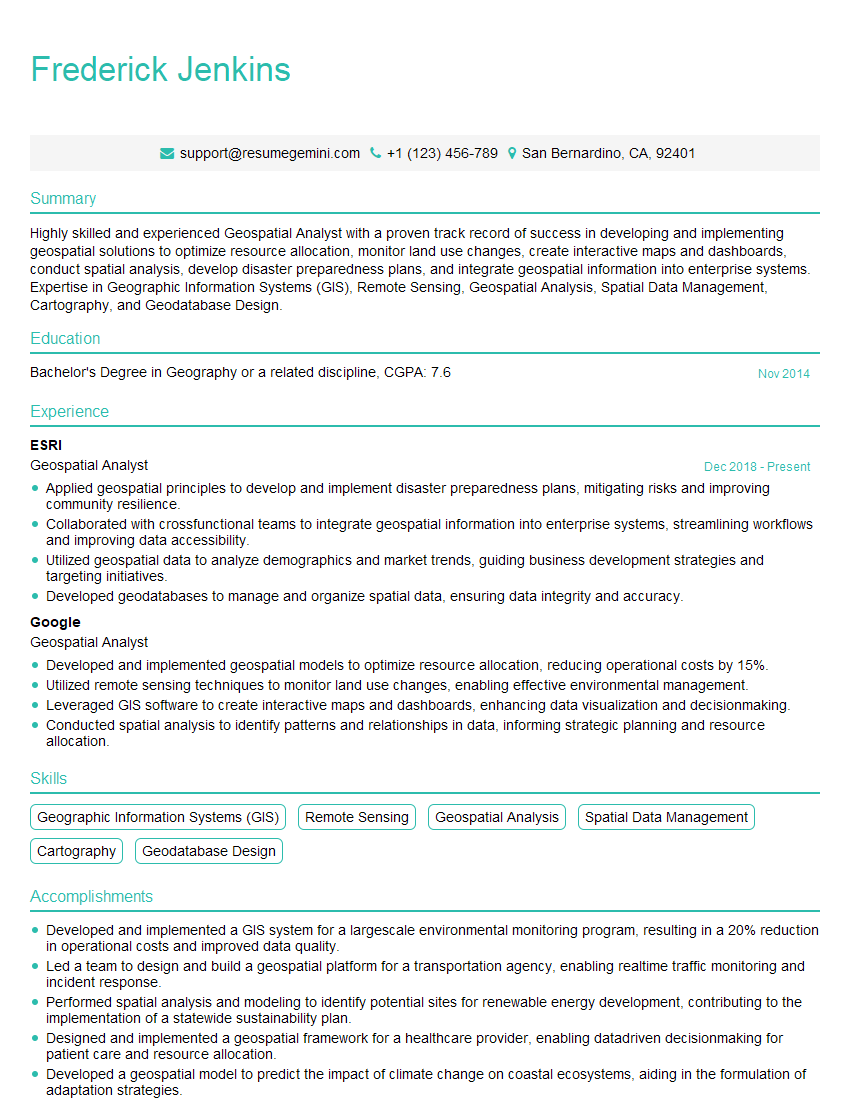
Geospatial Analyst Resume Sample

Cartographer Resume Sample

Photogrammetrist Resume Sample
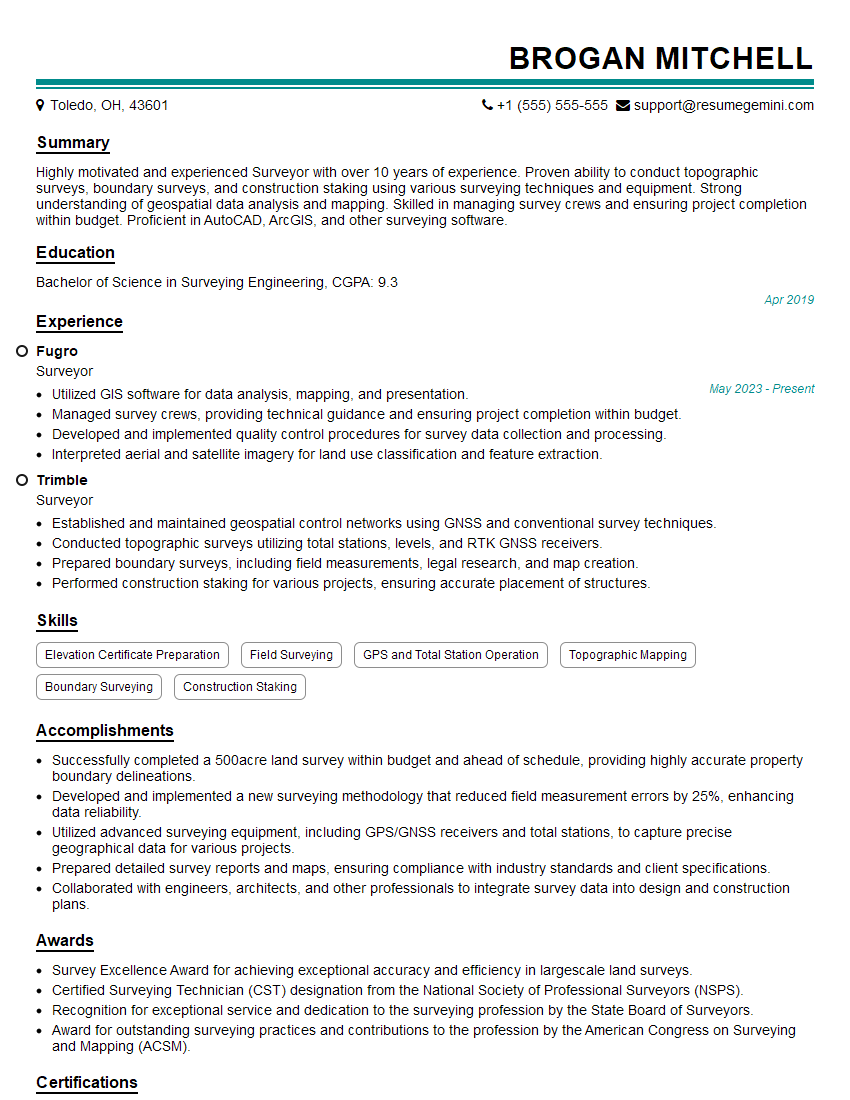
Surveyor Resume Sample
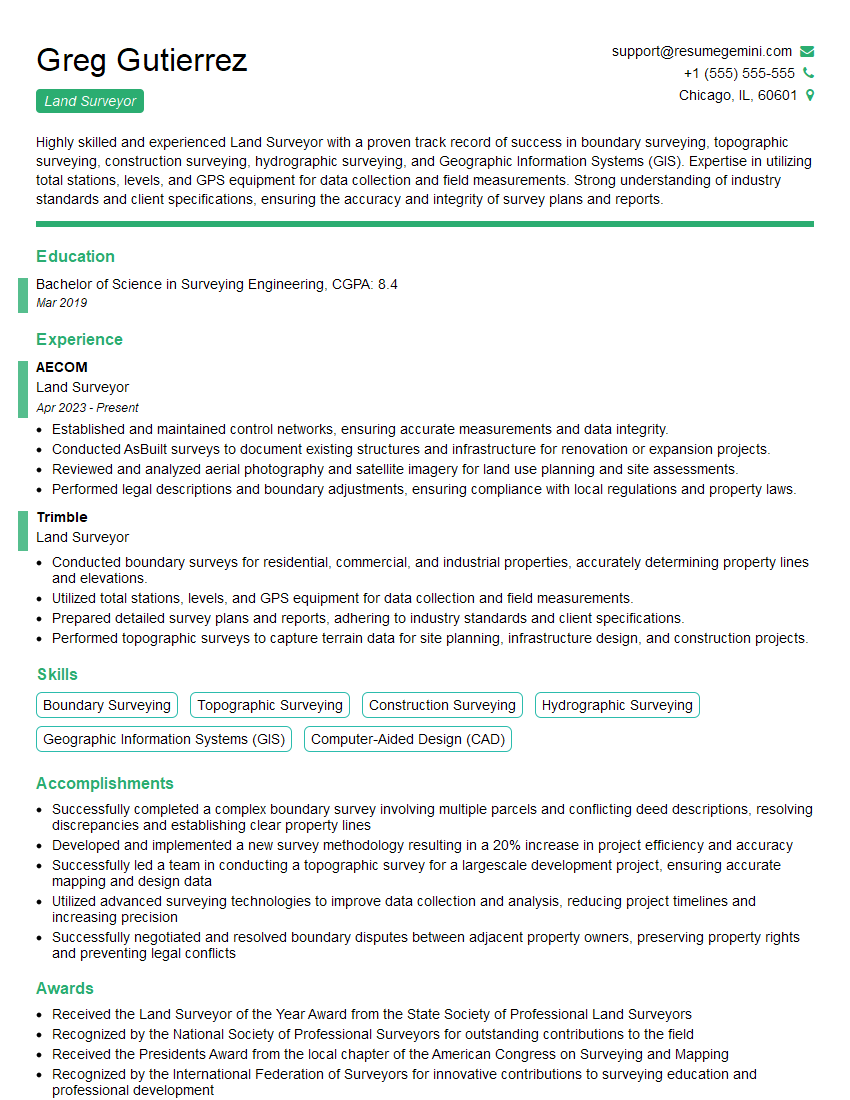
Land Surveyor Resume Sample

Mine Surveyor Resume Sample

Survey Party Chief Resume Sample

Chain Person Resume Sample
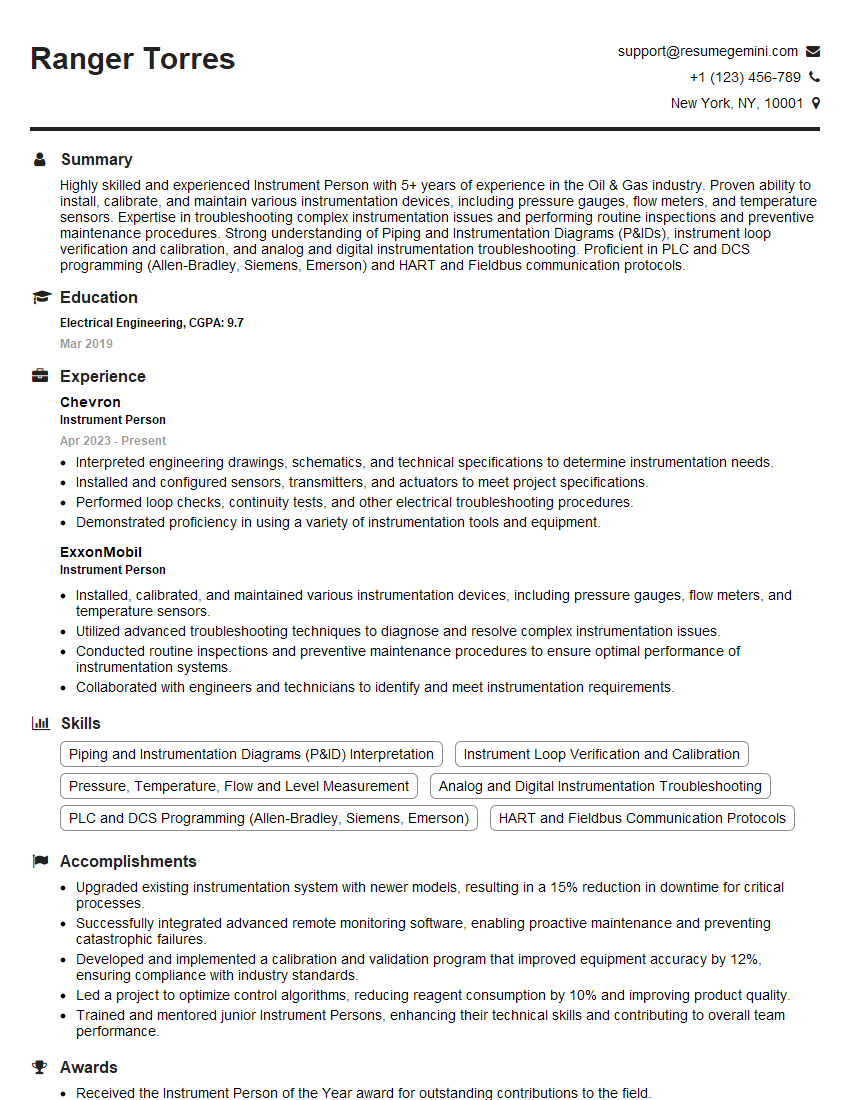
Instrument Person Resume Sample
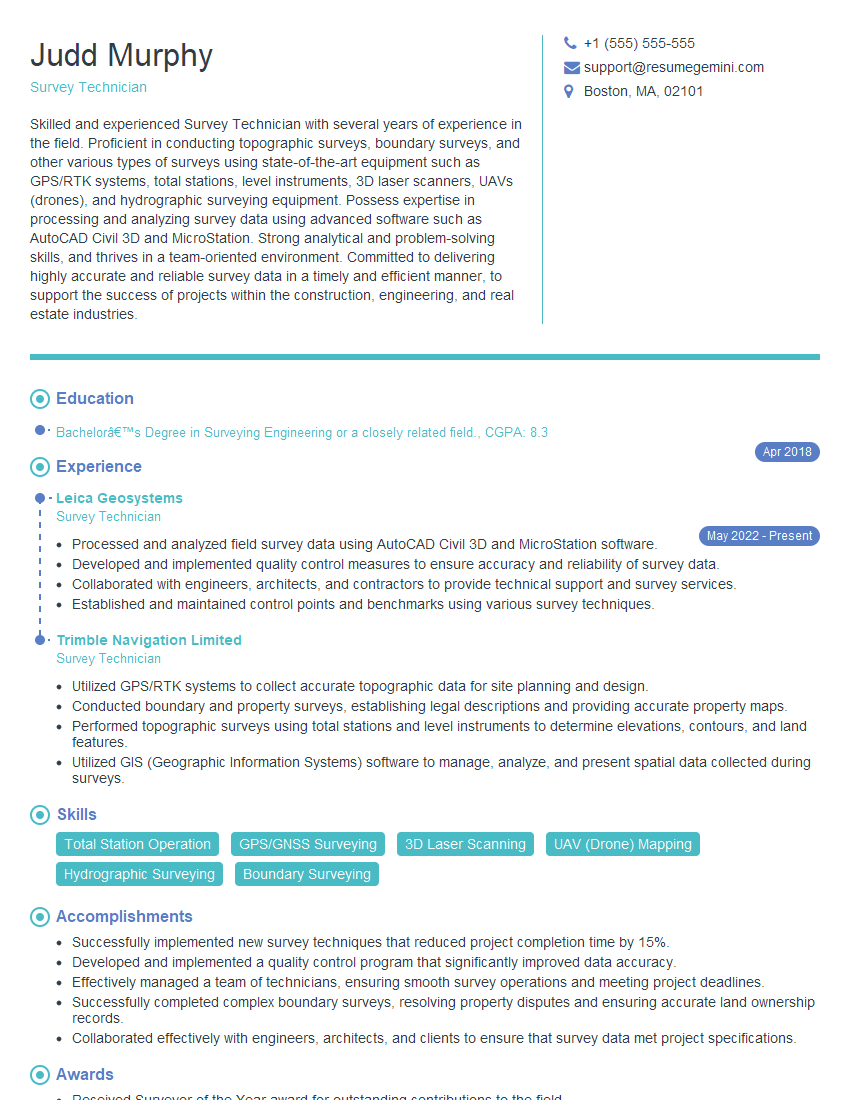
Survey Technician Resume Sample
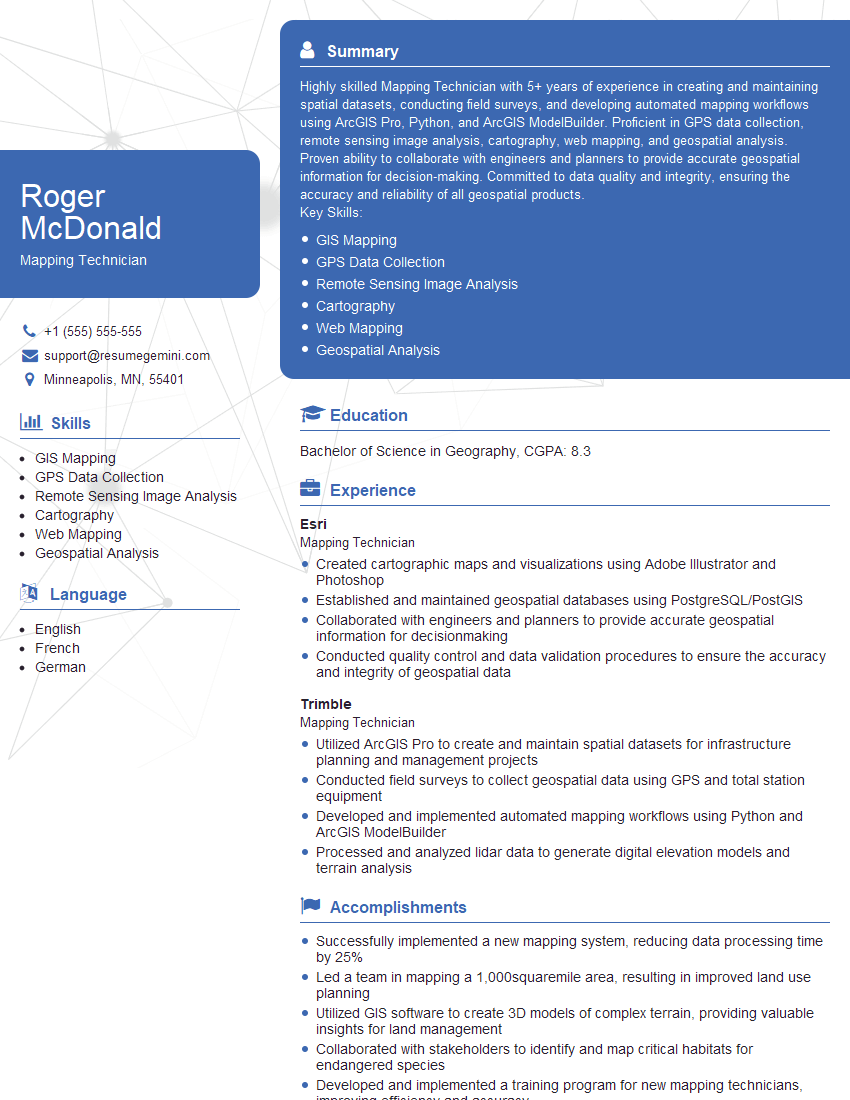
Mapping Technician Resume Sample

Remote Sensing Specialist Resume Sample
Explore more articles
Users Rating of Our Blogs
Share Your Experience
We value your feedback! Please rate our content and share your thoughts (optional).
What Readers Say About Our Blog
Very informative content, great job.
good