Every successful interview starts with knowing what to expect. In this blog, we’ll take you through the top Basketball Knowledge interview questions, breaking them down with expert tips to help you deliver impactful answers. Step into your next interview fully prepared and ready to succeed.
Questions Asked in Basketball Knowledge Interview
Q 1. Explain the difference between a zone and man-to-man defense.
The core difference between zone and man-to-man defense lies in how players guard their opponents. In man-to-man, each defender is assigned a specific offensive player to guard throughout their movement on the court. Think of it like a one-on-one matchup throughout the possession. This requires strong individual defensive skills and communication to help each other. In contrast, zone defense divides the court into areas, or zones, with each defender responsible for guarding their assigned area. Players will switch opponents as the offense moves. It prioritizes team work and reading the offensive movements.
Man-to-man is great for teams with strong individual defenders who can stay in front of their opponents. It allows for pressure and can force turnovers. Zone excels at defending strong post players (those who play close to the basket), preventing easy drives to the basket, and when the team is tired and needs a more conservative approach. The Golden State Warriors famously employed a switching man-to-man defense known as “Death Lineup” while the Boston Celtics under Coach Bill Russell are known for their great zone defenses.
Q 2. Describe the offensive strategy of the pick-and-roll.
The pick-and-roll is a fundamental offensive play in basketball. It involves two players: a ball-handler (usually a guard) and a screener (usually a big man or center). The screener sets a screen, meaning they position themselves between the ball-handler and their defender, temporarily blocking the defender’s path. This creates an advantage for the ball-handler, who can either shoot, drive to the basket, or pass to the screener if they’ve rolled to the basket following their screen.
The success of a pick-and-roll depends on several factors: the ball-handler’s ability to read the defense and make quick decisions, the screener’s effectiveness in setting a solid screen, and the off-ball movement of other teammates. A well-executed pick-and-roll can create mismatches, open shots, and driving lanes. Think of Stephen Curry and Draymond Green for the Golden State Warriors, a classic example of pick and roll excellence. The timing, spacing, and quick decision making are crucial elements for the play to be effective.
Q 3. What are the key components of a successful fast break?
A successful fast break hinges on several key components: speed, transition defense, and efficient passing. Once a defensive rebound is secured, the team immediately pushes the ball down the court, usually with a fast outlet pass. This requires a quick transition from defense to offense.
- Quick transition: This means getting the ball up the court quickly and efficiently. The players who secure the rebound must find teammates quickly and strategically, usually avoiding unnecessary dribbles.
- Precise outlet passes: Accurate long passes are crucial for bypassing opponents and getting the ball to a teammate in a good scoring position.
- Smart spacing and cuts: Players need to move in synchronicity to create open lanes and scoring opportunities. This requires reading the play and anticipation of teammate and opponent’s movements.
- Finishing ability: Players must be able to finish at the basket efficiently, utilizing layups, dunks, or jump shots to capitalize on the advantage created by the fast break.
The 7-second rule (the time limit for a team to advance the ball across half court) plays a significant role in fast break success. Think of the Showtime Lakers of the 80s and their legendary fast breaks; Magic Johnson’s court vision and ability to accelerate the tempo of the game played a central role.
Q 4. How do you assess a player’s potential?
Assessing a player’s potential requires a holistic approach, considering several factors beyond just on-court statistics. I look at:
- Physical attributes: Height, weight, athleticism, and natural talent are foundational. While this is not everything, a player needs a foundation to build upon.
- Basketball IQ: This includes court awareness, decision-making skills under pressure, and understanding game strategy. Can this player “read” the game well?
- Work ethic and coachability: A player’s dedication to improvement, their receptiveness to coaching, and their overall attitude are critical for long-term development. Talent without discipline doesn’t get you far.
- Skill level and potential for improvement: Are the existing skills polished? What is the potential for the player to improve in different facets of the game?
- Character and leadership qualities: A player’s attitude in the locker room, their respect for teammates and coaches, and their willingness to lead by example are all indicators of character.
I often observe players in practice, scrimmages, and games against different levels of competition to get a better idea of the player’s potential. It is an art, not a science, but there are systematic ways to improve the evaluation process.
Q 5. What metrics do you use to evaluate team performance?
Evaluating team performance goes beyond just wins and losses. I utilize a combination of metrics:
- Offensive Rating and Defensive Rating: These metrics measure points scored and allowed per 100 possessions, giving a clearer picture of offensive and defensive efficiency.
- Net Rating: The difference between offensive and defensive rating, a useful metric to measure overall team performance.
- Field Goal Percentage (FG%), Three-Point Percentage (3P%), and Free Throw Percentage (FT%): Shooting efficiency is vital to offensive success.
- Rebounding Percentage (REB%): Dominance on the boards greatly impacts both offense and defense.
- Assist Percentage (AST%): This measures ball movement and the team’s ability to create scoring opportunities.
- Turnover Percentage (TOV%): Lower turnover rates are crucial for efficiency and maintaining possession.
- Plus/Minus (+/-): This metric measures the point differential when a particular player is on the court. It helps determine impact of a specific player on the flow of the game.
These metrics, when studied in combination with qualitative assessments (e.g. game film review, scouting reports), give a comprehensive insight into the team’s strengths, weaknesses, and areas for improvement.
Q 6. Explain the importance of player rotations.
Player rotations are crucial for maintaining energy levels, preventing injuries, and keeping players fresh throughout the game. A well-planned rotation provides opportunities for all players to contribute while limiting fatigue.
Factors influencing rotation decisions include players’ minutes, skill sets, matchups, performance levels, and the game situation. Experienced players or those who are performing well may get more minutes, while younger players or those needing development might have shorter stints in crucial moments. However, rotations may need to be adjusted based on the situation – maybe a player is in foul trouble, or a specific matchup requires substitution. A coach needs to keep track of player stamina and avoid overplaying any one individual to keep up the team’s performance. Effective rotations ensure players are always ready and reduce the chance of burnout.
Q 7. Describe your coaching philosophy.
My coaching philosophy centers around player development, teamwork, and accountability. I believe in creating a positive and supportive environment where players feel empowered to improve and grow both on and off the court.
I emphasize:
- Fundamentals: Strong fundamentals are the foundation of success in basketball. This includes shooting, dribbling, passing, and defensive techniques.
- Strategic thinking: I encourage players to develop their basketball IQ, learn how to read the game, and make smart decisions both offensively and defensively.
- Team cohesion: Building a strong team bond where players trust each other, communicate effectively, and play together is a top priority. This means emphasis on practices that encourage teamwork and open communication.
- Performance-based evaluation: I use data-driven metrics in conjunction with player observation to help create individual development plans and identify areas of strength and weakness.
- High standards: I maintain high standards of effort, sportsmanship, and commitment both on and off the court. I believe in developing players who respect the game and demonstrate leadership qualities.
Ultimately, my goal is to develop players into not only skilled basketball players, but also well-rounded individuals with strong character. This extends to building a collaborative culture with the coaching staff, athletic trainers, and other support personnel, prioritizing an integrated approach.
Q 8. How do you handle player conflicts?
Handling player conflicts requires a multifaceted approach prioritizing open communication, fairness, and a focus on team unity. It’s not about picking sides, but about resolving the underlying issue.
- Immediate Intervention: Address conflicts promptly and privately. Avoid public confrontations.
- Active Listening: Let each player fully express their perspective without interruption. Understand the root cause of the conflict, which might be performance-related, personality clashes, or even off-court issues.
- Mediation and Facilitation: Guide players toward finding a mutually acceptable solution. Emphasize teamwork and shared goals. Sometimes, a simple apology goes a long way.
- Setting Clear Expectations: Establish team rules and codes of conduct regarding behavior and respect. Consistently enforce these rules to prevent future conflicts.
- Individual Check-ins: Regularly check in with players to address any lingering concerns or issues. A proactive approach prevents small conflicts from escalating.
For example, if two players are constantly arguing over playing time, I would sit down with each individually, understand their perspectives, and then work together to create a plan that fairly allocates minutes based on performance and team needs. This might involve creating specific roles and targets, increasing practice time for areas needing improvement or finding ways for them to support each other’s strengths on the court. The goal is to foster collaboration and mutual respect, not to simply quell the conflict temporarily.
Q 9. How do you motivate players?
Motivating players involves understanding their individual needs and aspirations, and leveraging intrinsic and extrinsic motivators. It’s about connecting with them on a personal level and fostering a positive team environment.
- Positive Reinforcement: Recognize and praise good performance, effort, and positive attitudes. Focus on improvement and progress, not just results.
- Individualized Approach: Players are motivated by different things. Some respond to public recognition, while others prefer private encouragement. Learn what motivates each player and tailor your approach accordingly.
- Setting Clear Goals: Establish specific, measurable, achievable, relevant, and time-bound (SMART) goals both individually and as a team. This gives players something tangible to strive for.
- Creating a Positive Team Culture: Foster camaraderie and trust amongst players. Team bonding activities can boost morale and create a strong sense of unity.
- Leading by Example: Demonstrate the values and work ethic you expect from your players. Your actions speak louder than words.
- Addressing Challenges Constructively: Provide constructive feedback, focusing on improvement rather than criticism. Help players learn from their mistakes and grow as individuals and as a team.
For instance, with a struggling young player, I might focus on building confidence by highlighting their strengths, assigning them roles where they can succeed, and providing targeted coaching to address their weaknesses. With a veteran player, I might focus on their leadership skills, encouraging them to mentor younger teammates and take ownership of their role on the team. The key is to tailor motivation strategies to the specific needs and personalities of each individual.
Q 10. How do you adapt your strategy based on opponent scouting reports?
Opponent scouting reports are crucial for developing a winning game plan. By analyzing their strengths and weaknesses, we can tailor our strategies to exploit vulnerabilities and mitigate potential threats.
- Identifying Strengths and Weaknesses: Scouting reports should detail the opponent’s offensive and defensive schemes, key players’ tendencies, and overall team style.
- Developing Counter-Strategies: Once we’ve identified the opponent’s strengths, we develop counter-strategies to neutralize them. For example, if they have a dominant inside player, we might focus on double-teaming them or using zone defenses.
- Exploiting Weaknesses: We identify any weaknesses in the opponent’s game and design plays to exploit them. If their perimeter defense is weak, we might focus on more three-point shots or drives to the basket.
- Adapting to Game Situations: Scouting reports provide a baseline, but the game itself dictates adjustments. In-game adjustments may involve changing defensive schemes, offensive plays, or even player substitutions based on the flow and momentum of the game.
- Utilizing Different Strategies: Consider a variety of strategies, including offensive and defensive adjustments. This ensures you aren’t predictable and are ready for any changes in the opposing team’s tactics.
For example, if our scouting report indicates an opponent’s weakness against pick-and-roll plays, we’ll design our offensive plays to heavily incorporate this strategy. Conversely, if their strength lies in fast breaks, we might focus on controlling the tempo, minimizing turnovers, and running a more methodical offense. This dynamic approach, informed by in-depth scouting, significantly increases our chances of success.
Q 11. What are some common basketball injuries and how are they prevented?
Basketball involves a significant risk of injury, primarily to knees, ankles, and shoulders. Prevention is paramount.
- Ankle Sprains: Very common, often caused by sudden changes in direction. Prevention involves strengthening ankle muscles, proper footwear, and improving agility and balance.
- Knee Injuries: ACL tears, meniscus tears, and other knee injuries are frequently caused by forceful twisting or direct impact. Strengthening leg muscles, proper landing techniques, and using appropriate knee braces are crucial for prevention.
- Shoulder Injuries: Rotator cuff tears and other shoulder injuries are often the result of repetitive overhead motions. Strengthening shoulder muscles, proper throwing techniques, and appropriate warm-up exercises are important.
- Concussions: Head injuries can occur from impacts to the head. Proper protective gear, concussion protocols, and awareness of potential dangers are vital.
Prevention strategies include a comprehensive strength and conditioning program focusing on functional movements, proper warm-up and cool-down routines, and adhering to strict injury prevention guidelines. Players should be educated on proper techniques, and regular monitoring for fatigue and overtraining should be done. Early detection of potential problems through regular physical exams and using sports medicine professionals to ensure appropriate treatment and rehabilitation are crucial aspects of injury prevention.
Q 12. Describe the importance of proper warm-up and cool-down routines.
Proper warm-up and cool-down routines are crucial for injury prevention and performance enhancement.
- Warm-up: Increases blood flow to muscles, prepares the cardiovascular system, and increases flexibility and range of motion, reducing the risk of muscle strains and tears. A good warm-up typically involves light cardio, dynamic stretching (movements like arm circles, leg swings), and sport-specific drills.
- Cool-down: Helps the body gradually return to a resting state, reducing muscle soreness and stiffness. It usually involves light cardio and static stretching (holding each stretch for 15-30 seconds).
Think of it like this: warming up is like gently waking up your muscles, preparing them for the demands of the game. Cooling down is like gently putting your muscles to sleep, allowing them to recover and repair. Skipping these steps is like starting a cold car engine and then immediately turning it off without letting it properly cool down. Both increase the risk of injury or performance issues.
Q 13. Explain the rules of the three-second violation.
The three-second violation occurs when an offensive player remains in the free-throw lane (also known as the key or restricted area) for more than three consecutive seconds while their team possesses the ball in the frontcourt.
- The Key: The free-throw lane is the rectangular area extending from the free-throw line to the baseline.
- Possession: The offensive team must have control of the ball within the frontcourt.
- Three Seconds: The player cannot remain in the lane for longer than three consecutive seconds.
- Exceptions: A player is allowed to be in the lane while actively shooting, rebounding, or while the ball is in the backcourt. A player may also briefly enter the lane to avoid contact.
Example: A center stands stationary near the basket inside the free-throw lane for four seconds, while their team has possession of the ball in the frontcourt. This results in a three-second violation.
Q 14. What are the key differences between NCAA and NBA rules?
The NCAA and NBA rules differ in several key areas, reflecting the different levels of competition and player development priorities.
- Shot Clock: The NBA uses a 24-second shot clock, while the NCAA uses a 30-second shot clock. This affects pacing and offensive strategies.
- Free Throw Lane Width: The NBA lane is wider than the NCAA lane, impacting offensive movement and defensive strategies near the basket.
- Timeouts: The number and length of timeouts differ between the two leagues, impacting coaching strategies and pacing.
- Eligibility Requirements: The NCAA has stricter eligibility rules regarding players’ academic performance, age, and amateur status.
- Player Contact: The NBA allows more physical play, while the NCAA referees tend to call more fouls, resulting in a more free-flowing style of play in the NBA.
- Game Length: NBA games are longer and played over a higher number of regular season games.
These differences reflect the varied goals of each organization. The NCAA focuses on player development within a structured academic setting, while the NBA emphasizes high-level professional competition. These rule differences influence the styles of play, coaching strategies, and overall competitive landscape of each league.
Q 15. Explain the concept of ‘pace’ in basketball.
Pace in basketball refers to the tempo of the game, essentially how quickly possessions are played. A high-pace game involves many possessions in a short amount of time, often characterized by fast breaks and quick shots. Conversely, a low-pace game features fewer possessions, with a focus on deliberate offense and strong defensive sets. Think of it like this: a high-pace game is like a sprint, while a low-pace game is more like a marathon.
Analyzing pace involves looking at possessions per game, shot clock usage, and transition opportunities. Teams like the Golden State Warriors under Steve Kerr, known for their fast-paced, free-flowing offense, are a prime example of a high-pace team. In contrast, a team prioritizing half-court sets and methodical play would demonstrate a low-pace approach. Understanding a team’s pace is crucial for strategic game planning – a high-pace team might need to be countered with a fast-break strategy, while a low-pace team might require a patient, possession-based attack.
Career Expert Tips:
- Ace those interviews! Prepare effectively by reviewing the Top 50 Most Common Interview Questions on ResumeGemini.
- Navigate your job search with confidence! Explore a wide range of Career Tips on ResumeGemini. Learn about common challenges and recommendations to overcome them.
- Craft the perfect resume! Master the Art of Resume Writing with ResumeGemini’s guide. Showcase your unique qualifications and achievements effectively.
- Don’t miss out on holiday savings! Build your dream resume with ResumeGemini’s ATS optimized templates.
Q 16. How do you analyze game film to identify areas for improvement?
Analyzing game film requires a structured approach. First, I identify key performance indicators (KPIs) based on the team’s goals, such as shooting percentage, assist-to-turnover ratio, defensive rebounds, or transition points. Then, I systematically review the film, focusing on specific players and plays. I use time-coding and annotation tools to track key events and trends. For example, I might track a player’s shot selection, looking for patterns of success or failure in different situations. I also look at defensive rotations, identifying breakdowns in coverage and opportunities for improvement.
After identifying patterns, I analyze the context of each play – what led to a successful or unsuccessful outcome? This includes examining opponent schemes, player matchups, and the team’s execution of plays. Finally, I synthesize my findings, creating specific recommendations for improvement, whether it’s adjusting offensive sets, refining defensive rotations, or individual player development. This might involve suggesting different shot selections, emphasizing defensive communication, or working on specific drills to improve skills.
Q 17. What are some effective offensive and defensive strategies against a specific type of player (e.g., tall post player)?
Strategies against a tall post player hinge on understanding their strengths and weaknesses. Offensively, we could employ a zone defense to limit their post touches or use quick switches to prevent them from establishing a good position. Another effective tactic is to double-team them in the post, forcing them to pass to less capable teammates. On offense, we could use pick-and-pop plays to exploit their defensive positioning, or exploit their defensive limitations in space by using quicker guards who can get to the basket or shoot from the perimeter. A common offensive strategy is to use a smaller, quicker player to post up against them, creating mismatches.
For example, against a dominant center like Joel Embiid, a team might use a combination of zone defenses, double-teams in the post, and quick switches to make him work hard for every point, while simultaneously attacking him with quicker guards on the perimeter and focusing on creating outside shots. If he’s a poor three-point shooter, we can concentrate on defending the paint while making them shoot from a long distance. Conversely, if he’s a good shooter, we focus on contesting those shots effectively.
Q 18. Discuss the role of analytics in basketball.
Analytics play a vital role in modern basketball, providing data-driven insights to improve decision-making. This includes tracking various metrics like shooting efficiency, player movement, defensive rotations, and pace of play. By analyzing this data, coaches and management can identify areas of strength and weakness, optimize player rotations, and develop more effective game strategies. Tools like NBA’s Second Spectrum and other tracking systems provide detailed information that is then analysed and interpreted for strategic advantage.
For example, advanced metrics like ‘Expected Points Added’ (EPA) can quantify a player’s contribution beyond simple box score statistics. Analytics also helps in evaluating potential draft picks and free agents by analyzing their performance data across different aspects of the game. Data-driven scouting reports provide a more comprehensive and objective evaluation compared to traditional scouting methods. It’s not about replacing scouting, but rather enhancing it through objective data that complements the human eye’s ability to observe nuance and context.
Q 19. Explain different offensive and defensive formations.
Offensive and defensive formations are crucial for success. Common offensive formations include the triangle offense (emphasizing ball movement and passing), the motion offense (creating off-ball movement and screens), and the spread offense (spacing players to create driving lanes). Defensive formations include man-to-man (each defender guards a specific player) and zone defenses (defenders cover areas on the court). Zone defenses can be 2-3 zone, 3-2 zone etc. Each has variations and adjustments based on opponent matchups.
The choice of formation depends on personnel, opponent style of play, and game situation. A team with strong perimeter shooters might favor a spread offense, while a team with a dominant post player might utilize a high-post offense to exploit mismatches. Defensively, a man-to-man defense requires strong individual defenders, whereas a zone defense might be chosen to limit penetration or disrupt opponent’s passing lanes. The ability to adapt formations throughout the game based on the opponent’s strategy and your team’s success or failure is critical for success.
Q 20. How do you deal with player fatigue during a game?
Managing player fatigue during a game is crucial. It involves strategic substitutions, adjusting the pace of play, and ensuring adequate rest and recovery between games. Early identification of fatigue signs such as decreased intensity, slower movements and poor shot selection is important. Frequent rotations and short breaks allow players to recover physically and mentally. Hydration and nutrition also play a significant role in reducing fatigue.
The coaching staff plays a vital role in monitoring player workloads throughout the season to avoid burnout. This requires careful planning of practice sessions, utilizing data analysis to assess player fatigue levels, and communicating effectively with the medical staff to ensure players are fit and well-rested. Substituting players when fatigue is evident is not a sign of weakness, but a display of sound strategic management, leading to improved performance over the long run and reducing the risk of injury.
Q 21. What is your preferred style of play?
My preferred style of play is a balanced approach that combines fast-paced transition opportunities with a disciplined half-court offense. This means leveraging our strengths in transition whenever possible but not relying on it exclusively. We need to possess a well-defined half-court strategy to control the tempo and dictate the flow of the game when the transition opportunities are limited. Defensively, this would mean combining strong man-to-man principles with zone adjustments that can effectively disrupt the opponent’s offense. The specific tactical elements would depend on the strengths of my team’s personnel. Ultimately, flexibility and adaptability are key – knowing when to push the pace and when to slow it down based on the game situation is critical.
An example of a team that effectively uses this style is the San Antonio Spurs under Gregg Popovich. They consistently demonstrated exceptional half-court execution but also transitioned effectively when opportunities arose. It’s about understanding that balance is crucial. A team that’s only fast-paced is predictable; a team that’s only half-court oriented can struggle to keep up with high-scoring teams. The ideal is a combination of both, adapting to the game situation.
Q 22. How do you scout opposing teams?
Scouting opposing teams is a multifaceted process crucial for strategic game planning. It involves a deep dive into their strengths, weaknesses, tendencies, and individual player capabilities. My approach combines film study with live game observation and statistical analysis.
- Film Study: I meticulously review game footage, paying close attention to offensive and defensive sets, player rotations, common plays, and individual player tendencies – such as preferred shots, dribbling styles, defensive positioning, and tendencies to foul.
- Live Game Observation: Attending games in person allows me to observe subtle nuances missed on film, such as player chemistry, energy levels, and reactions to specific situations. I also note how a team adjusts their strategy in response to what the opposing team is doing.
- Statistical Analysis: Advanced statistics like effective field goal percentage (eFG%), assist-to-turnover ratio, and defensive rating give a quantitative perspective on team performance and individual player effectiveness. This helps identify potential matchups and exploit weaknesses.
For example, scouting a team known for their pick-and-roll offense might involve identifying the strengths and weaknesses of their ball-handler and center in executing this play. We would then tailor our defensive strategy to counter their specific style. This could involve switching assignments, using traps, or adjusting our defensive rotations.
Q 23. What are some common basketball training drills?
Basketball training drills are designed to improve specific skills, from fundamental shooting techniques to advanced offensive and defensive strategies. A well-rounded program encompasses various drills focusing on:
- Shooting Drills: These range from basic free throws and jump shots to more advanced drills like spot-shooting, off-the-dribble shots, and game-situation shooting.
- Ball-handling Drills: Dribbling drills focus on improving control, speed, and agility with the ball, including crossover drills, behind-the-back dribbles, and between-the-legs dribbles.
- Passing Drills: These focus on accuracy, speed, and timing, including chest passes, bounce passes, and overhead passes. We work on both short and long passes, as well as passes under pressure.
- Defensive Drills: Drills focus on defensive positioning, footwork, and communication – including drills to practice sliding, staying low, and effectively guarding different types of offensive players. We also practice different defensive strategies, such as zone and man-to-man defense.
- Conditioning Drills: These drills enhance players’ endurance and stamina, such as suicides, sprints, and shuttle runs.
For instance, a common shooting drill involves players shooting 50 shots from various spots on the court, focusing on proper form and consistent release. The coach monitors form and provides feedback to correct any mistakes. This reinforces proper technique and improves shooting accuracy over time.
Q 24. Explain the importance of mental toughness in basketball.
Mental toughness is paramount in basketball. It’s the ability to maintain focus, composure, and resilience in the face of pressure, setbacks, and adversity. Players with high mental toughness can overcome challenges, stay positive, and perform consistently at their peak even under intense pressure.
- Focus and Concentration: Mentally tough players can stay focused on the task at hand despite distractions and maintain concentration throughout the game.
- Resilience: They bounce back quickly from mistakes and setbacks without losing confidence or letting it affect their performance.
- Emotional Control: They can manage their emotions effectively, controlling frustration or anxiety, and maintain a positive attitude even when facing difficult situations.
- Confidence: They believe in their abilities and maintain a strong sense of self-belief even during tough times.
For example, a player who misses a crucial free throw in the final seconds of a close game might react negatively, becoming frustrated and impacting their subsequent performance. A mentally tough player would acknowledge the miss, refocus, and approach the next opportunity with renewed determination. Regular mental training and visualization techniques can significantly enhance mental toughness.
Q 25. How do you create a positive team culture?
Creating a positive team culture requires fostering an environment of mutual respect, trust, and shared goals. This begins with establishing clear expectations and values from the outset.
- Open Communication: Encourage open and honest communication among players and coaches. This allows for the free exchange of ideas, feedback, and concerns.
- Mutual Respect: Cultivate an atmosphere where players respect each other’s strengths and weaknesses, encouraging support and camaraderie.
- Shared Goals: Clearly define team goals and ensure every player understands their role in achieving those goals. This creates a sense of unity and purpose.
- Team Building Activities: Organize team-building exercises and activities outside of practice to help build relationships and strengthen bonds between players.
- Positive Reinforcement: Emphasize positive reinforcement and feedback. Celebrate successes and learn from failures constructively.
For instance, I’ve implemented team dinners or outings to facilitate informal interactions and build stronger relationships outside of the court. This helps foster a sense of unity and shared identity among the team members, creating a more cohesive and supportive environment.
Q 26. What is your experience with player recruitment?
My experience in player recruitment is extensive, encompassing identifying, evaluating, and recruiting talented players at various levels. My process involves a multi-step approach:
- Identifying Prospects: I utilize various resources to identify potential recruits, including scouting services, attending games, and networking with coaches at different levels.
- Evaluating Talent: I evaluate players based on their skills, athleticism, academic record, and character. I consider their potential for growth and their fit within the team’s culture and style of play. This may include watching game film, attending practices and games, and conducting interviews.
- Building Relationships: Building strong relationships with players and their families is crucial. It’s important to communicate effectively, provide support, and answer questions honestly and transparently. I want them to feel valued and understood.
- Negotiations and Offers: Once a player is identified as a good fit, the recruitment process will lead to contract negotiations and eventually an offer to join the team.
I’ve successfully recruited players who have significantly contributed to our team’s success, proving the effectiveness of a strategic and comprehensive recruitment plan.
Q 27. Describe a time you had to make a difficult decision regarding a player.
One of the most difficult decisions I faced involved a talented but inconsistent player. He possessed incredible skill but lacked focus and discipline, often making crucial mistakes due to carelessness. His talent was undeniable, but his inconsistent performance and attitude negatively impacted team morale.
I had to decide whether to continue investing in his development, hoping he’d improve his attitude and consistency, or to make a change to benefit the overall team. After careful consideration – including several conversations with the player and his family, as well as observing his behavior over several weeks – I decided to implement a performance improvement plan with specific goals and expectations. The plan included additional individual coaching and mentoring. While this was difficult, it was ultimately a necessary step to maximize the team’s overall potential.
The outcome? The player eventually responded positively, improving his consistency and contributing significantly to the team. This situation taught me the importance of balancing individual player development with the collective goals of the team. Sometimes tough decisions must be made for the ultimate good of the group.
Q 28. How do you manage timeouts effectively during a game?
Effective timeout management is crucial for strategic adjustments and maintaining team morale. My approach is based on clear pre-game planning and in-game adaptability.
- Pre-Game Planning: Before the game, I identify potential scenarios where timeouts might be needed (e.g., late-game situations, opponent’s successful run, etc.) and prepare specific strategies or plays to be used.
- In-Game Assessment: During the game, I continuously assess the team’s performance and the opponent’s strategies, looking for areas for improvement or exploiting vulnerabilities.
- Clear Communication: Timeouts provide an opportunity for clear and concise communication, delivering specific instructions, making adjustments to plays, and addressing any issues of performance. I use this time to encourage the team, motivate them, and build their confidence.
- Adaptability: I am ready to adjust my plan based on the game situation and the team’s response. A flexible approach is needed depending on the specifics of the game.
For example, if the opponent is executing a certain offensive play successfully, I’ll use a timeout to show the team the play, explain the defensive adjustment required, and then practice the change before continuing play. Timeouts are not just for strategy; they’re also opportunities to boost team morale, re-establish confidence, and make sure everyone is on the same page.
Key Topics to Learn for Basketball Knowledge Interview
- Game Strategy & Fundamentals: Understanding offensive and defensive schemes, player positioning, and basic rules. Consider how different strategies adapt to varying team compositions and opponent styles.
- Player Analysis & Scouting: Evaluating player strengths, weaknesses, and potential. Practice analyzing game footage and identifying key performance indicators (KPIs) for success.
- Statistical Analysis: Interpreting advanced basketball statistics (e.g., PER, True Shooting Percentage) to inform decision-making and player evaluation. Focus on applying statistical insights to practical scenarios.
- Coaching Philosophies & Styles: Familiarize yourself with different coaching approaches and their impact on team performance. Think about how various philosophies align with specific player skillsets and team goals.
- Team Dynamics & Leadership: Understanding the importance of team cohesion, communication, and leadership within a basketball context. Consider case studies of successful and unsuccessful teams and their leadership dynamics.
- Injury Prevention & Rehabilitation: (If applicable to the role) Knowledge of common basketball injuries, prevention strategies, and rehabilitation processes.
- Rules and Regulations: A thorough understanding of the official rules of basketball, including interpretations and nuances.
- Current Events & Trends: Staying up-to-date on current events in the basketball world, including player transactions, league developments, and emerging trends.
Next Steps
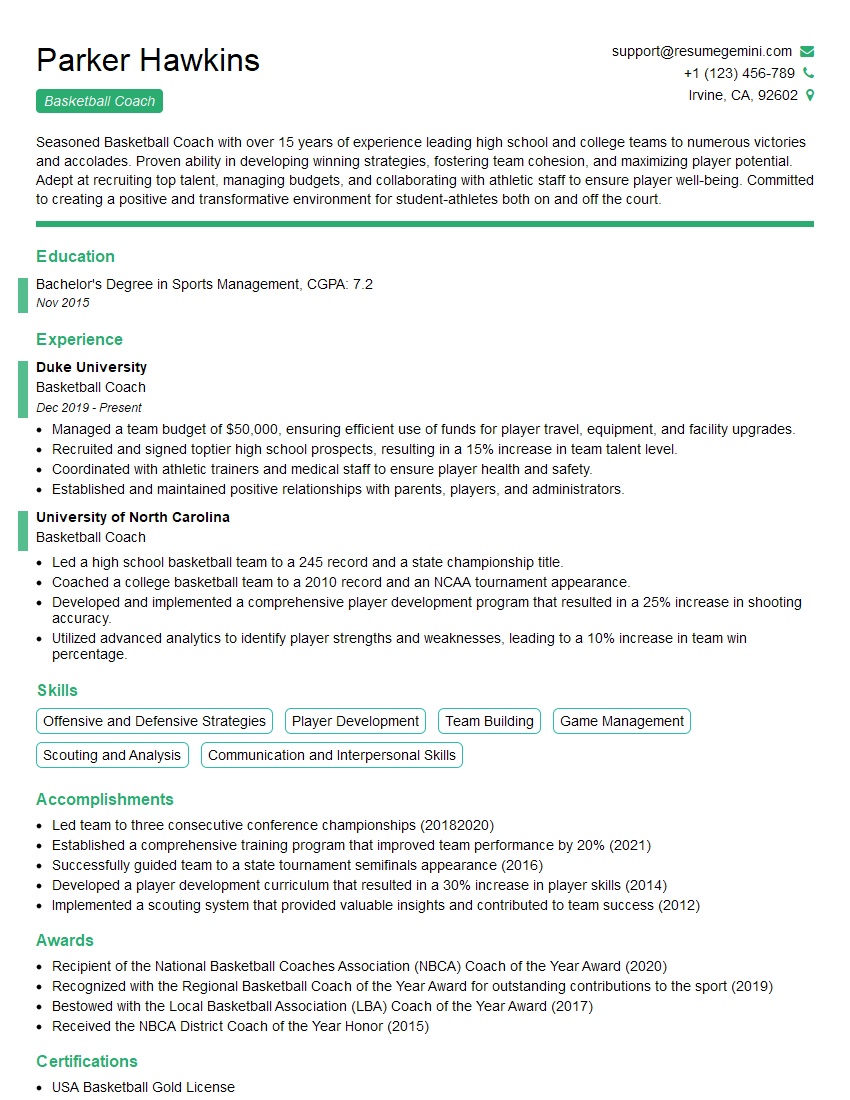
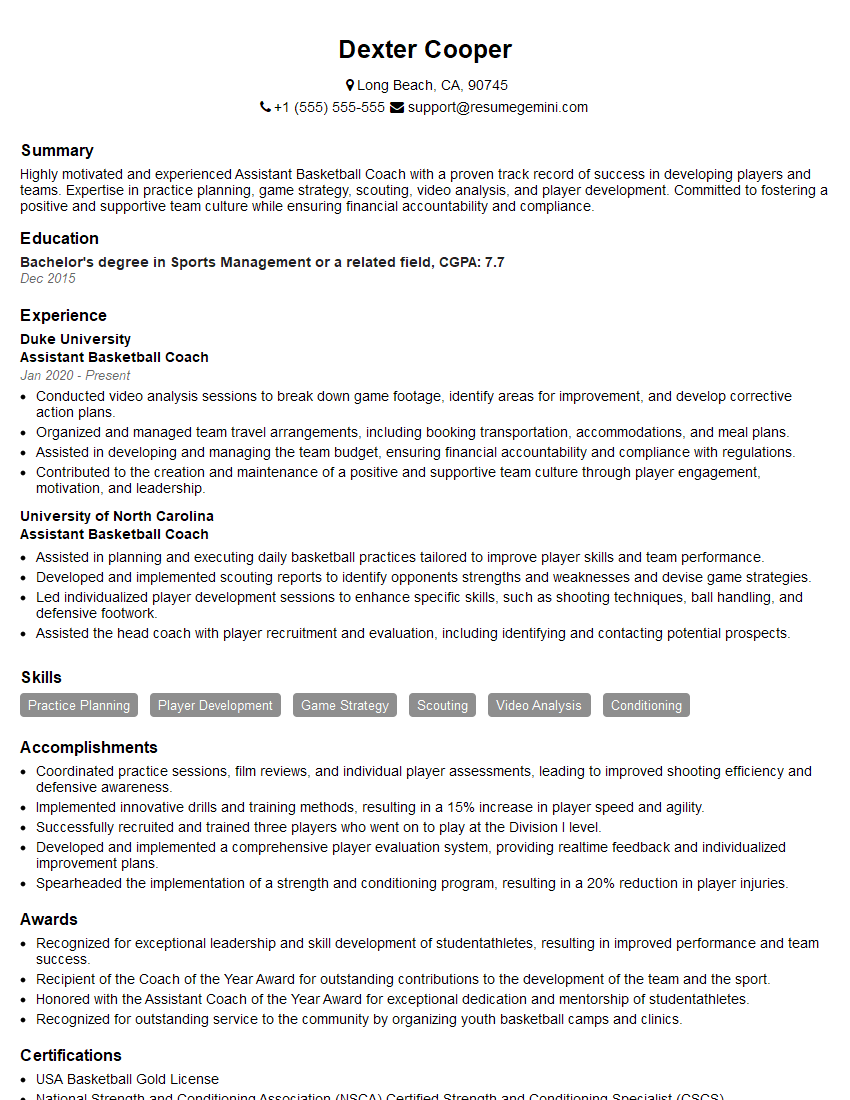
Mastering basketball knowledge is crucial for career advancement in this dynamic field. A strong understanding of the game, its strategic complexities, and player dynamics significantly enhances your value to any team. To maximize your job prospects, it’s essential to present your skills effectively through an ATS-friendly resume. ResumeGemini is a trusted resource to help you build a professional and impactful resume tailored to your specific experience and career goals. Examples of resumes tailored to showcasing Basketball Knowledge are available to help you get started.
Explore more articles
Users Rating of Our Blogs
Share Your Experience
We value your feedback! Please rate our content and share your thoughts (optional).
What Readers Say About Our Blog
Very informative content, great job.
good