Interviews are opportunities to demonstrate your expertise, and this guide is here to help you shine. Explore the essential Batch Sewing interview questions that employers frequently ask, paired with strategies for crafting responses that set you apart from the competition.
Questions Asked in Batch Sewing Interview
Q 1. What types of sewing machines are you proficient with?
My proficiency extends across a range of sewing machines, including industrial single-needle machines (like those used for straight stitching on denim), multi-needle machines for high-volume production of seams, and overlock (serger) machines for finishing seams and preventing fraying. I’m also experienced with specialized machines like button-attaching machines and blind-stitch machines, crucial for different stages of garment production. I’m comfortable adjusting settings like stitch length, tension, and presser foot pressure based on the fabric and desired stitch type. For example, I’d use a different stitch length and tension for delicate silk compared to heavy canvas.
Q 2. Describe your experience with different sewing techniques (e.g., straight stitch, zigzag stitch, blind stitch).
I’m highly skilled in various sewing techniques. A straight stitch is the foundation—used for seams, hems, and topstitching. The zigzag stitch is versatile; it’s used for reinforcing seams, finishing raw edges (to prevent fraying), and adding decorative elements. A blind stitch is essential for creating virtually invisible hems, particularly on garments where a neat finish is crucial, like dress pants or skirts. Beyond these, I’m adept at techniques like topstitching, gathering, inserting zippers, and working with different types of closures like buttons and snaps. For example, I can adjust the tension on a zigzag stitch to create a decorative effect on a children’s clothing line while ensuring durability, or use a precise blind stitch for a professional-looking hem on a tailored suit.
Q 3. How do you maintain the efficiency and quality of your work in a high-volume batch sewing environment?
Maintaining efficiency and quality in high-volume batch sewing requires a systematic approach. This involves optimizing machine settings for each specific fabric and stitch type, ensuring smooth fabric flow, and consistently checking the quality of each garment piece. I always follow a pre-determined workflow that minimizes downtime. Proper machine maintenance (regular cleaning and oiling) prevents malfunctions and reduces costly delays. I also utilize time study techniques to identify and eliminate bottlenecks in the sewing process. For example, if I notice a pattern of slower stitching on a specific part of the garment, I may need to adjust the machine settings or look for improvements in the cutting and assembly stages of production. Maintaining a clean and organized workspace also enhances efficiency and prevents accidents.
Q 4. Explain your process for identifying and resolving quality issues in batch sewing.
My process for identifying and resolving quality issues starts with thorough inspection at every stage of production. I use a checklist that details critical points for quality control. If a defect is found (e.g., a missed stitch, uneven seam, or faulty closure), I immediately stop the production line to prevent further faulty garments. I record the problem, including the type of defect, the affected garment pieces, and the likely cause. We use a root cause analysis to address the problem, which might involve adjusting machine settings, re-training operators, or even correcting pattern flaws. I document all corrective actions and follow up to ensure the issue is resolved and does not recur. In one instance, we identified a consistent problem with buttonhole placement. This led to adjustment of the machine settings and better training for operators, preventing further defects.
Q 5. How do you handle production quotas and deadlines in a fast-paced setting?
Handling production quotas and deadlines requires meticulous planning and efficient execution. I prioritize tasks based on urgency and deadlines. I break down larger tasks into smaller, manageable steps, and track my progress using production schedules and time tracking. Communication is key; I maintain open communication with team members and supervisors to ensure everyone is informed about progress and potential roadblocks. If deadlines appear impossible to meet, I proactively raise concerns and propose solutions, such as adjusting the workflow or requesting additional resources. For instance, during a particularly high-demand period, we successfully met all deadlines by implementing a flexible shift system and re-organizing the workflow to ensure optimal machine utilization.
Q 6. What is your experience with different types of fabrics and their sewing requirements?
My experience encompasses a wide variety of fabrics, from lightweight silks and delicate linens to heavy-duty denim and canvas. I understand the specific sewing requirements of each. For example, delicate fabrics require finer needles and slower stitch speeds to avoid damage. Heavier fabrics require stronger needles and higher stitch densities for durability. I’m familiar with the characteristics of different weaves, knits, and blends and adjust my techniques accordingly. Working with stretch fabrics necessitates using appropriate needles and stitches to prevent puckering or damage. I always test a sample of fabric before commencing the main production run, making sure all settings are optimized for the material.
Q 7. Describe your experience with troubleshooting sewing machine malfunctions.
Troubleshooting sewing machine malfunctions requires a combination of knowledge, experience, and methodical approach. I begin with basic checks: Is the machine plugged in? Is the needle correctly inserted? Is the bobbin properly wound and inserted? Then, I examine the stitch quality—irregular stitching, skipped stitches, or broken threads—to diagnose more complex problems, which might involve tension adjustments, lubrication, or even replacement of parts. If the problem is not readily identified, I consult manuals, troubleshoot guides, and if necessary, I call for professional maintenance or repair. I meticulously document each troubleshooting step and any repairs made, along with the date and time, to minimize future issues.
Q 8. How do you ensure consistent stitch quality and tension throughout a large batch?
Maintaining consistent stitch quality and tension across a large batch is paramount for producing professional-grade garments. It’s not just about the aesthetics; consistent stitching ensures durability and prevents weak points in the seams. I achieve this through a multi-pronged approach.
Regular Machine Maintenance: Before starting a batch, I meticulously inspect and clean my sewing machine. This includes lubricating moving parts, checking the tension settings, and ensuring the needle is sharp and correctly installed. A poorly maintained machine is the biggest culprit for inconsistent stitching.
Test Stitching: I always perform a test stitch on a scrap of the same fabric I’ll be using for the batch. This allows me to fine-tune the stitch length, tension, and pressure foot settings to perfectly suit the fabric’s weight and weave. Think of it as a ‘calibration’ step for each project.
Consistent Fabric Handling: Evenly feeding the fabric through the machine is critical. I avoid pulling or tugging, letting the feed dogs do their job. Consistent speed and a steady hand are key. I often use a seam guide to maintain consistent seam allowances.
Regular Checks: Throughout the sewing process, I regularly check the stitching for consistency. Catching small inconsistencies early prevents major problems down the line. This includes checking stitch length, straightness, and tension. It’s better to stop and adjust than to continue and risk ruining a large portion of the batch.
Q 9. What is your experience with different types of sewing needles and their applications?
My experience with sewing needles is extensive. Different needles are designed for different fabric types and sewing tasks. Selecting the right needle is crucial for preventing skipped stitches, broken needles, and damage to the fabric.
Universal Needles: These are general-purpose needles suitable for a wide range of fabrics, but they don’t always excel. I use them when speed and versatility are priorities, but prefer more specific options when possible.
Ballpoint Needles: Essential for knit fabrics. The rounded point slides between the fabric’s loops, preventing damage and skipped stitches. I’ve used these extensively on jersey, interlock, and other stretch materials.
Sharp Needles: Best for woven fabrics like cotton, linen, and silk. The sharp point pierces the fibers cleanly. I use these for crisp seams and detailed work.
Jeans Needles: These are heavy-duty needles designed for thick, tough fabrics. The reinforced construction and extra-strong shaft prevent breakage when sewing denim or canvas.
Embroidery Needles: These needles have a larger eye to accommodate heavier embroidery thread. I use these needles with embroidery machines.
Choosing the correct needle size is equally important. Smaller needles are used for finer fabrics, while larger needles are needed for heavier fabrics. It’s essential to consult the needle size chart provided by the needle manufacturer and use the correct size to prevent needle breakage and fabric damage.
Q 10. How familiar are you with different types of sewing machine feet and their purposes?
Sewing machine feet are specialized attachments that influence the stitch quality, allow for different sewing operations and protect the fabric being sewn. My experience encompasses a variety of feet:
Standard/General-Purpose Foot: The workhorse of the sewing machine. Used for most basic sewing tasks. It’s my go-to for straight stitching, creating seams, and hemming.
Zipper Foot: Allows for precise sewing along the zipper teeth. The narrow construction of this foot ensures the stitching remains close to the zipper.
Buttonhole Foot: Creates even, consistent buttonholes. I’ve utilized various types of buttonhole feet—some automatic, others requiring more manual guidance.
Walking Foot: Excellent for sewing multiple layers of fabric or thicker materials. This foot helps feed the fabric evenly through the machine, minimizing puckering or shifting.
Rolled Hem Foot: Creates professional, neat rolled hems on lightweight fabrics. This is particularly useful for delicate materials.
Understanding the capabilities of different feet is critical for producing high-quality results. The wrong foot can lead to poor stitching or damage to the fabric.
Q 11. What safety precautions do you follow when operating sewing machines?
Safety is my utmost priority when operating sewing machines. I adhere to several crucial precautions:
Never sew with loose clothing or jewelry: These can become entangled in the moving parts of the machine, causing injury.
Keep my fingers away from the needle and presser foot: Always use the seam guide to measure and mark seam allowances, avoiding unnecessary hand movements near the needle.
Unplug the machine before changing needles, adjusting tension, or performing maintenance: This prevents accidental shocks or injuries.
Maintain a clean and organized workspace: A cluttered space increases the risk of accidents. I regularly clear away scraps and maintain a tidy workspace to minimize the risk of tripping or falling.
Regularly check the electrical cord: A damaged cord is a significant safety hazard. I regularly inspect and replace cords if necessary.
Q 12. How do you maintain your work area and equipment to ensure safety and efficiency?
A well-maintained work area and equipment are essential for both safety and efficiency. My approach involves:
Daily Cleaning: I clear away fabric scraps, thread trimmings, and other debris at the end of each workday. This prevents dust build-up and potential fire hazards.
Regular Machine Cleaning and Maintenance: Beyond the daily cleaning, I perform more thorough cleaning and lubrication of the machine as recommended by the manufacturer. This keeps the machine running smoothly and extends its lifespan.
Proper Storage of Supplies: Needles, thread, and other sewing supplies are stored in organized containers to avoid damage or loss and to maintain a clean workspace.
Ergonomic Setup: My workstation is arranged to promote good posture and minimize strain. This includes comfortable seating, proper lighting, and a workspace height that allows me to work without hunching or reaching.
A well-organized and clean workspace is not just tidier; it significantly increases productivity and minimizes risks, ensuring smoother and more efficient batch sewing.
Q 13. Describe your experience working with patterns and specifications.
I possess significant experience interpreting and working with sewing patterns and specifications. This includes understanding technical drawings, grading sizes, and making necessary adjustments. My experience ranges from simple garments to complex designs.
Pattern Interpretation: I can accurately read and understand pattern markings, including seam allowances, notches, and grainlines. I also recognize and understand different pattern construction methods.
Size Grading: I’m proficient in grading patterns to different sizes, ensuring consistent proportions and fit across a range of sizes. This involves careful calculations and adjustments to pattern pieces.
Specification Adherence: I meticulously follow all provided specifications, ensuring that the final product meets the client’s requirements in terms of fabric type, stitching details, and overall finish.
Problem-Solving: If ambiguities arise in patterns or specifications, I actively seek clarification before proceeding to prevent errors. I’m adept at identifying and resolving inconsistencies or potential issues.
My attention to detail and experience ensures the accurate and efficient production of garments that meet the highest standards of quality.
Q 14. How do you handle variations in fabric or pattern during batch sewing?
Variations in fabric or pattern can pose challenges in batch sewing. My approach involves a combination of careful planning and adaptable techniques.
Pre-Sewing Assessment: Before starting a batch, I thoroughly examine the fabric for any inconsistencies, such as variations in weight, texture, or color. I check the pattern pieces for any discrepancies or errors.
Fabric Pre-Treatment: Some fabrics require pre-treatment, such as washing or pre-shrinking, to prevent shrinkage after the garment is sewn. This step is crucial to ensure consistency across the batch.
Adjustments as Needed: Depending on the type of variation, I make appropriate adjustments to the sewing process. This might involve slightly altering the stitch length, tension, or pressure foot pressure. I might even need to adjust seam allowances.
Careful Note-Taking: I document all adjustments and modifications made during the process. This allows me to maintain consistency across the batch and provides valuable information for future projects.
Quality Control: Throughout the sewing process, I regularly inspect the garments for inconsistencies, and address any issues immediately. This ensures that the final products maintain a consistent level of quality.
Adaptability is key in batch sewing. The ability to adjust techniques and address variations in fabric or pattern is critical for producing high-quality results, even when dealing with unexpected challenges.
Q 15. Describe your experience with different types of sewing machine threads.
My experience with sewing machine threads spans a wide range, from basic polyester threads for everyday sewing to specialized threads like nylon for durability and rayon for sheen. Understanding thread properties is crucial for batch sewing. For instance, polyester offers good strength and a consistent stitch, making it ideal for mass production runs of garments like t-shirts. However, for items requiring a more luxurious finish, like a tailored dress, a finer rayon thread might be preferred. I’ve also worked extensively with different thread weights (deniers), adjusting the needle size and stitch length accordingly. Heavier threads are suitable for thicker fabrics and require a stronger needle, while finer threads are better for delicate materials. Selecting the appropriate thread is vital for achieving the desired aesthetic and durability in the finished product.
- Polyester: Cost-effective, strong, versatile.
- Nylon: High strength, resistant to stretching and abrasion.
- Rayon: Smooth, lustrous, adds a sophisticated finish.
- Cotton: Natural fiber, absorbent, suitable for certain fabrics.
Choosing the right thread type is essential for maintaining consistent quality throughout a batch production. A wrong choice can lead to broken threads, inconsistent stitching, and ultimately, rejected products.
Career Expert Tips:
- Ace those interviews! Prepare effectively by reviewing the Top 50 Most Common Interview Questions on ResumeGemini.
- Navigate your job search with confidence! Explore a wide range of Career Tips on ResumeGemini. Learn about common challenges and recommendations to overcome them.
- Craft the perfect resume! Master the Art of Resume Writing with ResumeGemini’s guide. Showcase your unique qualifications and achievements effectively.
- Don’t miss out on holiday savings! Build your dream resume with ResumeGemini’s ATS optimized templates.
Q 16. What is your experience with using various marking tools (e.g., chalk, pins)?
Marking tools are an essential part of efficient and accurate batch sewing. I’m proficient with various methods, selecting the best tool based on the fabric and pattern. For example, tailor’s chalk is ideal for marking on lighter fabrics as it’s easily removed. However, for darker or more delicate materials, I use disappearing ink pens or water-soluble markers to avoid leaving permanent marks. Pins are invaluable for holding fabric pieces together accurately before stitching, particularly for intricate designs or multiple layers of fabric. I’ve also used pattern weights, which provide a more stable surface and are useful when working with slippery fabrics. The key is accuracy; careful marking prevents misalignment and ensures consistent results throughout the batch.
In one instance, we were working with a delicate silk fabric. Tailor’s chalk proved too harsh, leaving visible marks. Switching to a water-soluble marker ensured clean lines without damaging the fabric, maintaining the quality of the finished product.
Q 17. How do you manage your time effectively during a busy production period?
Managing time effectively during busy production periods requires a structured approach. I utilize a combination of techniques including detailed planning and prioritization. Before starting a batch, I carefully review the order specifications and estimate the time required for each stage, from pre-sewing preparation to final quality checks. This allows me to create a realistic timeline. I prioritize tasks based on deadlines and urgency, focusing on the most time-sensitive aspects first. Throughout the process, I maintain consistent speed and accuracy, minimizing errors that can cause delays. When faced with unexpected challenges, I adapt my schedule and communicate effectively with the team. Breaking down large tasks into smaller, manageable units also helps maintain focus and momentum.
For example, during a high-volume order of 500 identical blouses, I divided the production into smaller batches of 50 each, allowing for regular quality checks and adjustments. This approach ensured timely completion and maintained a consistent standard across all the blouses.
Q 18. What is your experience with different types of sewing machine lubrication?
Proper lubrication is crucial for maintaining the smooth operation and longevity of sewing machines. My experience encompasses various types of lubricants, from general-purpose sewing machine oil to specialized greases for specific components. I understand the importance of using the correct lubricant for different parts of the machine—for example, lighter oils for moving parts like the needle bar and heavier greases for gears and bearings. Regular lubrication prevents wear and tear, reduces friction, and ensures consistent stitch quality. Over-lubrication can also be detrimental, attracting dust and lint, leading to machine malfunctions. Therefore, I always follow the manufacturer’s recommendations for lubrication frequency and the type of oil or grease to use.
Ignoring lubrication can lead to costly repairs or machine downtime. In my experience, regular maintenance, including proper lubrication, significantly reduces these issues and extends the machine’s lifespan, resulting in increased productivity and cost savings.
Q 19. Describe your experience with pre-sewing preparation (e.g., cutting, marking).
Pre-sewing preparation is paramount in batch sewing. It lays the foundation for efficient and accurate stitching. My experience includes precise fabric cutting using patterns and various cutting tools, ensuring accurate dimensions and minimizing waste. I’m adept at using different marking techniques to accurately transfer pattern markings onto the fabric, ensuring accurate placement of seams and other design elements. This involves using appropriate tools as discussed previously. Proper pre-sewing preparation, including accurate cutting and precise marking, is crucial for a streamlined process and reduces errors during the sewing stage.
For instance, during a recent order of tailored jackets, precise cutting of interfacing and careful marking of buttonhole placements were key to ensuring a high-quality finish for all 100 jackets. Any inaccuracies at this stage would have resulted in inconsistent products and potential rework.
Q 20. How do you ensure the accuracy of your work throughout the batch production?
Accuracy is non-negotiable in batch production. I employ several strategies to ensure consistency throughout the process. Regular quality checks at various stages are critical – from initial fabric inspection to final product evaluation. I use calibrated measuring tools to verify dimensions and ensure adherence to specifications. Maintaining consistent stitch length and tension throughout the sewing process is also crucial. Additionally, I use a standardized checklist to guide my work and ensure all steps are completed accurately and consistently. This involves paying close attention to detail and immediately addressing any inconsistencies that arise. Regular machine maintenance, as discussed earlier, helps maintain stitch quality and accuracy.
For example, I recently managed a batch of 150 pairs of pants. By implementing regular checks at multiple steps, we identified a minor stitching error early on. Addressing it promptly saved time and avoided producing an entire batch with inconsistencies.
Q 21. What is your experience with using computer-aided design (CAD) in sewing?
My experience with Computer-Aided Design (CAD) in sewing is limited to its application in pattern making and grading. While I don’t directly operate CAD software myself, I understand its role in creating accurate and consistent patterns, which are then utilized in the cutting and sewing stages. I’m familiar with how digital patterns are translated into physical patterns and how grading is used to adapt patterns for different sizes. This ensures that patterns are accurate and consistent across different sizes, allowing us to produce well-fitting garments efficiently across a batch production. The use of CAD streamlines the pattern-making process, reducing errors and improving efficiency.
While I’m not a CAD operator, my understanding of the system allows me to effectively use the patterns provided, maximizing productivity and minimizing errors.
Q 22. Describe your experience with quality control checks during and after batch sewing.
Quality control in batch sewing is paramount. It’s a multi-stage process, starting from the initial fabric inspection and continuing through each step of the sewing process and finally, a thorough post-production check. During sewing, I regularly inspect the work-in-progress for defects such as stitching inconsistencies, missed seams, fabric flaws, and incorrect measurements. I use checklists and standardized quality control procedures which may involve checking against a sample garment or template. This ‘in-process’ check allows for immediate correction of errors, minimizing waste and improving efficiency. After the batch is complete, a more rigorous final inspection takes place. This involves examining every finished garment for quality issues, using a detailed checklist and often involving multiple inspectors for cross-checking. Any defective items are flagged and set aside for repair or disposal. For example, if I notice a consistent problem with the stitching tension, I’ll immediately alert the supervisor and potentially adjust the machine settings. Similarly, post-production, any garment with visible flaws goes back to the sewing line for correction before packaging and shipping.
Q 23. How do you prioritize tasks in a high-volume production environment?
In a high-volume environment, prioritization is crucial. I utilize a combination of techniques including the urgency/importance matrix and the first-in, first-out (FIFO) method. Urgent, high-impact tasks, such as meeting a critical deadline for a large order, take precedence. I use a combination of visual aids like kanban boards and digital task management tools. Less urgent tasks are scheduled to allow for efficient workflow and minimize bottlenecks. For example, if I have a rush order for 500 dresses and a smaller order of 100 shirts, I’ll focus on the dresses first. I’ll regularly assess the production flow, adjusting priorities as needed to accommodate changing demands. This ensures that all tasks are completed efficiently and effectively, and deadlines are consistently met.
Q 24. How do you communicate effectively with colleagues and supervisors in a factory setting?
Clear and effective communication is vital in a factory setting. I prioritize direct, concise communication. I use both verbal and non-verbal communication effectively. For example, I use clear and concise language when reporting issues, and always use body language that shows attentiveness and respect. With colleagues, I actively listen, and work collaboratively, assisting them when needed and seeking help when I face challenges. With supervisors, I maintain open and honest communication, reporting progress, problems, and potential solutions promptly. I prefer face-to-face communication whenever possible, but also utilize written communication for documentation and follow-up. I’ve found that a respectful and proactive approach fosters strong working relationships and a more efficient production process. For example, If I encounter a problem, I’ll immediately inform my supervisor, describe the problem, and propose potential solutions.
Q 25. Describe a time you had to troubleshoot a complex sewing machine issue.
In one instance, a sewing machine repeatedly jammed during a large batch production. Initially, I suspected a problem with the needle, but replacing it didn’t solve the issue. Then, I systematically checked each component, including the bobbin, tension, and feed dogs. After carefully examining the machine’s manual and consulting with a more experienced colleague, we discovered that a small piece of fabric had become lodged in the shuttle hook. Removing the obstruction and carefully cleaning the area resolved the problem. This experience reinforced the importance of methodical troubleshooting and seeking assistance from experienced colleagues when needed. It was a valuable lesson in identifying root causes versus treating surface symptoms.
Q 26. How do you adapt to changes in production requirements or deadlines?
Adaptability is essential in this role. I’ve handled numerous instances where production requirements or deadlines changed unexpectedly. My approach involves calmly assessing the situation, prioritizing tasks based on the new requirements, and communicating openly with my supervisor and team. If a new deadline is tighter, I work with my team to streamline the process or adjust workflow to meet the new timeline. This may involve adjusting our schedule, prioritizing urgent orders, or re-allocating tasks amongst team members. I’m comfortable working under pressure and effectively manage unexpected changes. For example, if a rush order comes in, I re-prioritize my tasks to ensure that the urgent order is met without compromising the quality of other work.
Q 27. What are your strengths and weaknesses as a batch sewing operator?
My strengths include my meticulous attention to detail, my efficiency and speed in meeting production targets, and my excellent problem-solving skills. I am a highly motivated and adaptable team player. I pride myself on maintaining high quality standards in all aspects of my work. My weakness is that I can sometimes be too focused on perfection, which can occasionally lead to slower speeds if I’m not careful to manage my time effectively. However, I’m actively working to balance speed and precision by implementing efficient work habits and delegating tasks when needed.
Q 28. What are your salary expectations for this role?
My salary expectations are commensurate with my experience and skills, and in line with the industry standard for a batch sewing operator with my qualifications. I am open to discussing a specific range after learning more about the details of the position and the compensation package offered.
Key Topics to Learn for Batch Sewing Interview
- Understanding Production Schedules: Learn to interpret and efficiently manage batch sewing production schedules, including deadlines and order priorities.
- Sewing Machine Operation & Maintenance: Demonstrate proficiency in operating various industrial sewing machines and performing basic maintenance tasks to minimize downtime.
- Fabric Knowledge & Selection: Understand different fabric types, their properties, and appropriate sewing techniques for optimal results. This includes identifying potential issues based on fabric choice.
- Quality Control & Inspection: Explain your approach to quality control during batch sewing, including identifying and resolving defects efficiently. This includes understanding industry standards for quality.
- Teamwork & Collaboration: Highlight your experience working effectively within a team environment, sharing responsibilities, and contributing to overall production goals.
- Problem-Solving & Troubleshooting: Discuss your ability to identify and resolve common sewing machine malfunctions, fabric-related issues, and production bottlenecks.
- Safety Procedures & Regulations: Demonstrate knowledge of relevant safety protocols and industry regulations related to industrial sewing machine operation and workplace safety.
- Efficiency & Productivity Strategies: Explain your strategies for maximizing efficiency and productivity within a batch sewing environment, including techniques for optimizing workflow.
Next Steps
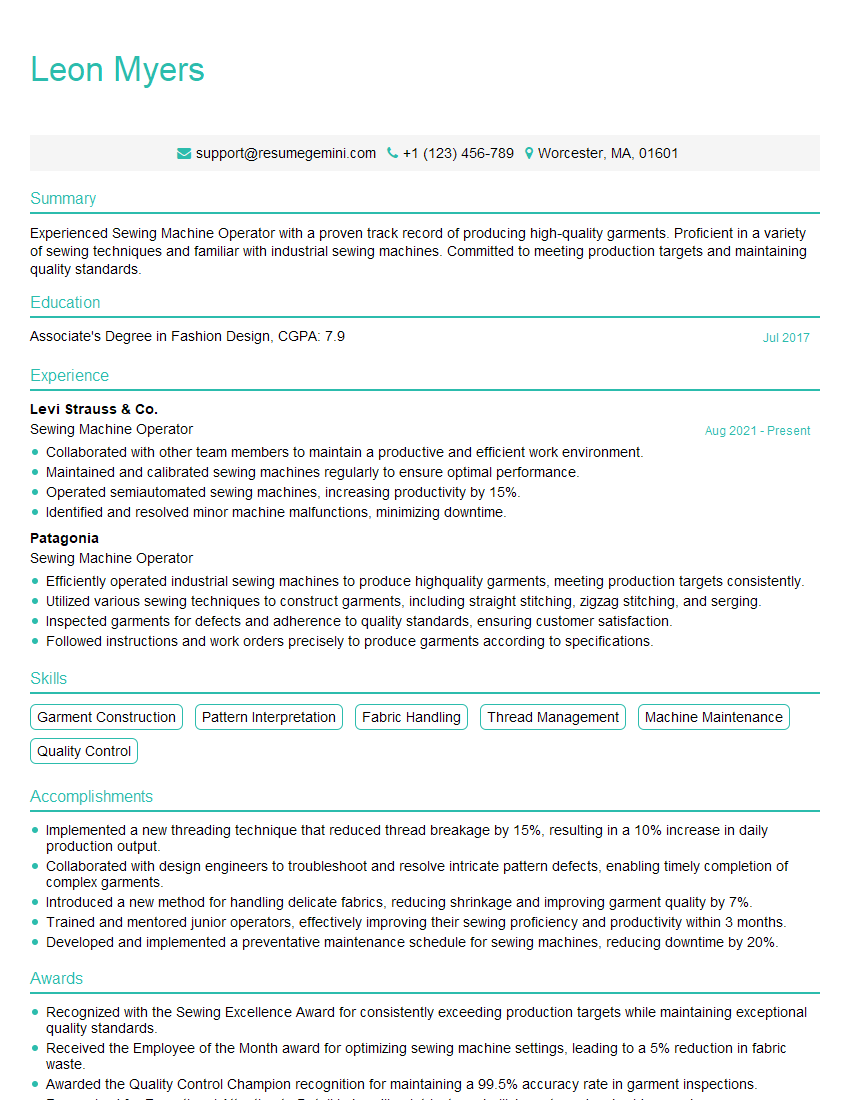
Mastering batch sewing opens doors to rewarding careers in the garment industry, offering opportunities for advancement and specialization. To stand out, a well-crafted, ATS-friendly resume is crucial. ResumeGemini is a trusted resource that can help you build a professional resume that highlights your skills and experience effectively. We provide examples of resumes tailored to the Batch Sewing industry to give you a head start. Invest time in crafting a compelling resume – it’s your first impression to potential employers.

Explore more articles
Users Rating of Our Blogs
Share Your Experience
We value your feedback! Please rate our content and share your thoughts (optional).
What Readers Say About Our Blog
Very informative content, great job.
good