Are you ready to stand out in your next interview? Understanding and preparing for Body Structure Design interview questions is a game-changer. In this blog, we’ve compiled key questions and expert advice to help you showcase your skills with confidence and precision. Let’s get started on your journey to acing the interview.
Questions Asked in Body Structure Design Interview
Q 1. Explain the principles of musculoskeletal biomechanics.
Musculoskeletal biomechanics explores how the body’s bones, muscles, and joints interact to produce movement. It’s governed by principles of mechanics, including levers, forces, and energy. We analyze forces acting on the body (like gravity and muscle contractions) and how they create movement, stability, and even injury.
Consider a simple bicep curl: the bicep muscle contracts (force), acting on the forearm (lever) at the elbow joint (fulcrum). This creates movement, but the amount of movement depends on factors like the muscle’s strength, the lever arm length, and joint flexibility. Biomechanical principles help us understand how to optimize movement for efficiency, power, and injury prevention.
- Levers: Bones act as levers, with joints as fulcrums and muscles providing force.
- Forces: Gravity, muscle tension, external loads influence movement.
- Energy: Movement requires energy, and biomechanics helps understand energy expenditure and efficiency.
Q 2. Describe different types of joints and their ranges of motion.
Joints classify based on their structure and range of motion (ROM). ROM refers to the degree of movement possible at a joint.
- Fibrous Joints: Immovable (e.g., sutures in the skull).
- Cartilaginous Joints: Slightly movable (e.g., intervertebral discs).
- Synovial Joints: Freely movable, classified further:
- Ball-and-socket (e.g., hip, shoulder): Wide ROM in multiple planes.
- Hinge (e.g., elbow, knee): Movement primarily in one plane (flexion and extension).
- Pivot (e.g., atlantoaxial joint): Rotation around a central axis.
- Saddle (e.g., thumb): Movement in two planes (flexion/extension, abduction/adduction).
- Condyloid (e.g., wrist): Movement in two planes (flexion/extension, abduction/adduction) with limited rotation.
- Gliding (e.g., vertebrae): Sliding movements between bones.
For instance, the shoulder’s ball-and-socket joint provides a much wider ROM than the knee’s hinge joint. Understanding joint types and ROM is crucial for designing effective rehabilitation programs and ergonomic products.
Q 3. What are the key factors influencing posture and its impact on the body?
Posture, the position of our body segments in relation to each other, is influenced by many factors. Poor posture can lead to musculoskeletal problems.
- Muscular Strength and Flexibility: Weak core muscles or tight muscles can lead to poor posture.
- Joint Structure and Mobility: Degenerative joint conditions restrict movement impacting posture.
- Neuromuscular Control: The nervous system controls muscle activation for posture. Impaired control leads to poor posture.
- Habitual Behaviors: Prolonged sitting or slouching develops bad postural habits.
- Psychological Factors: Stress and depression can affect posture.
The impact of poor posture ranges from discomfort to serious problems like back pain, neck pain, headaches, and even respiratory issues. Maintaining proper posture involves strengthening core muscles, improving flexibility, and being mindful of body position.
Q 4. How do you analyze human movement using biomechanical principles?
Analyzing human movement involves applying biomechanical principles to observe, measure, and interpret movements.
- Motion Capture: Systems record joint angles and body segment movements using markers.
- Force Plates: Measure ground reaction forces during movement, providing data on force and balance.
- Electromyography (EMG): Measures electrical activity of muscles to determine muscle activation patterns.
Data collected is then analyzed using software to generate graphs, animations and reports about movement patterns, joint angles, forces, and muscle activation timings. This helps in identifying movement inefficiencies, potential injury risks, and opportunities for improvement in sports training, rehabilitation, and ergonomics.
For example, analyzing a golfer’s swing can reveal timing issues or inefficient force application, allowing for targeted training interventions. Similarly, analyzing a worker’s lifting technique can pinpoint risky movements to prevent workplace injuries.
Q 5. Explain the concept of ergonomics and its application in product design.
Ergonomics focuses on designing workspaces and tools to match human capabilities. Its aim is to minimize physical strain, discomfort, and injury.
In product design, ergonomics considers:
- Anthropometry: Body dimensions and proportions to ensure products are appropriately sized.
- Biomechanics: Movement analysis to design products that minimize stress during use.
- Human Factors: Cognitive and perceptual aspects to make products intuitive and easy to use.
For example, designing a chair considers posture and reduces pressure points, reducing back pain risk. Designing a keyboard considers hand and wrist position, reducing carpal tunnel syndrome risk. Ergonomics improves user comfort, efficiency, and safety.
Q 6. Describe different anthropometric measurement techniques.
Anthropometric measurements capture physical dimensions of the human body. Techniques include:
- Direct Measurement: Using tools like anthropometers, calipers, and measuring tapes to directly measure body dimensions (e.g., height, weight, limb length).
- Photogrammetry: Using photographs and image analysis software to estimate body dimensions.
- 3D Scanning: Creating detailed 3D models of the body surface to obtain precise measurements.
These techniques allow us to collect data on various aspects like height, weight, limb lengths, body girths, and joint angles. The choice of technique depends on the required accuracy, cost, and time constraints.
Q 7. How do you apply anthropometric data in the design process?
Anthropometric data is vital for design. It ensures products fit the target population, enhancing comfort and usability.
The design process integrates anthropometric data by:
- Establishing Design Criteria: Determining the range of body sizes to accommodate (e.g., 5th percentile female to 95th percentile male).
- Designing for the Extremes: Prioritizing design parameters that accommodate extreme body sizes.
- Creating Adjustable Designs: Incorporating adjustable features to accommodate individual differences (e.g., adjustable chair height).
- Using Design Allowances: Accounting for body movement and clothing to prevent discomfort.
Example: Designing a car seat considers the range of body sizes and adjusts seat position, backrest angle, and headrest height to accommodate different individuals and optimize safety and comfort. Without anthropometric data, designs risk being uncomfortable or even unsafe for a large proportion of potential users.
Q 8. What software are you proficient in for 3D modeling of body structures?
My proficiency in 3D modeling software for body structures is extensive. I’m highly skilled in industry-standard packages like Autodesk Maya, 3ds Max, and Blender. These programs allow me to create highly detailed anatomical models, from individual bones and organs to complete musculoskeletal systems. My expertise extends beyond simply creating models; I’m adept at utilizing their sculpting, rigging, and animation tools to simulate movement and deformation, crucial for biomechanical analysis.
For example, using Maya’s sculpting tools, I can realistically model the complex surface anatomy of the human heart, including its chambers and valves. Then, using rigging techniques, I can create a virtual model that accurately reflects the heart’s contractions and blood flow. This level of detail is essential for understanding physiological processes and designing medical devices.
Q 9. Explain your experience with CAD software for anatomical modeling.
My experience with CAD (Computer-Aided Design) software for anatomical modeling is extensive. I’ve used software like SolidWorks and Autodesk Inventor to design and analyze medical devices and prosthetics. These programs are essential for precise measurements, intricate designs, and the creation of manufacturing-ready models. For example, I used SolidWorks to design a custom knee implant, meticulously incorporating precise dimensions and material properties to ensure compatibility with the patient’s anatomy and biomechanics.
Furthermore, I leverage the capabilities of CAD software to perform simulations and stress analyses, which helps in predicting the performance and longevity of my designs before physical prototyping. This iterative process ensures a high level of accuracy and reduces the risk of design flaws.
Q 10. Describe your understanding of different types of tissues and their mechanical properties.
Understanding tissue types and their mechanical properties is fundamental to my work. For instance, bone is a strong, stiff composite material with high tensile and compressive strength but brittle failure properties. Cartilage, on the other hand, is a more flexible and resilient material, providing cushioning and shock absorption in joints. Muscle tissue exhibits viscoelastic properties, meaning its stiffness and response to forces depend on the rate of loading. Ligaments and tendons are strong fibrous tissues that connect bones and muscles and exhibit high tensile strength.
The differences in these mechanical properties are critical when designing medical devices or analyzing biomechanical stresses. For example, a hip implant must be designed to distribute forces across the bone and cartilage to minimize wear and tear, considering the different mechanical properties of these tissues. Ignoring these variations can lead to implant failure or injury.
Q 11. How do you assess the biomechanical risks associated with specific tasks or activities?
Assessing biomechanical risks involves a multi-step process. First, I carefully define the task or activity, considering the forces, postures, and movements involved. Then, I use a combination of methods to analyze potential risks. This might include reviewing existing literature on similar activities, conducting ergonomic assessments using tools like OWAS (Ovako Working Posture Analyzing System), and creating biomechanical models using software like AnyBody or OpenSim.
For example, when assessing the risk of repetitive strain injury in assembly line workers, I would observe their work posture, measure the forces exerted during tasks, and create a computer model to simulate the loading on their muscles and joints. Based on these findings, I would provide recommendations to modify the work environment or procedures to reduce the risk of injury. This could include adjusting workstation height, implementing tool redesign, and suggesting rest breaks.
Q 12. Explain your approach to designing assistive devices or prosthetics.
My approach to designing assistive devices or prosthetics is patient-centered and highly iterative. It begins with a thorough understanding of the patient’s needs and limitations, considering their medical history, functional goals, and lifestyle. I use a combination of 3D scanning, CAD modeling, and simulations to create customized designs. Prototypes are then fabricated and tested iteratively until the device achieves optimal fit, function, and comfort.
For example, when designing a prosthetic hand, I would incorporate feedback from the patient regarding grip strength, dexterity requirements, and cosmetic preferences. The design would then be refined through simulations and physical prototypes to ensure it meets the functional requirements while maintaining a natural appearance. This iterative approach ensures the final product aligns with the patient’s individual needs and improves their quality of life.
Q 13. Describe your experience with finite element analysis (FEA) in biomechanics.
Finite Element Analysis (FEA) is a cornerstone of my biomechanical work. FEA is a powerful computational technique used to predict how a structure will react to real-world forces, stresses, and strains. In biomechanics, this allows me to simulate the behavior of bones, tissues, and implants under various loading conditions. I use software packages such as ANSYS and Abaqus to conduct FEA simulations. This helps optimize designs for strength, durability, and safety.
For instance, before implanting a new type of knee replacement, I would use FEA to simulate the stresses and strains on the implant and surrounding bone during various activities like walking, running, and climbing stairs. This simulation helps predict potential points of failure or areas of excessive stress, which enables me to optimize the design for better performance and longevity. The results inform design modifications, allowing for improvements in strength and reducing the risk of failure.
Q 14. How do you interpret and apply data from motion capture systems?
Motion capture systems provide valuable data for understanding human movement and biomechanics. I use data from these systems, typically in the form of marker trajectories, to analyze gait, posture, and other movements. This data is invaluable for designing assistive devices, analyzing workplace ergonomics, and creating realistic biomechanical models. I use specialized software to process and analyze motion capture data, such as Vicon Nexus or MotionBuilder. The data helps understand joint angles, moments, and power generation during various activities.
For example, when assessing a patient’s gait after a stroke, motion capture data allows me to quantify their deviations from normal walking patterns. This information informs the design of rehabilitation strategies and assistive devices tailored to their specific needs, improving their mobility and reducing the risk of falls. Combining motion capture data with FEA allows for a complete picture of the forces and stresses on the musculoskeletal system, creating a powerful tool for analysis and intervention design.
Q 15. Explain your understanding of human factors and its impact on usability.
Human factors engineering considers the capabilities and limitations of humans in the design process. It’s all about making sure that the things we design – whether it’s a chair, a car, or a prosthetic limb – are compatible with the human body and mind. Usability, in this context, is how easily and effectively a person can use a design to achieve a specific goal. Poor human factors lead to unusable designs. For example, a chair that’s too low will be uncomfortable and difficult to get out of, impacting usability. Similarly, a medical device with controls that are too small or difficult to operate may be unsafe for the user. Good human factors ensures intuitive, efficient, and safe interactions.
- Cognitive factors: Considering mental workload, attention, and decision-making processes.
- Physical factors: Considering anthropometry (body measurements), posture, strength, and reach.
- Environmental factors: Considering lighting, noise, temperature, and vibration.
A classic example of poor human factors impacting usability is the placement of controls in a vehicle. If crucial controls are placed in a difficult-to-reach location, or are visually obscured, this can result in accidents and poor driving experiences. The design needs to prioritize ease of use and safety considering the physical and cognitive demands of driving.
Career Expert Tips:
- Ace those interviews! Prepare effectively by reviewing the Top 50 Most Common Interview Questions on ResumeGemini.
- Navigate your job search with confidence! Explore a wide range of Career Tips on ResumeGemini. Learn about common challenges and recommendations to overcome them.
- Craft the perfect resume! Master the Art of Resume Writing with ResumeGemini’s guide. Showcase your unique qualifications and achievements effectively.
- Don’t miss out on holiday savings! Build your dream resume with ResumeGemini’s ATS optimized templates.
Q 16. Describe your approach to designing for accessibility and inclusivity.
Designing for accessibility and inclusivity means creating products and environments that can be used by people with a wide range of abilities and disabilities. My approach is to consider the full spectrum of human diversity from the very beginning of the design process, not as an afterthought. This involves:
- Understanding user needs: Conducting thorough user research with diverse participants, including those with disabilities.
- Universal design principles: Applying design principles that benefit all users, such as providing multiple ways to accomplish a task.
- Assistive technology compatibility: Ensuring designs work seamlessly with assistive technologies, such as screen readers and voice controls.
- Accessibility standards compliance: Following established accessibility guidelines, such as WCAG (Web Content Accessibility Guidelines) for digital products or ADA (Americans with Disabilities Act) Standards for physical spaces.
For instance, when designing a wheelchair, careful consideration must be given to the adjustability of the seat and armrests to accommodate users of various sizes and physical limitations. It’s not just about making it functional but also about considering aspects of dignity and comfort – ensuring that the user feels safe, secure, and in control.
Q 17. How do you ensure the safety and comfort of users in your designs?
Safety and comfort are paramount in body structure design. I ensure both through a multi-faceted approach:
- Biomechanical analysis: Using computer modeling and simulations to predict forces and stresses on the human body during use. This helps to identify potential points of failure and injury.
- Material selection: Choosing materials that are biocompatible, durable, and comfortable against the skin. Considering factors like breathability, temperature regulation, and hypoallergenic properties.
- Ergonomic design: Optimizing the design for proper posture, minimizing strain, and reducing the risk of fatigue or repetitive strain injuries.
- Rigorous testing: Conducting extensive testing, including wear testing, impact testing, and user trials to verify safety and comfort.
For example, in designing a prosthetic limb, safety is ensured through the selection of strong, lightweight materials and precise engineering to replicate natural movement. Comfort is achieved through the use of soft, breathable liners and careful consideration of the limb’s overall weight and fit. The design would also undergo rigorous testing before being used by patients to ensure it can perform safely and meet expectations.
Q 18. Explain your experience with different material selection for body structure applications.
My experience spans a wide range of materials, each with its unique advantages and disadvantages for body structure applications.
- Metals (Titanium, Stainless Steel): Offer high strength and durability, making them suitable for load-bearing applications like hip implants or prosthetic components. Titanium’s biocompatibility is an added advantage.
- Polymers (Polyethylene, PEEK): Lightweight, flexible, and often biocompatible, polymers are ideal for creating soft tissue replacements or components that require flexibility. PEEK offers high strength and wear resistance.
- Composites (Carbon Fiber, Fiberglass): Combining the strength of fibers with a matrix material, composites provide high strength-to-weight ratios, useful for lightweight prosthetic limbs or external fixation devices.
- Bioceramics (Alumina, Zirconia): These materials offer excellent biocompatibility and wear resistance, making them suitable for joint replacements and dental implants.
- 3D-printed materials: Offer design flexibility and the ability to create complex geometries, enabling highly personalized designs and improved patient-specific fit.
The selection process involves carefully weighing the properties of each material against the specific requirements of the application, including biocompatibility, strength, weight, cost, and manufacturability. For example, in designing a knee replacement, the choice of material would depend on factors such as the patient’s age, activity level, and the specific biomechanical demands on the joint.
Q 19. How do you address challenges related to individual variations in body structure?
Addressing individual variations in body structure is crucial for creating truly effective and comfortable designs. My approach involves:
- Anthropomorphic data: Utilizing detailed anthropometric data (body measurements) to design for a range of body sizes and shapes. This data informs the design dimensions and adjustability features.
- Customization and adjustability: Incorporating features that allow for adjustments to accommodate individual variations, such as adjustable straps, padded inserts, or modular components.
- Personalized design: Employing advanced technologies, such as 3D scanning and 3D printing, to create highly customized designs based on individual patient measurements and needs.
- User-centered design: Involving users with diverse body types in the design process through interviews, focus groups, and usability testing. This allows for direct feedback and iterative refinement of the design.
For instance, when designing an exoskeleton, I would utilize 3D scanning to capture the exact dimensions and proportions of each individual user, ensuring a proper fit and avoiding discomfort or pressure points. This ensures that the exoskeleton enhances movement and reduces strain without causing injury or hindering the user.
Q 20. Explain your approach to integrating user feedback in the design process.
User feedback is invaluable throughout the design process. I incorporate user feedback through several methods:
- Early-stage feedback: Gathering feedback from potential users during the concept development phase using surveys, interviews, and focus groups. This helps to refine the design concept early on, preventing costly mistakes later in the process.
- Prototype testing: Testing prototypes with users to identify usability issues, ergonomic problems, and areas of discomfort. This involves observing users interacting with the design and gathering their feedback on its functionality and comfort.
- Iterative design: Using user feedback to inform design iterations and improvements. This is a cyclical process involving design, prototyping, testing, and refinement, ensuring the final design meets user needs.
- Post-launch feedback: Collecting feedback from users after the design has been launched through surveys, online reviews, and customer support channels. This helps to identify areas for improvement in future iterations of the design.
For example, in designing a new type of wheelchair, we would conduct extensive user testing throughout the design process. We would involve users with different levels of mobility impairments and gather feedback on factors such as maneuverability, comfort, adjustability, and overall satisfaction. This feedback would then be used to refine the design, ensuring that the final product meets the needs of its users.
Q 21. Describe your experience with prototyping and iterative design processes.
Prototyping and iterative design are essential for creating successful body structure designs. My approach involves:
- Rapid prototyping: Utilizing various rapid prototyping techniques, such as 3D printing, to create physical models and test designs quickly and efficiently.
- Iterative design cycles: Employing a cyclical process of design, prototyping, testing, and refinement. Each iteration incorporates feedback from previous stages.
- Different prototyping levels: Using different levels of fidelity in prototyping, from simple sketches and cardboard models to highly realistic functional prototypes.
- Simulation and modeling: Employing computer-aided design (CAD) software and finite element analysis (FEA) to simulate the performance of designs under different loading conditions.
For example, when developing a new type of prosthetic hand, we might start with a simple 3D-printed model to test the overall shape and size. Then, we would create a more sophisticated prototype incorporating functional components, testing its grip strength and dexterity. Finally, a high-fidelity prototype mimicking the final design would undergo rigorous testing with user feedback to make any final adjustments.
Q 22. How do you conduct user testing and evaluate the effectiveness of your designs?
User testing is crucial for validating body structure designs. My approach involves a multi-stage process, starting with formative evaluations early in the design process and concluding with summative evaluations once a prototype is available.
Formative evaluations often involve usability testing with target users, observing their interactions with mockups or low-fidelity prototypes. We use think-aloud protocols, where users verbalize their thought processes as they interact, providing invaluable insights into their understanding and experience. We also employ heuristic evaluations, where expert reviewers assess the design against established usability principles.
Summative evaluations usually involve more rigorous testing with a larger, more representative sample of users. This could include A/B testing different design iterations to compare their effectiveness. We analyze quantitative data such as task completion rates, error rates, and time-on-task, and qualitative data such as user feedback and observations to assess the design’s overall usability and effectiveness. For example, when designing a new prosthetic limb, we might conduct gait analysis and user surveys to assess comfort, ease of use, and functionality.
Q 23. Explain your understanding of regulatory standards related to body structure designs.
Regulatory standards for body structure designs vary depending on the specific application (e.g., medical devices, prosthetics, ergonomic furniture). In the medical device field, compliance with standards like ISO 13485 (quality management systems) and ISO 14971 (risk management) is essential. These standards dictate rigorous testing and documentation procedures to ensure safety and efficacy. For example, a new prosthetic design would need to undergo extensive biocompatibility testing to ensure it doesn’t cause adverse reactions.
Other relevant regulations might include those related to biomechanics, materials safety (e.g., REACH for chemical substances), and accessibility standards (e.g., ADA for assistive devices). Staying abreast of these evolving regulations requires ongoing professional development and collaboration with regulatory experts. Failure to comply with these standards can lead to product recalls, legal liabilities, and reputational damage.
Q 24. Describe your experience with project management and collaboration in a design team.
I have extensive experience in collaborative design environments. I thrive in team settings, leveraging the diverse skills and perspectives of colleagues to achieve optimal outcomes. My approach emphasizes open communication, clear task delegation, and proactive problem-solving. I’m proficient in using project management tools like Jira and Asana to track progress, manage tasks, and maintain transparency.
In a recent project involving the design of a customized exoskeleton for rehabilitation, I led a team of engineers, designers, and therapists. I employed Agile methodologies, utilizing daily stand-up meetings, sprint reviews, and retrospectives to ensure efficient workflow and timely delivery. My role involved not only the technical aspects of design but also facilitating effective communication between team members and managing potential conflicts to ensure a collaborative and productive environment.
Q 25. How do you stay up-to-date with the latest advancements in body structure design?
Staying current in this rapidly evolving field necessitates a multifaceted approach. I regularly attend industry conferences, such as those hosted by the Biomedical Engineering Society or the Society for Biomaterials, to learn about the latest research and technological advancements. I actively participate in professional organizations, engaging with colleagues and experts through online forums and publications.
Furthermore, I dedicate time to reviewing peer-reviewed journals and industry publications like Biomaterials and Journal of Biomechanics. I also leverage online learning platforms, such as Coursera and edX, to acquire new skills and knowledge in areas like advanced materials science, 3D printing technologies, and bioprinting. This continuous learning ensures my designs are at the forefront of innovation and safety.
Q 26. Describe a challenging design problem you faced and how you overcame it.
One challenging project involved designing a prosthetic hand with enhanced dexterity and sensory feedback. The challenge lay in balancing the need for advanced functionality with the constraints of size, weight, power consumption, and cost-effectiveness. Initial designs proved too bulky and energy-intensive.
To overcome this, I adopted a modular design approach, breaking down the hand’s functionality into independent components. This allowed us to optimize each component separately and employ different materials and technologies where appropriate. We used lightweight, yet strong, carbon fiber composites for the structural elements and integrated miniaturized sensors for improved feedback. This iterative process, coupled with extensive simulations and prototyping, resulted in a prosthetic hand that was both functional and user-friendly. The final design was significantly smaller, lighter, and more energy-efficient than the initial prototypes while maintaining the desired dexterity and sensory feedback.
Q 27. What are your salary expectations for this role?
My salary expectations are in the range of [Insert Salary Range] annually, commensurate with my experience, skills, and the responsibilities of this role. I am open to discussing this further based on the specifics of the position and benefits package.
Q 28. Do you have any questions for me?
Yes, I have a few questions. First, can you elaborate on the specific technologies and software used by your team? Second, what are the company’s long-term goals and strategic direction for body structure design? Finally, what opportunities are there for professional development and advancement within the company?
Key Topics to Learn for Body Structure Design Interview
- Human Anatomy & Physiology: Understanding the musculoskeletal system, including bones, joints, muscles, and their interactions is fundamental. Consider the biomechanics of movement and posture.
- Anthropometry & Ergonomics: Apply knowledge of human body dimensions and proportions to design products and environments that are comfortable, safe, and efficient. Explore case studies of successful ergonomic designs.
- Biomechanics & Movement Analysis: Analyze human movement patterns to identify areas for improvement in design. Learn about different methods of motion capture and analysis.
- CAD Software & Modeling: Develop proficiency in relevant 3D modeling software to create and refine designs based on anatomical knowledge. Practice creating models of the human body or body parts.
- Material Selection & Properties: Understand the properties of different materials used in body structure design, considering factors like biocompatibility, strength, and flexibility. Research the implications of material choice on design functionality.
- Design for Manufacturing & Production: Explore the practical aspects of bringing your designs to life, considering manufacturing processes and potential challenges.
- Prototyping & Testing: Gain experience in creating prototypes and rigorously testing them to ensure they meet design specifications and user needs. Understand iterative design processes.
- Ethical Considerations & Safety Standards: Familiarize yourself with relevant safety standards and ethical guidelines in the field of body structure design.
Next Steps
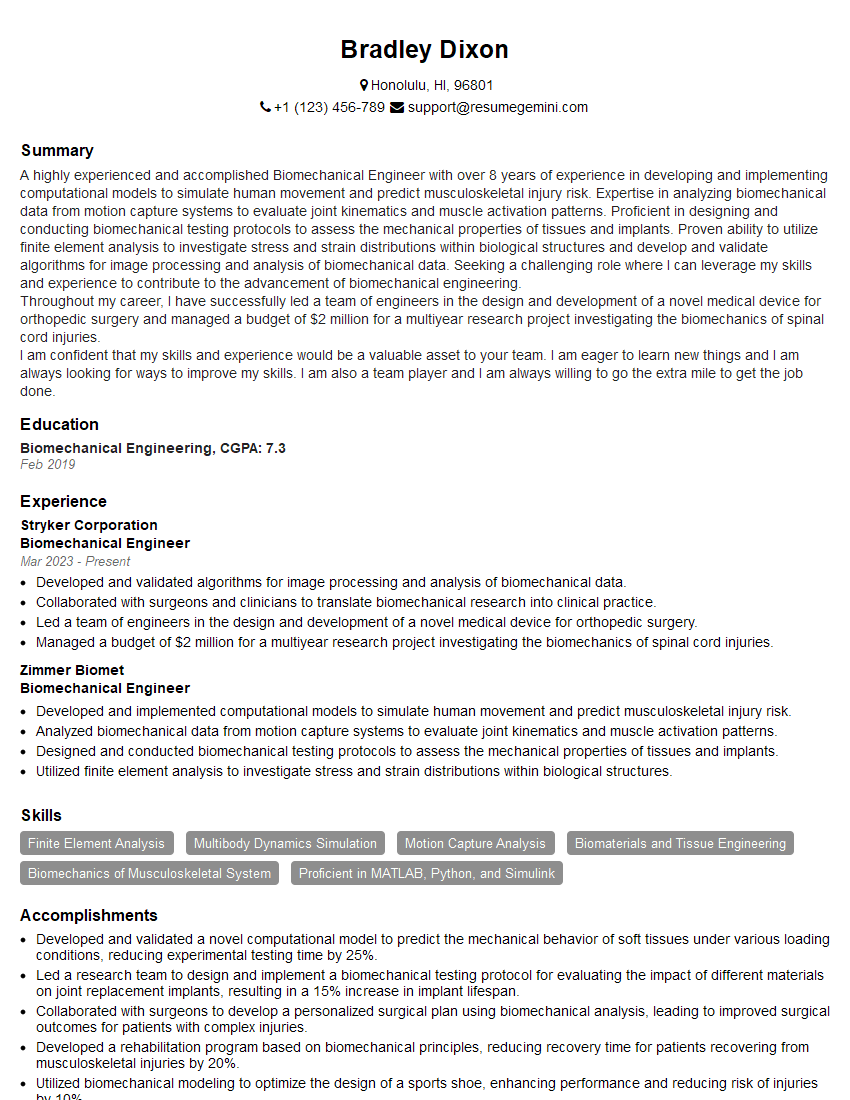
Mastering Body Structure Design opens doors to exciting and impactful careers in fields like prosthetics, orthotics, ergonomics, and human-computer interaction. A strong understanding of these principles is highly sought after by employers. To significantly improve your job prospects, create a compelling and ATS-friendly resume that showcases your skills and experience effectively. We highly recommend using ResumeGemini, a trusted resource for building professional resumes. ResumeGemini offers examples of resumes tailored to Body Structure Design to help you craft a winning application.
Explore more articles
Users Rating of Our Blogs
Share Your Experience
We value your feedback! Please rate our content and share your thoughts (optional).
What Readers Say About Our Blog
Attention music lovers!
Wow, All the best Sax Summer music !!!
Spotify: https://open.spotify.com/artist/6ShcdIT7rPVVaFEpgZQbUk
Apple Music: https://music.apple.com/fr/artist/jimmy-sax-black/1530501936
YouTube: https://music.youtube.com/browse/VLOLAK5uy_noClmC7abM6YpZsnySxRqt3LoalPf88No
Other Platforms and Free Downloads : https://fanlink.tv/jimmysaxblack
on google : https://www.google.com/search?q=22+AND+22+AND+22
on ChatGPT : https://chat.openai.com?q=who20jlJimmy20Black20Sax20Producer
Get back into the groove with Jimmy sax Black
Best regards,
Jimmy sax Black
www.jimmysaxblack.com
Hi I am a troller at The aquatic interview center and I suddenly went so fast in Roblox and it was gone when I reset.
Hi,
Business owners spend hours every week worrying about their website—or avoiding it because it feels overwhelming.
We’d like to take that off your plate:
$69/month. Everything handled.
Our team will:
Design a custom website—or completely overhaul your current one
Take care of hosting as an option
Handle edits and improvements—up to 60 minutes of work included every month
No setup fees, no annual commitments. Just a site that makes a strong first impression.
Find out if it’s right for you:
https://websolutionsgenius.com/awardwinningwebsites
Hello,
we currently offer a complimentary backlink and URL indexing test for search engine optimization professionals.
You can get complimentary indexing credits to test how link discovery works in practice.
No credit card is required and there is no recurring fee.
You can find details here:
https://wikipedia-backlinks.com/indexing/
Regards
NICE RESPONSE TO Q & A
hi
The aim of this message is regarding an unclaimed deposit of a deceased nationale that bears the same name as you. You are not relate to him as there are millions of people answering the names across around the world. But i will use my position to influence the release of the deposit to you for our mutual benefit.
Respond for full details and how to claim the deposit. This is 100% risk free. Send hello to my email id: lukachachibaialuka@gmail.com
Luka Chachibaialuka
Hey interviewgemini.com, just wanted to follow up on my last email.
We just launched Call the Monster, an parenting app that lets you summon friendly ‘monsters’ kids actually listen to.
We’re also running a giveaway for everyone who downloads the app. Since it’s brand new, there aren’t many users yet, which means you’ve got a much better chance of winning some great prizes.
You can check it out here: https://bit.ly/callamonsterapp
Or follow us on Instagram: https://www.instagram.com/callamonsterapp
Thanks,
Ryan
CEO – Call the Monster App
Hey interviewgemini.com, I saw your website and love your approach.
I just want this to look like spam email, but want to share something important to you. We just launched Call the Monster, a parenting app that lets you summon friendly ‘monsters’ kids actually listen to.
Parents are loving it for calming chaos before bedtime. Thought you might want to try it: https://bit.ly/callamonsterapp or just follow our fun monster lore on Instagram: https://www.instagram.com/callamonsterapp
Thanks,
Ryan
CEO – Call A Monster APP
To the interviewgemini.com Owner.
Dear interviewgemini.com Webmaster!
Hi interviewgemini.com Webmaster!
Dear interviewgemini.com Webmaster!
excellent
Hello,
We found issues with your domain’s email setup that may be sending your messages to spam or blocking them completely. InboxShield Mini shows you how to fix it in minutes — no tech skills required.
Scan your domain now for details: https://inboxshield-mini.com/
— Adam @ InboxShield Mini
support@inboxshield-mini.com
Reply STOP to unsubscribe
Hi, are you owner of interviewgemini.com? What if I told you I could help you find extra time in your schedule, reconnect with leads you didn’t even realize you missed, and bring in more “I want to work with you” conversations, without increasing your ad spend or hiring a full-time employee?
All with a flexible, budget-friendly service that could easily pay for itself. Sounds good?
Would it be nice to jump on a quick 10-minute call so I can show you exactly how we make this work?
Best,
Hapei
Marketing Director
Hey, I know you’re the owner of interviewgemini.com. I’ll be quick.
Fundraising for your business is tough and time-consuming. We make it easier by guaranteeing two private investor meetings each month, for six months. No demos, no pitch events – just direct introductions to active investors matched to your startup.
If youR17;re raising, this could help you build real momentum. Want me to send more info?
Hi, I represent an SEO company that specialises in getting you AI citations and higher rankings on Google. I’d like to offer you a 100% free SEO audit for your website. Would you be interested?
Hi, I represent an SEO company that specialises in getting you AI citations and higher rankings on Google. I’d like to offer you a 100% free SEO audit for your website. Would you be interested?