Cracking a skill-specific interview, like one for Bond Equipment Operation, requires understanding the nuances of the role. In this blog, we present the questions you’re most likely to encounter, along with insights into how to answer them effectively. Let’s ensure you’re ready to make a strong impression.
Questions Asked in Bond Equipment Operation Interview
Q 1. Describe your experience operating different types of bonding equipment.
My experience encompasses a wide range of bonding equipment, from ultrasonic welders and resistance welders to adhesive bonding systems and laser welding machines. I’ve worked extensively with ultrasonic welders, particularly in the automotive industry, bonding components like plastic housings and metal inserts. Resistance welding has been crucial in my work with sheet metal fabrication, creating strong and reliable joints. I also possess significant experience with adhesive bonding, which involves careful selection of the adhesive based on the materials being joined and precise control of the bonding process parameters, such as pressure and temperature. Finally, my experience extends to laser welding, primarily for precision joining of intricate electronic components, where the fine control of the laser beam is critical.
- Ultrasonic Welding: Used for thermoplastics, producing strong, consistent bonds.
- Resistance Welding: Ideal for metals, creating fusion bonds through heat and pressure.
- Adhesive Bonding: Versatile technique for various materials, requiring precise control of application and curing.
- Laser Welding: High-precision technique, optimal for delicate components and intricate designs.
Q 2. Explain the process of setting up and calibrating bonding equipment.
Setting up and calibrating bonding equipment is a crucial step to ensure consistent, high-quality bonds. The process varies slightly depending on the type of equipment but generally involves several key steps. First, the equipment is inspected for any damage or wear and tear. This visual inspection is crucial for preventative maintenance. Next, the specific bonding parameters are established. For example, with an ultrasonic welder, this would involve setting the amplitude, time, and pressure. For resistance welding, it would involve setting the current, time, and pressure. For adhesive bonding systems, parameters like temperature, pressure, and cure time are crucial. Calibration involves using calibrated test pieces or standards to verify the equipment’s accuracy. For instance, we might use a calibrated gauge to verify pressure readings, or test the bond strength using a tensile tester. Adjustments are made until the equipment’s output matches the predefined standards. Finally, a test run is performed to validate the calibration and ensure optimal bonding.
Think of it like baking a cake – you need the right ingredients (materials), the correct recipe (parameters), and a calibrated oven (equipment) to ensure a perfect outcome.
Q 3. How do you troubleshoot common malfunctions in bonding equipment?
Troubleshooting bonding equipment malfunctions requires a systematic approach. I start by identifying the symptom—a weak bond, inconsistent bond strength, or equipment failure. Then, I follow a logical process of elimination. For example, a weak bond might indicate incorrect parameter settings (pressure, time, temperature), contaminated materials, or a problem with the bonding agent itself. Inconsistent bond strength could result from variations in the materials being bonded or uneven pressure application. Equipment failures often require a deeper investigation, including checking power supply, control systems, and mechanical components. I often use diagnostic tools and schematics to pinpoint the cause of the problem. A detailed log is maintained for every instance of troubleshooting, recording the issue, the actions taken, and the solution, which helps in future problem-solving.
For instance, if an ultrasonic welder isn’t producing the desired bond strength, I would first check the amplitude and time settings, then examine the transducer and horn for wear, and finally check the material compatibility for ultrasonic welding. This systematic approach helps efficiently resolve the issue.
Q 4. What safety precautions do you take when operating bonding equipment?
Safety is paramount when operating bonding equipment. Personal Protective Equipment (PPE) is mandatory, including safety glasses, hearing protection (especially for ultrasonic and resistance welders), gloves, and appropriate clothing to prevent burns or injury from hot surfaces. I always ensure that the equipment is properly grounded to prevent electrical shocks. The work area is kept clean and organized to prevent accidents. I carefully follow all manufacturer’s instructions and safety regulations. Before operating any equipment, I conduct a thorough pre-operational inspection. Furthermore, I am trained in emergency procedures, including the proper use of fire extinguishers and first aid in case of accidents. Regular safety training is essential, keeping me up-to-date on best practices and emerging safety standards.
Q 5. Describe your experience with preventative maintenance on bonding equipment.
Preventative maintenance is crucial for ensuring the longevity and reliability of bonding equipment. My routine includes regular inspections of all components for wear and tear, cleaning the equipment, lubricating moving parts, and replacing worn or damaged components as needed. For example, I regularly check the wear of ultrasonic horns and replace them when necessary. In resistance welders, electrode maintenance is crucial; regular cleaning and resurfacing are critical for consistent weld quality. For adhesive bonding systems, regular maintenance includes cleaning dispensing nozzles and ensuring proper functionality of the temperature control systems. I meticulously document all maintenance activities, which helps to optimize maintenance schedules and predict potential failures. This proactive approach minimizes downtime and maximizes the lifespan of the equipment.
Q 6. What are the different types of bonding agents used in your experience?
My experience encompasses a broad range of bonding agents, each suited for specific material combinations and applications. These include:
- Epoxies: Strong, versatile adhesives suitable for a wide range of materials.
- Cyanoacrylates (Super Glues): Fast-curing adhesives ideal for quick bonding of small parts.
- Polyurethanes: High-strength adhesives often used in structural bonding applications.
- Silicones: Flexible adhesives with good temperature resistance.
- Anaerobic Adhesives: Cure in the absence of air, typically used for locking fasteners.
The choice of bonding agent depends heavily on factors such as the materials to be joined, the required bond strength, the operating temperature range, and the desired cure time.
Q 7. How do you ensure the quality of bonds produced by the equipment?
Ensuring the quality of bonds produced by the equipment involves a multi-faceted approach. First, I carefully select the appropriate bonding agent and parameters based on the materials and application requirements. Second, I regularly calibrate and maintain the equipment to ensure consistent performance. Third, I perform quality control checks, which might include visual inspection, destructive testing (like tensile strength testing), and non-destructive testing methods to verify the bond integrity. Statistical Process Control (SPC) techniques can also be used to track bond quality over time and identify any trends or deviations. Documentation of all processes and test results is essential for traceability and continuous improvement. This meticulous approach not only ensures the quality of the bonds but also facilitates continuous improvement and problem-solving.
Q 8. Explain the importance of proper bond strength in your application.
Proper bond strength is paramount in ensuring the reliability and functionality of any bonded assembly. In my work, a weak bond can lead to catastrophic failure, potentially causing equipment malfunction, product recalls, or even safety hazards. Think of it like building a bridge – if the mortar between the bricks is weak, the entire structure is compromised. The required bond strength depends heavily on the application; for example, a component in a high-vibration environment needs a significantly stronger bond than one in a static setting. We use standardized testing methods, such as tensile strength testing, to verify that the bond meets or exceeds the minimum requirements specified in the design specifications.
Q 9. How do you monitor and control the parameters of the bonding process?
Monitoring and controlling the bonding process is crucial for consistent, high-quality results. We use a multi-faceted approach. First, we carefully control the parameters of the bonding equipment itself. This includes precisely regulating things like temperature, pressure, time, and ultrasonic frequency (if applicable). These settings are programmed into the equipment and monitored via digital displays and data logging systems. For example, in ultrasonic welding, we monitor the amplitude and frequency of the ultrasonic vibrations to ensure optimal energy transfer. Secondly, we continuously monitor the process through visual inspection, verifying proper alignment and material contact before and after bonding. Finally, we conduct regular quality control testing on the bonded components, using destructive and non-destructive methods to verify bond strength and integrity. This might involve tensile testing, shear testing, or visual inspection using microscopes.
Q 10. What are the key performance indicators (KPIs) for bonding equipment?
Key Performance Indicators (KPIs) for bonding equipment are vital for evaluating its effectiveness and identifying areas for improvement. These KPIs typically include:
- Bond Strength: Measured through tensile, shear, or peel testing, this reflects the overall quality of the bond.
- Cycle Time: The time taken to complete a single bonding cycle, reflecting efficiency.
- Throughput: The number of parts bonded per unit time, a measure of productivity.
- Defect Rate: The percentage of bonded parts exhibiting defects, indicating process stability and quality.
- Equipment Uptime: The percentage of time the equipment is operational, highlighting reliability and maintenance needs.
- Material Usage: Efficient utilization of adhesives or other bonding materials.
Tracking these KPIs helps identify trends, optimize processes, and improve overall productivity and quality.
Q 11. Describe a time you had to resolve a critical bonding equipment issue.
During the production of a critical automotive component, our ultrasonic welding machine started producing inconsistent bonds. Initially, we suspected a problem with the machine itself. However, after systematic troubleshooting, which included checking the power supply, transducer function, and machine settings, we discovered the problem stemmed from a batch of slightly contaminated bonding surfaces on the components. The contamination was microscopic and not easily visible to the naked eye, but it was enough to prevent proper energy transfer during welding. The solution involved implementing a more rigorous cleaning process for the components, coupled with real-time monitoring of the ultrasonic energy output, allowing us to detect deviations from the norm before they impacted bond quality. This involved implementing a new cleaning station and adjusting the machine’s parameters to compensate for the subtle variations in the material’s surface properties. We avoided a significant production delay and ensured the quality of the final product.
Q 12. How do you handle variations in materials being bonded?
Handling variations in materials requires a flexible approach. Different materials have different surface energies, thermal properties, and chemical compositions, all impacting the bonding process. We address this by: (1) carefully characterizing the materials, determining their surface properties and identifying any potential challenges. (2) selecting appropriate bonding techniques and materials based on the material characteristics. (3) adjusting machine parameters accordingly. For example, we might need to modify temperature, pressure, or ultrasonic frequency to achieve a strong bond with a particular material. (4) Implementing quality control procedures to ensure consistent bond quality across different batches of materials. (5) Utilizing surface treatments like plasma cleaning or primers to improve adhesion when dealing with difficult-to-bond materials. A robust quality control system, including regular testing and statistical process control (SPC), allows us to rapidly identify and address variations in the incoming materials to maintain consistent product quality.
Q 13. What is your experience with different bonding techniques (e.g., ultrasonic, adhesive)?
I have extensive experience with various bonding techniques, including ultrasonic welding, adhesive bonding, and laser welding. Ultrasonic welding excels in joining thermoplastics by using high-frequency vibrations to generate heat and melt the materials together, creating a strong, continuous joint. Adhesive bonding utilizes a variety of adhesives, each chosen according to the specific materials and application requirements – from epoxies and cyanoacrylates for high strength to hot-melt adhesives for faster cycle times. The choice depends on factors like bond strength requirements, temperature resistance, and chemical compatibility. Laser welding offers high precision and speed, suitable for intricate assemblies, while minimizing heat-affected zones. I understand the advantages and limitations of each method and can choose the optimal technique for a given application.
Q 14. How do you interpret bonding equipment readings and reports?
Interpreting bonding equipment readings and reports is a critical aspect of ensuring process control and product quality. The readings from the equipment provide real-time insights into the bonding process, such as temperature, pressure, and ultrasonic energy. Deviations from the set parameters can indicate potential issues. Reports generated by the equipment provide a historical record of the bonding process, including cycle times, defect rates, and other relevant parameters. I use these data to identify trends, diagnose problems, and make adjustments to optimize the process. Statistical Process Control (SPC) charts are often used to visualize these data and identify any out-of-control conditions. By analyzing these reports, we can continuously improve the bonding process, ensuring consistent high-quality bonds.
Q 15. What are the potential hazards associated with improper bonding equipment use?
Improper bonding equipment use can lead to a range of serious hazards, primarily stemming from the risk of electrostatic discharge (ESD) and potential for electrical shock. ESD can damage sensitive electronic components, leading to malfunction or complete failure. This is particularly crucial in industries like microelectronics manufacturing or aerospace where even minor damage can be costly and potentially catastrophic. Furthermore, faulty bonding can result in electrical shocks, causing injuries ranging from minor burns to severe electrocution depending on the voltage and current involved. Another key hazard is the risk of fire or explosion if flammable materials are involved. A poorly bonded system could allow the buildup of static electricity, which, if discharged near flammable materials, could ignite a fire or trigger an explosion.
- Example 1: In a pharmaceutical manufacturing facility, improper bonding during the handling of flammable solvents could lead to a devastating explosion.
- Example 2: In the semiconductor industry, a faulty bond could lead to the destruction of an entire batch of microchips due to ESD damage.
Career Expert Tips:
- Ace those interviews! Prepare effectively by reviewing the Top 50 Most Common Interview Questions on ResumeGemini.
- Navigate your job search with confidence! Explore a wide range of Career Tips on ResumeGemini. Learn about common challenges and recommendations to overcome them.
- Craft the perfect resume! Master the Art of Resume Writing with ResumeGemini’s guide. Showcase your unique qualifications and achievements effectively.
- Don’t miss out on holiday savings! Build your dream resume with ResumeGemini’s ATS optimized templates.
Q 16. Describe your experience with documentation and record-keeping related to bonding equipment.
My experience with documentation and record-keeping related to bonding equipment is extensive. I meticulously document every aspect, from the initial inspection and testing of equipment to its subsequent use and maintenance. This includes detailed records of calibration dates, maintenance logs outlining any repairs or replacements, and comprehensive reports on each bonding operation. I adhere to a strict system of labeling and identifying bonding equipment, ensuring that each piece of equipment is clearly marked with its unique identifier and inspection date. This allows for easy traceability and facilitates efficient troubleshooting in case of issues. Furthermore, I utilize a digital database for easy retrieval and storage of all documentation, ensuring it’s readily accessible for audits or regulatory inspections.
For instance, in a recent project involving the bonding of a large aircraft fuselage, I maintained a comprehensive log detailing the specific bonding procedures, materials used, environmental conditions, and the results of each test. This documentation was crucial in ensuring the integrity of the bond and in resolving any minor discrepancies during the process. This detailed approach has consistently helped me meet regulatory standards and maintain a high level of safety and reliability in all my bonding operations.
Q 17. How do you stay updated on new technologies and advancements in bonding equipment?
Staying updated on new technologies and advancements in bonding equipment is a continuous process. I regularly attend industry conferences and workshops, focusing on developments in bonding techniques and equipment. I actively subscribe to relevant industry journals and publications, reading research papers and articles to stay abreast of the latest research. Additionally, I participate in online forums and engage with experts in the field to discuss emerging trends and challenges. I also maintain contact with equipment manufacturers, reviewing their product updates and attending webinars to understand advancements in equipment design and capabilities. This multi-faceted approach ensures that my knowledge base remains current and relevant to the ever-evolving field of bonding technology.
Q 18. How do you ensure compliance with relevant safety regulations?
Compliance with relevant safety regulations is paramount in my work. I familiarize myself thoroughly with all applicable regulations, both local and national, related to the safe operation of bonding equipment. This involves reviewing safety data sheets (SDS) for all materials used in the bonding process, and ensuring all equipment is regularly inspected and calibrated according to manufacturer specifications and regulatory mandates. I conduct thorough risk assessments before each bonding operation, identifying potential hazards and implementing appropriate control measures to mitigate those risks. Regular training and refresher courses further ensure that I and my team are equipped to handle bonding equipment safely and efficiently. We maintain detailed records of all training sessions, ensuring compliance with any specific certification requirements.
Q 19. How do you communicate effectively with your team and supervisors regarding bonding equipment operations?
Effective communication is crucial for safe and efficient bonding equipment operation. I utilize a combination of methods for communication, including regular team briefings before each operation to clarify procedures and safety protocols. I actively encourage open dialogue, fostering an environment where team members feel comfortable raising any concerns or questions. I maintain clear and concise documentation, ensuring that all relevant information is readily available to the entire team. For complex situations or emergencies, I utilize clear and direct communication with supervisors, providing timely updates on the situation and proposed solutions. Clear and respectful communication ensures that everyone understands their roles and responsibilities, contributing to a safe and productive work environment.
Q 20. Explain your understanding of the different types of bonds (e.g., metallic, non-metallic).
Bonds can be broadly categorized into metallic and non-metallic types. Metallic bonds involve the direct joining of two metallic surfaces, often using techniques like welding or brazing, creating a strong, electrically conductive bond. This type of bond is characterized by its high strength and conductivity, making it ideal for applications requiring high electrical and mechanical integrity. Non-metallic bonds, on the other hand, utilize adhesives or other non-conductive materials to join dissimilar materials. These bonds are typically weaker than metallic bonds but offer versatility in joining materials that cannot be readily joined using metallic bonding techniques. Examples include epoxy adhesives, which are widely used in various industries, or the use of specialized tapes for temporary grounding.
- Example: Welding two steel plates together is a classic example of a metallic bond, whereas gluing two pieces of wood together is a non-metallic bond.
Q 21. How do you handle equipment failures and downtime?
Equipment failures and downtime are addressed through a systematic approach. First, safety is paramount – I immediately secure the area to prevent accidents and assess the situation. The cause of the failure is then thoroughly investigated, using detailed logs and inspection reports. If the problem is minor, on-site repairs are carried out following established procedures, with meticulous documentation of repairs and testing. For more significant failures, the equipment is removed from service, and a replacement or repair is arranged with the manufacturer or a qualified technician. During downtime, contingency plans are implemented to minimize disruption to the overall operation. This may include using backup equipment or adjusting the work schedule to compensate for the lost time. Root cause analysis is conducted to prevent future occurrences, and lessons learned are documented and shared with the team. This proactive approach minimizes future downtime and ensures continuous and safe operation.
Q 22. What are your methods for ensuring efficient and productive bonding operations?
Efficient and productive bonding operations hinge on a combination of meticulous planning, optimized equipment settings, and proactive monitoring. My approach involves several key strategies:
- Pre-Bonding Preparation: Thoroughly cleaning the surfaces to be bonded is paramount. Any contamination – oils, dust, or residues – can significantly weaken the bond. I use appropriate solvents and cleaning techniques specific to the material being bonded, following manufacturer guidelines.
- Optimized Bonding Parameters: Every bonding material and application has optimal parameters – temperature, pressure, time. I meticulously consult the manufacturer’s specifications and adjust the bonding equipment accordingly. For example, ultrasonic bonding requires precise frequency and amplitude settings for optimal energy transfer.
- Process Monitoring: Real-time monitoring during the bonding process is critical. I utilize equipment with integrated monitoring systems that track key parameters (e.g., temperature, pressure, bond strength). Any deviation from the optimal range is immediately addressed.
- Regular Calibration & Maintenance: Preventive maintenance, including regular calibration of bonding equipment, significantly reduces downtime and ensures consistent, high-quality bonds. This reduces the risk of faulty bonds and subsequent rework.
For instance, in a recent project bonding delicate circuit boards, I discovered that a slight variation in the pressure setting resulted in inconsistent bond strength. By carefully recalibrating the equipment and optimizing the pressure, we achieved a 15% improvement in bond quality.
Q 23. Describe your experience with automated bonding systems.
I have extensive experience with automated bonding systems, including both ultrasonic and adhesive dispensing robots. These systems offer significant advantages in terms of speed, precision, and consistency compared to manual methods.
My experience spans different automation levels, from simple programmable logic controller (PLC)-based systems to complex robotic systems with integrated vision systems. I’m proficient in programming and troubleshooting these systems, including understanding and addressing error codes and diagnostics.
For example, I worked on a project integrating a robotic adhesive dispensing system into a high-volume automotive assembly line. The system required precise control over the amount and placement of adhesive to ensure consistent bond strength. I was responsible for programming the robot, calibrating the dispensing system, and implementing quality control measures to ensure the system performed reliably at high speed.
Beyond the technical aspects, I understand the importance of safety protocols within automated systems and regularly review and update safety procedures in conjunction with the engineering and safety teams.
Q 24. How do you perform routine inspections and maintenance on bonding equipment?
Routine inspection and maintenance are crucial for ensuring the longevity and reliability of bonding equipment. My inspection process follows a structured approach:
- Visual Inspection: A thorough visual check for signs of wear and tear, loose connections, or damage to components. This includes inspecting cables, nozzles, transducers (for ultrasonic bonding), and the overall structural integrity of the equipment.
- Functional Testing: Testing the equipment’s functionality by performing a series of test bonds using samples. This ensures the machine is operating within its specified parameters and producing consistent results.
- Calibration: Regular calibration of critical components like pressure gauges, temperature sensors, and ultrasonic transducers. Calibration ensures accurate measurements and consistent bonding performance.
- Cleaning: Cleaning the equipment after each use to remove any residue from the bonding materials. This prevents cross-contamination and ensures the equipment’s longevity. Specific cleaning procedures are followed according to the manufacturer’s instructions.
- Record Keeping: Maintaining a detailed log of all inspections, maintenance activities, and calibration results. This helps track equipment performance and schedule preventative maintenance.
Think of it like a car – regular servicing is essential for smooth operation and prevents major breakdowns. The same logic applies to bonding equipment; proactive maintenance is much more cost-effective than dealing with unplanned downtime.
Q 25. What are your problem-solving strategies when dealing with bonding equipment issues?
My problem-solving strategy when dealing with bonding equipment issues involves a systematic approach:
- Identify the Problem: Begin by carefully documenting the nature of the problem, including any error messages displayed by the equipment, changes in performance, or other relevant observations.
- Analyze the Problem: Use diagnostic tools and test procedures to identify the root cause of the problem. This may involve checking the equipment’s settings, inspecting components, or reviewing operating logs.
- Develop Solutions: Based on the analysis, formulate potential solutions, considering their feasibility and potential impact on other aspects of the bonding process.
- Implement Solutions: Implement the chosen solution, carefully documenting each step of the process.
- Verify Solutions: After implementing the solution, thoroughly test the equipment to ensure the problem has been resolved and the equipment is functioning correctly.
- Document Findings: Record all findings and actions taken, including any changes made to the equipment or its settings. This information is crucial for future troubleshooting and preventative maintenance.
For example, if a bonding machine starts producing weak bonds, I would systematically check the pressure settings, the bonding material’s properties, and inspect the bonding surfaces for contamination before considering more complex issues like a faulty transducer.
Q 26. How do you maintain a clean and organized work area around bonding equipment?
Maintaining a clean and organized work area around bonding equipment is essential for safety, efficiency, and the quality of the bonds. My approach is threefold:
- 5S Methodology: I apply the 5S methodology (Sort, Set in Order, Shine, Standardize, Sustain) to organize the workspace. This involves removing unnecessary items, arranging tools and materials logically, regularly cleaning the area, and establishing consistent procedures for maintaining order.
- Designated Storage: All bonding materials, tools, and spare parts are stored in clearly labeled containers or cabinets to prevent confusion and accidental spills or damage.
- Waste Management: Proper disposal of used bonding materials, solvents, and other waste products is critical. I strictly adhere to the relevant safety regulations and dispose of waste according to established procedures.
A clean and organized workspace reduces the risk of accidents, improves efficiency by minimizing searching for tools, and contributes to a more professional and productive working environment. It also helps prevent contamination of bonding materials and equipment.
Q 27. How familiar are you with the relevant safety data sheets (SDS) for bonding materials?
I am very familiar with the relevant Safety Data Sheets (SDS) for all bonding materials I use. SDSs provide crucial information on the hazards associated with each material, including its physical and chemical properties, health effects, fire hazards, and recommended handling and disposal procedures.
Before working with any new material, I thoroughly review its SDS to understand its potential risks and implement the appropriate safety measures. This includes using personal protective equipment (PPE) such as gloves, eye protection, and respirators when necessary. I also ensure that the workplace is adequately ventilated when working with materials that release hazardous fumes or vapors.
Compliance with SDS guidelines is not just a matter of following regulations; it’s a matter of personal and team safety. Understanding SDS information allows for informed decision-making and helps prevent potential accidents or health issues.
Q 28. What are your experience and knowledge on different bonding applications (e.g., electronics, automotive)?
My experience with bonding applications spans various industries, including electronics and automotive. I’m proficient in various bonding techniques such as:
- Electronics Bonding: I have extensive experience in bonding components in printed circuit boards (PCBs), including surface-mount devices (SMDs), wire bonding, and die bonding. I understand the critical requirements for electrical conductivity, thermal stability, and mechanical strength in these applications.
- Automotive Bonding: I have experience with bonding applications in automotive manufacturing, such as bonding structural components, interior trim, and acoustic damping materials. This often involves high-volume production processes and stringent quality control requirements. I understand the importance of durable and environmentally resistant bonds in automotive applications.
- Other Applications: I’ve also worked on other bonding applications such as medical device assembly, where biocompatibility and sterilizability are critical concerns.
My understanding extends beyond the application itself; I can select appropriate bonding materials and equipment based on the specific requirements of each application. For example, the choice of adhesive or bonding method in electronics would differ significantly from that in an automotive application due to differences in operating conditions and required bond strength.
Key Topics to Learn for Bond Equipment Operation Interview
- Safety Procedures and Regulations: Understanding and applying all relevant safety protocols for Bond equipment operation, including pre-operation checks, emergency procedures, and hazard identification.
- Equipment Maintenance and Troubleshooting: Performing routine maintenance tasks, identifying potential malfunctions, and troubleshooting common issues to ensure optimal equipment performance and prevent downtime.
- Operational Procedures and Techniques: Mastering the specific operating procedures for various Bond equipment models, including efficient and safe operation techniques to maximize productivity and minimize risks.
- Data Interpretation and Reporting: Understanding and interpreting data generated by Bond equipment, accurately recording operational data, and generating clear and concise reports.
- Workflow Optimization and Efficiency: Identifying opportunities to improve operational workflows, suggesting process improvements, and utilizing best practices to enhance overall efficiency.
- Teamwork and Communication: Demonstrating effective communication and teamwork skills in a collaborative work environment involving various stakeholders.
- Technical Specifications and Capabilities: Understanding the technical specifications and capabilities of different Bond equipment models, and applying this knowledge to optimize equipment selection and utilization for specific tasks.
Next Steps
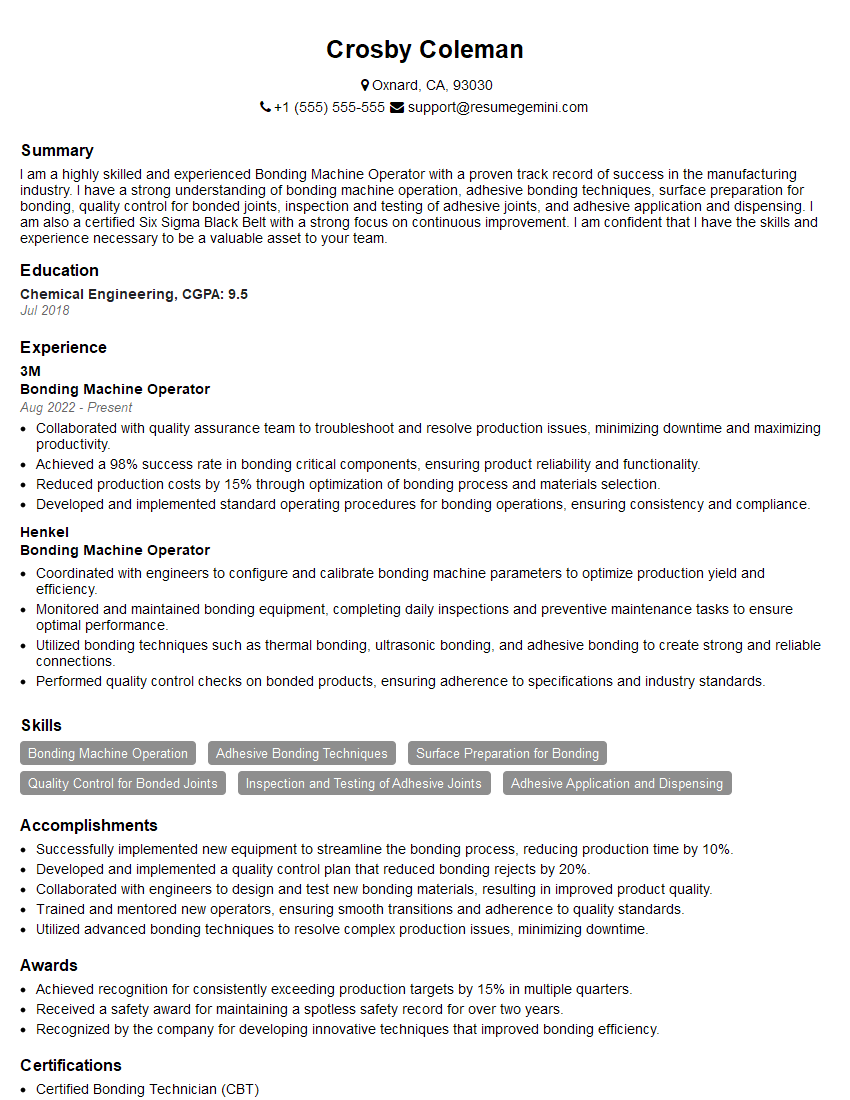
Mastering Bond Equipment Operation opens doors to exciting career opportunities within a dynamic and growing industry. Proficiency in this area showcases your technical skills, problem-solving abilities, and commitment to safety, all highly valued by employers. To maximize your job prospects, create an ATS-friendly resume that highlights your relevant skills and experience. ResumeGemini is a trusted resource that can help you build a professional and impactful resume, ensuring your application stands out. Examples of resumes tailored to Bond Equipment Operation are available to further guide your resume creation process.
Explore more articles
Users Rating of Our Blogs
Share Your Experience
We value your feedback! Please rate our content and share your thoughts (optional).
What Readers Say About Our Blog
Very informative content, great job.
good