Preparation is the key to success in any interview. In this post, we’ll explore crucial Bouquet Creation interview questions and equip you with strategies to craft impactful answers. Whether you’re a beginner or a pro, these tips will elevate your preparation.
Questions Asked in Bouquet Creation Interview
Q 1. Describe your experience with various floral arrangements (e.g., hand-tied, cascade, round).
My experience encompasses a wide range of floral arrangement styles. Hand-tied bouquets, for instance, require a delicate balance of technique and artistry. I carefully select stems, considering their texture, color, and length, to create a naturally flowing, almost organic form. The process involves holding the stems in one hand while gradually adding more, using floral tape to secure the arrangement as I go. This requires a keen eye for balance and proportion. Cascade bouquets, on the other hand, demand a more structured approach. Their dramatic, cascading shape requires strong, sturdy stems and careful placement to achieve a graceful, weeping effect. They often incorporate trailing greenery and flowers to emphasize the downward flow. Finally, round bouquets offer a classic elegance, achieved through careful layering and shaping. I focus on creating a symmetrical, balanced arrangement, with flowers and greenery strategically placed to create visual interest and depth. Each style presents unique challenges and rewards, demanding both skill and creative vision.
Q 2. Explain your knowledge of different flower types, their care, and longevity.
A deep understanding of flower types is crucial. Roses, for example, are renowned for their beauty but require careful handling to prevent damage to their delicate petals. Hydrangeas are stunning but need consistent watering to maintain their hydration. Tulips are known for their vibrant colors but need proper hydration and support, otherwise their stems will bend. Lilies boast a powerful fragrance but their pollen can stain, so careful placement is key. I take into account the various needs of each flower— their water requirements, optimal temperature, and susceptibility to wilting — to ensure longevity. For instance, I avoid combining flowers with differing water requirements in the same vase to ensure they all remain fresh for as long as possible. Knowing the characteristics of different flowers allows me to create arrangements that will remain vibrant and beautiful for the desired duration.
Q 3. How do you choose the appropriate flowers and foliage for a specific event or occasion?
Selecting the appropriate flowers and foliage depends heavily on the event’s theme and mood. A wedding, for example, might call for elegant roses and lilies, perhaps incorporating seasonal blooms for a fresh touch. For a rustic barn wedding, wildflowers and more textural elements, such as seeded eucalyptus and Queen Anne’s Lace, would be more suitable. A corporate event might require a more modern and minimalist approach, emphasizing clean lines and monochromatic color palettes, perhaps with orchids and calla lilies. Considering the client’s preferences, the venue, and the overall atmosphere helps guide my selection, ensuring the floral arrangements perfectly complement the occasion.
Q 4. Describe your process for creating a cohesive color palette in a bouquet.
Creating a cohesive color palette is an art in itself. I often start with the client’s preferences, their chosen color schemes, and the overall theme of the event. From there, I develop a palette using the color wheel as a guide. I might choose analogous colors (colors next to each other on the wheel), complementary colors (colors opposite each other), or a monochromatic scheme (various shades of one color). For instance, a wedding with a blush pink and ivory theme might incorporate various shades of pink, from pale blush to deeper rose, alongside creamy white and soft green accents. The key is to create a harmonious blend that enhances the overall aesthetic without overwhelming the senses. I also consider the flowers’ natural hues and textures to make sure the chosen colors work together organically.
Q 5. What are some common techniques for preserving the freshness of flowers?
Preserving flower freshness is paramount. This starts with proper handling from the moment the flowers arrive. I ensure they are immediately placed in clean water with flower food. Regularly changing the water and trimming the stems at an angle to remove any air pockets are essential. Maintaining optimal temperatures, away from direct sunlight and heat sources, is crucial. Using a flower preservative solution, carefully following its instructions, significantly extends the flowers’ life. These steps ensure the bouquets stay fresh and vibrant for their intended period.
Q 6. Explain your experience with different floral design styles (e.g., modern, traditional, rustic).
My experience spans various floral design styles. Traditional styles often incorporate classic flowers like roses and lilies, arranged in structured, symmetrical designs. Modern styles, in contrast, embrace asymmetry and bold color combinations. I use unusual textures and shapes to create unique and unexpected pieces. Rustic styles draw inspiration from nature, using wildflowers, greenery, and natural materials like wood and burlap. I often combine these elements into unique designs to suit my client’s tastes, tailoring each arrangement to their specific vision. For instance, a modern arrangement might use geometric shapes and strong lines, whereas a rustic arrangement might incorporate wildflowers with natural, unprocessed elements for a more informal, organic look.
Q 7. How do you manage time effectively when creating multiple bouquets simultaneously?
Managing time effectively when creating multiple bouquets simultaneously requires meticulous planning and efficient workflow. I begin by organizing my workspace, arranging all necessary supplies and flowers within easy reach. I then prioritize tasks based on deadlines and complexity. Often I’ll assemble simple arrangements alongside more complex ones, alternating between them to maintain momentum. Pre-cutting stems and prepping flowers ahead of time saves valuable time during the arrangement process. It is important to ensure that a quality control check happens for each arrangement before handing off to the delivery team. This organized approach allows me to create multiple beautiful arrangements within the given time constraints, maintaining a high standard of quality.
Q 8. How do you handle client requests that conflict with your design aesthetic?
Balancing client requests with my design aesthetic is a crucial aspect of my work. I believe in collaborative design, so I begin by actively listening to the client’s vision, understanding their preferences for color palettes, flower types, and overall style. I then gently guide them, offering suggestions and alternatives that align with both their vision and my expertise in creating aesthetically pleasing and long-lasting arrangements. For instance, if a client requests a very trendy but potentially short-lived arrangement, I’ll suggest incorporating some longer-lasting elements to maintain the visual appeal for a longer period. This collaborative approach ensures the client feels heard while receiving a high-quality arrangement that reflects both their desires and my design principles. If a request is truly incompatible with my design philosophy (e.g., using materials that are environmentally unsustainable), I will have an open and honest conversation, suggesting alternative solutions or, if necessary, respectfully declining the commission. Transparency is key in maintaining positive client relationships.
Q 9. Describe your experience working with various types of vases and containers.
My experience spans a wide range of vases and containers, from classic crystal vases and elegant ceramic urns to rustic wooden boxes and modern metal vessels. Understanding the unique properties of each container is vital for creating a cohesive and balanced arrangement. For instance, a tall, slender vase lends itself beautifully to a cascading design using long-stemmed flowers like delphiniums or lisianthus. In contrast, a wide, shallow bowl is perfect for a low, sprawling arrangement, showcasing the texture and color of flowers like succulents or roses. I also consider the material: a delicate glass vase might require a lighter arrangement to avoid breakage, while a sturdy ceramic urn can support heavier blooms and more robust designs. This understanding allows me to match the container to the flowers and design style flawlessly, enhancing the overall aesthetic appeal.
Q 10. What software or tools do you use for floral design (e.g., design programs, inventory management)?
While floral design is largely a hands-on process, I utilize several tools to streamline my workflow and enhance efficiency. For inventory management, I rely on a customized spreadsheet to track flower stock, supplier information, and order history. This helps me forecast demand, ensure timely ordering, and minimize waste. For design visualization, though not strictly necessary, sketching is an invaluable tool to plan the structure, balance, and color scheme of each arrangement. I also use a basic photo editing program to adjust lighting in photographs of completed arrangements, enabling effective presentation to clients. The most crucial tools, however, remain my hands and my keen eye for color, texture, and form. Technology serves to support, not replace, the artistry of floral design.
Q 11. Explain your process for creating a budget for a floral arrangement.
Creating a budget for a floral arrangement involves a detailed breakdown of costs. First, I identify the client’s requirements, including the type, quantity, and quality of flowers. Then, I obtain pricing from my suppliers for each element—this includes flowers, foliage, containers, ribbons, and any other embellishments. I meticulously calculate the cost of labor, factoring in the time required for sourcing, design, arrangement, and delivery. Next, I add a profit margin to cover overhead costs and ensure profitability. Finally, I present the client with a clear, itemized breakdown of the budget, ensuring transparency and allowing for adjustments based on their preferences and budget limitations. For example, if the client’s budget is limited, I may suggest substituting certain high-cost blooms with more affordable alternatives without compromising the aesthetic integrity of the design. This meticulous approach ensures both client satisfaction and business sustainability.
Q 12. How do you source your flowers and materials?
I source my flowers and materials from a combination of local growers, wholesalers, and specialized nurseries. Building strong relationships with these suppliers is key to ensuring consistent quality and availability. Local growers provide access to fresh, seasonal flowers, which often translates to richer colors and better longevity. Wholesalers offer a broader selection, particularly for less common or out-of-season varieties. Specialized nurseries are my go-to for unique foliage and unusual plant materials. I always prioritize sustainable practices, seeking out suppliers who employ environmentally friendly growing techniques. This dedication to ethical sourcing ensures both the quality of my arrangements and the environmental responsibility of my business. Moreover, maintaining strong relationships allows me to secure the freshest, highest-quality materials, leading to exquisite and long-lasting arrangements for my clients.
Q 13. Describe your experience with floral preservation techniques.
My experience with floral preservation techniques primarily focuses on extending the life of fresh flowers as long as possible. While techniques like pressing or air drying are options, I prioritize methods that retain the flower’s natural beauty for the longest period. This often involves creating ideal conditions—correct humidity and temperature—and employing floral preservatives in the water to slow down the wilting process. I also take extra care in handling the flowers to avoid bruising or damage. For more elaborate preservation, I will collaborate with specialized preservation services. It’s important to note that while many methods aim to preserve flowers, it’s rare to maintain their exact appearance for very long. The goal is to prolong their beauty and help them last as long as possible within the constraints of the natural life cycle of the flowers.
Q 14. How do you handle damaged or wilting flowers during the design process?
Handling damaged or wilting flowers requires immediate attention to minimize further deterioration and preserve the overall aesthetic of the arrangement. First, I carefully assess the extent of the damage. If a flower is only slightly wilted, I might rejuvenate it by trimming the stem and placing it in a solution of water and floral preservative. For more significant damage, I may need to remove the affected flower or part of it entirely. In some cases, I can strategically position other flowers or foliage to mask minor imperfections. The key is to maintain the overall balance and visual appeal of the arrangement. Preparation is crucial; selecting the freshest possible flowers initially is the best preventative measure against this problem. Regular checks throughout the creation and display of arrangements are also essential.
Q 15. How do you maintain a clean and organized workspace?
Maintaining a clean and organized workspace is paramount in floral design. It’s not just about aesthetics; it’s about efficiency and safety. My approach is threefold: Preparation, Process, and Preservation.
Preparation: Before I begin any project, I ensure my work area is completely clear. This includes sweeping the floor, wiping down surfaces, and organizing my tools and supplies. I lay out my materials in a logical sequence, anticipating my workflow. Think of it like a painter preparing their palette – each color (flower) has its place.
Process: As I work, I maintain a system of organization. Used tools are immediately cleaned and returned to their designated spots. Flower scraps are collected in separate containers for easy disposal. I constantly assess the space and declutter as needed. It’s a continuous process, not a one-time task.
Preservation: At the end of each day, the workspace undergoes a thorough cleaning. All tools are sanitized, surfaces are wiped down, and perishable materials are properly stored or discarded. This ensures a fresh start the next day, minimizing the risk of contamination or cross-contamination.
This systematic approach not only ensures a visually appealing workspace, but also enhances my efficiency and reduces the risk of accidental damage to flowers or tools.
Career Expert Tips:
- Ace those interviews! Prepare effectively by reviewing the Top 50 Most Common Interview Questions on ResumeGemini.
- Navigate your job search with confidence! Explore a wide range of Career Tips on ResumeGemini. Learn about common challenges and recommendations to overcome them.
- Craft the perfect resume! Master the Art of Resume Writing with ResumeGemini’s guide. Showcase your unique qualifications and achievements effectively.
- Don’t miss out on holiday savings! Build your dream resume with ResumeGemini’s ATS optimized templates.
Q 16. Describe your knowledge of flower mechanics and techniques (e.g., wiring, taping).
Flower mechanics are fundamental to floral design. They involve techniques that enhance the longevity and aesthetic appeal of the arrangements. Wiring and taping are two crucial techniques I employ regularly.
Wiring: This involves inserting floral wire into the stem of a flower to provide support and enable bending or shaping. For example, delicate blooms like roses or orchids often require wiring to hold their shape and prevent drooping. Different gauges of wire are used depending on the flower’s size and sturdiness. I use specialized tools to make the process efficient and minimize damage to the flower.
Taping: Floral tape is used to secure the wire to the stem, providing a camouflage effect and adding a professional finish. The tape is flexible and stretches when applied, conforming to the stem and creating a seamless look. Color-matched tape ensures a natural appearance that is virtually invisible.
Beyond wiring and taping, I’m also proficient in other techniques such as creating floral foam armatures for large arrangements, and utilizing various types of adhesives for secure attachment. My knowledge of these techniques allows me to create arrangements with both structural integrity and artistic appeal.
Q 17. How do you ensure the structural integrity of a large and complex arrangement?
The structural integrity of a large, complex arrangement is paramount. It’s about creating a strong foundation that supports the weight and shape of the flowers while maintaining its aesthetic balance. I accomplish this through a combination of techniques:
Floral foam: This is the backbone of many large arrangements. I carefully select the size and density of the foam, ensuring it’s appropriate for the design’s scale and weight. It provides a stable platform to anchor the flowers.
Strategic Stem Placement: I don’t just haphazardly insert flowers. I thoughtfully place stems, considering their weight and length, to distribute the weight evenly throughout the arrangement. Longer stems are often positioned towards the base for better support.
Support Structures: For truly massive arrangements, I sometimes incorporate hidden support structures, like chicken wire or mesh, to provide additional strength and prevent collapse. These are skillfully concealed to maintain the aesthetic integrity of the design.
Proper Hydration: Keeping the floral foam adequately hydrated is crucial. I use oasis hydration solutions to ensure the flowers remain fresh and the foam maintains structural support.
Think of it like building a house; you need a strong foundation (foam), properly positioned support beams (stems), and potentially additional bracing (support structures) to ensure it stands the test of time. Each of these elements is carefully considered when constructing a large, complex floral arrangement.
Q 18. Explain your experience with creating different types of floral arrangements for weddings (e.g., bridal bouquet, centerpieces).
Wedding floral design is a significant part of my expertise. I’ve crafted a wide range of arrangements, each tailored to the unique style and vision of the couple.
Bridal Bouquets: From classic cascading bouquets to modern hand-tied designs, I consider the bride’s dress, personality, and the overall wedding theme. I carefully select flowers, considering color palettes, textures, and fragrance to create a bouquet that’s both aesthetically pleasing and complements the bride’s style.
Centerpieces: I design centerpieces that enhance the ambiance of the reception, considering factors such as table size, lighting, and overall decor. I’ve created everything from romantic low arrangements to dramatic high centerpieces, always aiming for cohesion with the overall wedding theme.
Ceremony Decor: This includes flower arrangements for the altar, pews, aisle decorations, and other ceremony spaces. I create designs that create a cohesive and unforgettable setting.
Each wedding presents a unique design challenge, requiring careful planning, communication with the client, and an understanding of the latest floral trends. I approach each project with creativity and attention to detail, ensuring the flowers perfectly reflect the couple’s special day.
Q 19. Describe your understanding of floral symbolism and its importance in design.
Floral symbolism plays a vital role in design. Different flowers carry cultural and emotional weight, influencing the overall message and impact of an arrangement. Understanding this allows me to create arrangements that not only look beautiful but also convey a specific feeling or message.
Roses: Often symbolize love and romance, but the color can significantly alter the meaning. Red roses represent passionate love, while white roses signify purity and innocence.
Lilies: Represent purity, beauty, and majesty. Different colors have slightly varied interpretations, like white lilies for sympathy and orange lilies for passion.
Tulips: Symbolize perfect love, and different colors have various meanings, such as red for true love and yellow for cheerful thoughts.
I use this knowledge to tailor arrangements to specific events or occasions. For example, a funeral arrangement would use flowers with connotations of sympathy, while a wedding arrangement would utilize flowers representing love and joy. It’s about layering meaning and enhancing the emotional resonance of the design.
Q 20. How do you communicate effectively with clients regarding their floral needs?
Effective communication with clients is crucial. It’s a collaborative process, not a dictation. I begin by actively listening to their vision, asking clarifying questions, and understanding their preferences. I encourage them to share inspiration images or ideas.
Consultation: I conduct detailed consultations, discussing their budget, style preferences, flower choices, and any specific requests. I present mood boards and sketches to visually convey my ideas.
Visual Aids: I utilize visual aids, such as catalogs, photos, and samples, to help them visualize the final product. I showcase different styles and color palettes to help them make informed decisions.
Open Dialogue: Throughout the process, I maintain an open dialogue, addressing their questions and concerns promptly. I provide realistic timelines and keep them updated on the progress of their order.
Clear and consistent communication ensures that the final product aligns perfectly with their vision and expectations, resulting in a happy client and a successful project.
Q 21. Explain your problem-solving skills regarding unexpected issues with flowers or materials.
Unexpected issues with flowers or materials are inevitable in floral design. My approach to problem-solving is proactive and adaptable.
Assessing the Problem: First, I calmly assess the situation, identifying the nature and extent of the problem. Is it a damaged flower? A shortage of materials? A color mismatch?
Creative Solutions: I brainstorm creative solutions, drawing upon my experience and knowledge of alternative materials and techniques. Perhaps a substitute flower can be used, or a design element can be subtly altered to compensate for the issue. Resourcefulness is key.
Client Communication: If the problem significantly impacts the initial design, I immediately communicate with the client, offering alternative solutions and managing their expectations. Transparency and honesty are crucial.
For example, if a crucial flower type is unavailable, I might propose a visually similar alternative, explaining the rationale to the client. I prioritize maintaining the overall aesthetic integrity of the arrangement while ensuring client satisfaction.
Q 22. How do you stay up-to-date on current floral design trends and techniques?
Staying current in floral design requires a multi-pronged approach. It’s not just about fleeting trends, but understanding the evolution of style and technique. I actively engage in several strategies:
Industry Publications and Websites: I regularly read magazines like Floral Management and Bloom, and follow influential floral designers and studios on platforms like Instagram and Pinterest. This gives me exposure to a wide range of styles, from minimalist to maximalist, and keeps me informed about new flower varieties and design techniques.
Workshops and Conferences: Attending workshops and conferences, both online and in-person, allows for hands-on learning and networking with other professionals. Recently, I attended a workshop on sustainable floral design practices, which significantly impacted my sourcing strategies.
Competitions and Exhibitions: Participating in or simply observing floral design competitions and exhibitions provides invaluable insight into the current state of the art. Seeing innovative designs and techniques firsthand is incredibly inspiring and educational.
Mentorship and Collaboration: I actively seek mentorship from experienced designers and collaborate with colleagues to share ideas and learn from each other’s expertise. This collaborative approach fosters innovation and keeps my skills sharp.
Q 23. Describe your experience with designing floral arrangements for different venues and settings.
My experience spans a diverse range of venues and settings. I’ve designed arrangements for intimate weddings in rustic barns, large-scale corporate events in modern hotels, and elegant funerals in traditional chapels. Each setting necessitates a unique approach:
Intimate Settings: For smaller events, I focus on creating arrangements with a personal touch. For example, I incorporated the bride’s grandmother’s favorite roses into her wedding bouquet, adding a sentimental element.
Large-Scale Events: These require meticulous planning and coordination. For a recent gala, I designed a series of large-scale installations that incorporated dramatic lighting and architectural elements to complement the venue’s design. This involved careful logistical planning, including managing a large team and coordinating flower delivery and installation schedules.
Corporate Events: These often call for designs that are sophisticated and reflect the company’s branding. For a technology company launch, I used sleek lines and modern color palettes to create a chic and contemporary look.
Funerals: These designs demand sensitivity and an understanding of the specific cultural and religious customs. I focus on creating arrangements that offer comfort and reflect the deceased’s personality and life.
Q 24. How do you manage your inventory of flowers and supplies?
Efficient inventory management is crucial for success in this industry. My system combines careful forecasting with meticulous tracking:
Forecasting Demand: I analyze past orders, upcoming events, and seasonal trends to predict flower and supply needs. This allows me to order in advance and avoid last-minute shortages.
Supplier Relationships: I maintain strong relationships with reliable suppliers who can provide high-quality flowers consistently. This ensures a consistent supply of fresh blooms.
Inventory Software: I utilize inventory management software to track flower types, quantities, and their shelf life. This software helps optimize ordering, reduce waste, and manage storage efficiently. This minimizes waste and ensures that flowers are used at their peak freshness.
FIFO Method: I use the First-In, First-Out (FIFO) method to ensure that the oldest flowers are used first, minimizing spoilage.
Q 25. What is your approach to handling customer complaints?
Handling customer complaints requires empathy, professionalism, and a proactive approach. My strategy involves the following steps:
Active Listening: I carefully listen to the customer’s concerns, allowing them to express their dissatisfaction fully without interruption. I then summarize their concerns to ensure I understand their perspective.
Empathy and Apology: I express empathy and sincerely apologize for any inconvenience or dissatisfaction, regardless of who is at fault. A genuine apology goes a long way in de-escalating a situation.
Problem-Solving: I work collaboratively with the customer to find a solution that meets their needs. This might involve a refund, a replacement arrangement, or a discount on future services. I offer various options to provide the best outcome.
Follow-Up: After resolving the issue, I follow up with the customer to ensure they are satisfied and to gauge their overall experience. This shows that I value their feedback and am committed to providing excellent service.
Q 26. How do you ensure the safety and hygiene standards in your workspace?
Maintaining a safe and hygienic workspace is paramount. My practices include:
Regular Cleaning and Sanitization: All work surfaces, tools, and equipment are thoroughly cleaned and sanitized at the beginning and end of each day, and after each project. This prevents the spread of bacteria and ensures a clean working environment.
Proper Waste Disposal: Flower waste and other materials are disposed of properly to maintain a clean and organized workspace and comply with local regulations. Thorough disposal methods are critical.
Personal Hygiene: I maintain high personal hygiene standards, including handwashing and the use of protective gloves when handling flowers and other materials. Protective equipment usage is part of the protocol.
Safety Equipment: Appropriate safety equipment, such as sharp-object handling tools and protective eyewear, is used to prevent accidents. Safe practices are implemented and regularly checked.
Q 27. Describe your experience with creating and managing floral designs for large-scale events.
My experience with large-scale events involves meticulous planning, efficient resource management, and strong team leadership. For example, in creating floral designs for a large wedding with 300 guests, my process involved:
Detailed Design Plan: Working closely with the event planner, I developed a detailed design plan specifying the types and quantities of flowers, the arrangement styles, and the placement of floral installations throughout the venue.
Team Coordination: I assembled and managed a team of experienced floral designers and assistants, delegating tasks effectively to ensure timely completion. Clear communication and organization are vital.
Logistics Management: I oversaw the logistics of flower sourcing, transportation, and storage, ensuring the flowers arrived fresh and on time. Effective coordination of suppliers and delivery personnel is key.
On-Site Installation: I supervised the on-site installation of the floral designs, coordinating with other vendors to ensure seamless integration with the overall event design. On-site adjustments and troubleshooting are part of the process.
Q 28. Explain your understanding of sustainability and ethical sourcing in the floral industry.
Sustainability and ethical sourcing are crucial aspects of my work. I believe in minimizing my environmental impact and supporting fair labor practices throughout the supply chain. My practices include:
Locally Sourced Flowers: Whenever possible, I source flowers from local growers. This reduces transportation costs and emissions and supports local businesses. This is a vital aspect of my sustainable approach.
Seasonal Flowers: I prioritize using seasonal flowers, which reduces the need for energy-intensive greenhouse cultivation and supports the natural growth cycle. This lowers the carbon footprint of my work.
Sustainable Packaging: I utilize eco-friendly and biodegradable packaging materials to minimize waste and environmental impact. Recycling is a key practice followed.
Fair Trade Practices: I research and choose suppliers committed to fair labor practices, ensuring that workers throughout the supply chain are treated ethically and fairly. Knowing my suppliers’ labor practices is very important.
Flower Recycling and Composting: I encourage and implement flower recycling and composting programs to minimize waste and return nutrients to the environment. This reduces waste and has an environmental benefit.
Key Topics to Learn for Bouquet Creation Interview
- Floral Design Principles: Understanding color theory, texture, shape, and line as applied to bouquet construction. Practical application includes creating visually appealing and balanced arrangements.
- Flower Selection and Care: Knowledge of various flower types, their lifespans, and proper handling techniques. This includes understanding how to choose flowers appropriate for different occasions and client preferences, and how to maintain their freshness.
- Techniques and Styles: Mastering various bouquet styles (e.g., round, cascading, hand-tied) and the associated techniques (e.g., wiring, taping, using floral foam). Practical application involves demonstrating proficiency in different techniques and adapting them to create unique designs.
- Sustainability and Ethical Sourcing: Understanding environmentally conscious practices in floral design, including sourcing locally grown flowers and minimizing waste. This demonstrates awareness of current industry trends and responsible business practices.
- Client Consultation and Communication: Effectively understanding client needs, preferences, and budget to create bespoke floral arrangements. This involves active listening, clear communication, and the ability to translate client vision into reality.
- Troubleshooting and Problem-Solving: Addressing common challenges in bouquet creation, such as wilting flowers, broken stems, or design inconsistencies. This includes demonstrating resourcefulness and problem-solving skills under pressure.
Next Steps
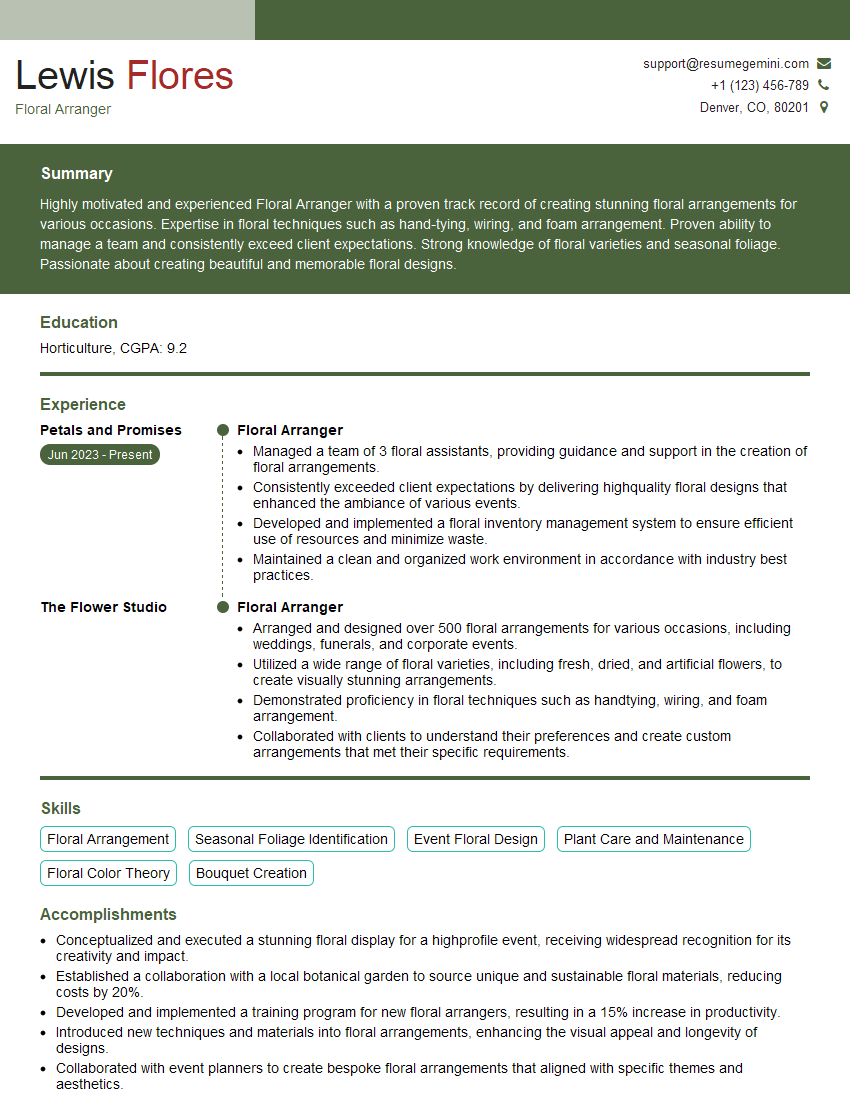
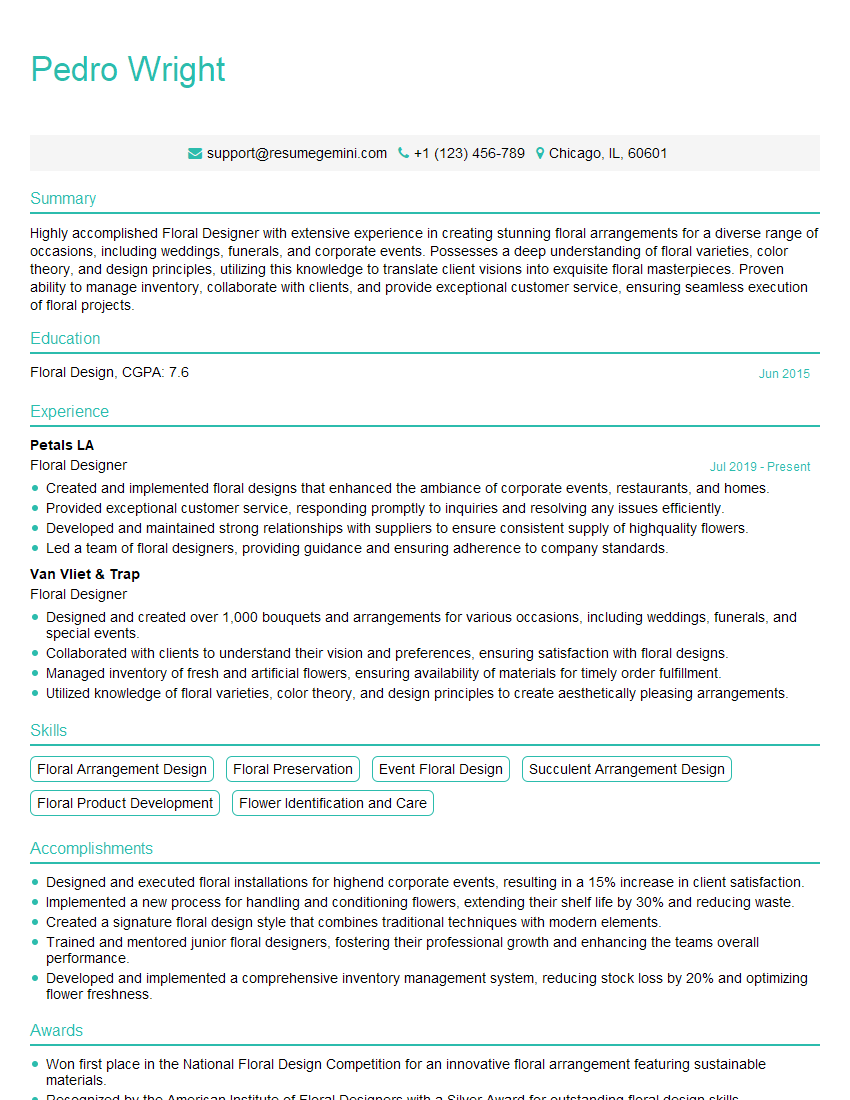
Mastering the art of bouquet creation opens doors to exciting opportunities in the floral industry, offering diverse career paths and potential for growth. To maximize your job prospects, creating an ATS-friendly resume is crucial. A well-crafted resume ensures your application gets noticed by recruiters. We highly recommend using ResumeGemini to build a professional and effective resume tailored to the specific requirements of bouquet creation roles. Examples of resumes tailored to the Bouquet Creation field are available to help you get started.
Explore more articles
Users Rating of Our Blogs
Share Your Experience
We value your feedback! Please rate our content and share your thoughts (optional).
What Readers Say About Our Blog
Attention music lovers!
Wow, All the best Sax Summer music !!!
Spotify: https://open.spotify.com/artist/6ShcdIT7rPVVaFEpgZQbUk
Apple Music: https://music.apple.com/fr/artist/jimmy-sax-black/1530501936
YouTube: https://music.youtube.com/browse/VLOLAK5uy_noClmC7abM6YpZsnySxRqt3LoalPf88No
Other Platforms and Free Downloads : https://fanlink.tv/jimmysaxblack
on google : https://www.google.com/search?q=22+AND+22+AND+22
on ChatGPT : https://chat.openai.com?q=who20jlJimmy20Black20Sax20Producer
Get back into the groove with Jimmy sax Black
Best regards,
Jimmy sax Black
www.jimmysaxblack.com
Hi I am a troller at The aquatic interview center and I suddenly went so fast in Roblox and it was gone when I reset.
Hi,
Business owners spend hours every week worrying about their website—or avoiding it because it feels overwhelming.
We’d like to take that off your plate:
$69/month. Everything handled.
Our team will:
Design a custom website—or completely overhaul your current one
Take care of hosting as an option
Handle edits and improvements—up to 60 minutes of work included every month
No setup fees, no annual commitments. Just a site that makes a strong first impression.
Find out if it’s right for you:
https://websolutionsgenius.com/awardwinningwebsites
Hello,
we currently offer a complimentary backlink and URL indexing test for search engine optimization professionals.
You can get complimentary indexing credits to test how link discovery works in practice.
No credit card is required and there is no recurring fee.
You can find details here:
https://wikipedia-backlinks.com/indexing/
Regards
NICE RESPONSE TO Q & A
hi
The aim of this message is regarding an unclaimed deposit of a deceased nationale that bears the same name as you. You are not relate to him as there are millions of people answering the names across around the world. But i will use my position to influence the release of the deposit to you for our mutual benefit.
Respond for full details and how to claim the deposit. This is 100% risk free. Send hello to my email id: [email protected]
Luka Chachibaialuka
Hey interviewgemini.com, just wanted to follow up on my last email.
We just launched Call the Monster, an parenting app that lets you summon friendly ‘monsters’ kids actually listen to.
We’re also running a giveaway for everyone who downloads the app. Since it’s brand new, there aren’t many users yet, which means you’ve got a much better chance of winning some great prizes.
You can check it out here: https://bit.ly/callamonsterapp
Or follow us on Instagram: https://www.instagram.com/callamonsterapp
Thanks,
Ryan
CEO – Call the Monster App
Hey interviewgemini.com, I saw your website and love your approach.
I just want this to look like spam email, but want to share something important to you. We just launched Call the Monster, a parenting app that lets you summon friendly ‘monsters’ kids actually listen to.
Parents are loving it for calming chaos before bedtime. Thought you might want to try it: https://bit.ly/callamonsterapp or just follow our fun monster lore on Instagram: https://www.instagram.com/callamonsterapp
Thanks,
Ryan
CEO – Call A Monster APP
To the interviewgemini.com Owner.
Dear interviewgemini.com Webmaster!
Hi interviewgemini.com Webmaster!
Dear interviewgemini.com Webmaster!
excellent
Hello,
We found issues with your domain’s email setup that may be sending your messages to spam or blocking them completely. InboxShield Mini shows you how to fix it in minutes — no tech skills required.
Scan your domain now for details: https://inboxshield-mini.com/
— Adam @ InboxShield Mini
Reply STOP to unsubscribe
Hi, are you owner of interviewgemini.com? What if I told you I could help you find extra time in your schedule, reconnect with leads you didn’t even realize you missed, and bring in more “I want to work with you” conversations, without increasing your ad spend or hiring a full-time employee?
All with a flexible, budget-friendly service that could easily pay for itself. Sounds good?
Would it be nice to jump on a quick 10-minute call so I can show you exactly how we make this work?
Best,
Hapei
Marketing Director
Hey, I know you’re the owner of interviewgemini.com. I’ll be quick.
Fundraising for your business is tough and time-consuming. We make it easier by guaranteeing two private investor meetings each month, for six months. No demos, no pitch events – just direct introductions to active investors matched to your startup.
If youR17;re raising, this could help you build real momentum. Want me to send more info?
Hi, I represent an SEO company that specialises in getting you AI citations and higher rankings on Google. I’d like to offer you a 100% free SEO audit for your website. Would you be interested?
Hi, I represent an SEO company that specialises in getting you AI citations and higher rankings on Google. I’d like to offer you a 100% free SEO audit for your website. Would you be interested?