Unlock your full potential by mastering the most common Brother 737 Coverstitch Machine Operation interview questions. This blog offers a deep dive into the critical topics, ensuring you’re not only prepared to answer but to excel. With these insights, you’ll approach your interview with clarity and confidence.
Questions Asked in Brother 737 Coverstitch Machine Operation Interview
Q 1. Describe your experience operating a Brother 737 coverstitch machine.
My experience with the Brother 737 coverstitch machine spans several years, encompassing both high-volume production work and intricate detail projects. I’ve worked with various fabrics, from delicate silks to heavy-duty knits, mastering the nuances of achieving a professional finish on each. My expertise extends beyond basic operation; I’m proficient in troubleshooting common issues, optimizing stitch settings for specific fabric types, and maintaining the machine for optimal performance. I understand the importance of consistent stitch quality and efficient workflow, which are crucial in any sewing environment.
For example, I recently completed a large order of athletic wear, utilizing the Brother 737’s ability to create durable and comfortable coverstitching. The project required precise stitch regulation and consistent tension control, which I successfully managed, resulting in a flawless final product.
Q 2. What are the common stitch types achievable on a Brother 737?
The Brother 737 coverstitch machine is capable of producing several stitch types, primarily variations of a three- or four-thread coverstitch. These stitches are characterized by their clean, flat finish ideal for finishing seams and creating professional-looking hems. The most common stitches include:
- Three-thread coverstitch: A versatile stitch offering good elasticity and strength, often used for seaming and hemming knit fabrics.
- Four-thread coverstitch: Adds a fourth chain stitch, creating a wider, more robust stitch. Perfect for heavier fabrics or applications requiring extra durability. This is great for items like athletic wear where seams need to withstand stress.
- Narrow coverstitch: Achieved by adjusting the stitch width settings, this is often used for delicate fabrics or narrow seams.
- Wide coverstitch: Ideal for creating a decorative or functional edge finish on heavier fabrics, providing greater coverage and increased durability.
The exact stitch variations depend on needle and looper threading configurations, providing flexibility to match the fabric and desired aesthetic.
Q 3. How do you troubleshoot a broken needle on a Brother 737?
A broken needle on the Brother 737 is usually caused by hitting a pin, needle plate damage, improper needle installation, or using the wrong type of needle. Troubleshooting involves a systematic approach:
- Safety First: Unplug the machine before any adjustments.
- Inspect the needle: Carefully examine the needle for bends, breaks, or damage. Replace if necessary, ensuring it’s the correct size and type for your fabric.
- Check the needle plate: Look for any dents or burrs on the needle plate, which can cause needle breakage. Gently clean the area or replace if severely damaged.
- Verify needle installation: Double-check that the needle is correctly inserted and tightened. Incorrect installation is a very common cause.
- Examine the fabric: Check the fabric for pins or other obstructions that might have caused the needle to break.
- Test the machine: After addressing potential issues, run a test stitch to confirm the problem is resolved.
Remember to always use the recommended needle size and type for your fabric to prevent breakage. A bent needle, even slightly, will usually break quickly.
Q 4. Explain the process of threading a Brother 737 coverstitch machine.
Threading the Brother 737 coverstitch machine can seem complex, but with a step-by-step approach, it’s manageable. The process involves threading the needles, the loopers, and the take-up lever. A good reference point is always the machine’s manual. Each step must be followed closely.
Generally, you start with the needles, progressing to the loopers, ensuring proper tension in each thread path. I find it helpful to refer to the detailed diagrams often found on the machine’s casing or in the instruction booklet. Color-coded threads can make the process much easier. Once all the threads are in place, a test stitch confirms the successful threading. Improper threading is among the most common causes of stitch formation problems.
Q 5. How do you adjust the stitch length and width on a Brother 737?
Adjusting stitch length and width on the Brother 737 is usually done via dedicated dials or controls on the machine’s front panel. The stitch length dial controls the distance between each stitch, affecting the fabric’s overall drape and strength. A longer stitch length is generally suitable for stretchy fabrics, while shorter stitches are better for non-stretch materials. The stitch width dial affects the width of the coverstitch, influencing the fabric’s finished edge appearance. The desired width depends on the fabric’s weight and the application.
For example, a longer stitch length and wider stitch width might be used when creating a decorative edge on a sweatshirt, whereas a shorter stitch length and narrower stitch width might be best for a delicate lace fabric. Always test settings on a scrap of fabric before working on your project to avoid costly mistakes.
Q 6. What are the different types of coverstitch needles used with a Brother 737?
The Brother 737 typically uses specialized coverstitch needles designed to handle the unique demands of this stitch type. The most common needle types include:
- System 130/705H needles: These are designed for general coverstitching and are a common choice for a range of fabrics.
- System 134 needles: These needles are often favored for more delicate fabrics and allow for finer stitch work.
The needle size is selected based on the fabric weight; heavier fabrics generally require larger needles. Using the incorrect needle size can lead to skipped stitches, broken needles, or poor stitch quality. Always check your machine’s manual for recommended needle sizes for different fabric types.
Q 7. How do you maintain the proper tension on a Brother 737?
Maintaining proper tension on a Brother 737 coverstitch machine is crucial for achieving consistent and high-quality stitches. Incorrect tension leads to loose or puckered stitches, broken threads, or skipped stitches. Tension is adjusted using individual tension dials for each thread (needles and loopers). These are generally numbered dials and adjustments are often small and incremental.
Achieving the correct tension requires experience and often involves a process of trial and error. Start with the manufacturer’s recommended settings and then fine-tune them based on your fabric and desired stitch quality. Adjusting one tension dial might require you to readjust others to keep everything in balance. A test stitch is crucial after any adjustment to observe changes.
For example, if your stitches are loose, you might need to increase the tension on your needles or loopers. Conversely, if your stitches are too tight, you will need to loosen them up. This skill comes from experience. One helpful method is to adjust one dial at a time and observe the impact on the test stitches.
Q 8. How do you identify and resolve common coverstitch faults (e.g., skipped stitches, loops)?
Skipped stitches and loops on a Brother 737 coverstitch machine usually stem from issues with threading, tension, or needle condition. Let’s troubleshoot systematically.
Skipped Stitches: This often points to a bent or damaged needle. Inspect the needle carefully for any imperfections. Replace it if necessary. Another common culprit is incorrect threading. Carefully trace the thread path, making sure each thread is correctly positioned in its designated tension discs and looper. Incorrect needle-plate positioning can also cause this. Ensure it’s aligned and tightened correctly.
Loops: Loops usually indicate problems with the looper threads or tension. Check the tension discs on both the looper and needle threads. They should be adjusted correctly according to your fabric type. Loose or broken threads in the loopers are another prime cause. Open the machine’s front cover and examine the loopers for any snags or breakage. Rethreading these is crucial.
Example: I once encountered excessive looping on a lightweight silk. After carefully checking, I found the tension on the left looper was too loose. A slight adjustment corrected the problem immediately.
Systematic Approach: I always follow this order: 1. Check the needle; 2. Check the threading; 3. Check the tension; 4. Check the looper condition. This minimizes the guesswork.
Q 9. What is the appropriate cleaning and lubrication schedule for a Brother 737?
Regular cleaning and lubrication are vital for the Brother 737’s longevity and consistent performance. A good schedule involves daily and monthly maintenance.
Daily: After each sewing session, use a soft brush to remove lint and dust from the feed dogs, needle plate, and around the bobbin area. Wipe down the exterior with a slightly damp cloth.
Monthly: More thorough cleaning is required. Remove the needle plate and carefully clean any accumulated lint or debris. Apply a small amount of high-quality sewing machine oil (specifically designed for sewing machines) to the moving parts. Focus on the hook assembly, the feed dogs, and any other areas with visible moving parts. Avoid over-lubrication, as this can attract more lint.
Important Note: Always refer to your Brother 737’s user manual for specific lubrication points and recommended oil type. Using the wrong oil can damage the machine.
Q 10. Describe your experience working with various fabrics on a Brother 737.
My experience working with diverse fabrics on the Brother 737 is extensive. The machine’s adaptability makes it ideal for a range of materials, but adjustments are key.
Lightweight Fabrics (Silk, chiffon): Require delicate handling. Reduce stitch length and tension. Use a fine needle. A slight increase in differential feed can help control the fabric’s movement.
Medium-Weight Fabrics (Cotton, linen): Generally straightforward. Standard needle and stitch length settings usually suffice. Differential feed can be used to prevent stretching or puckering.
Heavyweight Fabrics (Denim, canvas): Demand a heavier needle and might necessitate increasing the stitch length. Check the needle plate for any potential obstructions. Proper tension settings are crucial to prevent broken needles.
Example: When working with stretchy fabrics like jersey, I utilize the differential feed extensively to control the fabric’s feed rate, resulting in a perfectly even coverstitch without distortion.
Q 11. Explain how to adjust the differential feed on a Brother 737.
The differential feed on a Brother 737 controls the feed rate of the fabric from left to right. This feature is invaluable for preventing stretching or gathering, particularly on stretchy fabrics. The adjustment is usually via a dial or knob.
Adjusting the Differential Feed: The dial typically ranges from 0.7 to 2.0. A setting of 1.0 means both sides of the fabric feed at the same rate. A setting below 1.0 will feed the right side slower than the left (useful for preventing stretching on stretchy fabrics). A setting above 1.0 will feed the right side faster than the left (useful for creating gathers).
Practical Example: For a knit fabric prone to stretching, I’d use a setting below 1.0, perhaps 0.8 to 0.9. For a gathered cuff, I’d use a setting above 1.0.
Important Note: Always test the differential feed on a scrap of the same fabric before applying it to your project.
Q 12. How do you handle fabric jams or thread breaks on a Brother 737?
Fabric jams and thread breaks are common occurrences, but they’re easily addressed with a systematic approach.
Fabric Jams: First, turn off the machine and disconnect the power. Carefully lift the presser foot and needle plate to remove the jammed fabric. Never force it. Inspect the feed dogs for any obstructions. If the jam is severe, refer to your machine’s manual or seek professional help.
Thread Breaks: Identify which thread broke (needle, looper, or both). Reread the threading guide in your manual, paying close attention to the thread path. Check the tension discs for any irregularities or potential jams. Ensure the spools are correctly seated and that there are no knots or tangles in the threads.
Prevention is Key: Always check for knots in your thread before starting and use high-quality thread.
Q 13. What safety precautions do you follow when operating a Brother 737?
Safety is paramount when operating any sewing machine, including the Brother 737. My safety protocols include:
Always disconnect the power cord before cleaning, oiling, or making any adjustments to the machine’s internal components.
Keep hands and fingers away from moving parts while the machine is running. Use the appropriate presser foot and appropriate needle for the fabric type.
Maintain a clean and organized workspace, free of clutter to prevent accidents.
Follow the user manual’s safety guidelines thoroughly.
Never operate the machine if it is damaged or malfunctioning.
Example: Before every sewing session, I inspect the power cord and the plug for any damage. This simple precaution avoids potential electrical hazards.
Q 14. How would you troubleshoot a problem with inconsistent stitch formation?
Inconsistent stitch formation often arises from a combination of factors that we need to address systematically.
Tension: Uneven tension is the most common culprit. Check both needle and looper thread tensions. Adjust them individually while sewing a test piece until you achieve even stitches.
Needle: A bent or dull needle can cause inconsistent stitches. Replace it with a new, sharp needle of the correct size for the fabric.
Threading: Incorrect threading can also lead to problems. Carefully trace the thread path on the machine, ensuring the threads are correctly positioned.
Needle Plate: A dirty or damaged needle plate can interfere with proper stitch formation. Clean it thoroughly and replace it if necessary.
Fabric: The fabric itself can sometimes cause problems. Make sure to use the appropriate needle type and size for the fabric.
Troubleshooting Strategy: I often start by checking the tension, then move on to the needle, threading, and needle plate. By following a structured approach, the cause is usually identified quickly.
Q 15. What is your experience with different types of coverstitch threads?
My experience with coverstitch threads encompasses a wide range, from standard polyester to more specialized options like textured or metallic threads. The choice of thread heavily influences the final stitch quality and aesthetic. For instance, using a high-quality polyester thread ensures durability and consistent stitching on a variety of fabrics. Conversely, using a textured thread adds visual interest, but might require slight adjustments in tension to prevent puckering. I’m familiar with different thread weights (deniers) and their impact on stitch density and strength. For example, a finer thread will create a more delicate stitch, while a thicker thread is suitable for heavier fabrics and requires a wider stitch width. I regularly work with multiple colors and thread types to achieve various design outcomes.
- Polyester: The workhorse – strong, consistent, and widely available.
- Textured: Adds visual interest; requires careful tension adjustments.
- Metallic: Creates a shimmering effect; may require specialized needles.
Career Expert Tips:
- Ace those interviews! Prepare effectively by reviewing the Top 50 Most Common Interview Questions on ResumeGemini.
- Navigate your job search with confidence! Explore a wide range of Career Tips on ResumeGemini. Learn about common challenges and recommendations to overcome them.
- Craft the perfect resume! Master the Art of Resume Writing with ResumeGemini’s guide. Showcase your unique qualifications and achievements effectively.
- Don’t miss out on holiday savings! Build your dream resume with ResumeGemini’s ATS optimized templates.
Q 16. Describe your experience with maintaining the timing of your Brother 737.
Maintaining the timing on my Brother 737 is crucial for consistent stitch quality. I regularly check and adjust the timing using the machine’s built-in mechanisms. This involves carefully observing the needle and looper interaction during stitching. Imperfect timing can lead to dropped stitches, uneven stitch formation, or skipped stitches. Think of it like a well-oiled clock – each part needs to work harmoniously with the others. My process involves:
- Visual Inspection: Observing the stitch formation to detect any irregularities.
- Test Stitching: Running test stitches on scrap fabric to fine-tune the settings.
- Adjustment Screws: Utilizing the machine’s adjustment screws to fine-tune the looper and needle timing according to the manufacturer’s manual. This is a delicate process requiring patience and precision.
Over time, I’ve developed a keen eye for recognizing subtle timing issues and adjusting accordingly. I also perform routine maintenance to ensure the machine remains properly lubricated and free from lint build-up, which can also affect timing.
Q 17. How familiar are you with the different presser foot options for the Brother 737?
The Brother 737 offers a variety of presser feet, each designed for specific fabric types and stitch applications. I’m proficient in using different presser feet including:
- Standard Coverstitch Foot: Used for most general coverstitching tasks.
- Narrow Coverstitch Foot: Ideal for creating finer stitches and working with delicate fabrics.
- Binding Foot: Specifically designed for applying bias binding to edges.
- Narrow Hemming Foot: Useful for creating narrow rolled hems.
Selecting the right presser foot is essential for achieving consistent stitch quality and preventing damage to the fabric. For instance, using the wrong presser foot on a delicate fabric can lead to skipped stitches or fabric puckering. I have developed a deep understanding of the applications for each and regularly change feet to suit the project.
Q 18. How do you ensure the consistent quality of stitching on a Brother 737?
Consistent stitch quality on the Brother 737 hinges on several factors, all of which I meticulously manage. It’s a matter of paying attention to the details. Imagine baking a cake – each ingredient and step matters to achieve the perfect result. Similarly, coverstitching demands precision.
- Proper Threading: Correctly threading the machine is paramount to avoid missed stitches and tension issues.
- Consistent Thread Tension: Fine-tuning the thread tension dials is critical for balanced stitches; this often requires adjustments depending on fabric weight and thread type.
- Needle Selection: The right needle for the fabric type prevents breakage and ensures smooth stitching.
- Proper Stitch Length and Width: Adjusting these settings according to the fabric and desired aesthetic.
- Regular Maintenance: Cleaning and oiling the machine keeps it running smoothly and prevents malfunctions.
By systematically checking and adjusting these parameters, I ensure every stitch meets the required quality standards.
Q 19. What are the common causes of broken needles and how do you prevent them?
Broken needles on a Brother 737 are usually caused by one of these factors:
- Bent Needles: Using a bent needle will lead to immediate breakage. Always inspect needles before use.
- Incorrect Needle Size: Using the wrong needle size for the fabric weight can cause the needle to bend or break under stress.
- Incorrect Threading: Improperly threading the needle can lead to friction and breakage.
- Fabric Obstructions: Pins or other obstructions in the fabric path can cause the needle to bend or break.
- Improper Timing: Poor timing of the needle and loopers can also result in needle breakage.
To prevent needle breakage, I always:
- Inspect needles carefully before each use.
- Use the correct needle size for the fabric and thread.
- Ensure correct threading.
- Carefully check the fabric for pins or obstructions.
- Maintain proper machine timing.
Q 20. How would you handle a situation where your Brother 737 machine malfunctioned during production?
Machine malfunctions during production require a calm and systematic approach. My first step is to identify the problem. This might involve checking the power supply, the thread path, or any unusual sounds or vibrations. Then I proceed with troubleshooting steps based on my experience, which often involves the following:
- Safety First: Unplug the machine and assess the situation.
- Visual Inspection: Check for obvious issues like loose connections, tangled thread, or damaged parts.
- Troubleshooting: Consult the machine’s manual or online resources to identify potential causes and solutions.
- Basic Repairs: If I can identify and fix the problem (like a simple threading issue), I’ll do so.
- Seek Professional Help: If the issue is beyond my expertise or involves a critical component, I would contact a qualified technician for repair. Downtime is costly, so prompt action is key.
I always prioritize safety and ensuring the machine is repaired correctly to prevent further damage or safety risks.
Q 21. Describe your experience with different types of fabric weights and how you adjust your settings accordingly.
Experience with different fabric weights is fundamental to coverstitching. I adapt my settings according to the fabric, much like a chef adjusts their recipe for different ingredients. Heavier fabrics require more robust settings, while lighter ones require more delicate ones. The adjustments generally relate to these settings:
- Stitch Length: Longer stitches are usually better for heavier fabrics, while shorter stitches suit lighter fabrics.
- Stitch Width: Wider stitches are often preferred for heavier fabrics, whereas narrower stitches are better suited to lighter fabrics. This affects the stitch density and overall look.
- Presser Foot Pressure: Heavier fabrics often require more pressure to feed consistently; lighter fabrics may need less to prevent stretching or damage.
- Thread Tension: This adjustment is crucial for all fabric weights, but fine-tuning is essential depending on the material’s weight and structure.
- Needle Size: I select the appropriate needle size and type to ensure smooth piercing of the fabric without breakage or damage.
For example, when working with lightweight fabrics like chiffon, I use a finer needle, shorter stitch length, and lower presser foot pressure. However, when working with heavier fabrics like denim, I adjust to a heavier needle, longer stitch length, and higher presser foot pressure to maintain consistent stitch quality. Careful attention to these details directly impacts the quality of the finished product.
Q 22. How familiar are you with preventative maintenance for a Brother 737 coverstitch machine?
Preventative maintenance on a Brother 737 coverstitch machine is crucial for its longevity and consistent performance. It’s like regularly servicing your car – small efforts prevent major breakdowns. My routine includes:
- Daily Cleaning: Removing lint and thread buildup from the hook area, looper mechanisms, and feed dogs. This prevents jams and ensures smooth thread flow. I use a small brush and compressed air.
- Weekly Lubrication: Applying a high-quality sewing machine oil to designated lubrication points as indicated in the machine’s manual. This reduces friction and extends the life of moving parts. Over-lubrication is as bad as under-lubrication, so precision is key.
- Monthly Inspection: Checking the tension of the looper threads and the needle, ensuring they are correctly aligned and tightened. I also examine the condition of the needles for any bending or damage. Dull needles result in poor stitch quality and potential breakage.
- Quarterly Deep Clean: A more thorough cleaning that might involve disassembling certain parts to remove ingrained lint and debris. This helps maintain optimal machine function.
- Annual Service: A professional service is recommended annually to check for any wear and tear on internal components and ensure everything is perfectly aligned and functioning correctly. This helps to identify potential problems before they become major issues.
Following this schedule ensures my Brother 737 runs smoothly and produces high-quality stitches consistently.
Q 23. What are some ways to improve efficiency and productivity when using a Brother 737?
Improving efficiency and productivity with a Brother 737 involves optimizing workflow and machine setup. Key strategies include:
- Proper Threading: Mastering the correct threading procedure significantly reduces downtime caused by broken threads or skipped stitches. I always double-check each step.
- Efficient Thread Management: Using appropriate thread cones and ensuring adequate thread supply minimizes interruptions for refilling. I organize my threads for easy access.
- Optimized Stitch Settings: Understanding the impact of stitch length, differential feed, and tension settings on fabric types helps adjust the machine quickly for different projects, minimizing adjustments during the sewing process.
- Streamlined Workflow: Organize your workspace, fabric, and patterns to minimize wasted movement and maximize the time spent actually sewing.
- Preventative Maintenance: As discussed earlier, regular maintenance keeps the machine running smoothly and prevents unexpected downtime.
- Batch Production: Sewing multiple similar items in a batch minimizes setup changes and increases efficiency.
By consistently applying these methods, I can significantly increase my output and maintain high-quality results.
Q 24. Describe your experience with using different types of coverstitch finishing techniques.
I’ve experience with various coverstitch finishing techniques, each producing a unique aesthetic and functional outcome. These include:
- Standard Coverstitch: The basic coverstitch, ideal for clean, durable seams in knits and other stretchy fabrics.
- Narrow Coverstitch: Creates a more delicate and less bulky seam, often used for finer garments or details.
- Wide Coverstitch: Produces a broader, more substantial stitch, frequently used for added strength and visual impact.
- Chain Stitch Combination: Combining coverstitching with a chainstitch on the same seam adds decorative appeal and strength.
- Flatlock Seam: The coverstitch machine can create flatlock seams, which are both strong and visually appealing, often used in sportswear.
My experience allows me to select the appropriate technique based on project requirements, fabric type, and desired aesthetic.
Q 25. How would you train a new employee on how to operate a Brother 737?
Training a new employee on the Brother 737 involves a structured approach:
- Safety First: Emphasize safe operating procedures, including proper handling of needles and ensuring the machine is unplugged during cleaning or maintenance.
- Machine Familiarization: Introduce the machine’s components, functions, and controls through a combination of demonstration and hands-on practice. I’d show them diagrams and explain each part.
- Threading Practice: Thorough, repeated practice on threading the needle and loopers is crucial. I’d guide them step-by-step, correcting mistakes and reinforcing correct techniques.
- Stitch Settings and Adjustment: Explain the impact of stitch length, differential feed, and tension on the final stitch quality. We’d experiment with different settings on sample fabrics.
- Troubleshooting Basics: Cover common stitch faults (skipped stitches, broken threads, etc.) and how to identify and resolve them using a systematic approach.
- Practical Application: Supervise the new employee as they work on progressively challenging projects. This hands-on experience is key to consolidating their learning.
- Ongoing Support: Provide continued support and mentoring, answering questions and addressing challenges that arise.
My training approach emphasizes both theoretical knowledge and hands-on practice, ensuring the employee gains a solid understanding and competence in operating the machine.
Q 26. How would you determine the cause of a specific stitch fault on your Brother 737?
Diagnosing a stitch fault on the Brother 737 requires a systematic approach. I’d follow these steps:
- Visual Inspection: Carefully examine the stitch quality, looking for skipped stitches, uneven tension, broken threads, or other irregularities. This will often provide clues.
- Check Threading: Ensure the needle and loopers are correctly threaded. Incorrect threading is a very common cause of problems.
- Inspect Tension: Verify the tension settings for the needle and loopers are appropriate for the fabric and thread type being used. Often, slight adjustments can fix the issue.
- Needle Condition: Check the needle for damage, bending, or dullness. A damaged needle is a frequent culprit of poor stitch quality.
- Looper Alignment: Ensure the loopers are correctly aligned and functioning properly. Misaligned loopers can cause significant stitch problems.
- Differential Feed: Adjust the differential feed setting if necessary. An incorrect setting can lead to puckering or stretching in the fabric.
- Clean and Lubricate: Make sure the machine is clean and well lubricated. Lint or debris can interfere with the machine’s mechanisms.
By following this process of elimination, I can usually identify and correct the cause of most stitch faults.
Q 27. What is your experience with using different types of Looper threads on your machine?
My experience with different looper threads is extensive. The choice of thread significantly impacts stitch quality and appearance. I’ve worked with:
- Polyester Threads: These offer excellent strength and durability, ideal for high-stress areas and activewear. They also tend to maintain their tension well, resulting in even stitches.
- Cotton-Covered Polyester Threads: A blend providing a softer hand than 100% polyester while still maintaining good strength. Suitable for a wide range of applications.
- Nylon Threads: Known for their elasticity, useful when working with stretchy fabrics, preventing the seam from breaking under stress.
- Specialty Threads: Threads with metallic or textured finishes can add a decorative element to the coverstitch. These often require specific tension settings.
The selection of looper threads depends on the fabric, the desired stitch appearance, and the required durability of the finished garment. Experimentation and understanding of each thread type are crucial to achieving optimum results.
Q 28. Describe a time you had to troubleshoot a complex issue with your Brother 737 coverstitch machine
I once encountered a particularly challenging issue where the Brother 737 was producing inconsistent stitches – sometimes perfect, sometimes skipped stitches. After systematically checking the usual suspects (threading, tension, needle condition), the problem persisted. The issue turned out to be a tiny piece of lint lodged deep within the looper mechanism, causing intermittent interference with the thread flow. This was difficult to identify because the lint wasn’t visible from a simple visual inspection. I had to carefully disassemble part of the looper mechanism using the appropriate tools, clean the area thoroughly with a brush and compressed air, and then meticulously reassemble it.
This experience highlighted the importance of a methodical troubleshooting approach, even when dealing with seemingly insignificant issues. A small piece of lint can have a big impact on machine performance, reminding us that thorough cleaning and regular maintenance are indispensable for consistent high-quality work.
Key Topics to Learn for Brother 737 Coverstitch Machine Operation Interview
- Machine Setup and Maintenance: Understanding the threading process, proper needle and looper adjustments, and routine maintenance procedures for optimal performance and preventing malfunctions.
- Stitch Types and Adjustments: Mastering different stitch types achievable with the Brother 737 (e.g., narrow, wide, chained), and knowing how to adjust tension, stitch length, and differential feed for various fabrics and desired finishes.
- Fabric Handling and Feeding: Developing proficiency in guiding different fabric types (lightweight, medium-weight, heavyweight) through the machine to achieve even stitching and prevent puckering or damage.
- Troubleshooting Common Issues: Recognizing and resolving common problems such as skipped stitches, broken threads, uneven stitch length, and needle breakage, demonstrating problem-solving skills.
- Safety Procedures and Best Practices: Understanding and adhering to safety regulations related to machine operation, including proper use of guards and tools, and maintaining a clean and organized workspace.
- Production Efficiency and Speed: Demonstrating an understanding of optimizing sewing speed and maintaining consistent quality while meeting production targets.
- Understanding Coverstitch Applications: Knowing the typical applications of coverstitching in garment construction (e.g., hems, necklines, cuffs) and how the Brother 737 contributes to high-quality finishing.
Next Steps
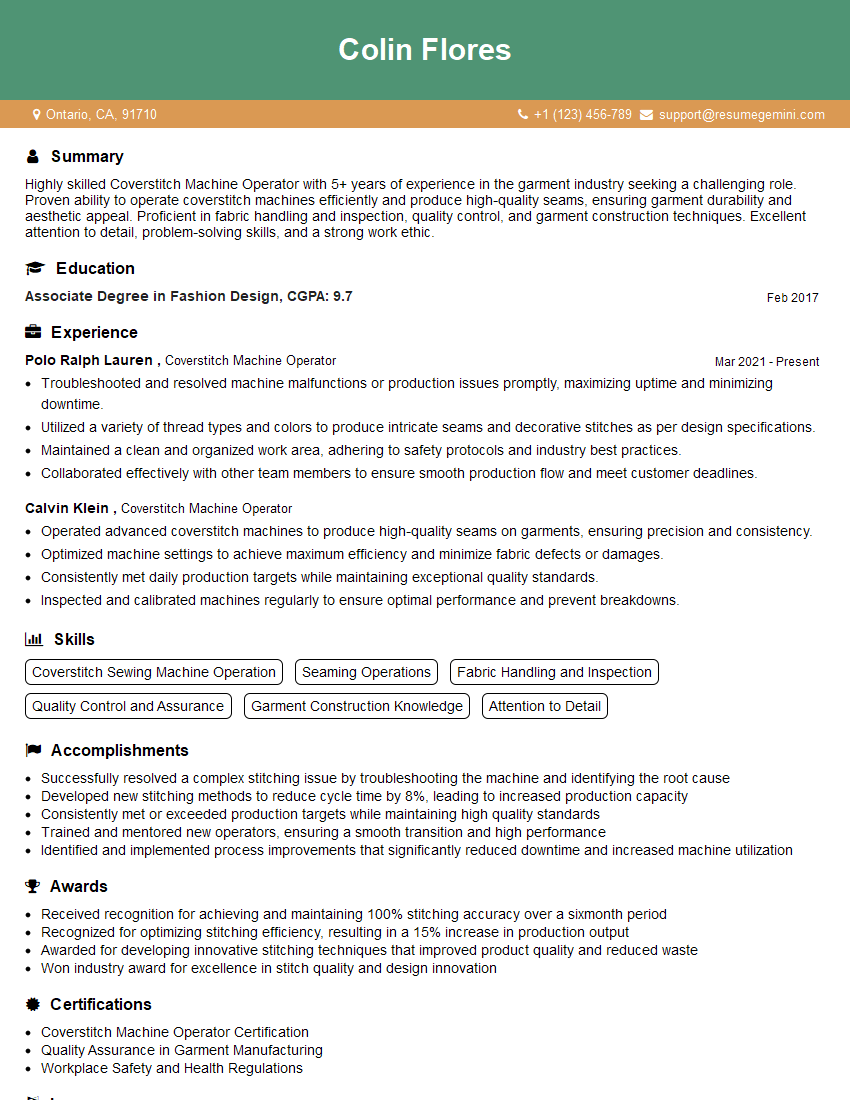
Mastering Brother 737 Coverstitch Machine Operation opens doors to rewarding careers in the apparel and textile industries. Proficiency in this skill is highly valued, allowing you to command competitive salaries and advance your career. To maximize your job prospects, create a compelling and ATS-friendly resume that highlights your skills and experience effectively. ResumeGemini is a trusted resource to help you build a professional resume that showcases your abilities. Examples of resumes tailored to Brother 737 Coverstitch Machine Operation are available to guide you in crafting your own.
Explore more articles
Users Rating of Our Blogs
Share Your Experience
We value your feedback! Please rate our content and share your thoughts (optional).
What Readers Say About Our Blog
Very informative content, great job.
good