Interviews are more than just a Q&A session—they’re a chance to prove your worth. This blog dives into essential Building Code Expertise interview questions and expert tips to help you align your answers with what hiring managers are looking for. Start preparing to shine!
Questions Asked in Building Code Expertise Interview
Q 1. Explain the difference between a building code and a zoning ordinance.
Building codes and zoning ordinances are both crucial for regulating construction and land use, but they focus on different aspects. Think of it like this: building codes dictate how a building is constructed, while zoning ordinances dictate where and what kind of building can be constructed.
Building Codes: These are sets of rules and regulations that govern the design, construction, and maintenance of buildings to ensure public safety and health. They cover structural integrity, fire safety, accessibility, plumbing, electrical systems, and more. A building code violation might be using substandard materials or failing to meet fire-resistance requirements.
Zoning Ordinances: These are local laws that regulate the use of land within a municipality. They determine permitted land uses (residential, commercial, industrial), building height limits, lot sizes, setbacks from property lines, and density regulations. A zoning violation might be constructing a factory in a residential zone.
In essence, you need to comply with both. You can’t build a perfectly safe building (meeting building codes) in a location where that type of building is prohibited (violating zoning ordinances).
Q 2. Describe your experience with the International Building Code (IBC).
I have extensive experience working with the International Building Code (IBC). My experience spans over 10 years, encompassing plan review, inspections, and code interpretation for a wide range of projects, from small residential additions to large-scale commercial developments. I’m particularly familiar with the IBC’s provisions on structural design, fire protection systems, and accessibility requirements. For example, I’ve frequently used the IBC’s prescriptive and performance-based design pathways in projects to meet specific client needs and site conditions. I’m also proficient in navigating the various appendices and referenced standards within the IBC, allowing for a thorough and accurate code interpretation.
One memorable project involved a complex multi-story building where we had to carefully consider the IBC’s requirements for wind load and seismic design, ensuring the structure could withstand significant forces. The meticulous application of the IBC’s provisions was critical in ensuring the building’s structural integrity and safety.
Q 3. How do you handle discrepancies between local codes and national standards?
Discrepancies between local codes and national standards like the IBC are a common challenge. The guiding principle is that the most stringent code always prevails. This means that if a local code has stricter requirements than the IBC, the local code must be followed. My approach involves a multi-step process:
- Identify the Discrepancy: Carefully compare the relevant sections of the local code and the national standard to pinpoint the differences.
- Determine the More Stringent Code: Analyze each requirement to determine which provides a higher level of safety or protection.
- Apply the More Stringent Code: The more stringent code becomes the governing document for that specific aspect of the project. This might require adjustments to the design or construction methods.
- Documentation: Meticulously document all decisions and justifications for choosing one code over another. This is crucial for audits and compliance.
For instance, if the IBC allows a certain type of fire-resistant material and the local code mandates a higher fire-rating for that specific application, we would have to use the material specified by the local code, even if it’s more expensive or less readily available.
Q 4. What are the key provisions of the Americans with Disabilities Act (ADA) related to building design?
The Americans with Disabilities Act (ADA) significantly impacts building design, aiming to ensure accessibility for individuals with disabilities. Key provisions related to building design include:
Accessible Routes: Providing clear and unobstructed pathways with appropriate ramps, elevators, and accessible doors.
Accessible Entrances: Ensuring that at least one accessible entrance is available, with ramps or level entries.
Accessible Restrooms: Designing accessible restrooms with proper clearances, grab bars, and accessible fixtures.
Accessible Parking: Providing designated accessible parking spaces with appropriate signage and proximity to entrances.
Accessible Signage: Utilizing clear and easy-to-read signage with tactile and braille elements where needed.
Accessible Features: Incorporating features such as lowered countertops, accessible drinking fountains, and assistive listening devices.
I have extensive experience in incorporating ADA compliance into building design, working closely with architects and engineers to ensure that all aspects of a project meet or exceed ADA standards. Understanding and adhering to the ADA is not only legally required but also reflects a commitment to inclusivity and equal access for all.
Q 5. Describe your experience reviewing construction plans for code compliance.
My experience in reviewing construction plans for code compliance is substantial. This involves a detailed examination of blueprints, specifications, and calculations to verify that the proposed design adheres to all applicable building codes and regulations. This process usually involves:
Thorough Plan Review: Carefully reviewing the architectural, structural, mechanical, electrical, and plumbing (MEP) drawings to identify potential code violations.
Calculations Verification: Checking calculations related to structural loads, fire resistance, and other relevant aspects.
Material Specifications: Verifying that the specified materials meet the required standards of performance.
Accessibility Review: Ensuring compliance with ADA standards.
Coordination with Design Team: Working collaboratively with architects, engineers, and contractors to address identified deficiencies.
I’ve worked on hundreds of plans and specifications, from small-scale renovations to complex high-rise buildings. In one instance, I identified a critical structural deficiency in a proposed design that could have led to serious safety issues. My timely identification and prompt communication with the design team prevented a potential catastrophe.
Q 6. How do you identify and address potential code violations during inspections?
Identifying and addressing potential code violations during inspections requires a systematic approach. I typically follow these steps:
Pre-Inspection Planning: Reviewing the approved construction plans and specifications to understand the intended design and construction methods.
Visual Inspection: Conducting a thorough visual inspection of the work, noting any discrepancies between the as-built condition and the approved plans.
Testing and Verification: Where necessary, I’ll use testing equipment to verify compliance with relevant code requirements (e.g., testing fire-rated assemblies).
Documentation: Meticulously documenting all findings, including photographs and detailed descriptions of any observed violations.
Communication: Communicating findings to the contractor or owner, specifying the necessary corrective actions.
Follow-up Inspections: Conducting follow-up inspections to ensure that all violations have been addressed properly.
A recent example involved an inspection where I discovered that the fire-stopping around a penetration in a fire-rated wall was incomplete. This was a significant violation, and I immediately notified the contractor, outlining the necessary repairs to ensure fire safety. The contractor corrected the issue promptly, and the project proceeded without further issues.
Q 7. What is your experience with fire-rated assemblies and their applications?
Fire-rated assemblies are critical components of fire protection systems in buildings. These assemblies, which might include walls, floors, doors, and even ductwork, are designed to resist the passage of fire and smoke for a specific duration (e.g., 1 hour, 2 hours). My experience with fire-rated assemblies includes specifying, inspecting, and testing them across a range of projects. I’m familiar with various types of assemblies, including those constructed from concrete, gypsum board, steel, and specialized fire-resistant materials.
I’ve worked on several projects where the design and installation of fire-rated assemblies were critical. For example, a high-rise building required extensive fire-rated walls and floors to compartmentalize the building and limit the spread of fire in case of an incident. Accurate installation and testing of these assemblies were essential to ensuring compliance and safeguarding the occupants. Incorrect installation or the use of non-compliant materials could drastically reduce the effectiveness of the fire protection system.
Q 8. Explain your understanding of life safety codes.
Life safety codes are the cornerstone of building codes, prioritizing the protection of human life and ensuring safe evacuation in case of emergencies. They dictate requirements for things like fire protection systems (sprinklers, alarms, fire exits), emergency lighting, means of egress (paths to exits), and accessibility for people with disabilities. Think of it like a building’s immune system – it’s designed to protect its occupants from harm.
For instance, a life safety code might specify the minimum width of a corridor to allow for safe and quick evacuation, the maximum travel distance to an exit, or the type and placement of fire extinguishers. These aren’t arbitrary; they’re based on extensive research, testing, and statistical analysis of fire and emergency scenarios. Non-compliance can lead to serious consequences, including fines, legal action, and, most importantly, loss of life.
- Fire Suppression: Specifies requirements for fire sprinklers, standpipes, and fire alarm systems.
- Means of Egress: Defines requirements for exit doors, corridors, stairwells, and emergency lighting to ensure safe evacuation.
- Occupancy Classification: Categorizes buildings based on their intended use (residential, commercial, industrial, etc.) to determine appropriate safety measures.
Q 9. How do you stay updated on changes and amendments to building codes?
Staying current with building code changes is crucial for maintaining my expertise. I employ a multi-pronged approach:
- Subscription to Code Organizations: I subscribe to publications and online resources from organizations like the International Code Council (ICC) and local building departments, receiving updates on code amendments and interpretations.
- Professional Development: I actively participate in continuing education courses and workshops offered by reputable organizations to stay abreast of the latest code changes and best practices. This often involves attending conferences and seminars presented by code experts.
- Networking: I maintain a strong professional network with other building code professionals, architects, engineers, and contractors, exchanging information and insights.
- Online Resources: I utilize online databases and code search engines for quick access to current code provisions and interpretations.
This combined approach ensures I’m always up-to-date and prepared to handle any changes or challenges that may arise.
Q 10. Describe your process for resolving code disputes or conflicts with contractors.
Resolving code disputes requires a methodical and collaborative approach. My process typically involves:
- Thorough Review: I start by carefully reviewing the disputed code provisions and the contractor’s proposed solutions.
- Open Communication: I initiate a dialogue with the contractor to understand their perspective and rationale, aiming for a mutually agreeable solution.
- Code Interpretation: I clarify the code’s intent and demonstrate how it applies to the specific situation, often referencing code sections and relevant case studies.
- Alternative Solutions: If there’s a conflict, I work collaboratively with the contractor to explore alternative solutions that satisfy both the code requirements and the project’s needs.
- Documentation: I meticulously document all discussions, agreements, and decisions to ensure clarity and avoid future misunderstandings. If a consensus can’t be reached, I escalate the issue to the relevant authority for formal resolution.
The goal is always a solution that ensures code compliance without jeopardizing the project’s timeline or budget, while always prioritizing safety.
Q 11. How would you handle a situation where a contractor is intentionally ignoring code requirements?
Intentional disregard of code requirements is a serious issue. My approach would involve:
- Documentation: I would meticulously document all instances of code violations, including photographic and video evidence.
- Formal Communication: I would issue a formal written warning to the contractor, outlining the specific violations and their potential consequences.
- Escalation: If the contractor continues to ignore the code requirements, I would escalate the matter to the relevant authorities – such as the building inspector, licensing board, or even legal counsel. This might involve issuing stop-work orders if necessary.
- Client Communication: Throughout the process, I would keep the client informed of the situation and the steps being taken to address it.
My priority would be ensuring the building’s safety and compliance, even if it means taking firm action.
Q 12. What is your familiarity with energy efficiency codes and standards?
I have extensive familiarity with energy efficiency codes and standards, such as those established by ASHRAE (American Society of Heating, Refrigerating and Air-Conditioning Engineers) and the International Energy Conservation Code (IECC). Understanding these codes is crucial for designing and constructing sustainable and environmentally responsible buildings. These codes address many aspects, including:
- Building Envelope: Requirements for insulation, air sealing, and window performance to minimize energy loss.
- HVAC Systems: Specifications for efficient heating, ventilation, and air conditioning equipment and systems.
- Lighting: Regulations for energy-efficient lighting systems and controls.
- Appliances: Standards for energy-efficient appliances and equipment.
My experience includes reviewing energy modeling results, verifying compliance with energy codes, and suggesting design modifications to improve energy performance. I understand the impact of these codes on both environmental sustainability and long-term building operating costs.
Q 13. Explain your understanding of building envelope requirements.
The building envelope is the outermost layer of a building that separates the interior from the exterior environment. Its primary function is to provide protection from the elements, and its design plays a critical role in energy efficiency and occupant comfort. Building envelope requirements typically include:
- Thermal Performance: Requirements for insulation levels to minimize heat transfer, helping to maintain consistent indoor temperatures and reduce energy consumption. This often involves U-values and R-values.
- Airtightness: Specifications for air sealing to prevent air leakage, minimizing energy loss and preventing moisture problems. This often involves air leakage testing.
- Moisture Control: Strategies to prevent moisture intrusion, protecting the building structure and preventing mold growth. This includes considerations for flashing, drainage, and vapor barriers.
- Durability and Weather Resistance: Requirements for materials and construction techniques to ensure the long-term performance and resistance to weather conditions.
I understand the interplay of various components within the building envelope and can identify potential issues that could compromise its performance.
Q 14. Describe your experience working with different types of building materials and their code implications.
My experience encompasses a broad range of building materials, each with unique code implications. For instance:
- Wood: Wood framing requires adherence to specific fire resistance ratings, treatment requirements for moisture protection, and limitations on the size and spacing of members. The code dictates fire-resistant treatments and the spacing of framing members in walls and floors.
- Steel: Steel structures have their own set of fire protection requirements, often involving fireproofing coatings to protect the steel from high temperatures and prevent structural collapse.
- Concrete: Concrete requires careful consideration of its compressive strength, mix design, and reinforcement to meet structural code requirements. Specific tests and inspections are needed to ensure its structural integrity.
- Insulation: Insulation materials must meet specified R-values and fire resistance ratings, and proper installation is crucial to achieve optimal performance.
Understanding the properties and code requirements of each material is crucial for selecting appropriate materials and ensuring compliance with building codes. I consider factors like material properties, fire resistance, structural integrity, and environmental impact when making material selections.
Q 15. How do you prioritize multiple code violations during an inspection?
Prioritizing code violations during an inspection involves a systematic approach that considers several factors. It’s not simply a matter of counting violations; it’s about assessing the level of risk each presents.
- Immediate Safety Hazards: Violations that pose an immediate threat to life safety, such as structural instability or dangerous electrical issues, are always addressed first. Think of a cracked load-bearing beam – that’s top priority.
- Health Hazards: Violations affecting health and well-being, like significant mold growth or improper ventilation, are next. These might not be immediately life-threatening but can cause long-term health problems.
- Code Severity: The severity of the violation as defined in the building code is a key factor. For example, a minor violation like a missing light fixture is less urgent than a major one like improper fire suppression systems.
- Impact on Occupancy: Violations that prevent or hinder safe occupancy take precedence. For instance, a lack of emergency exits is a critical issue.
- Systematic Approach: I often use a matrix to rate violations based on these criteria and then prioritize accordingly. This ensures a clear, documented process.
For example, in one inspection, I found both a minor paint violation and a significant electrical fault. The electrical fault, due to its risk of fire and shock, was addressed immediately, while the paint violation was documented and scheduled for a later correction.
Career Expert Tips:
- Ace those interviews! Prepare effectively by reviewing the Top 50 Most Common Interview Questions on ResumeGemini.
- Navigate your job search with confidence! Explore a wide range of Career Tips on ResumeGemini. Learn about common challenges and recommendations to overcome them.
- Craft the perfect resume! Master the Art of Resume Writing with ResumeGemini’s guide. Showcase your unique qualifications and achievements effectively.
- Don’t miss out on holiday savings! Build your dream resume with ResumeGemini’s ATS optimized templates.
Q 16. Explain your experience with accessibility audits and inspections.
Accessibility audits are a crucial part of my inspections. I’m experienced in identifying barriers to accessibility for people with disabilities, based on the Americans with Disabilities Act (ADA) standards and relevant local codes. This includes evaluating features such as ramps, elevators, signage, door widths, and restroom facilities.
During inspections, I carefully review the building plans to identify potential accessibility issues before even stepping onto the site. Onsite, I conduct a thorough visual inspection, using tools like a tape measure to check for compliance with specific dimensions mandated by the ADA. I also interview building occupants to understand how the spaces are used and to identify any accessibility challenges they might face. I pay special attention to details such as appropriate signage size and contrast, and adequate maneuvering space in hallways and doorways. I’ve worked on various projects, including residential, commercial, and public buildings, helping ensure they are accessible and inclusive for all.
For example, in a recent audit of a newly constructed apartment building, I discovered that while the ramps met the minimum slope requirements, the landing areas were too small, violating the ADA. This could hinder wheelchair users’ ability to safely turn and navigate the ramps. I documented this as a major violation and recommended appropriate corrections.
Q 17. How do you communicate complex code requirements to non-technical individuals?
Communicating complex code requirements to non-technical individuals requires clear, concise language and visual aids. I avoid jargon and use plain English to explain the issue and its potential consequences.
- Analogies and Real-World Examples: I often use relatable analogies to explain complex concepts. For instance, explaining fire resistance ratings by comparing them to the time it takes for a piece of wood and a steel beam to burn.
- Visual Aids: Diagrams, photos, and even short videos can help illustrate the code requirements. A picture of the proper spacing around a gas meter is more effective than a lengthy paragraph.
- Step-by-Step Explanations: Breaking down complex requirements into smaller, manageable steps makes them easier to understand and implement.
- Focus on Consequences: Explaining the potential consequences of non-compliance (fines, injuries, etc.) can motivate action.
For example, when explaining the importance of proper ventilation to a homeowner, I might use the analogy of a house needing to ‘breathe’ to prevent moisture buildup and mold growth. I then show them pictures of proper vent placement and explain the consequences of inadequate ventilation.
Q 18. What is your process for documenting code violations and issuing reports?
My process for documenting code violations and issuing reports is meticulous and follows a standardized format to ensure consistency and clarity.
- Detailed Observation: I use a checklist during the inspection, carefully documenting each violation using precise measurements, location information, and photographic evidence.
- Code References: I cite the specific section of the building code violated, ensuring the report is legally sound.
- Severity Classification: Each violation is classified based on its severity (minor, major, critical), aligning with the building code’s categorization.
- Clear Recommendations: The report provides clear and concise recommendations for correcting each violation.
- Formal Report: The final report is professionally formatted, including a cover page, a table summarizing violations, detailed descriptions of each violation with photos, and appendices with supporting documentation.
I often use specialized software for creating these reports, allowing for automated code references and easy generation of clear, professional documents. The digital format also allows for convenient sharing and archiving.
Q 19. Describe your experience using building code software or databases.
I am proficient in using various building code software and databases. These tools are essential for efficient and accurate inspections. I’m familiar with ICC’s i-Codes suite, as well as other specialized software that helps manage inspection schedules, track violations, and generate reports.
These databases are invaluable for quickly accessing the latest code updates and ensuring that my inspections are compliant with all relevant regulations. The software’s search functions allow me to instantly locate the applicable sections of the code for specific situations, saving time and ensuring accuracy. Further, features for creating and managing inspection reports, along with photo and video documentation features, substantially improve efficiency and reporting quality.
For instance, I recently used the ICC i-Codes to verify the current requirements for fire-rated assemblies in a renovation project. The software allowed me to quickly find the relevant sections, verify the specified ratings, and check for any recent code changes that might affect the project.
Q 20. How do you ensure the safety of yourself and others during building inspections?
Safety is my paramount concern during building inspections. I follow a strict protocol to mitigate risks:
- Personal Protective Equipment (PPE): I always wear appropriate PPE, including safety glasses, hard hats, and high-visibility vests, depending on the site conditions.
- Site Assessment: Before entering a site, I assess potential hazards like exposed wires, unstable structures, and hazardous materials. I will not enter an unsafe area.
- Proper Training: I have received extensive training in workplace safety and hazard recognition.
- Communication: I maintain clear communication with the site owner/manager and other workers on-site to ensure everyone is aware of my presence and the potential hazards.
- Emergency Procedures: I’m familiar with emergency procedures on each site and know where safety equipment such as fire extinguishers and first aid kits are located.
In one instance, while inspecting a construction site, I noticed loose scaffolding. I immediately halted the inspection and contacted the site supervisor to address the safety hazard before proceeding. Safety is not negotiable.
Q 21. What is your understanding of the legal implications of building code violations?
Understanding the legal implications of building code violations is crucial for my role. Violations can lead to a range of consequences, impacting both the building owner and myself as the inspector.
- Fines and Penalties: Building code violations can result in significant fines for the owner, increasing with the severity and number of violations.
- Stop-Work Orders: In serious cases, I have the authority to issue a stop-work order until the violations are corrected.
- Legal Action: Repeated or severe violations can lead to legal action, including lawsuits and potential criminal charges.
- Insurance Implications: Uncorrected violations may invalidate insurance coverage, leaving the owner liable for significant losses in the event of an accident or damage.
- Inspector Liability: While I am tasked with identifying violations, I am not responsible for enforcing corrections. However, failure to properly document and report violations could have legal ramifications.
It’s important to maintain thorough documentation and communication to protect both the building owner and myself. My professional obligation is to ensure compliance with building codes to protect public safety and prevent legal issues.
Q 22. Explain your experience with different types of construction projects (residential, commercial, etc.).
My experience spans a wide range of construction projects, encompassing residential, commercial, and industrial sectors. In residential projects, I’ve worked extensively on single-family homes, multi-family dwellings, and townhouses, reviewing plans for everything from foundation design to HVAC systems and ensuring compliance with local and national building codes. Commercial projects have included office buildings, retail spaces, and restaurants, where the complexity increases significantly due to factors like occupancy loads, fire safety systems, and accessibility requirements. My experience in industrial settings has involved projects like warehouses and manufacturing facilities, focusing on structural integrity, hazardous materials handling, and unique safety regulations. This diverse background gives me a comprehensive understanding of the challenges and nuances associated with each building type.
For instance, in one project involving a large commercial development, I ensured that the structural engineers’ designs met seismic standards mandated by the International Building Code (IBC) for the region, crucial in earthquake-prone areas. In another instance, I helped a homeowner navigate the intricacies of local codes related to permitted additions to their residential property, emphasizing the importance of appropriate insulation and energy efficiency measures.
Q 23. How do you ensure consistent and fair application of building codes?
Consistent and fair application of building codes is paramount. I achieve this through meticulous review of plans, adherence to established procedures, and a commitment to objective evaluation. This includes using up-to-date code books – including the International Building Code (IBC) and local amendments – and staying current on code changes and interpretations through continuing education and professional development. I maintain detailed records of every inspection and review, documenting all findings and rationale clearly and transparently.
To ensure fairness, I treat all projects and stakeholders equitably. I apply the code uniformly across all types of projects regardless of size, budget, or developer. If discrepancies or ambiguities arise, I always refer to established code interpretations or consult with other experts within the field to ensure consistency and avoid biases. This transparent approach builds trust and fosters collaboration between all project stakeholders.
Q 24. Describe your experience with variance requests and appeals processes.
I have extensive experience with variance requests and appeals processes. These requests often arise when a project doesn’t fully conform to the existing code due to unique site constraints, unusual design features, or unforeseen circumstances. My role involves carefully evaluating the justification for the variance, assessing the potential impact on public safety and welfare, and determining whether an exception can be granted while still maintaining code compliance in other areas.
The appeals process often involves reviewing the decisions of lower authorities, gathering additional evidence, and presenting a comprehensive analysis of the situation. For example, I recently worked on a variance request for a historic building renovation, where the owner wanted to maintain some original architectural features that didn’t meet current accessibility requirements. We worked together to find a solution that preserved the building’s historical character while ensuring it met minimum accessibility standards.
Q 25. What is your experience with code enforcement and legal proceedings?
My experience with code enforcement and legal proceedings involves working with various agencies and stakeholders to resolve violations. This can include issuing stop-work orders when necessary, initiating formal enforcement actions, and providing expert testimony in legal proceedings. I’m familiar with the legal procedures and documentation requirements involved in such processes. My approach prioritizes collaborative problem-solving whenever possible, but I am prepared to take decisive action when necessary to protect public safety and ensure code compliance.
For example, I worked on a case where a contractor had made significant deviations from the approved plans without proper permits. I collaborated with the relevant authorities to document the violations and guide the contractor toward correcting the issues. Clear communication and documentation are critical in these situations, both for legal purposes and to ensure that the remediation is completed effectively.
Q 26. How do you maintain impartiality and objectivity during inspections?
Maintaining impartiality and objectivity during inspections is crucial for ensuring fairness and protecting public safety. I achieve this by following established procedures diligently, basing my evaluations solely on the applicable codes and standards, and meticulously documenting all findings. I avoid any preconceived notions or personal biases, focusing solely on factual observations and code compliance. This includes carefully reviewing all supporting documentation – such as engineering calculations and material certifications – before making any decisions.
Transparency is key. I strive to maintain open communication with all parties involved and clearly explain my findings and rationale to both builders and owners. I welcome questions and address concerns objectively, and where appropriate, refer to higher authorities for clarification on complex or ambiguous issues.
Q 27. Describe a challenging code compliance situation you faced and how you resolved it.
One particularly challenging situation involved a commercial building project where the contractor had installed an HVAC system that didn’t meet the required fire-rated separation standards. This posed a significant fire safety hazard. Initially, the contractor was reluctant to address the issue, citing increased costs and project delays.
To resolve this, I started by clearly explaining the safety implications of the non-compliant installation using specific code references. I then worked collaboratively with the contractor, the building owner, and the fire marshal to explore alternative solutions that met code requirements while minimizing disruption to the project schedule. This involved reviewing the manufacturer’s specifications for alternative fire-rated components and finding a solution that both met the code and was cost-effective. The project ultimately was completed successfully, and safety was ensured without significant additional costs or delays.
Q 28. What are your strategies for preventing code violations before they occur?
Preventing code violations proactively involves a multi-pronged approach. First, it starts with thorough plan review – ensuring the designs fully comply with all applicable codes and standards before construction even begins. This includes detailed checking of structural calculations, fire protection systems, accessibility provisions, and energy efficiency measures.
Second, I advocate for clear communication and collaboration between all stakeholders, starting with a pre-construction meeting to establish a shared understanding of code requirements and potential challenges. Regular site inspections throughout the construction process identify potential issues early, allowing for corrective action before they escalate. Finally, I prioritize education and training, providing guidance to contractors and builders on current code requirements and best practices. This proactive approach prevents violations and ensures a safer and more compliant built environment.
Key Topics to Learn for Building Code Expertise Interview
- Code Comprehension & Interpretation: Understanding the language and intent behind building codes, including local, state, and national regulations. Focus on practical application of code provisions in real-world scenarios.
- Plan Review & Analysis: Critically assessing building plans for code compliance. Develop your ability to identify potential conflicts and propose solutions efficiently and effectively. This includes understanding plan sets and common design elements.
- Construction Practices & Materials: A thorough understanding of construction methods and material properties relevant to code compliance. This involves recognizing how materials and construction techniques impact code adherence.
- Life Safety Systems: Deep knowledge of fire protection, egress planning, and accessibility requirements as defined by building codes. Be ready to discuss the rationale behind these regulations and their application in diverse building types.
- Sustainability & Energy Efficiency: Understanding green building concepts and how they intersect with building codes. Be prepared to discuss energy efficiency standards and their impact on design and construction.
- Code Enforcement & Inspection Procedures: Familiarity with the processes involved in code enforcement and building inspections. Understand the role of an inspector and the steps involved in addressing code violations.
- Problem-Solving & Critical Thinking: Demonstrate your ability to analyze complex situations, identify code-related issues, and propose practical solutions that meet both code requirements and project goals. Be ready to articulate your reasoning.
Next Steps
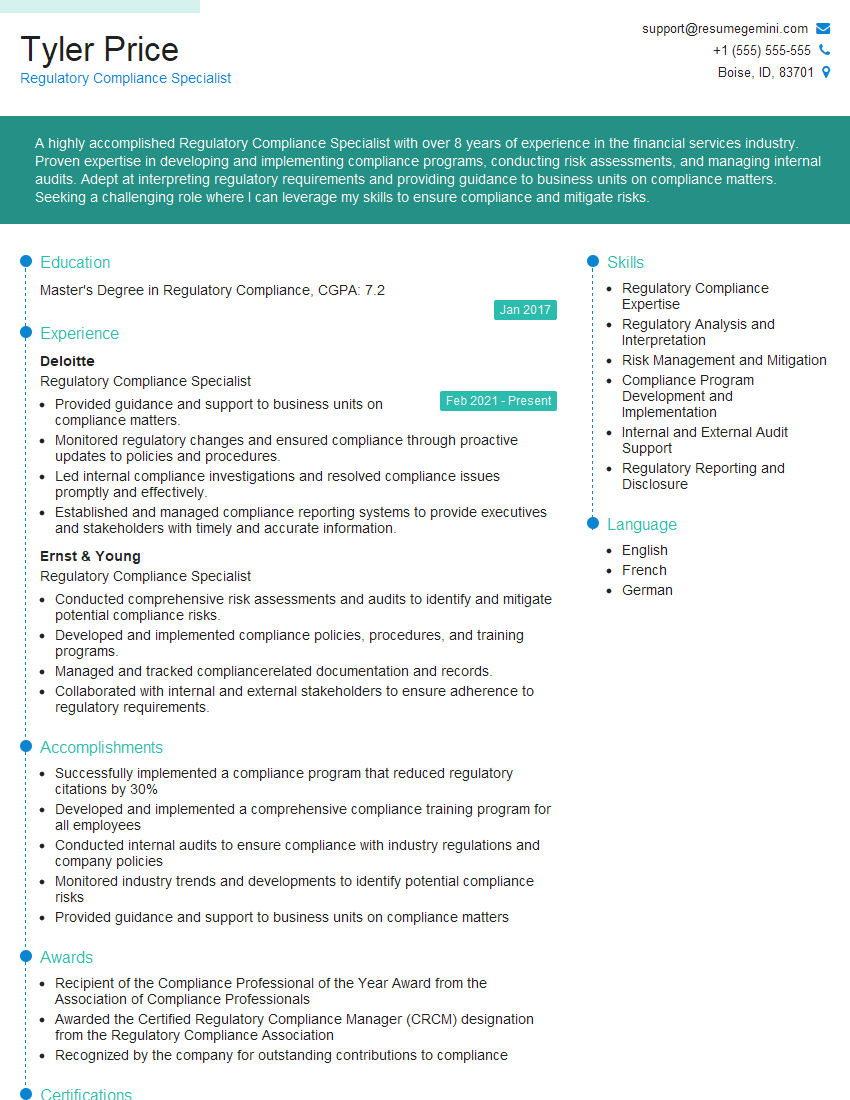
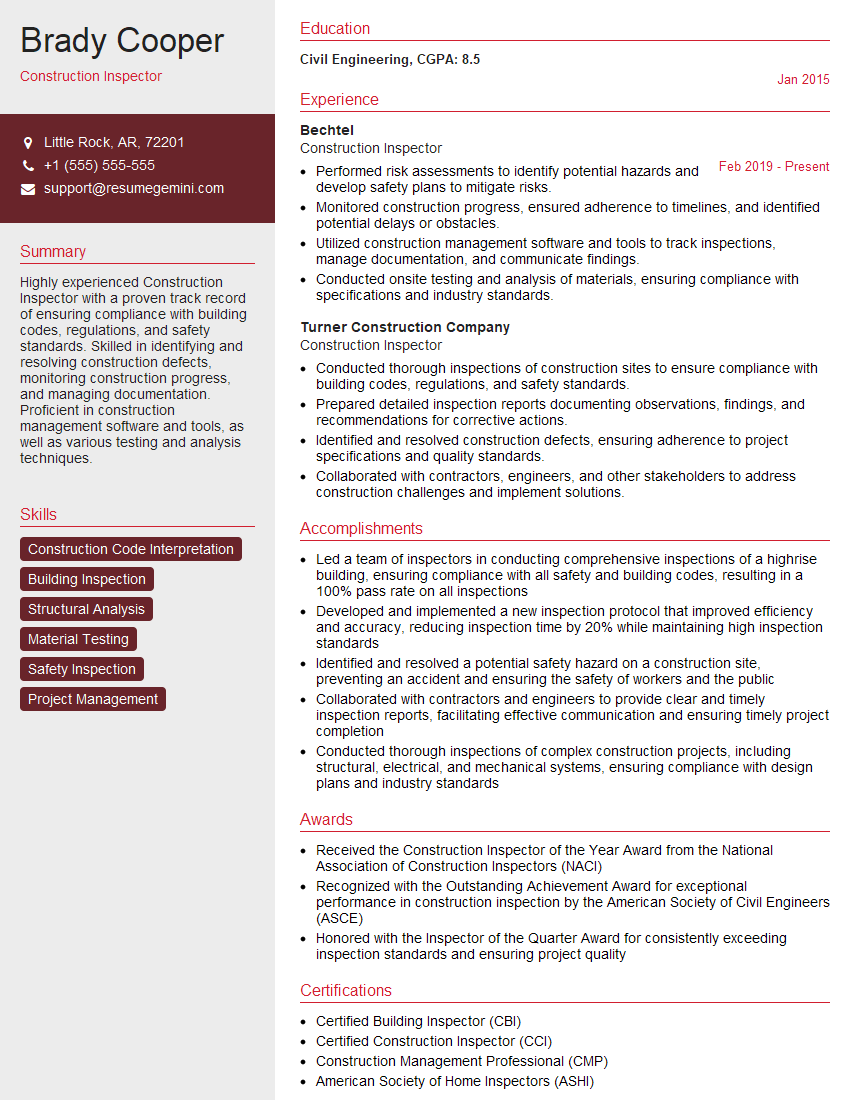
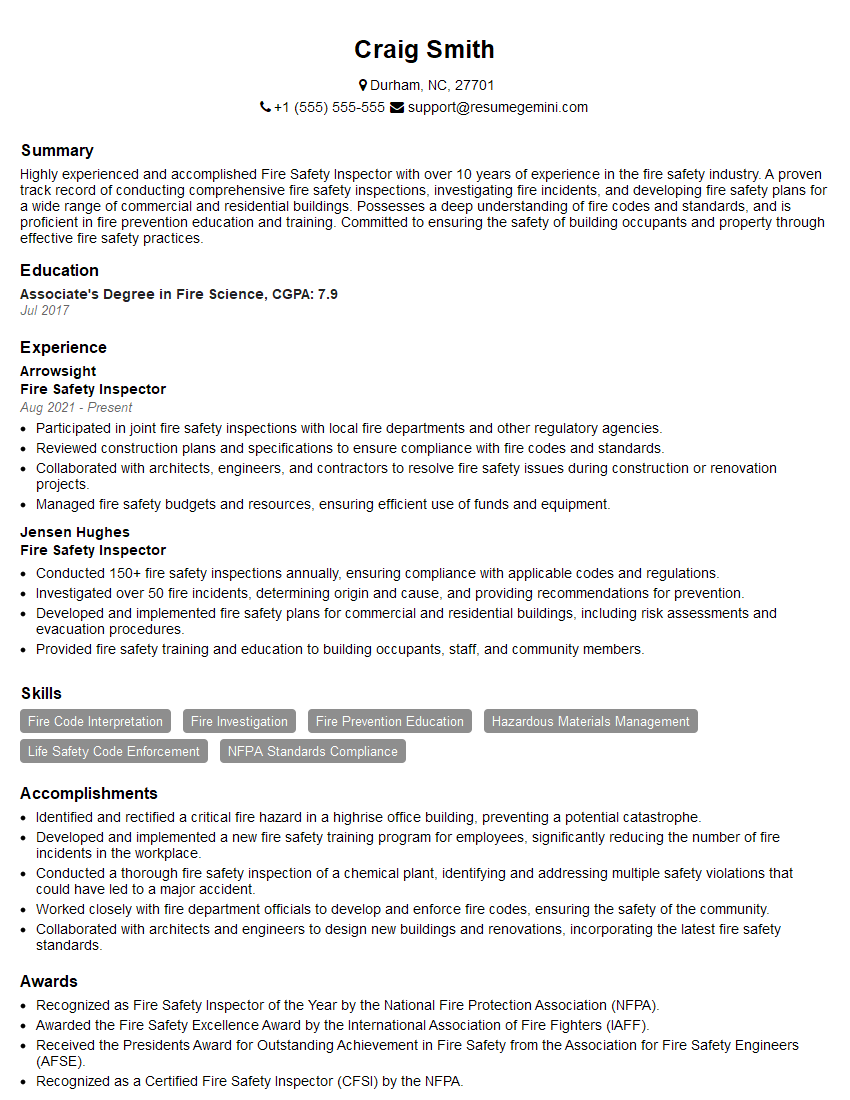
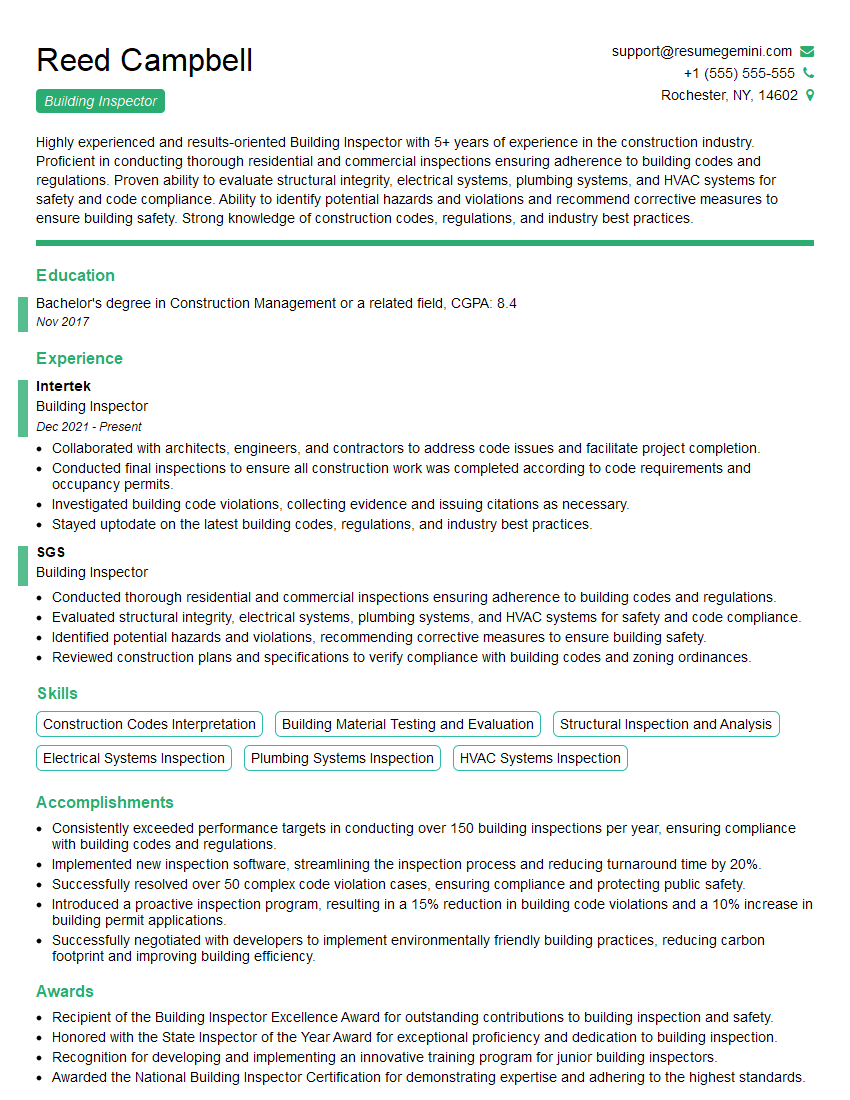
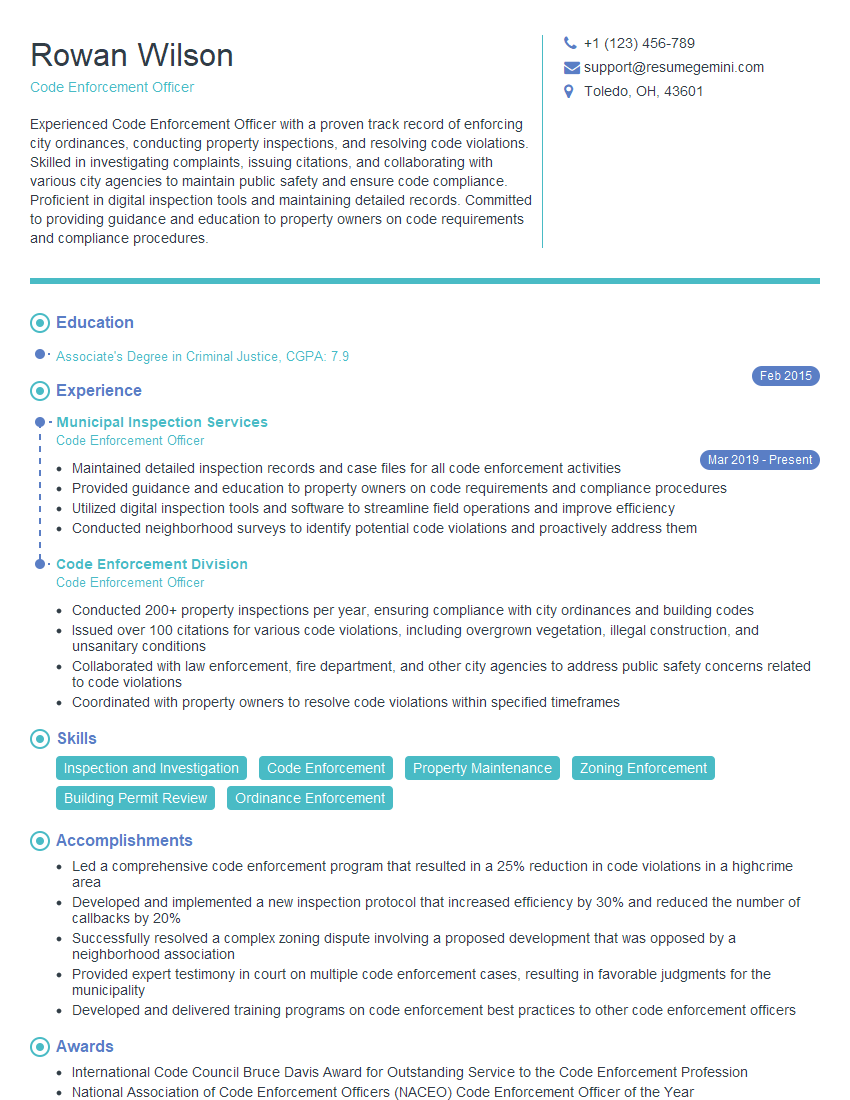
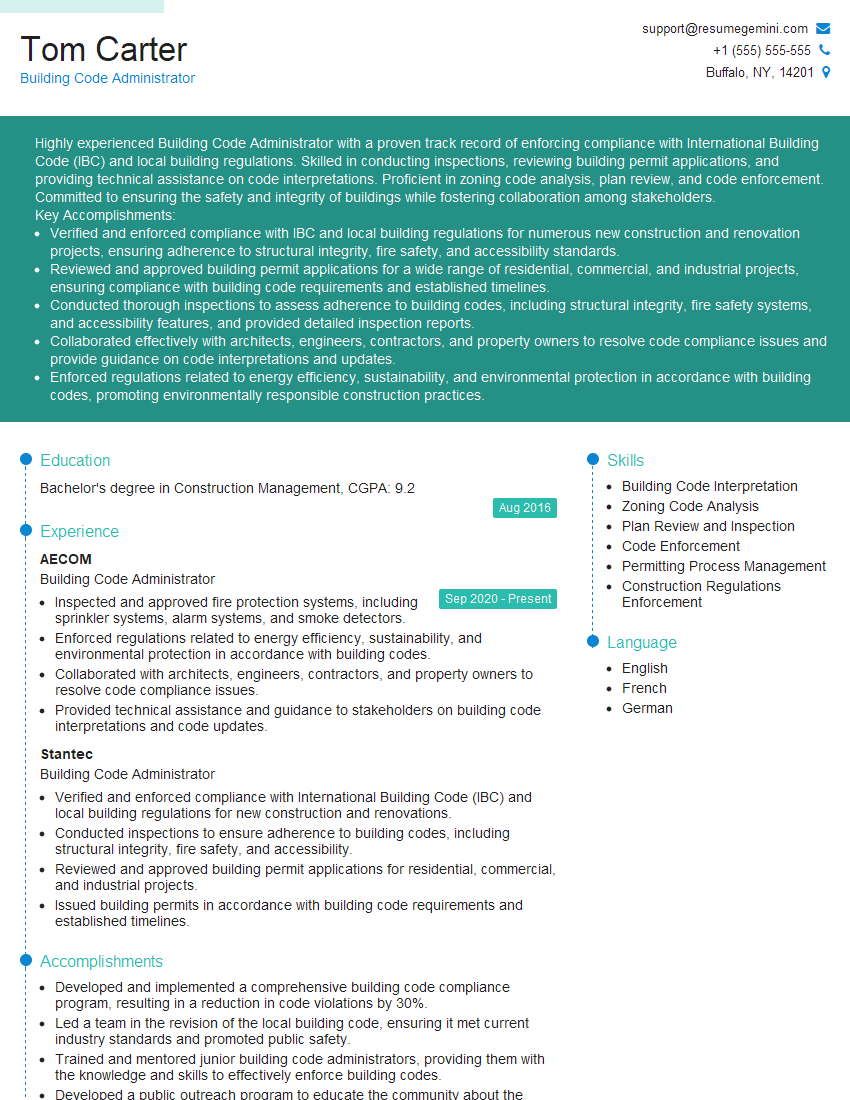
Mastering Building Code Expertise is crucial for career advancement in the construction and design industries, opening doors to senior roles and specialized projects. A strong understanding of building codes demonstrates your commitment to safety, quality, and compliance. To significantly improve your job prospects, focus on crafting an ATS-friendly resume that showcases your skills and experience effectively. ResumeGemini is a trusted resource that can help you build a compelling and professional resume. We provide examples of resumes tailored to Building Code Expertise to guide you in creating a document that highlights your unique qualifications.
Explore more articles
Users Rating of Our Blogs
Share Your Experience
We value your feedback! Please rate our content and share your thoughts (optional).
What Readers Say About Our Blog
Very informative content, great job.
good