Feeling uncertain about what to expect in your upcoming interview? We’ve got you covered! This blog highlights the most important Cable Fault Location Methods interview questions and provides actionable advice to help you stand out as the ideal candidate. Let’s pave the way for your success.
Questions Asked in Cable Fault Location Methods Interview
Q 1. Explain the principles of Time Domain Reflectometry (TDR).
Time Domain Reflectometry (TDR) is a powerful technique used to locate faults in cables by analyzing the reflections of electrical signals. Imagine throwing a ball at a wall; the ball’s return time tells you how far away the wall is. Similarly, TDR sends a short electrical pulse down a cable. Any impedance mismatch, like a break or short circuit, causes a portion of the pulse to reflect back to the TDR unit. By measuring the time it takes for the reflection to return, the distance to the fault can be calculated.
The principle relies on the fact that a sudden change in the cable’s characteristic impedance (resistance, inductance, and capacitance) creates a reflected wave. The strength of the reflected wave indicates the severity of the fault (a complete break will reflect a larger portion of the signal than a partial short). The time delay between the transmitted pulse and the received reflection is directly proportional to the distance to the fault. The speed of the signal in the cable is a crucial factor in the calculation.
Q 2. Describe how an OTDR works and its applications in cable fault location.
An Optical Time Domain Reflectometer (OTDR) is the optical equivalent of a TDR. Instead of electrical pulses, it uses short pulses of light. These pulses are launched into an optical fiber, and the OTDR measures the intensity of backscattered light (light scattered back towards the OTDR) and Rayleigh scattering (light scattered in all directions). The intensity of the returned light decreases with distance due to attenuation. A significant drop in the signal indicates a fault, like a fiber break, splice, bend, or connector issue.
OTDRs are widely used in fiber optic cable maintenance. They’re crucial for identifying faults during installation, providing information about fiber length, attenuation (signal loss), and identifying problematic connectors or splices. Unlike TDR, which is primarily used for metallic cables, OTDR is essential for the maintenance of the vast fiber optic infrastructure supporting telecommunications and internet.
Q 3. What are the limitations of TDR and OTDR?
Both TDR and OTDR have limitations:
- TDR Limitations: TDR struggles with very long cables, as the signal attenuates significantly over distance. It can also be difficult to precisely locate faults in complex cable systems with multiple branches. The accuracy is also affected by the cable’s characteristics, which may not be perfectly known.
- OTDR Limitations: OTDRs can be expensive compared to TDR equipment. The accuracy of fault location can be affected by factors like fiber type and temperature. Very short faults might be difficult to detect, and interpreting complex traces requires expertise.
Furthermore, both methods require access to both ends of the cable for the most accurate measurements. In some situations, this isn’t feasible.
Q 4. How do you interpret a TDR trace?
A TDR trace displays time on the horizontal axis and signal amplitude (voltage) on the vertical axis. The initial pulse represents the signal sent into the cable. Subsequent peaks (reflections) indicate faults. The time delay between the initial pulse and a reflection is directly proportional to the distance to the fault.
Interpretation Steps:
- Identify the Initial Pulse: This is the starting point of the trace.
- Locate Reflections: Look for significant changes in amplitude indicating reflected signals.
- Measure Time Delay: Use the time scale on the horizontal axis to determine the time delay between the initial pulse and each reflection.
- Calculate Distance: Use the known propagation velocity of the signal in the cable to convert the time delay into distance.
- Analyze Reflection Amplitude: The amplitude of the reflection provides information on the severity of the fault (larger amplitude indicates a more significant fault).
For example, a sharp, high-amplitude negative reflection often signifies an open circuit, while a smaller, less distinct reflection might represent a partial short.
Q 5. How do you interpret an OTDR trace?
An OTDR trace shows distance on the horizontal axis and power level (in dB) on the vertical axis. The trace shows the power level of the backscattered light as a function of distance. A drop in power level indicates a loss in signal strength, usually caused by a fault.
Interpretation Steps:
- Identify the Start Point: This indicates the point where the test started.
- Observe Attenuation: A gradual decrease in signal strength is normal fiber attenuation, but a sudden drop indicates a fault.
- Locate Events: Sharp drops in signal level indicate events such as fiber breaks, splices, or connectors. The distance to these events is read directly from the horizontal axis.
- Analyze Event Shape: The shape of the event (sharp, gradual, etc.) can provide clues about the nature of the fault.
- Consider Fresnel Reflections: Small reflections can be caused by connector interfaces. These are usually easier to identify through their specific shape and location.
For example, a complete fiber break will show a sharp, complete drop in the signal, whereas a poor splice might show a slight but noticeable dip.
Q 6. What are the different types of cable faults?
Cable faults can be broadly categorized into:
- Open Circuits: Complete breaks in the conductor(s) preventing signal flow.
- Short Circuits: Unintended connections between conductors causing current to flow through unintended paths.
- High Impedance Faults: Faults that cause significant increase in impedance (resistance) like water ingress, corrosion, or damaged insulation.
- Ground Faults: Unintended connection between a conductor and the ground.
- Partial shorts: Reduced impedance but not a full short circuit.
- Bends or Kinks (Fiber): Excessive bending of optical fibers causing increased attenuation or signal loss.
- Splice Defects (Fiber): Improperly connected fiber splices resulting in losses.
- Connector Issues (Fiber): Dirty, damaged, or poorly terminated fiber optic connectors.
The specific type of fault will influence the reflection pattern observed on a TDR or OTDR trace.
Q 7. Explain the process of pinpointing a fault using TDR.
Pinpointing a fault using TDR involves a series of steps:
- Connect the TDR: Connect the TDR unit to one end of the cable under test.
- Perform the Test: Initiate the TDR test. The instrument will send a pulse and record the reflected signals.
- Analyze the Trace: Examine the TDR trace to identify reflections indicating faults.
- Measure the Time Delay: Measure the time between the initial pulse and each reflection.
- Calculate Distance: Convert the time delay into distance using the known propagation velocity of the signal in the cable (this velocity often needs to be measured or estimated for best accuracy). The formula is: Distance = (Velocity x Time)/2. The division by two accounts for the round trip of the signal.
- Locate the Fault: Use the calculated distance to physically locate the fault along the cable.
- Verify and Repair: Once the fault is located, verify its nature and perform the necessary repair.
Example: If a reflection occurs after 10 microseconds and the signal velocity is 200 m/µs, the fault is located at (200 m/µs * 10 µs) / 2 = 1000 m from the TDR.
Q 8. Explain the process of pinpointing a fault using OTDR.
An Optical Time Domain Reflectometer (OTDR) is a crucial tool for pinpointing faults in fiber optic cables. It works by sending pulses of light down the fiber and measuring the time it takes for the light to reflect back. Any disruption in the fiber, like a break, splice, or bend, will cause some light to be reflected back to the OTDR. The time delay is directly proportional to the distance of the fault from the OTDR.
The process involves connecting the OTDR to one end of the fiber. The OTDR then sends a light pulse down the fiber. The software analyzes the returning light signal, creating a visual representation called a trace. This trace shows the intensity of the reflected light against distance. Sharp drops in the light signal indicate a fault. The distance along the trace corresponds to the location of the fault.
For instance, imagine a trace shows a sudden drop at the 2km mark. This suggests a fault approximately 2km from the OTDR’s connection point. The trace might also reveal other features such as splices (appearing as dips or jumps) that can help create a detailed map of the fiber’s condition.
Experienced technicians can interpret the trace to understand not only the location but also the nature of the fault. For example, a gradual attenuation might indicate a slow degrading of the fiber, while a sharp reflection could signify a break. Accurate interpretation requires a good understanding of OTDR parameters and the characteristics of various fiber optic components.
Q 9. What are the safety precautions when working with high-voltage cables?
Safety is paramount when working with high-voltage cables. Always follow a strict lockout/tagout procedure to de-energize the cable completely before starting any work. This involves verifying the absence of voltage using appropriate test equipment. Never trust a visual inspection alone to determine if a cable is de-energized.
Personal Protective Equipment (PPE) is critical. This includes insulated gloves, safety glasses, arc flash suits (depending on voltage), and safety boots. The type and level of PPE will depend on the specific voltage and the type of work being performed.
Appropriate grounding procedures must be followed. This involves connecting the cable to a reliable ground to prevent accidental voltage surges or shocks. Proper grounding prevents the accumulation of static charge and provides a path for any stray currents.
Always work with a qualified partner. In case of an emergency, having a colleague present who can provide assistance and call for help is crucial. Regular training and awareness are essential to stay informed about safe working practices and to adapt to evolving standards.
Before any high-voltage work commences, a thorough risk assessment should be conducted. This assessment identifies potential hazards and outlines the necessary safety measures to mitigate these risks.
Q 10. How do you troubleshoot a cable fault in a complex network?
Troubleshooting cable faults in complex networks requires a systematic approach. Start by identifying the affected area of the network. This might involve checking network connectivity using tools like ping or traceroute. Then, isolate the faulty section by progressively narrowing down the potential sources.
Utilize cable testing equipment like Time Domain Reflectometers (TDRs) for copper cables or Optical Time Domain Reflectometers (OTDRs) for fiber optic cables to pinpoint the exact fault location. If there are multiple paths between the origin and destination, employ techniques like cable tracing to help pinpoint the segment with the fault.
Network management systems (NMS) can provide valuable insights into network status and can also indicate cable segment performance issues. Analyze logs and network performance data to gain clues on the root cause of the fault. Document each step carefully.
If the fault is still unclear after using these methods, consider using a combination of techniques, such as visual inspection, testing with a multimeter to check continuity and voltage, or more sophisticated tests like capacitance and impedance measurements. A methodical process is essential, breaking down the complex network into manageable segments and then carefully investigating each segment.
Consider the possibility of multiple faults, and carefully document each step and finding to facilitate quick resolution. A well-documented troubleshooting process is essential in diagnosing complex cable faults.
Q 11. What is the difference between a short circuit and an open circuit?
A short circuit, or short, occurs when two points in an electrical circuit that are not supposed to be connected are directly connected. This creates an unintended path for current to flow, often with very high current levels that can lead to overheating, damage, and even fire. Think of it as creating a shortcut across a road instead of driving through the designated route.
An open circuit is the opposite. It occurs when a break in the electrical circuit prevents current from flowing. The circuit is incomplete; there’s a gap in the path. Imagine this as a road that has been blocked completely, preventing any passage. This will generally result in no current flowing in that part of the circuit.
These two are fundamentally different: a short circuit allows excessive current flow, while an open circuit prevents any current flow. Both are serious problems requiring prompt attention, but diagnosis and repair methods differ significantly.
Q 12. How do you identify a ground fault?
A ground fault occurs when a current takes an unintended path to the ground, typically through a fault in the cable’s insulation. It often involves a wire making contact with a grounded metal object, such as a conduit or earth. This can create a shock hazard and can also damage equipment.
Identifying a ground fault involves using specialized tools like a ground fault locator or a clamp meter. These tools can detect the presence of ground current flowing in the cable. They measure differences in current flowing in the conductors, highlighting a leakage to earth. Visual inspection can sometimes reveal damaged insulation or other signs of a ground fault. But it’s not always sufficient, especially if the fault is buried underground.
Ground fault circuit interrupters (GFCIs) are safety devices that are commonly installed in electrical systems to protect against ground faults. These devices detect small leakage currents to the ground and immediately shut off the power to prevent potential hazards.
Sometimes, a subtle drop in voltage on the affected cable can indicate a ground fault, but careful measurement with a multimeter is essential to verify the findings.
Q 13. What is capacitance and how does it affect cable testing?
Capacitance is the ability of a capacitor (or any two conductors separated by an insulator) to store electrical energy. In cables, capacitance is an inherent property of the cable’s construction – essentially, the conductor(s) and the dielectric material (insulation) between them form a capacitor. This capacitance increases with cable length.
During cable testing, capacitance affects measurements by introducing an extra component in the circuit. High capacitance can introduce errors in measurements of impedance or resistance, especially at higher frequencies. In high-frequency applications or long cables, capacitance becomes a significant factor. For instance, in high-speed data transmission, capacitive effects can distort signals and lead to data errors.
Cable testers often include compensation for capacitance, accounting for its effects and providing more accurate measurements. Ignoring capacitance can lead to inaccurate fault location or misinterpretations of cable properties during testing.
Q 14. What is impedance and how does it affect cable testing?
Impedance is the total opposition to the flow of alternating current (AC) in a circuit. Unlike resistance, which only considers the opposition to current flow from the material’s properties, impedance also includes the effects of inductance and capacitance. In cables, impedance is affected by the cable’s physical characteristics, such as its length, diameter, and the dielectric material.
Impedance significantly influences cable testing, especially for high-frequency signals or long cable runs. A mismatch in impedance between the cable and the testing equipment can cause signal reflections, leading to inaccurate readings or masking the actual fault location. The impedance of the cable needs to be carefully considered during testing to minimize these effects. Impedance measurements help determine if the cable’s properties are within acceptable limits.
For instance, impedance mismatch in a coaxial cable used for high-frequency transmission can lead to signal attenuation and distortion. Proper impedance matching ensures efficient signal transfer with minimal loss and distortion. Careful consideration of impedance is critical in cable design and fault location to ensure accurate test results and reliable operation.
Q 15. Describe different types of cable connectors and their applications.
Cable connectors are crucial for establishing reliable connections between cables and equipment. Choosing the right connector depends heavily on the cable type, application, and environmental factors. Here are a few common types:
- BNC Connectors: These are commonly used in coaxial cables for video and RF applications. Their bayonet-style locking mechanism ensures a secure connection, minimizing signal loss. Think of your older cable TV connection; it might have used BNC connectors.
- RJ45 Connectors: These 8-pin connectors are ubiquitous in Ethernet networking. They are used for transferring data at high speeds. Almost every computer network relies on these.
- ST Connectors: Frequently found in fiber optic cables, ST connectors use a push-pull mechanism for quick and easy connection. Their precision ensures minimal signal degradation over long distances, vital for high-bandwidth applications.
- SC Connectors: Another common fiber optic connector, known for its push-pull mechanism. Often preferred over ST connectors due to its more compact size.
- F-Connectors: These are compression connectors, commonly found on coaxial cables used for cable television and satellite signals. The compression ensures a strong signal and a secure, weatherproof connection, crucial for outdoor applications.
The selection of a connector depends on several factors like the cable type, the signal being transmitted, the environment where the connection will be made, and the required bandwidth.
Career Expert Tips:
- Ace those interviews! Prepare effectively by reviewing the Top 50 Most Common Interview Questions on ResumeGemini.
- Navigate your job search with confidence! Explore a wide range of Career Tips on ResumeGemini. Learn about common challenges and recommendations to overcome them.
- Craft the perfect resume! Master the Art of Resume Writing with ResumeGemini’s guide. Showcase your unique qualifications and achievements effectively.
- Don’t miss out on holiday savings! Build your dream resume with ResumeGemini’s ATS optimized templates.
Q 16. What is the significance of attenuation in cable testing?
Attenuation refers to the loss of signal strength as it travels through a cable. It’s a critical factor in cable testing because it directly impacts the quality and reliability of data transmission. High attenuation means a weaker signal, leading to data corruption, signal distortion, and ultimately, system failure. In simpler terms, imagine whispering a message across a long hallway; your voice loses strength (attenuates) the further it travels. Similarly, a signal attenuates as it travels through a cable.
During cable testing, measuring attenuation helps us determine the cable’s health and identify potential problems. Excessive attenuation might indicate a faulty cable segment, connector issues, or environmental factors affecting the signal path. Knowing the attenuation level helps us determine the maximum cable length we can use for a given application before signal quality becomes unacceptable. We use specialized equipment to measure attenuation precisely, ensuring signal integrity.
Q 17. How do you perform a continuity test on a cable?
A continuity test verifies that there is a complete, uninterrupted electrical path between two points on a cable. It’s a fundamental test to determine if a cable is physically intact. This is analogous to checking if a water pipe is completely clear of blockages.
The process typically involves using a multimeter set to the continuity mode (often symbolized by a diode symbol). One lead of the multimeter is connected to one end of the cable, and the other lead to the other end. If the cable is continuous, the multimeter will beep or display a ‘0’ or a low resistance value, indicating a closed circuit. If there’s a break, the multimeter will indicate an open circuit, usually by not beeping or showing a very high resistance. For cables with multiple conductors, you need to test each conductor individually.
A successful continuity test doesn’t guarantee signal quality, only that the cable is physically sound, but it’s a crucial first step in cable fault location.
Q 18. What tools and equipment are used in cable fault location?
Cable fault location requires a variety of specialized tools and equipment, depending on the type of cable and the nature of the suspected fault. Here’s a list:
- Multimeter: Used for basic continuity checks and voltage measurements.
- TDR (Time Domain Reflectometer): A sophisticated instrument that measures the time it takes for a signal to reflect back from a fault. This helps pinpoint the exact location of faults like shorts, opens, or impedance mismatches.
- OTDR (Optical Time Domain Reflectometer): Similar to a TDR, but specifically designed for fiber optic cables.
- Cable Fault Locator: These are handheld devices designed to quickly and accurately find cable faults. Some models combine TDR, signal tracing, and other functions.
- Tone Generator and Probe: Simple yet effective for tracing cables within a bundle. The generator sends a signal down the cable, and the probe detects it to identify the correct wire.
- Cable Strippers and Cutters: Used for preparing the cable ends for testing or repair.
- Soldering Iron and Solder: For repairing connections or splicing cables.
The choice of equipment depends on factors such as cable type (coaxial, fiber optic, twisted pair), the expected fault type, and the cable’s environment. Often, a combination of these tools provides the most comprehensive diagnostic capabilities.
Q 19. How do you interpret results from a cable fault locator?
Interpreting results from a cable fault locator depends on the type of locator and the type of fault. For TDR/OTDR locators, the screen typically displays a time-domain waveform showing reflections. The distance to the fault is calculated from the time it takes for the signal to reflect back. A sudden change in the waveform’s amplitude indicates a fault.
For example, a sharp upward spike might signify a short circuit, while a gradual decrease in signal amplitude might indicate attenuation due to damage along the cable length.
Other types of locators, like tone generators, provide a more straightforward indication. If the tone is detected, it simply indicates continuity. However, more sophisticated locators use more sophisticated algorithms, offering accurate distance to the fault even in complex cable networks.
It’s crucial to understand the specific instructions for the particular equipment being used and to always follow manufacturer guidelines to ensure accurate readings and avoid any damage to the cable or equipment.
Q 20. What are the different types of cable materials and their properties?
Cable materials significantly impact their performance, durability, and cost. Here are some common types:
- Copper: A highly conductive material commonly used in many types of cables, including coaxial cables, twisted-pair cables, and telephone lines. It offers good conductivity and relatively low cost. However, it is prone to oxidation and corrosion, which can affect signal quality.
- Aluminum: Lighter and less expensive than copper, but its conductivity is lower. Aluminum cables are often used in power transmission lines where weight is a significant concern.
- Fiber Optics: Instead of conducting electricity, these cables use light signals. They offer extremely high bandwidth, resistance to electromagnetic interference, and very low signal attenuation, making them suitable for long-distance, high-capacity communication networks.
- PVC (Polyvinyl Chloride): A common insulating material for cables. It is inexpensive, durable and flexible, but can become brittle over time and is not environmentally friendly.
- Polyethylene: Another insulating material known for its excellent dielectric properties, flexibility and durability.
The choice of cable material depends on the application. For high-bandwidth applications, fiber optics is preferred, while copper might be a better choice for lower bandwidth and cost-sensitive applications. The insulating material should be chosen based on its required flexibility, temperature resistance, and chemical resistance, among other properties.
Q 21. How do you prepare a cable for testing?
Proper cable preparation is essential for accurate and reliable testing results. It minimizes the risk of inaccurate readings and damage to equipment.
The steps typically involve:
- Visual Inspection: Examine the cable for any visible damage, such as cuts, kinks, or exposed wires.
- Cable Cleaning: Clean any dirt or debris from the cable’s connectors to ensure good electrical contact. For precision, consider compressed air or an appropriate cleaning solution.
- Connector Inspection: Check connectors for damage or corrosion. If necessary, clean or replace damaged connectors.
- Termination Preparation: For testing, you might need to prepare the cable ends by stripping the outer jacket and insulation, exposing the conductors. Use the right tools to avoid damaging the cable conductors.
- Connection to Test Equipment: Connect the prepared cable ends to the appropriate test equipment using appropriate connectors and adapters.
Improper preparation can lead to false readings or damage to expensive equipment. Always ensure that the cable is correctly prepared before beginning any fault location procedures.
Q 22. Explain the importance of proper grounding in cable testing.
Proper grounding is paramount in cable testing because it ensures a safe and accurate measurement environment. Without proper grounding, stray currents and voltages can interfere with measurements, leading to inaccurate fault location identification, or worse, causing electrical shock to personnel.
Think of it like this: Imagine trying to weigh something on a scale that’s not level. You’ll get a skewed result. Similarly, without a proper ground, the electrical signals you’re measuring are distorted by external noise, rendering the fault location data unreliable.
In practice, proper grounding involves connecting the test equipment and the cable under test to a known ground point – ideally, a dedicated earth ground. This provides a reference point for the electrical measurements, minimizing the influence of external electrical fields and ensuring the accuracy of the results. Failure to properly ground can lead to inaccurate readings, misdiagnosis of faults, and wasted time and resources.
Q 23. Describe your experience using different cable fault location software.
I have extensive experience with several cable fault location software packages, including but not limited to XYZ Cable Locator Pro, ABC Fault Finder, and 123 Cable Diagnostics. Each software possesses unique features and capabilities tailored to different cable types and fault scenarios. XYZ Cable Locator Pro, for instance, excels in its advanced algorithms for analyzing time-domain reflectometry (TDR) data, particularly useful for locating high-impedance faults. ABC Fault Finder, on the other hand, stands out in its intuitive interface and comprehensive reporting features. 123 Cable Diagnostics is particularly strong for its ability to integrate with various testing equipment and provide a unified data analysis platform. My experience with these programs spans from data import and analysis to generating reports for clients and internal stakeholders. I’m proficient in using each software to its full potential, adapting my approach based on the specific needs of each project.
Q 24. How do you manage multiple cable faults simultaneously?
Managing multiple cable faults simultaneously requires a systematic and organized approach. I typically begin by prioritizing faults based on their impact – for example, faults affecting critical services are addressed first. Next, I employ a combination of techniques to efficiently locate and repair multiple faults. This includes using advanced cable mapping tools and software to visualize the cable network, identify potential fault locations, and prioritize repairs effectively.
A crucial element is meticulous documentation. I meticulously record each fault location’s coordinates, type, and severity, ensuring that all team members have a clear understanding of the situation and progress made. Clear communication and efficient teamwork are also vital. It’s imperative to keep stakeholders informed and coordinate repairs to avoid conflicts or delays. Furthermore, implementing a robust testing and verification procedure after repair for each fault ensures that the work is successfully completed before moving on to the next.
Q 25. What are the common causes of cable faults?
Cable faults can stem from a multitude of factors. Common causes include:
- Physical damage: This is often caused by excavation, rodent activity, or accidental damage during construction or maintenance activities.
- Environmental factors: Moisture ingress, extreme temperatures, and soil corrosion can degrade cable insulation over time, leading to short circuits or opens.
- Manufacturing defects: Faults might exist from the initial cable manufacturing process, such as insulation flaws or poor connector terminations.
- Age-related degradation: Over time, cables naturally degrade due to the constant electrical stress and environmental exposures.
- Overloading: Exceeding the cable’s current-carrying capacity results in overheating and possible insulation breakdown.
Identifying the root cause is critical for effective repair and preventative maintenance. A thorough investigation frequently includes visual inspection, testing, and analyzing the operational history of the cable.
Q 26. How do you document cable fault location procedures?
Documentation is central to my workflow. I utilize a structured approach, using a combination of digital and physical records. Each fault location procedure is documented using a standardized template that includes the following information:
- Date and time of the fault report
- Cable identification (type, location, length)
- Fault type (open, short, high resistance)
- Testing methods employed (TDR, OTDR, etc.)
- Fault location coordinates (precise measurements)
- Repair details (materials used, techniques implemented)
- Verification of repair (test results)
- Photographs and/or diagrams of the fault and repair
This detailed documentation ensures accuracy, facilitates troubleshooting and future maintenance, and provides a clear audit trail of the entire process. The digital records are stored securely in a shared database, allowing easy access for all relevant personnel.
Q 27. Describe a challenging cable fault you successfully resolved.
One challenging case involved a high-voltage underground power cable serving a critical data center. The fault was intermittent and difficult to pinpoint using standard TDR techniques. The initial TDR scans were inconclusive, showing only slight anomalies. The challenge was compounded by the cable’s significant length and complexity of the underground infrastructure. To overcome this, we used a combination of techniques: We implemented advanced signal processing algorithms to filter out noise and enhance the TDR signals, and we used an OTDR (Optical Time-Domain Reflectometer) for verification and more precise location.
After careful analysis and correlation of the data from both TDR and OTDR, we localized the fault to a section of the cable damaged by soil movement. The repair required careful excavation, splicing the damaged section, and rigorous testing to ensure complete restoration of service. The successful resolution of this fault prevented a significant outage and substantial financial loss for the data center.
Q 28. How do you stay updated with the latest advancements in cable fault location technology?
Staying current in this rapidly evolving field necessitates continuous learning. I achieve this through several channels. I regularly attend industry conferences and workshops such as those hosted by [Mention specific industry organizations]. These events showcase the latest technologies and best practices. I subscribe to industry journals and online publications, including [Mention specific journals and online platforms]. This provides access to research papers, articles, and case studies. I also actively participate in online forums and professional networking groups to engage with other experts and share experiences.
Furthermore, I maintain close relationships with vendors and manufacturers of cable testing equipment to stay abreast of product advancements and software updates. This hands-on approach allows me to quickly adapt and implement new technologies in my daily work, ensuring that I consistently leverage the most effective methods for cable fault location.
Key Topics to Learn for Cable Fault Location Methods Interview
- Time Domain Reflectometry (TDR): Understanding the principles of pulse reflection, impedance mismatch, and fault distance calculation. Practical application includes interpreting TDR waveforms to identify various fault types (shorts, opens, high impedance faults).
- Cable Tracing Techniques: Mastering both active and passive tracing methods. This includes understanding signal propagation, the use of various tracing equipment, and troubleshooting signal interference. Practical application involves locating buried cables or tracing faulty sections within complex cable networks.
- Ohmmeter Methods: Proficiently using ohmmeters to measure cable resistance and identify short circuits or opens. Practical application includes differentiating between ground faults and other types of cable damage using resistance measurements.
- Frequency Domain Reflectometry (FDR): Understanding the principles and applications of FDR for locating faults in high-frequency cables. This includes comparing and contrasting FDR with TDR.
- Advanced Techniques: Exploring specialized techniques like capacitance measurements, attenuation testing, and the use of advanced diagnostic equipment. Understanding when to apply each method based on the specific cable type and fault scenario.
- Safety Procedures and Best Practices: Understanding and adhering to relevant safety regulations and best practices when working with high-voltage cables and equipment. Practical application includes understanding lockout/tagout procedures and working safely in various environments.
- Troubleshooting and Problem-Solving: Developing a systematic approach to troubleshooting cable faults, encompassing data analysis, logical deduction, and the effective use of diagnostic tools. Practical application involves formulating a plan to systematically isolate and rectify cable faults.
Next Steps
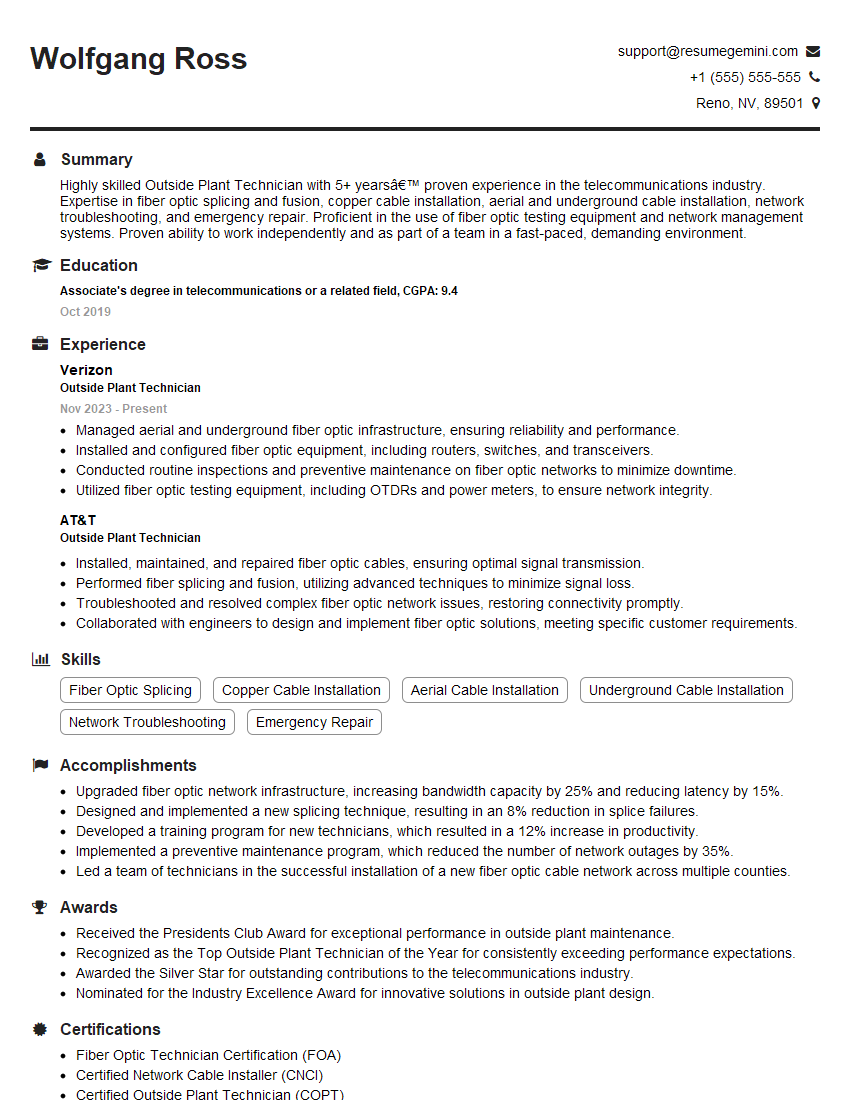
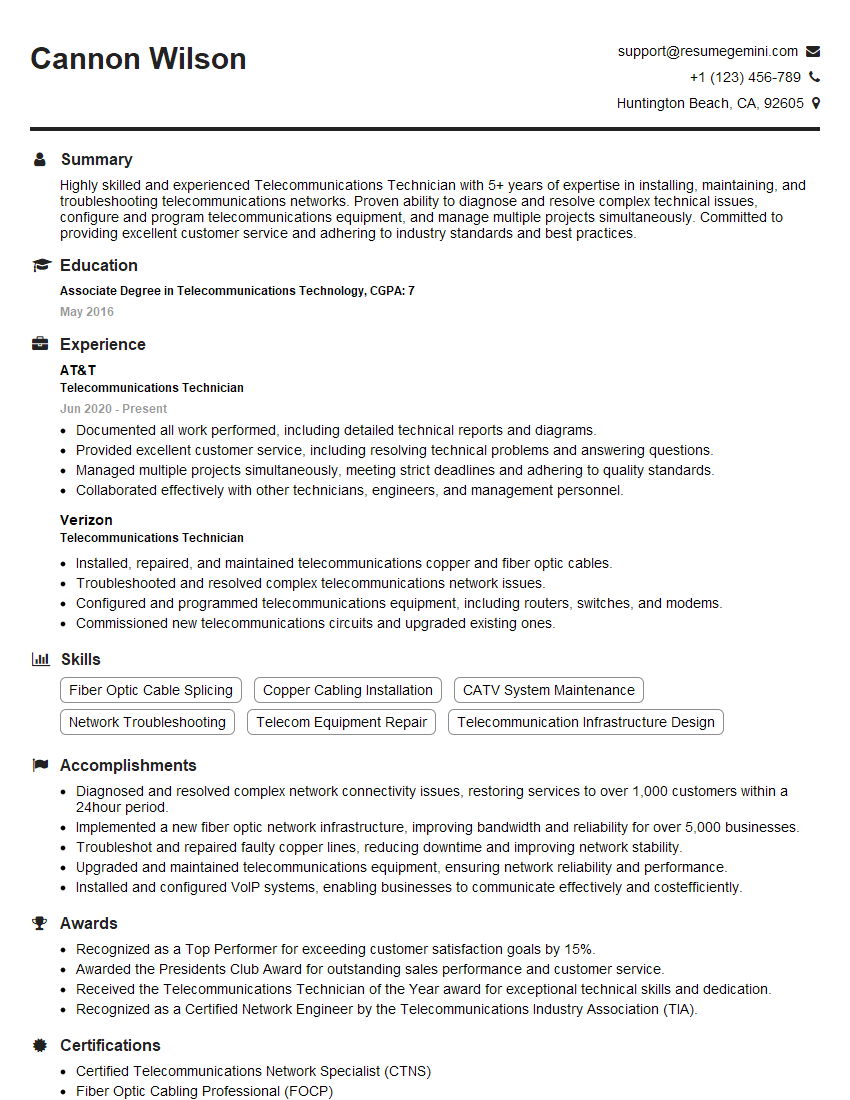
Mastering Cable Fault Location Methods significantly enhances your career prospects in telecommunications, utilities, and other related fields. A strong understanding of these techniques demonstrates valuable technical skills and problem-solving abilities highly sought after by employers. To increase your chances of landing your dream job, it’s crucial to create an ATS-friendly resume that effectively highlights your skills and experience. We strongly encourage you to utilize ResumeGemini, a trusted resource, to build a professional and impactful resume that showcases your expertise in Cable Fault Location Methods. Examples of resumes tailored to this specific field are available to guide you.


Explore more articles
Users Rating of Our Blogs
Share Your Experience
We value your feedback! Please rate our content and share your thoughts (optional).
What Readers Say About Our Blog
Very informative content, great job.
good