Unlock your full potential by mastering the most common Cable Plant Design interview questions. This blog offers a deep dive into the critical topics, ensuring you’re not only prepared to answer but to excel. With these insights, you’ll approach your interview with clarity and confidence.
Questions Asked in Cable Plant Design Interview
Q 1. Explain the differences between inside plant (ISP) and outside plant (OSP) cable design.
Inside Plant (ISP) and Outside Plant (OSP) cable design differ significantly in their environmental considerations, cable types, and installation methods. ISP refers to the cabling within a building, while OSP encompasses the cabling infrastructure outside a building, connecting to other buildings or networks.
- Inside Plant (ISP): Typically involves controlled environments with less exposure to harsh weather conditions. Common cable types include twisted pair, fiber optic, and coaxial cables. Installation is generally simpler, utilizing pathways like cable trays, conduits, and walls. Focus is on aesthetics and ease of maintenance within the building.
- Outside Plant (OSP): Deals with challenging conditions like extreme temperatures, moisture, rodents, and physical damage from digging or weather events. OSP cabling requires durable, weather-resistant cables often with additional protection like steel armor or polyethylene jackets. Installation methods involve trenching, aerial placement on poles, and underground conduits. Design must prioritize longevity and resistance to environmental factors.
For example, a data center’s internal network (ISP) might use high-density fiber optic cables within carefully managed pathways, while the connection to the main internet service provider (OSP) would likely involve buried fiber optic cables encased in protective conduits.
Q 2. Describe your experience with various cable types (e.g., fiber optic, coaxial, twisted pair).
My experience encompasses a wide range of cable types, each with its own strengths and limitations:
- Fiber Optic Cable: I have extensive experience designing and deploying fiber optic networks for high-bandwidth applications like data centers and long-haul communications. My work includes specifying different fiber types (single-mode, multi-mode), connector types (SC, LC, MTP), and cable construction to meet specific performance requirements. I’ve worked with fusion splicing and various testing methodologies to ensure optimal performance.
- Coaxial Cable: I’ve worked with coaxial cabling primarily in video distribution systems and legacy network infrastructures. Understanding the signal attenuation characteristics of different coaxial cable types is crucial for ensuring signal integrity over long distances. Experience includes proper termination techniques and the selection of appropriate amplifiers or repeaters.
- Twisted Pair Cable: This is the backbone of many LANs and I have significant experience selecting the appropriate category (Cat5e, Cat6a, etc.) based on bandwidth requirements and distance limitations. I’m also familiar with different cabling topologies (star, ring, mesh) and their impact on network performance.
In a recent project, I designed a hybrid network combining fiber optic for backbone connections and high-speed data transmission with twisted pair for shorter connections within individual offices, optimizing the cost-effectiveness and performance.
Q 3. How do you determine the appropriate cable routing for optimal performance and signal integrity?
Optimal cable routing is paramount for signal integrity and system performance. The process involves careful consideration of several factors:
- Signal Attenuation: The longer the cable, the greater the signal loss. Shorter routes minimize attenuation and improve performance.
- Electromagnetic Interference (EMI): Routing cables away from potential sources of EMI (power lines, motors) is crucial, especially for sensitive applications like fiber optics or high-speed data transmission. Shielded cables and proper grounding techniques are also important.
- Physical Protection: Cables should be protected from physical damage, including sharp objects, excessive bending, and environmental hazards. Proper cable pathways and raceways are essential.
- Accessibility and Maintainability: Future maintenance and troubleshooting should be considered. Well-documented cable pathways and easily accessible points of connection are key.
I typically use cable management software and CAD drawings to plan routes, ensuring that all these factors are taken into account. For example, in a data center, high-speed fiber optic cables would be routed separately from power cables to minimize EMI and ensure optimal performance.
Q 4. What are the key considerations for designing a cable plant for a data center?
Designing a cable plant for a data center requires a holistic approach prioritizing high bandwidth, redundancy, scalability, and efficient management. Key considerations include:
- High-Density Cabling: Data centers require extremely high bandwidth and connectivity. High-density fiber optic cabling and structured cabling systems are essential.
- Redundancy and Fault Tolerance: Redundant pathways and equipment are crucial to ensure continuous operation. This might involve multiple fiber optic paths or redundant power supplies.
- Scalability: The design should anticipate future growth and allow for easy expansion of the network without significant disruption.
- Cooling and Airflow: High-density cabling can generate significant heat, impacting equipment performance and reliability. Careful cable management is crucial for optimizing airflow and cooling within the data center.
- Security: Protecting against unauthorized access and physical tampering is vital. Secure cable pathways and access control measures are necessary.
For instance, a well-designed data center cable plant would utilize a structured cabling system with multiple fiber optic pathways and redundant equipment to ensure high availability and minimize downtime in case of failure.
Q 5. Explain your understanding of cable pathways, raceways, and cable management best practices.
Cable pathways, raceways, and cable management are integral to a well-designed cable plant. They provide protection, organization, and ease of maintenance.
- Cable Pathways: These define the routes cables take. They can be as simple as routing cables along walls or ceilings or as complex as dedicated pathways within raised floors or cable trays.
- Raceways: These are enclosed channels or conduits that protect cables from physical damage and environmental factors. Common types include metal conduits, PVC conduits, and cable trays.
- Cable Management Best Practices: These include techniques like labeling, proper bundling, color-coding, and the use of cable ties and straps to prevent cable clutter and ensure easy identification.
Employing effective cable management techniques minimizes signal interference, simplifies troubleshooting, and ensures long-term system reliability. For example, a well-organized cable tray with labeled cables makes maintenance and upgrades much more efficient.
Q 6. How do you ensure compliance with relevant industry standards and regulations (e.g., TIA, BICSI)?
Compliance with industry standards is paramount for ensuring a safe and reliable cable plant. I am well-versed in standards such as TIA (Telecommunications Industry Association) and BICSI (Building Industry Consulting Service International) standards.
- TIA Standards: These standards define cabling infrastructure requirements, including cable types, testing procedures, and installation methods for various network technologies (e.g., TIA-568). Following these standards ensures interoperability and performance.
- BICSI Standards: BICSI provides comprehensive guidelines on designing, installing, and maintaining telecommunications and low-voltage systems. Their standards address best practices and safety procedures.
I consistently incorporate these standards into my design and ensure that all installations meet the specified requirements. This involves careful selection of materials, adherence to proper installation techniques, and thorough testing and documentation to demonstrate compliance.
Q 7. Describe your experience with cable testing and certification procedures.
Cable testing and certification are critical for verifying the performance and integrity of a cable plant. My experience encompasses a wide range of testing procedures using specialized equipment.
- Testing Procedures: These involve using tools like cable testers, time-domain reflectometers (TDRs), and optical time-domain reflectometers (OTDRs) to measure signal attenuation, return loss, and other parameters to ensure that the cable plant meets the specified requirements.
- Certification: After testing, I generate detailed reports documenting test results, verifying compliance with relevant standards (e.g., TIA-568). This certification is crucial for verifying warranty claims and demonstrating the quality of the work.
In a recent project, we used OTDR testing to identify and resolve a fault in a fiber optic cable, preventing a significant network outage. The meticulous testing and certification ensured that the repaired network met the required performance levels.
Q 8. How do you handle unexpected challenges or changes during a cable plant design project?
Handling unexpected challenges in cable plant design requires a proactive and adaptable approach. Think of it like building a house – you always have a blueprint, but unforeseen issues like rock formations or underground utilities can arise. My strategy involves:
- Thorough initial site surveys: A comprehensive survey minimizes surprises. This includes verifying existing infrastructure, soil conditions, and potential interference sources.
- Contingency planning: I always incorporate buffer zones and alternative routing options in the design. This allows flexibility if unforeseen obstacles appear.
- Open communication: Regular communication with stakeholders (contractors, clients, etc.) is vital. Early identification of issues through transparent communication prevents delays and costly rework.
- Problem-solving skills: When a challenge emerges, I use my experience to quickly assess the situation, identify potential solutions, and implement the most cost-effective and efficient approach. This might involve rerouting cables, using different cable types, or adjusting specifications.
- Documentation updates: Every change, however minor, is meticulously documented and reflected in the final design. This maintains accuracy and helps prevent future misunderstandings.
For example, on a recent project, we encountered unexpected underground utilities during excavation. By having planned alternate routes, we were able to reroute the cable and complete the project on schedule with minimal cost impact.
Q 9. What software and tools are you proficient in for cable plant design (e.g., AutoCAD, Visio)?
Proficiency in design software is crucial. I’m highly skilled in AutoCAD, for creating detailed drawings and schematics. I also leverage Visio for creating network diagrams and documenting complex cable pathways. Beyond these, my toolset includes:
- Autodesk Revit: For integrating cable plant design with building information modeling (BIM).
- Bentley MicroStation: For large-scale infrastructure projects.
- Specialized cable design software: These tools assist with cable sizing, loss calculations, and other technical aspects.
- Spreadsheet software (Excel, Google Sheets): For managing bills of materials (BOMs) and other project data.
I’m adept at using these tools not only to create accurate designs, but also to effectively communicate those designs to stakeholders through clear, concise visualizations.
Q 10. Explain your experience with fiber optic cable splicing and termination.
Fiber optic splicing and termination are critical aspects of my expertise. It’s akin to connecting the individual strands of a complex neural network, requiring precision and careful attention to detail. My experience covers:
- Fusion splicing: I’m proficient in using fusion splicers to precisely join fiber optic cables, achieving low loss connections.
- Mechanical splicing: I’m familiar with mechanical splice techniques for applications where fusion splicing isn’t feasible.
- Termination techniques: I’ve extensive experience terminating fibers using various connectors (SC, LC, ST, etc.) and ensuring proper alignment and polishing.
- Testing and troubleshooting: I utilize optical time-domain reflectometers (OTDRs) and other testing equipment to verify connection quality and identify potential faults.
I’ve worked on numerous projects involving the installation and testing of fiber optic cable systems, including high-capacity long-haul networks and data centers. Understanding the intricacies of fiber optics ensures the reliability and performance of the networks I design.
Q 11. How do you design for future scalability and expansion in a cable plant?
Designing for future scalability is paramount. Imagine designing a highway without considering potential traffic growth – it quickly becomes inadequate. My approach focuses on:
- Modular design: The cable plant is designed in a modular fashion, allowing easy addition of new cables and equipment without major disruptions.
- Overcapacity: I intentionally design with excess capacity in terms of fiber counts, bandwidth, and physical space to accommodate future growth.
- Flexible infrastructure: Utilizing standardized components and cable pathways allows for easy reconfiguration and upgrades.
- Future-proof technology: I carefully consider the technological advancements that might impact the system and choose components and architectures that are compatible with future upgrades.
For instance, when designing a data center’s cable plant, I’d incorporate sufficient space and pathways to accommodate increases in server racks and network devices projected over the next 5-10 years.
Q 12. Describe your process for documenting and managing cable plant designs.
Documentation and management are vital for a successful cable plant project. Think of it as creating a detailed instruction manual that allows anyone to understand and maintain the system. My process includes:
- Detailed drawings and schematics: AutoCAD drawings showing cable routes, equipment locations, and termination points.
- Bill of materials (BOM): A comprehensive list of all cables, connectors, and equipment used in the design.
- Network diagrams: Visio diagrams illustrating the connectivity between different network components.
- As-built drawings: Updated drawings reflecting any changes made during construction or installation.
- Database management: Utilizing a database system for tracking cable information, locations, and maintenance records.
All documentation is stored in a centralized, easily accessible repository, allowing for seamless collaboration and effective management throughout the project’s lifecycle and beyond.
Q 13. What are the key factors to consider when selecting cable types for different applications?
Cable selection is a crucial step, impacting performance, cost, and longevity. Each application has specific requirements. Factors to consider include:
- Bandwidth requirements: High-bandwidth applications like 4K video streaming necessitate higher-capacity cables (e.g., fiber optics) compared to lower-bandwidth applications (e.g., twisted-pair for low-speed data).
- Distance: For long distances, fiber optic cables are preferred due to their lower signal attenuation. For shorter distances, twisted-pair cables might suffice.
- Environment: Harsh environments (e.g., outdoor installations) require cables with superior protection against moisture, UV radiation, and temperature extremes.
- Cost: Fiber optic cables are generally more expensive than twisted-pair cables but offer higher bandwidth and longer transmission distances.
- Safety and regulations: Compliance with relevant safety standards and building codes is mandatory.
For example, a data center would typically employ high-density fiber optic cables for interconnecting servers and network equipment, whereas a simple home network might utilize twisted-pair Ethernet cables.
Q 14. Explain your understanding of grounding and bonding in cable plant design.
Grounding and bonding are critical for safety and system reliability. They’re like the electrical system’s safety net, preventing surges and ensuring consistent operation. My understanding covers:
- Grounding: Connecting the metallic parts of the cable plant to earth, providing a low-impedance path for fault currents to flow to the ground, preventing electrical shocks and equipment damage.
- Bonding: Connecting metallic parts of the system together to ensure electrical continuity and eliminate potential voltage differences that can cause problems. This prevents stray currents from causing interference.
- Grounding rods and conductors: Proper sizing and placement of grounding rods and conductors are essential for effective grounding.
- Grounding points: Strategically placing grounding points throughout the cable plant minimizes the potential for ground loops and noise.
- Compliance with standards: Adhering to relevant grounding and bonding standards (e.g., NEC) is crucial for safety and legal compliance.
A poorly grounded cable plant can lead to equipment malfunction, data loss, and even fire hazards. Therefore, meticulous design and implementation of grounding and bonding are essential for a robust and safe cable infrastructure.
Q 15. How do you ensure signal integrity and minimize signal loss in a cable plant?
Ensuring signal integrity and minimizing signal loss in a cable plant is paramount for reliable network performance. Think of it like a water pipe system – you want the water (signal) to flow smoothly and without significant leakage. We achieve this through several key strategies:
Proper Cable Selection: Choosing the right cable type (e.g., fiber optic for long distances or high bandwidth, twisted-pair for shorter runs) based on the application is crucial. Fiber optic cables, for instance, offer significantly lower signal loss compared to copper cables over longer distances.
Attenuation Considerations: Signal attenuation, or weakening, increases with distance and frequency. We carefully calculate the acceptable attenuation levels based on the network’s requirements and choose cables and components accordingly. For example, we might use amplifiers or repeaters to boost signals over longer distances.
Careful Termination and Splicing: Incorrect termination can introduce significant signal loss. We use precision tools and techniques to ensure proper connections, minimizing impedance mismatches. For fiber optics, fusion splicing offers the lowest loss compared to mechanical splicing.
Environmental Factors: External factors like electromagnetic interference (EMI) and radio frequency interference (RFI) can degrade signal quality. Shielding cables (as discussed in a later question) and proper grounding techniques are essential to mitigate these interferences.
Testing and Monitoring: Regular testing using tools like OTDRs (Optical Time-Domain Reflectometers) for fiber and TDRs (Time-Domain Reflectometers) for copper cables helps identify signal loss and pinpoint potential problems. Continuous monitoring ensures the plant maintains optimal performance.
Career Expert Tips:
- Ace those interviews! Prepare effectively by reviewing the Top 50 Most Common Interview Questions on ResumeGemini.
- Navigate your job search with confidence! Explore a wide range of Career Tips on ResumeGemini. Learn about common challenges and recommendations to overcome them.
- Craft the perfect resume! Master the Art of Resume Writing with ResumeGemini’s guide. Showcase your unique qualifications and achievements effectively.
- Don’t miss out on holiday savings! Build your dream resume with ResumeGemini’s ATS optimized templates.
Q 16. How familiar are you with different cable termination methods?
I’m highly familiar with various cable termination methods, each tailored to specific cable types and applications. For instance:
RJ45 Termination (Twisted-Pair): This is a common method for terminating Ethernet cables, requiring precision crimping tools and adherence to the TIA/EIA-568 standards to ensure proper wire pairing. A poorly crimped RJ45 connector can lead to connectivity issues or signal degradation.
Fiber Optic Termination: This involves cleaning the fiber ends meticulously before using either mechanical connectors (SC, LC, ST) or fusion splicing for permanent connections. Fusion splicing offers superior performance and minimal signal loss.
Coaxial Cable Termination: Termination for coaxial cables (e.g., RG-6, RG-59) usually involves using a specific connector type, such as F-type connectors, and requires careful impedance matching to prevent signal reflections.
My experience extends to various connector types, including those used in telecommunications, CATV, and data centers. The choice of termination method depends heavily on factors such as cable type, required bandwidth, and the environment.
Q 17. Describe your experience with network topology design and its impact on cable plant design.
Network topology significantly influences cable plant design. Think of the topology as the blueprint, and the cable plant as the infrastructure that brings the blueprint to life. Different topologies demand different cabling strategies:
Star Topology: This is the most common topology in LANs, with all devices connected to a central hub or switch. This simplifies cable management and troubleshooting. The cable plant design in this case involves running cables from each device to the central point.
Bus Topology: Devices connect to a single cable. This is less common now but was used extensively in older networks. Cable plant design is simpler in terms of cable runs but failure of a single cable segment can bring down the entire network.
Ring Topology: Data travels in a closed loop. This offers redundancy, but failure of a single cable can impact the entire ring. Careful planning and redundancy are critical aspects of the cable plant design here.
Mesh Topology: Multiple paths connect devices, providing high redundancy. This topology demands a complex cable plant design with potentially many redundant cable runs and requires meticulous planning and installation.
My experience involves translating network topology requirements into practical cable plant designs, considering factors like cable lengths, routing, and the need for redundancy.
Q 18. Explain your understanding of different cable shielding techniques and their applications.
Cable shielding techniques protect against EMI and RFI, ensuring signal integrity. It’s like wrapping a valuable item in protective layers. Common techniques include:
Foil Shielding: A metallic foil layer wrapped around the cable provides a barrier against external electromagnetic fields.
Braided Shielding: A braided metallic mesh offers more flexibility than foil shielding while still providing good protection. The braid density influences the effectiveness of the shielding.
Double Shielding: Combining both foil and braided shielding offers superior protection, particularly in noisy environments.
The application of shielding depends on the environment and the sensitivity of the signal. In high-EMI environments, like industrial settings, double-shielded cables might be necessary, while in less noisy environments, a single layer of shielding may suffice. Proper grounding of the shield is critical for its effectiveness – a shield without proper grounding acts like a Faraday cage.
Q 19. How do you manage risks and potential problems during a cable plant design project?
Risk management in cable plant design projects involves proactive identification, assessment, and mitigation of potential problems. We employ a structured approach:
Thorough Site Surveys: Detailed surveys identify potential obstacles like existing infrastructure, environmental conditions (temperature, humidity), and access restrictions.
Detailed Design Plans: Comprehensive plans with accurate cable routes and specifications minimize errors during installation.
Material Selection & Quality Control: Using high-quality materials and rigorous quality checks minimize failures during installation and operation.
Contingency Planning: Having backup plans for unexpected issues, such as delays or material shortages, keeps projects on track.
Regular Inspections: Regular inspections during and after installation identify and address any deviations from the plan.
By employing these strategies, we minimize risks and ensure the cable plant is built to meet the specified performance and reliability requirements.
Q 20. What are your strategies for effective communication and collaboration with project teams?
Effective communication and collaboration are crucial for successful cable plant projects. My approach involves:
Regular Team Meetings: Scheduled meetings ensure everyone is on the same page and allows for timely problem-solving.
Clear Documentation: Detailed design documents, specifications, and installation instructions minimize misunderstandings.
Active Listening and Feedback: Actively listening to team members’ concerns and providing constructive feedback fosters a collaborative environment.
Transparent Communication: Openly sharing information about project progress, challenges, and potential solutions builds trust and transparency.
Using Collaboration Tools: Leveraging project management software and communication platforms enables efficient information sharing.
Through consistent and open communication, I foster a team environment where everyone feels valued and empowered to contribute to the project’s success.
Q 21. Describe your experience with budgeting and cost estimation for cable plant projects.
Accurate budgeting and cost estimation are essential for cable plant projects. My approach involves:
Detailed Bill of Materials (BOM): A comprehensive BOM lists all required materials, including cables, connectors, hardware, and tools, with accurate pricing.
Labor Cost Estimation: Accurate estimation of labor hours needed for each task, considering factors like installation complexity and crew size.
Contingency Budgeting: Allocating funds to cover unforeseen expenses, such as material delays or unexpected site conditions.
Software Tools: Utilizing specialized software for cost estimation and project management provides detailed cost breakdowns and facilitates better tracking.
Experience-Based Adjustments: Leveraging my past experience to make informed judgments on potential cost fluctuations based on project scope and complexity.
By carefully analyzing all cost components and including contingencies, I develop realistic budgets that minimize financial risks and ensure projects remain within allocated funds.
Q 22. How do you stay up-to-date on the latest advancements in cable plant technology?
Staying current in the rapidly evolving field of cable plant technology requires a multi-pronged approach. I actively participate in industry events like BICSI conferences and trade shows, attending workshops and networking with peers to learn about the newest fiber optic technologies, advancements in structured cabling systems, and emerging standards. I subscribe to leading industry publications and online resources such as technical journals and online forums. Furthermore, I regularly review the latest standards and best practices from organizations like TIA and ISO. This ensures I remain informed about new cable types (e.g., advancements in high-bandwidth fiber optics), innovative installation techniques, and the latest in network management tools that improve efficiency and fault tolerance. I also actively participate in online professional development courses to maintain my certifications.
Q 23. Explain your experience with troubleshooting cable plant issues.
Troubleshooting cable plant issues requires a systematic approach. I begin by gathering information – visually inspecting cables, utilizing OTDR (Optical Time Domain Reflectometer) and TDR (Time Domain Reflectometer) testing for fault location, checking network documentation, and interviewing the affected parties. For instance, I once encountered a significant network outage in a large office building. My initial investigation revealed intermittent connectivity issues. By using a combination of cable testing tools and network diagnostics, I pinpointed the problem to a faulty patch panel connector on the 10th floor. Replacing the faulty connector quickly restored network functionality. Another scenario involved a fiber optic link failure. Using an OTDR, I was able to isolate the break to a specific segment of cable, allowing for quick repair and minimizing downtime. Each situation presents a unique challenge, and my process emphasizes methodical problem-solving with the appropriate testing tools and a deep understanding of cable plant infrastructure.
Q 24. What are your preferred methods for quality control and assurance in cable plant design?
Quality control and assurance in cable plant design are paramount. My methods encompass a three-tiered approach: pre-design, during-design, and post-design. Pre-design involves thorough site surveys, defining clear requirements, and selecting appropriate cabling infrastructure based on the anticipated needs. During the design phase, I use CAD software to create detailed, accurate drawings and specifications. These drawings are meticulously reviewed for compliance with standards and best practices. Regular quality checks are performed throughout the design process, incorporating simulations and models to verify design integrity. Finally, post-design involves rigorous testing and inspection. This includes checking cable lengths, connector types and terminations, and performing thorough testing of the network for performance. For example, we use automated testing tools to verify the end-to-end connectivity and data transmission rates are as expected. This comprehensive approach minimizes errors, ensures compliance, and promotes a reliable cable plant.
Q 25. Describe your experience with cable plant documentation and as-built drawings.
Precise and up-to-date documentation is crucial for the long-term maintainability and management of a cable plant. My experience includes creating comprehensive documentation using AutoCAD, Visio and other relevant software packages. This includes detailed cable schematics, labeling conventions, termination diagrams, and as-built drawings that accurately reflect the final installation. I ensure the documentation follows industry standards such as TIA-568, and incorporates a robust labeling system that enables easy identification of every cable and its purpose. Furthermore, I implement version control, ensuring that all documentation remains current. As-built drawings are updated throughout the project and finalized upon completion, providing an accurate representation of the cable plant’s physical layout and infrastructure. This ensures the long-term maintainability of the infrastructure. Having accurate as-built drawings proved particularly useful in one project when a contractor needed to perform maintenance years after the initial installation.
Q 26. How do you ensure the security and protection of the cable infrastructure?
Securing a cable plant involves a multi-layered approach to protect against physical damage, unauthorized access, and electromagnetic interference. This includes implementing physical security measures, such as locking cabinets, utilizing cable trays with covers, and controlling access to critical areas. In addition to physical security, measures are taken to protect against unauthorized access and tampering. This could include using access control systems and implementing regular security audits. To protect against electromagnetic interference (EMI), I specify cables and components with appropriate shielding and grounding techniques. For instance, using shielded twisted pair cables for data transmission and utilizing proper grounding techniques to prevent signal degradation and data loss. Regular maintenance and inspections play a crucial role in identifying potential vulnerabilities and preventing breaches.
Q 27. Explain your understanding of different types of connectors and their applications.
A deep understanding of various connector types and their applications is essential for effective cable plant design. Common connectors include RJ45 (for twisted-pair cabling), SC, LC, and ST (for fiber optic cabling). RJ45 connectors are widely used in Ethernet networks, while SC, LC, and ST are used for fiber optic connections, differing primarily in their physical size and locking mechanisms. The choice of connector depends on factors such as cable type, bandwidth requirements, and environmental conditions. For example, LC connectors are preferred in high-density applications due to their smaller size. In high-bandwidth applications, we use higher-quality connectors and consider factors like insertion loss and return loss to ensure signal integrity. Furthermore, I’m proficient in the different termination techniques for each connector type, ensuring proper and reliable connections. Selecting the wrong connector can lead to signal attenuation and poor network performance, so choosing the correct one is critical.
Q 28. How would you approach designing a cable plant for a large-scale enterprise network?
Designing a cable plant for a large-scale enterprise network necessitates a comprehensive and structured approach. It begins with a detailed needs assessment, including identifying the number of users, anticipated bandwidth requirements, and future scalability needs. A hierarchical design is typically employed, encompassing backbone cabling (high-capacity links connecting buildings or floors), horizontal cabling (connecting workstations to the distribution layer), and equipment rooms (housing network equipment). I would employ a modular design, allowing for easy expansion and changes in the future. Redundancy is incorporated into the design to ensure high availability and fault tolerance, such as using multiple pathways for critical links. Proper grounding and shielding techniques are incorporated to minimize EMI and protect against signal interference. The design adheres to relevant standards like TIA-942 and employs robust documentation and labeling systems to simplify maintenance and troubleshooting. Regular monitoring and maintenance are also incorporated to ensure the longevity and reliable performance of the cable plant. The entire design process would be closely documented and updated throughout the stages of the project.
Key Topics to Learn for Cable Plant Design Interview
- Network Topologies: Understanding different network architectures (star, ring, mesh) and their impact on cable plant design, including advantages and disadvantages in various scenarios.
- Cable Selection and Specifications: Knowing the properties of different cable types (fiber, copper, coaxial) and how to select the appropriate cable for specific applications considering factors like bandwidth, distance, and environment. Practical application includes justifying cable choices based on project requirements and cost-effectiveness.
- Fiber Optics: Mastering concepts like optical loss, dispersion, and different fiber types (single-mode, multi-mode). Practical application includes designing fiber optic networks, calculating losses, and troubleshooting issues.
- Passive Optical Networks (PON): Understanding the architecture and functionality of PON systems, including splitting ratios and optical power budgeting. Practical application involves designing and deploying PON networks for high-density areas.
- Cable Infrastructure Design: Developing robust and scalable cable plant designs that meet industry standards and best practices. This includes aspects like cable routing, duct sizing, and splice closures. Practical application involves creating detailed drawings and specifications for new builds or upgrades.
- Testing and Troubleshooting: Familiarity with testing equipment and procedures used to verify cable plant performance and troubleshoot issues. This includes Optical Time-Domain Reflectometry (OTDR) and other relevant testing methodologies.
- Standards and Regulations: Knowledge of relevant industry standards and regulations (e.g., TIA, BICSI) that impact cable plant design and installation.
- Project Management and Budgeting: Understanding the project lifecycle, from initial design to implementation and testing, and the importance of effective budgeting and resource allocation.
- Documentation and As-Built Drawings: Creating comprehensive and accurate documentation for cable plant installations, including as-built drawings for future reference and maintenance.
Next Steps
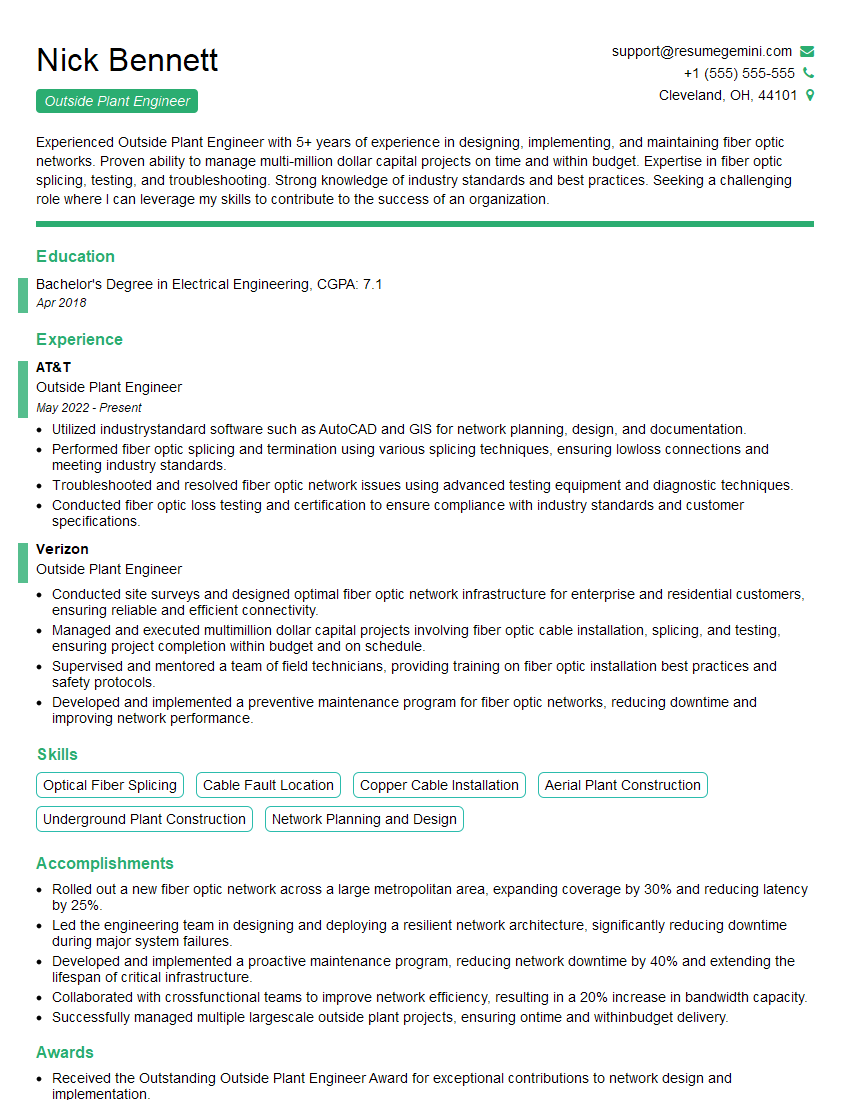
Mastering Cable Plant Design opens doors to exciting career advancements within the telecommunications and networking industries, offering opportunities for specialization and leadership roles. To significantly increase your chances of securing your dream position, focus on creating an ATS-friendly resume that highlights your skills and experience effectively. ResumeGemini is a trusted resource that can help you build a professional and compelling resume. Examples of resumes tailored specifically to Cable Plant Design are available to guide you. Invest the time to build a strong resume – it’s your first impression on potential employers.
Explore more articles
Users Rating of Our Blogs
Share Your Experience
We value your feedback! Please rate our content and share your thoughts (optional).
What Readers Say About Our Blog
Very informative content, great job.
good