The thought of an interview can be nerve-wracking, but the right preparation can make all the difference. Explore this comprehensive guide to Calibration Management Software interview questions and gain the confidence you need to showcase your abilities and secure the role.
Questions Asked in Calibration Management Software Interview
Q 1. Explain the importance of calibration management software in maintaining equipment accuracy.
Calibration management software is crucial for maintaining equipment accuracy because it provides a structured system for tracking, scheduling, and managing the calibration process. Think of it as a meticulous record-keeper for your measuring instruments. Without it, you risk inaccurate measurements, potentially leading to faulty products, compromised safety, and non-compliance with regulations. The software ensures that your equipment is calibrated regularly and according to specific standards, reducing the chances of errors and improving the reliability of your data.
For example, imagine a pharmaceutical company using scales to measure precise amounts of medication. Without proper calibration management, the scales might become inaccurate over time, leading to incorrect dosages and potentially dangerous consequences. The software helps prevent this by providing alerts for upcoming calibrations and maintaining a detailed history of each instrument’s performance.
Q 2. Describe different types of calibration methods and their applications.
Calibration methods vary depending on the type of instrument and its intended use. Broadly, they fall into two categories: comparison calibration and functional calibration.
- Comparison Calibration: This method involves comparing the readings of the instrument being calibrated against a known standard with higher accuracy (a ‘traceable’ standard). The difference between the readings provides the correction factor. For instance, calibrating a thermometer by comparing its readings to a calibrated reference thermometer.
- Functional Calibration: This method verifies the instrument’s performance against its specified requirements. It might involve measuring known values or simulating real-world conditions to assess the instrument’s accuracy and functionality. Think of calibrating a pressure gauge by applying known pressures and comparing the gauge readings to the applied pressure.
There are also variations within these categories. For example, you might perform a ‘direct’ comparison or an ‘indirect’ comparison, depending on the instrument and the available standards. The choice of method always depends on the specific instrument and the required level of accuracy.
Q 3. How do you ensure data integrity within a calibration management system?
Data integrity is paramount in a calibration management system. It ensures that the calibration data is accurate, complete, consistent, and trustworthy. To achieve this, we employ several strategies:
- Audit Trails: Maintaining a complete and immutable record of all changes made to the system. This helps in tracking down any errors or unauthorized modifications.
- Access Control: Restricting access to the system based on user roles and responsibilities. This prevents unauthorized changes or deletions of data.
- Data Validation: Implementing checks and balances to ensure that the data entered into the system is valid and consistent. For example, range checks, format checks, and cross-referencing with other data points.
- Backup and Recovery: Regularly backing up the system’s data to prevent data loss in case of hardware failure or other unforeseen events.
- Electronic Signatures: Using digital signatures to authenticate calibration records and provide non-repudiation.
Think of it like maintaining a highly secure bank vault – multiple layers of protection to guarantee the integrity of the assets (in this case, calibration data).
Q 4. What are the key features to look for when selecting calibration management software?
When selecting calibration management software, consider these key features:
- Instrument Tracking: The ability to track instruments throughout their lifecycle, from purchase to disposal.
- Calibration Scheduling: Automated scheduling of calibrations based on frequency and due dates.
- Workflow Management: A streamlined workflow for managing calibration tasks, from initiation to completion.
- Reporting and Analysis: Generate reports on calibration performance, instrument history, and compliance.
- Integration capabilities: The ability to integrate with other systems such as ERP or LIMS.
- User-friendliness: A simple and intuitive interface that is easy to learn and use.
- Compliance Features: Support for relevant industry regulations and standards.
Choosing the right software requires a careful evaluation of your specific needs and requirements. For example, a small laboratory might have different needs than a large manufacturing plant. A thorough assessment will ensure the chosen software meets all your current and future needs.
Q 5. Explain your experience with different calibration management software platforms.
During my career, I’ve worked extensively with several calibration management software platforms, including [Software Name 1], [Software Name 2], and [Software Name 3]. [Software Name 1] impressed me with its robust reporting capabilities, while [Software Name 2] excelled in its user-friendly interface and intuitive scheduling features. [Software Name 3] stood out due to its powerful integration capabilities with other laboratory management systems. My experience with these platforms has provided me with a comprehensive understanding of their strengths and weaknesses, enabling me to make informed decisions on which software best suits particular organizational needs.
I found that the selection process often depended on the specific needs of the organization and their existing infrastructure. Factors such as the number of instruments, the complexity of the calibration processes, and the integration needs with other systems played a significant role in determining which software was the most appropriate. In each case, my role involved not only implementing the software but also training the staff, ensuring smooth transition and optimal utilization of the system.
Q 6. How do you manage calibration certificates and associated documentation?
Managing calibration certificates and associated documentation requires a systematic approach. The software plays a vital role in this process by providing centralized storage and easy retrieval of documents. We typically use the software to:
- Scan and Upload Certificates: Digitally store calibration certificates and other relevant documentation.
- Link Certificates to Instruments: Associate certificates with specific instruments for easy access.
- Automated Reminders: Receive notifications when certificates are approaching expiration.
- Version Control: Maintain different versions of calibration certificates and associated documentation.
- Secure Storage: Ensure secure and reliable storage of sensitive documents.
This systematic management ensures that all calibration records are readily available, and the risk of losing crucial documentation is minimized. Imagine the hassle of searching through countless files to find a specific calibration certificate; with a properly implemented system, it is a quick and straightforward process.
Q 7. Describe your experience with instrument calibration procedures and methodologies.
My experience spans various instrument calibration procedures and methodologies. I’ve worked with a wide range of instruments, including pressure gauges, thermometers, balances, and electrical test equipment. The methodologies used are often defined by standards such as ISO 17025. This includes understanding the uncertainties involved in the measurement process and appropriately documenting them.
For example, calibrating a balance involves using calibrated weights to establish the balance’s accuracy across its operating range. This process might involve a series of measurements at different weight loads, followed by analysis to determine the linearity and repeatability of the balance. Similar systematic approaches are employed for other instruments, adapting the methodology to the instrument’s specific functionality and characteristics. This methodical approach ensures that calibrations are performed accurately and that any deviations from expected performance are identified and addressed.
Q 8. How do you handle calibration discrepancies and out-of-tolerance results?
Handling calibration discrepancies and out-of-tolerance results is crucial for maintaining the accuracy and reliability of measurement equipment. The process begins with immediate investigation. We need to understand why the discrepancy occurred. Was there a user error? Is the equipment nearing the end of its useful life? Is there a problem with the calibration standards themselves?
Once the root cause is identified, corrective actions are implemented. This might involve recalibrating the instrument, repairing it, or replacing it entirely. We also document all steps taken, including the initial discrepancy, investigation, corrective action, and verification that the problem is resolved. This detailed record is essential for continuous improvement and for demonstrating compliance with regulations. For example, if a pressure gauge consistently reads low, we might investigate for leaks in the system, a malfunctioning sensor, or simply user error in reading the gauge. The corrective action could be anything from tightening a fitting to replacing the entire gauge. The software plays a key role in tracking this entire process, flagging out-of-tolerance results, and generating reports for analysis.
Q 9. Explain the role of traceability in calibration management.
Traceability in calibration management is like a chain of custody for your measurements, ensuring that every calibration can be linked back to a known and reliable standard. This chain begins with national or international standards maintained by metrology institutes. These standards are then used to calibrate working standards, which in turn calibrate the instruments used in our daily operations. Each step in this chain is documented, creating an unbroken line of traceability that demonstrates the accuracy and reliability of our measurements.
Imagine a bakery using a scale to weigh ingredients. The scale’s accuracy is critical for consistent product quality. Traceability ensures that if a customer questions the weight of a loaf of bread, the bakery can trace back the scale’s calibration to the national standards, demonstrating that the scale was functioning correctly. Calibration management software is essential here, recording all calibration events and the relationships between standards, ensuring complete traceability throughout the entire process.
Q 10. How do you ensure compliance with relevant industry standards and regulations?
Ensuring compliance with industry standards and regulations (like ISO/IEC 17025, GMP, etc.) requires a multifaceted approach. First, we need to thoroughly understand the specific requirements relevant to our organization and the types of equipment we calibrate. This involves carefully reviewing the standards and regulations, keeping up-to-date with any changes or updates.
Next, we implement robust procedures and workflows to ensure compliance. These procedures cover everything from instrument selection and calibration intervals to record-keeping and reporting. The calibration management software plays a crucial role here by automating many of these processes, providing features like automated alerts for upcoming calibrations, automated report generation, and built-in checks and balances to prevent non-compliant actions. Regular internal audits, and where appropriate, external audits, help to verify our ongoing compliance. Finally, continuous improvement is vital; we regularly review our procedures and identify areas for enhancement to maintain our compliance effectively.
Q 11. Describe your experience with calibration scheduling and workload management.
Calibration scheduling and workload management are critical for optimizing resource allocation and ensuring timely calibration of all equipment. Our approach uses a combination of automated scheduling features within the software and manual adjustments based on priorities and available resources. The software allows us to define calibration intervals for different instruments, predict future workload based on these intervals, and automatically generate schedules.
We prioritize critical equipment needing calibration, ensuring that those instruments impacting safety or product quality are prioritized. Workload balancing is achieved by assigning calibration tasks to technicians based on their skills and availability, using the software’s features for task assignment and tracking. We also regularly review the schedule and make adjustments based on unexpected equipment failures or changing priorities. For example, if a critical instrument fails, the software allows us to quickly reschedule its calibration and notify the relevant personnel. Regular reporting on workload and scheduling efficiency helps us improve our processes over time.
Q 12. How do you integrate calibration management software with other enterprise systems?
Integrating calibration management software with other enterprise systems, such as CMMS (Computerized Maintenance Management Systems), ERP (Enterprise Resource Planning) systems, or LIMS (Laboratory Information Management Systems) is crucial for a seamless workflow. This typically involves using APIs (Application Programming Interfaces) to exchange data between the systems. For example, we might integrate our calibration management software with a CMMS to automatically update the maintenance status of an instrument after calibration.
Integration with an ERP system can provide access to real-time information on equipment location, ownership, and cost. This data can be automatically included in calibration records, reducing manual data entry and improving accuracy. Similarly, integration with a LIMS could allow for the automatic transfer of calibration data into laboratory records, streamlining workflows and reducing errors. The specific integration methods vary depending on the systems involved, but the overall goal is to create a unified view of equipment management and calibration data.
Q 13. Explain the process of validating calibration management software.
Validating calibration management software is essential to ensure it meets the needs of our organization and complies with relevant standards. This is a rigorous process that typically involves several stages. Firstly, we define the requirements for the software, specifying what functions it needs to perform and how it should perform them.
Next, we perform various tests, including functional testing (does it do what it’s supposed to?), performance testing (how fast and efficiently does it operate?), and security testing (is it protected from unauthorized access?). We then compare the actual performance of the software to the defined requirements to identify any gaps. This often involves using test cases and checklists to systematically evaluate the software’s functionality. Documentation of the entire validation process is critical and forms part of the overall quality management system. Finally, we ensure all changes and updates to the software are also validated to maintain its integrity and reliability.
Q 14. How do you manage user access and permissions within a calibration system?
Managing user access and permissions within a calibration management system is crucial for maintaining data integrity and security. We typically employ a role-based access control system, where users are assigned different roles based on their responsibilities. For instance, a technician might have permission to enter calibration data, but not to modify calibration procedures, while a manager might have full access to all system functions, including user management.
The system should allow for the creation of custom roles with granular permission levels, allowing us to precisely define what each user can and cannot do. Password policies, regular password changes, and audit trails of user activity are also essential components of a robust security strategy. This ensures that only authorized personnel can access sensitive information, preventing unauthorized modifications or data breaches. Regular reviews of user access permissions ensure that they remain appropriate and up-to-date.
Q 15. Describe your experience with generating reports and analyzing calibration data.
Generating reports and analyzing calibration data is fundamental to ensuring the accuracy and reliability of our measurement equipment. My experience involves using calibration management software to create various reports, ranging from simple instrument summaries to complex trend analyses. I’m proficient in extracting data points like calibration dates, due dates, results, and uncertainties. For instance, I routinely generate reports showing the overall compliance status of all calibrated instruments within a facility, highlighting those nearing their due dates or exhibiting trends of degradation. These reports are essential for proactive maintenance scheduling and preventing costly downtime. Beyond basic reports, I utilize the analytical features of the software to identify patterns, like recurring failures in specific types of equipment or a consistent drift in a particular parameter, allowing for targeted preventative actions. This data-driven approach allows for improvements in calibration processes and enhances the overall efficiency of the calibration lab.
For example, in a previous role, we identified a consistent deviation in the calibration of our pressure gauges after analyzing several months of data. This led us to investigate the environmental conditions within the calibration lab, ultimately revealing temperature fluctuations causing the inconsistency. By addressing this issue, we significantly improved the accuracy of our pressure readings and eliminated repetitive recalibrations.
Career Expert Tips:
- Ace those interviews! Prepare effectively by reviewing the Top 50 Most Common Interview Questions on ResumeGemini.
- Navigate your job search with confidence! Explore a wide range of Career Tips on ResumeGemini. Learn about common challenges and recommendations to overcome them.
- Craft the perfect resume! Master the Art of Resume Writing with ResumeGemini’s guide. Showcase your unique qualifications and achievements effectively.
- Don’t miss out on holiday savings! Build your dream resume with ResumeGemini’s ATS optimized templates.
Q 16. How do you troubleshoot common issues encountered with calibration equipment and software?
Troubleshooting calibration equipment and software issues requires a systematic approach. I start by identifying the nature of the problem – is it a hardware issue with the equipment, a software glitch, or a procedural error? For hardware problems, I begin with the basics: checking connections, power supply, and physical integrity of the equipment. I also refer to the equipment’s troubleshooting manual and contact the manufacturer’s support if necessary. Software issues are often resolved by checking for updates, reviewing the software’s documentation, and contacting the software vendor for assistance. Sometimes, the issue may stem from incorrect calibration procedures or data entry mistakes; a review of the calibration method and the calibration data itself will quickly reveal such errors.
Imagine a scenario where a digital thermometer consistently shows readings that are off by 2 degrees. I would first check the thermometer’s calibration certificate to confirm it’s within its tolerance. If not, I would then check its connections and ensure the probe is clean and properly inserted. If the problem persists, I would investigate the software used for calibration, checking for any error messages or software bugs. If the issue remains unresolved, I would contact the manufacturer for support or investigate if the calibration equipment itself requires recalibration.
Q 17. Explain your understanding of different calibration intervals and their determination.
Calibration intervals are crucial for maintaining the accuracy of measurement equipment. Determining the appropriate interval depends on several factors, including the instrument type, its criticality to the process, its stability, its usage frequency, and environmental conditions. Many organizations rely on standards, manufacturer recommendations, and regulatory requirements to guide these decisions. For instance, a critical instrument used in safety-critical applications may require more frequent calibration than a less critical instrument used infrequently. Some industries also utilize risk assessments to determine intervals.
For high-precision instruments, the interval might be monthly or even weekly, whereas for more stable instruments, it could be annually or even less frequently. It’s important to document the rationale behind choosing a specific calibration interval; this documentation often forms part of the calibration procedure.
A common approach is to start with manufacturer recommendations and adjust based on historical data from past calibrations. If an instrument shows signs of instability or significant drift over time, the interval may need to be shortened. Conversely, consistent stability and accuracy can justify lengthening the interval – always with a focus on maintaining the required accuracy for the specific application.
Q 18. How do you handle equipment maintenance requests related to calibrated instruments?
Handling equipment maintenance requests for calibrated instruments necessitates a structured process to avoid compromising calibration status and data integrity. Requests are typically submitted through a system (e.g., a CMMS or a dedicated calibration management software module) and are prioritized based on urgency and impact. I make sure the maintenance activity does not compromise the calibration status. Before initiating any maintenance, I ensure all relevant calibration data is backed up and secured. The work order includes the instrument’s calibration details to guide the maintenance team. After maintenance, the instrument may require recalibration to confirm its accuracy was not affected by the service. All maintenance activities and recalibration details are recorded within the calibration management system to maintain a complete audit trail.
For instance, if a calibrated analytical balance needs preventative maintenance like cleaning or a minor repair, I would create a work order clearly outlining the instrument’s ID, its calibration status, and the maintenance required. This ensures that the maintenance technician understands the importance of handling the instrument carefully to avoid accidental damage or misalignment that would require recalibration. Post-maintenance, I’d then initiate a recalibration process to verify the balance’s continued accuracy.
Q 19. What is your experience with different types of calibration standards?
My experience encompasses various types of calibration standards, which are essential for ensuring traceability to national or international standards. These standards can range from simple weight sets and thermometers to highly sophisticated laser interferometers and specialized electrical standards. I’m familiar with both primary and secondary standards. Primary standards are the most accurate and are usually traceable to national metrology institutes. Secondary standards are calibrated against primary standards and used for calibrating other instruments in the field. The choice of standard depends on the accuracy required, the instrument being calibrated, and the available resources.
For example, when calibrating a pressure gauge, I may use a high-accuracy deadweight tester as a secondary standard, which is itself calibrated against a primary standard maintained by a national metrology institute. In another scenario, if calibrating a digital multimeter, I might use a calibrated precision voltage source and a precision resistance standard.
Q 20. How do you ensure the accuracy and reliability of calibration data?
Ensuring the accuracy and reliability of calibration data involves several key steps. Firstly, meticulous adherence to established calibration procedures is crucial. These procedures should be clearly documented and readily accessible to all technicians. Secondly, utilizing properly calibrated and maintained equipment is paramount. The traceability of the equipment used for calibration to national standards needs to be verifiable. Thirdly, trained and competent personnel executing the calibration procedures are vital. Regular training and competency assessments are necessary to ensure consistency and reliability. Fourthly, effective data management is key. This involves using reliable calibration management software for recording, tracking, and analyzing data. Finally, regular internal audits and external proficiency testing, such as participation in inter-laboratory comparisons, validate the overall quality of the calibration processes.
Regular internal audits provide an independent assessment of the calibration processes, identifying areas for improvement and ensuring compliance. Proficiency testing confirms that our lab produces results that are comparable to those from other reputable calibration labs, further bolstering the credibility and reliability of our calibration data.
Q 21. Describe your experience with different reporting features within calibration software.
Calibration software offers a variety of reporting features, crucial for managing and analyzing calibration data. I have experience with software that generates a wide range of reports, including instrument-specific reports showing calibration history, compliance status, and results; summary reports providing an overview of the calibration status of all instruments within a specific department or facility; trend analyses identifying potential equipment issues or patterns of degradation; and custom reports catering to specific needs. Some systems also offer data export functionality in various formats, allowing for integration with other systems. Advanced features might include dashboard views providing quick summaries of key metrics and compliance status, and automated report generation based on pre-defined schedules or triggers.
For example, I’ve used software that automatically generates email alerts when an instrument is approaching its due calibration date, simplifying proactive scheduling. I also have experience generating reports that visualize calibration data graphically, making it easier to spot trends and potential problems early on. Data visualization makes it easier to communicate technical information effectively and efficiently to management, stakeholders, or even regulators.
Q 22. How do you manage and resolve calibration discrepancies with vendors or external labs?
Managing calibration discrepancies with external vendors or labs requires a systematic approach focused on clear communication, documentation, and a well-defined escalation process. First, we meticulously review the calibration certificate or report, comparing the results against our acceptance criteria. If a discrepancy exists, we immediately contact the vendor, providing them with specific details about the issue, including the instrument’s identification, the specific parameters in question, and our documented acceptance criteria. This communication is always documented, preferably via email, for a clear audit trail.
We then collaboratively investigate the root cause. This might involve reviewing the vendor’s calibration procedures, examining the instrument’s history, or even re-calibrating the instrument at our facility if necessary. If the discrepancy cannot be resolved through investigation and discussion, we might involve a third-party arbitrator or leverage our contractual agreements to ensure remedial action. Ultimately, the goal is not just to resolve the immediate discrepancy but to prevent similar issues in the future, possibly through improved vendor selection or calibration process reviews.
For example, if a pressure gauge returned from calibration had a significantly different reading than expected, we’d present the vendor with detailed data and calibration records. We’d work with them to determine whether this was due to an error in their calibration process, a problem with the gauge itself, or an issue with our testing methodology. The process is always documented in detail, allowing for tracking and improvement.
Q 23. How would you approach improving the efficiency of a current calibration management process?
Improving the efficiency of a calibration management process often involves a blend of technological and procedural enhancements. First, we’d conduct a thorough process mapping exercise to identify bottlenecks and areas for improvement. This would involve analyzing workflow diagrams, examining current data management practices, and gathering feedback from personnel involved in the calibration process. This step is crucial for understanding the ‘as-is’ state and identifying opportunities.
Next, we would consider leveraging technology. Implementing a robust calibration management software (CMS) can automate many manual tasks, such as scheduling, tracking, and reporting. Features like automated reminders, electronic signature capture, and integrated reporting drastically reduce administrative overhead. For instance, automating the generation of calibration certificates and sending out reminders for upcoming calibrations frees up valuable staff time. We might also explore the use of barcode or RFID technology for streamlined asset tracking.
Finally, we’d focus on streamlining procedures. This could include optimizing calibration intervals based on risk assessment, centralizing calibration resources, or implementing a more effective calibration scheduling system. For example, implementing a preventive maintenance program to reduce unexpected instrument failures can significantly enhance calibration efficiency. This systematic approach ensures efficiency improvements align with overall organizational goals and resource availability.
Q 24. Describe your understanding of uncertainty analysis in calibration.
Uncertainty analysis in calibration is critical for understanding the reliability of measurement results. It quantifies the doubt associated with a measurement, acknowledging that no measurement is perfectly precise. This uncertainty isn’t a measure of error but rather a statement of the range within which the true value likely lies. It considers various sources of uncertainty, including the accuracy of the calibration equipment, the skill of the technician, and the environmental conditions during the calibration process.
The process usually involves identifying all potential sources of uncertainty and quantifying their contributions using statistical methods. These contributions are then combined to yield a final overall uncertainty estimate, often expressed as a plus-or-minus value around the measured value. This final uncertainty value is crucial for decision-making, as it informs us of the reliability of our measurements and their implications for process control or product quality. A larger uncertainty value indicates a lower confidence level in the result.
Imagine calibrating a thermometer. Sources of uncertainty could include the accuracy of the calibration standard, the resolution of the thermometer itself, the stability of the temperature bath, and the human error in reading the thermometer. By systematically analyzing each of these sources, we can obtain an overall uncertainty value that represents the total doubt in the thermometer’s calibration.
Q 25. What is your experience using statistical process control (SPC) in calibration?
Statistical Process Control (SPC) plays a vital role in monitoring the stability and consistency of calibration processes. By employing control charts, we can track calibration data over time and identify any trends, shifts, or unusual variations that could indicate problems. The most common control charts used in this context are the X-bar and R charts, which monitor the average and range of calibration data. Using these, we can effectively identify systematic errors (bias) or random variations in measurements.
In practice, we’d collect data from repeated calibrations of the same instrument or type of instrument and plot it on a control chart. If the data consistently falls within the control limits, we can assume the calibration process is under statistical control. However, if the data exceeds the limits or shows clear trends, it indicates that the process may be out of control, suggesting the need for investigation and corrective action. This could involve recalibrating equipment, retraining personnel, or improving the calibration environment.
For instance, if we consistently observe a downward trend in the calibration results of a specific type of pressure gauge, this would be a strong indication of a systematic problem that needs immediate attention. SPC enables a proactive approach to calibration management, allowing for timely intervention and preventing inaccurate measurements before they significantly impact operations.
Q 26. Explain how you would train new users on a calibration management software system.
Training new users on a calibration management software system necessitates a structured and multi-faceted approach. It should start with an overview of the software’s purpose and overall functionality, followed by hands-on training on specific features. We would begin with a general introduction, explaining the importance of calibration management within the organization and the software’s role in streamlining the process. This would be followed by detailed training on each key feature, using a blend of presentations and practical exercises.
The training would be modular, allowing users to progress at their own pace. We would cover core functionalities like instrument registration, calibration scheduling, data entry, report generation, and audit trail management. Practical exercises would be incorporated to simulate real-world scenarios. For instance, users could be tasked with scheduling calibrations, entering calibration data, and generating reports. The training will also cover troubleshooting common issues and maintaining data integrity. Finally, a comprehensive FAQ document and ongoing support will enhance understanding and encourage adoption.
To ensure effective knowledge retention, we would utilize various methods, including interactive sessions, online tutorials, and on-the-job mentoring. We would also use quizzes and assessments to evaluate understanding and reinforce learning. Post-training follow-up would provide an opportunity for additional support and address any lingering questions. A tiered training approach tailored to specific roles within the organization would ensure efficient and effective use of the system.
Q 27. Describe your experience with implementing a new calibration management system.
Implementing a new calibration management system (CMS) requires careful planning and execution. It involves a systematic approach that ensures a smooth transition with minimal disruption to ongoing operations. We’d begin with a thorough needs assessment to define the requirements for the new system, taking into consideration factors like the size and complexity of the organization, the number of instruments to be managed, and regulatory compliance needs.
Next, we would select a suitable CMS that meets these requirements, considering factors like cost, functionality, user-friendliness, and vendor support. A key part of the implementation is data migration from the old system (if applicable). This is a critical step that needs to be carefully planned and executed to ensure data integrity. During the implementation phase, we’d provide comprehensive training to users, ensuring they are proficient in using the new system. We would also conduct thorough testing to identify and resolve any issues before going live.
A phased rollout is often the most effective approach, starting with a pilot group of users before expanding to the entire organization. This minimizes risk and allows for addressing any issues before widespread adoption. Post-implementation, ongoing support and maintenance are vital to ensure the system continues to meet organizational needs and evolves with changing requirements. For example, we implemented a new CMS for a large manufacturing facility, using a phased approach starting with a small department. This allowed us to refine the process before rolling it out across the plant. Close monitoring and communication throughout the process are essential for a successful implementation.
Q 28. How do you ensure the security and backup of calibration data?
Ensuring the security and backup of calibration data is paramount for maintaining data integrity and regulatory compliance. This requires a multi-layered approach that incorporates both physical and digital security measures. Physical security includes controlling access to servers and storage areas where calibration data is stored, potentially using access controls and security cameras. We also employ robust digital security measures, including secure passwords, access controls, and encryption of sensitive data, both in transit and at rest.
Regular data backups are critical, with multiple copies stored in different locations, ideally off-site. We would use a robust backup and recovery strategy, employing incremental backups and version control to allow for easy restoration in case of data loss. The frequency of backups would depend on the sensitivity of the data and the business continuity requirements. For instance, we could implement a daily incremental backup and a weekly full backup, with off-site storage of a full backup copy at least once a month.
Data access controls are essential, ensuring that only authorized personnel can access and modify calibration data. Regular security audits and penetration testing are critical to identify potential vulnerabilities and mitigate risks. Compliance with relevant regulations, such as ISO 17025 or FDA 21 CFR Part 11, is also vital. This comprehensive approach helps to protect calibration data against loss, theft, or unauthorized access, ensuring the long-term integrity and reliability of calibration records.
Key Topics to Learn for Calibration Management Software Interview
- Software Functionality: Understand the core features of calibration management software, including instrument registration, calibration scheduling, certificate generation, and reporting functionalities. Explore different software architectures and their implications.
- Calibration Processes and Standards: Grasp the theoretical underpinnings of calibration processes, focusing on ISO/IEC 17025 and other relevant industry standards. Be prepared to discuss practical applications of these standards within the software’s context.
- Data Management and Analysis: Learn how calibration data is managed, stored, and analyzed within the software. Discuss the importance of data integrity, traceability, and the generation of meaningful reports for compliance and decision-making.
- Workflow Automation and Integration: Explore how calibration management software streamlines workflows and integrates with other systems (e.g., CMMS, ERP). Understand the benefits of automation and the potential challenges in implementation.
- Troubleshooting and Problem-Solving: Develop your ability to identify and resolve common issues related to data entry, scheduling conflicts, reporting discrepancies, and system errors. Practice using a systematic approach to problem-solving.
- User Management and Access Control: Understand the security aspects of the software, including user roles, permissions, and audit trails. Be prepared to discuss best practices for maintaining data security and compliance.
- Calibration Methodologies: Familiarize yourself with various calibration methodologies and how they are implemented within the software. Be able to discuss the advantages and disadvantages of different approaches.
Next Steps
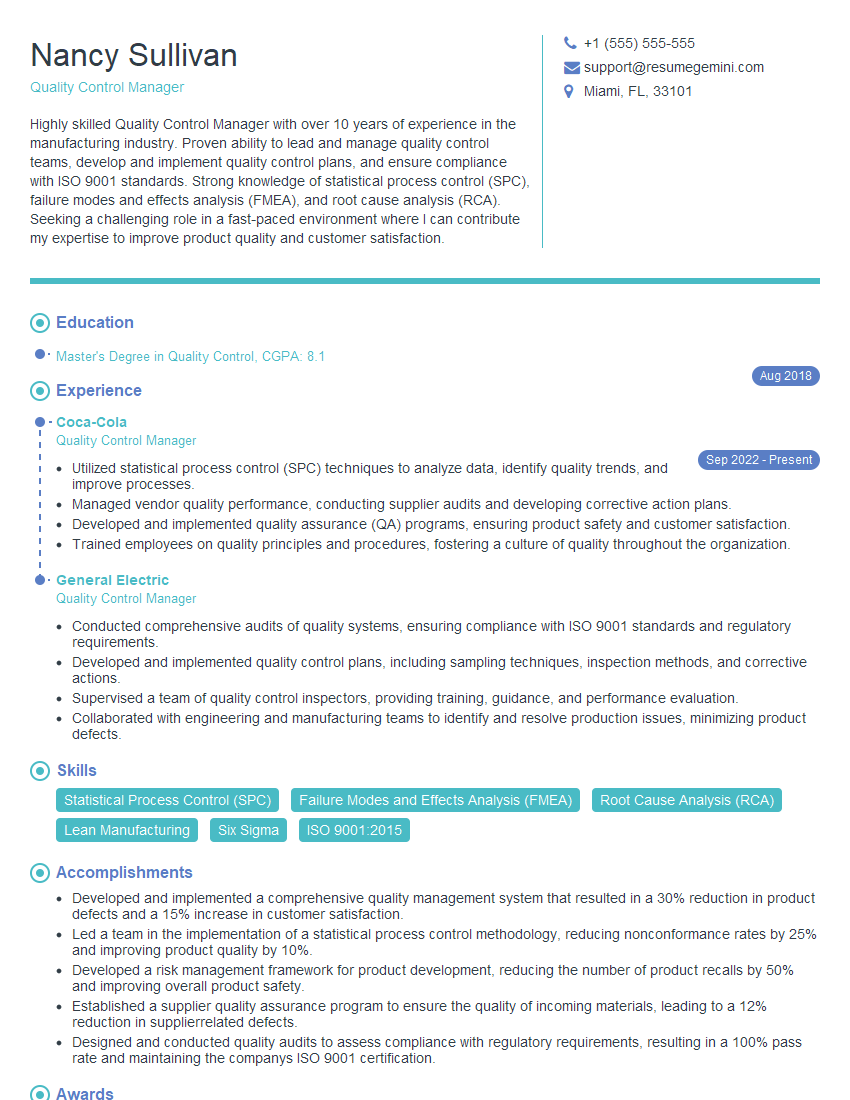
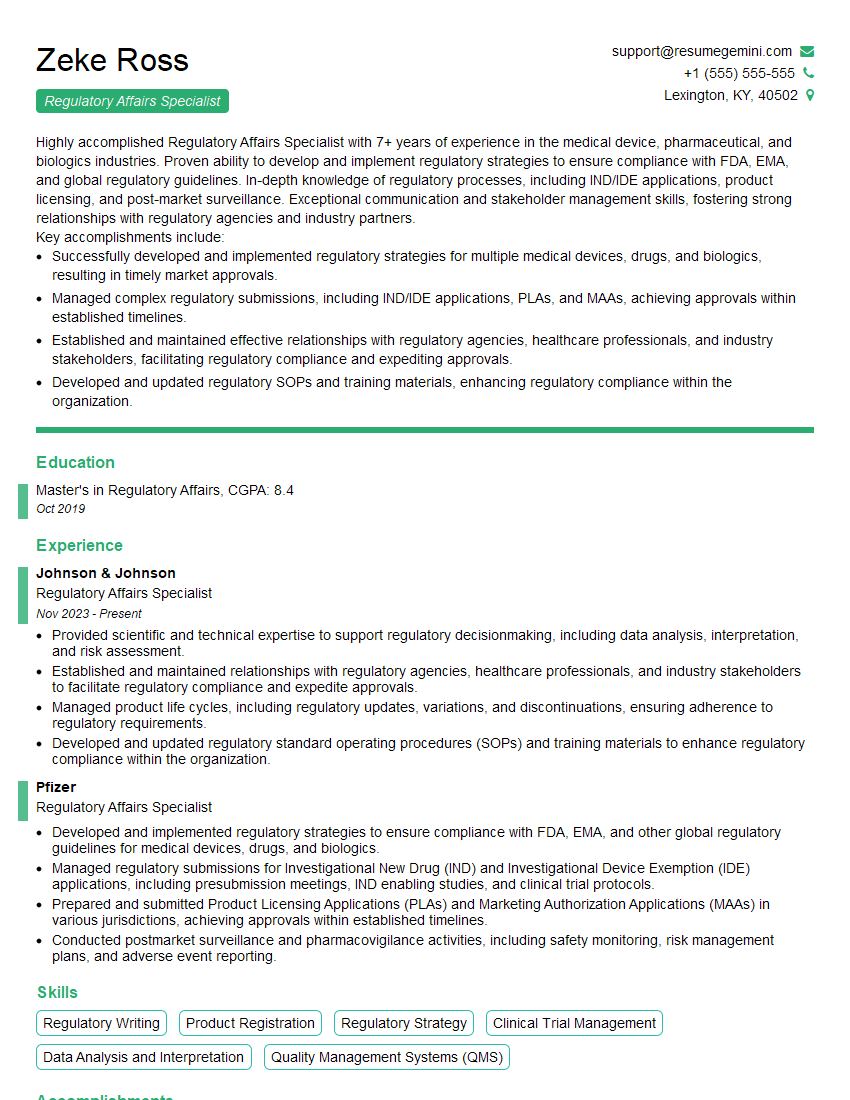
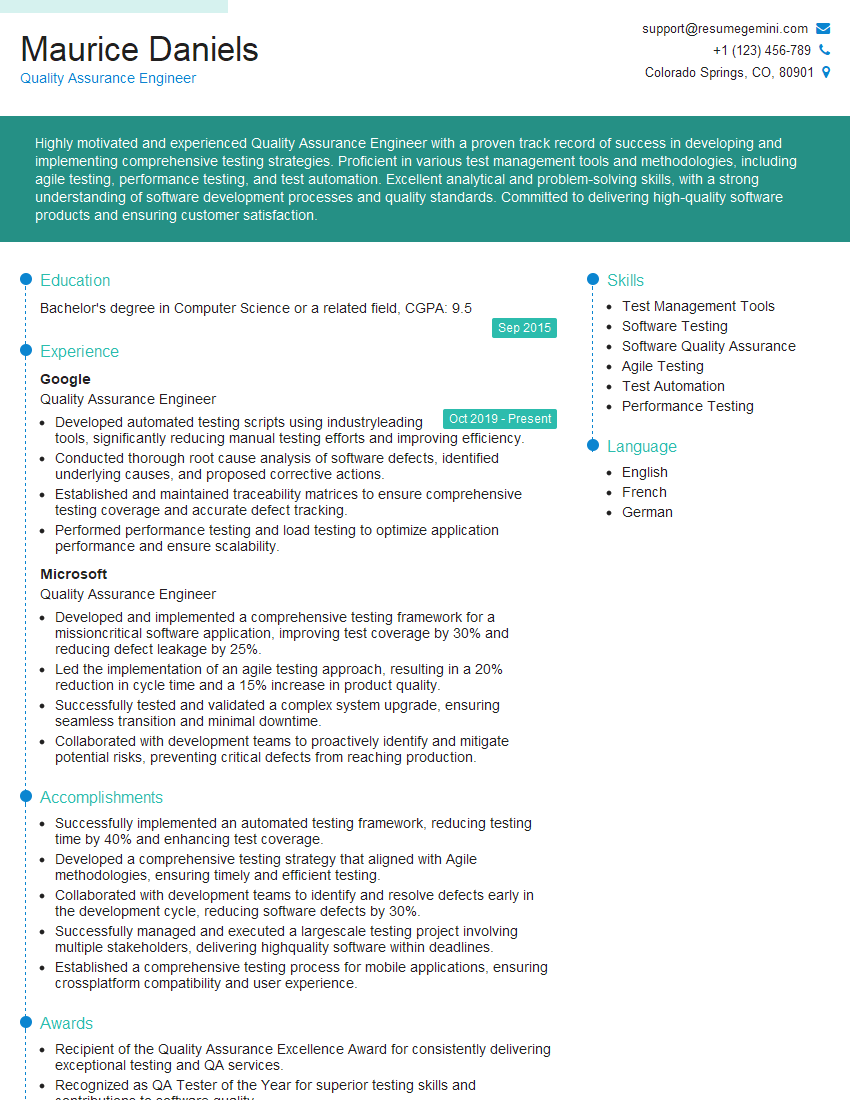
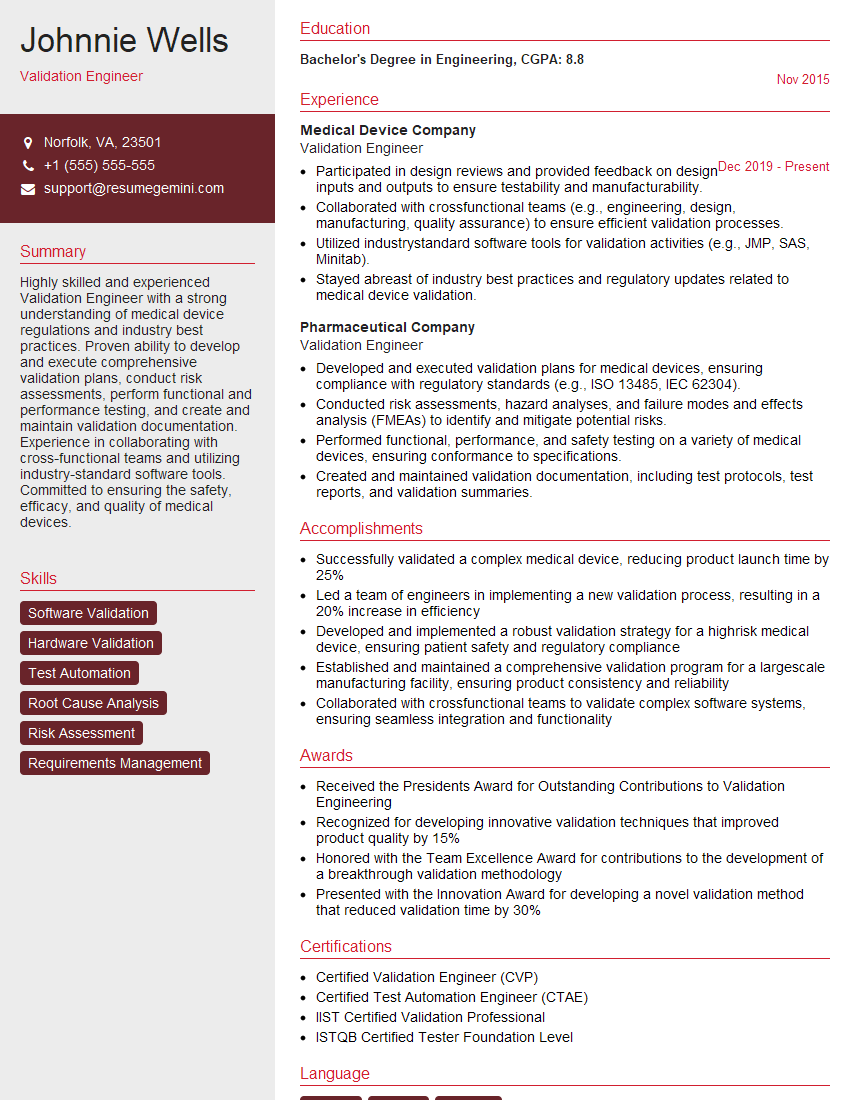
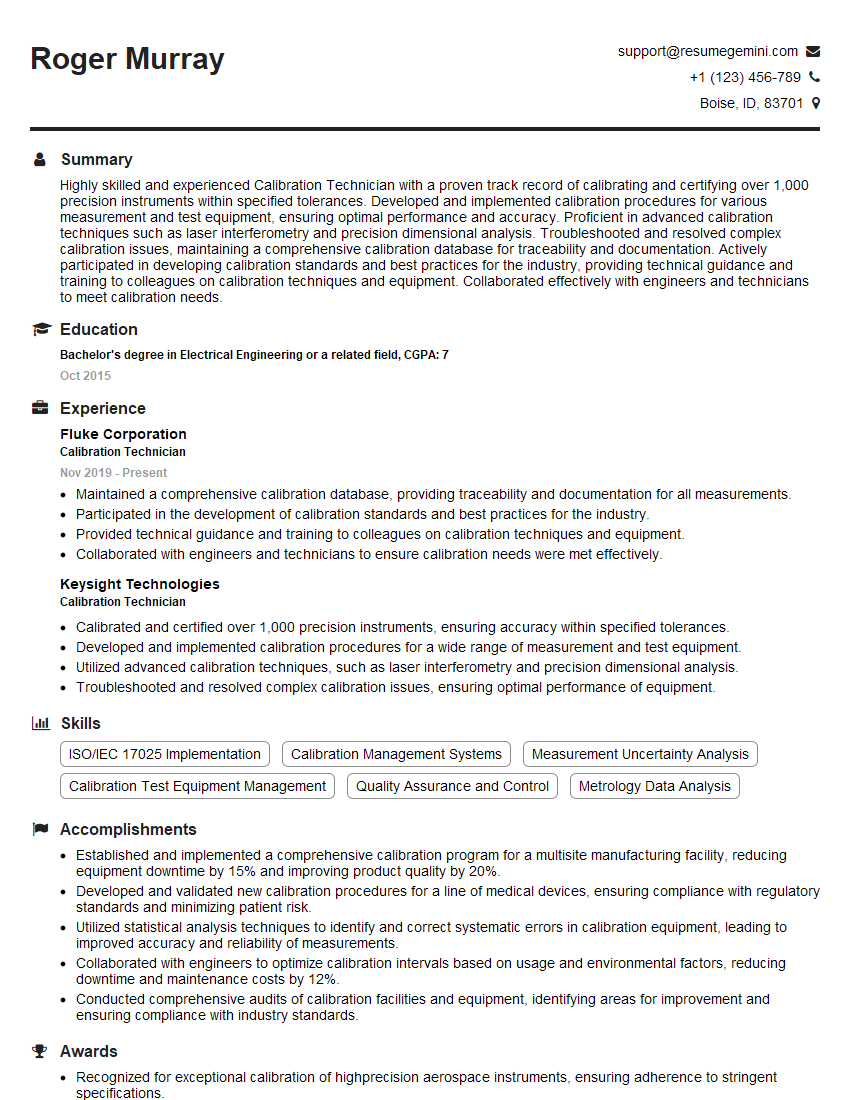
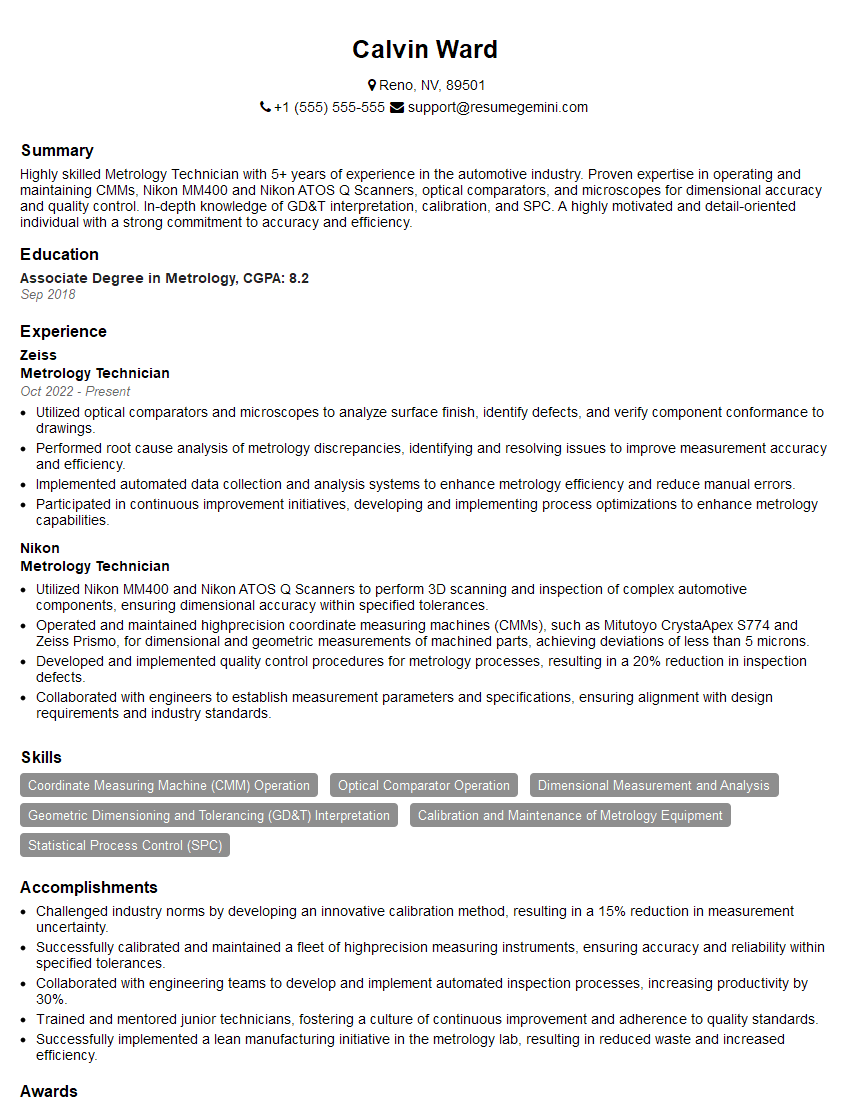
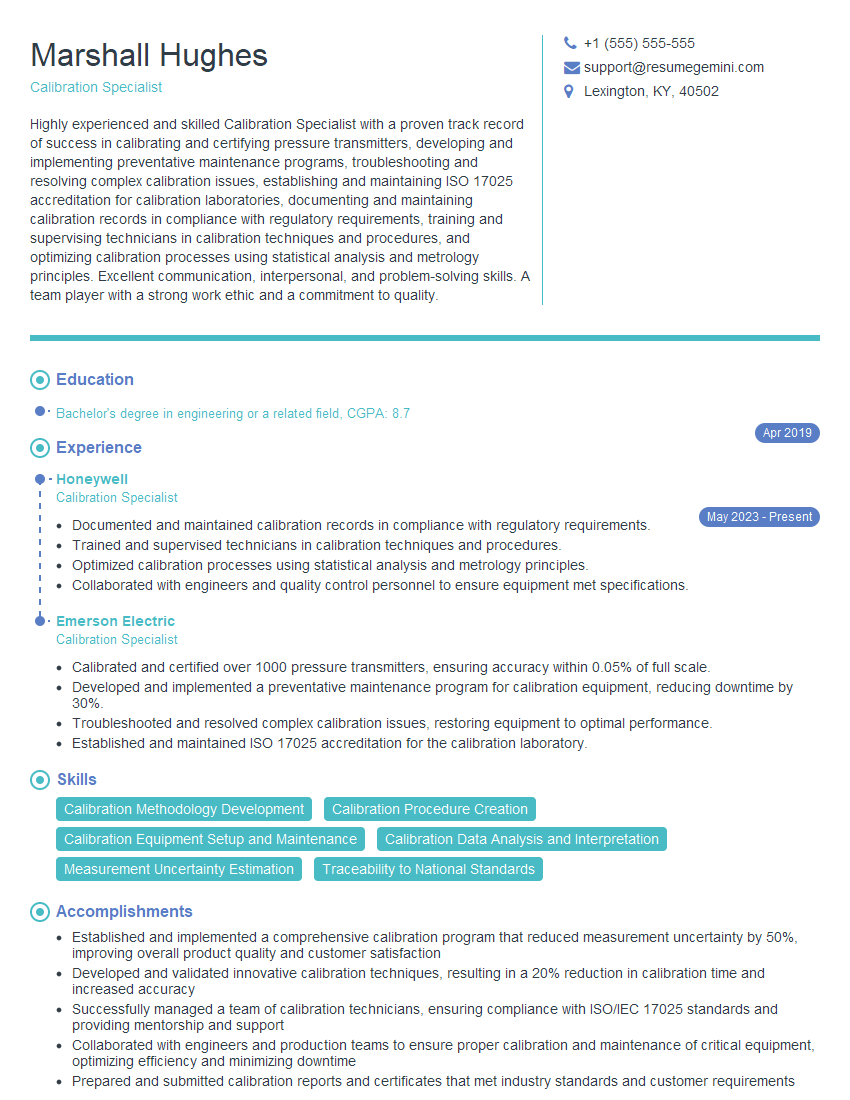
Mastering Calibration Management Software opens doors to exciting career opportunities in quality control, metrology, and instrumentation. Demonstrating expertise in this area significantly enhances your job prospects and allows you to contribute meaningfully to organizations that rely on precise measurements and reliable equipment. To maximize your chances of landing your dream role, focus on creating an ATS-friendly resume that highlights your skills and experience effectively. ResumeGemini is a trusted resource for building professional and impactful resumes, and we provide examples specifically tailored to Calibration Management Software professionals to help you showcase your qualifications.
Explore more articles
Users Rating of Our Blogs
Share Your Experience
We value your feedback! Please rate our content and share your thoughts (optional).
What Readers Say About Our Blog
Very informative content, great job.
good