Are you ready to stand out in your next interview? Understanding and preparing for Canvas Sewing interview questions is a game-changer. In this blog, we’ve compiled key questions and expert advice to help you showcase your skills with confidence and precision. Let’s get started on your journey to acing the interview.
Questions Asked in Canvas Sewing Interview
Q 1. What types of canvas fabrics are best suited for marine applications?
For marine applications, you need canvas that’s incredibly durable, resistant to mildew and UV degradation, and strong enough to withstand harsh weather conditions. The best choices typically fall into a few categories:
- Heavy-duty acrylic canvas: This is a popular choice due to its excellent strength, water resistance, and UV protection. It’s often treated with mildew-resistant coatings for added longevity.
- Solution-dyed acrylic canvas: The color is infused into the fibers during manufacturing, making it exceptionally fade-resistant compared to surface-dyed options. This is crucial for marine environments with prolonged sun exposure.
- Polyester canvas (with appropriate coatings): While not as traditionally used as acrylic, high-quality polyester canvases treated with UV inhibitors and water-repellent finishes can offer a strong and lightweight alternative. However, careful selection is key, ensuring the coatings meet the rigorous demands of marine use.
In choosing, always check for the manufacturer’s specifications regarding UV resistance, water repellency, and tear strength. These ratings will directly correlate to the canvas’s lifespan in a marine environment. For instance, a canvas rated for 500 hours of UV exposure is significantly less suitable than one rated for 2000+ hours.
Q 2. Describe your experience with different canvas stitching techniques.
My experience encompasses a wide range of canvas stitching techniques, from basic to highly specialized. I’m proficient in:
- Straight stitch: The foundation of most canvas sewing, ideal for seams needing strength and durability. I carefully adjust stitch length depending on the canvas weight and the project’s stress points.
- Backstitch: Used for added security in high-stress areas, such as corners or points of attachment. It’s crucial for applications where seams must endure considerable force.
- Saddle stitch: A hand-sewing technique often used for finer canvas work, particularly when a clean, invisible seam is desired. It’s strong and aesthetically pleasing, though time-consuming.
- Running stitch: Used for basting and gathering canvas before final stitching. It’s a temporary stitch for securing fabric pieces in place.
- Overlock stitching (serging): While not strictly necessary for canvas, an overlock stitch can prevent fraying and enhance the finished look, particularly on thicker canvases where raw edges are more prone to unraveling.
I adapt my technique based on the specific project’s requirements. For example, when creating a heavy-duty canvas boat cover, I’d prioritize strength with a combination of straight and backstitching. For a more delicate canvas bag, a saddle stitch might be appropriate. My experience allows me to select the optimal technique for both strength and aesthetics.
Q 3. How do you determine the appropriate thread weight for a given canvas project?
Selecting the right thread weight for a canvas project is critical for achieving a durable and aesthetically pleasing result. The general rule is to choose a thread weight that is proportionally matched to the canvas weight. Too thin, and the stitches will easily break. Too thick, and it can damage the needle and create an uneven, bulky seam.
Here’s how I approach thread selection:
- Canvas Weight: Heavier canvas (e.g., 18 oz. or heavier) requires heavier-weight thread (e.g., Tex 210 or higher). Lighter canvas (e.g., 8-12 oz.) can handle a lighter thread (e.g., Tex 150-180).
- Project Application: The intended use influences thread choice. For highly stressed areas (e.g., boat sails), a much heavier thread is recommended. For less-demanding applications (e.g., decorative canvas wall hanging), lighter thread can suffice.
- Thread Material: Polyester thread offers superior strength and UV resistance compared to cotton, making it a better option for outdoor applications.
I usually consult thread weight charts provided by manufacturers, which often cross-reference canvas weights with recommended thread weights. It’s always a good idea to test your thread and needle combination on a scrap piece of canvas before working on the main project.
Q 4. Explain the process of creating a canvas pattern.
Creating a canvas pattern involves precision and an understanding of the project’s design. Here’s the step-by-step process:
- Design and Sketch: Begin by sketching the desired design on paper, including accurate measurements for all parts.
- Drafting on Pattern Paper: Transfer the design onto heavy-weight pattern paper (or use a digital pattern-making program). Consider seam allowances, especially important with thicker canvas.
- Template Creation: Cut out the pattern pieces precisely. If there are multiple identical pieces (e.g., two identical sides for a tote bag), carefully check for symmetry to avoid errors.
- Testing and Adjustments: Before cutting the canvas, test fit the pattern pieces on a less expensive fabric of similar weight. This allows for adjustments before committing to the final material.
- Marking the Canvas: Pin or trace the pattern pieces onto the canvas, ensuring that the fabric is laid out correctly. Use tailors’ chalk or a fabric marker to transfer the pattern outlines onto the canvas. It is crucial to use a water soluble marker or one that is suited for the type of canvas used as some markers will leave a permanent mark.
Throughout the process, accuracy is paramount. A poorly made pattern directly translates into a poorly made product. I often create multiple pattern pieces and check my measurements several times before cutting into the final canvas material.
Q 5. How do you ensure accurate measurements when working with canvas?
Accurate measurements are fundamental to successful canvas sewing. I use a combination of tools and techniques to ensure precision:
- Accurate Measuring Tools: I use a flexible measuring tape that is suited for the type of canvas I am working with and is not prone to stretching. I also employ a ruler or T-square, especially when working with large pieces.
- Marking Techniques: I utilize tailors’ chalk or water-soluble markers for marking cutting lines and pattern details on the canvas. I always use the correct marker based on the material so that I do not damage it permanently.
- Double-checking Measurements: I consistently double-check all measurements, especially before cutting the canvas. A small error in measurement can significantly affect the final product.
- Using Templates: For intricate shapes or repetitive pieces, I use carefully constructed templates to ensure uniformity.
- Pre-washing Canvas: Before cutting any material it is always best practice to pre-wash it to ensure that it does not shrink.
One instance I recall was constructing a bespoke sail. A single millimeter error in the panel’s dimensions could have had a noticeable impact on its performance. My meticulous approach to measurement ensured a perfect fit and optimal function.
Q 6. What are the common challenges encountered during canvas sewing?
Canvas sewing presents unique challenges due to the material’s thickness and stiffness. Some common issues include:
- Needle breakage: Using the wrong needle size or type for the canvas weight can easily lead to breakage. A heavy-duty needle is always crucial.
- Skipped stitches: Canvas’s dense weave can cause skipped stitches. Adjusting the machine’s tension and using a stronger thread can often mitigate this.
- Difficult maneuvering of fabric: The stiffness of the canvas can make it challenging to feed through the sewing machine. Careful feeding and potentially using a walking foot can help.
- Seam puckering: Pucker can occur if the seam allowance isn’t properly prepared. Clipping curves and using a seam roller can help to avoid this.
- Fabric tearing: This can happen due to blunt needles or high tension, especially with heavier canvas. Regular needle changes and careful tension adjustments are crucial.
Experience helps in anticipating these challenges and implementing appropriate preventative measures. For example, I always pre-test my needle and thread combination on a scrap piece, and use a walking foot when sewing heavy canvas to evenly feed both layers through the machine.
Q 7. Describe your experience with industrial sewing machines.
I have extensive experience operating various industrial sewing machines, including:
- Heavy-duty walking foot machines: Essential for handling thick canvas and ensuring even feeding of multiple layers.
- Post bed machines: Useful for large canvas pieces or when working with multiple layers, providing excellent stability and maneuverability.
- Cylinder arm machines: These machines are best suited for sewing curves and cylindrical shapes. This is a common task in sail making, bag making or other canvas items.
Beyond basic operation, I understand the importance of proper machine maintenance, including regular lubrication and needle changes to ensure efficient and consistent stitching. I am adept at adjusting machine settings (tension, stitch length, feed dog adjustment) to suit different canvas weights and project needs. My familiarity with various industrial machine types allows me to select the optimal machine for a specific job, maximizing efficiency and minimizing the risk of damage to the equipment or the material.
Q 8. How do you handle difficult-to-sew canvas materials?
Canvas, especially heavier weights, can be challenging to sew due to its thickness and stiffness. The key is to prepare the material and use the right tools and techniques.
- Pre-wash and preshrink: Always pre-wash and iron your canvas to prevent shrinkage after the project is completed. This is especially crucial for natural canvas.
- Sharp needles and strong thread: Use heavy-duty needles designed for canvas (size 16-20 or even higher depending on canvas weight) and a strong, high-quality thread like upholstery thread, waxed linen thread, or heavy-duty polyester thread. A broken needle in the middle of a project is a real setback!
- Walking foot: A walking foot attachment for your sewing machine is indispensable. It feeds both layers of fabric evenly, preventing slippage and puckering, a common problem with thick materials. Think of it as giving both layers of canvas a synchronized ‘walk’ through the machine.
- Slow and steady wins the race: Reduce your sewing machine’s speed. Sew slowly and deliberately to maintain control and avoid breaking needles or damaging your fabric. It’s better to be accurate than fast.
- Clipping curves: For curved seams, clip the curves frequently to allow the fabric to lie flat. This is essential to prevent puckering and stress points in tight turns.
- Seam allowances: Use a generous seam allowance (at least 1/2 inch, often more) to accommodate the bulk of the fabric.
- Testing: Always test your settings and stitching on a scrap piece of canvas first. This lets you perfect your stitch length, tension, and needle choice before committing to your project.
For example, I recently worked on a custom-designed canvas tote bag. The client wanted a very thick, stiff sailcloth canvas. I followed these steps and the result was a beautiful, durable, and perfectly sewn bag. Without these techniques, the bag would have been a disaster!
Q 9. What safety precautions do you take when working with canvas and sewing equipment?
Safety is paramount when working with canvas and sewing equipment. Here are some key precautions:
- Sharp needles and pins: Always use a needle threader to avoid pricking your fingers. Keep pins in a pincushion when not in use.
- Machine maintenance: Regularly clean and oil your sewing machine according to the manufacturer’s instructions. This prevents malfunctions and ensures smooth operation. A well-maintained machine is a safe machine.
- Proper posture: Maintain good posture while sewing to prevent back strain and fatigue. Take breaks regularly.
- Eye protection: When working with heavy canvas, tiny fabric particles can fly around. Safety glasses protect your eyes.
- Finger guards: Use a finger guard or thimble when sewing by hand, especially with sharp needles and tough fabric.
- Proper lighting: Ensure adequate lighting to prevent eye strain and to improve visibility while working.
- Unplug machine: Always unplug your sewing machine when making adjustments or cleaning it. Never attempt to repair a machine yourself unless you have the proper training.
I always start each project by assessing the risks involved and making sure I have all necessary safety equipment. For instance, before starting a project involving large cutting tools, I always ensure my workspace is clear and tidy.
Q 10. What is your experience with canvas repair techniques?
Canvas repair requires a careful approach. The method depends on the type of damage and the canvas itself.
- Small tears: Small tears can often be repaired with a needle and thread, using a whip stitch or ladder stitch to neatly close the gap. Matching thread color is essential for an inconspicuous repair.
- Larger tears: For larger tears, a patch may be necessary. Choose a patch material that matches the canvas in both color and weight. Use strong stitching to secure the patch, often overlapping the edges. For heavy-duty canvas, I sometimes use a specialized patching fabric, like a canvas reinforcing patch, for extra strength.
- Holes: Small holes can sometimes be darned using a technique similar to darning socks. For larger holes, patching is again the best approach.
- Water damage: Water-damaged canvas may require more extensive repair. This often involves cleaning the affected area, drying it thoroughly, and then patching or reinforcing it.
For example, I once repaired a vintage canvas backpack with a large tear using a patch of matching canvas and heavy-duty thread. The repair was nearly invisible and strengthened the bag significantly. The success was due to careful preparation, using the correct stitches and strong materials.
Q 11. How do you calculate the amount of fabric needed for a given project?
Calculating fabric for canvas projects requires careful planning, as canvas is often sold in wider widths than other fabrics. You need to account for pattern pieces, seam allowances, and potential waste.
- Create a pattern: Develop accurate patterns for all the project’s components.
- Add seam allowances: Add seam allowances to each pattern piece (usually 1/2 inch or more for canvas). Remember that thicker canvas needs larger seam allowances.
- Account for pattern placement: Determine how to most efficiently place your pattern pieces on the fabric to minimize waste. This often involves using a fabric layout diagram.
- Consider shrinkage: Always pre-wash and preshrink the canvas. Pre-shrinking prevents shrinkage after the project is completed.
- Add extra fabric: Add extra fabric to compensate for potential errors, cutting imperfections, and pattern matching (especially if the canvas has a pattern or texture that needs to be aligned).
For example, if a project requires a 24”x 36” rectangle with 1/2-inch seam allowances, you’d need a piece of canvas at least 25” x 37”. Always double-check calculations and create a detailed layout.
Q 12. Describe your proficiency with different types of sewing machine needles.
Choosing the right sewing machine needle is crucial for success when working with canvas. Different needles are designed for different tasks and fabric weights.
- Heavy-duty needles: For heavy-weight canvas, heavy-duty needles (size 16-20 or higher) are essential. These needles have a stronger shaft and point to pierce the thick fabric.
- Leather needles: Leather needles are also suitable for canvas, as they have a rounded point that prevents the needle from cutting the fibers, which is key for preventing thread breakage.
- Jeans needles: Jeans needles can handle the weight of canvas but might not be as effective as heavy-duty needles for extremely thick materials.
- Universal needles: Universal needles can be used for lighter-weight canvases but are often not strong enough for heavier weights.
I always choose the correct needle size and type to ensure even stitches and avoid needle breakage. A broken needle in the middle of a project can be incredibly frustrating! Experience helps me quickly assess the fabric weight and choose the appropriate needle.
Q 13. How do you select appropriate hardware (e.g., grommets, zippers) for canvas projects?
Hardware selection for canvas projects is critical for both aesthetics and functionality. The choice depends heavily on the project’s intended use and the canvas weight.
- Grommets: Grommets should be sized appropriately for the canvas thickness and the intended use. Too small, and they might tear through; too large, and they might not fit securely. High-quality grommets are essential for durability.
- Zippers: Heavy-duty zippers designed for outdoor use or heavy fabrics are best for canvas projects. Consider the zipper length and whether a separating or continuous zipper is more suitable.
- Buckles & straps: D-rings, buckles, and straps should be strong enough to withstand the weight of the project’s contents. Metal or heavy-duty plastic are preferred.
- Snaps & buttons: Sturdy snaps and buttons are necessary to ensure the closure is secure and withstands repeated use. Larger buttons and thicker snaps are usually more suitable for heavy canvases.
For example, when constructing a heavy-duty canvas duffel bag, I always opt for high-quality brass grommets, a durable separating zipper, and heavy-duty straps, ensuring that the entire hardware complements the durability of the canvas itself. Poor quality hardware would diminish the bag’s strength and longevity.
Q 14. How do you maintain your sewing equipment?
Maintaining your sewing equipment is crucial for longevity and safe operation. Regular maintenance prevents breakdowns and keeps your machine running smoothly.
- Regular cleaning: Remove lint, dust, and fabric scraps from the bobbin area, feed dogs, and other parts of the machine regularly. Use a soft brush or compressed air to do this.
- Lubrication: Lubricate moving parts of your sewing machine with a high-quality sewing machine oil. This ensures smooth operation and prevents wear and tear.
- Needle changes: Change your needles frequently, especially when sewing heavy canvas, to prevent breakage and damage to the fabric. A slightly bent needle can create uneven stitches.
- Tension adjustment: Check and adjust the tension on your sewing machine regularly. Proper tension is vital for creating neat and secure stitches.
- Bobbin checks: Inspect your bobbin frequently to ensure it’s properly wound and free of snags or damage. A poorly wound bobbin can lead to skipped stitches or broken threads.
- Professional service: Schedule regular professional servicing of your sewing machine. A professional can identify and address potential problems before they become major issues.
I follow a strict maintenance schedule for my machines, including a thorough cleaning and oiling after each large project. This proactive approach ensures the machines are always ready for the next challenge. Ignoring this essential step can lead to expensive repairs or even machine failure!
Q 15. Describe your experience with different canvas finishing techniques.
Canvas finishing techniques are crucial for enhancing the durability, aesthetics, and water resistance of a finished product. My experience encompasses a range of methods, tailored to the specific project requirements.
- Edge Finishing: This prevents fraying and adds a professional touch. Techniques include binding with bias tape, using welting cord, or applying a simple serged edge. For heavier canvas, a strong topstitched edge is often preferred. I’ve found that choosing the right method depends heavily on the weight of the canvas and the overall design aesthetic.
- Corner Finishing: Clean, reinforced corners are critical for strength. Methods include mitered corners (requiring precise cutting and sewing), bar tacking (for added strength), or using corner guards (especially useful for outdoor applications).
- Surface Treatments: These improve the canvas’s appearance and performance. I’m proficient in applying sealants to improve water resistance, and using waxes or finishes to enhance the color and texture of the canvas. For instance, a waxed canvas will have a richer look and feel, and be more resistant to the elements. I’ve experimented with various waxes, selecting the best option based on the project’s needs and desired final look.
The choice of finishing technique is not arbitrary; it’s a critical design element. For example, a simple serged edge might suit a casual tote bag, while mitered corners and a waxed finish would be more appropriate for a high-end backpack.
Career Expert Tips:
- Ace those interviews! Prepare effectively by reviewing the Top 50 Most Common Interview Questions on ResumeGemini.
- Navigate your job search with confidence! Explore a wide range of Career Tips on ResumeGemini. Learn about common challenges and recommendations to overcome them.
- Craft the perfect resume! Master the Art of Resume Writing with ResumeGemini’s guide. Showcase your unique qualifications and achievements effectively.
- Don’t miss out on holiday savings! Build your dream resume with ResumeGemini’s ATS optimized templates.
Q 16. What are the differences between various canvas weights and their applications?
Canvas weight, typically measured in ounces per square yard (oz/sq yd), significantly impacts its application. Heavier canvas is stronger and more durable but also stiffer and more difficult to sew. Lighter canvas is more pliable and easier to work with but may not be as robust.
- Lightweight Canvas (6-8 oz/sq yd): Ideal for bags, pouches, and lightweight apparel. It’s easy to sew and offers good drape.
- Medium-Weight Canvas (10-12 oz/sq yd): A versatile choice for bags, totes, and upholstery projects. It offers a good balance of strength and flexibility.
- Heavy-Weight Canvas (14 oz/sq yd and above): Suitable for durable applications like awnings, boat sails, and heavy-duty bags. Its strength is unmatched but requires industrial sewing machines and more experienced handling.
For example, I recently used a lightweight canvas for a stylish shopping bag, while a heavy-weight canvas was essential for constructing a sturdy tent. Understanding the nuances of weight is essential for choosing the appropriate canvas for a specific project. Incorrect weight selection can lead to a product that is too flimsy or unnecessarily difficult to manage.
Q 17. What software or CAD systems are you familiar with for canvas pattern design?
While I primarily rely on my pattern-making skills and physical templates, I am proficient in using several digital tools to aid in canvas pattern design.
- Adobe Illustrator: I use this for creating precise vector-based patterns, especially when intricate designs or repeated motifs are involved.
- Wilcom Embroidery Studio (or similar): If the project incorporates embroidery, this software allows for seamless integration of embroidery designs into my canvas patterns.
- CAD Software (Generic): Depending on the project scope and availability, experience with various CAD systems, such as those found in industrial settings, allows me to adapt quickly to diverse workflows.
I find that a hybrid approach, combining traditional pattern-making techniques with digital tools for intricate detailing and scaling, offers the most flexibility and control.
Q 18. How do you manage your time effectively during a large canvas project?
Managing time effectively on large canvas projects requires meticulous planning and organization. My approach involves several key steps:
- Detailed Project Breakdown: I start by breaking the project into smaller, manageable tasks. This allows for better time estimation and progress tracking.
- Realistic Scheduling: I create a detailed schedule, accounting for potential delays and unforeseen challenges. This involves setting realistic deadlines for each task.
- Prioritization: I prioritize tasks based on their urgency and dependency, ensuring that critical steps are completed on time.
- Regular Check-ins: I regularly review my progress against the schedule, making adjustments as needed to stay on track.
- Resource Allocation: Effective management of resources, such as materials and tools, prevents delays caused by shortages or equipment malfunctions. I meticulously plan for material needs, keeping a buffer for potential waste.
For instance, on a recent large sail-making project, this approach ensured timely completion, despite several unexpected challenges with material sourcing. Effective time management is crucial for maintaining both quality and meeting deadlines.
Q 19. Explain your understanding of canvas waterproofing treatments.
Waterproofing canvas involves applying treatments to make it resistant to water penetration. The choice of treatment depends on the desired level of water resistance and the type of canvas.
- Waxing: A traditional method that imparts water resistance and a distinctive texture. It’s effective but requires reapplication over time.
- Silicone-based sprays: Offer good water resistance, are relatively easy to apply, and are less likely to alter the canvas’s texture. However, they may not be as durable as waxing.
- Water-repellent coatings: More durable than sprays and waxes, offering superior water resistance. These usually require professional application and are often applied to canvas that is already manufactured.
The application method also plays a significant role. I’ve found that even application and sufficient drying time are critical to achieving optimal results. For example, I have worked with clients who required their canvas outdoor furniture to be treated with a durable, waterproof coating, therefore ensuring long-lasting protection from the elements. The longevity and effectiveness of waterproofing treatments are greatly influenced by the quality of the product and proper application.
Q 20. Describe your experience working with different canvas colors and designs.
My experience encompasses a wide range of canvas colors and designs. I’ve worked with everything from classic solid colors to intricate patterns and custom prints.
- Solid Colors: These are widely available and are a versatile choice for various applications. My experience with them ranges from basic beige to vibrant hues.
- Printed Designs: These add a unique flair to projects. I’ve worked with many different designs, sourced from both commercial suppliers and custom-designed for specific projects.
- Custom Dyeing: For bespoke projects, I can work with dyers to achieve unique colors or color combinations not readily available commercially. This allows for truly original and customized designs.
Recently, I worked on a project that required a custom-dyed canvas for a theatrical backdrop, needing a specific shade of faded blue to evoke a specific mood. Understanding how color choices affect the overall aesthetic is a critical aspect of my design process.
Q 21. How do you identify and resolve common canvas sewing errors?
Identifying and resolving canvas sewing errors is a critical skill. My experience allows me to quickly diagnose and fix various issues.
- Uneven Stitching: This often stems from inconsistent tension on the sewing machine or improper needle selection. The solution involves adjusting the machine settings and using the appropriate needle for the canvas weight.
- Skipped Stitches: This can be caused by a dull needle, improper thread tension, or incorrect stitch length. I address this by replacing the needle, adjusting the tension, and optimizing the stitch length.
- Fabric Distortion: This can occur due to improper cutting, uneven pulling during sewing, or using an inappropriate stitch type. Precision cutting and careful handling during sewing are crucial to avoid this.
- Broken Needles: Using the wrong needle type for the canvas or hitting pins during sewing can result in broken needles. Selecting the proper needle and meticulous attention to detail are crucial.
Troubleshooting often involves a systematic process of identifying the cause, adjusting settings, and using the appropriate tools. Careful attention to detail during all phases of sewing is critical to minimizing errors and ensuring a high-quality outcome. Experience allows me to efficiently identify and address these issues before they escalate.
Q 22. How do you handle customer requests or modifications during a project?
Handling customer requests and modifications is crucial for client satisfaction. My approach involves a three-step process: First, I carefully listen to the client’s request, clarifying any ambiguities and documenting all changes in writing. Second, I assess the feasibility and impact of the modification on the project timeline and budget. This includes considering material costs, labor hours, and potential design challenges. Finally, I present the client with a revised timeline and a clear breakdown of any additional costs. For example, a recent client wanted to add an extra pocket to a custom canvas duffel bag. I discussed the additional material needs and the slight increase in stitching time, confirming this with the client before proceeding. Open communication is key; I ensure the client is informed at every stage, and I encourage their feedback throughout the process. Transparency builds trust and contributes to a positive customer experience.
Q 23. Describe your experience with quality control procedures in canvas manufacturing.
Quality control in canvas manufacturing is paramount. My experience involves a multi-stage process, starting with raw material inspection. I meticulously check the canvas for defects such as imperfections in the weave, inconsistencies in color, or any signs of damage. During the cutting and sewing process, I regularly inspect the work-in-progress to ensure precise measurements and flawless stitching. I employ a checklist that covers stitch quality, seam strength, and overall adherence to the design specifications. Following the completion of each piece, a final inspection is conducted, evaluating the overall finish, hardware quality, and ensuring no flaws have been overlooked. Any discrepancies are addressed immediately. For instance, during a recent production run of canvas tote bags, I discovered a slight variation in the cut of the handles. I immediately stopped the production line, corrected the cutting pattern, and re-inspected the work to maintain consistent quality. This proactive approach minimizes defects and ensures delivery of premium quality products.
Q 24. How do you maintain consistency in your stitching and finishing?
Maintaining consistent stitching and finishing relies on a combination of skill, technique, and diligent practice. I utilize a consistent stitch length and tension, employing the same sewing machine settings for similar projects. This ensures uniformity in stitch appearance and strength. Before starting any project, I meticulously prepare my workspace to avoid distractions. I use high-quality needles and thread suitable for the canvas material. Further, regular maintenance of my sewing machine is critical. Proper lubrication and needle changes prevent inconsistencies that can arise from machine malfunction. I also incorporate regular self-assessment of my work, comparing my stitching to established quality standards. A simple method is to compare the stitch pattern and tightness across multiple sections of the same project to catch inconsistencies early. This consistent approach ensures a professional and polished finish on every project.
Q 25. How do you stay up-to-date with the latest advancements in canvas sewing techniques?
Staying current with advancements in canvas sewing is essential for remaining competitive and innovative. I achieve this through several avenues. I actively participate in industry workshops and conferences, learning about new techniques, materials, and technologies. I subscribe to trade magazines and online publications dedicated to textile and sewing advancements. Additionally, I regularly engage with online communities and forums, connecting with other professionals to exchange ideas and best practices. Learning about new types of canvas, like coated canvases or recycled options, expands design possibilities. For example, I recently discovered a new technique for creating reinforced corners using a specialized stitch and a type of backing fabric, which has significantly improved the durability of my projects. Continuous learning enables me to optimize my techniques and introduce more efficient and durable methodologies to my work.
Q 26. What is your experience working with different types of canvas reinforcement?
Experience with canvas reinforcement is critical for creating durable and long-lasting products. I’ve worked extensively with various reinforcement methods, including adding webbing or heavy-duty canvas patches to stress points like corners or handles. I also utilize interfacing, such as fusible interfacing or canvas interlining, to add structure and stability to the fabric, enhancing overall durability. The choice of reinforcement depends on the project’s specific requirements and the expected stress it will endure. For example, a heavy-duty duffel bag will require more robust reinforcement compared to a lightweight tote. Selecting the right type of reinforcement demands an understanding of both the canvas material and the intended use of the finished product, ensuring the final product is both visually appealing and exceptionally durable.
Q 27. How do you assess the durability of different canvas materials?
Assessing canvas durability involves a multi-faceted approach. I begin by reviewing the manufacturer’s specifications, noting details like thread count, weight, and fiber composition. A higher thread count generally indicates a more durable canvas. I also physically examine the fabric, checking for irregularities in the weave and assessing its overall thickness and density. I perform stress tests on sample pieces, subjecting them to tension and abrasion to evaluate their resistance. Furthermore, I consider the canvas’s water resistance and its response to exposure to sunlight and other environmental factors. For example, I might test how easily the canvas tears under stress and its resistance to fading from prolonged sun exposure. This comprehensive approach allows for accurate assessment and selection of suitable canvas material for diverse projects.
Q 28. Describe your experience with working on large-scale canvas projects.
Working on large-scale canvas projects requires meticulous planning and organization. I have experience managing projects involving multiple components and significant quantities of materials. These projects necessitate careful coordination of the work process, ensuring seamless integration of the various elements. This includes creating detailed cutting plans, managing material inventory, and efficiently coordinating multiple team members if needed. For example, on a recent project involving the creation of a large canvas sail, I created a detailed diagram that segmented the sail into manageable panels, coordinating the stitching and assembly with a small team, ensuring consistent stitching across the whole sail. Effective communication and precise planning are fundamental for successful execution of large-scale projects, guaranteeing both quality and timely completion.
Key Topics to Learn for Your Canvas Sewing Interview
- Understanding Canvas Materials: Explore different types of canvas fabrics, their properties (weight, weave, drape), and suitability for various projects. Consider how these properties influence design choices and construction techniques.
- Pattern Drafting & Alterations for Canvas: Learn the unique considerations for drafting patterns for structured canvas garments. Practice adapting existing patterns to account for the stiffness and thickness of canvas. Focus on techniques for achieving clean lines and crisp corners.
- Seam Construction & Finishing: Master techniques specific to canvas sewing, such as reinforced seams, bound edges, and appropriate interfacing choices. Understand the importance of strong, durable seams for longevity and professional finish.
- Working with Interfacing: Explore the various types of interfacing and their applications in canvas garment construction. Learn how to choose and apply interfacing to achieve desired structure and support without compromising flexibility or drape.
- Hardware & Findings: Familiarize yourself with appropriate hardware (buttons, buckles, zippers) and findings (lining fabrics, decorative elements) commonly used in canvas projects. Understand how to select and incorporate these elements effectively.
- Troubleshooting Common Canvas Sewing Challenges: Develop problem-solving skills related to common issues such as puckering, uneven seams, and difficulty manipulating the stiff fabric. Be prepared to discuss your approach to troubleshooting and quality control.
- Advanced Techniques (optional): Depending on the role, you might explore more advanced techniques like tailored canvas construction, welt pockets, or specific finishing methods.
Next Steps
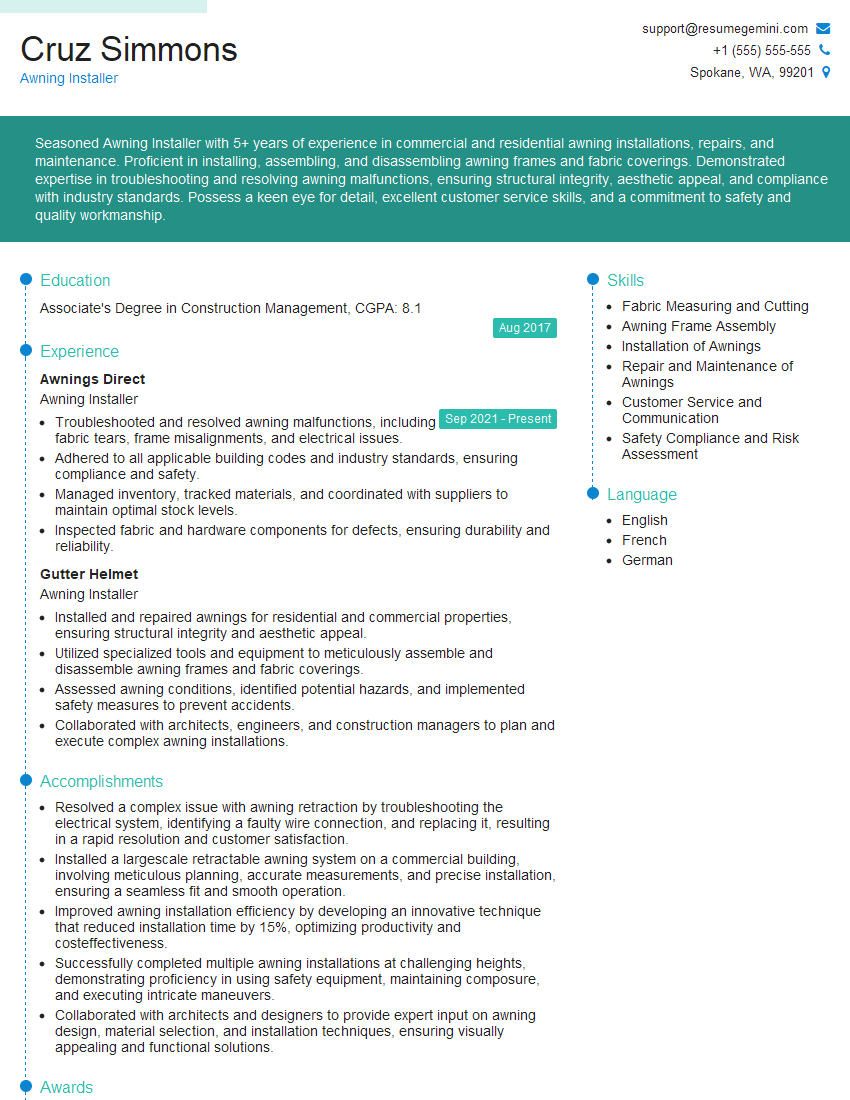
Mastering canvas sewing opens doors to exciting opportunities in the fashion and design industries, offering rewarding careers with a focus on quality craftsmanship. To maximize your job prospects, crafting an ATS-friendly resume is crucial. This ensures your skills and experience are effectively communicated to potential employers. We highly recommend using ResumeGemini to build a professional and impactful resume. ResumeGemini provides valuable tools and resources, including examples of resumes tailored to Canvas Sewing professionals, to help you showcase your expertise effectively. Take the next step towards your dream career today!
Explore more articles
Users Rating of Our Blogs
Share Your Experience
We value your feedback! Please rate our content and share your thoughts (optional).
What Readers Say About Our Blog
Very informative content, great job.
good