The right preparation can turn an interview into an opportunity to showcase your expertise. This guide to Carpet Hardwood Flooring Installation interview questions is your ultimate resource, providing key insights and tips to help you ace your responses and stand out as a top candidate.
Questions Asked in Carpet Hardwood Flooring Installation Interview
Q 1. What types of adhesives are suitable for different hardwood flooring types?
Choosing the right adhesive is crucial for a successful hardwood floor installation. The best adhesive depends heavily on the type of hardwood flooring you’re using. Solid hardwood, engineered hardwood, and even prefinished vs. unfinished planks all have different requirements.
- Solid Hardwood: Often requires a moisture-resistant, high-performance adhesive like polyurethane-based construction adhesive. This is especially important in areas prone to moisture, such as kitchens or bathrooms. Think of it like super glue for wood; it needs to be strong and durable enough to hold the planks securely for decades.
- Engineered Hardwood: Can sometimes use a slightly less robust adhesive, depending on the manufacturer’s recommendations. Many engineered wood products work well with modified acrylic or PVA (polyvinyl acetate) adhesives. These offer a good balance of strength and ease of application.
- Prefinished vs. Unfinished: The type of finish doesn’t directly dictate the adhesive type, but it can influence the installation method. With prefinished, you’ll want an adhesive that won’t damage the finish during application. Unfinished planks might allow for a slightly broader range of adhesive choices, but always refer to the manufacturer’s instructions.
Always check the manufacturer’s specifications for both the flooring and the adhesive before beginning. They’ll specify the recommended adhesive and application methods to ensure a long-lasting and trouble-free installation.
Q 2. Explain the process of acclimating hardwood flooring before installation.
Acclimation is a critical step often overlooked, but it’s essential for preventing problems like shrinking, expanding, or cupping after installation. Think of it as letting the wood ‘adjust’ to its new environment.
The process involves storing the hardwood flooring in the room where it will be installed, unopened in its original packaging, for a minimum of 72 hours, and ideally for 2-3 weeks, depending on the wood species and humidity levels of your home. This allows the wood to reach equilibrium with the room’s temperature and humidity. Imagine taking a cake out of the fridge – you wouldn’t eat it immediately, would you? You’d let it sit to come to room temperature to have the best experience. It’s the same principle.
Failing to acclimate can result in significant problems down the line. The wood might shrink as it dries out, creating gaps between the planks. Or it could swell from excess moisture, leading to buckling and warping. Both scenarios result in costly repairs or even complete reflooring.
Q 3. Describe different methods for installing carpet, including stretching and seaming.
Carpet installation involves several techniques depending on the carpet type and the subfloor condition. The two most common methods are stretching and seaming.
- Stretching: This involves using a power stretcher to firmly pull and secure the carpet into place, ensuring a taut, wrinkle-free fit. We typically use a knee kicker and a power stretcher to pull carpet tightly into the tack strip, removing any wrinkles and achieving a seamless look. It’s like carefully stretching a canvas before painting; it creates a smooth base.
- Seaming: When dealing with large rooms, multiple carpet pieces are often required. Seaming involves precisely joining these pieces with an adhesive and a seam sealer, creating a nearly invisible join. This involves careful measuring and cutting to ensure a smooth transition. For a proper and strong seam, a heat-activated seam sealer is used. It must be done with precision to avoid visible seams.
Other methods include direct gluing, which is often used for commercial applications or specialized carpets. We also might use carpet tape, although this is more for smaller repairs than full-scale installations.
Q 4. How do you measure for carpet installation to minimize waste?
Accurate measuring is crucial to minimize carpet waste and ensure you have enough material for the job. We begin by carefully measuring the length and width of each room, accounting for any irregularities or obstacles (like doorways or columns). It’s best to measure multiple times in different places to get an exact average. Then, we typically add 6-12 inches to the total square footage to account for waste during cutting, seaming, and pattern matching. This extra material provides a buffer and prevents running out of carpet during the installation.
We use diagrams and detailed notes to record these measurements. In complex layouts, we might even create a scaled drawing to visualize the carpet placement and minimize waste. Thinking ahead and planning carefully saves money and materials.
Q 5. What are the common problems encountered during hardwood floor installation and their solutions?
Hardwood floor installation, while beautiful, can present several challenges. Some common problems include:
- Uneven Subfloor: This leads to squeaking, uneven surfaces, and potential damage to the flooring. Solution: A self-leveling compound can correct minor irregularities. For significant unevenness, subfloor repair is necessary before installation.
- Gaps Between Planks: These can be caused by poor acclimation, insufficient adhesive, or moisture fluctuations. Solution: Proper acclimation is key. Using the right adhesive, and monitoring environmental conditions helps prevent this. In some cases, carefully filling the gaps with wood filler might be necessary.
- Cupping or Crowning: This refers to the warping of planks due to moisture issues. Solution: Identify and address the moisture source (leaky pipes, excessive humidity). Sometimes, damaged planks need to be replaced.
- Improper Nail Placement: Visible nails or nail holes are undesirable. Solution: Proper nail gun techniques and countersinking are key. You want the nail to be hidden below the surface of the wood without damaging the plank.
Addressing these issues promptly is key to preventing costly repairs or even complete reflooring. Attention to detail is everything.
Q 6. How do you ensure proper moisture content in subflooring before installation?
Maintaining proper moisture content in subflooring is critical for the longevity of any hardwood floor. Excessive moisture leads to warping and buckling; insufficient moisture can cause shrinkage and gaps. We use a moisture meter to measure the moisture content of the subfloor before installation. The acceptable moisture level varies by wood type and geographical location but generally falls between 6% and 12%. This is important because wood is hygroscopic, meaning it expands and contracts with changes in humidity.
If the moisture content is too high, we’ll need to wait for it to dry or use a dehumidifier to lower the moisture levels. If it’s too low, we may need to take steps to increase the moisture to prevent issues. It’s crucial to let the subfloor reach the proper moisture equilibrium before installing the flooring. Think of it like baking a cake; you need the right amount of moisture for optimal results.
Q 7. What safety precautions do you take during flooring installation?
Safety is paramount during flooring installation. We always prioritize the following:
- Proper Personal Protective Equipment (PPE): This includes safety glasses, hearing protection, dust masks, and work gloves to protect against flying debris, loud noises, dust inhalation, and potential cuts and scrapes.
- Tool Safety: We use tools correctly and ensure that all power tools are properly maintained and grounded. Before starting work, we inspect all tools to ensure they are in proper working order to prevent accidents.
- Work Area Safety: We maintain a clean and organized work area to minimize tripping hazards. We use caution when using ladders and other elevated equipment, adhering to safety guidelines. And, we also make sure the area is well-ventilated to prevent inhalation of dust or fumes from adhesives.
- Material Safety Data Sheets (MSDS): We always review the MSDS for all materials used to understand potential hazards and necessary precautions. Adhering to the guidelines on MSDS is crucial for handling adhesives and other materials safely.
Our safety procedures aim to create a risk-free environment, protecting both ourselves and the homeowner’s property.
Q 8. What tools and equipment are essential for carpet and hardwood installation?
The tools and equipment needed for carpet and hardwood installation vary slightly, but a well-equipped installer will have a comprehensive set. For carpet installation, essentials include a power stretcher, knee kicker, carpet knife, seam sealer, measuring tape, padding, and various tools for trimming and finishing. Think of the power stretcher as the muscle, ensuring the carpet is taut and wrinkle-free. The knee kicker is used for more precise adjustments. For hardwood installation, the list expands. You’ll need a circular saw or miter saw for cutting planks, a nail gun or flooring stapler (depending on the installation method), a hammer, wood blocks to protect the surface, a measuring tape, a moisture meter (crucial for checking subfloor conditions), and various levels and squares for ensuring accurate placement. Beyond these core tools, specific tools are useful like pull bars, tapping blocks, and spacers, depending on the project’s complexity and the flooring material.
- Carpet: Power stretcher, knee kicker, carpet knife, seam sealer, measuring tape, padding.
- Hardwood: Circular saw, nail gun/flooring stapler, hammer, wood blocks, moisture meter, levels, squares.
Q 9. Explain the difference between solid and engineered hardwood flooring.
The key difference between solid and engineered hardwood lies in their construction and how they react to moisture. Solid hardwood planks are made from a single piece of wood, typically ¾ inch thick. This makes them exceptionally durable and refinishable multiple times, lasting for generations. Imagine a classic, heirloom piece of furniture – that’s the longevity you get with solid hardwood. However, they are more susceptible to moisture damage, expanding and contracting with changes in humidity. This means they’re best suited for dry climates or rooms with controlled humidity. Engineered hardwood, on the other hand, is composed of several layers. A thin veneer of hardwood sits atop a plywood core, typically around ½ inch thick. The plywood core provides stability and resistance to moisture fluctuations, making it more suitable for basements or humid environments. While engineered hardwood can be refinished, it usually only allows for one or two refinishes due to the thinner veneer. Consider engineered hardwood if you need a more affordable and moisture-resistant option, but solid hardwood if longevity and multiple refinishes are priorities. Think of engineered hardwood as a more robust, all-weather version suitable for diverse conditions.
Q 10. How do you handle transitions between different flooring types?
Transitioning between different flooring types, such as carpet and hardwood, requires careful planning and execution to create a seamless and aesthetically pleasing result. The key is to use transition strips or reducers specifically designed to bridge the height difference and provide a clean edge. These are available in various materials and styles to match your flooring. For example, a T-molding sits on top of both flooring surfaces, covering the seam. A reducer is used when one flooring type is higher than the other, gently sloping the transition. A threshold is used for doorways, often providing a metal or wood accent. The choice depends on the specific height difference and aesthetic preferences. Proper installation involves precise measurements and cuts to ensure a smooth and flush transition. A poorly installed transition will be noticeable and detract from the overall appearance of the flooring.
Q 11. What are the various types of carpet padding and their applications?
Carpet padding, also known as underlayment, plays a vital role in both comfort and the longevity of your carpet. Different types offer varying levels of cushioning, moisture resistance, and density. Foam padding is the most common and affordable option, offering good cushioning and comfort. Rebond padding is made from recycled fibers and is a budget-friendly choice, but it may not be as durable or resilient as other options. Memory foam padding provides superior cushioning and conforms to the shape of your feet for enhanced comfort, but is more expensive. High-density foam padding offers increased durability and better support for the carpet fibers, extending the life of the carpet. The choice of padding depends on factors like budget, desired comfort level, and the type of carpet being installed. For high-traffic areas, a denser, more durable padding is recommended. For bedrooms or low-traffic areas, a softer, more comfortable padding might suffice.
Q 12. Describe your experience with different types of hardwood flooring (e.g., oak, maple, bamboo).
My experience encompasses a wide range of hardwood species, each with its unique characteristics and challenges. Oak, a classic choice, is known for its durability and beautiful grain patterns, ranging from light to dark tones. It’s relatively easy to work with and readily available. Maple offers a harder, more durable surface, ideal for high-traffic areas. It comes in both light and darker shades and has a clean, modern look. I’ve worked extensively with both solid and engineered versions of both oak and maple, tailoring installation methods to suit each one. Bamboo, a sustainable alternative, is becoming increasingly popular. It’s surprisingly strong and very durable; however, its hardness requires careful handling during installation to avoid cracking. Each species needs its unique installation approach. For instance, bamboo may need more careful acclimation to the room’s humidity before installation to avoid warping. Overall, careful attention to the specific characteristics of each species is crucial for a successful installation.
Q 13. How do you calculate the square footage of a room for flooring installation?
Calculating the square footage for flooring is fundamental for accurate material ordering and cost estimation. For rectangular rooms, it’s straightforward: measure the length and width of the room in feet, then multiply them (Length x Width = Square Footage). For irregularly shaped rooms, divide the space into smaller, easily measurable rectangles or triangles, calculate the area of each section, and then add them together. Don’t forget to account for waste. A general rule of thumb is to add 5-10% extra material to account for cuts, mistakes, or patterns that need matching. Precise measurement is paramount. Inaccurate measurements lead to material shortages or excess. For example, if a room measures 12 feet by 15 feet, the square footage would be 180 square feet (12 x 15 = 180). Adding 10% waste results in a total order of 198 square feet (180 x 1.1 = 198).
Q 14. What are the common causes of hardwood floor squeaking and how do you resolve them?
Hardwood floor squeaking is a common issue often caused by loose floorboards rubbing against each other or the joists beneath. This usually happens over time due to normal house settling or changes in humidity. Several methods exist for resolving it. One approach is to locate the source of the squeak by carefully applying pressure to different areas of the floor. Once identified, you can insert screws or nails through the existing nail holes, or use construction adhesive to secure the squeaky boards to the subfloor. For stubborn squeaks, a simple fix can be to drill small pilot holes and then inject a lubricant, such as talcum powder or silicone spray, into the gap between the boards and the joists. Another method involves using specialized shims to lift the squeaky board slightly and eliminate the friction. Before attempting any repairs, ensure you properly identify the root cause of the squeak to avoid causing further damage. If the problem is widespread, it may be better to consult a professional flooring contractor to prevent more extensive damage.
Q 15. How do you handle uneven subfloors before installation?
Uneven subfloors are a major obstacle to successful flooring installation. They can lead to squeaky floors, premature wear, and even damage to the flooring itself. Before installation, I meticulously assess the subfloor’s levelness using a long straight edge and level. Any significant unevenness needs to be addressed.
Minor Unevenness: For minor imperfections, I might use a self-leveling compound. This is a pourable mixture that spreads evenly, filling in small dips and creating a smooth surface. Think of it like creating a perfectly flat pancake for your flooring to rest on!
Significant Unevenness: Larger discrepancies require more involved solutions. This could involve using plywood underlayment to raise lower sections or planing down high spots using a floor sander. The goal is to achieve a consistently flat surface within the acceptable tolerance for the chosen flooring type.
Proper subfloor preparation is crucial; it’s the foundation of a beautiful and long-lasting floor. Cutting corners here will always show up later.
Career Expert Tips:
- Ace those interviews! Prepare effectively by reviewing the Top 50 Most Common Interview Questions on ResumeGemini.
- Navigate your job search with confidence! Explore a wide range of Career Tips on ResumeGemini. Learn about common challenges and recommendations to overcome them.
- Craft the perfect resume! Master the Art of Resume Writing with ResumeGemini’s guide. Showcase your unique qualifications and achievements effectively.
- Don’t miss out on holiday savings! Build your dream resume with ResumeGemini’s ATS optimized templates.
Q 16. Explain your experience with installing flooring in different environments (e.g., residential, commercial).
My experience spans both residential and commercial settings. Residential projects often involve smaller spaces and unique design choices, requiring a more personalized approach. For example, I’ve worked on intricate inlay designs in a Victorian home, needing precise cuts and careful planning.
Commercial projects are different; they usually involve larger spaces and strict deadlines, demanding efficient workflow and meticulous planning to stay on schedule. One memorable project was a large office space, where we had to coordinate with other contractors and complete the flooring installation within a very tight timeframe.
In both environments, careful attention to detail, efficient resource management and maintaining a clean and safe work environment is crucial.
Q 17. What are your preferred methods for cutting and trimming hardwood flooring?
Precision cutting is paramount in hardwood flooring. My preferred methods depend on the cut needed and the material.
Circular Saw: For straight cuts and large quantities, a circular saw equipped with a fine-toothed blade is efficient. This is especially helpful when ripping boards to length.
Hand Saw: For intricate cuts and smaller tasks, a high-quality hand saw allows for greater precision and control. This is essential for fitting pieces around obstacles or creating custom patterns.
Jigsaw: For curved or irregular cuts, a jigsaw is indispensable. I use it carefully, ensuring a smooth cut to avoid splintering.
Regardless of the tool used, I always prioritize safety, using proper safety gear like eye protection and hearing protection. Precise and clean cuts ensure a seamless, professional finish.
Q 18. Describe your experience with using a floor stapler and power stretcher.
The floor stapler and power stretcher are essential tools for installing hardwood flooring, particularly engineered wood.
Floor Stapler: I use a pneumatic floor stapler to securely fasten the flooring to the subfloor, ensuring a stable and long-lasting installation. Experience allows me to adjust the staple depth based on the flooring type and subfloor material, ensuring optimal hold without damage.
Power Stretcher: This tool is crucial for stretching and aligning engineered wood flooring planks. It helps ensure tight joints and eliminates gaps. Proper technique with the stretcher is vital to prevent damage to the flooring and achieve consistent board spacing.
Proficient use of both tools requires a keen understanding of their mechanics and the specific requirements of each flooring project. Years of practice have honed my skill in employing these tools efficiently and safely.
Q 19. How do you clean up after a flooring installation job?
Maintaining a clean worksite is crucial for both safety and the client’s satisfaction. After completion, I follow a thorough cleanup procedure:
Debris Removal: All sawdust, scraps, and packaging materials are meticulously removed from the work area and disposed of properly.
Vacuuming: The floor is thoroughly vacuumed to remove any remaining dust or debris.
Final Inspection: A final walk-through with the client to ensure satisfaction and address any concerns.
A clean and organized job site reflects professionalism and respect for the client’s home.
Q 20. What are the industry standards and best practices for flooring installation?
Industry standards and best practices are crucial for ensuring quality and longevity. These guidelines cover various aspects, including:
Subfloor Preparation: Ensuring a level, clean, and dry subfloor is non-negotiable. Moisture barriers might be needed depending on the subfloor type.
Acclimation: Allowing the flooring to acclimate to the room’s temperature and humidity levels before installation prevents expansion and contraction issues later on. This is like letting your new shoes adjust to your feet before you wear them all day!
Proper Installation Methods: Following the manufacturer’s guidelines for each flooring type is crucial. This may involve specific spacing requirements, nailing patterns, or adhesive application.
Safety Procedures: Using appropriate safety gear (eye protection, respirators, ear protection) and adhering to safe work practices are mandatory.
Staying current with the latest industry standards and best practices through continued education is essential for providing top-tier service.
Q 21. How do you manage your time effectively during a large-scale flooring project?
Managing time effectively on a large-scale project requires detailed planning and efficient execution.
Detailed Project Plan: I create a detailed project plan outlining each step, assigning specific tasks with realistic timelines. This involves considering factors like material delivery, manpower, and potential unforeseen delays.
Teamwork and Communication: For larger projects, I work with a reliable team, ensuring clear communication and coordination. This fosters efficiency and helps identify and address potential issues promptly.
Prioritization: I prioritize tasks based on their urgency and dependencies, ensuring a smooth workflow. This means focusing on critical path tasks first to keep the project on track.
Regular Monitoring and Adjustments: Regular progress checks help me identify any potential delays and make necessary adjustments to the plan. This proactive approach minimizes disruption and keeps the project moving forward efficiently.
Effective time management is not just about speed, it’s about delivering high-quality work on time and within budget. This is where experience and meticulous planning really shine.
Q 22. Describe a situation where you had to solve a problem during a flooring installation.
During a recent hardwood installation, we encountered unexpected subfloor inconsistencies. The existing concrete slab had significant variations in height, exceeding the acceptable tolerance for a smooth, level surface. This would have led to squeaking and potential damage to the hardwood over time. Instead of proceeding directly with installation, we first addressed the subfloor issue.
Our solution involved using a self-leveling compound. This allowed us to create a perfectly level base for the hardwood. This involved carefully measuring the low points, preparing the surface thoroughly (cleaning and priming), and then carefully applying the compound in thin layers, ensuring even distribution. This extra step, though time-consuming, guaranteed a high-quality, long-lasting installation, preventing future problems and maintaining customer satisfaction.
Q 23. How do you handle customer complaints or unexpected issues on a job site?
Handling customer complaints requires a calm and professional approach. I always start by actively listening to their concerns without interruption. Once I fully understand the issue, I explain the situation clearly and honestly. If the complaint is valid, I focus on finding a solution. If it’s a misunderstanding, I address it with patience.
For instance, if a customer complains about a gap between boards, I would first check for potential causes, like improper acclimation of the wood or variations in the subfloor. If the issue is within acceptable industry standards, I’d clearly explain that to the customer. If, however, the issue stems from a mistake on our part, we rectify it immediately, perhaps by replacing affected boards or refinishing the area. Open communication and a willingness to find solutions are crucial in maintaining a positive working relationship.
Q 24. What is your experience with different types of floor underlayment?
I have extensive experience with various underlayments, each serving a distinct purpose. The choice depends largely on the type of flooring and the subfloor conditions.
- Vapor Barriers: These are crucial in areas prone to moisture, especially over concrete slabs. They prevent moisture vapor from migrating up and damaging the wood flooring.
- Foam Underlayments: These offer cushioning, sound insulation, and improved thermal performance. They come in various thicknesses and densities, affecting the final floor height and level of comfort. I often use these under engineered hardwood.
- Cork Underlayment: Cork provides excellent sound dampening and insulation while offering a comfortable feel underfoot. It’s a good choice for homes with multiple levels.
- LVL (Laminated Veneer Lumber): Used for leveling uneven subfloors, LVL is extremely durable and rigid, ideal for leveling significant imperfections.
Selecting the appropriate underlayment ensures a long-lasting installation and enhances the flooring’s performance and longevity.
Q 25. Are you familiar with different types of hardwood finishes (e.g., polyurethane, oil-based)?
Yes, I’m well-versed in various hardwood finishes. The choice of finish significantly impacts the floor’s appearance, durability, and maintenance requirements.
- Polyurethane: This is a popular choice due to its durability, ease of maintenance, and water resistance. It’s available in both water-based and oil-based formulations, with water-based being increasingly preferred for its low VOCs (volatile organic compounds).
- Oil-based Finishes: These provide a more natural look and feel, enhancing the wood’s grain and color. However, they require more maintenance and are less water-resistant than polyurethane. They also tend to have a longer drying time.
- UV-cured finishes: These are applied in a factory setting and are extremely durable, and are a common method for prefinished hardwood flooring.
I discuss the pros and cons of each option with clients before making a decision, ensuring that the final choice aligns with their needs and preferences.
Q 26. What is your understanding of building codes and safety regulations relevant to flooring installation?
Understanding building codes and safety regulations is paramount in flooring installation. This includes adherence to local and national standards regarding subfloor preparation, moisture content of the wood, proper ventilation, and the use of appropriate adhesives and safety equipment.
For example, I’m familiar with standards related to the proper installation of moisture barriers and ensuring that the subfloor meets the required levelness and structural integrity. I also strictly adhere to safety protocols like wearing appropriate personal protective equipment (PPE), including respirators when working with adhesives and dust masks when sanding. Staying informed about these regulations is crucial for ensuring a safe and compliant installation.
Q 27. Describe your experience working with a team on a flooring installation project.
Teamwork is essential in flooring installation. I’ve been part of numerous projects where effective communication and collaboration were crucial to successful completion. I believe in clear task assignments and open communication between team members.
On a recent large-scale project, our team consisted of installers, finishers, and a project manager. We used a detailed project plan, outlining each stage of the installation, assigning responsibilities, and establishing timelines. Regular meetings ensured that everyone was on the same page, and any issues were addressed promptly. This collaborative approach ensured a smooth and efficient installation process, exceeding client expectations and completing the project on time and within budget.
Q 28. How do you stay updated on the latest trends and techniques in flooring installation?
Staying updated on the latest trends and techniques is crucial for success in this field. I regularly attend industry trade shows, workshops, and seminars. I also subscribe to industry publications and online resources, ensuring I remain informed about new products, tools, and installation methods.
Furthermore, I actively participate in professional organizations, networking with colleagues and sharing best practices. Continuous learning is key to refining my skills and providing my clients with the best possible service. For example, I recently learned about new adhesive technologies that offer improved bonding and reduced environmental impact; this knowledge is directly applicable to my work and benefits both my clients and the environment.
Key Topics to Learn for Carpet & Hardwood Flooring Installation Interview
- Subfloor Preparation: Understanding different subfloor types (concrete, plywood, etc.), moisture content testing, leveling techniques, and necessary repairs before installation.
- Acclimation & Measurement: Proper acclimation procedures for hardwood flooring to prevent expansion and contraction issues. Accurate room measurement and material calculation to minimize waste.
- Carpet Installation Methods: Familiarity with various carpet installation techniques (stretch-in, glue-down, etc.), understanding padding types and their impact on installation and longevity.
- Hardwood Installation Methods: Proficiency in different hardwood installation methods (nail-down, glue-down, floating), understanding expansion gaps and moisture barriers.
- Transitioning Materials: Knowledge of various transition methods between carpet and hardwood flooring, including thresholds, reducers, and T-moldings.
- Tools & Equipment: Familiarity with common tools and equipment used in both carpet and hardwood installation, including power tools, measuring instruments, and safety gear.
- Problem-Solving & Troubleshooting: Experience identifying and resolving common installation issues, such as uneven subfloors, buckling, squeaking, and gap formation.
- Safety Procedures: Understanding and adhering to all relevant safety regulations and procedures to prevent accidents and injuries on the job site.
- Industry Standards & Codes: Awareness of relevant building codes and industry best practices for carpet and hardwood flooring installation.
- Estimating & Budgeting: Ability to accurately estimate material costs and labor hours for various projects.
Next Steps
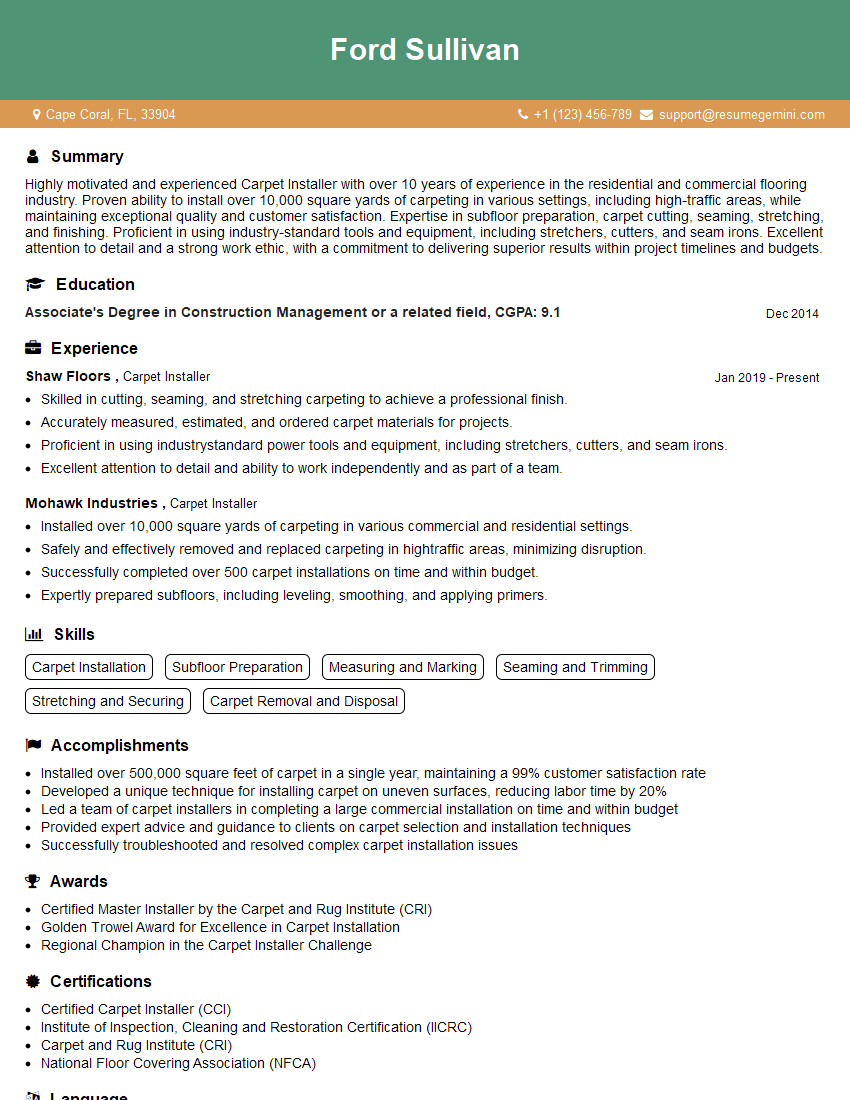
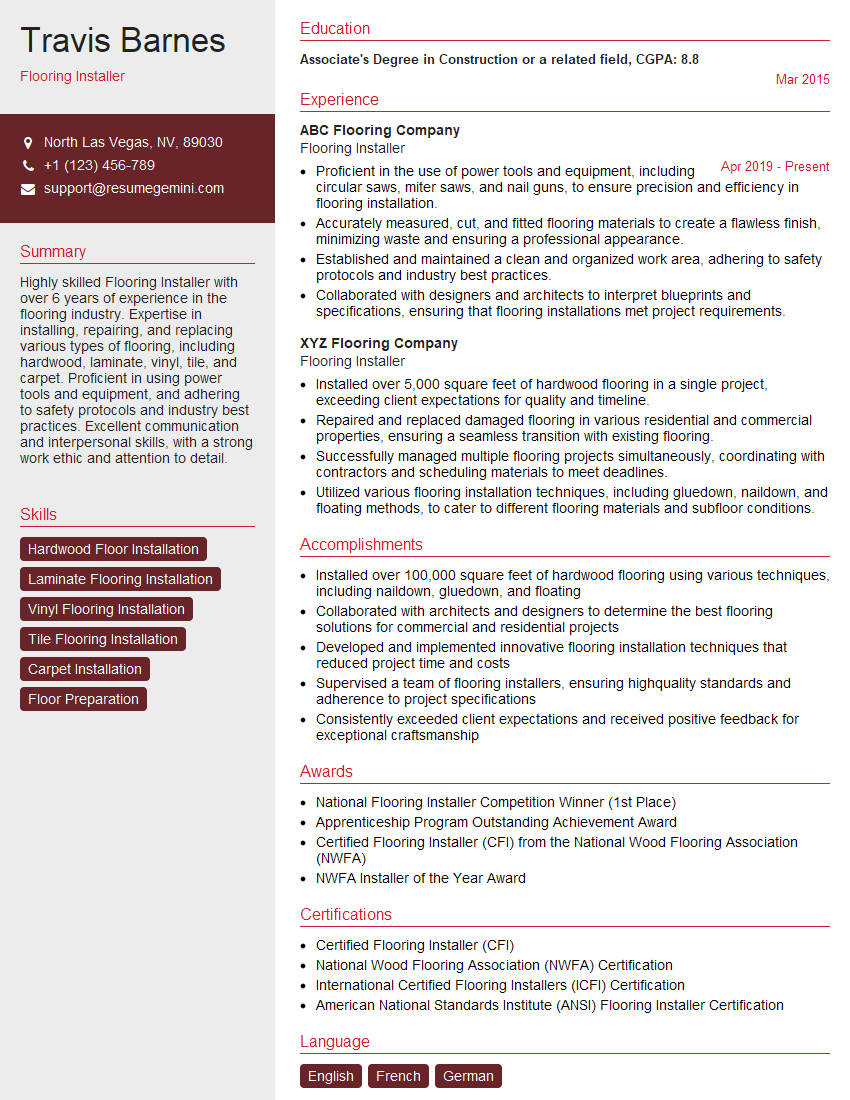
Mastering carpet and hardwood flooring installation opens doors to a rewarding career with excellent growth potential. Demand for skilled installers remains high, offering opportunities for advancement and increased earning potential. To maximize your job prospects, create an ATS-friendly resume that highlights your skills and experience effectively. ResumeGemini is a trusted resource that can help you build a professional resume that stands out. Examples of resumes tailored to Carpet & Hardwood Flooring Installation are available to guide you. Investing time in crafting a strong resume is crucial for landing your dream job.

Explore more articles
Users Rating of Our Blogs
Share Your Experience
We value your feedback! Please rate our content and share your thoughts (optional).
What Readers Say About Our Blog
Very informative content, great job.
good