The right preparation can turn an interview into an opportunity to showcase your expertise. This guide to Carpet Laminate Flooring Installation interview questions is your ultimate resource, providing key insights and tips to help you ace your responses and stand out as a top candidate.
Questions Asked in Carpet Laminate Flooring Installation Interview
Q 1. What types of underlayment are suitable for laminate flooring?
Choosing the right underlayment for laminate flooring is crucial for its longevity and performance. It acts as a buffer, providing insulation, sound dampening, and a smoother surface for the laminate to click into place. The best type depends on your specific needs and subfloor conditions.
- Foam Underlayment: This is the most common type, offering good cushioning and sound absorption. Look for thicker options (6mm or more) for better comfort and noise reduction. Different densities are available, with higher density offering better durability. Think of it like a soft mattress for your laminate.
- Cork Underlayment: A natural and eco-friendly option known for its excellent sound insulation and moisture resistance. It’s a little more expensive but offers superior comfort underfoot and can help with uneven subfloors.
- Fiberboard Underlayment: Offers good dimensional stability and a harder, more rigid surface. This is a good choice for areas with high traffic or where a very flat surface is needed. However, it generally provides less sound insulation than foam or cork.
- Combination Underlayments: Some underlayments combine different materials to blend the benefits of various types, for instance, a foam core with a polyethylene layer for moisture resistance.
For example, in a basement installation, a moisture-resistant underlayment like cork or a combination underlayment is crucial to protect your flooring from dampness. In an upstairs bedroom, a foam underlayment with good sound dampening will help keep the noise level down.
Q 2. Explain the process of acclimating flooring materials before installation.
Acclimating flooring materials is essential to prevent expansion and contraction after installation, which can lead to gaps, buckling, or cupping. This is particularly important for wood-based products like laminate flooring and even some types of carpet backing. Imagine leaving a cold bottle of soda out in the sun – it will sweat. Similarly, flooring exposed to drastic temperature or humidity changes will react.
The process involves storing the flooring materials in the room where they will be installed for a minimum of 48 hours, but preferably 72 hours. The ideal temperature should be between 65°F and 75°F (18°C and 24°C), and the humidity should be maintained at 30% to 60% relative humidity. Open the packaging to allow proper air circulation. Keep the flooring away from direct sunlight or heat sources. Failing to acclimate the material can lead to problems down the road, so it’s a crucial step!
Q 3. How do you measure for carpet and laminate flooring installations?
Accurate measuring is the foundation of a successful flooring installation. Inaccurate measurements lead to material waste or shortages, both costly mistakes.
- Carpet: Measure the length and width of each room where carpet will be installed, ensuring you’re measuring to the furthest points. Add extra for doorways and transitions. Always round up to the nearest foot to account for waste and cutting.
- Laminate: Similarly, measure the length and width of each area. It’s crucial to account for doorways, walls, and any obstacles. For laminate, you need to factor in the expansion gap (usually around ¼ inch per wall). Accurate measurements ensure you have enough material, especially if you’re using complex patterns or require many cuts.
For both carpet and laminate, sketch a simple diagram of the room with dimensions. This helps visualize the layout and identify potential issues ahead of time, like awkwardly shaped areas that need careful planning. It is a good practice to get extra material because every situation and room is different.
Q 4. Describe the proper methods for cutting laminate flooring.
Cutting laminate flooring requires precision to avoid damage and ensure a clean, professional finish. A circular saw with a fine-tooth blade designed for laminate is ideal for straight cuts. But other tools exist, and the best is dependent on the cut you need.
- Straight Cuts: Use a circular saw with a fine-tooth blade set to the desired depth. Use a straight edge as a guide for consistent and accurate cuts. Always support the laminate board to avoid chipping.
- Angle Cuts: A miter saw is best for accurate angle cuts needed at doorways or transitions. A hand saw with a fine-tooth blade can be used for smaller angle cuts. Remember to adjust the blade angle on the saw according to the desired angle of cut.
- Curve Cuts: A jigsaw with a fine-tooth blade can cut curves. Take your time and use a pencil to mark the cut line before cutting.
Regardless of your chosen method, always practice your cuts on a scrap piece of laminate before cutting the actual flooring. This allows you to get a feel for the tool and the material. Remember safety glasses and hearing protection are essential!
Q 5. What tools are essential for carpet and laminate installation?
The tools required for carpet and laminate installation vary, but some essentials overlap. Here’s a breakdown:
- Carpet: Measuring tape, carpet knife, knee kicker, power stretcher, seam sealer, tack strip, padding.
- Laminate: Measuring tape, laminate flooring underlayment, tapping block, pull bar, spacer blocks, circular saw, jigsaw (for curves), pencil, safety glasses, and hearing protection.
For both types of flooring installations, you will need a quality measuring tape, a sharp knife (utility knife or carpet knife), and a pencil for marking. Investing in good-quality tools is crucial for both speed and precision.
Q 6. How do you handle transitions between different flooring types?
Handling transitions between different flooring types requires careful planning and execution to create a seamless and aesthetically pleasing finish. The method depends on the types of flooring involved.
- Carpet to Laminate: A transition strip is commonly used. These strips are designed to bridge the gap in height and provide a smooth transition between the two flooring types. They’re available in various materials and styles to match your decor.
- Laminate to Tile: A reducer strip or a T-molding is typically used, creating a neat and finished edge. Similar to carpet transitions, it covers the height difference and provides a smooth transition.
- Tile to Carpet: Transition strips similar to carpet/laminate transitions are available here as well.
Accurate measurements are key for proper fitting. Cutting the transition strip to the exact length and ensuring a level and flush fit is crucial for a professional finish. Pre-planning the type of transition strip and how it will look before starting the install is beneficial.
Q 7. Explain the importance of proper moisture barrier installation.
A proper moisture barrier is critical, particularly when installing flooring over concrete subfloors or in basements. Concrete can emit moisture, which can damage wood-based flooring materials like laminate. The moisture can lead to warping, buckling, or mold growth.
A moisture barrier prevents moisture from reaching the laminate flooring and damaging it. Options include polyethylene plastic sheeting, which should be laid down with overlapping seams and sealed with tape. Other options include specialized moisture-resistant underlayments.
Testing the moisture level of the concrete subfloor before installation is always recommended. If the moisture level is too high, you may need to take steps to mitigate the moisture before installation. This may involve allowing the concrete to dry completely or using a specialized dehumidifier.
Q 8. What are common causes of laminate flooring buckling?
Laminate flooring buckling is a frustrating problem, often stemming from moisture issues or improper installation. Think of it like a thirsty sponge – if the wood absorbs too much water, it expands and buckles.
- Excess Moisture: This is the most common culprit. Spills, leaks, or high humidity can cause the coreboard of the laminate to swell, leading to warping and buckling. I once had a job where a small, unnoticed leak under the sink caused significant buckling in a kitchen several months after installation.
- Improper Acclimation: Laminate needs time to adjust to the room’s temperature and humidity before installation. Failure to acclimate can result in expansion and contraction issues after laying it, leading to buckling. Think of it as letting a new plant adjust to its environment before transplanting it.
- Uneven Subfloor: A subfloor that isn’t level creates stress points on the laminate, causing it to buckle in those areas. It’s like trying to build a house on uneven ground; the structure will eventually suffer.
- Insufficient Expansion Gaps: Laminate needs space to expand and contract with temperature and humidity changes. Not leaving enough gap around the perimeter of the room can lead to buckling as the flooring tries to expand against walls.
Diagnosing the cause is crucial for effective repair. Often, addressing the moisture issue and carefully reinstalling the affected sections (after allowing the flooring to dry) solves the problem. In severe cases, complete replacement may be necessary.
Q 9. How do you address uneven subfloors before installation?
A level subfloor is paramount for a successful laminate or carpet installation. Unevenness leads to issues ranging from buckling (as mentioned before) to squeaking and premature wear. Think of it as building a foundation for a house – you wouldn’t start construction on uneven ground!
Addressing unevenness depends on the severity:
- Minor Unevenness: For minor imperfections, a self-leveling compound is often sufficient. It’s like filling small potholes in a road – easy and effective. It’s poured over the subfloor and self-levels, creating a smooth surface.
- Significant Unevenness: More significant dips or bumps require more extensive work. This could involve using plywood underlayment to create a level surface. This is like building up the base before pouring the foundation; it’s more labor-intensive, but crucial for a stable floor.
Before applying any leveler or underlayment, it’s essential to clean the subfloor thoroughly and ensure it’s dry. Using a long straight-edge or a level, I check for high and low points, noting the areas that need attention. This careful preparation is key to a flawless installation. Ignoring this step can lead to costly mistakes down the line.
Q 10. Describe your experience with different types of carpet padding.
Carpet padding plays a vital role in comfort, sound insulation, and the longevity of your carpet. I’ve worked with various types, each with its own pros and cons:
- Rebond Padding: This is a common, cost-effective option made from recycled fibers. It’s good for basic installations but might not offer the best cushioning or longevity.
- Foam Padding: Offers better cushioning and insulation than rebond, often made from polyurethane or other synthetic foams. Comes in various densities, impacting comfort and cost. Higher density is more durable.
- High-Density Foam Padding: A step up from regular foam, offering superior cushioning, support, and sound absorption. It’s a great choice for high-traffic areas.
- Memory Foam Padding: Provides excellent cushioning and conforms to the shape of your foot, but is often more expensive.
- Rubber Padding: Excellent for moisture resistance and sound dampening, making it a good choice for basements or areas prone to spills.
My choice of padding depends on the client’s budget, the carpet’s quality, and the room’s function. A high-end carpet deserves high-quality padding, while a low-traffic area might not need the most expensive option. A detailed discussion with the customer is essential to determine the best fit for their needs.
Q 11. Explain the process of stretching and securing carpet.
Stretching and securing carpet is an art that requires precision and skill. The goal is to create a smooth, wrinkle-free surface that lies flat and securely. Imagine draping a sheet perfectly on a bed – that’s the level of precision we aim for.
The process typically involves:
- Laying the Carpet: Begin by rolling out the carpet, ensuring it’s facing the right direction. Make sure there’s extra carpet on the perimeter.
- Stretching the Carpet: Using a knee kicker or power stretcher, carefully stretch the carpet into position. This requires considerable strength and technique to avoid damaging the carpet.
- Securing the Carpet: Once stretched, the carpet is secured using tack strips along the perimeter. These strips have sharp tacks to hold the carpet edges. The carpet is then tucked into the strips.
- Trimming Excess Carpet: After stretching and securing, any excess carpet is trimmed using a sharp utility knife.
- Seaming: For larger rooms, sections of carpet need to be seamed together. This involves using seam tape and specialized tools to create a seamless transition. I often use a heat seamer for professional results.
Throughout the process, attention to detail is crucial. Even small imperfections can become noticeable over time. Accurate measurements and careful stretching are critical for a professional-looking finish.
Q 12. How do you install baseboards around carpet and laminate flooring?
Installing baseboards around carpet and laminate requires different techniques, and care must be taken to avoid damage.
- Around Carpet: Baseboards are typically installed after the carpet is in place. The baseboard is mitered (cut at a 45-degree angle) at the corners and nailed or glued to the wall, ensuring it sits flush against the wall and slightly overlaps the carpet. A small gap might be left between the baseboard and the carpet to allow for expansion and cleaning.
- Around Laminate: With laminate, the baseboard is usually installed before the laminate. This allows for a cleaner, more precise finish. The baseboard covers the expansion gap between the laminate and the wall.
The type of baseboard can impact the installation process. For example, flexible baseboards are easier to install around curves or irregularities in the wall. Accurate measurements and careful cutting are crucial, regardless of the installation sequence or type of baseboard used.
Q 13. What are the safety precautions you take during flooring installation?
Safety is paramount in flooring installation. I always prioritize safety for myself and my clients. My safety precautions include:
- Proper Personal Protective Equipment (PPE): This includes safety glasses, dust masks (especially when working with certain adhesives), work gloves, and sturdy footwear to protect against falling objects and sharp tools.
- Safe Tool Handling: All tools are used according to their intended purposes. Sharp knives are handled with care. Power tools are used with appropriate safety guards and are regularly maintained.
- Proper Ventilation: Adequate ventilation is essential when using adhesives or other materials that release fumes. Working in a well-ventilated area helps reduce the risk of inhaling harmful substances. I often use fans to ensure good air circulation.
- Clean and Organized Workspace: Maintaining a clean and organized workspace prevents accidents. Tools and materials are stored safely when not in use. This prevents tripping hazards and ensures a safer environment.
- Following Manufacturer’s Instructions: All materials, including adhesives, underlayments and flooring, are used according to the manufacturer’s instructions. This helps avoid improper usage and potential accidents.
Safety is not just about avoiding accidents; it’s about fostering a professional and efficient work environment. A safe work environment leads to better quality work and client satisfaction.
Q 14. How do you handle challenging installations (e.g., stairs, complex angles)?
Challenging installations, such as stairs and complex angles, demand meticulous planning and execution. They test the limits of your skills and often require more time than straightforward projects.
- Stairs: Installing carpet on stairs involves precise measurements, careful cutting, and the use of specialized tools like stair-nosing and tread-nosing tools to create a professional finish. Each stair is measured separately, and a pattern is created to ensure the carpet aligns perfectly on each step.
- Complex Angles: For rooms with complex angles or multiple transitions, accurate measurements and careful planning are crucial to ensure the flooring aligns correctly. Using templates and marking techniques helps with this. The installation may require more cuts and careful fitting. Accurate cutting and fit are key to success here.
These projects require patience, precision, and often involve the use of specialized tools and techniques. Thorough planning and careful execution minimize errors and waste. On some jobs, using a laser level or similar tools enhances accuracy. I always take photos before starting any challenging installation; this helps in case any issues arise.
Q 15. What are your preferred methods for cutting carpet?
Cutting carpet accurately and efficiently requires the right tools and technique. My preferred methods depend on the specific cut needed. For straight cuts, a sharp utility knife and a metal straight edge are essential. I always score the carpet deeply first, then apply firm, even pressure to cut through the backing. This ensures a clean cut and prevents fraying. For curved or intricate cuts, I use an electric carpet cutter. These tools are incredibly useful for precise cuts around obstacles like pipes or doorways. Think of it like using a sharp carving knife for intricate details versus a butcher’s knife for large, even cuts. The electric cutter allows me to precisely follow the marked lines without the risk of tearing the carpet fibers.
Safety is paramount. I always wear appropriate safety glasses and gloves when using any cutting tools. A good quality carpet knife with replaceable blades is also crucial for a clean cut every time.
Career Expert Tips:
- Ace those interviews! Prepare effectively by reviewing the Top 50 Most Common Interview Questions on ResumeGemini.
- Navigate your job search with confidence! Explore a wide range of Career Tips on ResumeGemini. Learn about common challenges and recommendations to overcome them.
- Craft the perfect resume! Master the Art of Resume Writing with ResumeGemini’s guide. Showcase your unique qualifications and achievements effectively.
- Don’t miss out on holiday savings! Build your dream resume with ResumeGemini’s ATS optimized templates.
Q 16. How do you ensure proper seaming and joining of laminate planks?
Seaming laminate planks correctly is vital for a professional finish and to prevent future problems. The most important aspect is ensuring a tight, even join. I always start by carefully aligning the planks, ensuring the click-lock mechanism (or whatever joining system is used) is properly engaged. I use a tapping block and a rubber mallet to gently tap the planks together, avoiding forceful hammering that could damage the planks. It’s like building with precision Lego bricks – each connection needs to be secure but not forced.
For a seamless look, I ensure the planks are aligned perfectly, minimizing visible gaps. Any minor gaps can be filled with a suitable laminate filler and matched to the flooring color. Maintaining a consistent expansion gap around the perimeter of the room is also crucial to accommodate changes in temperature and humidity, preventing buckling or warping.
Q 17. What are the signs of damaged or defective flooring materials?
Identifying damaged or defective flooring materials is a key skill. For carpet, I look for things like significant variations in color or texture within a single roll, obvious signs of staining or damage to the fibers, and loose or damaged backing. It’s like examining a piece of fabric closely for imperfections before you begin sewing. With laminate, I inspect each plank for scratches, chips, dents, or warping. I also check for inconsistencies in color or pattern. A defective plank might have a noticeable variation in shade or print compared to other planks. I carefully check for moisture damage or any indication that the planks may have been stored incorrectly.
If I find damaged materials, I immediately document the issue, photograph it for evidence, and contact the supplier or client to arrange a replacement. Never compromise on quality; using damaged materials will inevitably lead to problems later on.
Q 18. How do you deal with customer concerns or complaints during installation?
Handling customer concerns is a vital part of my job. I approach each situation with empathy and a commitment to finding a solution. I always listen carefully to the customer’s concerns, ensuring I understand their perspective fully. I then explain the issue clearly and professionally, offering possible solutions and outlining the steps I’ll take to address the problem.
For instance, if a customer is concerned about a minor imperfection, I explain why it might have occurred and what measures were taken to prevent it. If the issue is more substantial, I work with them to find a fair and reasonable resolution, perhaps by redoing the affected section or offering a partial refund. Transparency and clear communication are key to resolving complaints effectively. Maintaining a professional and respectful attitude, even in challenging situations, fosters trust and ensures a positive customer experience.
Q 19. Describe your experience with various flooring adhesives.
My experience with various flooring adhesives is extensive. I’ve worked with water-based adhesives, solvent-based adhesives, and pressure-sensitive adhesives. Water-based adhesives are generally preferred for their low VOC (Volatile Organic Compound) content and ease of cleanup. They are commonly used for carpet installation and offer good adhesion when applied correctly. However, they require a longer drying time. Solvent-based adhesives offer stronger adhesion and faster drying time, but they have a stronger odor and require more stringent safety precautions. Pressure-sensitive adhesives, often used for underlayment, are very convenient but might not be suitable for all types of flooring or subfloors.
The choice of adhesive depends entirely on the type of flooring and the subfloor conditions. I always select the adhesive best suited for the specific job and follow the manufacturer’s instructions meticulously. This ensures optimal adhesion and prevents problems such as delamination or bubbling.
Q 20. How do you maintain quality control throughout the installation process?
Maintaining quality control throughout the installation process is crucial. I start by carefully inspecting the subfloor, ensuring it is level, clean, and dry. This provides a stable base for the new flooring. I also meticulously check the flooring materials before installation, discarding any damaged or defective planks. During the installation itself, I regularly check my work for alignment, seams, and overall consistency. It’s like carefully checking each stitch in a garment to ensure quality. After each stage, I perform a quality check before proceeding to the next, which prevents costly mistakes down the line.
Finally, I conduct a thorough final inspection before handing over the job, ensuring everything meets the agreed-upon standards and addressing any last-minute concerns with the client.
Q 21. What is your experience with using power tools for flooring installation?
I am highly proficient in using various power tools for flooring installation. This includes circular saws for cutting carpet and underlayment, laminate trimmers for precise cuts, and nail guns for installing certain types of flooring. I’m also comfortable operating other equipment like floor levellers and moisture meters. Each tool requires specific safety precautions, and I adhere to them meticulously. Knowing how to use these tools efficiently and safely is key to a productive and safe working environment. Think of it like being a skilled chef: knowing the right tools for the job is half the battle. Improper use could lead to injuries or damage to materials. It’s a matter of both skill and safety awareness.
Regular maintenance and safety checks are paramount. I always keep my tools in good working condition, ensuring that blades are sharp and equipment is properly maintained.
Q 22. Explain your understanding of building codes and regulations related to flooring.
Building codes and regulations regarding flooring installation vary by location but generally focus on safety, accessibility, and fire resistance. For example, codes often specify minimum requirements for floor covering flammability, using fire-rated underlayment in certain areas, and ensuring proper transitions between different floor types to prevent tripping hazards. Accessibility codes mandate specific requirements for ramps and thresholds to ensure ease of movement for people with disabilities. Understanding these codes is crucial; neglecting them can lead to project delays, costly rework, and even legal issues. I always consult the local building department’s website or contact them directly to obtain the most current and accurate information for the specific project location. I meticulously review these codes before starting any project and ensure complete compliance throughout the installation process. For instance, recently on a commercial project, we had to use a specific type of adhesive and underlayment because the local code required a higher fire rating than usual.
Q 23. How do you estimate the time and materials needed for a flooring project?
Accurately estimating time and materials is paramount for successful flooring projects. My process begins with a thorough site survey, meticulously measuring the area, considering any obstacles (like doorways, columns), and noting the floor’s condition. I factor in the type of flooring (carpet vs. laminate), its complexity (pattern matching, intricate designs), and the removal of existing flooring, if necessary. For materials, I add extra to account for waste (cuts, mistakes) – typically 5-10% for laminate and 10-15% for carpet depending on the complexity. I use project management software to create detailed schedules, itemize materials, and track progress. For example, a simple laminate installation in a 10×12 room might take a day, whereas a complex carpet installation in a larger space with multiple rooms and intricate designs could take several days with a larger team. Time estimates also consider the type of subfloor preparation needed. I always discuss these estimates in detail with clients to ensure transparency and avoid surprises.
Q 24. What is your experience with different types of laminate locking systems?
I have extensive experience with various laminate locking systems. The most common are click-lock and drop-lock. Click-lock systems involve angling the planks and clicking them together, while drop-lock systems require dropping one plank into place. Some higher-end systems offer improved durability and water resistance. I’ve worked with Uniclic, Valinge, and other proprietary systems, each with its nuances. My experience allows me to quickly identify and address any potential installation challenges associated with specific locking mechanisms. For instance, I know that proper acclimation of the laminate planks to the room’s temperature and humidity is critical for all systems to ensure a tight, stable fit and prevent issues such as gaps or buckling later. I always carefully follow the manufacturer’s instructions for each specific system to ensure a flawless installation.
Q 25. Describe your experience with different carpet fibers and their properties.
Carpet fibers differ significantly in their properties, impacting durability, softness, stain resistance, and overall lifespan. Nylon is a popular choice for its strength and resilience, while polyester is known for its softness and affordability. Olefin offers excellent stain resistance and is often used in high-traffic areas. Wool is a luxurious natural fiber, offering exceptional comfort and resilience but demanding more care. Understanding these properties is key to selecting the appropriate carpet for a client’s needs and budget. For example, in a family home with children and pets, an olefin or stain-resistant nylon might be preferred, while a high-end wool carpet might be more suitable for a formal setting with lower foot traffic. I often discuss these fiber types with clients, helping them choose the option that best suits their lifestyle and expectations.
Q 26. How do you prepare a room for carpet and laminate installation?
Room preparation is a critical step. For both carpet and laminate, the subfloor must be clean, level, dry, and free from debris. This might involve repairing damaged areas, filling gaps, or addressing moisture issues. For laminate, a moisture barrier is often recommended, especially in basements or damp areas. For carpet, the subfloor needs to be especially level to prevent ripples or unevenness. Baseboards and other trim often need to be removed or carefully worked around during installation, and any existing flooring must be removed and disposed of properly. It’s crucial to protect the walls and other surfaces during installation to prevent damage from the work process. Thorough preparation is vital for a successful and long-lasting installation. In one instance, I discovered significant moisture problems during a pre-installation assessment, and was able to advise the client on needed subfloor repairs and the use of moisture barrier before proceeding. This prevented costly future problems.
Q 27. What are the different methods for removing old flooring?
Methods for removing old flooring depend on the material. For carpet, the standard process involves pulling up the tack strips, then using a carpet stretcher to loosen and roll up the carpet. For laminate, the planks are usually removed individually, starting at the edges and working your way inward. Vinyl flooring often requires scraping or using a specialized tool to loosen and peel away the material. Hardwood floors are removed more carefully and often require more specialized tools to avoid damaging the wood. Always wear appropriate safety gear, including eye protection, dust masks, and gloves when removing flooring materials to protect your health. I always assess the type of flooring and the condition of the subfloor to determine the most efficient and safest removal method. Improper removal can cause damage to the subfloor and increase installation time.
Q 28. How do you dispose of flooring materials responsibly?
Responsible disposal of flooring materials is essential for environmental protection. Carpet and padding often contain recyclable materials and should be disposed of through designated recycling centers or programs. Some regions may have curbside pickup for carpet, while others might require you to take it to a landfill or recycling facility. Laminate flooring may also contain recyclable materials. Always check with your local waste management facility for guidance on proper disposal methods. Many construction waste companies accept these materials and will properly sort them for recycling or disposal. It is important to follow all local and regional regulations to ensure proper environmental compliance and waste management. The responsible disposal of these materials is an important part of my commitment to environmentally-conscious construction practices.
Key Topics to Learn for Carpet & Laminate Flooring Installation Interview
- Subfloor Preparation: Understanding different subfloor types (concrete, wood, etc.), moisture content testing, leveling techniques, and necessary repairs before installation.
- Underlayment Selection & Installation: Choosing the appropriate underlayment based on flooring type and subfloor conditions, ensuring proper installation for optimal performance and longevity.
- Carpet Installation Techniques: Stretching, seaming, trimming, and finishing techniques for various carpet types (e.g., plush, Berber, loop pile). Understanding the use of power stretchers and other specialized tools.
- Laminate Flooring Installation: Acclimation procedures, proper handling and cutting techniques, clicking/locking mechanisms, and expansion gap considerations.
- Transitioning Between Flooring Types: Methods for seamlessly transitioning between carpet and laminate flooring, including the use of reducers and transitions.
- Problem-Solving & Troubleshooting: Identifying and resolving common installation issues such as uneven surfaces, buckling, gaps, and seams.
- Safety Procedures & Regulations: Understanding and adhering to safety protocols, using appropriate personal protective equipment (PPE), and complying with industry regulations.
- Tools & Equipment Knowledge: Demonstrating familiarity with common tools used in carpet and laminate flooring installation (e.g., knee kicker, power stretcher, measuring tape, utility knife).
- Estimating & Project Management: Basic understanding of estimating materials, labor costs, and project timelines.
- Quality Control & Inspection: Performing quality checks throughout the installation process to ensure a professional finish.
Next Steps
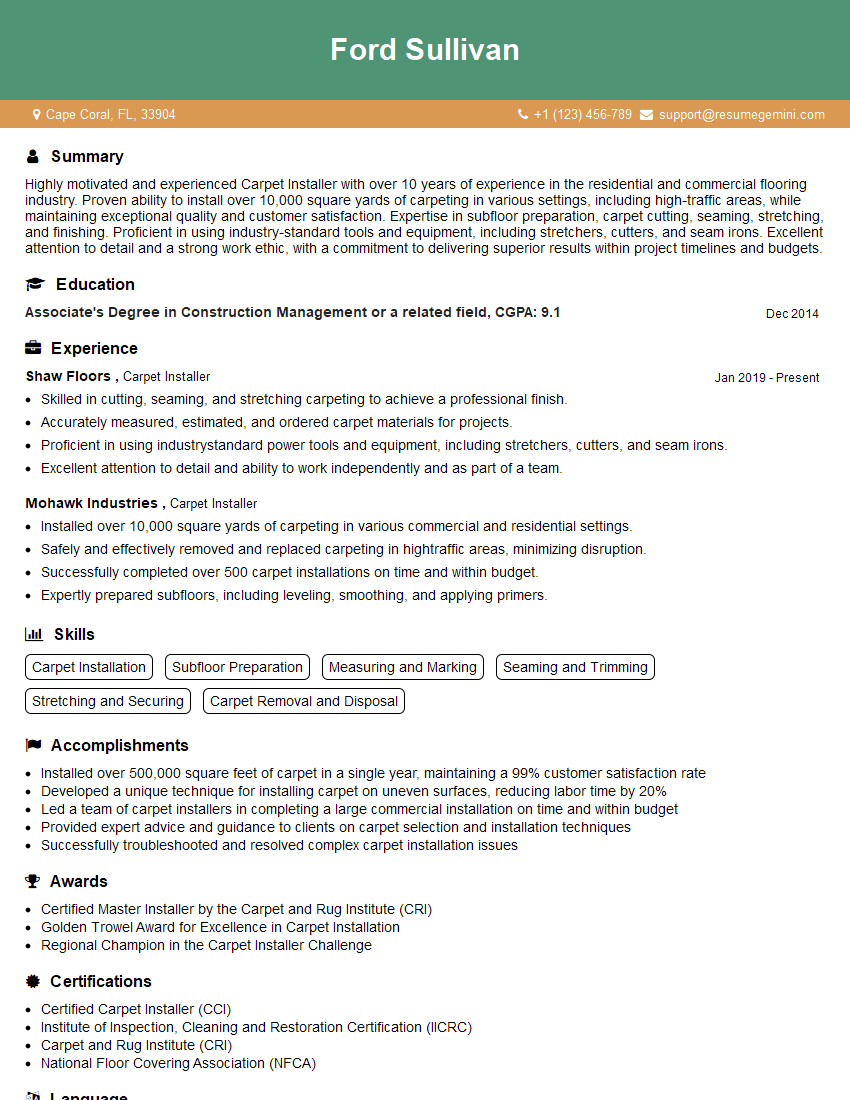
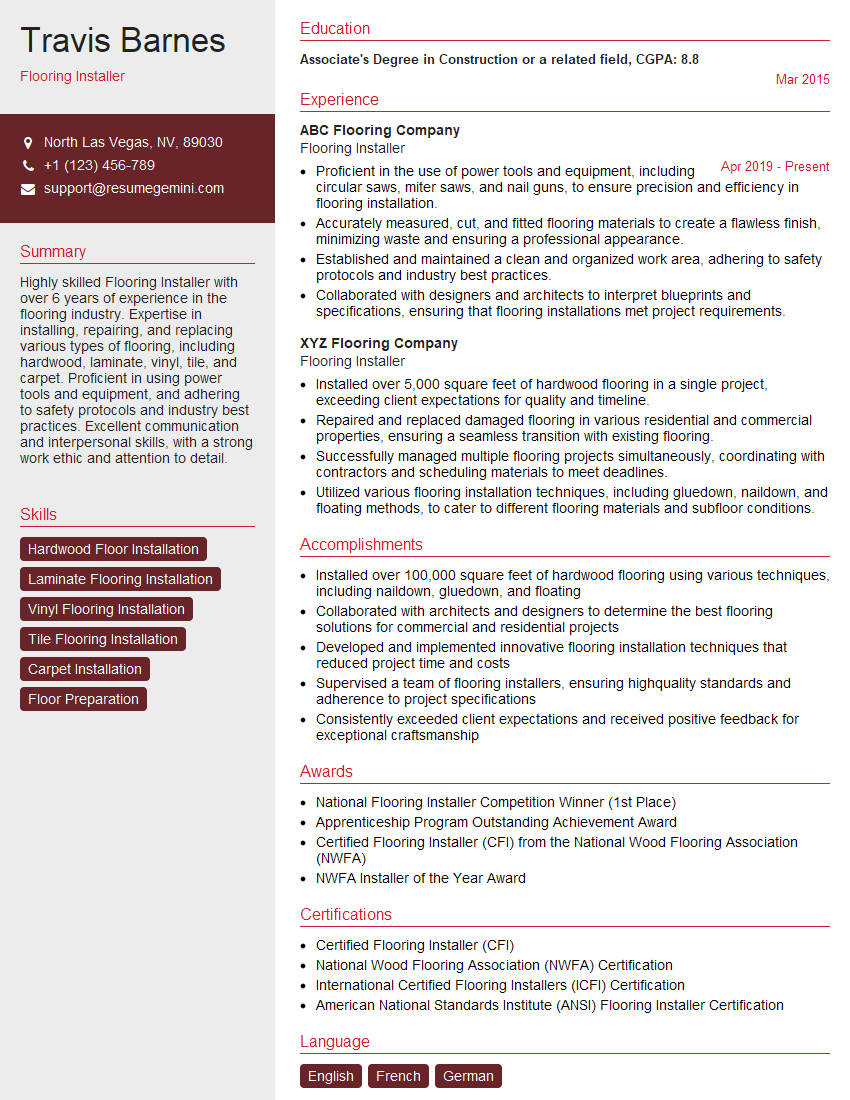
Mastering carpet and laminate flooring installation opens doors to a rewarding career with strong earning potential and opportunities for advancement. To maximize your job prospects, create a compelling and ATS-friendly resume that highlights your skills and experience. ResumeGemini is a trusted resource to help you build a professional resume that makes a lasting impression on potential employers. Examples of resumes tailored specifically to carpet and laminate flooring installation are available to guide you through the process. Invest time in crafting a strong resume – it’s your first impression on a future employer.

Explore more articles
Users Rating of Our Blogs
Share Your Experience
We value your feedback! Please rate our content and share your thoughts (optional).
What Readers Say About Our Blog
Very informative content, great job.
good