Unlock your full potential by mastering the most common Cartoon Animation Style interview questions. This blog offers a deep dive into the critical topics, ensuring you’re not only prepared to answer but to excel. With these insights, you’ll approach your interview with clarity and confidence.
Questions Asked in Cartoon Animation Style Interview
Q 1. Explain your experience with different animation techniques (e.g., traditional, 2D digital, 3D computer animation).
My experience spans across various animation techniques, each offering unique creative possibilities. Traditional animation, the cornerstone of classic cartoons, involves meticulously drawing each frame by hand. This painstaking process allows for incredible detail and a unique, hand-crafted feel, as seen in works like Disney’s early films. I’ve worked extensively with this method, understanding its nuances of timing, spacing, and squash and stretch.
2D digital animation offers a more efficient workflow, using software like Toon Boom Harmony to create and manipulate digital drawings. This approach maintains the charm of traditional 2D while significantly improving productivity and allowing for easier revisions. Think of modern shows like Adventure Time, a great example of the expressive possibilities of digital 2D.
Finally, 3D computer animation, using software such as Maya or Blender, allows for complex character modeling, realistic movement, and dynamic environments. While it deviates stylistically from the classic cartoon aesthetic, 3D techniques are increasingly used to create stylized cartoons, offering a blend of realism and cartoonish flair. I’ve used this to create more modern, dynamic cartoon projects, blending the best of both worlds.
Q 2. Describe your workflow for creating a cartoon character from concept to final animation.
Creating a cartoon character is a multi-stage process. It begins with concept art—sketches exploring different designs, personality traits, and overall aesthetic. Once the design is finalized, I move to modeling (in 2D or 3D, depending on the project). This involves creating a detailed representation of the character’s body, clothing, and features.
Next comes rigging (for 3D animation) or setting up the character’s structure in 2D software. This allows for fluid movement and posing. Then, the animation process begins, involving keyframing (defining the character’s pose at crucial points), in-betweens (filling in the gaps between keyframes for smooth motion), and finalizing the animation by adding details like shading, textures, and lip-sync. Post-production involves rendering, compositing, and adding sound effects and music.
For example, when I created the character ‘Zippy’ for a recent project, the concept phase involved numerous sketches exploring different animal combinations. The final design, a playful squirrel, was then meticulously modeled in Toon Boom Harmony, rigged, animated, and finally given a lively personality through detailed movements and expressions.
Q 3. What software are you proficient in (e.g., Toon Boom Harmony, After Effects, Maya, Blender)?
My software proficiency includes Toon Boom Harmony (my primary 2D animation software), After Effects (for compositing and visual effects), Maya (for 3D modeling and animation), and Blender (for additional 3D tasks). I’m also comfortable with Photoshop for concept art and texture creation. The specific software used depends heavily on the project’s style and requirements. For example, a traditional-style cartoon would primarily use Toon Boom Harmony, whereas a more modern, CGI-heavy cartoon would utilize Maya or Blender more extensively.
Q 4. How do you approach creating realistic movement in a cartoon character?
Creating realistic movement in a cartoon character requires understanding the principles of animation, even within a stylized context. While exaggeration and simplification are key to cartoon animation, believability in the character’s actions is crucial. This involves careful consideration of weight, mass, and momentum.
For instance, a heavy character will move slower and more deliberately than a light character. Understanding physics, even in an exaggerated form, helps maintain consistency and avoids jarring movements. I often study real-world footage of animals or humans to capture natural movements, then stylize these actions to fit the cartoon’s aesthetic. Squash and stretch, anticipation, and follow-through are fundamental principles that help create a sense of weight and realism, even in exaggerated situations.
Q 5. Explain your understanding of keyframes, in-betweens, and timing in animation.
Keyframes are the anchor points in animation, defining the character’s pose at crucial moments. In-betweens are the intermediate frames that bridge the gap between keyframes, creating smooth transitions. Timing determines the speed at which the character moves, influencing the overall feel and rhythm of the animation.
For example, a fast-paced comedic scene might have fewer frames between keyframes, resulting in quicker movements. A more dramatic or emotional scene would likely have more in-betweens, creating slower, more deliberate movements. Mastering these three elements is crucial to convey emotion, energy, and the intended message effectively. Incorrect timing can make an action feel unnatural or even comedic in a non-intended way. Proper timing is key to effective storytelling.
Q 6. Describe your experience working with storyboards and how they influence your animation process.
Storyboards are the visual blueprint for the animation, outlining the sequence of events and camera angles. They are invaluable for planning the animation process and ensuring a cohesive narrative. I collaborate closely with directors and story artists to refine storyboards, ensuring the animation faithfully reflects the intended story and emotion.
Storyboards help me visualize the pacing, character actions, and camera movements before I begin the actual animation. This prevents significant changes and re-work later on, saving time and resources. For example, if a storyboard scene requires a character to run quickly down a hill, the storyboard would indicate the speed and the character’s exaggerated poses, guiding the animation process.
Q 7. How do you handle feedback and revisions during the animation process?
Handling feedback and revisions is a crucial part of the animation process. I actively solicit feedback from directors, producers, and clients throughout the production pipeline. I encourage open communication and treat feedback as a collaborative process to enhance the final product.
I maintain detailed notes of the feedback received, including specific suggestions and revisions. I implement these changes systematically, always ensuring the revisions align with the overall artistic vision and technical feasibility. My process is iterative: I show progress regularly to allow for real-time adjustments, making the revision process more efficient and less disruptive.
Q 8. How do you ensure consistency in character design and animation across a project?
Maintaining consistency in character design and animation is crucial for a cohesive and professional-looking final product. Think of it like building with LEGOs – each brick needs to fit seamlessly with the others. We achieve this through several key methods:
- Style Guides: A comprehensive document outlining character proportions, color palettes, line weights, and even expressions. This becomes the bible for the entire team, ensuring everyone is on the same page.
- Reference Sheets: Detailed drawings of characters from multiple angles, including close-ups and action poses. This helps animators understand how the character moves and deforms realistically within the established style.
- Turnarounds: 360-degree views of characters which further solidify the character model and pose consistency.
- Regular Team Meetings & Reviews: Frequent check-ins allow for early detection of inconsistencies and enable quick adjustments to maintain uniformity.
- Using Template/Rigging Systems: Using consistent templates or rigs in 3D animation ensures that the character’s proportions and movement are uniform from scene to scene.
For example, on a recent project, we created a detailed style guide for a mischievous squirrel character. It specified everything from the exact shade of brown for his fur to the precise angle of his twitching nose. This made sure every animator, even if they started work on different scenes, maintained a consistent depiction.
Q 9. Explain your experience with rigging and weight painting (if applicable).
Rigging and weight painting are essential in 3D character animation. Think of rigging as creating a puppet’s skeleton – giving the character a framework of joints and bones that allows for movement. Weight painting then determines how the character’s skin (or mesh) reacts to the movement of that skeleton. I have extensive experience in both, primarily using Autodesk Maya and Blender.
In Maya, I’ve built complex rigs for characters ranging from simple bipeds to creatures with multiple limbs and complex facial expressions. This involved creating custom control systems to allow for intuitive and efficient animation. I’ve also had to troubleshoot various issues, like clipping or deformation artifacts, using techniques such as skinning weights adjustments and secondary animation techniques.
Weight painting, which is crucial for realistic deformation, was a critical part of this process. For instance, on a project involving a stretchy, rubbery character, I had to carefully paint weights to ensure that the skin deformed naturally when the character stretched or compressed. Improper weight painting would result in unnatural bunching or stretching, ruining the illusion of life.
Q 10. Describe your experience with compositing and visual effects in animation.
Compositing and visual effects (VFX) are the finishing touches that bring cartoon animation to life. Compositing is essentially layering different elements together – animation layers, background elements, and special effects – to create a complete image. VFX, in this context, enhances the animation with special effects such as explosions, magic, or weather effects.
My experience includes using compositing software like After Effects and Nuke. I’ve worked on projects where I’ve added lens flares to create a more cinematic feel, created atmospheric effects like fog or rain to build depth, and also rotoscoped characters and objects for complex composites. For instance, I composited a scene where a character was jumping through a portal; using different layers, I seamlessly integrated the animated character with a separately rendered portal effect. This ensured visual continuity and added to the magical quality of the scene.
Q 11. How do you manage time effectively to meet deadlines on animation projects?
Meeting deadlines in animation requires meticulous planning and efficient workflow management. I utilize several strategies:
- Detailed Shot Breakdown: Analyzing the project and dividing it into manageable tasks with clear deadlines for each. This ensures a structured approach and easy tracking of progress.
- Prioritization: Focusing on crucial scenes and characters first. This helps avoid getting bogged down in minor details while still adhering to overall timelines.
- Timeboxing: Allocating a specific timeframe for each task, preventing work from spilling over into other tasks.
- Regular Progress Reviews: Consistent monitoring of the schedule through daily/weekly updates and adjustments as needed. This helps detect and tackle potential delays early on.
- Collaboration & Communication: Effective communication with the team is crucial. Openly discussing challenges and adjusting schedules collectively helps ensure everything remains on track.
For example, I once used a Kanban board to manage a large-scale project. This visual representation helped track progress, identify bottlenecks, and prioritize tasks effectively, contributing to a seamless on-time delivery.
Q 12. What is your approach to problem-solving when faced with technical challenges during animation?
Problem-solving is a daily occurrence in animation. My approach is systematic and involves:
- Identifying the Root Cause: Instead of tackling symptoms, I meticulously investigate the core of the problem. This is often achieved through trial and error alongside careful testing.
- Research and Experimentation: Consulting online resources, forums, or colleagues, and experimenting with different solutions until I find the right fix.
- Breaking Down Complex Issues: Dividing large problems into smaller, more manageable tasks allows for easier resolution and prevents feeling overwhelmed.
- Seeking External Help: When necessary, I don’t hesitate to reach out to experienced colleagues or mentors for advice and support. This collaborative approach often proves effective.
- Documentation: Thoroughly documenting the problem, the solution, and the lessons learned for future reference.
For instance, I once encountered a particularly challenging rigging issue in Maya. By systematically investigating the problem, I discovered a conflict in the hierarchy of the character’s bones. After carefully reconstructing that part of the rig, the issue was resolved.
Q 13. How do you stay up-to-date with the latest trends and technologies in cartoon animation?
Staying current in the dynamic field of cartoon animation is essential. I utilize several strategies:
- Following Industry Blogs and Websites: Regularly reading articles and news from reputable sources about advancements in animation software and emerging trends.
- Attending Conferences and Workshops: Participating in industry events provides opportunities for networking and learning about cutting-edge techniques and technologies directly from experts.
- Online Courses and Tutorials: Leveraging numerous online platforms that offer courses and tutorials on various aspects of animation, from software mastery to creative skill enhancement.
- Experimentation and Practice: Continuously experimenting with new software and techniques is crucial for keeping my skills sharp and adapting to the latest technologies.
- Networking with Peers: Engaging with other animators through online communities and professional networks promotes knowledge sharing and collaborative learning.
For instance, I recently took an online course on using a new procedural animation software, which has drastically improved my workflow and efficiency in creating complex animations.
Q 14. Describe your experience with different animation styles (e.g., cel animation, limited animation, motion graphics).
My experience encompasses a range of animation styles:
- Cel Animation: I’ve worked on projects utilizing traditional cel animation techniques, particularly in the digital realm where software mimics the process of drawing and inking on cels. This includes understanding the importance of line weight and color variation to create depth and character.
- Limited Animation: I understand the principles of limited animation, where movement is simplified to focus on key poses and movements. This style is extremely efficient and is often employed in comedic animations or to achieve a specific stylistic effect.
- Motion Graphics: I’m proficient in creating motion graphics for titles, logos, and explainer videos. This often involves using software like After Effects to bring 2D or 3D graphics to life through animation and effects.
- 3D Animation: I’m experienced in using 3D animation software such as Maya and Blender to create realistic and stylized 3D characters and environments.
Understanding these different styles allows me to adapt my approach to suit the needs of each project and to leverage the strengths of each technique to achieve the desired visual impact.
Q 15. How do you create believable expressions and emotions in your cartoon characters?
Creating believable expressions in cartoon animation relies on understanding human anatomy and emotion, even if exaggerated. We don’t copy reality, but we build upon its foundation. Think of it like caricature – we emphasize key features to amplify feelings.
- Exaggeration of Features: For anger, we might make eyebrows sharper, eyes narrowed, and mouth a tense line. Happiness might involve wide, round eyes and a wide, upward-curving mouth.
- Shape Language: The shape of the character’s entire body plays a huge role. A slumped posture conveys sadness, while a straightened, upright pose might indicate confidence or anger.
- Subtlety in Movement: Tiny shifts in the eyes, a slight twitch of the mouth, or a subtle head tilt can add layers of emotional complexity. It’s often the small details that make the difference.
- Use of Light and Shadow: Strategic lighting can emphasize the depth of an expression. A shadowed eye socket can enhance a look of sadness, whereas bright highlights can brighten a happy expression.
For example, in a scene depicting sadness, I might exaggerate the droop of the character’s eyelids, elongate their face slightly, and create a subtle shadow under their eyes. I might even add a single tear to amplify the emotion, keeping the overall style consistent with the show.
Career Expert Tips:
- Ace those interviews! Prepare effectively by reviewing the Top 50 Most Common Interview Questions on ResumeGemini.
- Navigate your job search with confidence! Explore a wide range of Career Tips on ResumeGemini. Learn about common challenges and recommendations to overcome them.
- Craft the perfect resume! Master the Art of Resume Writing with ResumeGemini’s guide. Showcase your unique qualifications and achievements effectively.
- Don’t miss out on holiday savings! Build your dream resume with ResumeGemini’s ATS optimized templates.
Q 16. Explain your understanding of the principles of animation (e.g., squash and stretch, anticipation, follow-through).
The twelve principles of animation are fundamental to creating believable and engaging movement. They provide a framework for bringing characters to life, making them feel weighty, responsive, and dynamic.
- Squash and Stretch: This principle gives objects weight and volume by distorting their shape during motion. A ball bouncing should squash on impact and stretch as it rises.
- Anticipation: A character needs to prepare for an action. Before a jump, they might crouch; before a throw, they might wind up their arm. This prepares the viewer for the main action.
- Staging: Clarity is key. The pose and action should clearly convey the character’s emotion or intent to the audience.
- Straight Ahead Action and Pose to Pose: Two different approaches to animating. Straight ahead draws each frame in sequence, while pose to pose focuses on key poses and then fills in the in-betweens.
- Follow Through and Overlapping Action: Parts of the character continue moving after the main action stops. Hair, clothing, and limbs might move independently, creating a more natural effect.
- Slow In and Slow Out: Movement starts and ends slowly, mimicking real-world physics. Think of a pendulum – it slows down at the end of its swing.
- Arcs: Most natural movements follow curved paths, not straight lines. This adds grace and fluidity.
- Secondary Action: Small, supporting actions that enhance the main action. A character walking might swing their arms.
- Timing: The number of frames used to depict an action controls the speed and weight. More frames = slower movement.
- Exaggeration: Enhancing the natural movement for better effect. This is crucial in cartoons.
- Solid Drawing: Understanding form, weight, volume, and anatomy, even in stylized characters.
- Appeal: The overall design and animation should be engaging and attractive to the viewer.
Q 17. What is your experience with creating lip-sync animation?
Lip-sync animation is a challenging yet rewarding aspect of cartoon animation. It requires precise timing and a keen understanding of phonetics. I’ve worked extensively on lip-sync, using both traditional and digital methods.
- Traditional Methods: These involve carefully studying the audio and drawing individual frames for each mouth shape, ensuring accurate synchronization.
- Digital Methods: Software like Toon Boom Harmony or Autodesk Maya offer tools that automate some aspects of lip-sync, but meticulous attention to detail is still essential. These tools often employ automatic lip-sync features, but require manual adjustments for optimal results and character personality.
- Reference Material: Recording yourself saying the dialogue and using that as reference can be invaluable in ensuring accuracy and natural-looking lip movements. Paying attention to how the mouth and jaw move for each phoneme is crucial.
One project involved a character speaking a complex dialect. I had to work closely with a dialect coach and meticulously study reference videos to ensure authenticity and clarity. The final result was a nuanced and believable performance.
Q 18. How do you collaborate with other team members (e.g., animators, designers, directors)?
Collaboration is essential in animation. I believe in open communication and a shared vision.
- Animators: Regular feedback sessions are key to maintaining consistency in style and performance. We’ll share work-in-progress, review each other’s animation, and suggest improvements.
- Designers: Close collaboration with the designers ensures that the animation complements the character design and overall style guide. We discuss movements that work best with the character’s physical features and limitations.
- Directors: The director provides the overall vision and direction, and I work closely with them to ensure that my work aligns with the overall narrative and artistic intent. We discuss storyboarding, key poses, and overall performance notes.
For example, on one project, the director wanted a specific comedic timing for a particular scene. I worked with the other animators to adjust the pacing and exaggerate the character’s movements to achieve the desired comedic effect.
Q 19. How do you handle constructive criticism on your work?
Constructive criticism is invaluable for growth. I approach it as an opportunity to learn and improve.
- Active Listening: I listen carefully to the feedback, without getting defensive. I try to understand the points being made and their context.
- Asking Clarifying Questions: If something is unclear, I ask for clarification to ensure I fully understand the suggestions.
- Applying Feedback: I take the feedback seriously and integrate it into my workflow. If I disagree, I’ll respectfully explain my reasoning.
- Self-Reflection: After receiving feedback, I take some time to reflect on my work and see what I could do differently next time.
I remember one time a director pointed out that the pacing in a scene was too fast. I reviewed the animation and realized he was right. By slowing down certain movements and adding more anticipation, I improved the scene’s impact significantly.
Q 20. Describe your experience with different types of cameras and camera movements in animation.
Camera work is crucial in animation, defining perspective, emotion, and storytelling. My experience spans a variety of techniques.
- Camera Angles: High angles make characters seem vulnerable, low angles powerful. Side angles can create suspense or intrigue.
- Camera Movement: Panning, tilting, zooming, and dollying create dynamic shots and visual interest. Dolly zooms (simultaneous zoom and dolly) can create a sense of movement and speed.
- Camera Focus: Shallow depth of field keeps the focus on a single element, creating a dramatic effect. A wide depth of field keeps everything in focus.
- Shot Composition: Understanding the rule of thirds and other compositional techniques makes for visually engaging scenes. Leading lines and visual balance enhance the aesthetics.
In one project, we used a slow, deliberate zoom to highlight a character’s emotional state. This technique allowed us to subtly emphasize their internal conflict without any dialogue.
Q 21. Explain your understanding of color theory and how it impacts animation.
Color theory is fundamental to animation. It helps establish mood, atmosphere, and character.
- Color Temperature: Warm colors (reds, oranges, yellows) suggest warmth, happiness, or danger, while cool colors (blues, greens, purples) convey calmness, sadness, or mystery.
- Color Harmony: Using colors that complement each other (analogous, complementary, triadic) creates a visually pleasing and harmonious aesthetic.
- Color Saturation: Highly saturated colors are bold and vibrant; desaturated colors are muted and subdued. This can be used to highlight or downplay certain aspects of the scene.
- Color Contrast: Strong contrast between colors draws attention and creates visual interest. This can be used to highlight important elements or emphasize emotional shifts.
For example, in a scene depicting a scary monster, I might use deep, saturated reds and blacks to create a menacing atmosphere, while a peaceful forest scene would use softer, muted greens and blues. The use of color palettes consistently throughout the project helps unify the look and feel.
Q 22. How do you create convincing weight and mass in your animated characters?
Creating convincing weight and mass in cartoon animation is all about understanding physics and exaggerating it for comedic or dramatic effect. It’s not about realism, but about believability within the cartoon’s established style.
- Squash and Stretch: This classic animation principle is key. When a character jumps, their body should squash on impact, then stretch as they rebound. This visual cue instantly communicates weight and impact. Think of a bouncing ball – it squashes before it stretches.
- Secondary Action: Adding secondary actions like jiggling body parts or swaying clothing helps to sell the weight. A heavy character will have more pronounced jiggling than a light one. For example, a character’s large belly might jiggle more noticeably as they walk.
- Follow Through and Overlapping Action: These principles extend the effect of motion. A character’s limbs might continue moving slightly after they’ve stopped, showing inertia and weight. For example, a heavy character’s coat might continue swinging even after they come to a stop.
- Timing: The speed of movement directly impacts the perceived weight. A heavy character will move slower than a lighter one. Careful timing makes this clear. Consider the difference between a feather falling and a brick.
For instance, in a scene where a character is carrying a heavy sack, you’d exaggerate the slump of their shoulders, the way their legs bend under the weight, and the slowness of their movements. By applying these principles effectively, even a simple cartoon character can feel weighty and substantial.
Q 23. How do you design and use animation cycles?
Animation cycles are repetitive sequences of animation, like a character walking or breathing. They’re fundamental for efficiency and creating seamless loops.
- Design Phase: The design stage involves considering the character’s anatomy, style, and personality. A walk cycle for a clumsy character would look different from one for a graceful character. Key poses and in-betweens are planned.
- Key Poses: These are the most important frames in the cycle – the extremes of the motion. For a walk cycle, these might be the left foot forward, both feet together, and the right foot forward.
- In-Betweens: These frames fill the gaps between key poses, creating a smooth transition. Software can help automate this, but manual adjustments often ensure better character and realism.
- Looping: The final frames need to seamlessly loop back to the first, creating a continuous and believable animation.
- Variations: Once a base cycle is established, variations can be introduced for different speeds, styles, or moods. A faster walk might have more frames and less time spent on each pose.
For example, a simple walk cycle for a cartoon dog might have 8-12 frames. By carefully designing these frames and ensuring smooth transitions, you achieve a natural and believable walk that can be used repeatedly throughout the animation.
Q 24. What experience do you have with motion capture (mocap) and its integration into animation?
Motion capture (mocap) is a valuable tool, but its integration into cartoon animation requires a nuanced approach. It’s not simply about directly transferring the data.
My experience with mocap involves using it as a reference, not a replacement for skilled animation. I’ve used mocap data to capture realistic timing and movement in a character’s actions, particularly for complex actions like running, fighting, or interacting with objects. However, I always refine and stylize the mocap data to align with the cartoon’s specific style.
For example, I might use mocap data for the timing of a character’s run, but then exaggerate the arm movements, squash and stretch the body, and add secondary actions to match the cartoon aesthetic. The goal is to leverage the realism of mocap for a solid foundation but retain the unique characteristics of the cartoon style. This ensures that the final animation feels both believable and distinctly cartoonish. I’m proficient in using software like Maya and MotionBuilder to process and integrate mocap data.
Q 25. What are your strengths and weaknesses as an animator?
My greatest strengths lie in my understanding of traditional animation principles and my ability to create expressive characters. I have a strong grasp of timing, spacing, and weight, and I excel at crafting believable, engaging performances, even with exaggerated cartoon styles.
One area I’m always working to improve is my efficiency in using advanced animation software. While proficient, I’m always exploring new techniques and workflows to streamline my process and manage larger projects more effectively. I’m also keen to develop my skills in rigging complex characters, aiming for greater flexibility and control in my animation workflow.
Q 26. What are your salary expectations?
My salary expectations are in the range of $70,000 to $90,000 per year, depending on the benefits package and the specific responsibilities of the role. I’m confident that my skills and experience justify this range.
Q 27. Why are you interested in this specific position?
I’m interested in this specific position because of [Company Name]’s reputation for innovative and high-quality cartoon animation. I’ve been a long-time admirer of your work on [mention specific project or show], and I’m particularly drawn to your commitment to [mention specific company value, e.g., character-driven storytelling, creative experimentation]. The opportunity to contribute my skills to a team of such talented individuals is incredibly exciting.
Q 28. Where do you see yourself in five years?
In five years, I see myself as a highly skilled and respected senior animator at [Company Name], potentially leading a small team and mentoring junior animators. I aspire to significantly contribute to the studio’s creative vision and to work on increasingly challenging and impactful animation projects. I also aim to continue refining my skill set and exploring new technologies in the field.
Key Topics to Learn for Your Cartoon Animation Style Interview
- Character Design Principles: Understanding form, silhouette, exaggeration, and appeal in cartoon character design. Practical application: Analyzing existing cartoon styles and creating your own character sketches.
- Animation Principles (12 Principles): Mastering squash and stretch, anticipation, staging, follow through and overlapping action, etc. Practical application: Creating short animation tests showcasing your understanding of these principles.
- Software Proficiency: Demonstrating expertise in industry-standard software like Toon Boom Harmony, Adobe Animate, or similar. Practical application: Preparing a portfolio showcasing your skills in chosen software.
- Storyboarding and Layout: Understanding the process of translating a script into visual storytelling through storyboards and layouts. Practical application: Creating storyboards for a short scene.
- Acting and Performance: Bringing characters to life through expressive animation and timing. Practical application: Analyzing the acting in existing cartoon animations.
- Workflow and Pipeline: Understanding the different stages of production in a cartoon animation pipeline. Practical application: Describing your experience or understanding of a typical workflow.
- Style and Aesthetics: Demonstrating knowledge of various cartoon animation styles (e.g., Looney Tunes, Disney, Anime) and the ability to adapt your style. Practical application: Creating artwork demonstrating your understanding of different styles.
Next Steps
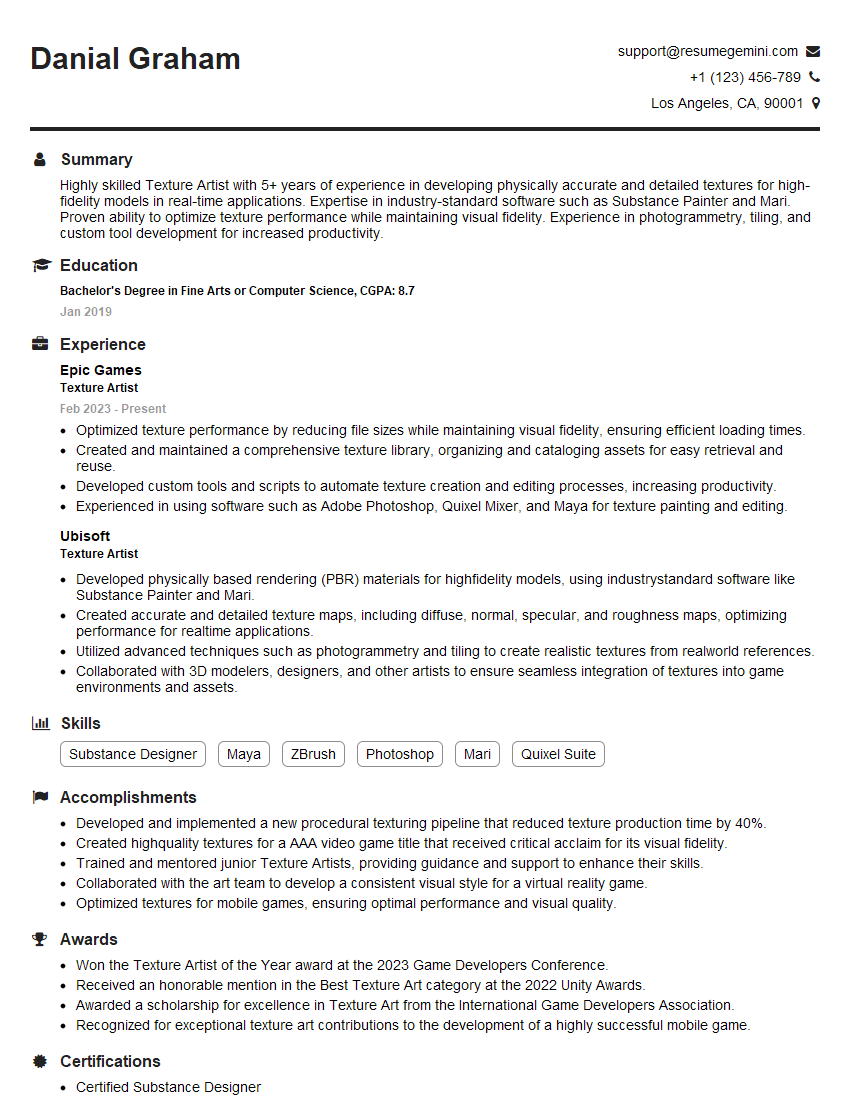
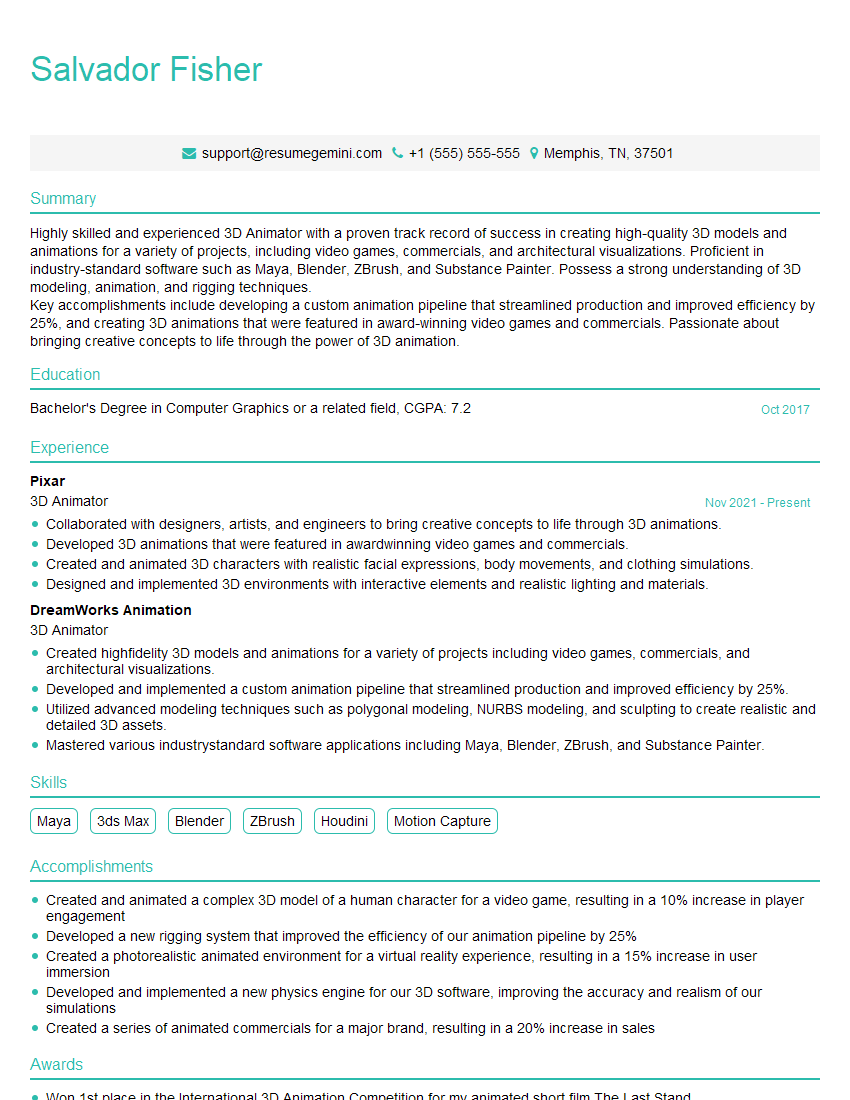
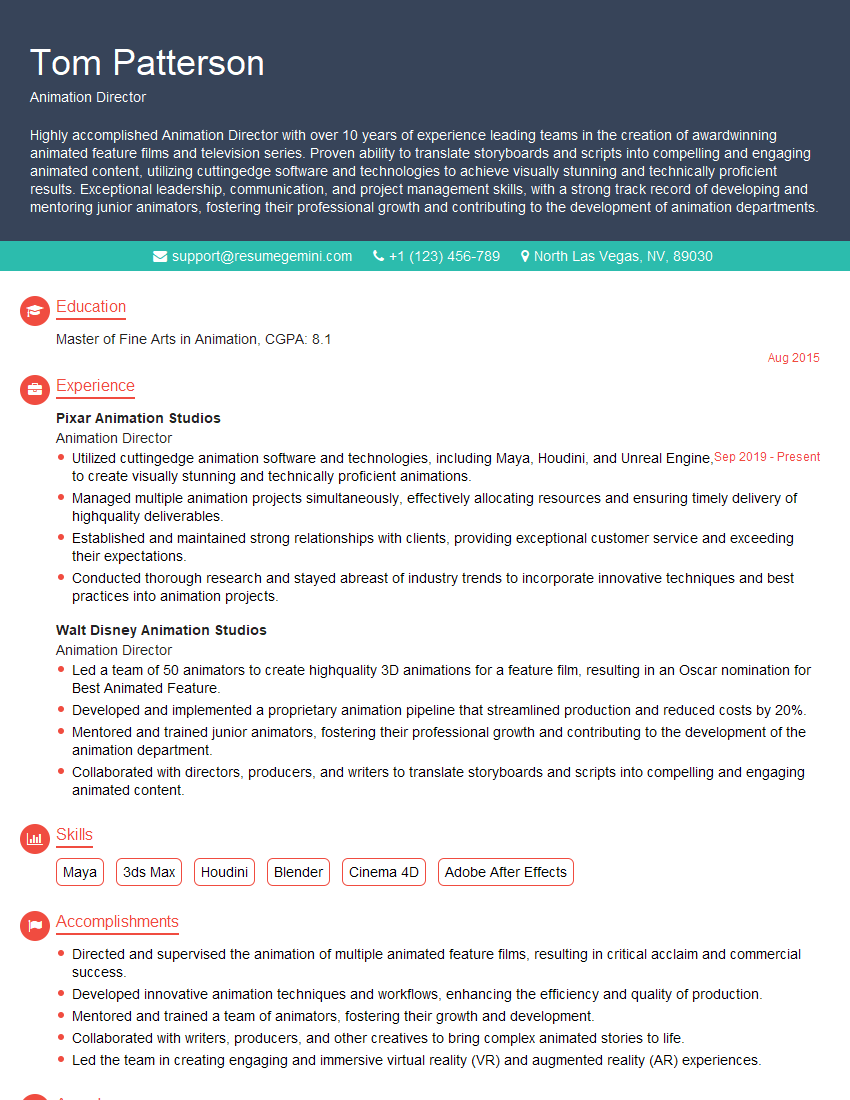
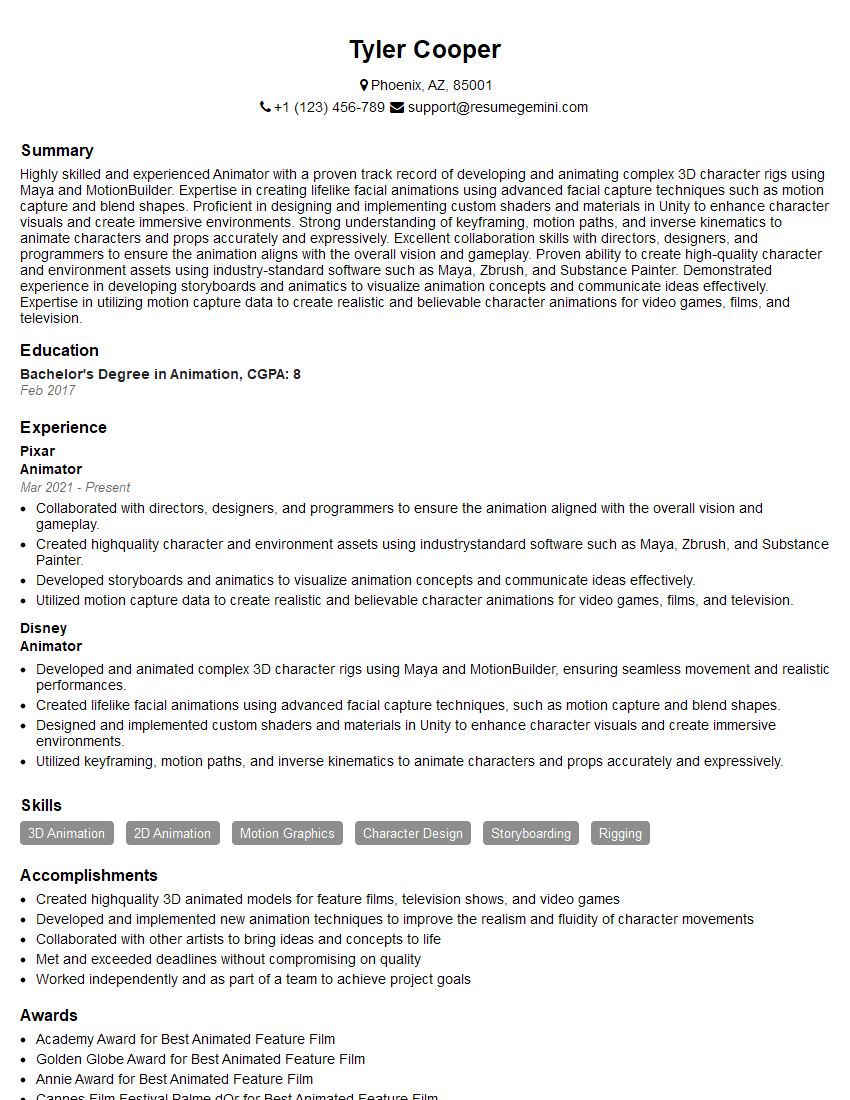
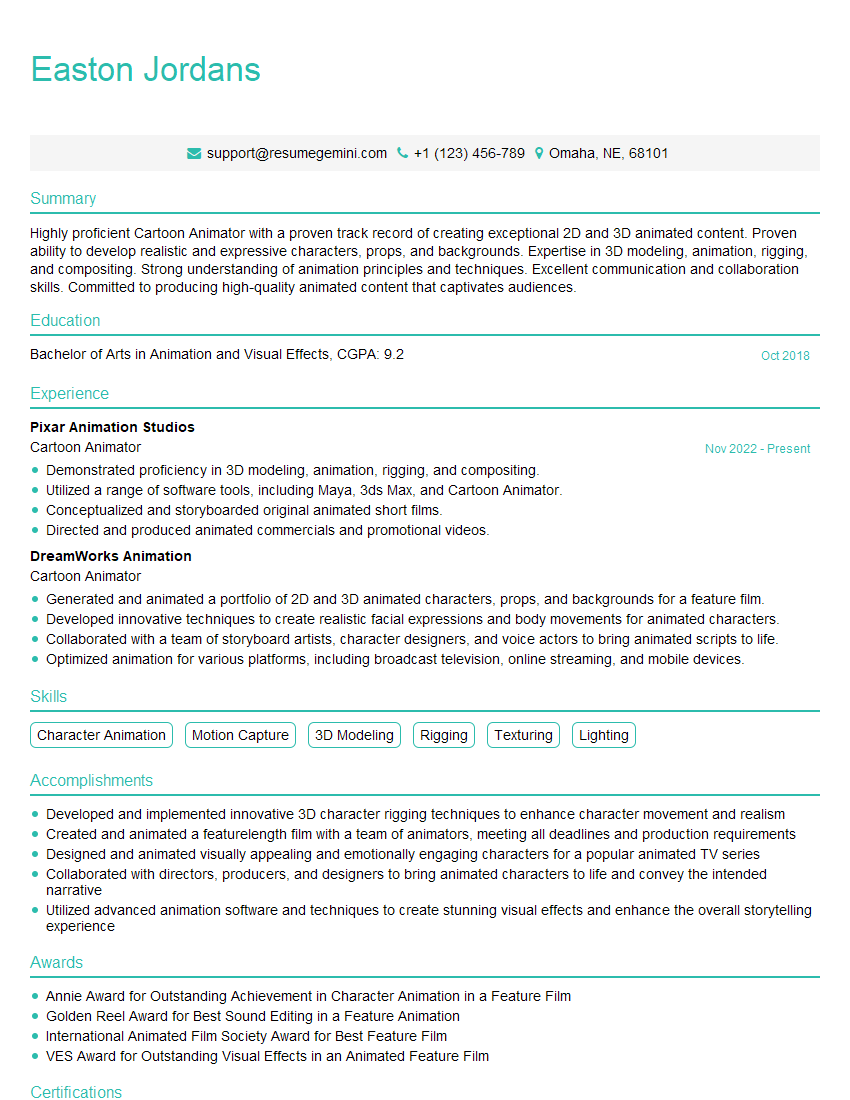
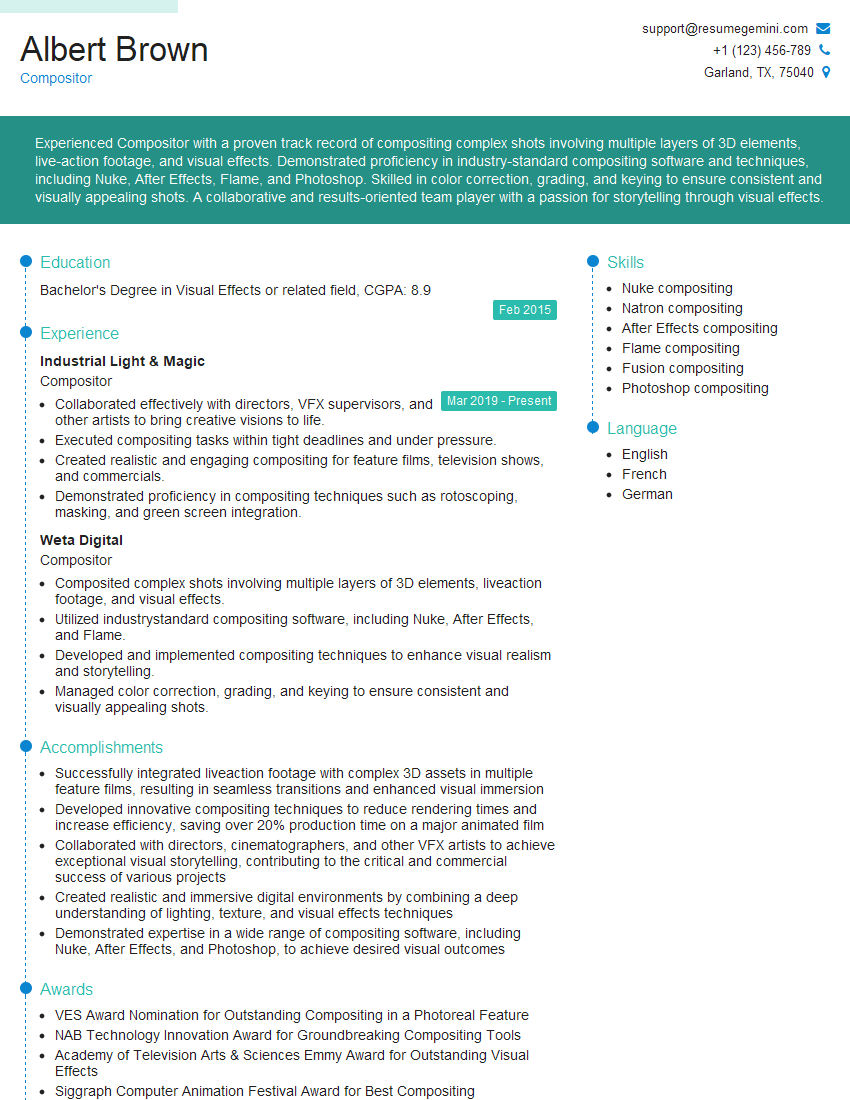
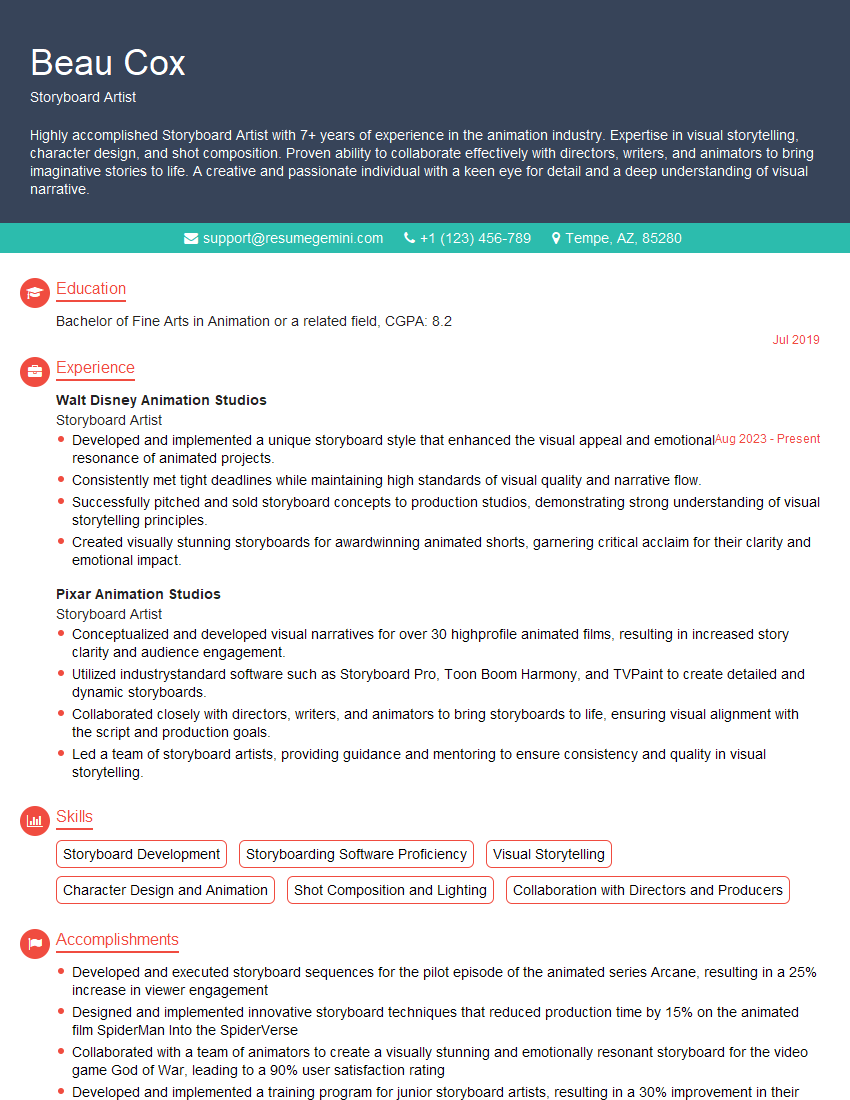
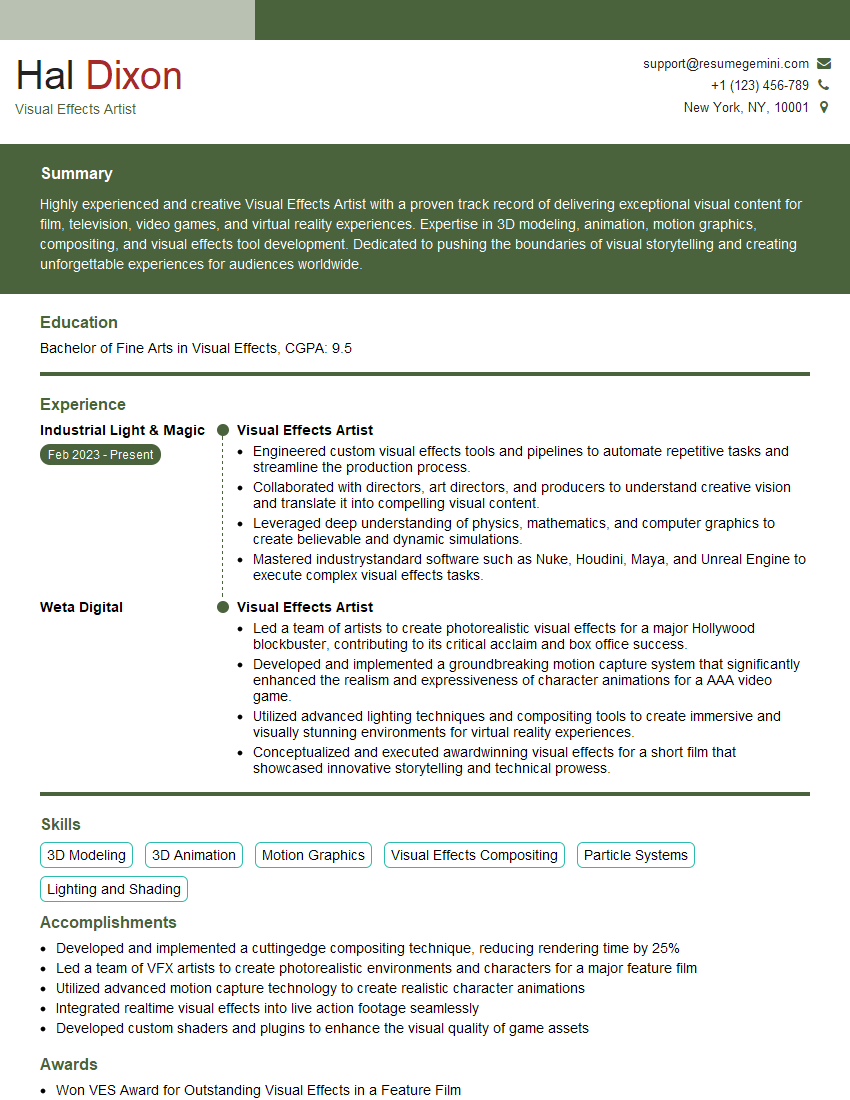
Mastering Cartoon Animation Style opens doors to exciting opportunities in the vibrant animation industry. A strong portfolio is crucial, but a well-crafted resume is your first impression. An ATS-friendly resume significantly increases your chances of getting noticed by recruiters. To build a truly standout resume that highlights your skills and experience, leverage the power of ResumeGemini. ResumeGemini provides a streamlined process for creating professional resumes, and we offer examples of resumes tailored specifically for the Cartoon Animation Style field to help you get started.
Explore more articles
Users Rating of Our Blogs
Share Your Experience
We value your feedback! Please rate our content and share your thoughts (optional).
What Readers Say About Our Blog
Very informative content, great job.
good