The right preparation can turn an interview into an opportunity to showcase your expertise. This guide to Chemical Characterization Techniques interview questions is your ultimate resource, providing key insights and tips to help you ace your responses and stand out as a top candidate.
Questions Asked in Chemical Characterization Techniques Interview
Q 1. Explain the principles of Gas Chromatography-Mass Spectrometry (GC-MS).
Gas Chromatography-Mass Spectrometry (GC-MS) is a powerful analytical technique used to identify and quantify volatile and semi-volatile organic compounds in a sample. It combines the separating power of gas chromatography (GC) with the identification capabilities of mass spectrometry (MS).
In GC, the sample is vaporized and injected into a column packed with a stationary phase. Different compounds interact differently with the stationary phase, leading to their separation as they travel through the column at varying speeds. Think of it like a race: different runners (compounds) have different speeds based on their interactions with the track (stationary phase). The separated compounds then exit the column and enter the mass spectrometer.
The mass spectrometer ionizes the separated molecules, fragments them, and then measures the mass-to-charge ratio (m/z) of each fragment. This produces a unique mass spectrum for each compound, acting like a fingerprint that allows for identification. By comparing the obtained mass spectrum to a database of known compounds, we can determine the identity of the unknown substances in the sample. The area under the peak in the chromatogram is proportional to the concentration of the compound, allowing for quantification.
Example: GC-MS is widely used in environmental monitoring to detect pollutants in water or air samples, in forensic science to analyze evidence, and in the food industry to analyze flavors and contaminants.
Q 2. Describe the different types of chromatography and their applications.
Chromatography is a family of separation techniques used to separate the components of a mixture based on their differential partitioning between a stationary phase and a mobile phase. There are various types, categorized primarily by the nature of the stationary and mobile phases.
- Gas Chromatography (GC): Uses a gaseous mobile phase and a liquid or solid stationary phase. Ideal for volatile compounds.
- High-Performance Liquid Chromatography (HPLC): Uses a liquid mobile phase and a solid stationary phase. Suitable for non-volatile and thermally labile compounds.
- Thin-Layer Chromatography (TLC): A simple and inexpensive technique using a thin layer of adsorbent material (stationary phase) on a plate, with a liquid mobile phase. Used for quick separations and preliminary analysis.
- Ion Chromatography (IC): Specifically designed for separating ions based on their charge and size. Often used for analyzing ionic compounds in environmental or biological samples.
- Size-Exclusion Chromatography (SEC): Separates molecules based on their size. Larger molecules elute faster, while smaller molecules get trapped longer in the pores of the stationary phase.
Applications: These techniques find applications in diverse fields, including pharmaceutical analysis (HPLC, GC), environmental monitoring (GC-MS, IC), food analysis (HPLC, GC), and many more. The choice of chromatography type depends on the properties of the analytes and the required separation resolution.
Q 3. What are the limitations of High-Performance Liquid Chromatography (HPLC)?
While HPLC is a powerful technique, it has some limitations:
- Sensitivity: Compared to some other methods, HPLC can have lower sensitivity for some analytes.
- Sample preparation: Often requires extensive sample preparation steps, which can be time-consuming and prone to error. Samples frequently need to be filtered and dissolved in a suitable solvent.
- Column degradation: The stationary phase in HPLC columns can degrade over time, affecting separation efficiency and requiring column replacement.
- Cost: HPLC instruments and maintenance can be expensive.
- Co-elution: Some compounds may have similar retention times and co-elute, making it challenging to separate them completely. This can often require method optimization, different stationary phases, or using coupled techniques such as HPLC-MS.
For example, while analyzing complex biological samples like blood plasma, the presence of numerous interfering components can reduce sensitivity and hinder the separation of target molecules, potentially leading to inaccurate results.
Q 4. How does Nuclear Magnetic Resonance (NMR) spectroscopy work?
Nuclear Magnetic Resonance (NMR) spectroscopy exploits the magnetic properties of atomic nuclei to determine the structure and dynamics of molecules. Many nuclei possess a property called ‘spin,’ which gives them a tiny magnetic moment. When placed in a strong external magnetic field, these nuclei can absorb radiofrequency (RF) energy at specific frequencies, depending on their chemical environment. This absorption is detected, generating an NMR spectrum.
The process involves placing the sample in a powerful magnet. The magnetic field aligns the nuclear spins. A radiofrequency pulse is then applied, perturbing the equilibrium. As the nuclei relax back to their equilibrium state, they emit RF signals at characteristic frequencies. This frequency, the chemical shift, depends on the electron density surrounding the nucleus and hence on the molecular structure. The intensity of the signal is proportional to the number of nuclei.
Think of it like this: Imagine different musical instruments in an orchestra. Each instrument produces a unique sound (frequency) at a specific time (chemical shift). NMR allows us to identify these instruments (atoms) and their arrangement (molecular structure) within the orchestra (molecule).
Q 5. Explain the difference between ¹H NMR and ¹³C NMR.
Both ¹H NMR and ¹³C NMR are types of NMR spectroscopy, differing primarily in the nucleus they observe:
- ¹H NMR (Proton NMR): Observes the ¹H (proton) nuclei. It’s highly sensitive due to the high natural abundance of ¹H. ¹H NMR provides information on the number of protons, their chemical environment, and their interactions with neighboring protons (spin-spin coupling). This is extremely useful for determining the connectivity of atoms in a molecule.
- ¹³C NMR (Carbon-13 NMR): Observes the ¹³C nuclei. It’s less sensitive than ¹H NMR due to the low natural abundance of ¹³C (about 1%). ¹³C NMR is particularly useful for determining the carbon skeleton of a molecule and the different types of carbon atoms present (e.g., alkyl, aryl, carbonyl).
In essence, ¹H NMR provides detailed information about proton environments, while ¹³C NMR provides a skeletal overview of the carbon atoms within the molecule. Often, both techniques are used complementarily to provide a complete structural characterization.
Q 6. Describe the principles of Infrared (IR) spectroscopy.
Infrared (IR) spectroscopy is based on the absorption of infrared radiation by molecules. Molecules possess different vibrational modes (stretching and bending of bonds). When IR radiation of a specific frequency matches the energy required for a particular vibrational mode, the molecule absorbs the radiation. The resulting spectrum shows the absorption intensity as a function of the frequency (or wavenumber) of the IR radiation.
Different functional groups absorb IR radiation at characteristic frequencies, resulting in specific peaks in the IR spectrum. These peaks act as fingerprints, allowing for the identification of functional groups present in the molecule. For example, a strong absorption around 1700 cm⁻¹ usually indicates the presence of a carbonyl group (C=O).
Example: IR spectroscopy is used to identify functional groups in polymers, confirm the presence of specific bonds in organic molecules, and monitor reaction progress by observing the appearance or disappearance of characteristic peaks.
Q 7. How is UV-Vis spectroscopy used to characterize molecules?
UV-Vis spectroscopy measures the absorbance or transmission of ultraviolet (UV) and visible (Vis) light by a sample. Molecules absorb UV-Vis light when the energy of the light matches the energy difference between electronic energy levels within the molecule. This absorption is specific to the molecule’s electronic structure and the presence of chromophores (functional groups that absorb in the UV-Vis region).
The resulting UV-Vis spectrum shows the absorbance (or transmittance) as a function of wavelength. The wavelength of maximum absorption (λmax) and the intensity of absorption are characteristic of the molecule. This information can be used to identify the molecule, determine its concentration (using Beer-Lambert law), and study its interactions with other molecules.
Example: UV-Vis spectroscopy is routinely used in quantitative analysis to determine the concentration of a compound in solution, in studying the kinetics of chemical reactions, and in characterizing biological molecules such as proteins and nucleic acids.
Q 8. What is X-ray diffraction (XRD) and how is it used in materials characterization?
X-ray diffraction (XRD) is a powerful technique used to determine the crystallographic structure of materials. It works by directing a beam of X-rays onto a crystalline sample. The X-rays interact with the electrons in the sample, causing them to scatter. The scattered X-rays interfere with each other, creating a diffraction pattern. This pattern is a unique fingerprint of the material’s crystal structure – the arrangement of atoms within the crystal lattice. By analyzing the angles and intensities of the diffracted beams, we can determine the unit cell dimensions, the arrangement of atoms within the unit cell, and even identify the phases present in a mixture.
For example, XRD is routinely used in the pharmaceutical industry to verify the crystal structure of active pharmaceutical ingredients (APIs). Slight changes in crystal structure can significantly impact drug solubility and bioavailability. In materials science, XRD is essential for characterizing the crystallinity of metals, ceramics, and polymers; it helps determine grain size, preferred orientation, and phase transitions.
Q 9. Explain the principles of Thermogravimetric Analysis (TGA).
Thermogravimetric Analysis (TGA) measures the change in mass of a sample as a function of temperature or time under a controlled atmosphere. Imagine placing a sample in a small pan within a precisely controlled oven. As the temperature increases (or decreases), the TGA monitors any weight loss or gain. This weight change is typically plotted against temperature, generating a thermogram. Weight loss can indicate processes like dehydration, decomposition, or oxidation. Weight gain can signify oxidation or absorption of gases.
For instance, TGA is often used to determine the moisture content in a sample. The initial weight loss at relatively low temperatures would indicate water evaporation. In polymer chemistry, TGA helps in assessing the thermal stability of polymers and identifying degradation products. It’s also used in the analysis of inorganic materials like metal hydrides to find their decomposition temperatures and the amount of gas they release.
Q 10. What is Differential Scanning Calorimetry (DSC) and what information does it provide?
Differential Scanning Calorimetry (DSC) measures the heat flow associated with transitions in a material as a function of temperature. It does this by comparing the heat flow into the sample with the heat flow into an inert reference. The difference in heat flow is plotted as a function of temperature, providing a thermogram that shows endothermic (heat absorbed) and exothermic (heat released) events. These events can correspond to glass transitions, melting points, crystallization, and chemical reactions.
Think of it like this: imagine heating two identical pans, one with your sample and one empty. DSC measures the difference in energy needed to keep both at the same temperature. A sharp peak indicates a transition like melting, while a gradual change might indicate a glass transition. DSC is invaluable in polymer science for characterizing the glass transition temperature (Tg), melting temperature (Tm), and crystallization behavior of polymers. In pharmaceuticals, it’s used to assess the purity and stability of drugs.
Q 11. Describe the applications of Inductively Coupled Plasma Mass Spectrometry (ICP-MS).
Inductively Coupled Plasma Mass Spectrometry (ICP-MS) is a highly sensitive technique used for elemental analysis. It ionizes a sample using an inductively coupled plasma (ICP), which is a high-temperature plasma generated by radio-frequency energy. These ions are then passed through a mass spectrometer, which separates them based on their mass-to-charge ratio. The abundance of each ion is then measured, allowing for the quantitative determination of the elements present in the sample.
ICP-MS is extremely versatile and finds applications in various fields. For example, it’s used extensively in environmental monitoring to detect trace metals in water and soil samples. In the food industry, it helps determine the elemental composition of food products. In clinical chemistry, it measures trace elements in biological samples for diagnostic purposes. The high sensitivity of ICP-MS allows for the detection of elements present at very low concentrations (parts per billion or even parts per trillion).
Q 12. How would you determine the purity of a chemical compound?
Determining the purity of a chemical compound often requires a multi-faceted approach, combining several techniques. No single method is universally sufficient. The specific techniques employed depend on the nature of the compound and the level of purity required.
- Melting Point Determination: A pure compound has a sharp melting point, while impurities broaden the melting point range. This is a simple and rapid technique, but it’s not highly accurate.
- Chromatography (GC or HPLC): These techniques separate the components of a mixture, allowing for the identification and quantification of impurities. High purity is indicated by a single, well-defined peak.
- Spectroscopy (NMR, IR, UV-Vis): These methods provide information about the molecular structure and can reveal the presence of impurities with different functional groups or structures.
- Titration: A quantitative method used for determining the concentration of a specific compound in a sample. The difference between the expected value and the measured value can indicate the presence of impurities.
Often, a combination of these techniques is necessary to comprehensively assess purity. For instance, you might use HPLC for initial separation and quantification of impurities, then confirm the identity of the major compound and impurities using NMR.
Q 13. Explain the concept of resolution in chromatography.
Resolution in chromatography refers to the ability of a chromatographic system to separate two closely eluting peaks. High resolution means the peaks are well-separated, allowing for accurate quantification and identification of individual components. Low resolution means the peaks overlap, making it difficult to distinguish between them.
Think of it like separating colored candies. High resolution is like having a perfectly sorted bag of candies – each color is clearly separated. Low resolution is like a mixed-up pile, where colors blend together. Resolution is affected by several factors, including column efficiency (number of theoretical plates), retention time, and peak width. The equation used to calculate resolution (Rs) takes into account these factors. A general rule of thumb is that a resolution of at least 1.5 is desired to ensure adequate separation of peaks.
Q 14. What are the different types of detectors used in GC and HPLC?
Gas Chromatography (GC) and High-Performance Liquid Chromatography (HPLC) utilize a variety of detectors depending on the properties of the analytes. The choice of detector is crucial for successful analysis.
- GC Detectors:
- Flame Ionization Detector (FID): A universal detector that responds to most organic compounds. It’s relatively simple, robust, and widely used.
- Electron Capture Detector (ECD): Highly sensitive to halogenated compounds and other electron-capturing substances.
- Thermal Conductivity Detector (TCD): A universal detector, but less sensitive than FID. It’s often used for permanent gases.
- Mass Spectrometer (MS): Provides both qualitative and quantitative information; it identifies compounds based on their mass-to-charge ratio.
- HPLC Detectors:
- UV-Vis Detector: The most common HPLC detector, suitable for compounds absorbing UV or visible light.
- Refractive Index Detector (RID): A universal detector that responds to changes in the refractive index of the eluent, but it’s less sensitive than other detectors.
- Fluorescence Detector (FLD): Highly sensitive to fluorescent compounds.
- Electrochemical Detector (ECD): Detects electroactive compounds, offering high sensitivity for specific analytes.
- Mass Spectrometer (MS): Provides structural information and enhances the identification and quantification capabilities.
The choice of detector depends heavily on the analytes being separated and the required sensitivity and selectivity.
Q 15. How do you interpret a mass spectrum?
Interpreting a mass spectrum involves identifying the mass-to-charge ratio (m/z) of ions and their relative abundances. Think of it like a fingerprint for a molecule. Each peak represents a fragment ion, formed when the molecule breaks apart in the mass spectrometer. The m/z value tells us the mass of the ion, and the peak’s height indicates its abundance.
We start by looking for the molecular ion peak (M+), which represents the intact molecule. Its m/z value gives us the molecular weight. Then, we analyze the fragment ions. By understanding typical fragmentation patterns for different functional groups, we can deduce the structure of the molecule. For instance, a peak at m/z 15 might suggest a methyl group (CH3) fragment. Software aids significantly in this process, often providing databases of known fragmentation patterns for comparison.
Example: Imagine a spectrum showing a strong peak at m/z 100 and other smaller peaks at m/z 72, 43, and 15. The peak at m/z 100 is likely the molecular ion. The presence of m/z 15 (methyl group) and m/z 43 (propyl group or acetyl group) could suggest a particular molecular structure that needs further verification.
Career Expert Tips:
- Ace those interviews! Prepare effectively by reviewing the Top 50 Most Common Interview Questions on ResumeGemini.
- Navigate your job search with confidence! Explore a wide range of Career Tips on ResumeGemini. Learn about common challenges and recommendations to overcome them.
- Craft the perfect resume! Master the Art of Resume Writing with ResumeGemini’s guide. Showcase your unique qualifications and achievements effectively.
- Don’t miss out on holiday savings! Build your dream resume with ResumeGemini’s ATS optimized templates.
Q 16. Describe the different types of NMR experiments.
Nuclear Magnetic Resonance (NMR) spectroscopy is incredibly versatile. Different experiments provide different types of information about a molecule’s structure and dynamics. Some common types include:
- 1H NMR (Proton NMR): This is the most common type, providing information about the number and types of hydrogen atoms in a molecule, based on their chemical environment. The chemical shift and splitting patterns (multiplet) reveal structural details.
- 13C NMR (Carbon NMR): Provides information about the carbon atoms in the molecule. It’s less sensitive than 1H NMR but gives valuable structural insights, especially about the carbon skeleton.
- 31P NMR: Useful for characterizing phosphorus-containing compounds, commonly seen in biochemistry and materials science.
- 2D NMR: These experiments correlate signals from different nuclei, providing more complex structural information. Examples include COSY (Correlation Spectroscopy), which shows correlations between protons that are coupled, and HSQC (Heteronuclear Single Quantum Coherence), which shows correlations between protons and directly attached carbons.
- Relaxation experiments (e.g., T1, T2 measurements): These provide information about the molecular dynamics and interactions with the surrounding environment.
The choice of experiment depends on the information needed and the nature of the sample.
Q 17. What are the advantages and disadvantages of using different types of spectroscopic techniques?
Different spectroscopic techniques offer unique advantages and disadvantages:
| Technique | Advantages | Disadvantages |
|---|---|---|
| UV-Vis Spectroscopy | Simple, fast, inexpensive; good for determining concentration | Limited structural information; requires chromophores |
| IR Spectroscopy | Provides information on functional groups | Can be complex to interpret; requires sample preparation |
| NMR Spectroscopy | Provides detailed structural information | Expensive, requires relatively high sample concentration, limited applicability to some compounds |
| Mass Spectrometry | Provides molecular weight and fragmentation information | Requires ionization, may cause fragmentation that masks the information. |
The best choice depends on the specific analytical question and the characteristics of the sample. Often, a combination of techniques is used to obtain a comprehensive characterization.
Q 18. How do you prepare a sample for analysis using different techniques?
Sample preparation is crucial for obtaining reliable results. The method varies greatly depending on the technique:
- Mass Spectrometry: Samples often need to be dissolved in a volatile solvent, and sometimes derivatized to improve ionization efficiency. Matrix-Assisted Laser Desorption/Ionization (MALDI) is used for large biomolecules.
- NMR Spectroscopy: Samples are usually dissolved in a deuterated solvent (e.g., D2O or CDCl3) to avoid interference from the solvent’s protons. Concentration needs to be optimized for sensitivity.
- IR Spectroscopy: Samples can be analyzed as liquids (thin films), solids (KBr pellets), or gases. Careful handling is necessary to avoid contamination.
- UV-Vis Spectroscopy: Samples are generally dissolved in a suitable solvent and measured in a quartz cuvette.
- Chromatography: Sample preparation depends on the type of chromatography but often involves filtration, dilution, or extraction to remove interfering substances.
In all cases, cleanliness and accurate weighing are essential to ensure the reliability of the results.
Q 19. How do you troubleshoot common problems encountered in chromatography?
Troubleshooting chromatography problems often involves a systematic approach:
- Poor peak shape: Check column condition (contamination, degradation), mobile phase (air bubbles, impurities), and injection technique.
- Low resolution: Optimize mobile phase composition (gradient, pH), column temperature, and flow rate. Consider using a different column.
- Ghost peaks: Check for contamination in the system (syringes, tubing, solvents) or sample.
- No peaks detected: Check sample preparation, detector settings, and instrument functionality.
- Drifting baseline: Check for column equilibration, mobile phase degassing, and detector stability.
Keeping detailed records of experimental conditions helps significantly in troubleshooting.
Q 20. Explain the importance of quality control in chemical characterization.
Quality control is paramount in chemical characterization. It ensures the accuracy, reliability, and reproducibility of results. This involves:
- Regular instrument calibration and maintenance: Calibration ensures accuracy, while regular maintenance prevents malfunctions.
- Use of certified reference materials: These materials are used to verify the accuracy of measurements.
- Use of appropriate quality control samples (blanks, standards): Blanks check for contamination, while standards verify instrument response and method accuracy.
- Proper data handling and documentation: Detailed records of experiments are essential to track results, identify potential errors, and ensure compliance.
- Statistical analysis of data: This allows evaluation of data reliability and precision.
Without quality control, results can be unreliable, leading to flawed conclusions and potentially unsafe products.
Q 21. How do you ensure the accuracy and reliability of your results?
Ensuring accuracy and reliability involves a multi-faceted approach:
- Careful sample preparation: Avoiding contamination and ensuring representative sampling are crucial.
- Proper instrument calibration and maintenance: As mentioned, this is essential for accurate measurements.
- Method validation: This process systematically assesses the accuracy, precision, and reliability of the chosen method.
- Use of appropriate controls and standards: This allows for error correction and assessment of instrument performance.
- Replicate measurements: Repeating experiments reduces the influence of random errors and provides a measure of precision.
- Data analysis and interpretation: Careful analysis and interpretation of data minimizes systematic errors.
- Appropriate reporting: The results and their limitations must be clearly reported.
By following these steps, we can ensure that the results are accurate, reliable, and fit for their intended purpose.
Q 22. Describe your experience with data analysis and interpretation in analytical chemistry.
Data analysis and interpretation are the cornerstones of analytical chemistry. It’s not just about generating numbers; it’s about extracting meaningful insights from raw data to understand the composition and properties of a sample. My experience spans various techniques, including interpreting chromatograms (GC, HPLC), spectra (NMR, IR, MS), and electrochemical data. I’m proficient in identifying peaks, calculating concentrations, determining purity, and assessing the quality of analytical results. For example, in a recent project involving HPLC analysis of pharmaceutical compounds, I utilized peak area integration to quantify the active pharmaceutical ingredient (API) and its impurities, then compared those results to regulatory standards to ensure product quality. Beyond simple quantification, I’m adept at advanced statistical analysis to validate results, identify outliers, and draw conclusions from complex datasets. This often involves assessing the precision and accuracy of the analytical method, considering factors like noise, baseline drift, and instrument resolution.
Q 23. What software packages are you familiar with for data analysis in chemical characterization?
I’m highly proficient in several software packages critical for data analysis in chemical characterization. These include:
- Chromatography Data Systems (CDS): Such as Agilent OpenLab CDS, Waters Empower, and Thermo Scientific Chromeleon. These are essential for processing and interpreting chromatographic data, including peak integration, quantification, and method development.
- Spectroscopy Software: I have extensive experience with software packages like Mestrenova (for NMR data processing), Omnic (for FTIR data analysis), and MassLynx (for mass spectrometry data). These platforms are crucial for analyzing spectral data, identifying compounds, and determining structural information.
- Statistical Software: I’m skilled in using statistical packages like R and MATLAB to perform more advanced data analysis, including multivariate analysis (PCA, PLS), calibration curve development, and statistical testing (t-tests, ANOVA).
- Spreadsheet Software: Microsoft Excel and Google Sheets are valuable tools for data organization, basic calculations, and creating visual representations of data. This includes plotting graphs, generating reports, and presenting the results effectively.
My expertise lies not only in using these software packages but also in understanding their limitations and selecting the most appropriate tool for the task at hand. I constantly keep abreast of the latest advancements and am ready to explore new software as needed.
Q 24. Explain the concept of method validation in analytical chemistry.
Method validation in analytical chemistry is a crucial process that ensures the reliability and accuracy of analytical methods before they’re used for routine analysis. It’s a systematic approach to demonstrate that a method is fit for its intended purpose. The key parameters validated typically include:
- Specificity: The ability of the method to measure the analyte of interest in the presence of potential interferents.
- Linearity: The ability of the method to produce results that are directly proportional to the concentration of the analyte over a defined range.
- Accuracy: The closeness of the measured value to the true value.
- Precision: The reproducibility of measurements obtained under the same conditions (repeatability and intermediate precision).
- Limit of Detection (LOD) and Limit of Quantification (LOQ): The lowest concentration of analyte that can be reliably detected or quantified.
- Robustness: The ability of the method to remain unaffected by small variations in experimental conditions.
Method validation involves rigorous testing and documentation. For example, preparing and analyzing a series of samples with known concentrations allows for the determination of linearity and accuracy. Analyzing the same sample multiple times assesses precision. This comprehensive process assures the quality and integrity of the analytical results and is often mandated by regulatory bodies.
Q 25. Describe your experience with different sample preparation techniques.
Sample preparation is a critical step in analytical chemistry, as it directly impacts the quality and accuracy of the results. My experience encompasses a wide range of techniques depending on the sample matrix and the analytical technique employed. This includes:
- Solid-phase extraction (SPE): Used to isolate and concentrate analytes from complex matrices, often employed before chromatographic analysis.
- Liquid-liquid extraction (LLE): Another separation technique where the analyte is partitioned between two immiscible solvents.
- Solid-phase microextraction (SPME): A solvent-free technique for extracting analytes from solid or liquid samples onto a fiber coating.
- Microwave-assisted extraction (MAE): A rapid and efficient technique for extracting analytes from solid samples using microwave energy.
- Ultrasonication: Used for homogenization and extraction, especially for biological samples.
- Digestion: For inorganic analysis, this involves dissolving solid samples in strong acids to release metal ions.
The choice of sample preparation technique is crucial for obtaining reliable results. For instance, choosing the wrong solvent in LLE can lead to incomplete extraction of the target compound. I’m always mindful of potential contamination during sample preparation and employ appropriate cleanroom techniques and quality control procedures.
Q 26. How would you approach characterizing an unknown material?
Characterizing an unknown material requires a systematic approach involving a combination of techniques. My strategy would be:
- Visual Inspection: Begin with a macroscopic examination of the material, noting its physical properties (color, texture, state).
- Initial Screening Tests: Perform simple tests like solubility in various solvents, melting point determination, or pH measurement to gain preliminary information.
- Spectroscopic Analysis: Employ techniques like FTIR, NMR, and mass spectrometry to obtain structural information. FTIR would help identify functional groups, NMR would provide detailed structural information, and mass spectrometry would give the molecular weight and fragmentation pattern.
- Chromatographic Analysis: If the material is a mixture, techniques like GC or HPLC would be used for separation and quantification of the individual components.
- Elemental Analysis: Techniques like inductively coupled plasma optical emission spectroscopy (ICP-OES) or X-ray fluorescence (XRF) would provide elemental composition information.
- Microscopy: Techniques like SEM or TEM would offer high-resolution images for morphological characterization.
The specific techniques selected would depend on the nature of the unknown material and the information sought. The data obtained from these analyses would then be integrated to build a comprehensive profile of the unknown material, culminating in its identification or characterization.
Q 27. Explain your understanding of good laboratory practices (GLP).
Good Laboratory Practices (GLP) are a set of principles that ensure the uniformity, consistency, reproducibility, quality, and integrity of non-clinical laboratory studies. It’s about establishing and maintaining a standardized and controlled laboratory environment to minimize errors and ensure the reliability of the data generated. Key aspects of GLP include:
- Standard Operating Procedures (SOPs): Documented procedures for all laboratory operations, ensuring consistency and reproducibility.
- Equipment Qualification and Calibration: Regular calibration and maintenance of instruments to ensure accurate and reliable measurements.
- Sample Management: Strict chain of custody for samples to maintain their integrity and traceability.
- Data Integrity: Ensuring that all data is accurate, complete, and reliable, with proper documentation and audit trails.
- Personnel Training: Adequate training for laboratory personnel to ensure they are competent to perform their tasks.
- Quality Assurance: A systematic approach to ensuring that all laboratory operations conform to GLP principles.
Adherence to GLP is critical for the validity and acceptance of laboratory results, especially in regulated industries like pharmaceuticals and environmental monitoring. Non-compliance can lead to significant consequences, including the rejection of data and regulatory penalties.
Q 28. Describe a challenging analytical problem you encountered and how you solved it.
One challenging analytical problem I encountered involved analyzing trace levels of pesticides in complex environmental samples (soil). The low concentrations and the presence of interfering compounds made accurate quantification difficult. The initial method, using HPLC with UV detection, lacked sufficient sensitivity and selectivity. To address this, I implemented several strategies:
- Sample Preparation Optimization: I investigated different extraction methods, finally selecting QuEChERS (Quick, Easy, Cheap, Effective, Rugged, and Safe) extraction for its efficiency and reduced solvent use. I further optimized the clean-up step using dispersive solid-phase extraction (d-SPE) to remove the interfering compounds.
- Method Development: I switched to HPLC coupled with tandem mass spectrometry (HPLC-MS/MS) which offered enhanced sensitivity and selectivity for detecting the pesticides at the required concentrations. This involved optimizing the chromatographic conditions (column type, mobile phase) and mass spectrometry parameters (ionization mode, precursor and product ions).
- Matrix-Matched Calibration: To account for matrix effects (interference from sample components), I used matrix-matched calibration curves, preparing calibration standards in the extracted soil matrix.
- Method Validation: A rigorous method validation process was conducted to ensure the accuracy, precision, and linearity of the improved method.
By implementing these modifications, I successfully improved the sensitivity and selectivity of the analytical method, allowing for accurate and reliable quantification of trace-level pesticides in the complex environmental samples. This experience highlighted the importance of a systematic approach to problem-solving and the iterative nature of method development in analytical chemistry.
Key Topics to Learn for Chemical Characterization Techniques Interview
- Spectroscopy: Understand the fundamental principles of various spectroscopic techniques (UV-Vis, IR, NMR, Mass Spectrometry). Focus on how these techniques provide information about molecular structure, functional groups, and composition. Be prepared to discuss the advantages and limitations of each.
- Chromatography: Master the principles of different chromatographic methods (GC, HPLC, TLC). Know how to interpret chromatograms, understand retention factors, and discuss the selection criteria for appropriate chromatographic techniques based on sample properties.
- Thermal Analysis: Familiarize yourself with techniques like TGA (Thermogravimetric Analysis), DSC (Differential Scanning Calorimetry), and DTA (Differential Thermal Analysis). Understand how these methods reveal information about thermal stability, phase transitions, and decomposition behavior of materials.
- Microscopy: Gain a working knowledge of various microscopy techniques (SEM, TEM, AFM) and their applications in characterizing the morphology, size, and surface properties of materials at the micro and nanoscale.
- X-ray Diffraction (XRD): Understand the principles of XRD and its use in determining crystal structure, phase identification, and crystallite size. Be able to interpret diffraction patterns.
- Practical Applications: Prepare examples from your experience (research, projects, coursework) demonstrating your practical application of these techniques to solve real-world problems. Highlight your ability to interpret data and draw meaningful conclusions.
- Data Analysis and Interpretation: Develop strong data analysis skills, including understanding error analysis and statistical methods relevant to chemical characterization. Be able to clearly and concisely explain your findings.
- Troubleshooting: Be prepared to discuss common challenges encountered during experiments and your approach to resolving these issues. This demonstrates problem-solving skills crucial in a laboratory setting.
Next Steps
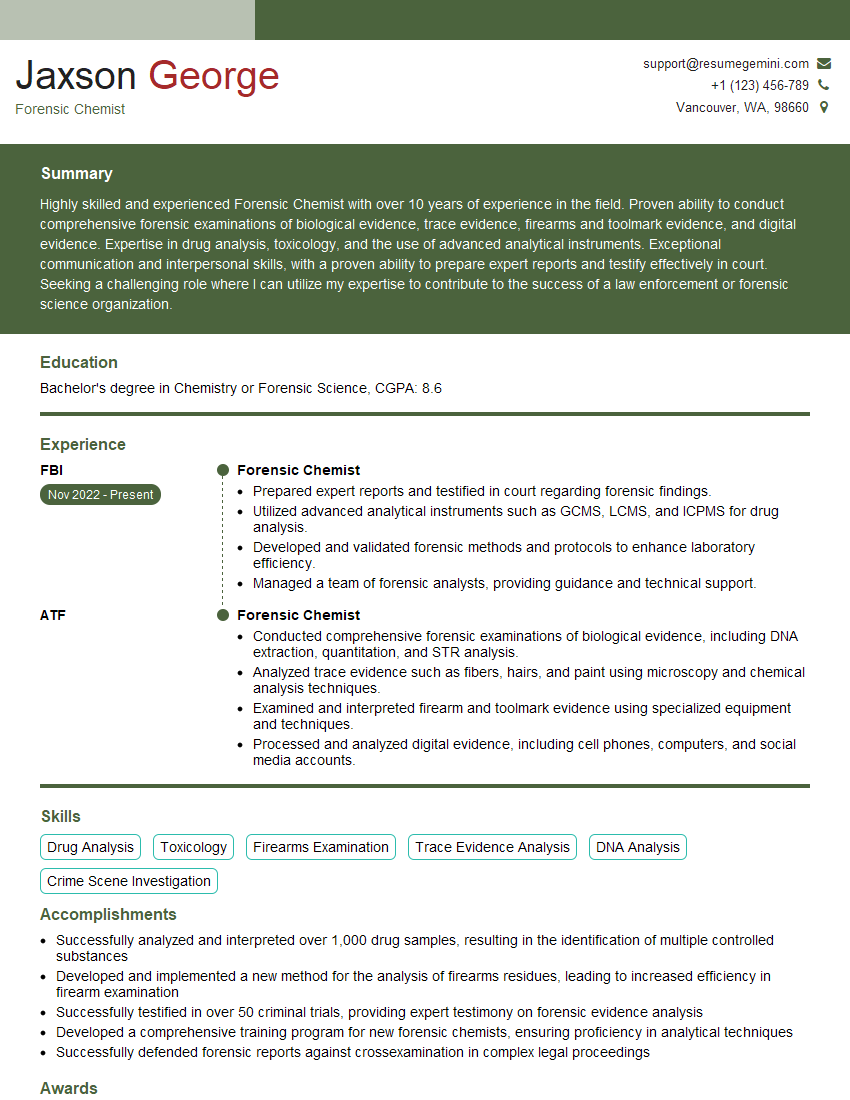
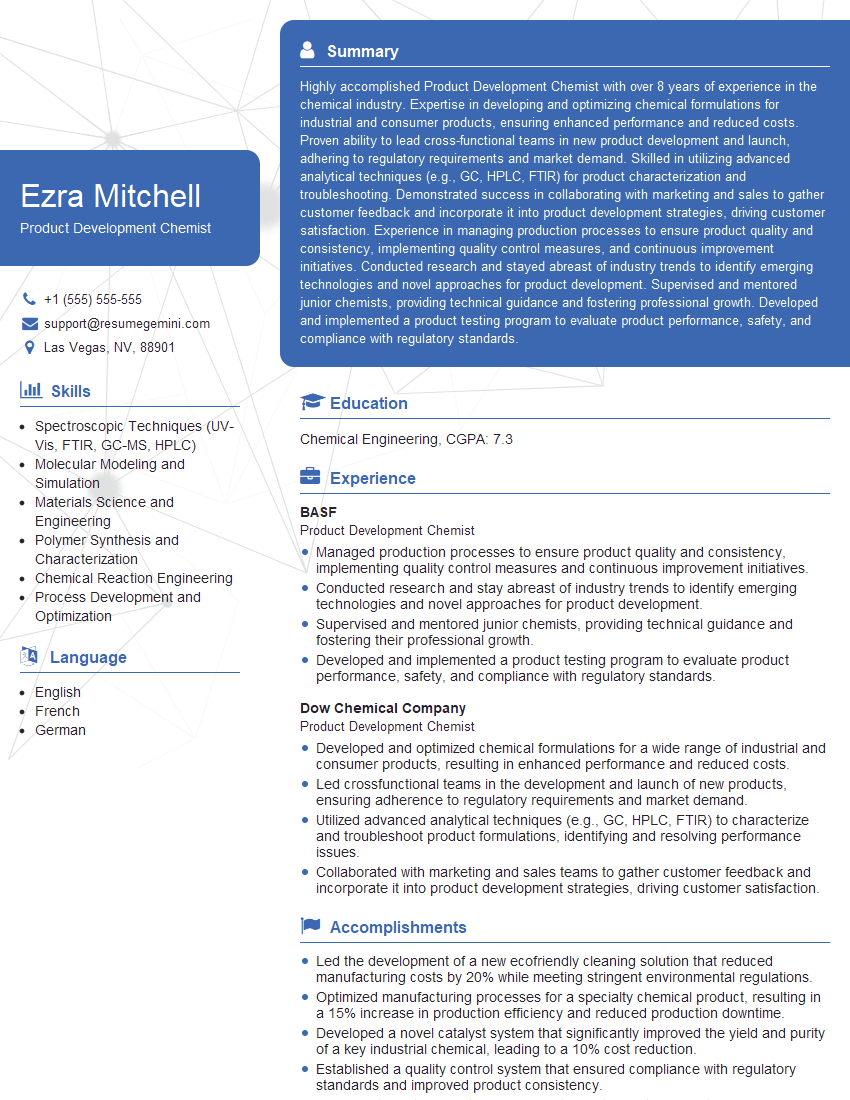
Mastering Chemical Characterization Techniques is paramount for career advancement in various scientific fields, opening doors to exciting opportunities in research, development, and quality control. A strong resume is your key to unlocking these prospects. Creating an ATS-friendly resume ensures your qualifications are effectively conveyed to potential employers. We strongly recommend utilizing ResumeGemini, a trusted resource for building professional resumes, to showcase your skills and experience. ResumeGemini provides examples of resumes tailored to Chemical Characterization Techniques to guide you in crafting a compelling document that highlights your expertise and secures your next interview.






Explore more articles
Users Rating of Our Blogs
Share Your Experience
We value your feedback! Please rate our content and share your thoughts (optional).
What Readers Say About Our Blog
Very informative content, great job.
good