Every successful interview starts with knowing what to expect. In this blog, we’ll take you through the top Choral Ensemble Performance interview questions, breaking them down with expert tips to help you deliver impactful answers. Step into your next interview fully prepared and ready to succeed.
Questions Asked in Choral Ensemble Performance Interview
Q 1. Describe your experience conducting various choral styles (e.g., Renaissance, Baroque, contemporary).
My conducting experience spans a wide range of choral styles, from the rich polyphony of the Renaissance to the dramatic expressiveness of the Baroque and the innovative soundscapes of contemporary compositions. I’ve had the privilege of working with ensembles performing works by composers like Josquin des Prez (Renaissance), Bach (Baroque), and Pärt (Contemporary). Each style demands a unique approach. For Renaissance music, I focus on clear articulation, precise rhythmic control, and a sense of elegance and balance. Baroque music often requires a more dynamic and dramatic interpretation, emphasizing ornamentation and the interplay between different vocal lines. With contemporary pieces, I prioritize a thorough understanding of the composer’s intentions, working closely with the singers to bring the music’s nuances to life. I adapt my conducting technique to suit the specific demands of each style, adjusting tempo, phrasing, and dynamics to reflect the composer’s vision.
For instance, conducting a Renaissance motet necessitates a different baton technique and interpretive approach compared to a contemporary piece that might incorporate unconventional vocal techniques or extended harmonies. The preparation and communication processes also shift – Renaissance pieces often require deep historical research, while contemporary works involve direct collaboration with the composer to understand their musical goals.
Q 2. Explain your approach to selecting repertoire for a choral ensemble.
Selecting repertoire for a choral ensemble is a multifaceted process that considers several key factors. First, I assess the ensemble’s vocal capabilities and range. Choosing pieces that fit the singers’ strengths ensures a positive rehearsal experience and a successful performance. Secondly, I consider the ensemble’s overall artistic goals and the audience’s expectations. This might involve selecting a thematic program or showcasing the ensemble’s versatility across different genres. Thirdly, I evaluate the availability of resources, including scores, accompaniment, and performance venues. Finally, I aim for a balance of challenging yet achievable pieces to foster growth and engagement.
For example, if I’m working with a beginning choir, I’ll prioritize simple, accessible pieces to build their foundation in sight-reading, vocal technique, and ensemble skills. With a more advanced group, I might select challenging pieces that push their technical abilities and artistic expression. I always strive for a program that tells a story and resonates with the singers and the audience. A balanced program with pieces of varying styles and difficulty levels keeps the singers engaged and presents a captivating concert experience.
Q 3. How do you manage rehearsal time efficiently to achieve artistic goals?
Efficient rehearsal time management is crucial for achieving artistic goals. My approach is based on meticulous planning and clear communication. Before each rehearsal, I create a detailed plan outlining specific objectives and allocate time for each section. This includes warm-ups, individual section work, full ensemble rehearsals, and time for feedback and adjustments. I also prioritize efficiency by focusing on one or two key aspects of the performance in each rehearsal, instead of trying to cover everything at once. This targeted approach helps to improve both the quality and the pace of the rehearsal process.
For instance, one rehearsal might focus solely on diction and articulation, another on dynamics and phrasing, and a third on balancing the different vocal sections. This segmented approach allows for more in-depth work on specific challenges, resulting in more significant progress. I also encourage active participation and communication from the singers, allowing them to contribute to the refinement of the musical interpretation.
Q 4. Detail your strategies for addressing vocal imbalances within a choir.
Addressing vocal imbalances requires a multi-pronged approach combining careful listening, strategic section work, and individualized instruction. I begin by identifying the specific sections or voices that are too loud or too quiet, using both my ears and a recording to pinpoint imbalances. Then, I work individually with singers who need to project more or those who need to blend better. This often involves vocal exercises and techniques to improve resonance, breath control, and vocal placement. I also experiment with microphone placement during rehearsals to optimize sound balance.
For example, I might work with the basses to improve their projection, while simultaneously coaching the sopranos on how to blend more seamlessly with the other sections. Sometimes, simple adjustments in seating arrangement can create a more balanced sound. It’s about finding the right balance – not trying to make every voice identical, but fostering a cohesive and unified sound where each voice is heard and valued.
Q 5. Describe your method for teaching sight-reading to a choral ensemble.
Teaching sight-reading is a gradual process that involves building a strong foundation in rhythm, melodic intervals, and musical notation. I start by introducing simple exercises that focus on one or two specific skills at a time. For example, I might start with exercises focusing only on rhythmic patterns, then progress to melodic intervals, and finally combine both rhythm and melody. I then introduce increasingly complex excerpts from the repertoire, allowing singers to apply their newfound skills in a practical setting. Regular, short sight-reading sessions are incorporated into each rehearsal. Positive reinforcement and constructive feedback are crucial throughout the process.
I find that using a variety of techniques – such as clapping rhythms, singing simple melodic lines, and using solfege – can greatly enhance a singer’s ability to grasp musical information quickly. This approach helps the singers develop their sight-reading skills gradually and with confidence. I also emphasize the importance of context and musical understanding, helping the singers understand what they are reading beyond the notes themselves.
Q 6. How do you foster a positive and productive rehearsal environment?
Fostering a positive and productive rehearsal environment is paramount. I believe in creating a space where singers feel respected, valued, and empowered. This involves clear communication, active listening, and a focus on collaboration. I establish clear expectations and guidelines at the beginning of the rehearsal process, explaining the goals and the schedule. I maintain a respectful and encouraging tone, ensuring that feedback is always constructive and focused on improvement rather than criticism. Creating a sense of community and mutual support is also crucial.
Simple strategies like starting rehearsals with a quick icebreaker, giving singers opportunities to provide input on the musical interpretation, and celebrating both individual and collective successes, can make a big difference. A positive and supportive environment allows for open communication and ensures that singers feel comfortable sharing their ideas and concerns, leading to more productive and satisfying rehearsals.
Q 7. Explain your approach to blending different vocal sections within a choir.
Blending different vocal sections involves careful attention to vocal technique, balance, and artistic interpretation. I address this through a combination of individual coaching, section work, and full ensemble rehearsals. I begin by ensuring that each section has developed a strong understanding of their individual parts and their role within the larger ensemble. Then, I work on achieving balance between sections, ensuring that each part is audible and contributes to the overall sonic texture. This often involves adjusting the volume, dynamics, and articulation of individual sections to create a smooth and unified sound.
Techniques such as vowel modification, breath control exercises, and focused attention on intonation are often employed. I encourage singers to listen actively to each other and to adjust their singing accordingly. The goal isn’t to homogenize the sound, but to create a beautiful and vibrant tapestry of sound where each voice contributes to the overall richness and harmony. A consistent, well-defined blend of vocal sections is a cornerstone of a successful choral performance, reflecting the collective effort and artistry of the entire ensemble.
Q 8. Describe your experience working with accompanists.
Collaboration with accompanists is crucial for a successful choral ensemble. It’s a partnership built on mutual respect and clear communication. My experience involves not only selecting the right accompanist whose style complements the choir’s sound, but also actively participating in rehearsal planning. This includes discussing interpretive ideas, tempo choices, and dynamic shaping. I ensure that the accompanist understands my vision for the piece, and that the accompaniment is supportive and doesn’t overpower the vocal lines. For instance, when working on a particularly delicate Renaissance piece, I might collaborate with the pianist to create a subtle, textural accompaniment, focusing on harpsichord-like textures instead of a full, romantic sound. Conversely, for a powerful gospel arrangement, a more robust and rhythmic accompaniment would be appropriate, something we would discuss beforehand. Beyond rehearsals, a strong working relationship ensures smooth transitions during performances, anticipating potential challenges and solving them together.
Q 9. How do you handle challenging singers or interpersonal conflicts within the choir?
Handling challenging singers or interpersonal conflicts requires a multifaceted approach combining empathy, clear communication, and firm but fair leadership. I start by identifying the root cause – Is it a skill gap? A personality clash? A misunderstanding? Once identified, I address the issue directly but sensitively. For instance, if a singer struggles with pitch accuracy, I might offer private coaching sessions, focusing on breath control and ear training exercises. If a conflict arises between singers, I facilitate a dialogue in a respectful environment, ensuring everyone feels heard and understood. I encourage them to find common ground and focus on collaborative problem-solving. Sometimes, a simple adjustment of seating arrangement or rehearsal schedule can significantly ease tensions. If these approaches don’t resolve the issue, I might involve a mediator or, in extreme cases, make personnel decisions in the best interests of the choir’s overall harmony and performance quality.
Q 10. What techniques do you use to develop vocal technique and musicianship in singers?
Developing vocal technique and musicianship requires a holistic approach. I integrate various techniques, including:
- Vocal warm-ups: A thorough warm-up routine focuses on breath support, articulation, and range expansion. We use exercises like scales, sirens, and humming patterns to prepare the vocal apparatus for singing.
- Individual coaching: Personalized feedback and guidance are essential. I assess individual vocal strengths and weaknesses, providing tailored exercises to improve resonance, intonation, and diction.
- Sight-reading practice: Regular sight-reading sessions improve musicianship, sight-singing, and adaptability. I incorporate varied musical styles and levels of difficulty.
- Music theory integration: A solid understanding of music theory enhances musicianship. I incorporate lessons on rhythm, harmony, and form into rehearsals, relating them to practical application in choral singing.
- Aural training: Interval and chord recognition exercises help improve pitch accuracy and harmonic awareness. We use dictation exercises and ear-training games to sharpen these skills.
By combining these techniques, I foster both vocal excellence and a deep appreciation of musicality, enriching the overall choral experience.
Q 11. How do you assess the vocal capabilities of individual singers during auditions?
Auditions are a crucial step in selecting singers for the ensemble. My assessment involves a multifaceted approach:
- Vocal range and tone quality: I evaluate the singer’s vocal range, tone quality, and vocal health. I listen for clarity, resonance, and evenness across the range.
- Pitch accuracy and intonation: I assess their ability to sing in tune, both independently and within a group context. I might use simple scales or solfège exercises to gauge this.
- Sight-reading skills: I test their ability to read music accurately and efficiently. A short, simple piece is usually sufficient.
- Musicality and expression: I assess their sense of rhythm, phrasing, and dynamics. I look for expressiveness and musicality beyond technical proficiency.
- Blending ability: I evaluate their ability to blend their voice seamlessly with others. A simple unison or two-part exercise is usually employed.
Beyond the technical aspects, I also consider the singer’s attitude, enthusiasm, and commitment to the ensemble. A positive attitude and a willingness to learn are valuable assets.
Q 12. Describe your experience with choral arrangement and adaptation of existing scores.
Arranging and adapting choral scores is a significant aspect of my work. It requires not only musical expertise but also a deep understanding of the choir’s vocal capabilities. I often adapt existing scores to suit the choir’s size, vocal range, and stylistic preferences. This might involve simplifying complex harmonies, rearranging vocal lines, or transposing sections to accommodate specific vocal ranges. For example, I might reduce a complex eight-part work to a more manageable six-part arrangement or adjust the tessitura (the comfortable range of pitch for singers) of certain parts to better suit the choir’s strengths. I also create original arrangements, blending musical styles or combining different pieces to create a cohesive and engaging program. This requires a solid understanding of musical structure, harmony, and counterpoint, as well as a deep appreciation for the chosen musical style.
Q 13. How do you prepare a choir for a performance, including technical aspects and stage presence?
Preparing a choir for a performance involves meticulous planning and detailed rehearsal strategies. The process includes:
- Rehearsal planning: A comprehensive rehearsal schedule is crucial, outlining specific goals for each rehearsal session. This includes focused work on individual sections, balances, and dynamics.
- Technical rehearsals: Technical rehearsals focus on stage movement, microphone placement, and lighting cues. These rehearsals mimic the actual performance conditions, helping the singers become comfortable and confident in their performance setting.
- Vocal and musical refinement: This phase focuses on achieving a polished and expressive performance, paying attention to details such as intonation, diction, phrasing, and overall musical interpretation.
- Stage presence training: I work with the singers on posture, eye contact, and stage demeanor to ensure a confident and engaging presentation. We incorporate exercises such as acting and movement to improve stage presence.
- Dress rehearsals: Full dress rehearsals, ideally in the performance venue, allow the choir to experience the performance setting and fine-tune their performance before the actual concert.
Throughout the preparation process, I emphasize open communication, providing constructive feedback and creating a supportive and collaborative environment.
Q 14. What are your strategies for motivating and inspiring singers?
Motivating and inspiring singers involves cultivating a positive and engaging rehearsal environment. Key strategies include:
- Celebrating achievements: Acknowledging and celebrating the choir’s progress builds confidence and encourages continued effort. Even small successes should be recognized.
- Setting challenging yet achievable goals: Challenging the choir with ambitious musical goals pushes their limits but ensures they remain attainable and rewarding.
- Creating a collaborative environment: Fostering a sense of community and teamwork enhances the singers’ motivation and enjoyment of the process. I encourage peer support and collaborative problem-solving.
- Sharing musical insights: Providing context and background information about the music increases appreciation and understanding, fostering a deeper connection with the material.
- Providing constructive feedback: Offering specific and constructive feedback helps singers improve and grow, while maintaining a supportive and encouraging tone.
By creating a positive and engaging experience, I aim to nurture a love of choral music and encourage each singer’s individual growth and the overall success of the ensemble.
Q 15. Explain your understanding of vocal health and injury prevention.
Vocal health is paramount in choral singing. Preventing injury requires a holistic approach encompassing physical, vocal, and mental well-being. Think of the voice as a finely tuned instrument; neglecting its care leads to damage.
- Hydration: Consistent water intake is crucial. Dehydration thickens vocal folds, leading to strain and fatigue. I always advise singers to carry water bottles and drink frequently, especially before, during, and after rehearsals.
- Warm-ups and Cool-downs: These are non-negotiable. A proper warm-up gradually prepares the vocal mechanism, while a cool-down allows for a gentle release, preventing sudden stress on the vocal folds. I use a range of exercises targeting breath control, articulation, and vocal range.
- Posture: Good posture supports efficient breath support and prevents strain. I constantly remind singers to stand tall with relaxed shoulders and a lifted chin. Poor posture restricts breath and forces the voice.
- Vocal Hygiene: Avoiding irritants like smoking, excessive alcohol consumption, and yelling is essential. I emphasize the importance of rest and avoiding vocal overuse. Overworking the voice is like over-training a muscle; it leads to injury.
- Awareness of Symptoms: Singers must be educated to recognize early signs of vocal fatigue, such as hoarseness, pain, or discomfort. Addressing these promptly prevents escalation into serious problems. I encourage my singers to communicate any issues immediately.
For example, during a particularly demanding rehearsal period, I might incorporate extra hydration breaks and shorter rehearsal sessions to prevent vocal fatigue. We also implement regular vocal health checks, allowing for early intervention and personalized advice for individual singers.
Career Expert Tips:
- Ace those interviews! Prepare effectively by reviewing the Top 50 Most Common Interview Questions on ResumeGemini.
- Navigate your job search with confidence! Explore a wide range of Career Tips on ResumeGemini. Learn about common challenges and recommendations to overcome them.
- Craft the perfect resume! Master the Art of Resume Writing with ResumeGemini’s guide. Showcase your unique qualifications and achievements effectively.
- Don’t miss out on holiday savings! Build your dream resume with ResumeGemini’s ATS optimized templates.
Q 16. How do you incorporate technology (e.g., recording software, notation software) into your work?
Technology significantly enhances choral ensemble performance. It’s not just about recording; it’s about leveraging tools for improvement and efficiency.
- Recording Software (e.g., Audacity, Logic Pro X): Recording rehearsals allows for objective analysis of balance, intonation, and overall ensemble sound. It helps identify areas needing improvement and allows singers to hear themselves objectively. We use recordings to track progress over time.
- Notation Software (e.g., Sibelius, Finale): This facilitates efficient score preparation, including customized arrangements and part extraction. It also allows for detailed annotations and marking of dynamic and expressive nuances. I often use this software to create personalized practice materials for individual singers.
- Digital Audio Workstations (DAWs): These sophisticated programs allow for advanced audio editing, mixing, and mastering, producing professional-quality recordings for performances and promotion.
- Online Collaboration Tools: Platforms like Google Drive or Dropbox facilitate efficient sharing of scores, recordings, and other materials, fostering seamless collaboration amongst singers, even remotely.
For instance, after a rehearsal, we’ll listen back to a recording, identifying sections where the bass line needs to be stronger or where the soprano section’s intonation is slightly off. We then work on those specific areas in subsequent rehearsals, using the recording as a guide for improvement.
Q 17. Describe your experience in programming and presenting concerts.
Concert programming and presentation is an art in itself, balancing artistic goals with audience engagement. It’s crucial to craft a narrative that resonates with the listeners.
- Program Selection: I carefully choose pieces considering the choir’s capabilities, audience preferences, and the overall thematic coherence of the concert. The selection process includes considering the balance between challenging and accessible pieces, and the overall pacing of the program. We might choose a theme, like ‘Love Songs through the Ages’ or ‘Music of the Renaissance,’ to provide a structured narrative.
- Presentation: This goes beyond simply performing the music. I prepare detailed program notes, offering insightful context and background information for the audience. I often incorporate visual elements, like projected images or stage lighting, to enhance the overall experience. I also work closely with the venue staff to ensure smooth logistics.
- Audience Engagement: I believe in interacting with the audience, providing brief introductions to each piece and connecting with them on an emotional level. This can include sharing anecdotes related to the music or composers.
- Marketing and Promotion: Effective promotion is crucial for a successful concert. I work on designing eye-catching flyers, utilizing social media, and collaborating with local media outlets to generate excitement and build anticipation.
For example, for a recent concert themed around ‘Nature,’ we included pieces reflecting various aspects of nature: the vastness of the ocean, the stillness of the forest, etc., incorporating visual projections to enhance the atmospheric experience. This thematic approach proved highly successful.
Q 18. What is your philosophy on working with diverse musical backgrounds and styles?
My philosophy centers on embracing diversity as a source of creative richness. Musical backgrounds and styles offer a unique opportunity for growth and innovation.
- Inclusivity: I create a supportive and inclusive environment where singers from diverse backgrounds feel comfortable sharing their unique perspectives and contributions. I actively seek out diverse repertoire, ensuring representation from various cultures and historical periods.
- Cross-Cultural Exchange: I encourage exploration of different musical styles, incorporating elements from world music into our repertoire or arranging pieces in novel ways. This fosters a deeper understanding and appreciation of diverse musical traditions.
- Collaboration: I often collaborate with musicians and artists from different disciplines, enriching the choral experience and expanding creative boundaries. This might involve incorporating instrumentalists, dancers, or visual artists into our performances.
- Respectful Dialogue: Open communication is essential. I encourage singers to share their cultural insights and experiences, enriching the interpretation and performance of the music. This mutual respect and open communication foster a creative and stimulating environment.
For instance, we recently incorporated West African rhythms and vocal techniques into a piece by a contemporary composer, creating a unique and exciting musical fusion that captivated the audience.
Q 19. How do you balance artistic vision with the technical capabilities of the choir?
Balancing artistic vision with technical capabilities requires careful planning and communication. It’s about finding the sweet spot between ambition and feasibility.
- Honest Assessment: I accurately assess the choir’s technical capabilities before choosing a repertoire. Ambitious projects require careful planning and gradual development of skills.
- Progressive Repertoire: I select repertoire that progressively challenges the choir, building their skills and confidence over time. This avoids overwhelming the choir with overly complex pieces too early on.
- Tailored Coaching: I provide personalized coaching to individual singers, addressing their specific needs and helping them overcome technical challenges. This often includes targeted exercises and vocal techniques.
- Collaborative Approach: I foster open dialogue with the choir, incorporating their input and suggestions into the performance process. This makes the experience more collaborative and satisfying. This also means being open to adapting the music or my artistic vision to suit the abilities of the singers.
- Strategic Arrangement: If necessary, I may work with arrangers to modify arrangements, making them more accessible without compromising the artistic integrity of the piece.
For example, if a piece has a challenging passage, we’ll break it down into smaller sections, working on individual parts before bringing it together as a whole. We might also adapt the tempo or dynamics to accommodate the singers’ abilities.
Q 20. Explain your experience in budgeting and resource management for choral activities.
Budgeting and resource management are critical for successful choral activities. It’s about responsible stewardship of funds and resources.
- Detailed Budgeting: I create detailed budgets outlining all anticipated expenses, including rehearsal space rental, music scores, travel costs, and performer fees. This meticulous planning ensures financial accountability and helps prevent unforeseen financial shortfalls.
- Fundraising Strategies: I explore various fundraising options, including grant applications, ticket sales, sponsorships, and donations. This ensures that we can fund the activities effectively without relying solely on a single funding source.
- Resource Allocation: I carefully allocate resources, ensuring that funds are used efficiently and effectively to maximize the impact of choral activities. This might involve finding cost-effective alternatives to reduce expenses or prioritizing essential expenditures.
- Financial Tracking: I maintain meticulous financial records, ensuring transparency and accountability in the management of funds. This involves regular monitoring of income and expenditure to track progress and identify any potential issues.
- Cost-Effective Practices: I actively look for ways to reduce costs where possible, such as negotiating discounted rates for rehearsal space, exploring cost-effective printing options, or finding sponsors who might help us offset costs.
For example, for a particular concert, we secured sponsorships from local businesses in exchange for promotional opportunities, helping to offset some of the performance costs.
Q 21. Describe your experience writing grant proposals or seeking funding for choral programs.
Securing funding is an essential skill for sustaining choral programs. It’s about crafting compelling narratives that resonate with potential funders.
- Identifying Funding Opportunities: I actively research and identify relevant funding opportunities from various sources, including arts councils, foundations, corporations, and private donors. This often involves thorough research of potential funding organizations to find the best fit for our program.
- Compelling Grant Proposals: I write persuasive grant proposals that clearly articulate our artistic vision, demonstrate the impact of our programs, and provide detailed budgets. A strong proposal showcases the value and significance of our work to the community.
- Building Relationships: I cultivate relationships with potential funders, building trust and demonstrating the dedication and professionalism of our program. This involves networking, attending events, and following up with funders after submissions.
- Monitoring Progress: I track the progress of our grant applications and follow up with funders as needed. This involves maintaining clear communication to ensure the proposal’s effectiveness.
- Adaptability: I adapt our grant proposals based on the specific requirements and priorities of each funding organization, ensuring that our application meets their criteria effectively.
For instance, in one successful grant application, we highlighted the community outreach initiatives embedded within our program, demonstrating the broader societal impact beyond the purely artistic aspects, appealing to the funder’s philanthropic goals.
Q 22. How do you recruit and retain singers in a choral ensemble?
Recruiting and retaining singers requires a multifaceted approach. It’s not just about finding talented voices; it’s about building a strong, supportive community.
Auditions: I conduct thorough auditions, focusing not only on vocal technique but also on the singer’s personality and potential for collaboration. I look for individuals who are enthusiastic, reliable, and possess a strong work ethic.
Outreach: I actively promote the ensemble through various channels – social media, local music schools, university music departments, and community events. This helps reach a wider pool of potential singers.
Building Camaraderie: I prioritize creating a positive and inclusive environment. Social events, informal rehearsals, and team-building activities foster a sense of belonging and encourage singers to stay engaged.
Clear Communication: Open and honest communication is vital. I keep singers informed about rehearsal schedules, performance dates, and any changes in the ensemble’s plans. Regular feedback sessions help address concerns and maintain morale.
Performance Opportunities: Providing diverse and high-quality performance opportunities is crucial. This includes concerts, competitions, and collaborations with other musical groups, which allows singers to showcase their talent and experience the rewards of their hard work.
Professional Development: I offer workshops and masterclasses to help singers improve their skills and expand their knowledge. This investment shows singers that their growth and development are valued.
Q 23. Explain your experience with conducting large and small choral ensembles.
My experience spans both large and small choral ensembles. Conducting a large ensemble requires a different approach than working with a smaller group.
Large Ensembles: With large groups, precise organization and efficient communication are paramount. I rely heavily on section leaders to assist with rehearsal management and individual coaching. Clear visual cues are also crucial for effective communication, especially in a larger space. I’ve successfully conducted choirs of over 100 singers, using section rehearsals to address individual challenges before bringing the full choir together for comprehensive performance.
Small Ensembles: Small ensembles offer opportunities for more individualized attention and experimentation. In this setting, there’s more scope for intimate musical interactions and a greater emphasis on blending and nuanced expression. I’ve worked with intimate chamber choirs of eight singers, where the focus shifts towards building a strong personal connection and crafting a cohesive sound with each voice heard distinctively.
In both scenarios, my emphasis is always on creating a strong musical foundation, fostering collaboration, and nurturing individual growth within the context of the ensemble’s overall artistic goals.
Q 24. How do you use feedback effectively to improve the choir’s performance?
Effective feedback is crucial for improving a choir’s performance. It needs to be specific, constructive, and delivered in a supportive manner.
Specific & Actionable Feedback: Instead of saying ‘that was flat’, I might say, ‘On the third beat of measure 12, the sopranos were slightly flat. Let’s try focusing on a clearer pitch reference point.’ This provides a clear understanding of the problem and a suggestion for improvement.
Balanced Approach: I always balance constructive criticism with positive reinforcement. Recognizing and praising the choir’s achievements fosters confidence and motivation.
Individual & Group Feedback: I provide both individual feedback to address specific singers’ needs and group feedback to address ensemble issues, such as balance and intonation.
Timing and Delivery: Feedback is most effective when given promptly and in a calm, respectful manner. I encourage questions and open discussion to ensure singers understand and can implement the suggestions.
Demonstrations: Sometimes, a simple demonstration of the desired sound or technique is the most efficient way to provide feedback. For example, if the choir is struggling with a particular phrase, I will demonstrate it for them to illustrate the correct approach.
Q 25. Describe your experience working with diverse age groups and skill levels.
My experience working with diverse age groups and skill levels has been incredibly rewarding. I have adapted my approach to accommodate the unique needs and learning styles of each group.
Children’s Choirs: Working with children requires patience, creativity, and a playful approach. I use games and activities to make rehearsals engaging and build their confidence. My focus is on developing their basic vocal skills, musicality, and teamwork, fostering a love for singing.
Adult Choirs: Adult choirs often have a wide range of experience and skill levels. I provide tailored support to individual singers, offering extra guidance to those who need it while challenging more experienced singers with advanced repertoire. Creating an inclusive and supportive environment where all feel valued and challenged is essential.
Mixed-age Choirs: Combining different age groups presents its own set of challenges, requiring careful repertoire selection and differentiated instruction. I strive to create a dynamic where younger singers learn from their older counterparts and older singers are inspired by the enthusiasm of the younger generation.
Adaptability and understanding are key. I tailor my communication style and teaching methods to fit the specific needs of the group, maintaining high musical standards while fostering inclusivity.
Q 26. What is your approach to dealing with performance anxiety in singers?
Performance anxiety is a common issue among singers. My approach focuses on building confidence and equipping singers with coping mechanisms.
Preparation and Practice: Thorough rehearsal and preparation are fundamental to reducing anxiety. The more comfortable singers are with the music, the less anxious they will be on stage.
Positive Self-Talk and Visualization: I encourage singers to use positive self-talk and visualization techniques to build confidence. This can involve imagining successful performances and focusing on their strengths.
Relaxation Techniques: I introduce relaxation techniques such as deep breathing exercises and mindfulness to help singers manage stress and calm their nerves before performances.
Performance Simulation: Holding mock performances in a rehearsal setting helps singers get used to the performance environment and build their confidence in a low-pressure environment.
Supportive Environment: Creating a supportive and encouraging rehearsal environment helps singers feel safe and confident enough to express themselves fully. A feeling of strong camaraderie and trust within the ensemble significantly lowers anxiety levels.
Addressing performance anxiety is a holistic process requiring a combination of practical strategies and emotional support. The goal is to empower singers to manage their anxiety and transform it into positive energy on stage.
Q 27. Describe your experience collaborating with other departments or organizations.
Collaboration is an essential aspect of choral performance. I have extensive experience working with various departments and organizations.
Schools and Universities: I have partnered with educational institutions to provide workshops and coaching for student choirs, integrating the ensemble into school events, and offering performance opportunities for talented young singers. This reciprocal relationship benefits both the ensemble and the educational institution.
Community Organizations: Collaborations with community organizations broaden our reach and allow us to contribute to community events. For example, we have performed at local festivals and charity events, creating a positive impact on our community.
Other Arts Organizations: Working with other arts organizations, such as orchestras or theatre groups, enhances our artistic experiences. These collaborations often result in diverse and enriching performance projects, expanding our artistic horizons.
Effective collaboration requires open communication, mutual respect, and a shared vision. By working together, we achieve more than we could individually.
Q 28. How do you adapt your conducting style to different musical genres and settings?
Adapting my conducting style to different genres and settings is crucial. My approach is to understand the essence of the music and tailor my technique accordingly.
Classical Music: When conducting classical music, precision and clarity are paramount. My movements are precise and expressive, reflecting the formal structure and emotional depth of the music. A clear beat and dynamic control are key to bringing out the nuances of the composition.
Contemporary Music: Contemporary music often demands a more flexible and improvisational approach. I adapt my conducting style to reflect the fluidity and rhythmic complexity of the music, using expressive gestures to guide the singers through unconventional harmonies and rhythms.
Different Settings: The setting significantly influences my approach. In a formal concert hall, my style is more refined and controlled, while in a more informal setting, such as a community event, I might adopt a more relaxed and engaging style to connect with the audience.
Essentially, my goal is always to serve the music. I adapt my techniques to achieve the composer’s intention and create a compelling musical experience for both the singers and the audience. My aim is to become a transparent conduit for the music, ensuring that the singers’ voices and the overall interpretation shine through.
Key Topics to Learn for Choral Ensemble Performance Interview
- Vocal Technique & Musicianship: Understanding breath control, vocal production, sight-reading, and stylistic nuances. This includes demonstrating knowledge of different vocal techniques and their applications in diverse choral styles.
- Rehearsal & Performance Practices: Discuss effective rehearsal strategies, conducting techniques (if applicable), score study, and problem-solving within the ensemble context. Be prepared to discuss your approach to learning new repertoire quickly and efficiently.
- Choral Literature & History: Demonstrate familiarity with major choral composers, historical periods, and representative works. Discuss your understanding of different choral styles and their historical development.
- Ensemble Dynamics & Collaboration: Explain your understanding of blending, balance, intonation, and diction within a choral ensemble. Highlight your ability to contribute positively to group dynamics and collaborative efforts. Be ready to discuss experiences resolving musical challenges within a team.
- Leadership & Communication: If applicable, discuss your experience leading or mentoring within a choral setting. Articulate your communication skills and your ability to effectively convey musical ideas to others.
- Aural Skills & Sight-Singing: Be prepared to demonstrate your proficiency in aural skills, including sight-singing, dictation, and ear training. This is a crucial element in many choral ensembles.
Next Steps
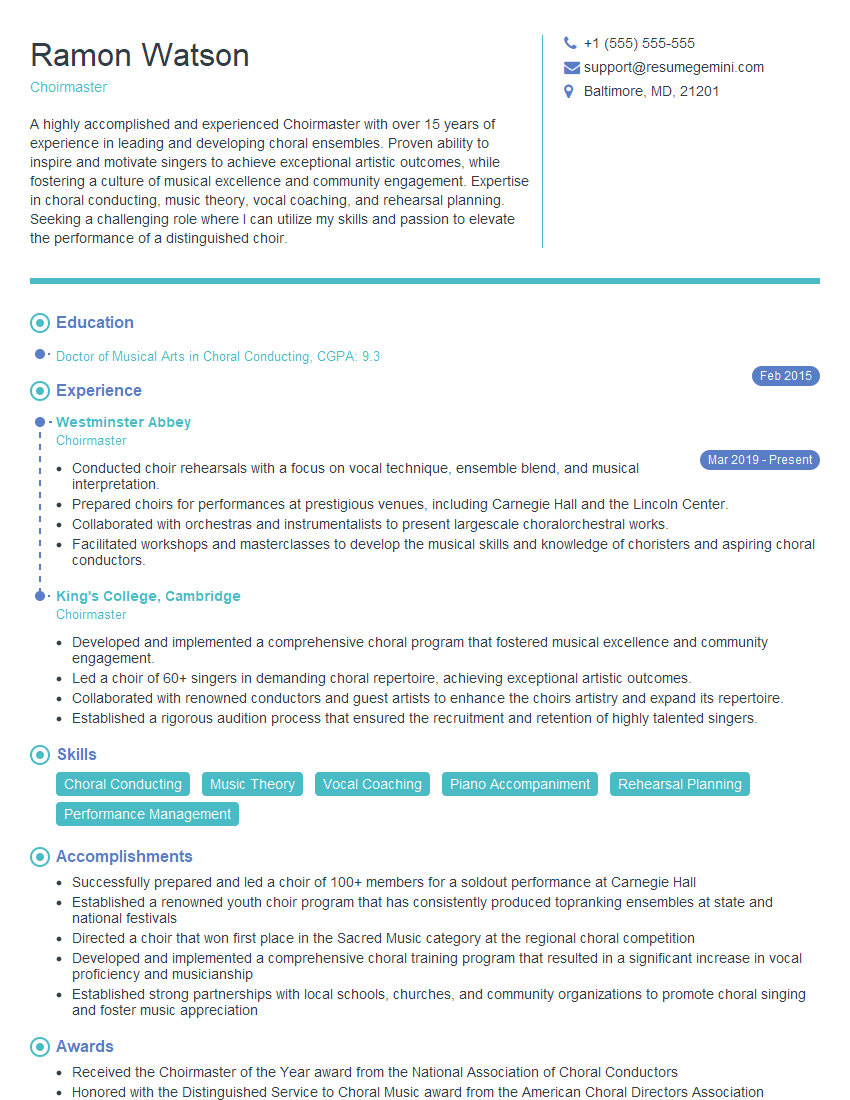
Mastering Choral Ensemble Performance opens doors to diverse and rewarding career paths, from professional choral singing to music education and arts administration. A strong resume is crucial to showcasing your skills and experience to potential employers. To maximize your job prospects, create an ATS-friendly resume that highlights your unique contributions and achievements. ResumeGemini is a trusted resource to help you build a professional and impactful resume that stands out. Examples of resumes tailored to Choral Ensemble Performance are available to help you get started.
Explore more articles
Users Rating of Our Blogs
Share Your Experience
We value your feedback! Please rate our content and share your thoughts (optional).
What Readers Say About Our Blog
Very informative content, great job.
good