The thought of an interview can be nerve-wracking, but the right preparation can make all the difference. Explore this comprehensive guide to Chord Progression Development interview questions and gain the confidence you need to showcase your abilities and secure the role.
Questions Asked in Chord Progression Development Interview
Q 1. Explain the difference between major and minor chord progressions.
The difference between major and minor chord progressions lies primarily in their emotional character and harmonic structure. Major chords, built on major scales, sound bright, happy, and uplifting. Minor chords, built on minor scales, evoke feelings of sadness, introspection, or mystery. This difference stems from the intervals used. A major chord is built with major thirds (4 semitones) between the root and the third, and the third and the fifth. A minor chord uses a minor third (3 semitones) between the root and the third.
For example, a C major chord (C-E-G) sounds significantly different from a C minor chord (C-Eb-G). The major third (E) creates a brighter sound, while the minor third (Eb) introduces a darker tone. This difference carries through to entire progressions. A major progression typically uses major chords, creating a light and optimistic feel. A minor progression uses minor chords, producing a moodier atmosphere. Think of a classic pop song with its major key feel versus a bluesy piece in a minor key.
Consider the common progression I-IV-V-I in both major and minor keys. In C major, it’s C-F-G-C. In C minor, it’s Cm-Fm-Gm-Cm. The same chord progression, but with drastically different emotional outcomes.
Q 2. Describe the function of a dominant chord in a progression.
The dominant chord plays a crucial role in a progression by creating tension and anticipation that needs resolution. It’s typically the V chord (fifth degree) in a major or minor key. Its strong tendency to resolve to the tonic (I chord) is what gives it its power. The dominant chord contains a leading tone, a note a half-step below the tonic, which powerfully pulls towards the tonic resolution.
Imagine it like a question that demands an answer. The dominant chord poses a musical question; the tonic chord provides the satisfying answer, resolving the tension. This creates a sense of musical closure and completeness. For example, in the key of C major, the G major chord (V chord) creates this pull to the C major chord (I chord). This ‘pull’ is due to the leading tone (B) in the G major chord naturally wanting to resolve upwards to C.
Q 3. What are common chord progressions used in pop music?
Pop music frequently employs several common chord progressions. The simplicity and memorability of these make them incredibly effective. The most ubiquitous is the I-IV-V-I progression (tonic-subdominant-dominant-tonic) which we’ve already discussed, but worth reiterating here due to its dominance in the genre. This is found across many genres, and is very flexible. It provides a strong sense of structure.
Another common progression is the vi-IV-I-V (relative minor – subdominant – tonic – dominant). This progression adds some complexity by borrowing from the relative minor key, often creating a more emotional and dynamic feel. Finally, the ii-V-I progression (supertonic-dominant-tonic) is very popular in jazz but also used in pop, adding a sophisticated harmonic flavor. The versatility of these progressions and their adaptation across various keys makes them incredibly prevalent.
Q 4. How do you create a secondary dominant chord?
A secondary dominant, also known as a borrowed chord, is a dominant chord built on a degree other than the V of the tonic key. It temporarily shifts the harmonic center to a different scale degree, creating a temporary ‘modulation’ before resolving back to the original key. It adds harmonic interest and color.
Let’s say you’re in C major. A secondary dominant would not be G major (the regular V chord), but could be, for example, D7 (dominant of G). This creates a temporary harmonic shift to the key of G before resolving back to C. The D7 chord acts as the dominant chord of G, creating a pull to G, and then the G chord resolves to C. This technique helps add complexity and anticipation to the progression.
Q 5. Explain the concept of chromaticism in chord progressions.
Chromaticism in chord progressions involves the use of notes outside the diatonic scale of the key. These ‘outside’ notes add unexpected tension and color, creating a richer and more sophisticated sound. It breaks the rules of traditional harmony and offers a surprising twist.
Imagine a song primarily in C major. Suddenly, a Db major chord appears – a chromatic chord. This Db chord doesn’t belong to the C major scale, creating dissonance. This dissonance immediately demands resolution; it creates tension which subsequently needs releasing, often through moving to the chord that would contain the Db chord in its scale (F major)
Q 6. How do you resolve a dissonance in a chord progression?
Resolving dissonance is crucial for creating a satisfying musical experience. Dissonance creates tension, and resolution releases that tension. Common methods include moving to a consonant chord that contains the dissonant note or moving the dissonant note to a consonant note, often a half-step movement up or down towards the tonic or the closest consonant pitch. For example, a leading tone (a half-step below the tonic) is a common dissonant note that resolves upwards to the tonic.
If you have a major seventh chord, the major seventh is often considered a dissonance that resolves downwards to the next note. If you have a tritone (an interval of six half-steps or three whole steps), the resolution usually occurs by one note moving upwards while the other moves downwards. The resolution provides that sense of completeness and satisfying closure.
Q 7. What is a circle of fifths and how is it used in chord progressions?
The circle of fifths is a visual representation of the relationships between the 12 major keys. Moving clockwise around the circle means you’re moving up a fifth (7 semitones) and that establishes a clear hierarchical structure between keys, making it an invaluable tool for composing and analyzing chord progressions.
It’s extremely useful because adjacent keys share many chords. This facilitates smooth transitions between keys and allows for sophisticated modulation. For instance, moving from C major to G major (a fifth) is relatively seamless, as G major shares several chords with C major. Composers and arrangers use it to create flowing and logical key changes, adding depth and interest to their work. Understanding the circle of fifths is fundamental for creating effective and satisfying chord progressions.
Q 8. Describe the use of inversions in chord progressions.
Inversions change the bass note of a chord without altering the chord’s root. Imagine a three-layered cake: the root is the bottom layer, the third is the middle, and the fifth is the top. A chord in root position has the root on the bottom. First inversion places the third in the bass, and second inversion puts the fifth in the bass. Inversions provide harmonic variety and smoother voice leading in a progression. They offer a different sonic flavor to the same chord, preventing monotony.
For example, a C major chord (C-E-G) in root position has C in the bass. The first inversion (E-G-C) has E in the bass, and the second inversion (G-C-E) has G in the bass. Using these inversions in a progression can create a more interesting and less predictable sound than sticking solely to root position chords.
Q 9. Explain the difference between parallel and relative major/minor keys.
Parallel keys share the same key signature but have different tonic notes. For instance, C major and C minor are parallel keys; they both have no sharps or flats, but C major’s tonic is C, while C minor’s tonic is C. Relative keys, on the other hand, share the same key signature but are major and minor. For example, C major and A minor are relative keys because they share the same key signature (no sharps or flats), but they have different tonic notes and sound distinctly different.
Think of it like this: parallel keys are like two siblings with the same appearance (key signature) but different personalities (tonic note). Relative keys are like two cousins – still related (sharing the key signature), but with their own unique characteristics (major vs. minor).
Q 10. How do you create a chord progression in a specific key?
Creating a chord progression in a specific key involves understanding the key’s diatonic chords – the chords built from the notes within the key’s scale. For example, in C major (C-D-E-F-G-A-B-C), the diatonic chords are C major, D minor, E minor, F major, G major, A minor, and B diminished. You can use these chords to construct progressions. You can start with the I chord (tonic), then experiment with different chord combinations (ii-V-I, vi-IV-I, etc.). The key is to create a satisfying harmonic journey by balancing tension and release. Often, you’ll use the dominant chord (V) to create tension that resolves to the tonic (I) for a satisfying conclusion.
For example, a simple progression in C major could be: Cmaj7 - G7 - Am7 - Fmaj7
Q 11. What are some common chord progressions in minor keys?
Common chord progressions in minor keys often utilize the relative major for variety and to create tension and release. Here are a few examples:
i - iv - V - i(e.g., Am – Dm – E7 – Am)i - vi - iii - VII(e.g., Am – Fmaj7 – Cmaj7 – G7)ii - V - i(e.g., Bm7 – E7 – Am)
These progressions leverage the minor key’s characteristic melancholy while incorporating brighter major chords from the relative major to provide lift and contrast. The use of the dominant (V) chord often leads to a strong resolution back to the tonic (i).
Q 12. How do you create tension and release in a chord progression?
Tension and release are created by using chords that are tonally distant from the tonic (I) chord to create tension, then resolving to the tonic (or a closely related chord) to create release. The dominant chord (V) is a prime example of a tension-creating chord; its strong pull towards the tonic makes its resolution to I very satisfying. Other tension-building chords include the viio (leading-tone chord) and sometimes even chords borrowed from the parallel major.
For example, in C major, using G7 (V) creates tension, and resolving to Cmaj7 (I) creates release. In a minor key, using the relative major’s dominant chord would similarly create tension before resolving back to the minor tonic.
Q 13. Explain the concept of voice leading in chord progressions.
Voice leading refers to the smooth movement of individual melodic lines (voices) between chords. Good voice leading minimizes large leaps and parallel fifths or octaves (unpleasant sonic effects). The goal is to create a natural and pleasing flow of musical lines. Smooth voice leading is crucial for a satisfying and coherent progression. Consider how each note in a chord moves to the next chord – it’s the ‘flow’ between notes that makes a progression sound graceful or awkward.
For example, if you’re moving from a C major chord to a G major chord, ideally you’d have some notes move stepwise (by a single degree) for a smooth transition, avoiding abrupt jumps.
Q 14. How do you analyze a given chord progression?
Analyzing a chord progression involves identifying the chords, their function (tonic, subdominant, dominant, etc.), and how they relate to the key. Start by determining the key of the progression. Then identify each chord’s Roman numeral designation (I, ii, iii, IV, V, vi, viio). Look at the chord progression’s structure, the use of inversions, and voice leading. Observe how tension and release are used to shape the emotional arc of the progression. Finally, consider the overall effect of the progression – does it sound joyful, sad, suspenseful, etc.? You may even need to consider any non-diatonic chords and their specific function within the progression. Analyzing progressions is key to understanding their construction and why they work.
Q 15. Describe different types of cadences (e.g., perfect, imperfect, plagal).
Cadences are the concluding phrases of a musical section, providing a sense of closure or resolution. They’re essentially the punctuation marks of music. Different types create different feelings:
- Perfect Authentic Cadence: This is the most common and strongest cadence, feeling like a definitive ending. It consists of a dominant chord (V) resolving to a tonic chord (I). For example, in C major, this would be G major (V) to C major (I).
G - C - Imperfect Authentic Cadence: Similar to the perfect authentic, but the dominant chord isn’t fully prepared. It still moves to the tonic, but lacks the same strong sense of finality. It might involve a slightly altered dominant chord or a different approach to the resolution.
G/B - C(G major chord with B in the bass) - Plagal Cadence: Often called the ‘Amen’ cadence due to its use in church music, this cadence goes from subdominant (IV) to tonic (I). In C major, this would be F major (IV) to C major (I).
F - CThis cadence feels more peaceful and less decisive than the authentic cadence. - Half Cadence: This cadence ends on a dominant chord (V), leaving a feeling of suspension and expectation. It ‘halts’ before a resolution, often setting up a continuation.
G(in C major)
Understanding cadences is crucial for crafting satisfying musical structures. Think of them as the ‘full stops’ and ‘commas’ in your musical sentences.
Career Expert Tips:
- Ace those interviews! Prepare effectively by reviewing the Top 50 Most Common Interview Questions on ResumeGemini.
- Navigate your job search with confidence! Explore a wide range of Career Tips on ResumeGemini. Learn about common challenges and recommendations to overcome them.
- Craft the perfect resume! Master the Art of Resume Writing with ResumeGemini’s guide. Showcase your unique qualifications and achievements effectively.
- Don’t miss out on holiday savings! Build your dream resume with ResumeGemini’s ATS optimized templates.
Q 16. How do you determine the key of a given chord progression?
Determining the key of a chord progression involves analyzing the chords present and their relationships. The most common approach is to identify the tonic chord – the home base of the key. This is usually the chord that appears most frequently and provides a sense of resolution.
Here’s a step-by-step process:
- Identify the most frequent chord: This is often your tonic.
- Examine the other chords: See if they are diatonic (belonging to the key) to the potential tonic. In a major key, you’ll commonly see I, IV, V, and vi chords (the Roman numerals representing the chord degree in the key). Minor keys often use i, iv, V, and bVII chords.
- Check for the dominant chord (V): The dominant strongly implies the tonic, especially if it resolves to the chord you believe to be the tonic.
- Consider the bass line: A strong bass line can further clarify the key.
- Look at the melody: While not directly a chordal element, the melody will largely stay within the confines of the key.
For example, if a progression includes C major, G major, and F major frequently, it’s highly likely to be in C major, with G major being the dominant (V) and F major the subdominant (IV). However, context is crucial – unusual chord choices or a different emphasis on other chords might indicate a different key or mode.
Q 17. What are some common substitutions you can use in a chord progression?
Chord substitutions add variety and color to chord progressions. They involve replacing a chord with a functionally similar one. This can create unexpected twists or enhance the emotional impact.
- SubV (Substitute Dominant): Instead of the V chord, you can use chords that have a similar function, like a secondary dominant or a borrowed chord from the parallel minor/major.
- Passing chords: These are chords that briefly appear between two more important chords, smoothly connecting them. They don’t necessarily fulfill a structural role but create a more fluid transition.
- Tritone substitution: A very common technique, this involves replacing a dominant 7th chord with another dominant 7th chord a tritone away. Example: In C major, G7 could be replaced by Db7.
- Secondary dominants: These create a temporary shift in tonal center, adding harmonic intrigue. For example, in C Major, the V of G (D7) could create a strong pull towards G Major before resolving to C Major.
Mastering substitutions takes practice and ear training, but the rewards are a richer and more sophisticated harmonic language.
Q 18. How does rhythm affect the perception of a chord progression?
Rhythm plays a vital role in how we perceive a chord progression. The same chord progression can evoke entirely different feelings depending on its rhythmic treatment.
For instance, a slow, sustained rhythm might create a feeling of solemnity or contemplation, while a fast, syncopated rhythm might feel energetic and exciting. The placement of chords within a rhythmic structure – such as emphasizing certain beats or creating rhythmic displacement – can highlight particular harmonies and create a sense of drive or tension.
Consider a simple I-IV-V-I progression. A slow, legato rhythm emphasizes the harmonic changes and creates a meditative feel. Conversely, a fast, driving rhythm with syncopation would make the progression feel upbeat and energetic.
Q 19. Explain the importance of considering the context when writing a chord progression.
Context is paramount when crafting a chord progression. The genre, style, and emotional intent of the piece heavily influence appropriate chord choices and progression types. What works wonderfully in a blues song might feel jarring in a classical piece.
For instance, a simple I-IV-V-I progression is common in folk and pop music, providing a basic framework. However, in jazz, the same progression might be embellished with 7th chords, altered dominants, and passing chords to create more complex harmonic textures. Considering the style’s harmonic conventions helps create progressions that fit the overall sound and style of the piece.
The emotional context is equally important. Sad songs tend to use minor keys and slower tempos, while upbeat songs frequently utilize major keys and faster tempos. Chord choice within the key can add to or detract from the intended emotion, enhancing the overall effect.
Q 20. How do you ensure a chord progression supports the melody?
A chord progression should complement and support the melody, not compete with it. The chords should provide harmonic underpinning, highlighting the melody’s notes and creating a cohesive whole.
To ensure support:
- Use chord tones: The melody should often use notes that are part of the underlying chord (chord tones). This creates a sense of consonance and harmonic resolution.
- Consider melodic motion: The melody’s movement should be considered alongside the chord changes. Smooth melodic lines often align with smoother chord progressions, while more dramatic leaps might be complemented by more contrasting chord changes.
- Voice leading: Smooth voice leading, where individual melodic lines move efficiently between chords, is crucial to avoid awkward leaps or jarring transitions.
- Use passing tones and neighbor tones: These non-chord tones add interest to the melody without compromising the overall harmonic structure.
A well-supported melody feels natural and satisfying, while a melody that clashes with the harmony will sound dissonant and unstable.
Q 21. How do you use chord progressions to evoke specific emotions?
Chord progressions are powerful tools for evoking specific emotions in music. Different harmonies create different feelings.
- Major keys: Generally associated with happiness, joy, and optimism.
- Minor keys: Often used to express sadness, melancholy, or introspection.
- Dissonant chords: Can create tension, anxiety, or unease.
- Chromatic chords: Often used to add intrigue, mystery, or a sense of longing.
- Specific chord progressions: Certain progressions have associations with specific emotions. For example, the I-VI-IV-V progression in a minor key often creates a melancholic feel.
Experimenting with different keys, chords, and progressions will help in creating the desired emotional responses. Consider the overall context: Tempo, rhythm, instrumentation, and dynamic variation all contribute to the overall emotional impact.
Q 22. What are some common pitfalls to avoid when creating chord progressions?
Creating compelling chord progressions requires avoiding several common pitfalls. One major issue is relying too heavily on clichés. Overused progressions like I-IV-V-I, while functional, can sound predictable and uninspired. Another pitfall is neglecting voice leading – the smooth movement of individual notes between chords. Poor voice leading creates awkward jumps and dissonances that disrupt the flow. Furthermore, neglecting the overall structure and harmonic direction of the progression can lead to a meandering and unsatisfying listening experience. A progression needs a clear beginning, middle, and end, with a sense of progression and resolution. Finally, ignoring the context – the melody, rhythm, and overall style of the music – can lead to a disconnect between the chords and the rest of the piece. For example, a complex, jazzy progression might feel out of place in a simple folk song.
- Example: A progression that constantly jumps between distant chords without smooth transitions will sound jarring and disjointed.
- Example: A progression that lacks a clear resolution (e.g., never reaching a satisfying tonic chord) will leave the listener feeling unresolved and unsatisfied.
Q 23. Explain your process for creating a chord progression from scratch.
My process for creating a chord progression from scratch is iterative and involves several steps. I usually begin by establishing a key and a tonal center. This provides a framework for building the progression. Then, I experiment with different chord types (major, minor, 7th, diminished, augmented) within the key, focusing on relationships between chords, such as parallel chords, relative chords and secondary dominants. I pay close attention to voice leading, ensuring smooth transitions between chords. I often start with a basic progression, like a I-IV-V-I in a major key, and then I modify it by substituting chords, adding extensions, or altering the rhythm. I might try inversions of chords to add variety to the bass line. I regularly listen back to what I’ve created and refine based on the overall sound and feel. The process involves a lot of experimentation and intuitive decision-making, guided by principles of harmony and musical theory.
For example, I might start with a simple C Major progression (C-G-Am-F) and then experiment with altering it by adding seventh chords (Cmaj7-G7-Am7-Fmaj7), changing the order (e.g., C-Am-G-F), or borrowing chords from the parallel minor key.
Q 24. Describe your experience working with different musical genres and their typical chord progressions.
My experience spans various genres, each with distinct approaches to chord progressions. In pop music, I frequently encounter common progressions like I-vi-IV-V or variations on the I-V-vi-IV structure, often with secondary dominants or borrowed chords for added harmonic interest. Classical music utilizes more complex progressions, involving intricate modulations and use of chromaticism. Jazz music explores a wider palette of chords, employing altered dominants, substitutions, and complex extended harmonies. Blues often centers around the I-IV-V progression but features a strong rhythmic and emotional element. In folk music, simple diatonic progressions are common, with a focus on creating a natural, flowing sound. Understanding these genre conventions is vital for creating chord progressions that sound authentic within the chosen style.
Q 25. How do you approach revising or improving an existing chord progression?
Revising an existing chord progression involves critical listening and thoughtful adjustments. I begin by identifying areas that feel stagnant or lack harmonic interest. This might involve sections with repetitive chord choices or awkward voice leading. I then experiment with different chord substitutions, inversions, or rhythmic variations to address these shortcomings. Adding passing chords, secondary dominants, or other embellishments can add harmonic color and movement. I might also consider changing the overall structure or key of the progression to achieve a different emotional effect. The key is to maintain a balance between making the progression more interesting and keeping it cohesive and functional within the larger musical context.
For instance, if a progression feels too static, I might insert a chromatic passing chord to add tension and release, or I might replace a major chord with a minor chord to create a more melancholic mood.
Q 26. What software or tools do you use for creating and analyzing chord progressions?
I utilize several software and tools for creating and analyzing chord progressions. Digital Audio Workstations (DAWs) like Logic Pro X, Ableton Live, and Pro Tools are essential for composing and experimenting with different chord voicings. These DAWs also offer built-in tools for analyzing harmonies and visualizing chord progressions. I also use dedicated notation software like Sibelius or Dorico for writing out scores and meticulously analyzing chord progressions. Furthermore, I find online tools and resources helpful for exploring harmonic theory and chord relationships. These tools often provide interactive visualizations of chord progressions and allow me to experiment with different variations.
Q 27. How do you handle feedback on your chord progressions?
Feedback is crucial in the development process. I actively seek feedback from musicians and listeners, valuing diverse perspectives. I approach criticism constructively, considering the validity of the points raised. When feedback is unclear, I ask clarifying questions to understand the concerns better. Sometimes, feedback is subjective, reflecting personal preferences, and I try to discern whether the criticism points to an objective flaw or a stylistic choice. Positive feedback reinforces successful aspects of the progression, while negative feedback helps me to identify areas needing improvement. Ultimately, I use feedback to refine the progression, balancing my artistic vision with constructive input.
Q 28. Explain your understanding of harmonic analysis.
Harmonic analysis is the process of dissecting and understanding the relationships between chords in a musical piece. It involves identifying the key, analyzing the function of individual chords (tonic, dominant, subdominant, etc.), and recognizing harmonic progressions and patterns. Techniques include Roman numeral analysis (labeling chords with Roman numerals based on their function in the key), identifying cadences (concluding harmonic progressions), and understanding voice leading and inversions. A deep understanding of harmonic analysis allows for creating more sophisticated and nuanced chord progressions, identifying potential problems in existing ones, and effectively analyzing and interpreting the work of other composers. It’s like understanding the grammar and syntax of musical language.
Key Topics to Learn for Chord Progression Development Interview
- Fundamental Harmony: Understanding major and minor scales, triads, seventh chords, and their inversions. Practical application: Analyzing existing progressions and identifying their underlying harmonic structure.
- Voice Leading and Smooth Transitions: Mastering techniques for creating fluid and pleasing transitions between chords. Practical application: Composing original progressions that avoid awkward leaps and clashes.
- Chord Function and Roman Numeral Analysis: Identifying the function of each chord (tonic, subdominant, dominant) within a progression using Roman numerals. Practical application: Analyzing and predicting the direction of a progression based on its harmonic function.
- Advanced Harmonic Concepts: Exploring secondary dominants, borrowed chords, modal interchange, and other advanced techniques to add color and complexity. Practical application: Creating unique and sophisticated progressions that go beyond basic formulas.
- Rhythmic Considerations: Understanding how rhythm interacts with harmony to create different moods and feels. Practical application: Experimenting with syncopation and rhythmic variation within chord progressions.
- Application in Different Genres: Analyzing and applying chord progression techniques across various musical genres (pop, jazz, classical, etc.). Practical application: Demonstrating versatility and adaptability in your compositional skills.
- Software and Technology Proficiency: Demonstrating familiarity with relevant music notation software (e.g., Sibelius, Finale) or Digital Audio Workstations (DAWs) like Logic Pro X or Ableton Live. Practical application: Showing your ability to create and present your work effectively.
Next Steps
Mastering chord progression development is crucial for career advancement in music production, composition, and related fields. A strong understanding of harmony and its application opens doors to exciting opportunities. To maximize your job prospects, create an ATS-friendly resume that highlights your skills and experience effectively. ResumeGemini is a trusted resource that can help you build a professional and impactful resume. They offer examples of resumes tailored to Chord Progression Development, allowing you to showcase your abilities in the best possible light.
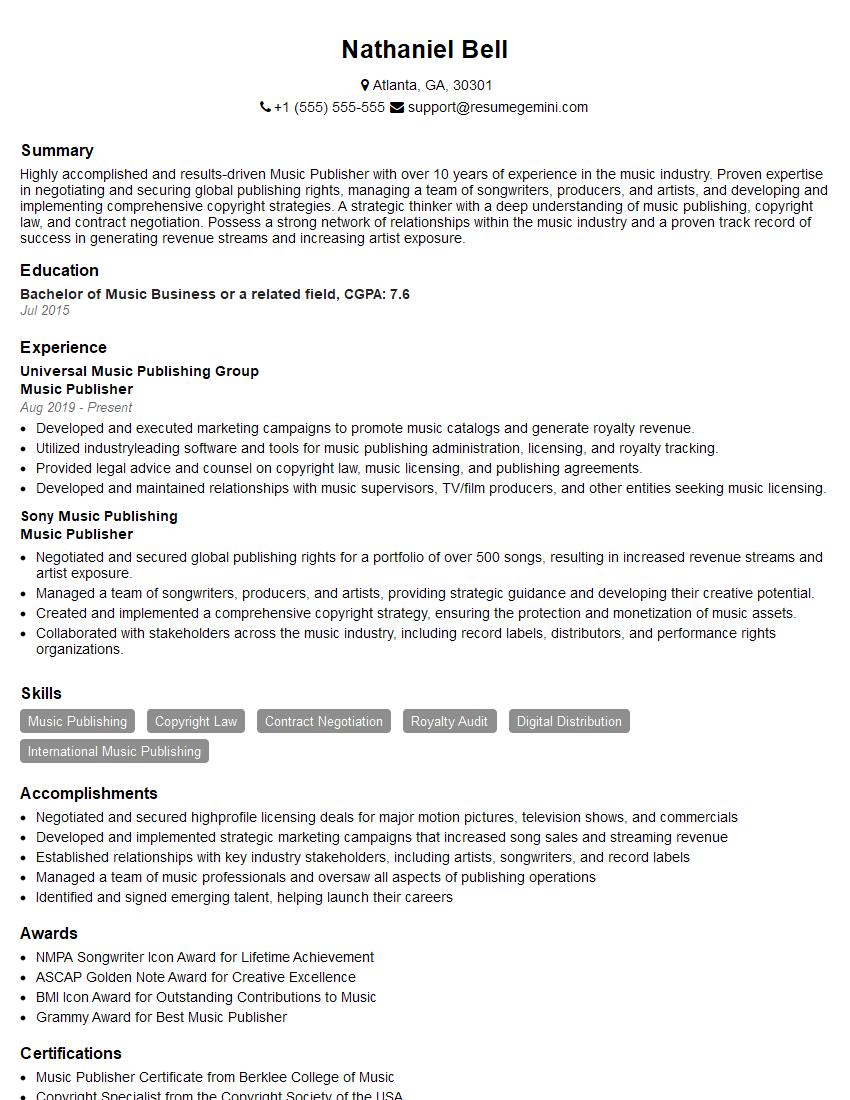
Music Publisher Resume Sample
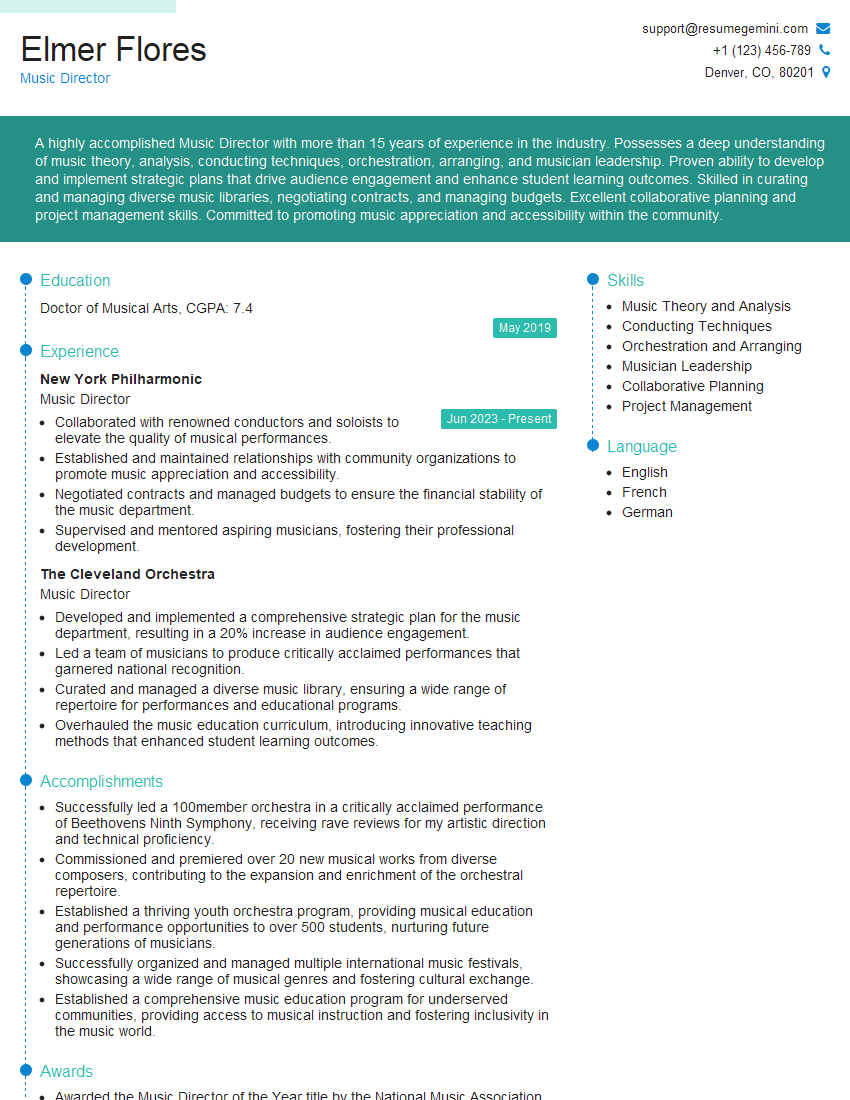
Music Director Resume Sample

Music Teacher Resume Sample
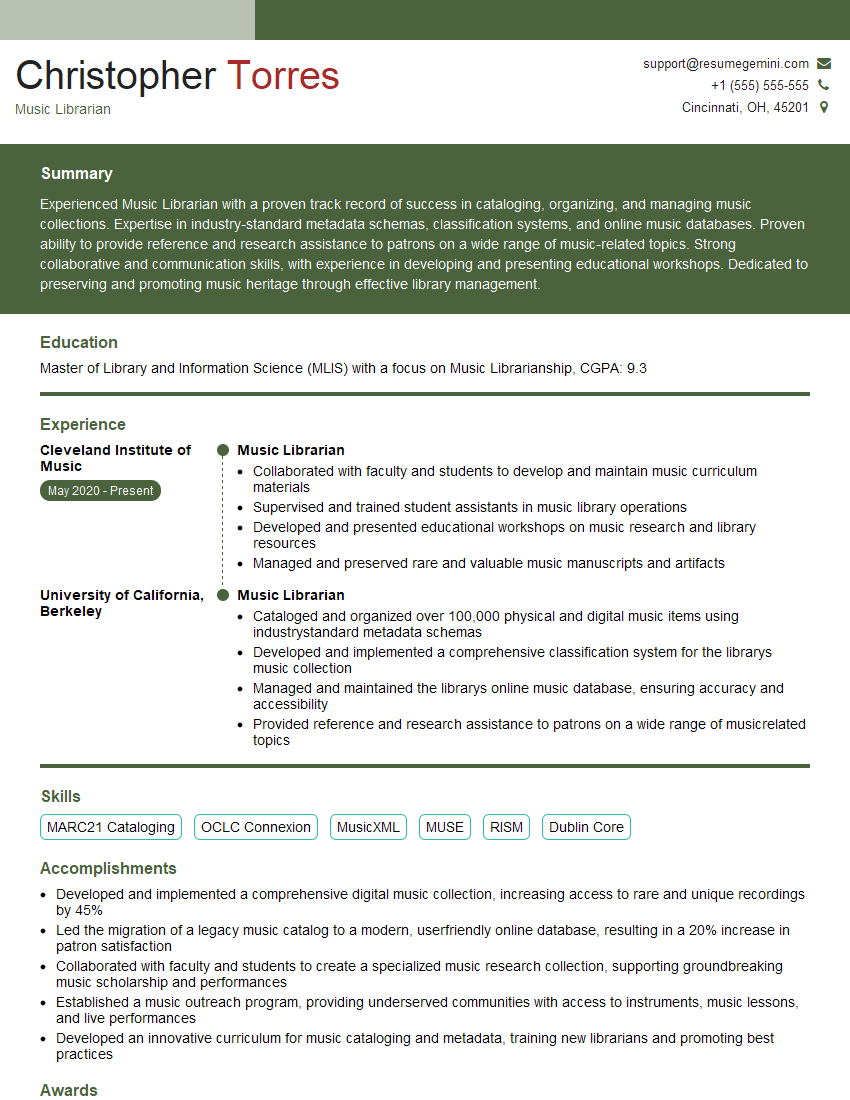
Music Librarian Resume Sample
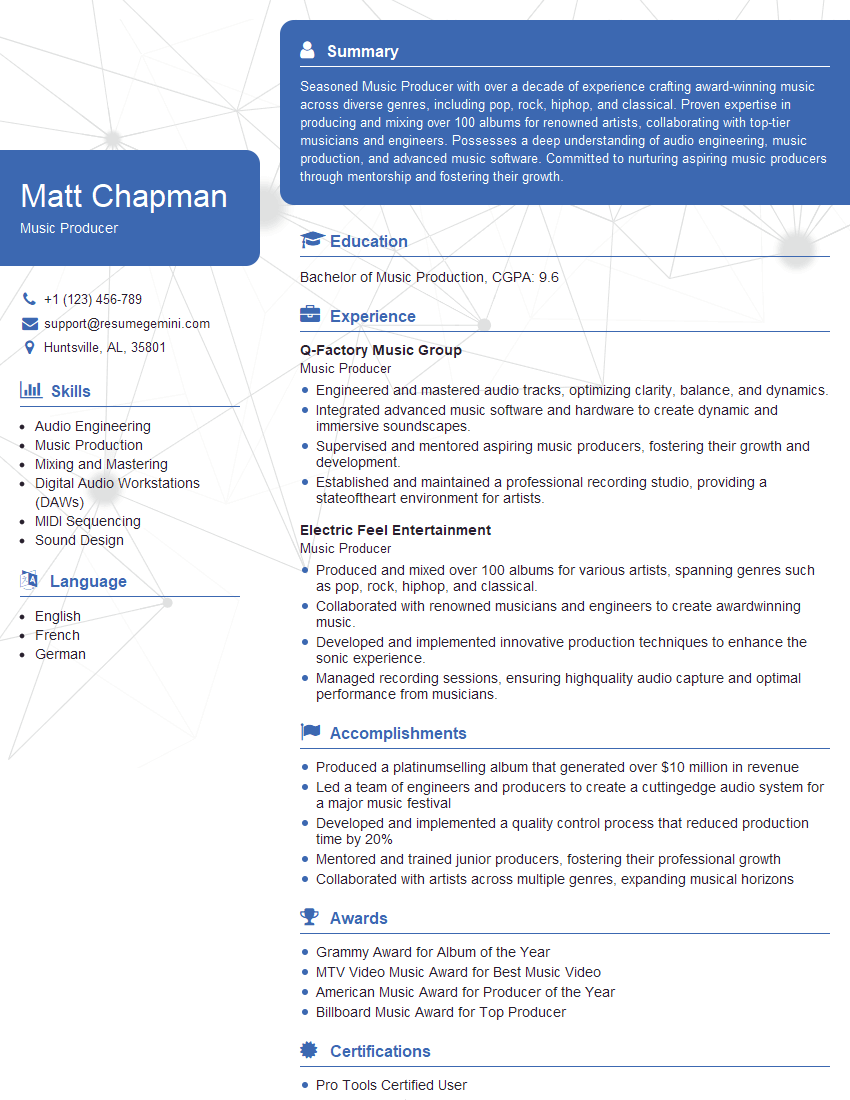
Music Producer Resume Sample
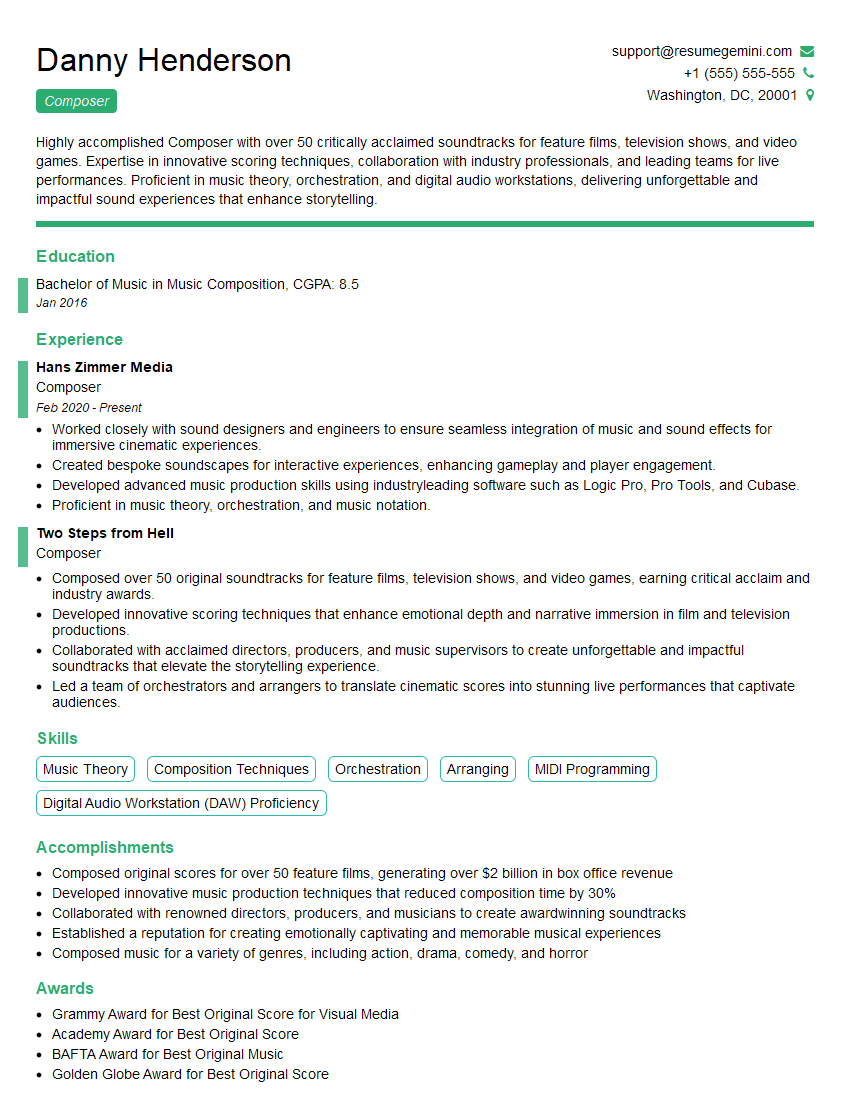
Composer Resume Sample
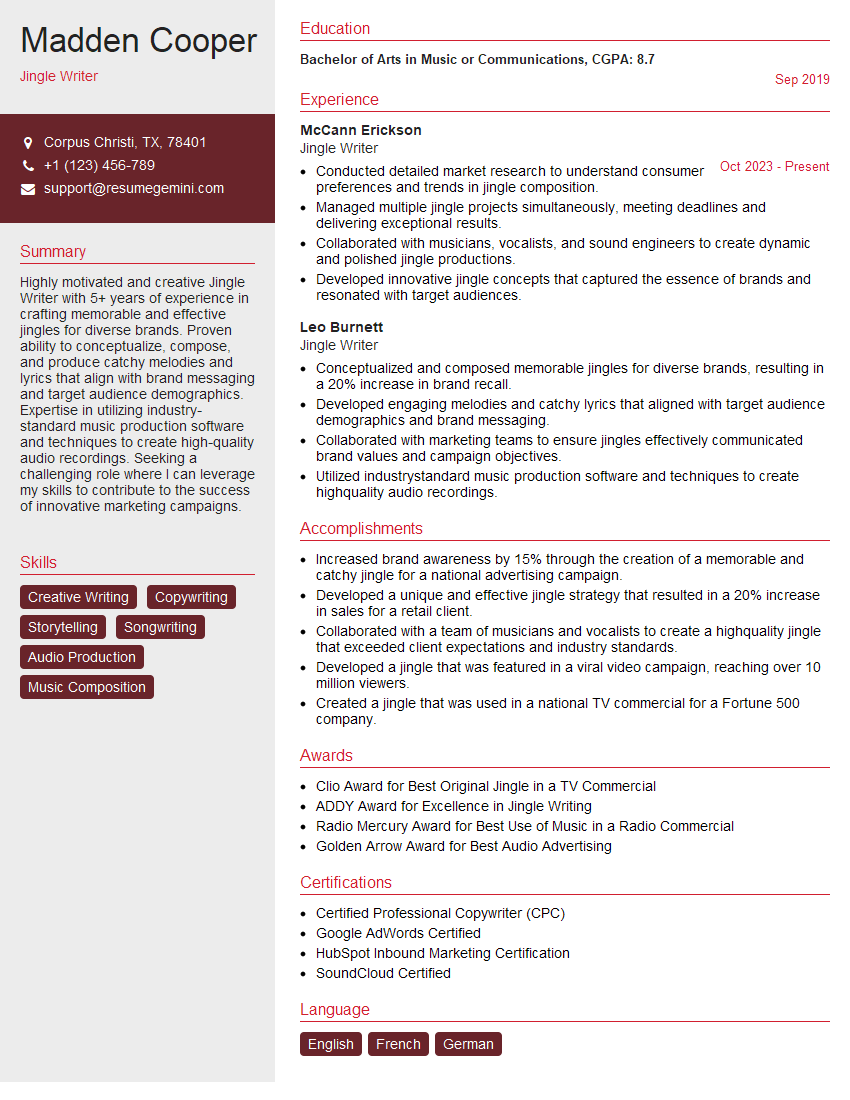
Jingle Writer Resume Sample
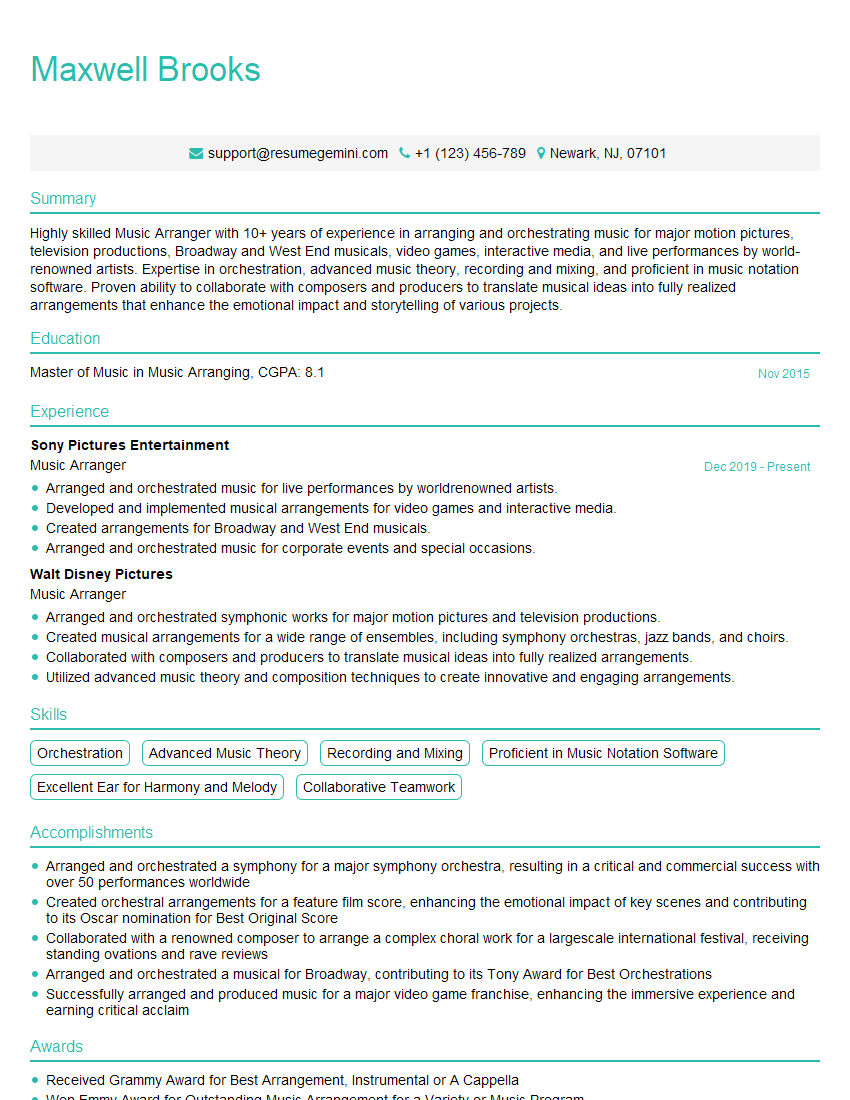
Music Arranger Resume Sample
Orchestrator Resume Sample
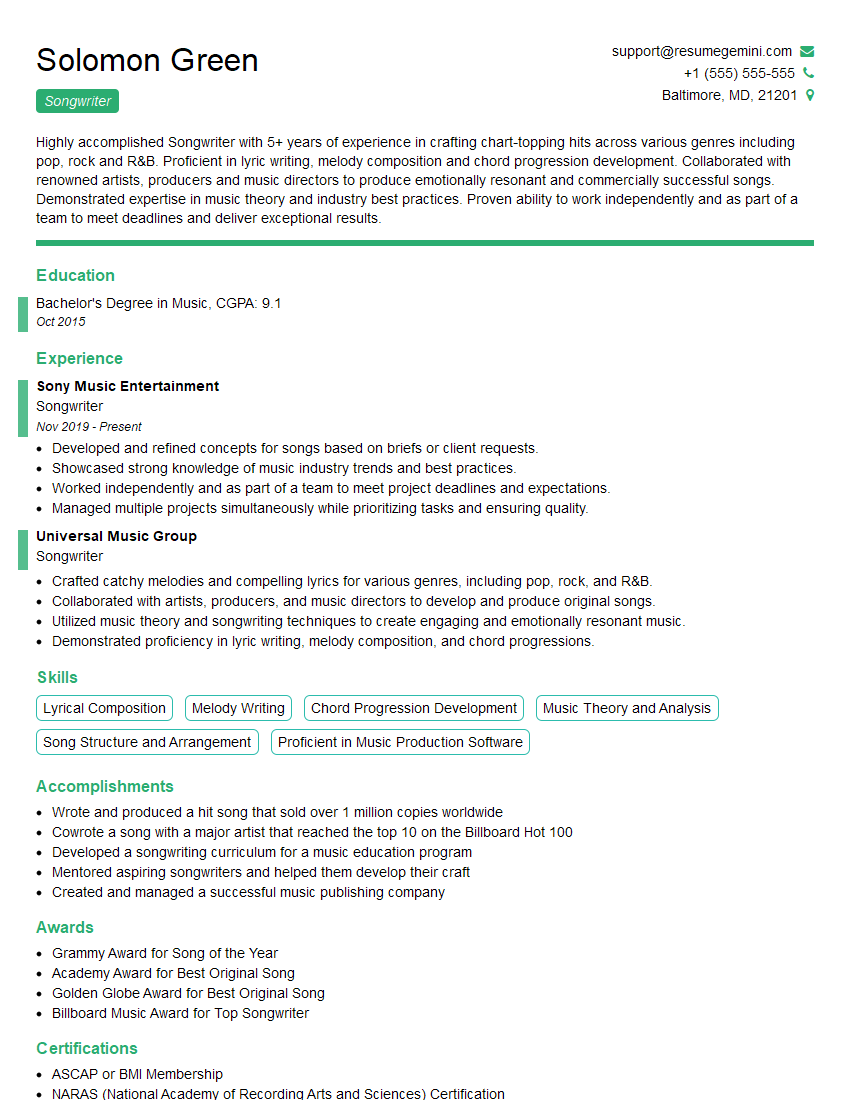
Songwriter Resume Sample
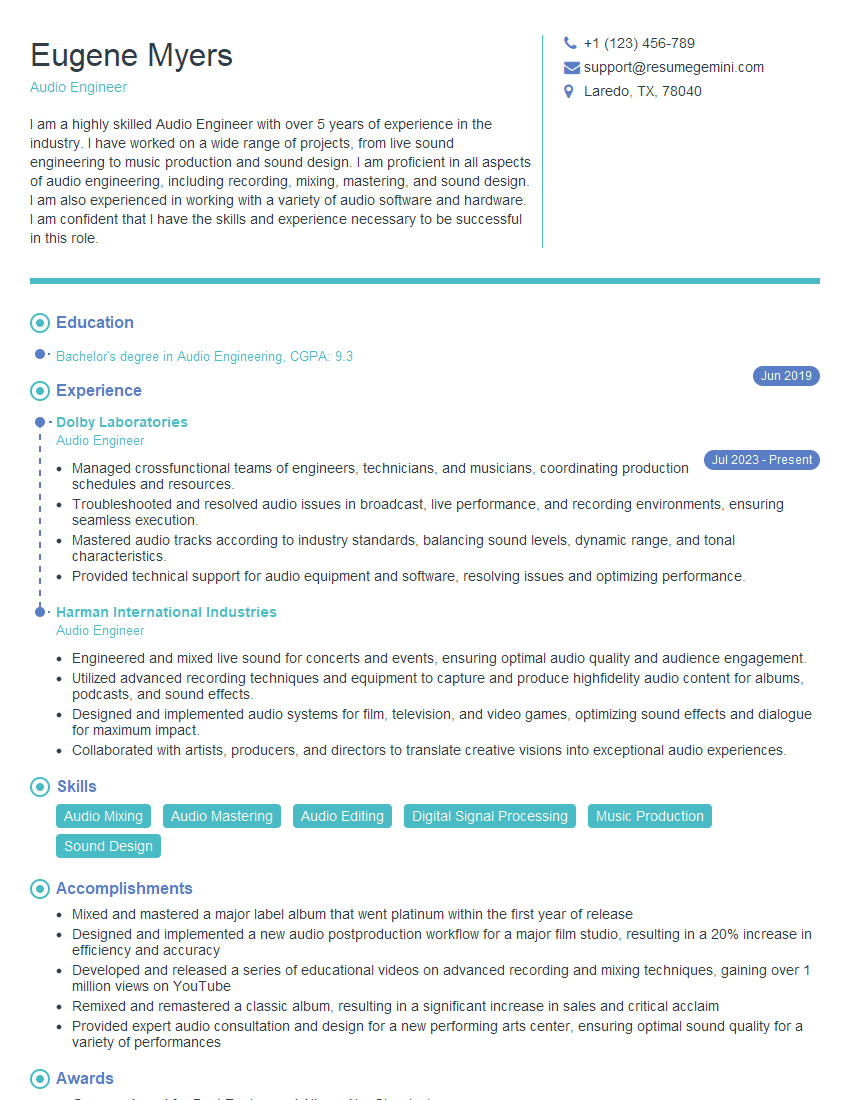
Audio Engineer Resume Sample
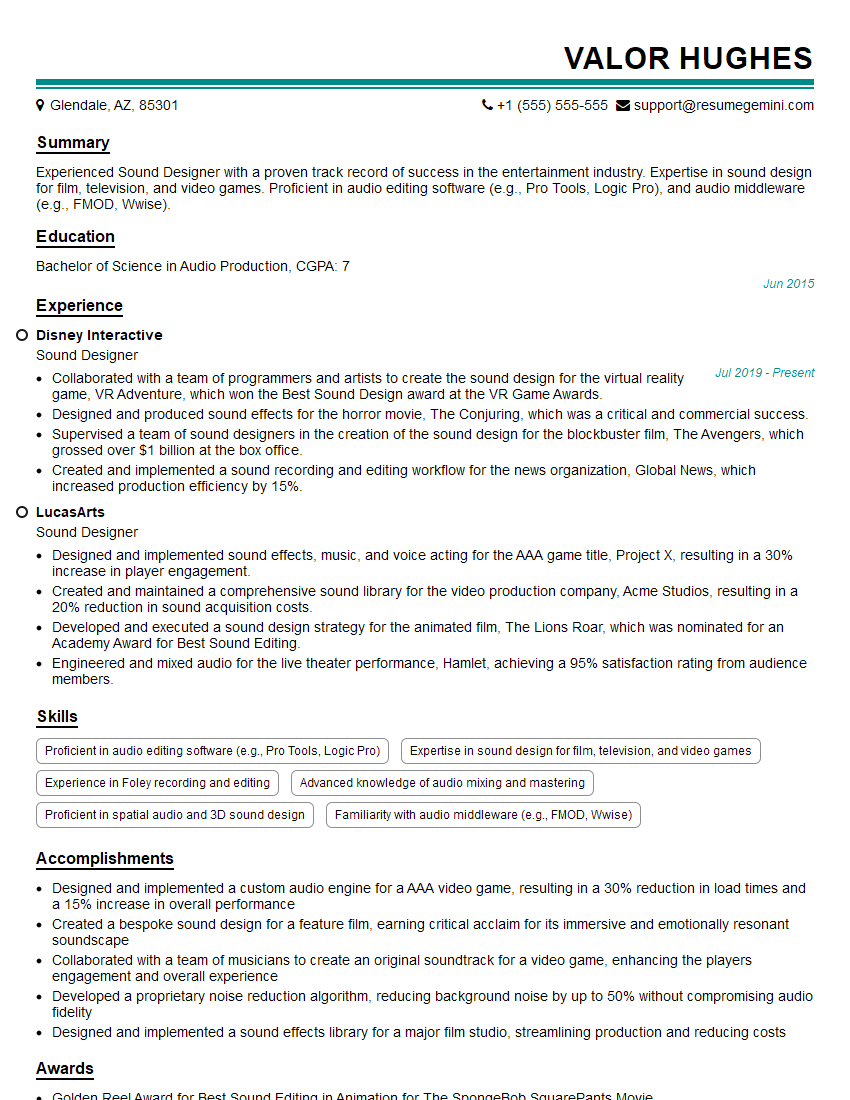
Sound Designer Resume Sample
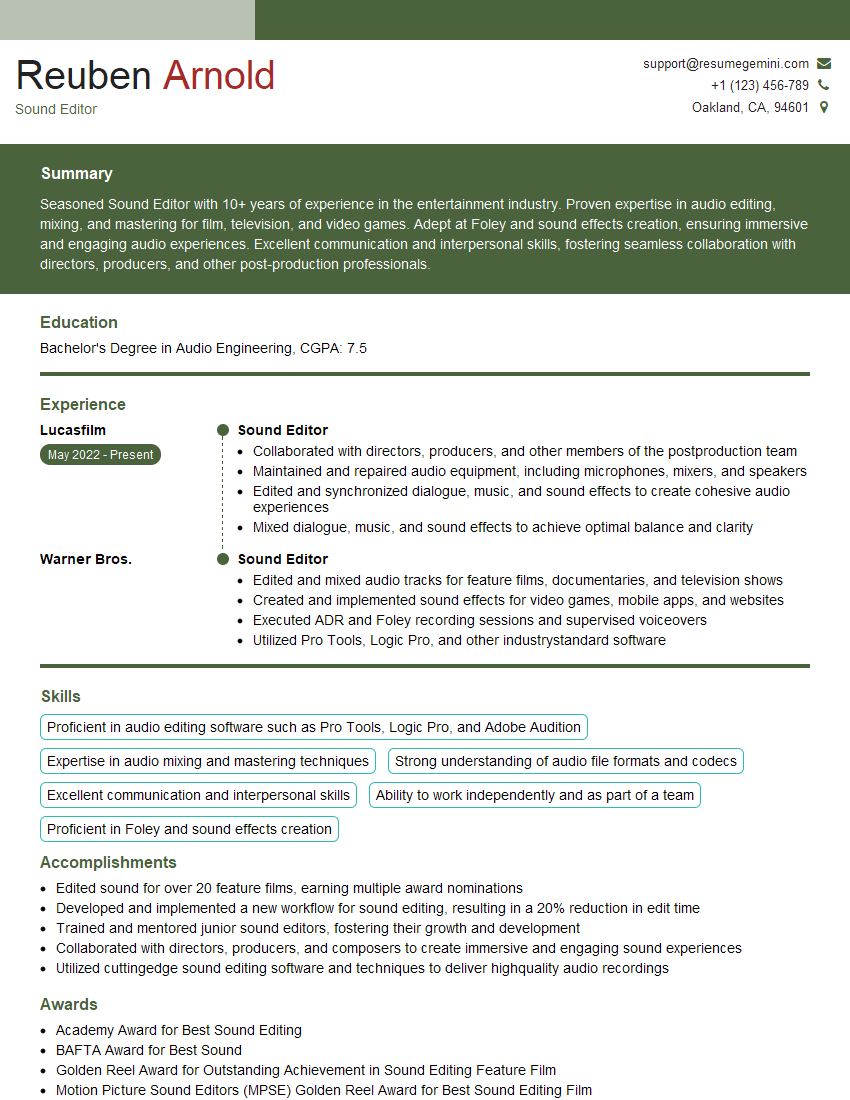
Sound Editor Resume Sample
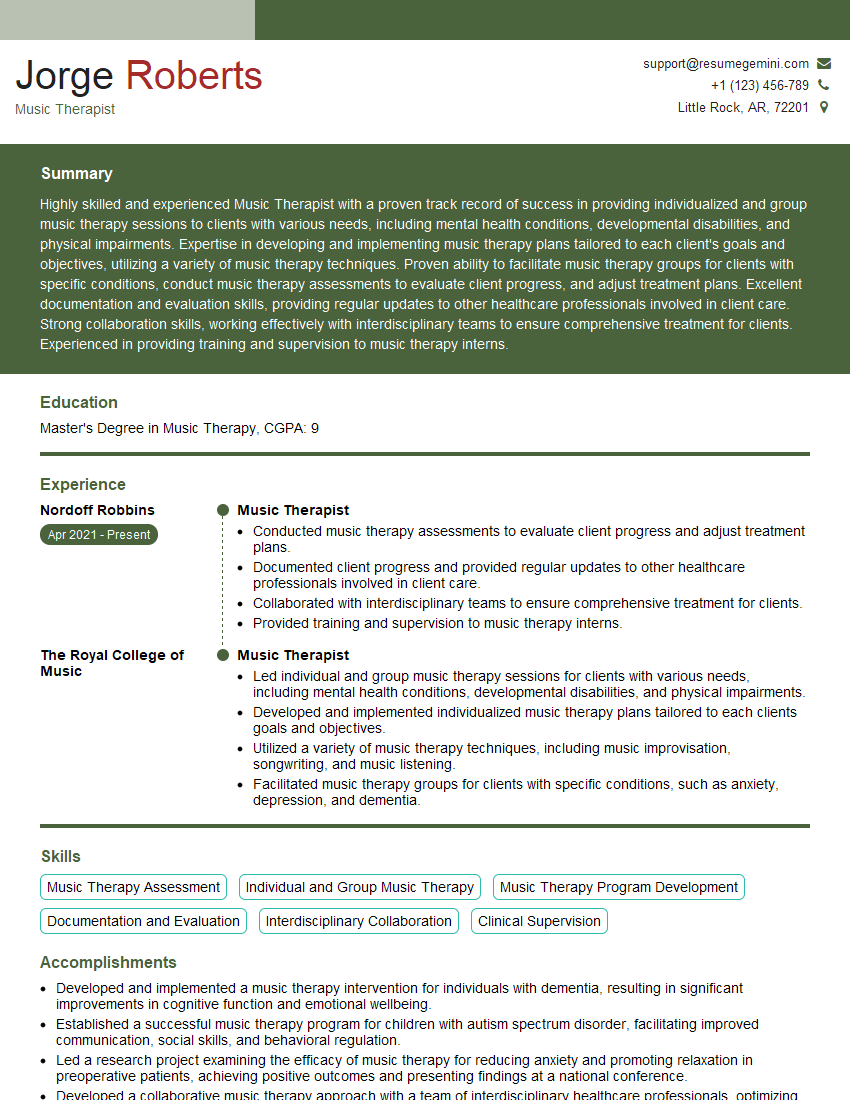
Music Therapist Resume Sample
Explore more articles
Users Rating of Our Blogs
Share Your Experience
We value your feedback! Please rate our content and share your thoughts (optional).
What Readers Say About Our Blog
Very informative content, great job.
good