Every successful interview starts with knowing what to expect. In this blog, we’ll take you through the top Choreographic Development interview questions, breaking them down with expert tips to help you deliver impactful answers. Step into your next interview fully prepared and ready to succeed.
Questions Asked in Choreographic Development Interview
Q 1. Describe your approach to developing a choreography concept from initial idea to final product.
My approach to choreographic development is a highly iterative process, starting with a core concept and evolving through experimentation and refinement. It’s like sculpting – you begin with a rough idea of the form, and then gradually chisel away, adding and removing details until you achieve the desired shape.
- Conceptualization: I begin by brainstorming, often drawing inspiration from music, literature, visual art, or even personal experiences. I develop a thematic core, a central idea or emotion I want to convey.
- Musical Analysis: If the piece involves music, I thoroughly analyze its structure, rhythm, melody, and dynamics. I look for moments of tension and release, acceleration and deceleration – these elements directly inform the movement vocabulary.
- Movement Exploration: This is where I experiment with different movement styles, improvisations, and motifs. I work with dancers, if available, to discover the physical embodiment of the concept. This phase is all about trying things out, discarding what doesn’t work, and refining what does.
- Structure and Sequencing: I arrange the chosen movements into a coherent sequence, considering the overall narrative arc and emotional flow. Transitions between movements are crucial; they should be smooth yet surprising, creating both unity and variety.
- Refinement and Polishing: This involves countless rehearsals, where I fine-tune details, adjust timing, and perfect the execution of each movement. Feedback from dancers is invaluable at this stage. The final product is a refined expression of the initial concept, honed through rigorous practice and creative adjustments.
For example, for a piece exploring the theme of isolation, I might begin with simple, repetitive movements, gradually building in complexity and intensity as the piece progresses, culminating in a powerful, yet ultimately solitary, final pose.
Q 2. Explain your process for collaborating with a director or other creative professionals.
Collaboration is the cornerstone of successful choreography. I believe in open communication and mutual respect. My process involves:
- Initial Meetings: Early discussions with the director and other creative professionals are crucial to establishing shared understanding of the piece’s goals, themes, and overall artistic vision.
- Open Dialogue: Throughout the creative process, I maintain ongoing communication, sharing my ideas and receiving feedback. This is a back-and-forth process, a collaborative conversation where everyone’s input is valued.
- Compromise and Adaptation: I am flexible and willing to adapt my ideas to accommodate the input of others. Choreography is not a solo endeavour; it’s a team effort that requires mutual compromise and a willingness to experiment.
- Clear Communication: I use visual aids, such as sketches or storyboards, and verbal descriptions to clearly convey my choreographic ideas to the director and other team members.
In one project, the director emphasized a specific emotional tone for a scene. Through dialogue, we found that incorporating elements of slow, deliberate movement, contrasted with sudden bursts of energy, would successfully portray this emotion.
Q 3. How do you adapt your choreographic style to suit different performance genres?
Adaptability is essential for a choreographer. My style adapts depending on the genre. Think of it as a chameleon – changing its colour to match its surroundings.
- Classical Ballet: Requires precision, elegance, and adherence to traditional vocabulary. My approach here would prioritize technically demanding steps, graceful lines, and storytelling through classical movement.
- Modern Dance: Allows for greater freedom and experimentation. I might incorporate floor work, unconventional body shapes, and unconventional movement patterns to express abstract ideas or emotions.
- Contemporary Dance: Combines elements of classical and modern dance. My approach here would involve blending the precision of classical technique with the fluidity and expressiveness of modern dance.
- Musical Theatre: Demands a blend of storytelling, character development, and clear communication. My choreography would emphasize sharp transitions, dynamic energy, and character-driven movements.
For example, a piece for a classical ballet would focus on refined technique and graceful lines, while a piece for a modern dance performance might explore raw emotion through unconventional movements.
Q 4. How do you incorporate music and rhythm effectively into your choreography?
Music and rhythm are fundamental to choreography. They are not merely accompaniment; they are the driving force, the heartbeat of the dance.
- Rhythmic Mapping: I carefully map out the music’s rhythmic structure, identifying key beats, accents, and changes in tempo. These rhythmic elements dictate the pace, phrasing, and energy of the movements.
- Dynamic Interpretation: I interpret the music’s dynamics, translating changes in volume, intensity, and mood into corresponding changes in movement quality. A crescendo in the music might translate into increasingly energetic and expansive movements.
- Motivic Development: I develop movement motifs, or short, repeated movement phrases, that reflect the music’s melodic and thematic structure. These motifs can be developed and varied throughout the choreography, creating a sense of unity and coherence.
- Spatial Relationships: I use the spatial dimensions – the stage space – to visually reflect the music’s structure. For example, a repetitive musical phrase might be represented by a repeated pattern of movement across the stage.
In a recent piece, a sudden shift in the music’s tempo from slow and melancholic to fast and energetic was mirrored by a corresponding change in the choreography, from languid, flowing movements to sharp, staccato steps.
Q 5. Describe your method for teaching and communicating choreography to dancers.
Teaching choreography is as much about communication as it is about technique. My method involves:
- Demonstration: I demonstrate the movements myself, providing a clear visual model for the dancers to follow.
- Verbal Instruction: I provide detailed verbal instructions, using clear, concise language and anatomical terminology. I break down complex movements into smaller, manageable steps.
- Individual Attention: I provide individual feedback and adjustments to ensure each dancer understands and executes the choreography correctly. I address individual needs and skill levels.
- Rehearsal Process: I utilize a structured rehearsal process, beginning with basic steps and gradually building in complexity. I use visual aids such as videos or diagrams.
- Feedback and Iteration: I encourage open communication and welcome feedback from the dancers. The rehearsal process is an iterative one, with adjustments made based on the dancers’ input and overall progress.
I often use storytelling and imagery to help dancers understand the intended emotion and meaning behind the movements. For example, I might describe a particular movement as ‘flowing like a river’ or ‘sharp as a knife’, helping to create a clearer mental image.
Q 6. How do you ensure the safety of dancers during rehearsals and performances?
Ensuring dancer safety is paramount. My approach includes:
- Warm-up and Cool-down: I always begin rehearsals with a thorough warm-up and end with a cool-down routine to prepare muscles and prevent injury.
- Proper Technique: I emphasize proper technique in all movements, teaching dancers to execute steps correctly to minimize the risk of injury.
- Safe Rehearsal Environment: I maintain a safe and organized rehearsal space, ensuring there are no tripping hazards or obstacles. The space should be properly ventilated.
- Modifications and Alternatives: I offer modifications and alternative movements for dancers with injuries or limitations, ensuring everyone can participate safely.
- Communication and Observation: I maintain open communication with dancers, encouraging them to report any discomfort or pain immediately. I observe dancers closely during rehearsals for any signs of fatigue or injury.
I remember one instance where a dancer experienced some back pain. We immediately modified a specific movement, adapting it to accommodate her discomfort while maintaining the integrity of the choreography.
Q 7. Explain your experience working with diverse groups of dancers with varying skill levels.
Working with diverse groups of dancers with varying skill levels is a rewarding challenge. My approach involves:
- Differentiated Instruction: I adapt my teaching methods to accommodate different skill levels, providing additional support for less experienced dancers and more challenging variations for advanced dancers.
- Individual Attention and Feedback: I provide individualized feedback, tailoring my instructions to meet the specific needs of each dancer. This includes providing encouragement and constructive criticism.
- Collaborative Environment: I foster a collaborative and supportive learning environment, encouraging dancers to learn from each other and work together.
- Clear Communication: I ensure clear communication to all dancers, using simple and accessible language.
- Positive Reinforcement: I emphasize positive reinforcement, celebrating successes and encouraging persistence.
In one project, I worked with a group of dancers with widely varying experience levels. By providing tailored instruction, adapting the choreography to accommodate different skill sets, and fostering a supportive atmosphere, we were able to create a unified and cohesive performance that showcased the unique talents of each dancer.
Q 8. How do you incorporate improvisation into your choreographic process?
Improvisation is the lifeblood of my choreographic process. It’s not just about spontaneous movement; it’s a crucial tool for discovery and pushing creative boundaries. I often begin with a period of free improvisation with dancers, encouraging them to explore movement phrases without predetermined structure. This allows me to observe their individual movement vocabulary and identify unique qualities to incorporate into the piece. For example, during the development of my piece ‘Ephemeral Echoes,’ I had the dancers improvise to a specific rhythmic structure, focusing on weight shifts and floorwork. Analyzing the resulting movements, I identified a recurring motif that became a central theme of the choreography, reflecting the piece’s ethereal quality. This initial improvisational phase then informs the structured sections, allowing for organic growth of ideas and a sense of authenticity within the choreography.
Q 9. How do you handle challenges or unexpected issues during the creative process?
Challenges are inevitable in the creative process, and they often lead to unexpected breakthroughs. For instance, during the production of ‘Urban Rhythms,’ a key dancer injured their ankle close to the premiere. Instead of panicking, I worked collaboratively with the dancers and my assistant choreographer. We adjusted sections of the choreography, focusing on movement patterns that minimized weight-bearing and emphasized upper body movement. We also incorporated some previously discarded improvisational material that naturally suited the altered dynamics. The unexpected injury forced us to re-evaluate the piece, and the outcome was surprisingly more nuanced and emotionally resonant than the initial conception. This situation highlighted the importance of adaptability and collaborative problem-solving in choreography.
Q 10. How do you manage time constraints and deadlines in a fast-paced production environment?
Managing time constraints requires meticulous planning and efficient workflow. I start by creating a detailed production schedule, breaking down the process into manageable phases: initial concept development, improvisation and exploration, refinement and structuring, rehearsal schedule, costume and prop integration, and finally, the technical rehearsal and premiere. This schedule serves as a roadmap, but it’s crucial to be flexible. I also prioritize tasks, focusing on the most critical elements first. Regular check-ins with the dancers and the production team ensure everyone is on track. Clear communication and a collaborative spirit are vital to navigate the pressures of a fast-paced environment. For example, during the ‘City Lights’ production, we had a very tight rehearsal schedule. To stay on track, we utilized short, intense rehearsal sessions focused on specific sequences, followed by video review and individual feedback. This maximized our limited time while ensuring quality.
Q 11. Explain your knowledge of different dance techniques and styles.
My background encompasses a wide range of dance techniques and styles, including Ballet, Modern, Contemporary, Jazz, and elements of African and Indian dance. Ballet provides a strong foundation in technique, precision, and body control; Modern dance allows for exploration of expressive movement and emotional depth; Jazz contributes to rhythm and musicality; while African and Indian dance styles bring a richness of cultural expression and unique movement qualities. I understand how each technique contributes to storytelling, emotional impact, and visual aesthetic. This knowledge enables me to create diverse and nuanced choreography tailored to specific artistic intentions. For example, in my piece ‘Across Cultures’ I combined elements of contemporary dance with Indian Bharatanatyam to reflect the fusion of cultures.
Q 12. How do you use spatial dynamics and staging to enhance storytelling in your work?
Spatial dynamics and staging are integral to effective storytelling. The use of levels, proximity, and pathways of movement can subtly or dramatically influence audience interpretation. For example, placing a character in isolation on a high platform can highlight their vulnerability or power, whereas having dancers interact closely can show intimacy or conflict. In my piece ‘Silent Scream’, the use of contrasting spatial arrangements – tight formations symbolizing oppression followed by expansive movements representing liberation – significantly amplified the narrative. Careful consideration of lighting and set design further enhances the spatial impact, reinforcing the emotional arc of the story.
Q 13. Describe your experience working with costumes and props in your choreography.
Costumes and props are not mere accessories; they are crucial elements shaping the narrative and visual impact of my choreography. I work closely with costume designers to create outfits that reflect the personality and emotional state of the characters, while ensuring the costumes are functional and allow for freedom of movement. For example, flowing fabrics in ‘Whispers of the Wind’ reflected the piece’s ethereal quality, while structured costumes in ‘Steel Heart’ emphasized strength and resilience. Props are incorporated strategically, enhancing the storytelling and providing dancers with additional tools for expression. In ‘Lost in Time,’ the use of antique clocks and scattered letters created a visually engaging and emotionally poignant portrayal of memory and nostalgia.
Q 14. Explain your process for selecting music for a dance piece.
Music selection is a critical aspect of my process. It’s not merely background music; it’s the emotional and rhythmic foundation upon which the choreography is built. I often begin by exploring various genres, paying close attention to the mood, tempo, dynamics, and harmonic structure of the music. The music must resonate with the themes and emotional intent of the choreography. For ‘Echoes of the Soul,’ I carefully selected a piece of classical music that mirrored the introspective and emotionally layered nature of the narrative, creating a symbiotic relationship between music and movement. Sometimes, I may even collaborate with composers to create original scores tailored specifically to the choreography, enhancing the symbiotic interplay between movement and sound.
Q 15. How do you ensure the emotional impact of your choreography connects with the audience?
Ensuring emotional impact in choreography hinges on understanding the story you want to tell and translating it into physical movement. It’s not just about the steps; it’s about the intention behind them. I achieve this through several key strategies:
Storytelling through movement: Each movement should contribute to a narrative arc, conveying emotions like joy, sorrow, anger, or hope. For example, sharp, angular movements might represent conflict, while flowing, circular movements could symbolize peace or serenity.
Dynamic use of space: How dancers use the stage – their proximity to each other, their level changes (high, low, middle) and their pathways – all influence the emotional resonance. A dancer isolated in a large space can convey loneliness, while a tightly clustered group might communicate unity or tension.
Musicality and timing: The rhythm, tempo, and dynamics of the music profoundly impact the emotional tone. I meticulously select music that complements and enhances the intended emotions of the choreography, ensuring the dancers’ movements synchronize precisely with the musical phrasing.
Facial expressions and body language: Dancers are storytellers; their faces and subtle body language need to be considered as integral parts of the storytelling process. I work closely with dancers to help them express the desired emotion authentically.
For instance, in a recent piece about resilience, I used sharp, staccato movements during moments of hardship, gradually transitioning to smoother, more expansive movements as the character overcame their challenges. The audience’s emotional response was palpable; they could feel the character’s journey.
Career Expert Tips:
- Ace those interviews! Prepare effectively by reviewing the Top 50 Most Common Interview Questions on ResumeGemini.
- Navigate your job search with confidence! Explore a wide range of Career Tips on ResumeGemini. Learn about common challenges and recommendations to overcome them.
- Craft the perfect resume! Master the Art of Resume Writing with ResumeGemini’s guide. Showcase your unique qualifications and achievements effectively.
- Don’t miss out on holiday savings! Build your dream resume with ResumeGemini’s ATS optimized templates.
Q 16. How do you balance artistic vision with the technical limitations of a performance space?
Balancing artistic vision with technical limitations requires adaptability and creative problem-solving. I address this by:
Site-specific choreography: I often begin by thoroughly assessing the performance space – its dimensions, height restrictions, stage machinery, lighting capabilities, and even the acoustics. This informs my initial design concepts, preventing conflicts later in the process.
Adapting movement vocabulary: If the space is small, I might opt for more intimate, contained movements. In a large space, I might employ expansive gestures and utilize the full depth of the stage. Conversely, height restrictions might lead me to design choreography that primarily uses the floor or avoids complex lifts.
Collaboration with technical team: Early and consistent communication with lighting designers, sound technicians, and stage managers is crucial. Their expertise helps me realize my artistic vision within the given constraints. For example, they can advise me on the feasibility of certain lighting effects or stage mechanisms.
Creative compromises: Sometimes, compromises are necessary. I might need to adjust specific elements of the choreography to accommodate the technical realities, but I always strive to maintain the core emotional and thematic essence of the piece.
In one instance, I had to adapt a grand finale that originally called for flying dancers. Due to venue limitations, we creatively substituted that sequence with a powerful ground-based movement that utilized dynamic lighting to create a similar visual effect and emotional impact.
Q 17. Describe your experience using technology in choreography, such as motion capture or digital design tools.
Technology has revolutionized choreography. I’ve extensively used motion capture and digital design tools to enhance my creative process and achieve innovative results.
Motion capture: This allows me to capture and analyze dancers’ movements with precision, enabling fine-tuning of sequences, creating virtual dancers, or even animating non-human characters. I have used this technology to create intricate, layered movement that would be very difficult to achieve through traditional methods.
Digital design tools: Software like Maya or Cinema 4D allows me to visualize choreography in 3D space before rehearsals, helping me identify potential problems or experiment with different staging possibilities. This saves time and resources during the production phase.
Virtual rehearsals and collaboration: Remote collaborations are made easier using these digital platforms, allowing me to share my choreographic work with collaborators regardless of geographic location. This facilitates efficient feedback and revisions.
For example, in a recent project involving a large ensemble, I utilized motion capture to refine intricate group formations, ensuring seamless transitions and preventing collisions. This allowed us to maximize efficiency during rehearsals, focusing more on artistic refinement.
Q 18. How do you adapt choreography to accommodate accessibility needs for performers or audience members?
Accessibility is paramount. I believe that dance should be inclusive, and I strive to make my choreography accessible to performers and audience members with diverse needs.
Adaptive choreography: I create variations in movements that accommodate physical limitations. This might involve simplifying steps, providing alternative movements, or incorporating assistive devices.
Inclusive casting: I actively seek to involve dancers of all abilities and backgrounds, recognizing that diversity enriches the artistic expression.
Accessible performance spaces: I collaborate with venues to ensure accessibility features like wheelchair access, audio description for visually impaired audience members, and sign language interpretation.
Sensory considerations: For some audience members, certain sensory aspects of a performance, such as strobe lighting or loud sounds, could be overwhelming. I collaborate with the production team to ensure the performance environment minimizes this possibility. This might involve providing quiet zones or implementing alternative lighting designs.
In one instance, I collaborated with a dancer who uses a wheelchair to incorporate her chair into the choreography, resulting in a powerful and inspiring performance that celebrated her unique abilities.
Q 19. What is your experience with creating choreography for different age groups or skill levels?
My experience spans diverse age groups and skill levels. I adapt my approach to meet the specific needs and capabilities of each group.
Children: Choreography for children prioritizes age-appropriate movements, clear instructions, and a focus on fun and engagement. I often use games and storytelling to keep them motivated and interested.
Teenagers: This age group often appreciates more complex movements and opportunities for self-expression. I incorporate elements of contemporary, hip-hop, or jazz styles, depending on their preferences.
Adults: Adult classes may focus on specific techniques or styles, offering opportunities for skill development and artistic exploration. I adapt the complexity based on the students’ pre-existing experience and fitness level.
Beginner vs. Advanced: For beginners, I focus on foundational techniques and gradually increase the complexity of movements. For advanced dancers, I focus on refining technique and exploring advanced concepts.
For example, while choreographing a piece for a youth dance group, I incorporated elements of storytelling and character development, allowing them to fully invest in their roles. This approach led to a performance that was both technically impressive and emotionally engaging.
Q 20. Explain your familiarity with copyright laws related to music and choreography.
Understanding copyright law is crucial for any choreographer. I am familiar with the legal frameworks governing the use of music and choreography.
Music licensing: I always obtain the necessary licenses to use copyrighted music in my productions. This involves securing permissions from copyright holders (composers, publishers, etc.) or utilizing royalty-free music libraries.
Choreography copyright: Choreographic works are protected by copyright, and unauthorized copying or reproduction is illegal. While precise legal interpretation can be complex, I understand the principles of copyright protection and ensure my work is appropriately registered and protected where applicable.
Fair use: I understand the concept of “fair use,” a limited exception to copyright that permits certain uses without permission. However, it’s a nuanced area of law, and I always err on the side of caution, seeking permission when in doubt.
Failing to adhere to copyright regulations can lead to legal repercussions, including hefty fines and lawsuits. Therefore, I meticulously research and obtain all necessary clearances before incorporating any copyrighted material into my work.
Q 21. Describe your approach to resolving creative differences with collaborators.
Creative differences are inevitable in collaborative projects. My approach to resolving these conflicts emphasizes respect, open communication, and finding mutually beneficial solutions.
Open dialogue and active listening: I encourage open communication from the outset, creating a safe space where everyone feels comfortable expressing their ideas and concerns. This includes actively listening to all viewpoints, even those that differ from my own.
Compromise and negotiation: Finding common ground often involves compromise. I approach discussions with a willingness to negotiate and find solutions that respect everyone’s contributions. This often involves brainstorming alternatives and exploring different possibilities.
Mediation (if necessary): In situations where disagreements persist, involving a neutral third party mediator can be beneficial. This can help facilitate constructive dialogue and guide the team towards a resolution.
Documentation: Maintaining clear documentation of decisions and agreements helps prevent future misunderstandings. This includes recording meeting minutes, emails, or other forms of communication.
I believe that healthy conflict resolution fosters a more robust and creative environment. Different perspectives lead to a richer, more nuanced final product. My focus is always on achieving a cohesive and high-quality outcome that reflects the strengths of all collaborators.
Q 22. How do you obtain feedback and incorporate suggestions into your work?
Feedback is crucial in choreographic development. I employ a multi-faceted approach. Firstly, I conduct regular observation sessions during rehearsals, noting both technical aspects (precision, timing, dynamics) and artistic expression (emotional impact, storytelling effectiveness). Secondly, I actively solicit feedback from dancers, using structured questionnaires and informal discussions to understand their perspectives on the piece’s challenges and their personal interpretations. Finally, I value the input of external viewers – collaborators, mentors, and test audiences – providing diverse viewpoints. I incorporate suggestions by prioritizing feedback that aligns with the overall artistic vision while remaining open to revisions that enhance clarity, emotional resonance, or technical proficiency. For instance, if a dancer suggests a modification that improves the flow of a particular transition, I’ll readily integrate it, ensuring it doesn’t compromise the piece’s structural integrity.
Q 23. Explain your understanding of the different stages of rehearsal and production processes.
The choreographic process unfolds in distinct stages. The initial conception phase involves brainstorming, researching, and developing the core concept and themes. This could involve exploring musicality, narrative, or abstract ideas. Then comes the composition phase, where I translate the abstract ideas into physical movement. This stage often involves experimentation, improvisation, and careful arrangement of sequences. The rehearsal phase is iterative. It begins with teaching the choreography to the dancers, focusing on individual technique and understanding of the movements. Subsequent rehearsals refine the movement, synchronization, and overall performance quality. We work on dynamics, phrasing, and emotional delivery. Finally, production encompasses the technical elements—lighting, sound, costumes, and set design. The integration of these elements with the choreography is crucial during this final stage, with dress rehearsals allowing for fine-tuning and problem-solving before the final performance. Think of it as building a house: conception is the blueprint, composition the framing, rehearsals are the interior design and fittings, and production is the landscaping and final touches.
Q 24. How do you maintain your creativity and motivation as a choreographer?
Maintaining creativity and motivation requires a conscious effort. I actively seek inspiration from diverse sources—art exhibitions, live music performances, films, and even everyday observations. Collaborating with other artists and engaging in cross-disciplinary projects expands my creative horizons. I also prioritize self-care, including physical exercise and mindful practices that help clear my mind and foster fresh perspectives. To combat creative blocks, I often engage in improvisational movement sessions, allowing myself to experiment without judgment. Furthermore, setting realistic goals and celebrating milestones along the way helps maintain a positive and productive mindset. For example, after completing a challenging project, I deliberately take time for reflection and celebrate the accomplishment, which helps rejuvenate my creative energy.
Q 25. What are your strengths and weaknesses as a choreographer?
My strengths lie in conceptualizing innovative and emotionally resonant choreography. I excel at crafting detailed movement vocabulary that effectively conveys narrative or abstract ideas. I’m also skilled at working collaboratively, fostering a supportive and creative environment for dancers. However, I am still working on delegation. While I have a strong vision, I sometimes struggle with relinquishing control during the production process, learning to trust the expertise of other professionals involved. This is something I am actively addressing through mentorship and by consciously delegating tasks to build trust and improve efficiency.
Q 26. Describe your long-term goals as a choreographer.
My long-term goal is to establish myself as a leading choreographer, creating work that pushes creative boundaries and resonates with diverse audiences. I aspire to expand my work internationally, collaborating with prominent artists and companies across different genres. I also aim to contribute to the broader choreographic field through mentorship and teaching, nurturing the next generation of choreographers. Ultimately, I want my work to spark dialogue, challenge perceptions, and leave a lasting impact on the world of dance.
Q 27. What is your salary expectation for this role?
My salary expectation for this role is commensurate with my experience and the responsibilities involved. I am open to discussing a competitive compensation package that reflects the value I bring to the company.
Q 28. Do you have any questions for me?
Yes, I have a few questions. Firstly, what opportunities are there for professional development within the company? Secondly, what is the company’s approach to collaboration with other artists and organizations? Finally, could you describe the company’s typical production timeline for new works?
Key Topics to Learn for Choreographic Development Interview
- Movement Vocabulary & Style: Understanding diverse movement styles (ballet, modern, jazz, contemporary, etc.) and their application within a choreographic context. Consider how different styles inform storytelling and emotional expression.
- Compositional Principles: Applying principles like motif development, phrasing, dynamics, spatial awareness, and use of levels to create compelling and structured choreography. Be prepared to discuss how you achieve unity and variety in your work.
- Collaboration & Communication: Articulating your artistic vision effectively to dancers and other collaborators. Discuss your experience giving clear and constructive feedback, and receiving and integrating feedback from others.
- Musicality & Rhythm: Demonstrating a deep understanding of how movement relates to music, including syncopation, phrasing, and dynamics. Be ready to discuss examples of how you’ve used music to inspire movement.
- The Choreographic Process: Explain your approach to the creative process, from initial inspiration to final product. Discuss your methods for generating ideas, refining concepts, and problem-solving during the creative process. Include your approach to rehearsal and adaptation.
- Technical Proficiency & Innovation: Display knowledge of various dance techniques and demonstrate your ability to adapt and innovate within a given style or framework. Think about unique challenges you’ve faced and overcome.
- Storytelling & Theme: Discuss how you use movement to convey a narrative, explore a theme, or evoke an emotion. Prepare examples of how your choreography conveys meaning beyond the purely physical.
Next Steps
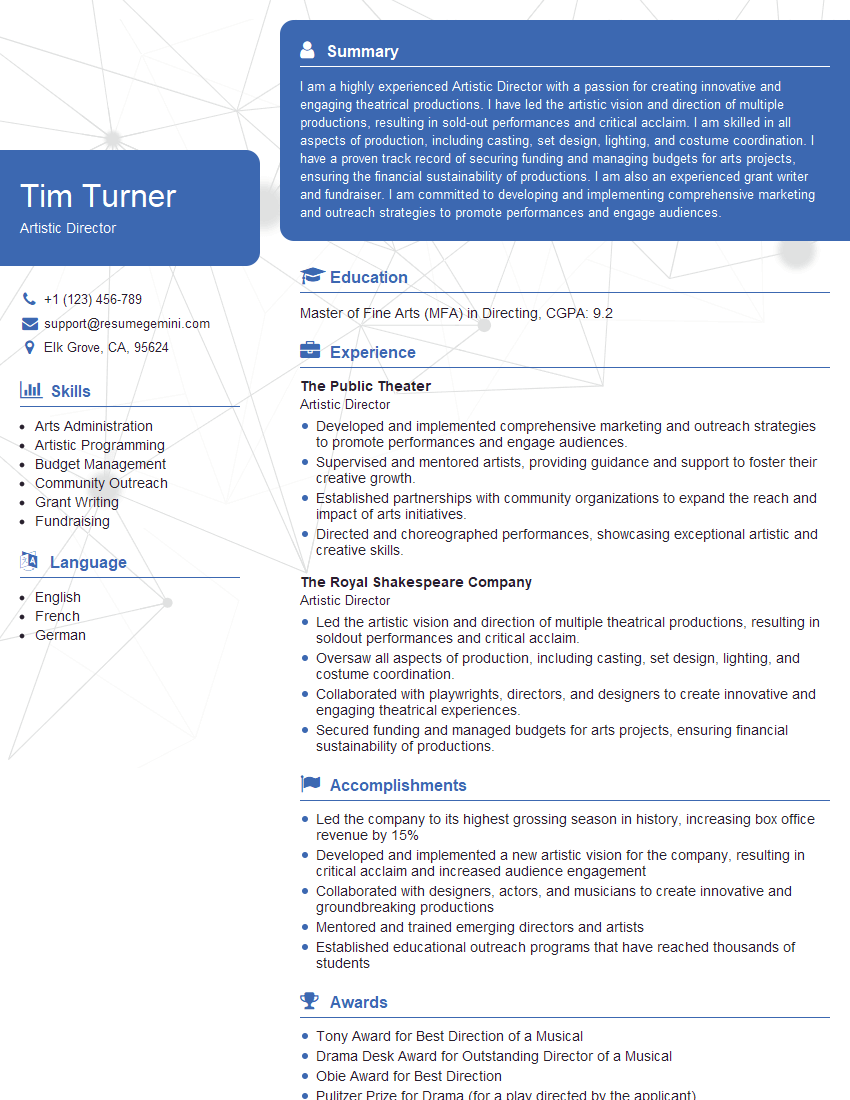
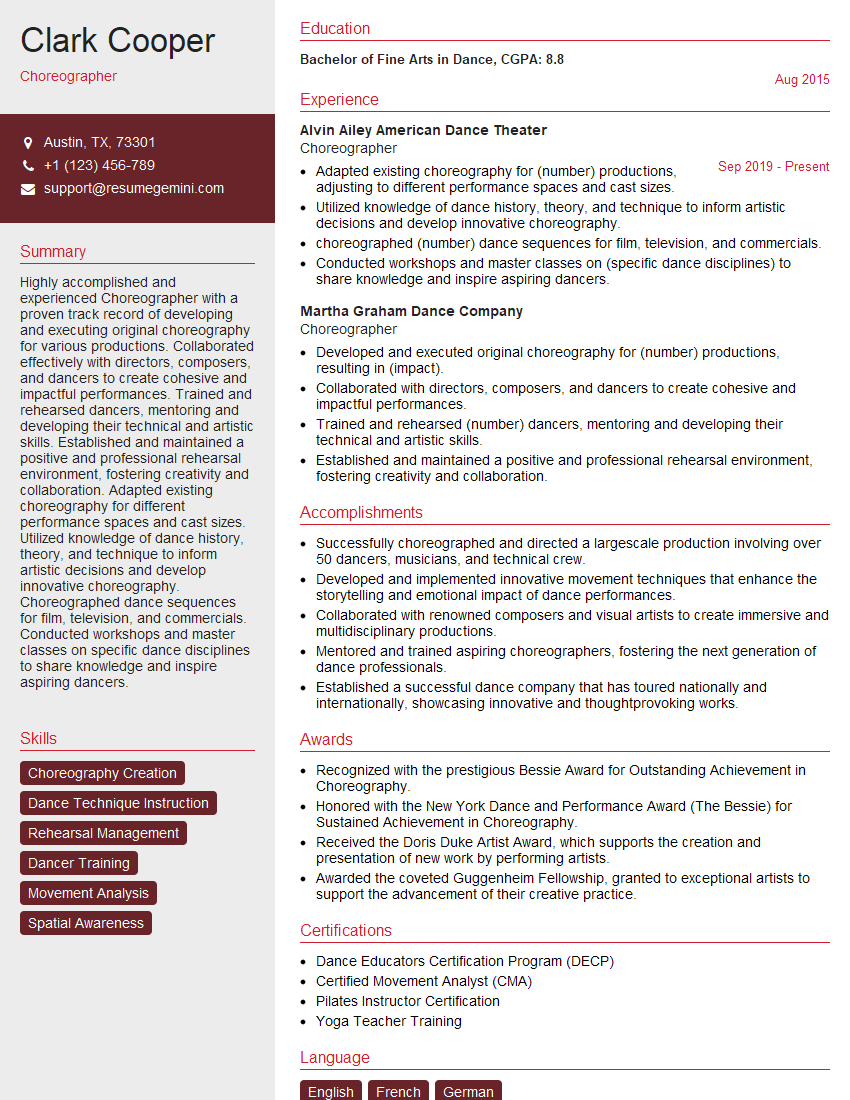
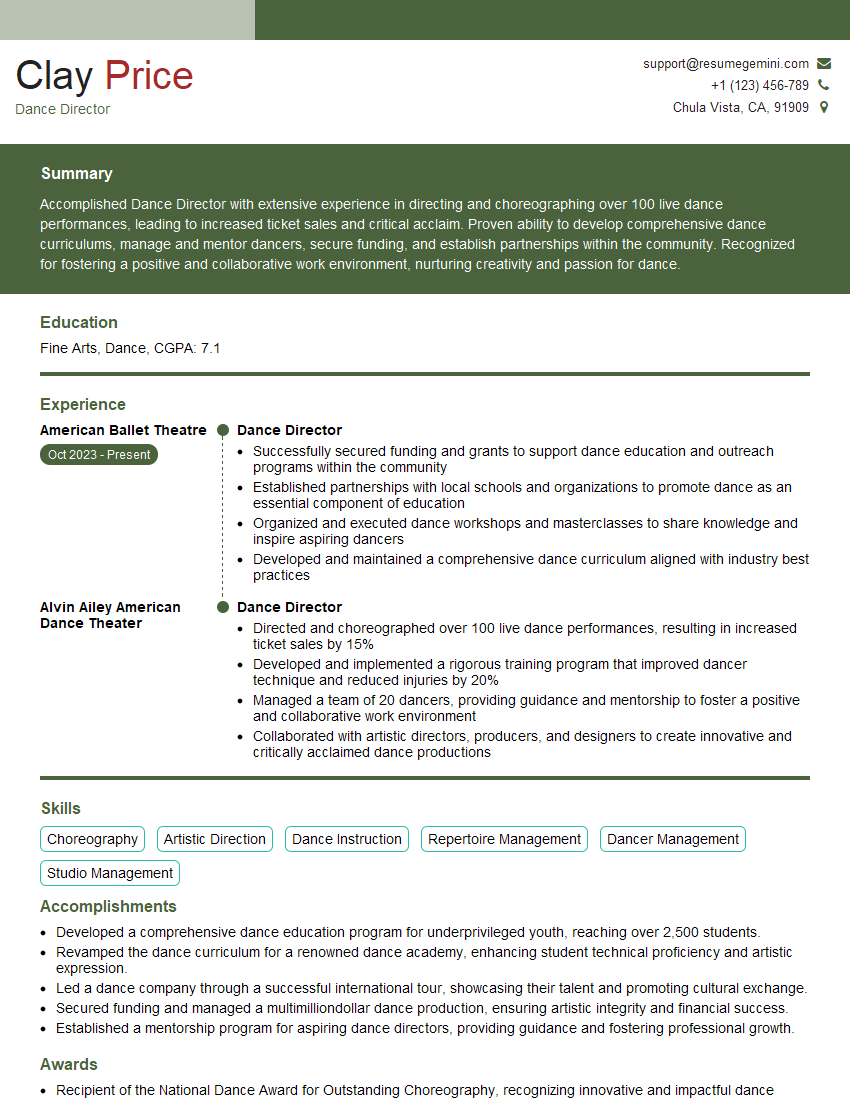
Mastering Choreographic Development is crucial for advancing your career, opening doors to exciting opportunities in various artistic settings. A well-crafted resume is your first step towards landing your dream role. An ATS-friendly resume, optimized for applicant tracking systems, significantly increases your chances of getting noticed. ResumeGemini is a trusted resource to help you build a professional and impactful resume that showcases your skills and experience effectively. Examples of resumes tailored to Choreographic Development are available to guide you. Invest time in crafting a resume that truly reflects your unique talent and passion for choreography – it’s your key to unlocking your career potential.
Explore more articles
Users Rating of Our Blogs
Share Your Experience
We value your feedback! Please rate our content and share your thoughts (optional).
What Readers Say About Our Blog
Very informative content, great job.
good