The thought of an interview can be nerve-wracking, but the right preparation can make all the difference. Explore this comprehensive guide to Church Music Leadership interview questions and gain the confidence you need to showcase your abilities and secure the role.
Questions Asked in Church Music Leadership Interview
Q 1. Describe your experience leading congregational singing.
Leading congregational singing is about more than just conducting; it’s about fostering a genuine sense of worship and participation. My experience involves a multifaceted approach encompassing careful song selection, dynamic leading, and creating a welcoming environment for all voices, regardless of skill level. I focus on clear articulation of the melody, providing visual cues as needed, and encouraging active listening. In one particular church, I successfully implemented a system where we started with simpler hymns, gradually introducing more complex pieces throughout the year, building confidence and improving the overall congregational singing. This involved regular workshops focused on breathing techniques and vocal projection. The visible improvement in the congregation’s confidence and enjoyment was incredibly rewarding.
I also believe in the power of storytelling. Before each hymn, I often share a brief anecdote about its history or composer, creating a deeper connection between the congregation and the music. This personal touch fosters a more meaningful and engaged worship experience.
Q 2. How do you select appropriate music for various liturgical seasons?
Selecting appropriate music for various liturgical seasons requires careful consideration of theological themes and liturgical context. I begin by examining the liturgical calendar and identifying the overarching themes for each season. For example, during Advent, the music should reflect themes of hope, anticipation, and the coming of Christ; Lent calls for music expressing repentance, sacrifice, and reflection; Easter triumphantly celebrates resurrection with joyful and celebratory music. My selection process involves a blend of traditional and contemporary pieces, ensuring a balance that caters to a diverse congregation. I research hymns and anthems that resonate with the season’s message, considering both the lyrics and the musical style.
I also actively seek out new and relevant contemporary pieces that speak to the congregation’s experience and express the season’s themes in a fresh and engaging way. This ensures a dynamic and relevant worship experience throughout the year. I regularly review my music library, updating it with new acquisitions and refining my selection for different seasons, seeking feedback from the congregation to ensure the music remains meaningful and relevant.
Q 3. Explain your approach to rehearsing a choir.
My approach to choir rehearsals is built on a foundation of mutual respect, clear communication, and a focus on both musical precision and spiritual growth. Rehearsals begin with a warm-up that focuses on vocal health and technique, establishing a positive atmosphere for the session. I prioritize thorough explanation of musical concepts, breaking down complex passages into smaller, manageable sections. I encourage questions and provide individual attention where necessary. I use a blend of traditional teaching methods and innovative techniques, such as incorporating listening exercises to enhance musicality and rhythmic precision. I also actively solicit feedback from the choir members, valuing their insights and experiences.
Furthermore, I aim to foster a sense of community and belonging within the choir. We incorporate social activities and team-building exercises during rehearsals, strengthening camaraderie and improving group dynamics. The ultimate goal is not simply to achieve flawless musical performance but to cultivate a sense of shared purpose and spiritual growth through musical expression. For example, during rehearsals for a complex piece of choral music, I’ve found that breaking down the piece into smaller sections and working with individual sections first allows for a more accurate and efficient rehearsal.
Q 4. What software or technology are you proficient in for music production in a church setting?
In the context of church music production, I’m proficient in several software applications. My expertise includes Logic Pro X and Ableton Live for recording, mixing, and mastering audio. I’m also skilled in using Sibelius for creating and editing scores, which is crucial for preparing arrangements for the choir and instrumentalists. For managing audio and video recordings, I use Final Cut Pro and Adobe Audition. I am also comfortable using various digital audio workstations (DAWs), allowing me to adapt to different technological setups and work efficiently in various church environments.
Beyond software proficiency, I understand the importance of proper microphone techniques, audio balancing, and sound system operation, ensuring a clear and professional sound for services. I’ve also used video conferencing software like Zoom to manage remote rehearsals during challenging circumstances.
Q 5. How do you manage the musical contributions of various volunteers?
Managing the musical contributions of volunteers requires effective communication, appreciation, and delegation. I start by establishing clear roles and expectations for each volunteer, providing them with sufficient training and support. Regular meetings facilitate open communication, allowing volunteers to share their ideas and concerns, fostering a sense of ownership and shared responsibility. I assign tasks based on individual skills and preferences, ensuring each member feels valued and challenged appropriately. Recognition and appreciation are vital – I acknowledge individual contributions and celebrate the collective achievements of the team.
For example, I’ve successfully managed a diverse team of instrumentalists and vocalists by holding regular planning meetings where we collaboratively chose music, assigning instrumental parts and soloists based on individual strengths. This collaborative approach ensures everyone feels actively involved and invested in the success of the music ministry.
Q 6. Describe your experience with budgeting and resource allocation for music ministry.
Budgeting and resource allocation for music ministry require meticulous planning and financial responsibility. I begin by creating a detailed budget, identifying all anticipated expenses, such as music scores, equipment maintenance, instrument repairs, and potential guest artist fees. I carefully research vendors and compare prices to find cost-effective solutions while maintaining a high standard of quality. Regular monitoring of expenses ensures that the budget stays on track. I proactively seek funding opportunities through grants and donations, often involving the congregation in fundraising activities. Transparent communication regarding the budget with church leadership is critical to ensuring accountability and ongoing support for the music program.
In the past, I successfully secured a grant to purchase new sound equipment, resulting in a significant upgrade to the church’s audio-visual capabilities. This careful budgeting and grant writing showcased my ability to manage resources efficiently and effectively.
Q 7. How do you incorporate contemporary and traditional music styles in your church services?
Incorporating contemporary and traditional music styles in church services is about finding a balance that honors the past while embracing the present, catering to the diverse preferences within the congregation. My approach involves carefully selecting pieces that complement each other, creating a cohesive and meaningful worship experience. Traditional hymns offer familiarity and a sense of continuity, while contemporary songs can resonate with younger generations and offer fresh expressions of faith. I ensure that both styles are presented with reverence and artistry, reflecting the deep spiritual meaning of the music.
I might, for example, begin the service with a traditional hymn, followed by a contemporary song of praise, then incorporate a more reflective traditional piece before concluding with a joyful, contemporary anthem. This thoughtful sequencing ensures a balanced and engaging service that speaks to both generations. I am also mindful of the musicians’ skills and comfort levels, selecting pieces that are appropriately challenging yet accessible for all involved.
Q 8. How do you handle musical disagreements among team members?
Musical disagreements are inevitable in any team, especially in a church music setting where diverse musical tastes and skill levels converge. My approach focuses on fostering open communication and collaborative problem-solving.
Active Listening: I prioritize creating a safe space where everyone feels comfortable expressing their opinions and concerns. I actively listen to understand each perspective, even if I don’t initially agree.
Identifying Common Goals: I remind the team of our shared objective – to create uplifting and spiritually meaningful music for the congregation. This helps refocus the discussion on the overarching purpose.
Compromise and Collaboration: Instead of imposing my preferences, I facilitate a discussion to find common ground. This might involve suggesting alternative arrangements, exploring different musical styles, or finding a middle ground between contrasting viewpoints.
Fair and Transparent Decision-Making: If a final decision needs to be made, I ensure it’s transparent and explained clearly to everyone. I strive for fairness and involve the team as much as possible in the decision-making process.
Individual Skill Development: If disagreements stem from differing skill levels, I offer individualized mentoring and training to help team members improve their skills and confidence. This can prevent future conflicts.
For example, in one instance, disagreement arose about the tempo for a particular hymn. By engaging in open dialogue, we discovered one musician preferred a slower, more reflective tempo, while another favored a more upbeat pace. We ultimately agreed on a compromise tempo that honored both perspectives while maintaining the hymn’s integrity.
Q 9. Describe your experience working with children or youth in a music context.
Working with children and youth in a music context requires patience, creativity, and a deep understanding of their developmental stages. My experience includes leading children’s choirs, teaching music classes, and directing youth ensembles.
Age-Appropriate Activities: I adapt musical activities to match the age and abilities of the children and youth. This includes using age-appropriate songs, games, and teaching methods. For younger children, this may involve incorporating movement and play into music lessons. Older youth can be challenged with more complex musical arrangements and composition activities.
Building Confidence: I prioritize creating a supportive and encouraging environment where children and youth feel safe to express themselves musically, regardless of their skill level. Positive reinforcement and celebrating successes, however small, are crucial.
Engaging Curriculum: I develop engaging and interactive music curricula that cater to their interests and learning styles. This might involve incorporating themes from their favorite stories, movies, or even current events into the musical repertoire.
Creative Expression: I encourage creative expression through improvisation, songwriting, and music composition. This empowers them to actively participate in the musical process and develop a deeper appreciation for music.
In one youth choir, for instance, the students were struggling with memorizing a complex piece. By incorporating movement and incorporating their ideas into the arrangement (changing some rhythms to match their suggestions), we made the process fun and engaging; resulting in a successful performance.
Q 10. How do you maintain the quality of your music program over time?
Maintaining the quality of a music program requires consistent effort and a multi-faceted approach. It’s not a one-time achievement, but an ongoing process.
Regular Evaluation and Feedback: I regularly assess the program’s effectiveness through surveys, informal feedback from congregation members and musicians, and self-reflection. This feedback informs improvements and adjustments.
Ongoing Training and Development: Providing opportunities for musicians to improve their skills through workshops, masterclasses, or private lessons is critical. This ensures the team stays fresh and motivated.
Repertoire Selection: Carefully selecting a diverse and engaging repertoire that caters to the congregation’s needs and preferences is essential. This ensures the music remains relevant and spiritually meaningful.
Recruitment and Retention: Actively recruiting new talent while retaining experienced musicians is crucial. A supportive team environment is essential for retaining members.
Adaptability and Innovation: Staying abreast of current trends in church music and incorporating new technologies or approaches enhances the program’s appeal and effectiveness.
For example, to address declining attendance at our youth choir rehearsals, we implemented a feedback system and incorporated more contemporary music into our repertoire, dramatically increasing participation and engagement.
Q 11. How do you assess the musical skills of potential volunteers?
Assessing potential volunteers requires a balanced approach that considers both musical skill and personal qualities.
Auditions: I conduct informal auditions to assess musical skills, including sight-reading, vocal/instrumental technique, and musicality. This allows me to gauge their ability to contribute to the ensemble.
Interview: I conduct an interview to evaluate their personality, commitment level, and understanding of the church’s musical style and liturgical context. This ensures a good fit within the team.
References: I often solicit references from previous musical directors or conductors to gain further insight into their abilities and work ethic.
Trial Period: A trial period allows me to observe their performance within the team setting and assess their ability to collaborate effectively.
It’s important to remember that a supportive and welcoming environment is key to attracting and retaining talented volunteers. Prioritizing their strengths and providing appropriate mentorship will help them contribute their best to the church community.
Q 12. What is your philosophy on music’s role in worship?
My philosophy on music’s role in worship centers on its ability to enhance and deepen the spiritual experience. Music is a powerful tool that can evoke emotions, inspire reflection, and connect us to the divine.
Liturgical Context: I believe music should always be considered within the context of the liturgical service. The music should complement and enhance the overall worship experience, not overshadow it.
Spiritual Meaning: I prioritize selecting music with spiritual depth and meaning, whether it’s traditional hymns or contemporary worship songs. The lyrics and melodies should convey a message of faith, hope, and love.
Accessibility and Inclusivity: I believe music should be accessible and inclusive to all members of the congregation, regardless of their musical background or preferences. This might involve incorporating a variety of musical styles and providing opportunities for congregation participation.
Corporate Worship: Music facilitates corporate worship by uniting the congregation in shared expression of faith. It provides a means of expressing our collective praise and adoration to God.
Music, therefore, is not merely entertainment; it’s a vital component of the liturgical service that helps us connect with God and one another.
Q 13. How do you train and mentor musicians?
Training and mentoring musicians involves a holistic approach that extends beyond technical skill development.
Individualized Training: I tailor training to each musician’s skill level and learning style. This might involve providing private lessons, group workshops, or online resources.
Repertoire Coaching: I provide coaching on specific pieces, focusing on musical interpretation, technique, and expression.
Ensemble Rehearsals: I conduct regular rehearsals focusing on ensemble blending, balance, and dynamics. I use a positive and constructive approach to encourage improvement.
Leadership Development: For those with leadership potential, I offer opportunities to lead sections within the ensemble or take on responsibility for specific tasks.
Spiritual Growth: I encourage spiritual growth by linking musical practice with faith formation. Music is a powerful tool for deepening one’s spiritual life.
For example, I mentored a young musician who lacked confidence in their abilities. Through individualized coaching, encouragement, and providing opportunities to lead smaller sections, their confidence blossomed, leading to significant growth in their musical skills and leadership capabilities within the choir.
Q 14. Describe your experience with copyright laws concerning church music.
Understanding and adhering to copyright laws concerning church music is crucial to avoid legal issues and maintain ethical practices. Copyright laws protect musical compositions, lyrics, and arrangements.
Licensing Agreements: Many organizations offer licensing agreements (such as CCLI) that grant permission to use copyrighted music in church services. It’s crucial to secure the appropriate license before using any copyrighted material.
Public Domain Music: Music in the public domain is free to use. However, it’s important to understand the criteria for a piece to fall into the public domain, often determined by age and copyright registration.
Original Compositions and Arrangements: Using original compositions or arrangements written by the church’s musicians or members is another legal approach.
Performance Rights Organizations: Organizations like ASCAP, BMI, and SESAC manage the performance rights of many copyrighted works and will often have different licensing fees depending on the size and type of church performance.
Transparency and Record-Keeping: Maintaining accurate records of purchased licenses and used music is critical for ensuring compliance and to avoid legal complications.
Ignoring copyright laws can result in significant fines and legal repercussions. It’s vital to educate oneself about these laws and maintain accurate records of music usage and licensing.
Q 15. How do you ensure accessibility for musicians with varying skill levels?
Ensuring accessibility for musicians of all skill levels is paramount in building a thriving church music program. It’s about creating an environment where everyone feels valued and empowered to contribute, regardless of their experience.
- Tiered Repertoire: I offer a variety of musical pieces, ranging from simple hymns easily learned by beginners to more complex arrangements for advanced musicians. This allows everyone to participate at their comfort level, fostering a sense of achievement and belonging.
- Mentorship Program: I establish a mentorship system where experienced musicians can guide and support those with less experience. This personalized approach helps beginners develop their skills while creating a stronger sense of community.
- Regular Workshops and Rehearsals: I conduct regular workshops and rehearsals specifically designed to cater to different skill sets. These sessions provide focused instruction and opportunities for practice, strengthening individual skills and ensemble performance.
- Clear Communication and Feedback: I prioritize open communication and constructive feedback. This ensures everyone understands expectations and receives guidance tailored to their individual needs. Regular check-ins and one-on-one sessions provide a safe space for questions and concerns.
For example, in one church I served, we had a dedicated ‘Beginner’s Choir’ that rehearsed separately, gradually integrating into the main choir as their confidence and skills improved. This created a low-pressure environment for growth and fostered a sense of accomplishment.
Career Expert Tips:
- Ace those interviews! Prepare effectively by reviewing the Top 50 Most Common Interview Questions on ResumeGemini.
- Navigate your job search with confidence! Explore a wide range of Career Tips on ResumeGemini. Learn about common challenges and recommendations to overcome them.
- Craft the perfect resume! Master the Art of Resume Writing with ResumeGemini’s guide. Showcase your unique qualifications and achievements effectively.
- Don’t miss out on holiday savings! Build your dream resume with ResumeGemini’s ATS optimized templates.
Q 16. How do you incorporate technology into your music ministry?
Technology plays a vital role in enhancing our church music ministry, making it more engaging and efficient. I strategically incorporate it to improve accessibility, organization, and overall effectiveness.
- Digital Music Libraries: I utilize digital music libraries like Notion or Sibelius to store and organize sheet music, making it easily accessible to all musicians. This eliminates the need for cumbersome physical binders and simplifies the distribution of new material.
- Audio/Video Recording and Playback: Recording rehearsals and services allows for self-assessment and improvement. We use high-quality audio and video equipment to capture performances, offering valuable feedback and opportunities for growth. Playback helps musicians learn parts and refine their techniques.
- Online Collaboration Tools: Tools like Google Drive or Dropbox facilitate collaboration and communication among musicians. This is particularly beneficial for musicians who might not be able to attend all rehearsals in person.
- Presentation Software: During services, PowerPoint or other presentation software can enhance the worship experience by providing lyrics, chord charts, or visual aids that complement the music.
For instance, using a digital music library saved us countless hours in searching for specific pieces and allowed us to easily manage revisions and updates. It also ensured that everyone had access to the most current version of the music.
Q 17. How do you create a welcoming and inclusive environment for musicians?
Creating a welcoming and inclusive environment is essential for fostering a thriving music ministry. It’s about recognizing the unique talents and contributions of each musician and ensuring everyone feels valued and respected.
- Open Communication and Feedback: I promote open dialogue and provide constructive feedback, creating a space where everyone feels comfortable expressing themselves and sharing their ideas.
- Diverse Repertoire: I select a diverse range of musical styles and genres to reflect the cultural backgrounds and preferences of our congregation. This ensures that everyone feels represented and connected to the music.
- Team Building Activities: We participate in team-building activities outside of rehearsals to foster camaraderie and build relationships amongst musicians. This strengthens the sense of community and allows individuals to connect on a personal level.
- Celebrate Individual Contributions: I publicly acknowledge and appreciate the contributions of each musician, emphasizing their unique skills and talents. This reinforces a sense of value and belonging.
In one instance, we created a ‘Music Appreciation’ session where we discussed diverse musical traditions and their relevance to our faith. This broadened our understanding and fostered a more inclusive environment.
Q 18. Describe your experience with program planning and evaluation.
Program planning and evaluation are crucial for a successful music ministry. I employ a structured approach that encompasses strategic planning, implementation, and ongoing assessment.
- Needs Assessment: I begin by assessing the needs of the congregation and the musicians. This involves considering their preferences, skill levels, and overall musical goals.
- Goal Setting: Based on the needs assessment, I set clear, measurable, achievable, relevant, and time-bound (SMART) goals for the music program.
- Program Development: I develop a comprehensive program that aligns with the set goals. This includes selecting music, scheduling rehearsals, and organizing special events.
- Implementation and Monitoring: I meticulously implement the program and regularly monitor its progress, making adjustments as needed.
- Evaluation: I conduct regular evaluations using methods such as surveys, feedback forms, and performance reviews to assess the program’s effectiveness and identify areas for improvement. This allows for ongoing refinement and enhancement of the program.
For instance, by implementing a post-service feedback form, we discovered a preference for more contemporary gospel music. This led us to incorporate more contemporary pieces into our repertoire, increasing congregation engagement.
Q 19. How do you handle requests for specific musical pieces or styles?
Handling requests for specific musical pieces or styles requires careful consideration and a balance between meeting congregational needs and maintaining artistic integrity.
- Open Dialogue: I encourage open dialogue with the congregation to understand their reasons for requesting specific pieces. This allows for a more informed decision-making process.
- Feasibility Assessment: I assess the feasibility of incorporating the requested pieces, considering factors such as the musicians’ skill levels, the availability of arrangements, and the overall context of the service.
- Alternative Suggestions: If incorporating the exact requested piece is not feasible, I offer alternative suggestions that align with the desired style or emotion.
- Gradual Integration: When incorporating new styles or pieces, I implement them gradually to allow musicians time to learn and adapt.
One time, a congregant requested a contemporary song. While it was outside our usual repertoire, we found an arrangement suitable for our skill level and incorporated it after careful rehearsal. This showed responsiveness while maintaining musical quality.
Q 20. How do you maintain a balance between tradition and innovation in church music?
Balancing tradition and innovation in church music is crucial for keeping the ministry relevant and engaging while honoring its heritage. This is not a matter of choosing one over the other, but rather a thoughtful integration of both.
- Respect for Tradition: I acknowledge and respect the importance of traditional hymns and liturgical music. These pieces hold deep meaning for many and form the foundation of our musical heritage.
- Incorporating Contemporary Elements: I strategically incorporate contemporary styles and arrangements to make the music more accessible to younger generations and to reflect the diversity of musical tastes within the congregation. This can include incorporating elements of gospel, pop, or world music.
- Creative Arrangements: I often use creative arrangements of traditional hymns, blending them with contemporary styles to maintain familiarity while adding a fresh perspective.
- Educational Initiatives: I organize workshops and educational sessions to help the congregation understand the historical significance of traditional music and the value of incorporating newer styles.
For example, we often incorporate traditional hymns but arrange them with contemporary instrumentation or a slightly altered rhythm to keep them fresh and engaging. This approach allowed us to connect generations through music.
Q 21. Describe a time you had to resolve a conflict related to music in the church.
Conflict resolution is an inevitable part of leading a church music ministry. Addressing these issues with grace and diplomacy is vital for maintaining harmony and productivity.
In one instance, a disagreement arose between two choir members regarding their assigned parts. One member felt their part was too challenging, while the other felt theirs was too simple. To resolve this:
- Active Listening: I listened to both members’ concerns, ensuring each felt heard and understood.
- Empathy and Validation: I validated their feelings, emphasizing that their contributions were valued regardless of their assigned parts.
- Collaborative Solution: We collaboratively explored potential solutions, including adjusting the parts slightly or offering additional rehearsal time for the more challenging part. Ultimately, we agreed on a compromise that satisfied both musicians.
- Follow-up: After implementing the solution, I followed up with both members to ensure they were satisfied and to maintain open communication.
This experience reinforced the importance of clear communication, empathy, and collaboration in resolving conflicts and maintaining a positive and productive musical environment.
Q 22. How do you communicate effectively with the pastor and church leadership?
Effective communication with pastors and church leadership is paramount. I believe in proactive, transparent, and collaborative relationships. This starts with regular meetings – both formal and informal – to discuss upcoming services, special events, and the overall direction of the music ministry. I present well-defined plans, including song selections and logistical details, ensuring alignment with the church’s theological direction and sermon themes. I actively solicit feedback and address concerns promptly and respectfully. For instance, if a pastor expresses concern about the tempo of a particular hymn, I’ll offer alternative arrangements or explain my musical choices. Open dialogue ensures we’re all working towards a unified worship experience.
- Regular Meetings: Scheduled meetings to discuss upcoming events and ministry plans.
- Transparent Communication: Openly sharing plans, challenges, and successes.
- Active Listening: Valuing the pastor’s and leadership’s perspectives and incorporating feedback.
Q 23. How do you stay current with trends in church music?
Staying current with trends in church music requires a multi-faceted approach. I regularly attend workshops and conferences focused on worship leading and contemporary church music. I actively engage with online resources, including professional journals, blogs, and social media groups dedicated to church musicians. This exposure keeps me informed about emerging styles, techniques, and technologies. Furthermore, I actively listen to various contemporary Christian artists and explore different musical genres to broaden my musical palette and understand the preferences of different generations within the congregation. This allows me to integrate contemporary elements into traditional services, striking a balance between preserving the church’s heritage and connecting with modern worshippers. For example, learning to incorporate elements of Gospel music into a more traditional hymn arrangement can appeal to a broader segment of the congregation.
Q 24. What is your approach to recruiting and retaining musicians?
Recruiting and retaining talented musicians involves creating a welcoming and supportive environment. I use a variety of recruitment methods including announcements in the church bulletin, social media outreach, and word-of-mouth referrals. Auditions are conducted in a supportive and encouraging manner, focusing not only on skill but also on personality and fit within the team. To retain musicians, I focus on fostering a strong sense of community through regular social gatherings, retreats, and opportunities for professional development. Regular feedback and appreciation are crucial; I celebrate individual contributions and recognize accomplishments. Providing clear expectations, fair compensation, and flexible scheduling further contributes to a satisfying experience for the musicians.
Q 25. How do you ensure the music program supports the overall mission of the church?
The music program is integral to the overall mission of the church. I actively collaborate with the pastor and church leadership to ensure that the music selected directly supports the sermon’s message and the church’s overarching theological themes. This includes choosing hymns and songs that reflect the weekly lectionary readings, special events, or current pastoral emphases. For instance, during a series on grace, we’d select music that emphasizes themes of forgiveness, mercy, and redemption. The music is meant to enhance the worship experience, deepen spiritual reflection, and support the overall mission of growing closer to God and serving others.
Q 26. How do you handle musical emergencies during a service?
Handling musical emergencies during service requires preparedness and a calm, decisive approach. This involves having backup musicians or instrumentalists ready to step in for any unexpected absences. I maintain a comprehensive list of substitute musicians and make sure they are familiar with the service’s planned music. In the event of a technical malfunction (e.g., a microphone failure), having backup equipment readily available is crucial. I have a thorough understanding of the sound system and am able to quickly troubleshoot minor issues. Maintaining a calm demeanor and adapting the program as needed will minimize disruption during the service.
Q 27. Describe your experience with sound reinforcement and audio-visual equipment.
I possess extensive experience with sound reinforcement and audio-visual equipment. I’m proficient in operating mixing consoles, microphones, speakers, and other audio equipment. I’m familiar with various audio software and can adjust sound levels, equalization, and effects to achieve optimal sound quality. My experience includes setting up and managing audio-visual presentations, including slideshows and video projections. I understand the importance of sound quality in enhancing the worship experience and can adapt to different venues and technological constraints. Troubleshooting technical problems is a key skill I use often – for example, quickly identifying the source of feedback in a microphone and resolving it before it disrupts the service.
Q 28. How do you balance the needs of the congregation with the artistic expression of the music?
Balancing congregational needs with artistic expression is a delicate but essential aspect of church music leadership. I achieve this by carefully selecting music that is both spiritually meaningful and musically engaging. I strike a balance between traditional hymns that resonate with long-time members and contemporary songs that appeal to younger generations. I prioritize congregational singing, making sure that hymns are chosen that are accessible and familiar to the majority of the congregation. However, I also incorporate opportunities for musical excellence and artistic expression through instrumental solos or special musical ensembles. Feedback from the congregation is essential in making these decisions. Surveys or informal conversations can provide valuable insights into preferences and preferences. The goal is to create a worship experience that is both spiritually enriching and artistically satisfying for all.
Key Topics to Learn for Church Music Leadership Interview
- Musical Proficiency & Style: Demonstrate a comprehensive understanding of various musical styles relevant to church services (e.g., hymns, gospel, contemporary Christian). Be prepared to discuss your experience leading different musical ensembles and adapting styles to suit diverse congregational needs.
- Liturgical Understanding: Show your knowledge of the liturgical calendar, different worship styles, and how music enhances the overall worship experience. Discuss how you integrate music with the sermon and other elements of the service.
- Teamwork & Collaboration: Highlight your experience working with other musicians, vocalists, and technical staff. Describe scenarios where you effectively collaborated to achieve a common musical goal. Discuss conflict resolution and maintaining positive team dynamics.
- Program Planning & Selection: Explain your approach to planning and selecting music for services, considering factors such as congregational preferences, theological themes, and seasonal appropriateness. Discuss your ability to create engaging and meaningful worship sets.
- Vocal Training & Musicianship: Discuss your experience in training vocalists, leading rehearsals, and maintaining a high standard of musical performance. Describe your methods for fostering musical growth within the choir or ensemble.
- Budget Management & Resource Allocation: If relevant to your experience, be prepared to discuss managing musical budgets, acquiring musical resources, and prioritizing expenditures effectively.
- Technological Proficiency: Demonstrate familiarity with music software, audio-visual equipment, and digital music distribution methods relevant to church settings.
- Spiritual Leadership & Discipleship: Articulate your understanding of the spiritual dimensions of church music ministry and how you integrate your faith into your leadership role. Discuss your approach to mentorship and spiritual growth within the musical team.
Next Steps
Mastering Church Music Leadership is crucial for career advancement, opening doors to influential roles within your church community and potentially beyond. An ATS-friendly resume is essential for maximizing your job prospects. To ensure your resume effectively showcases your skills and experience, we strongly encourage you to use ResumeGemini. ResumeGemini provides a powerful platform to build professional, impactful resumes, and we offer examples of resumes tailored to Church Music Leadership to guide you.
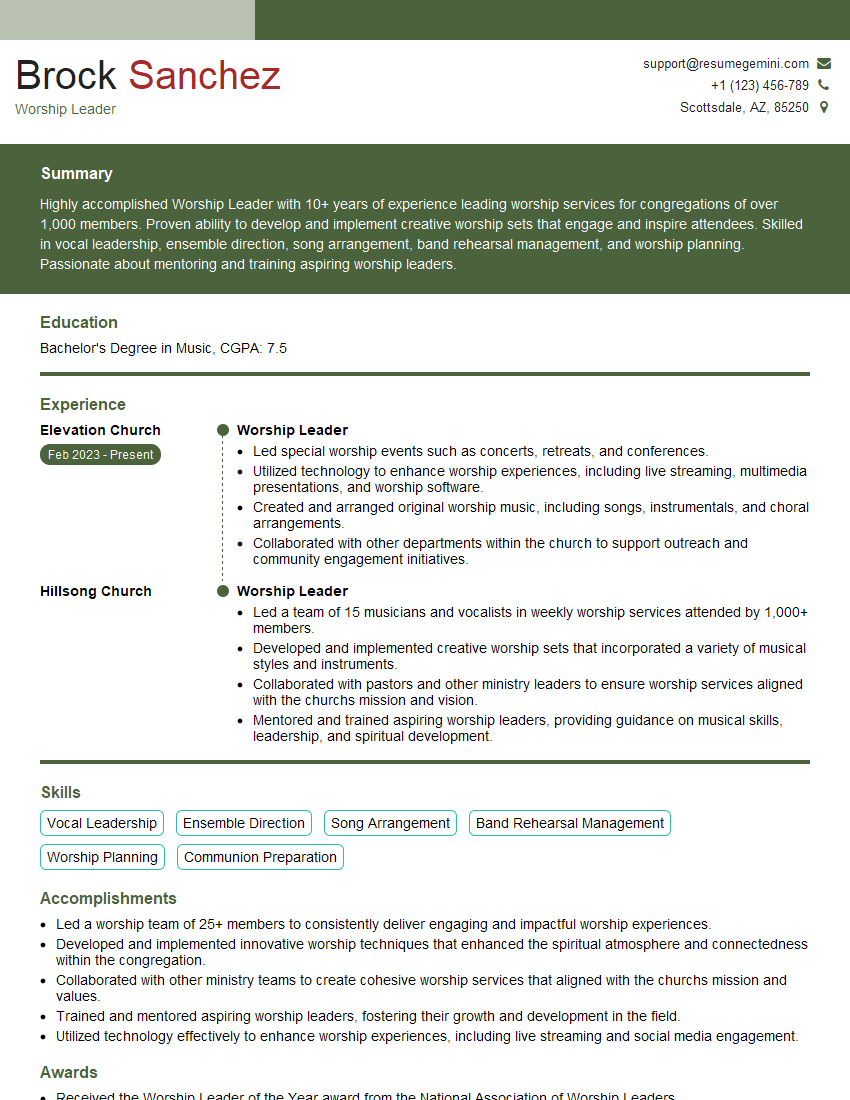
Worship Leader Resume Sample
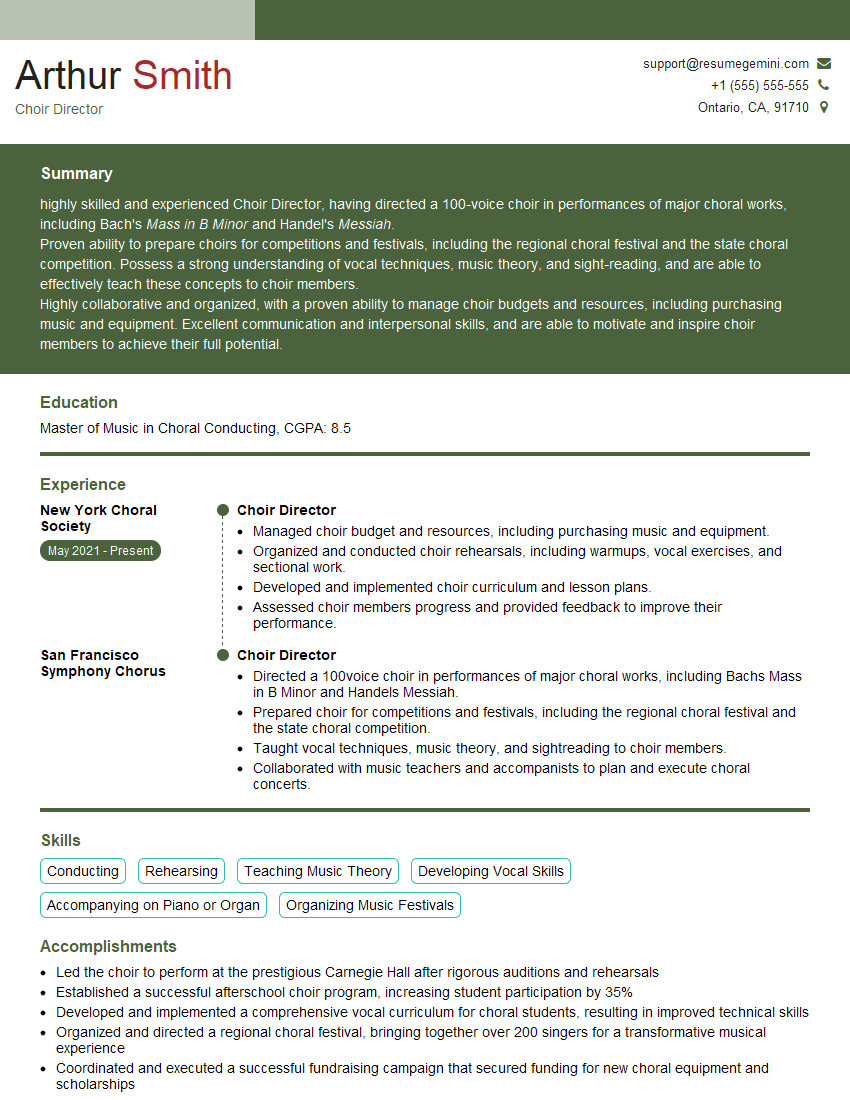
Choir Director Resume Sample
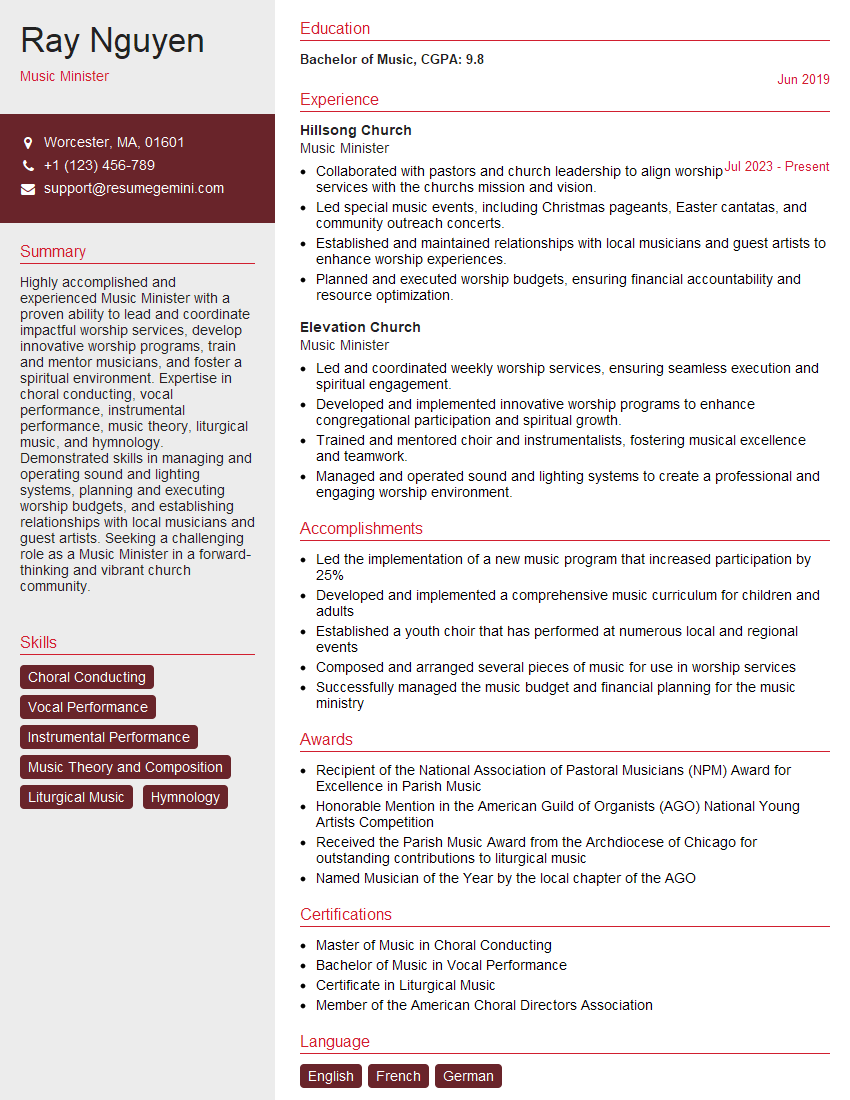
Music Minister Resume Sample
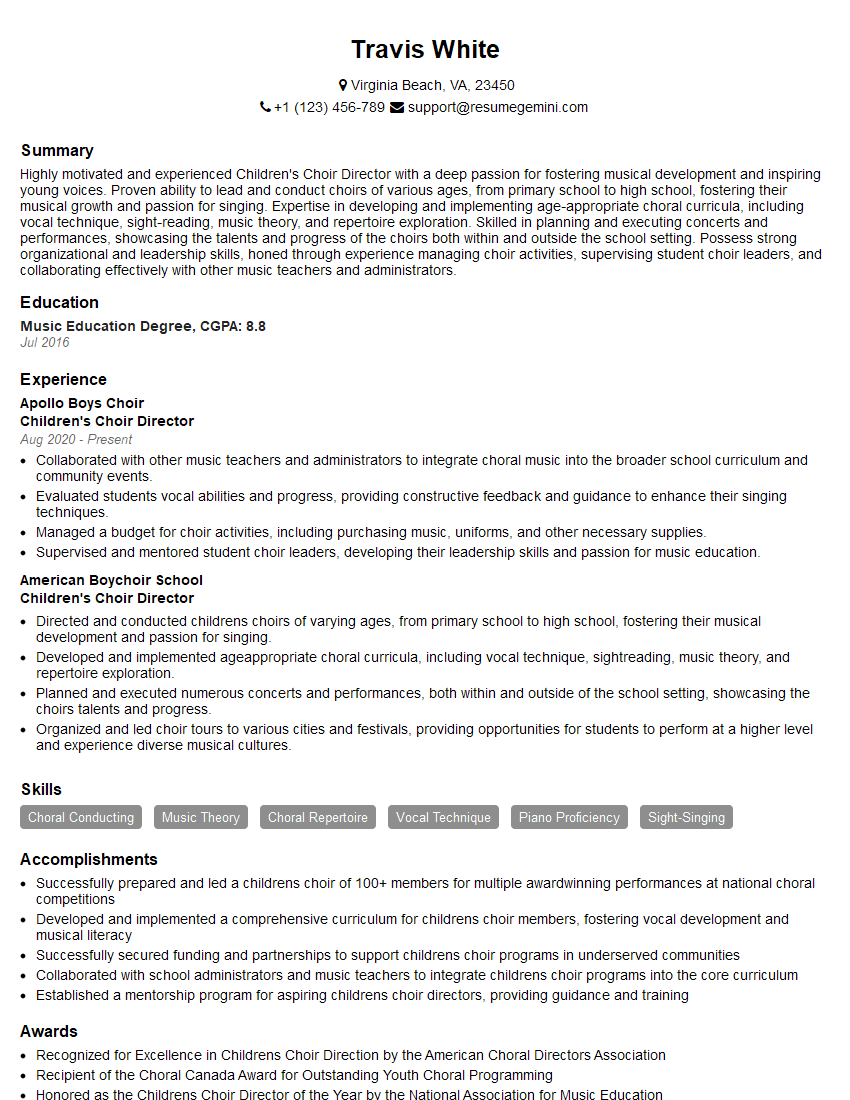
Children’s Choir Director Resume Sample
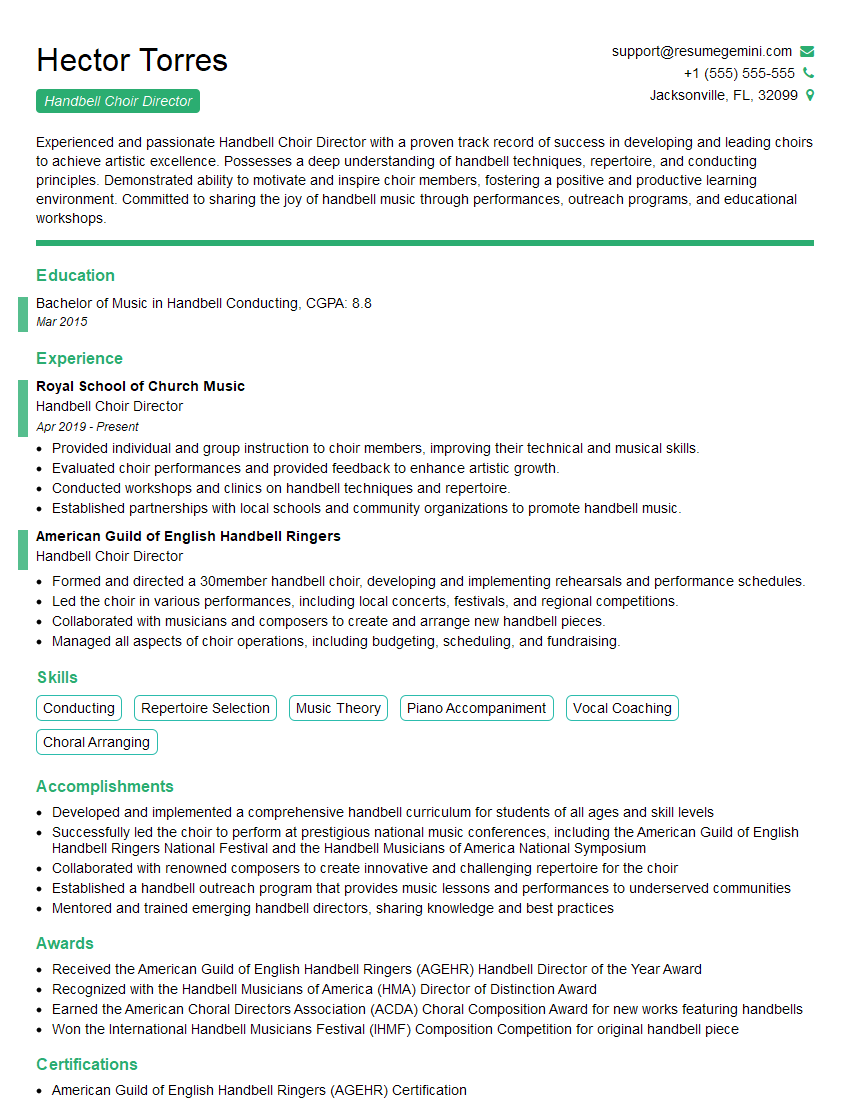
Handbell Choir Director Resume Sample
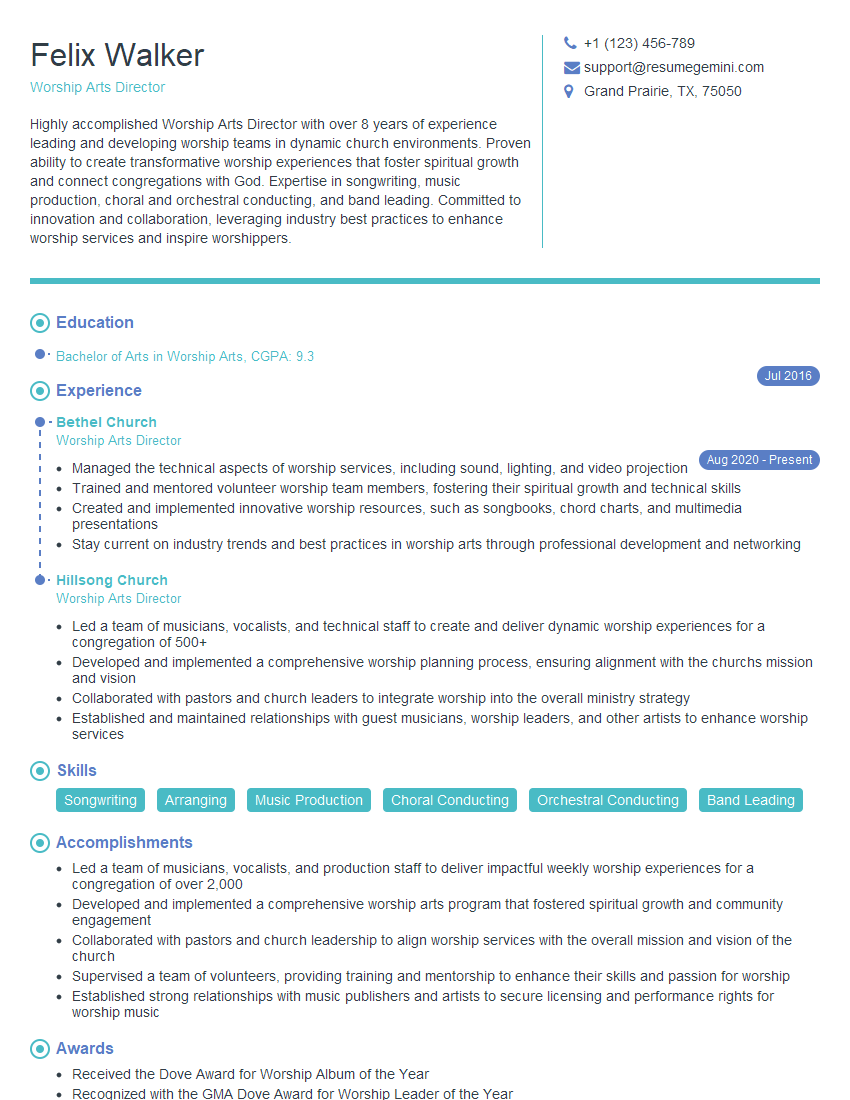
Worship Arts Director Resume Sample
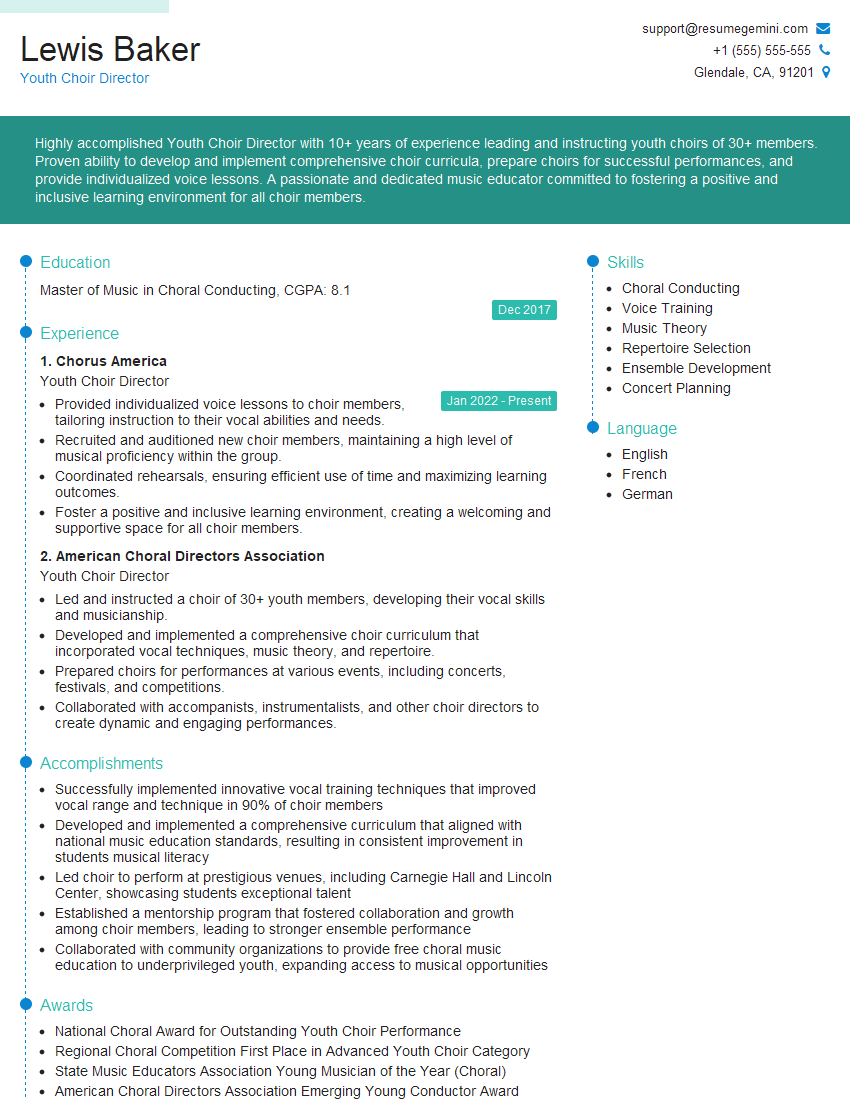
Youth Choir Director Resume Sample
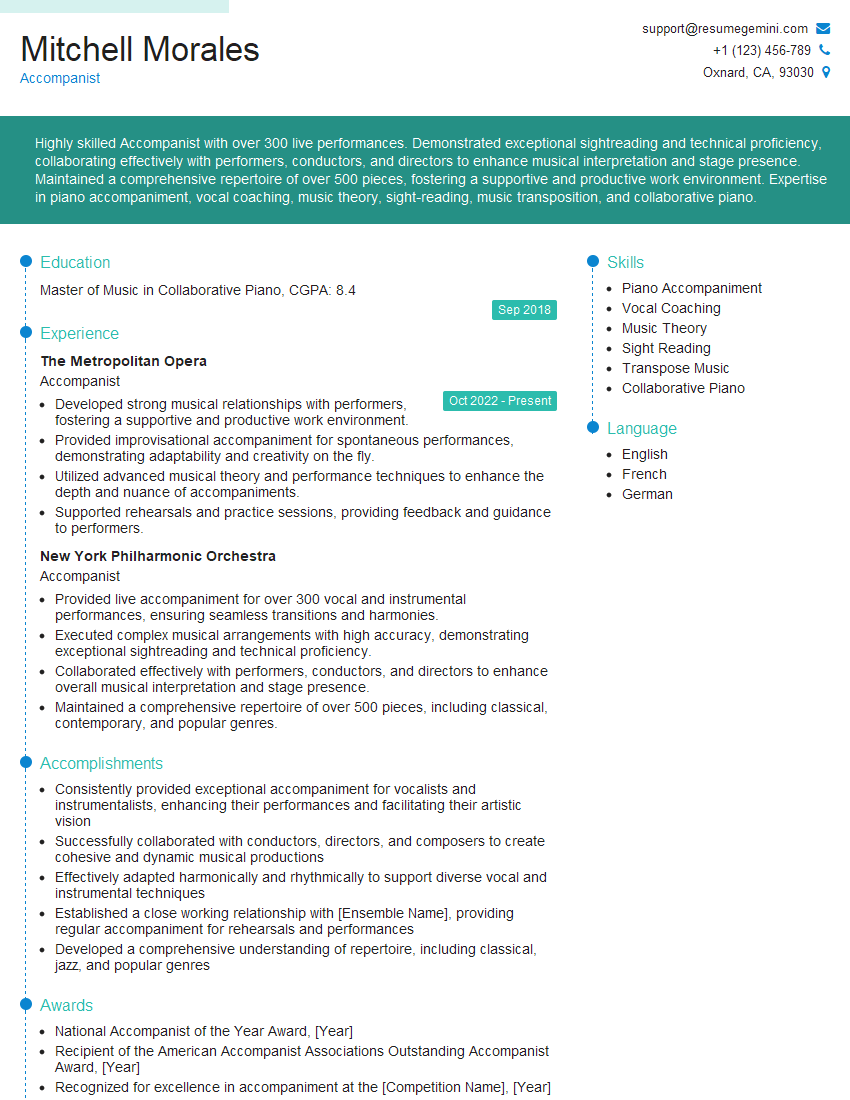
Accompanist Resume Sample
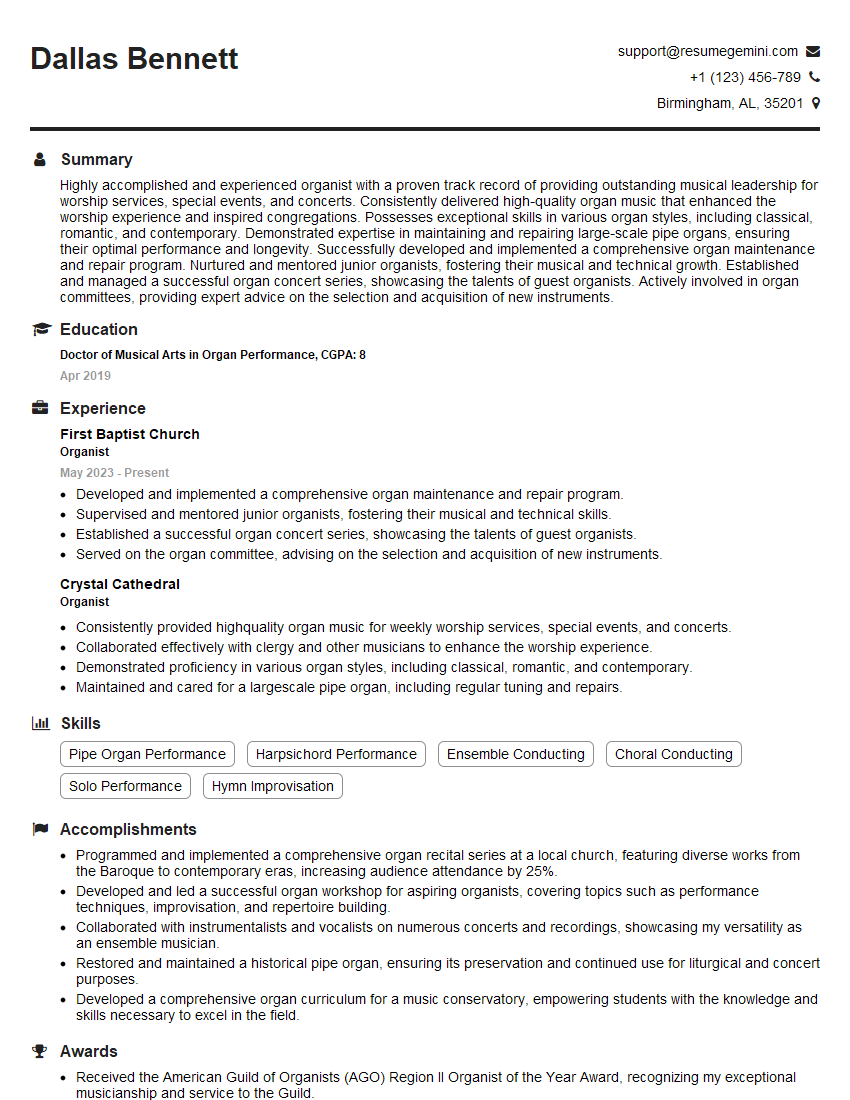
Organist Resume Sample
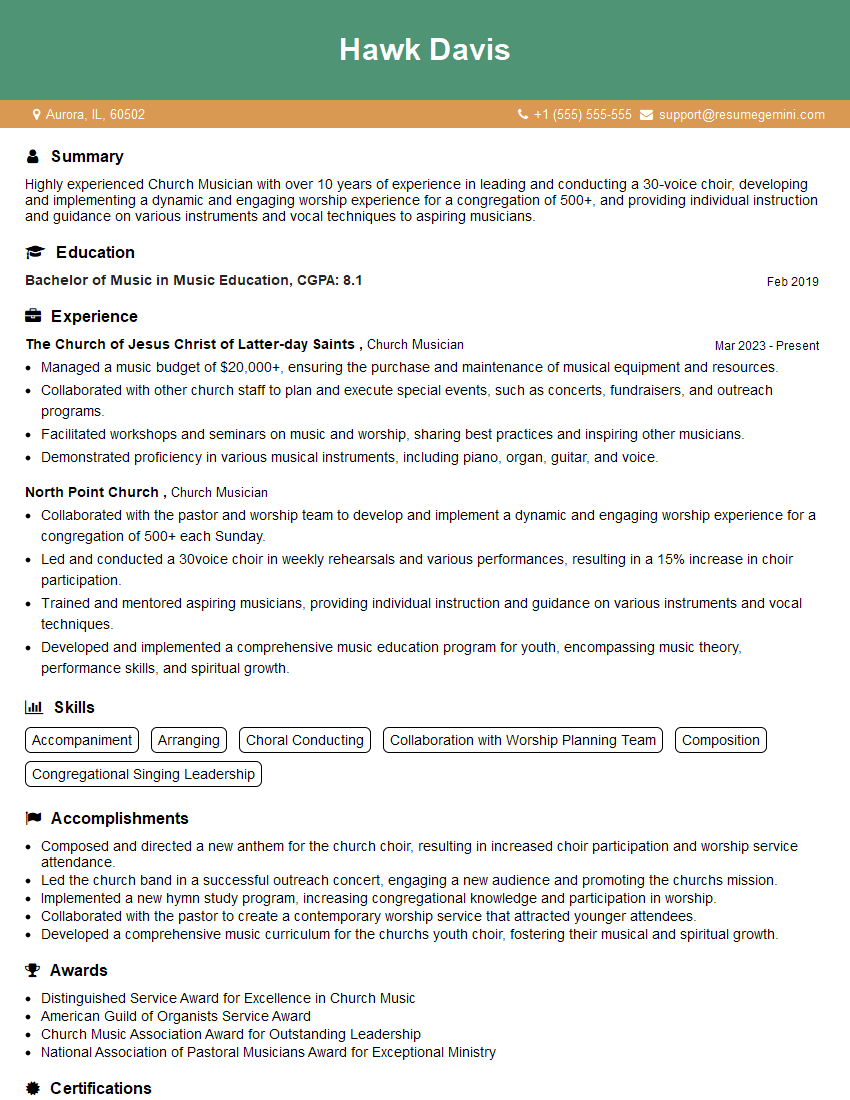
Church Musician Resume Sample
Explore more articles
Users Rating of Our Blogs
Share Your Experience
We value your feedback! Please rate our content and share your thoughts (optional).
What Readers Say About Our Blog
Very informative content, great job.
good