The right preparation can turn an interview into an opportunity to showcase your expertise. This guide to Cinematography interview questions is your ultimate resource, providing key insights and tips to help you ace your responses and stand out as a top candidate.
Questions Asked in Cinematography Interview
Q 1. Explain the difference between a wide shot and a close-up.
The difference between a wide shot and a close-up lies primarily in the amount of subject matter included within the frame and the resulting impact on the viewer’s perception.
A wide shot (WS), also known as a long shot, shows a broad view of the scene, often including the environment surrounding the subject. Think of establishing shots in films – they usually employ wide shots to set the scene and context. This gives the audience a sense of scale, location, and overall context of the action. The subject might be small in the frame, allowing for a greater emphasis on the surroundings.
A close-up (CU), on the other hand, focuses on a specific detail, usually a person’s face or a small object. It creates intimacy and emphasizes emotion or detail. Imagine a close-up of an actor’s tearful eyes; it dramatically intensifies the emotional impact of the scene. The environment is largely excluded, the focus being squarely on the subject’s expression and detail.
In short, wide shots provide context and establish the setting, while close-ups magnify emotions and details, providing a more intimate and focused view.
Q 2. Describe your experience with various camera lenses and their effects on the image.
My experience with various camera lenses spans many years and a diverse range of projects. Different lenses profoundly impact the image’s look and feel, influencing perspective, depth of field, and the overall aesthetic.
- Wide-angle lenses (e.g., 14-35mm): These lenses capture a wider field of view, creating a sense of spaciousness. They are frequently used for establishing shots, landscapes, and action sequences. However, they can also exaggerate perspective, making objects in the foreground appear larger than those in the background.
- Standard lenses (e.g., 50mm): Often referred to as ‘normal’ lenses, they offer a perspective similar to human vision. They are versatile and suitable for a wide range of shots, offering a balanced perspective.
- Telephoto lenses (e.g., 70-200mm): These lenses compress perspective, making distant objects appear closer. They are excellent for portraits, wildlife photography, and isolating subjects from their surroundings. However, they have a shallower depth of field at wider apertures, making background blur (bokeh) prominent.
- Macro lenses: Designed for extreme close-up photography, macro lenses allow incredibly detailed shots of small subjects like insects or textures. They offer a unique perspective impossible to capture with other lenses.
For instance, in a recent project, I utilized a wide-angle lens to establish a bustling city street, then switched to a telephoto lens to isolate a character’s solitary walk down that street, drawing the viewer’s focus to their emotional state. The strategic use of different lenses is crucial for visual storytelling.
Q 3. How do you choose the appropriate lighting setup for a scene, considering mood and narrative?
Choosing the appropriate lighting setup is a crucial aspect of cinematography, directly affecting the mood, narrative, and overall emotional impact of a scene. The process starts with understanding the scene’s requirements and translating them into a lighting plan.
Firstly, I analyze the script and discuss the director’s vision for the scene. Is it a tense thriller requiring dark, shadowy lighting? Or a romantic scene requiring soft, warm light? I consider the time of day, location, and the emotional tone the director wants to achieve.
The next step involves selecting the key lighting elements:
- Key Light: The main light source, shaping the subject and providing the dominant illumination.
- Fill Light: A softer light used to reduce shadows and fill in the areas left dark by the key light. It helps to control contrast.
- Back Light: A light positioned behind the subject, separating it from the background and adding depth. It can create a rim light or a halo effect, which adds visual interest and dimension.
I might use various lighting instruments like Fresnels, Softboxes, and practical lights (like lamps within the scene itself) depending on the scene’s needs. The intensity and color temperature of each light source are carefully adjusted to create the desired effect. For example, cool, bluish light might be used for a night scene, while warm, yellowish light could be used for a sunset.
Ultimately, the lighting setup needs to be consistent with the narrative, emphasizing mood and enhancing the story’s emotional impact. This is a collaborative process, and open communication with the director is vital for a successful outcome.
Q 4. What are your preferred methods for achieving depth of field?
Achieving depth of field – the area of the image that appears sharp – is a critical technique in cinematography, used to direct the viewer’s attention and control the focus of a scene.
My preferred methods for controlling depth of field center around the use of the camera’s aperture and lens choice:
- Aperture: A wider aperture (smaller f-stop number, e.g., f/1.4) creates a shallow depth of field, resulting in a blurry background (bokeh) and a sharp subject. This isolates the subject and draws the viewer’s eye to it. A narrower aperture (larger f-stop number, e.g., f/16) creates a greater depth of field, resulting in a sharper image from foreground to background.
- Lens Choice: Longer focal length lenses (telephoto lenses) inherently have a shallower depth of field than shorter focal length lenses (wide-angle lenses) at the same aperture. This allows for creative control over the amount of blur in the background.
- Focal Distance: The distance between the camera lens and the subject also influences depth of field. The closer the focus point is to the lens, the shallower the depth of field will be, particularly at wider apertures.
For example, in a portrait, I might use a 50mm lens at f/1.8 to create a blurry background that isolates the subject and draws attention to their facial features. In contrast, for a landscape shot, I might use a wider aperture to keep the entire scene sharp.
Q 5. Explain your understanding of color temperature and white balance.
Color temperature and white balance are fundamental concepts in cinematography that significantly impact the look and feel of an image. Understanding them is essential for creating consistent and accurate color reproduction.
Color temperature refers to the relative redness or blueness of white light, measured in Kelvin (K). Lower Kelvin values (around 2000K) represent warmer, more reddish light (like candlelight), while higher values (around 6500K) represent cooler, more bluish light (like daylight). The color temperature of a light source directly affects the colors in the scene. An incandescent bulb has a much warmer color temperature than a bright daylight scene.
White balance is the process of adjusting the camera to accurately reproduce white as white under different lighting conditions. Incorrect white balance can lead to color casts – the entire scene appearing too warm (orange/yellow) or too cool (blue). For instance, shooting indoors under tungsten lighting will result in a yellow color cast if the camera’s white balance isn’t adjusted to match the lighting’s color temperature. Most cameras allow you to set white balance manually or choose from presets (e.g., daylight, cloudy, tungsten).
Correct white balance ensures consistent color reproduction throughout the shot, avoiding unexpected color shifts. Failing to adjust for white balance leads to inaccurate color rendition and a less professional look. Achieving accurate white balance often involves using a white balance tool or taking a white balance reading directly from the scene.
Q 6. How do you work with a director to achieve their visual vision?
Collaboration with the director is the cornerstone of successful cinematography. It’s a continuous dialogue aimed at translating the director’s vision into compelling visuals.
I typically begin by reviewing the script and storyboards with the director, discussing their artistic vision for the film. We talk about mood, tone, style, and the specific look they want to achieve for each scene. This includes discussions around the desired depth of field, camera angles, movement, and overall aesthetic. We may also look at reference images or films to understand the director’s visual references.
Throughout the production process, open communication is vital. I present my lighting and camera plans, taking feedback and adapting to the director’s ideas. This is a collaborative effort; my role is not just to execute, but to offer creative solutions and suggestions, while always ensuring the visual choices align with the storytelling and director’s artistic vision. If there’s a disagreement, we discuss and negotiate, finding a solution that benefits the overall film.
My experience shows that strong director-cinematographer relationships produce the best results. It’s a partnership built on trust, mutual respect, and a shared commitment to the film’s visual storytelling.
Q 7. Describe your experience with different camera movement techniques (e.g., dolly, crane, steadicam).
My experience with camera movement techniques is extensive, and I’ve utilized various methods to enhance storytelling and visual impact. Each technique offers unique capabilities and aesthetic qualities.
- Dolly shots: These involve moving the camera smoothly along a track (a dolly), creating fluid and controlled movement. Dolly shots can be used to follow a subject, reveal new aspects of the environment, or create a sense of movement and momentum. A classic example would be a tracking shot that follows a character walking down a street.
- Crane shots: These utilize a crane to lift the camera high above the ground, allowing for sweeping panoramic views and dynamic perspectives. Crane shots are commonly used to reveal characters’ relationships to their environments and give the audience a broader sense of scale.
- Steadicam shots: These utilize a Steadicam, a stabilizing device that allows the camera operator to move smoothly and fluidly without the shakes and bumps of handheld camera work. Steadicam shots are perfect for creating a sense of immediacy and intimacy while maintaining stability. This is often used to follow characters in intense scenes.
- Handheld shots: While potentially shaky, handheld shots create a sense of realism and immediacy, reflecting a character’s point of view or creating a sense of urgency or chaos. Handheld shots are effective in action scenes or scenes where the audience is meant to experience an intense moment.
The choice of camera movement is always driven by the storytelling needs of the scene. I carefully consider the type of movement that best supports the narrative and enhances the emotional impact of the visuals. The goal is not simply to move the camera, but to use movement purposefully and creatively.
Q 8. How do you manage time constraints and logistical challenges on set?
Managing time and logistical challenges on set is paramount. It’s a delicate dance of preparation, communication, and adaptability. My approach is multifaceted and begins long before the first day of shooting.
- Detailed Pre-Production Planning: This includes meticulously scheduling each shot, factoring in setup time, camera moves, lighting adjustments, and potential delays. I use shot lists, storyboards, and detailed call sheets to anticipate needs and allocate time effectively. For example, knowing a complex crane shot will take longer than a simple close-up allows for better scheduling.
- Efficient Crew Management: A well-coordinated crew is crucial. Clear communication, delegated responsibilities, and trust in my team’s expertise help prevent bottlenecks. I encourage proactive problem-solving; for instance, I empower the gaffer and key grip to adjust lighting and camera positions without constant oversight, streamlining the process.
- Contingency Planning: Unexpected issues are inevitable. I always build buffer time into the schedule to account for unforeseen circumstances like equipment malfunctions, actor availability changes, or weather delays. This helps prevent stressful rushes and compromises in quality.
- Real-time Adaptability: On-set, I maintain flexibility. I continually reassess the schedule based on the day’s progress and make necessary adjustments to maintain momentum. This involves open communication with the director and other department heads to make informed decisions quickly.
Ultimately, efficient time management hinges on proactive preparation, strong communication, and the ability to make swift, decisive decisions under pressure.
Q 9. Describe your experience with various film stocks or digital sensors.
My experience spans both film and digital mediums, each offering unique characteristics. I’ve worked extensively with various film stocks, appreciating the rich grain structure and subtle color gradations of Kodak Vision3 500T and the higher contrast of Fuji Eterna 250D, for instance. The choice depends heavily on the desired aesthetic—a gritty, naturalistic feel versus a more vibrant, modern look.
In the digital realm, I’ve worked with a range of sensors, from RED cameras renowned for their high dynamic range and resolution, capturing detail even in extreme contrast, to Arri Alexa cameras celebrated for their superb skin tones and ease of color grading. Each sensor has its quirks – some are better at handling low light, others have a wider color gamut. Understanding these nuances informs my choices regarding lighting, exposure, and post-production workflow.
For example, when shooting a night scene on a RED camera, I know I can push the exposure significantly in post-production while retaining detail, whereas with a sensor with less dynamic range, I’d need to plan more carefully with lighting to maintain highlight and shadow detail.
Q 10. What is your process for prepping a shoot, from pre-production to post-production?
My pre-production process is thorough and systematic, laying the foundation for a smooth shoot and efficient post-production.
- Pre-Production: This phase involves script breakdown, shot planning, location scouting, casting, and crew assembly. I collaborate closely with the director to visualize the story through storyboards and shot lists, identifying key visual elements and potential challenges. This is where I define the overall look and feel, including color palettes, camera movements, and lighting styles.
- Production: On set, my responsibilities focus on executing the plan, managing the camera crew, ensuring proper exposure and framing, and maintaining communication with other departments. I supervise camera operation, lens selection, and monitor image quality in real-time.
- Post-Production: My involvement extends into post-production, particularly in color grading and image refinement. I work closely with the colorist to ensure the final product aligns with the creative vision established during pre-production. This may include adjustments to color balance, contrast, and saturation to achieve the desired mood and aesthetic.
Throughout the entire process, meticulous record-keeping and detailed communication are essential to maintaining consistency and clarity. This ensures everyone understands the vision and can contribute effectively.
Q 11. Explain your familiarity with various lighting instruments (e.g., Fresnel, HMI, LED).
My expertise encompasses a wide range of lighting instruments, each serving a specific purpose. I understand the strengths and limitations of each to create the desired lighting scheme for a given scene.
- Fresnel: Known for their adjustable beam spread and intensity, Fresnels are versatile for both key and fill light. I often use them for creating focused highlights on actors’ faces or highlighting specific details within a scene.
- HMI: High-intensity discharge lights (HMIs) provide powerful, daylight-balanced illumination, ideal for large outdoor sets or brightly lit interiors. Their color temperature consistency makes them a staple for maintaining a consistent look throughout a shoot.
- LED: LED lighting offers increased energy efficiency, color temperature adjustability, and smaller size. I use LEDs frequently for their flexibility in creating diverse lighting effects, especially in situations where energy consumption and space are crucial factors. Additionally, their precise color control allows for very specific color temperature matching across the production.
Choosing the right lighting instrument is often a blend of practical considerations and creative choices, factoring in budget, power availability, and the desired aesthetic. For instance, using LED panels for soft, diffused lighting on a close-up might be preferred over harsh Fresnel light.
Q 12. How do you handle unexpected technical difficulties on set?
Technical difficulties are inevitable on set. My approach prioritizes proactive problem-solving and efficient communication.
- Troubleshooting: I have a deep understanding of camera systems, lighting equipment, and other technical aspects. This allows me to quickly diagnose issues, often collaborating with the gaffer, key grip, and camera assistant to identify the source of the problem.
- Contingency Planning: As mentioned, having backup equipment and processes is crucial. This includes extra batteries, lights, and even having alternative shot compositions prepared in case of equipment failure.
- Communication: Open and transparent communication with the director and crew is key. I immediately inform the relevant personnel about any problem, working collaboratively to find a solution. Sometimes, a seemingly small problem can have cascading effects, so quick communication can minimize further delays.
- Decision-Making: I’m adept at making quick, well-informed decisions under pressure. This often involves evaluating the severity of the problem, the potential solutions, and the impact on the schedule, and then choosing the best course of action.
For example, if a lens malfunctions, I would assess if we have a replacement and whether a substitute lens could suffice. If not, I’d communicate the delay and collaborate with the director on adjustments to the schedule or shot plan.
Q 13. Explain your approach to working with actors and ensuring their comfort.
Building rapport with actors is essential for capturing authentic performances and ensuring their comfort on set. My approach is built on respect, clear communication, and empathy.
- Pre-Shoot Preparation: I review the script and discuss the character’s arc and emotional journey with the actors. This enables me to understand their needs and anticipate potential challenges.
- On-Set Communication: I strive for clear and concise communication, explaining camera angles, blocking, and lighting setups in a way that actors can easily understand. This minimizes confusion and avoids unnecessary tension.
- Creating a Comfortable Environment: I make every effort to create a relaxed and supportive environment on set. This includes addressing any concerns the actors might have, being mindful of their physical and emotional needs, and offering encouragement.
- Collaboration and Respect: I collaborate closely with the director and actors to ensure that the framing and lighting choices support their performance. I value their input and ensure they feel respected and valued as creative partners.
For instance, I might spend extra time setting up a shot to ensure an actor feels comfortable with the lighting and camera positions before we start filming, creating a collaborative process that enhances the creative output.
Q 14. Describe your experience with camera calibration and image processing.
Camera calibration and image processing are critical for achieving consistent and high-quality imagery. My experience encompasses both practical and theoretical aspects of these processes.
- Camera Calibration: I understand the importance of color calibration to achieve consistent color across different takes and shots. This involves using color charts and software to fine-tune the camera’s settings, ensuring accurate color reproduction.
- Image Processing: In post-production, I utilize color grading software like DaVinci Resolve to refine the look of the footage. This may involve adjustments to color balance, contrast, saturation, and other parameters to enhance the visual appeal and match the overall aesthetic vision. I’m familiar with techniques like color correction, color grading, and noise reduction to achieve optimal image quality.
- Workflows: I’m proficient in various digital imaging workflows, understanding the importance of maintaining consistent color space throughout the production process, from capture to final output. This includes color space transformation, managing metadata, and understanding the impact of different codecs on image quality.
For example, I might use a color chart on set to calibrate the camera and create a reference point for the colorist in post-production. This ensures that the color grading process is consistent and accurate, reflecting the artistic vision for the project.
Q 15. How familiar are you with different aspect ratios and their impact on storytelling?
Aspect ratio is the proportional relationship between the width and height of an image. Different ratios significantly impact storytelling by influencing the viewer’s perspective and the overall mood. For example, a wider aspect ratio like 2.39:1 (commonly used in cinemas) can create a sense of epic scale and grandeur, often used in sweeping landscapes or action sequences. Conversely, a squarer aspect ratio like 1:1 or 4:3 can feel more intimate and claustrophobic, drawing attention to details and characters’ emotions. Think of the difference between a wide shot showcasing a vast battlefield versus a close-up focusing on a single soldier’s face – the aspect ratio helps dictate this emotional impact.
I’ve extensively used various aspect ratios throughout my career, from the classic Academy ratio (1.37:1) to the modern widescreen formats. In one project, shifting from 16:9 to 2.39:1 for a key scene dramatically amplified the feeling of isolation and vulnerability for the protagonist. Choosing the right aspect ratio is a crucial stylistic decision that directly contributes to the overall narrative.
Career Expert Tips:
- Ace those interviews! Prepare effectively by reviewing the Top 50 Most Common Interview Questions on ResumeGemini.
- Navigate your job search with confidence! Explore a wide range of Career Tips on ResumeGemini. Learn about common challenges and recommendations to overcome them.
- Craft the perfect resume! Master the Art of Resume Writing with ResumeGemini’s guide. Showcase your unique qualifications and achievements effectively.
- Don’t miss out on holiday savings! Build your dream resume with ResumeGemini’s ATS optimized templates.
Q 16. Explain your understanding of composition and framing.
Composition and framing are fundamental aspects of cinematography. Composition refers to the arrangement of elements within the frame – subjects, backgrounds, and negative space. Framing involves strategically using the camera’s position and lens choice to control what the audience sees and how they perceive it. Think of it like painting a picture: you carefully place each element to create a balanced, engaging, and meaningful composition.
Effective framing techniques include the rule of thirds, leading lines, and headroom/noseroom. For instance, placing a subject off-center (rule of thirds) naturally draws the viewer’s eye and creates a more dynamic composition. Leading lines, such as roads or fences, can guide the viewer’s gaze towards a focal point. Proper headroom and noseroom ensure the subject isn’t cut off awkwardly, improving the visual balance.
I constantly use these techniques to enhance storytelling. For example, in a scene showcasing a character’s loneliness, I might use a wide shot with the character positioned in the lower third of the frame, emphasizing their isolation against a vast, empty background.
Q 17. What is your experience with different types of camera support (e.g., tripods, jibs)?
My experience with camera support is extensive, encompassing a wide range of equipment. Tripods are essential for stability, providing smooth, steady shots. I use them frequently for establishing shots, dialogue scenes, and any situation demanding precise framing and minimal camera movement. Jib arms allow for dynamic, sweeping movements, adding visual interest and a sense of scale or grandeur. I particularly rely on jibs for cinematic shots capturing expansive landscapes or following characters through complex environments.
Beyond tripods and jibs, I’m proficient with Steadicams for smooth, fluid tracking shots, and sliders for controlled, horizontal movements. Choosing the right support depends heavily on the scene’s requirements. A handheld shot might convey immediacy and realism, while a tripod provides stability for detailed, intimate moments.
In one project, we used a combination of a Steadicam and a jib to follow a character through a bustling marketplace. The Steadicam offered a sense of immediacy as the character navigated the crowds, while the jib allowed for broader establishing shots showcasing the scene’s scope.
Q 18. How do you collaborate with other departments on set (e.g., grips, electrics)?
Collaboration is paramount in filmmaking. As a cinematographer, I work closely with grips, electrics, and other departments to achieve the desired visual look. With grips, I discuss camera placement, rigging requirements (e.g., cranes, dollies), and ensuring safe and efficient operation of all camera support systems. Effective communication ensures the camera is securely mounted and ready for any desired movements.
With the electrics department, I collaborate extensively on lighting design and execution. We work together to achieve the mood and atmosphere required for each scene. This includes determining the type, intensity, and placement of lighting equipment, as well as color temperature and diffusion.
For example, before a night scene, I’ll meet with the gaffer (head electrician) to discuss the lighting plan, ensuring we achieve the desired level of darkness, shadows, and highlights to create the intended atmosphere – perhaps a dimly lit, mysterious alley or a brightly lit, bustling city street.
Q 19. Describe your workflow for post-production collaboration with editors and colorists.
My post-production workflow involves close collaboration with editors and colorists. I typically provide the editor with various takes, ensuring they have the flexibility to choose the best shots for the story. I’ll often provide notes regarding framing, composition, and the emotional impact of each shot. This collaborative approach ensures a cohesive and visually stunning final product.
With the colorist, I share my artistic vision regarding color grading, aiming for consistency throughout the film. We might discuss specific looks for different scenes, creating a cohesive visual palette. I often provide reference images or film stills to guide the color grading process. I utilize dailies (rushes) and carefully selected shots to help the colorist understand the desired look and feel. The goal is to refine the color grading in the post-production phase, adjusting white balance and saturation to enhance the overall visual experience.
Q 20. What software are you proficient in (e.g., DaVinci Resolve, Adobe Premiere)?
I am proficient in several industry-standard software packages. DaVinci Resolve is my primary choice for color grading, offering comprehensive tools for color correction, primary and secondary grading, and visual effects. I also frequently use Adobe Premiere Pro for video editing, particularly during the initial stages of assembly and rough cuts.
Furthermore, I have experience with other software like Foundry Nuke for compositing and visual effects, and Final Cut Pro for quick editing tasks. My software skills are constantly evolving as technology advances, enabling me to adapt to the latest industry trends and software updates.
Q 21. How do you create a mood or atmosphere through lighting?
Lighting is crucial for establishing mood and atmosphere. Hard light creates strong shadows and a dramatic feel, often used in thrillers or action films. Soft light is diffused, creating a more gentle and calming effect, frequently seen in romantic dramas or comedies. The color temperature of the light also greatly impacts the mood. Cooler tones (blues and greens) can evoke feelings of sadness, isolation, or mystery, while warmer tones (oranges and yellows) can create a sense of comfort, happiness, or nostalgia.
I frequently utilize lighting techniques such as backlighting to create silhouettes, emphasizing a character’s isolation or mystery. High-key lighting (bright, even illumination) creates an upbeat, cheerful mood, while low-key lighting (predominantly dark with selective highlights) can generate suspense and intrigue. The balance of light and shadow is fundamental to creating the visual atmosphere of a scene, guiding the viewer’s emotions and understanding of the narrative.
In one project, we used a combination of warm, low-key lighting and cool, backlighting to create a sense of unease and suspicion during a crucial night scene. The effect was stunning, perfectly conveying the underlying tension and mystery of the plot.
Q 22. Describe your experience with different color grading styles.
Color grading is the art of manipulating the color and tone of a film or video to achieve a specific aesthetic or mood. My experience spans a wide range of styles, from the vibrant and saturated looks favored in comedies and action films to the muted, desaturated palettes often used in dramas or period pieces. I’m proficient in various software such as DaVinci Resolve and Adobe Premiere Pro, and understand the importance of color temperature, contrast, and saturation in conveying emotion and atmosphere.
For example, I recently worked on a project that required a gritty, realistic look. We opted for a desaturated color palette with subtle adjustments to contrast and shadows, creating a feeling of authenticity and tension. In contrast, another project called for a bright, whimsical style, and we utilized vibrant colors and boosted saturation to reflect the upbeat tone. I always tailor my approach to the specific narrative and visual style demanded by the project.
Understanding the impact of different color grading styles is crucial. A warmer palette can evoke feelings of comfort and nostalgia, while cooler tones can suggest distance or mystery. Mastering this nuance enables me to contribute significantly to the overall storytelling.
Q 23. How do you ensure consistency in your camera work throughout a project?
Maintaining consistent camera work across a project is paramount for a cohesive viewing experience. I achieve this through meticulous planning and a robust workflow. Before shooting, I create a detailed shot list, storyboards, and a camera plan that outlines camera positions, movements, and focal lengths for each scene. This serves as a guide for the entire crew.
On set, I use a combination of techniques to ensure consistency. We establish a consistent base exposure setting, monitor camera settings diligently, and use color charts or reference images to ensure consistent color balance between shots. I also work closely with the camera operators to ensure that camera angles and movements are smoothly executed and aligned with the pre-visualization.
Furthermore, I use digital tools such as camera reports and logging software to maintain a detailed record of camera settings and metadata for each shot, simplifying post-production processes and helping us identify and correct inconsistencies early on. This meticulous approach ensures the final product exhibits a seamless visual flow.
Q 24. Explain your approach to working with different budgets and constraints.
Adaptability is key when working with varying budgets and constraints. My approach involves understanding the scope of the project and identifying areas where cost savings can be achieved without compromising the overall visual quality. For example, on lower-budget productions, I might rely more on creative camera angles and lighting techniques to achieve stunning shots rather than relying heavily on expensive equipment.
With larger budgets, I can incorporate more sophisticated equipment and techniques. However, I remain mindful of resource allocation and prioritize efficiency. Regardless of the budget, I focus on developing strong visual storytelling through careful planning, creative problem-solving, and close collaboration with the team.
For instance, on a low-budget short film, I used readily available lighting sources and clever camera placements to create a dramatic, intimate atmosphere. On a higher-budget feature film, I used specialized camera equipment and collaborated with a larger team to achieve a more complex and visually ambitious look, but the fundamental principle remains the same: telling the story visually with efficiency and style.
Q 25. How do you manage risks and safety protocols on set?
Safety is my utmost priority on set. Before commencing any shoot, I meticulously assess potential hazards and establish a detailed safety plan in collaboration with the production team. This involves risk assessments, regular safety briefings for the crew, and adherence to industry best practices.
Specific measures include ensuring proper lighting and grip setups to prevent accidents, employing safe handling procedures for equipment, and monitoring weather conditions to mitigate any potential risks. I emphasize the importance of using safety equipment, such as harnesses and helmets, when necessary and encourage open communication about any safety concerns from the crew.
I am also well-versed in relevant health and safety regulations and ensure that all production activities conform to these standards. My aim is to create a safe and productive environment where everyone feels protected and can perform their tasks effectively without compromising safety.
Q 26. Explain your understanding of camera movement and its storytelling potential.
Camera movement is a powerful storytelling tool, capable of influencing audience emotions and guiding their focus. I understand the nuanced impact of various camera movements and employ them strategically to enhance the narrative.
For instance, a slow, deliberate pan can emphasize a character’s isolation or build suspense, while a fast, dynamic zoom can heighten tension or excitement. A dolly zoom (vertigo effect) can create a disorienting feeling, emphasizing a character’s emotional state or a shift in perspective. Similarly, handheld camera work can convey a sense of immediacy and realism, while steady, static shots can highlight the environment and allow for contemplation.
Understanding how to utilize camera movement, from simple tilts and pans to complex crane shots and Steadicam movements, is crucial for creating a visually compelling and emotionally resonant experience for the viewer. I carefully consider the impact of each movement on the overall storytelling and choose the most effective techniques to achieve the intended effect.
Q 27. Describe a time you had to problem-solve a technical issue on set. What was your solution?
During a night shoot, our primary camera malfunctioned just as we were about to begin a crucial scene. The malfunction resulted in a complete loss of image on the monitor. After initial troubleshooting failed, I quickly recognized the problem as a faulty power supply. Luckily, we had a backup camera, but it lacked the specific lens we were using for that scene.
My solution involved a two-pronged approach. First, I immediately assigned a crew member to source a replacement power supply from our equipment store, while simultaneously organizing a swap of the lenses between our primary and secondary cameras. This required coordination with the camera assistants and gaffers to avoid damaging the lenses. Once the power supply was replaced (which took about 10 minutes), and the lens swap was complete, we resumed filming with minimal delay. This quick thinking, and the team’s cooperation ensured we were only delayed approximately 15 minutes.
Q 28. What are your career goals and how does this position fit into them?
My career goals center around becoming a highly respected and sought-after cinematographer known for creating visually stunning and impactful films. I aim to expand my expertise across different genres and push creative boundaries through innovative techniques and storytelling. This position aligns perfectly with my aspirations by offering a challenging and enriching environment to hone my skills and collaborate with talented professionals. I am eager to contribute to high-quality projects, further develop my skills in advanced cinematography techniques, and become an integral part of a successful team.
Key Topics to Learn for Your Cinematography Interview
- Camera Operation & Technique: Understanding various camera movements (panning, tilting, tracking, etc.), focusing techniques, and exposure control in different shooting scenarios.
- Lighting: Mastering three-point lighting, understanding color temperature, and applying lighting techniques to achieve specific moods and aesthetics. Discuss practical experience with various lighting equipment.
- Composition & Framing: Discuss the rule of thirds, leading lines, and other compositional techniques. Be prepared to explain your approach to framing shots for storytelling and visual impact.
- Shot Selection & Sequencing: Explain how different shot types (wide, medium, close-up) contribute to narrative flow and visual rhythm. Discuss your understanding of shot continuity and editing considerations.
- Lens Choice & Effects: Discuss different lens types (wide-angle, telephoto, macro) and their impact on perspective and depth of field. Be ready to discuss creative uses of lens effects (e.g., shallow depth of field for isolating subjects).
- Working with Directors & Crews: Describe your experience collaborating effectively within a film crew, demonstrating communication and teamwork skills. Highlight instances of problem-solving in challenging shooting conditions.
- Digital Workflow & Post-Production: Understanding image formats, color grading basics, and familiarity with post-production software (e.g., DaVinci Resolve, Adobe Premiere Pro) is beneficial.
- Visual Storytelling: Discuss your understanding of using cinematography to enhance the narrative, mood, and overall impact of a film or video project. Be prepared to articulate your creative vision.
Next Steps
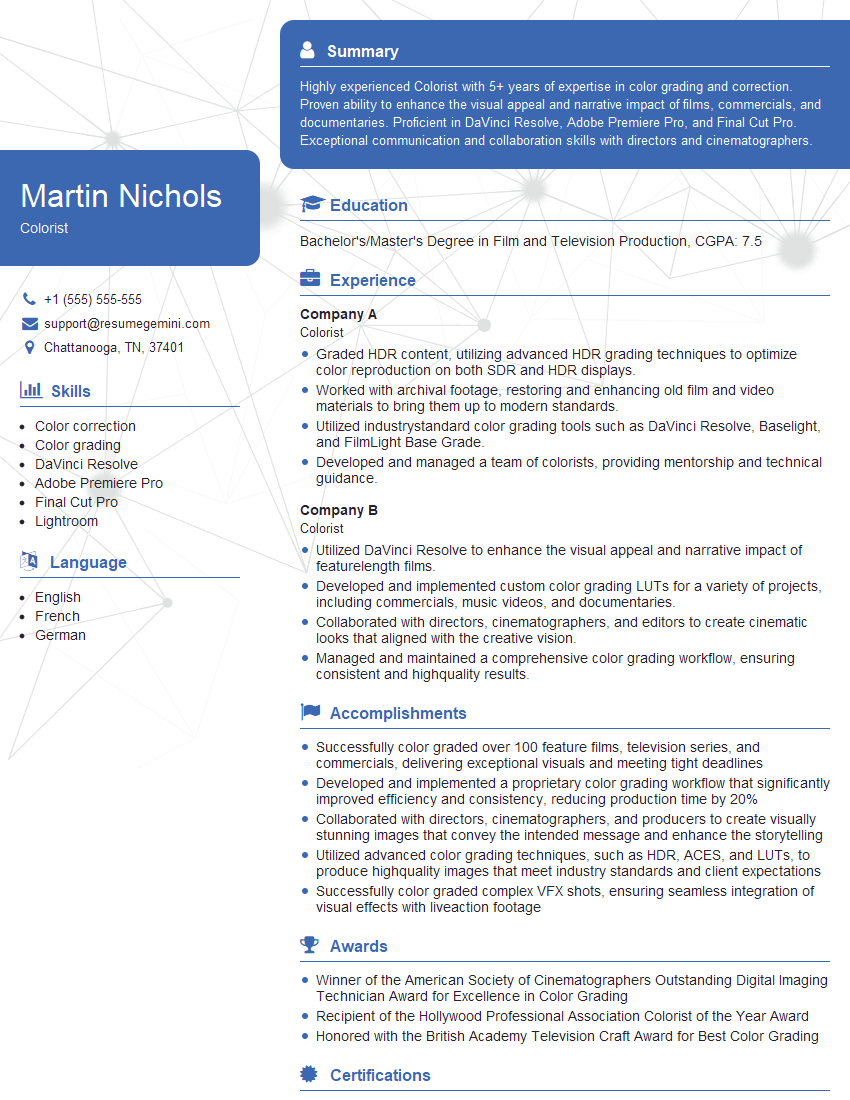
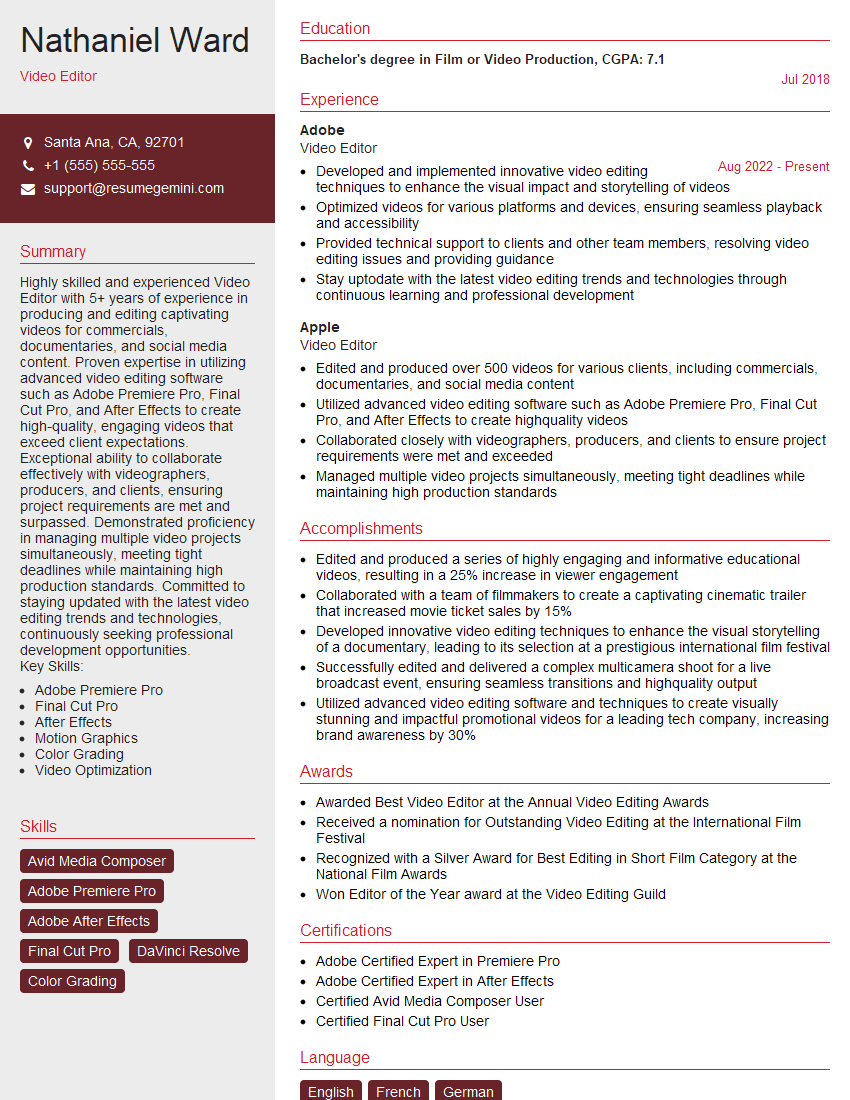
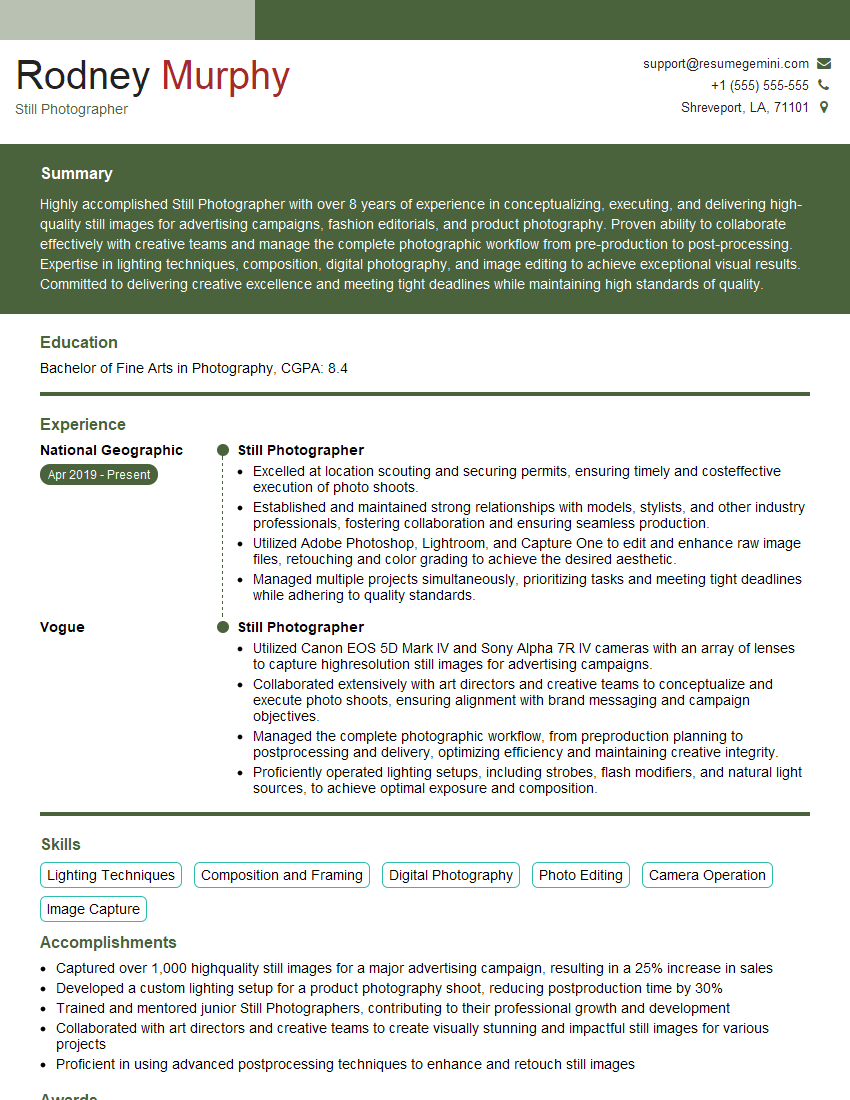
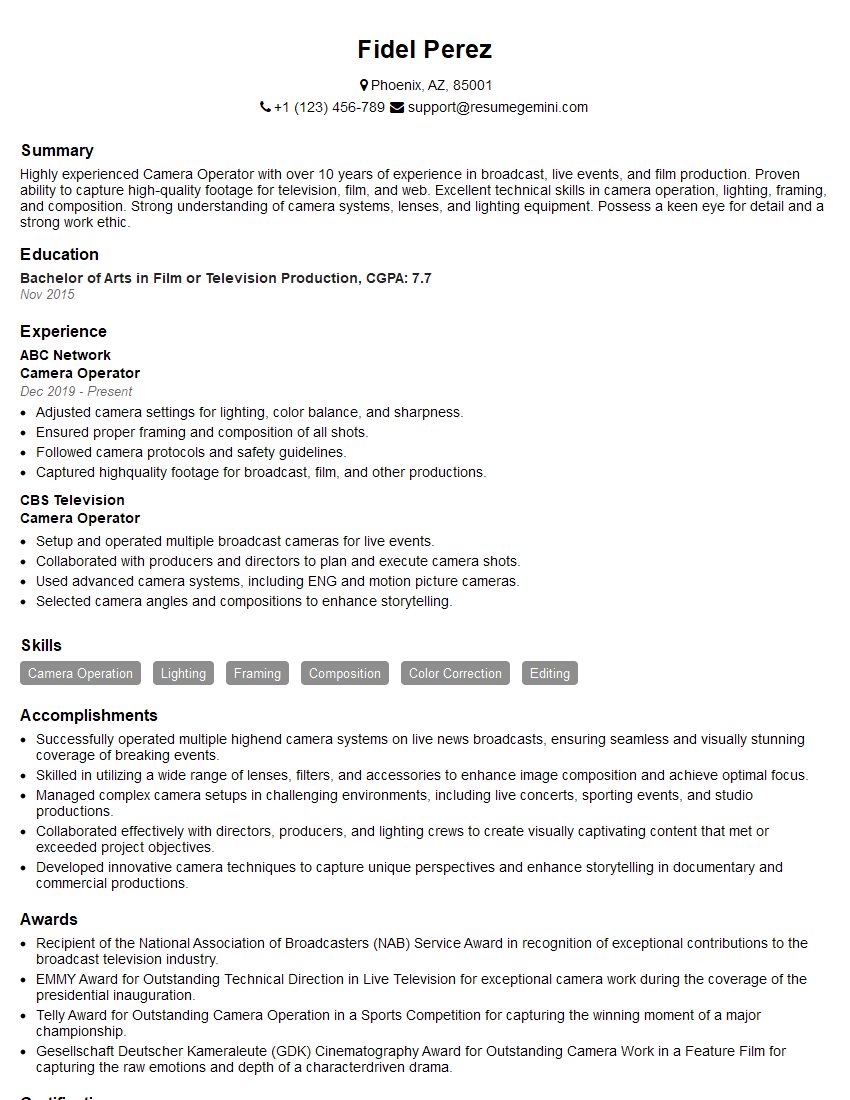
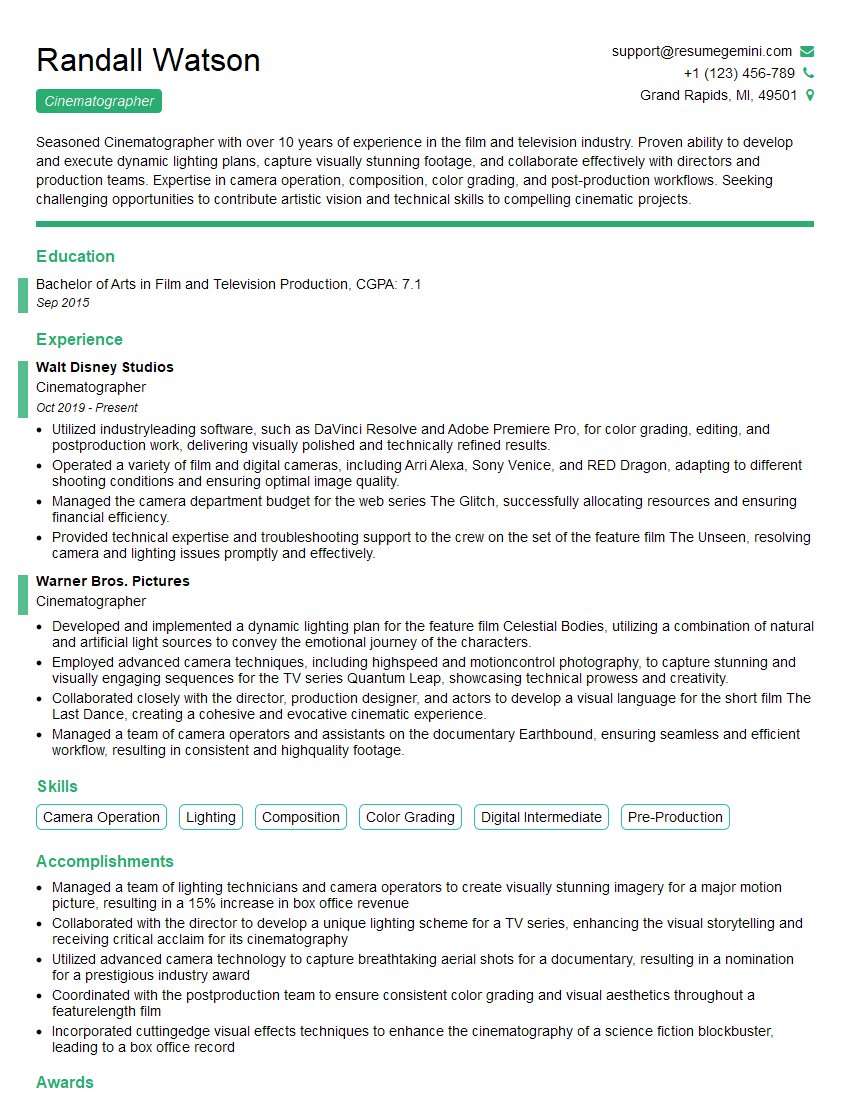
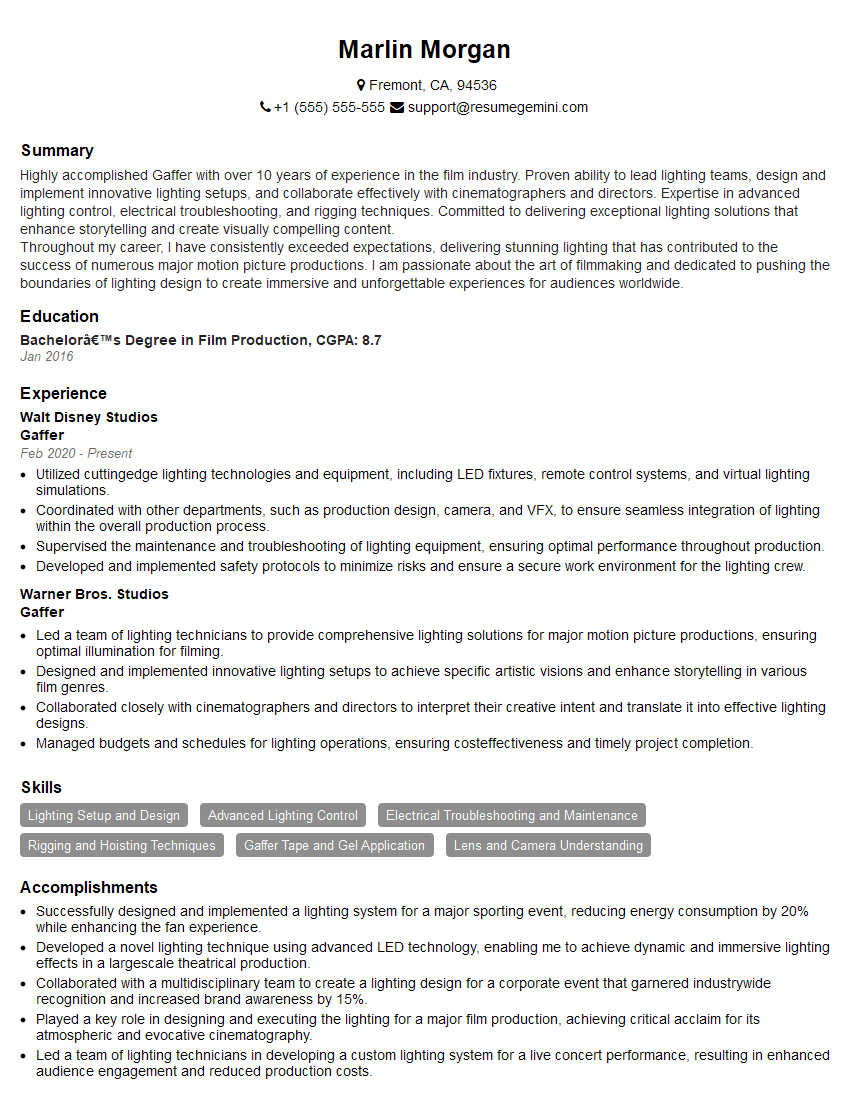
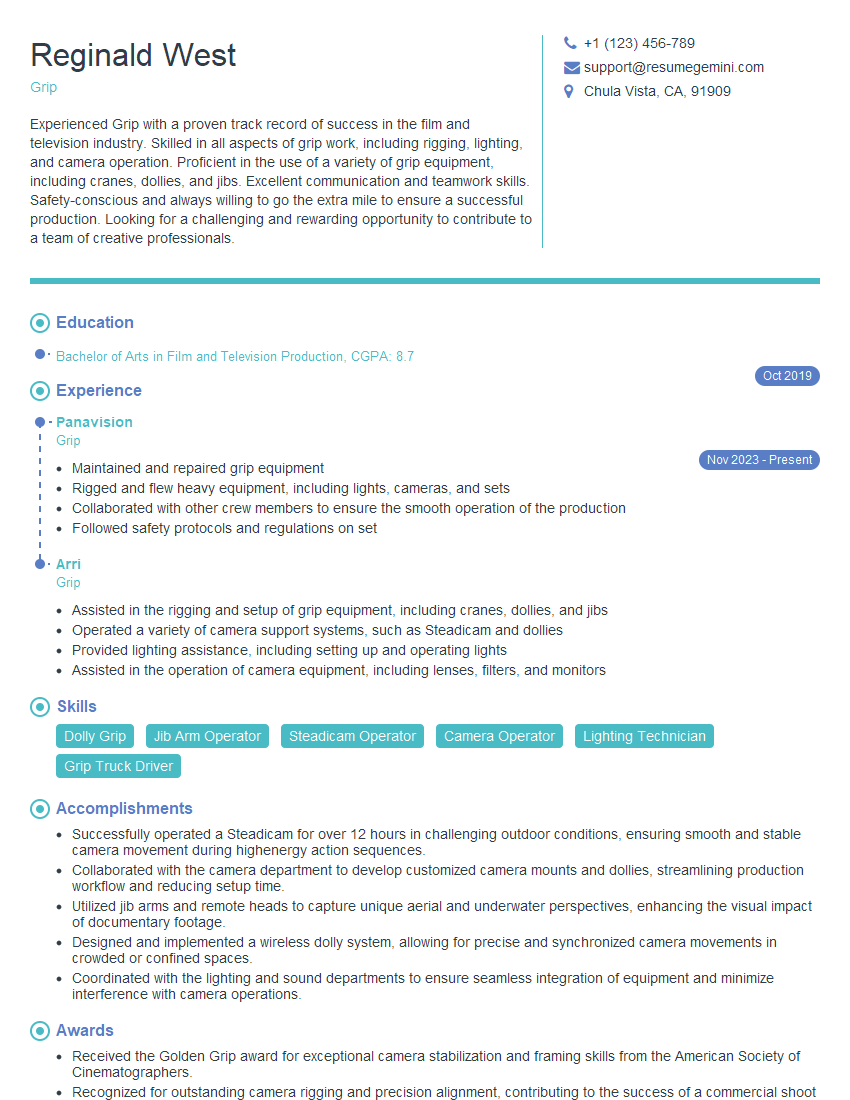
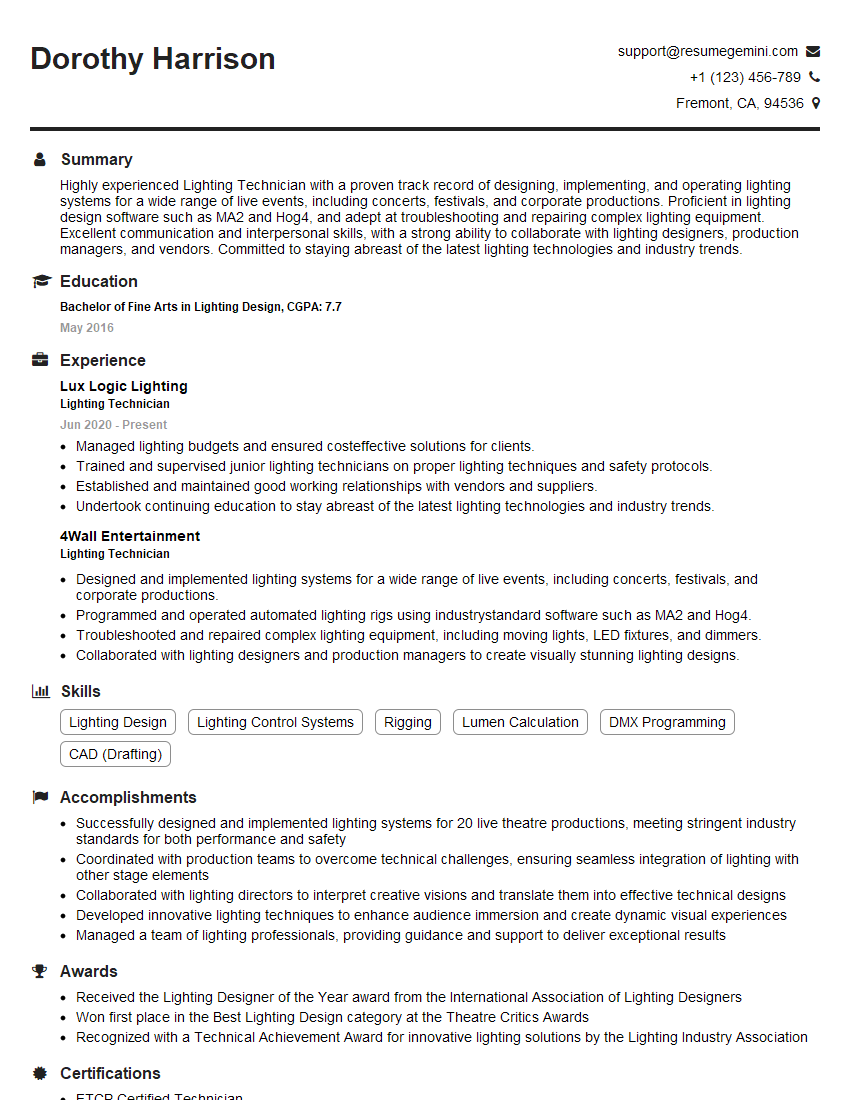
Mastering cinematography opens doors to exciting and fulfilling careers in film, television, and beyond. To maximize your job prospects, a strong and ATS-friendly resume is crucial. ResumeGemini is a trusted resource that can help you craft a compelling resume that showcases your skills and experience effectively. We provide examples of resumes tailored specifically to the Cinematography field to help you get started. Invest time in crafting a professional resume – it’s your first impression on potential employers.
Explore more articles
Users Rating of Our Blogs
Share Your Experience
We value your feedback! Please rate our content and share your thoughts (optional).
What Readers Say About Our Blog
Very informative content, great job.
good