The right preparation can turn an interview into an opportunity to showcase your expertise. This guide to Clairsentience interview questions is your ultimate resource, providing key insights and tips to help you ace your responses and stand out as a top candidate.
Questions Asked in Clairsentience Interview
Q 1. Describe your understanding of clairsentience and its various manifestations.
Clairsentience is the extrasensory perception (ESP) of feeling. It’s the ability to sense the emotions, feelings, and energies of others, places, or situations, without relying on ordinary senses like sight or hearing. Think of it as having an emotional antenna. Its manifestations are diverse and can include experiencing:
- Empathy amplification: Feeling others’ emotions intensely, sometimes to the point of mirroring their experiences.
- Physical sensations: Experiencing physical symptoms related to another person’s emotional or physical state, such as a headache when someone is stressed.
- Intuitive knowing: A gut feeling or strong sense about a person or situation based on their emotional energy.
- Emotional overwhelm: Feeling bombarded by a wave of emotions from multiple sources.
- Remote sensing: Sensing the emotional atmosphere of a distant place or event.
For example, I might feel a deep sadness emanating from a photograph of a stranger, or a sense of impending danger in a building before even entering it. The intensity and specificity of these feelings vary greatly from person to person.
Q 2. How do you differentiate clairsentience from other intuitive abilities?
While clairsentience overlaps with other intuitive abilities, it’s distinct. Clairaudience is hearing information intuitively, clairvoyance is seeing it, and clairsentience is *feeling* it. For example, you might hear (clairaudience) a message from a spirit guide, see (clairvoyance) a future event, but with clairsentience, you feel the sorrow of a grieving widow without any visual or auditory input. Intuitive knowing involves understanding without conscious reasoning, encompassing all ESPs. Clairsentience focuses specifically on the emotional and energetic realm. It’s the feeling aspect of intuition.
Q 3. Explain your process for grounding and protecting yourself during clairsentient readings.
Grounding and protection are crucial before, during, and after any clairsentient work. My process involves several steps:
- Physical grounding: I visualize roots growing from my feet deep into the earth, anchoring me and drawing away any unwanted energies.
- Energetic cleansing: I imagine a white light surrounding me, washing away any negative energy before the reading begins. I might use visualization techniques or even cleansing sounds/incantations.
- Setting boundaries: I clearly state my intention to only receive information relevant to the reading and protect myself from absorbing others’ intense emotions fully. I envision a protective bubble of light around myself.
- Time constraints: I set a timer to help regulate the session’s duration, preventing emotional exhaustion.
Think of it like wearing protective gear before handling hazardous materials. These techniques create a safe and controlled environment for both the client and myself.
Q 4. How do you manage emotional overwhelm during intense clairsentient experiences?
Intense clairsentient experiences can be emotionally draining. My strategies include:
- Mindful breathing: Deep, conscious breaths help regulate my nervous system and calm my emotional state.
- Emotional release: I might engage in a safe emotional release practice, such as journaling, gentle movement, or spending time in nature. I don’t suppress the feelings but allow them to flow through me and out.
- Grounding techniques (revisited): Returning to my grounding exercises strengthens my connection to the earth and helps dispel the residual energy.
- Self-compassion: I acknowledge that feeling overwhelmed is a natural part of the process and treat myself with kindness and understanding.
It’s like running a marathon; pacing myself and having recovery strategies are essential to avoid burnout.
Q 5. Describe a situation where your clairsentience provided inaccurate information. How did you handle it?
While I strive for accuracy, occasional inaccuracies occur. In one instance, I sensed intense anger and betrayal surrounding a client’s relationship, leading me to advise separation. However, the couple later reconciled, revealing a misunderstanding that created the perceived anger. I learned that my clairsentience was picking up on a past emotional residue rather than the current reality of the situation. My response involved acknowledging my error, explaining that clairsentience can sometimes be influenced by past energies or interpretations. Transparency and honesty with the client are vital. The learning experience improved my discernment abilities. I now place a stronger emphasis on validating information received through other means whenever possible.
Q 6. How do you ensure ethical conduct in your clairsentient practice?
Ethical conduct in clairsentience is paramount. My principles include:
- Confidentiality: Protecting client information is my highest priority.
- Honesty and transparency: I clearly state my limitations and don’t make promises I can’t keep.
- Avoiding judgment: I accept clients unconditionally and strive to create a non-judgmental space for them to explore their feelings and experiences.
- No predictions: I focus on providing insights and guidance, not definitive predictions about the future.
- Informed consent: Clients understand the nature of clairsentience and the process involved before engaging in a session.
Maintaining these ethical boundaries is critical for building trust and providing a responsible service.
Q 7. Explain your method for interpreting clairsentient information received during a session.
Interpreting clairsentient information requires careful consideration. My approach involves:
- Intuition and Discernment: I trust my gut feeling but also critically evaluate the information I receive. I look for patterns and consistency.
- Contextualization: I consider the client’s background, situation, and the surrounding energies to put the information in perspective.
- Symbolic interpretation: Sometimes clairsentience delivers information through symbols or metaphors that need to be deciphered. I use my intuition and knowledge of symbolism to interpret them.
- Validation: I might verify my impressions through other intuitive modalities or encourage the client to reflect on their own experiences.
- Client feedback: I encourage clients to share their insights and feedback throughout the session to ensure clarity and mutual understanding.
It’s a blend of intuitive perception, analytical thinking, and collaboration with the client to arrive at a meaningful interpretation.
Q 8. How do you integrate clairsentience into a client-centered approach?
Integrating clairsentience into a client-centered approach prioritizes the client’s needs and experience throughout the entire session. It’s not about *my* intuitive insights dominating, but about using those insights to help the client gain clarity and understanding regarding their own life.
This means starting with a thorough discussion of their goals and concerns. What specific questions do they have? What are they hoping to achieve through the session? I actively listen, creating a safe space where they feel comfortable sharing, even vulnerable information. Then, I carefully weave my clairsentient impressions into the conversation, always framing them as potential perspectives, rather than definitive pronouncements. For example, instead of saying ‘You will find new love next month,’ I might say ‘I’m sensing a strong possibility of new romantic connections entering your life in the coming weeks. What feelings does that evoke for you?’ This encourages reflection and self-discovery, empowering the client to make their own informed choices.
Q 9. What techniques do you use to enhance your clairsentient abilities?
Enhancing clairsentience involves a multifaceted approach. It’s a skill developed through practice and self-awareness. I prioritize:
- Mindfulness and Meditation: Regular meditation helps quiet the mental chatter, allowing for clearer reception of subtle energetic signals. I often use guided imagery and grounding techniques to focus my attention.
- Energy Work: Practices like Qi Gong and Yoga help to increase my own energy flow, making me more receptive to subtle energies. This enhances my sensitivity and clarity.
- Journaling and Reflection: I consistently document my intuitive impressions, analyzing patterns and refining my interpretation skills over time. This allows for continuous self-improvement and a better understanding of my own intuitive style.
- Grounding and Shielding: Before each session, I practice grounding techniques to protect my energy and maintain a clear energetic boundary. Shielding helps to prevent energy leakage and maintain focus.
It’s also important to note that enhancing clairsentience isn’t about seeking extraordinary experiences, but about building a consistent practice of cultivating awareness and trust in my intuition.
Q 10. How do you maintain objectivity while utilizing clairsentience?
Maintaining objectivity is crucial in clairsentient work. My role is to act as a conduit for information, not to impose my judgments or beliefs. I achieve this by:
- Acknowledging Limitations: I emphasize that my clairsentient impressions are potential interpretations, not certainties. I communicate this clearly to my clients from the outset, fostering an understanding that the information is meant to support, not dictate, their decisions.
- Separating Emotion from Information: I actively work on discerning between my own emotional reactions and the pure intuitive information I receive. This involves self-reflection and mindfulness practices.
- Seeking Validation (when possible): If appropriate and ethically sound, I might cross-reference my insights with other available information, such as client history or relevant external factors. This serves as a verification process, rather than the primary source of information.
- Using a Neutral Language: I avoid emotionally charged words and use factual, descriptive language when communicating my perceptions. This prevents bias and promotes clarity.
Objectivity doesn’t mean emotional detachment; it means maintaining a professional distance to ensure the information is presented accurately and doesn’t influence client choices inappropriately.
Q 11. Describe your experience working with diverse client populations.
I’ve worked with a wide range of clients across diverse backgrounds and belief systems. This includes people from various cultures, age groups, and with varied levels of familiarity with intuitive practices. I adapt my approach to each individual, respecting their unique perspectives and communication styles. For example, while some clients might feel comfortable with detailed energy readings, others might prefer a more straightforward approach. I’ve learned that successful communication involves patience, empathy, and a willingness to tailor my approach based on the individual’s needs and comfort levels.
Adaptability is key to working effectively with diverse populations. This includes understanding cultural nuances and being sensitive to individual sensitivities. It’s about creating a safe and non-judgmental environment that respects the unique journey of each client.
Q 12. How do you communicate clairsentient information in a way that is easily understood?
Communicating clairsentient information clearly requires translating complex energetic impressions into understandable language. I use several strategies:
- Metaphors and Analogies: I often use metaphors and analogies to explain abstract concepts. For instance, instead of saying ‘I sense a blockage in your energy field,’ I might say ‘It feels like there’s a knot in your energy, preventing the free flow of positive experiences.’
- Simple Language: I avoid technical jargon and use plain language. I check for understanding throughout the session, ensuring the client grasps the information.
- Visual Aids (where appropriate): Sometimes, a simple sketch or diagram can help illustrate energetic patterns or emotional connections. This can make complex information easier to understand.
- Focus on the Client’s Experience: I always ground the information in the client’s lived experience, connecting my perceptions to their feelings, actions, and relationships.
The goal is not just to convey information, but to foster a collaborative understanding of the insights I’ve received.
Q 13. How do you determine the appropriate boundaries in a clairsentient session?
Setting boundaries is essential for both the client and practitioner’s well-being. This includes:
- Time Limits: Clearly defining the session’s duration from the outset helps to manage expectations and prevent overextension.
- Scope of the Session: Defining the topics to be addressed during the session ensures focus and prevents the session from drifting into unrelated areas.
- Confidentiality: Establishing clear confidentiality guidelines safeguards the client’s privacy and builds trust.
- Professional Distance: Maintaining a professional relationship, avoiding dual relationships (such as friendship), helps to preserve objectivity and ethical integrity.
- Emergency Referrals: Having a clear plan for referring clients to appropriate professional support in case of significant emotional distress or crisis.
Setting and maintaining boundaries protects both parties from undue stress or potential harm and ensures a positive and productive session.
Q 14. What are your strategies for handling challenging or difficult clients?
Handling challenging clients requires patience, empathy, and a professional approach. My strategies include:
- Active Listening and Validation: I actively listen to their concerns, even if I don’t fully agree with their perspective. Validating their feelings demonstrates empathy and fosters a safer environment for communication.
- Setting Clear Boundaries: If a client’s behavior crosses professional boundaries, I address it firmly and respectfully, reiterating the session’s guidelines.
- Seeking Supervision: For particularly difficult situations, I consult with a supervisor or mentor to gain additional support and guidance.
- Referrals: If the situation warrants it, I might refer the client to other appropriate professionals, such as therapists or counselors, who are better equipped to handle their specific needs.
The goal is to de-escalate the situation, maintain professionalism, and ensure that the client receives the appropriate support they need, even if it means referring them elsewhere.
Q 15. How do you deal with skepticism or doubt from clients?
Skepticism is a natural and valid response when dealing with the unseen. I address it by creating a safe and trusting environment. I emphasize that clairsentience isn’t about making predictions; it’s about receiving intuitive insights that can be helpful in navigating life’s complexities. I explain that I’m a facilitator, helping them access their own inner wisdom. I also encourage clients to ask questions and to focus on what resonates with them, rather than blindly accepting everything I say. This collaborative approach fosters understanding and reduces the initial apprehension many clients have.
For example, if a client expresses doubt about a particular insight, I might say something like, ‘I understand your skepticism. What part of this feels off to you? Let’s explore that together.’ This demonstrates respect for their feelings and opens the door for further discussion and clarification.
Career Expert Tips:
- Ace those interviews! Prepare effectively by reviewing the Top 50 Most Common Interview Questions on ResumeGemini.
- Navigate your job search with confidence! Explore a wide range of Career Tips on ResumeGemini. Learn about common challenges and recommendations to overcome them.
- Craft the perfect resume! Master the Art of Resume Writing with ResumeGemini’s guide. Showcase your unique qualifications and achievements effectively.
- Don’t miss out on holiday savings! Build your dream resume with ResumeGemini’s ATS optimized templates.
Q 16. How do you ensure client confidentiality in your clairsentience practice?
Client confidentiality is paramount. I adhere to strict ethical guidelines. All sessions are conducted in a private and secure setting. I never disclose any information about a client to anyone without their explicit consent. I don’t record sessions and actively avoid keeping detailed notes that could identify clients. Any notes I do make are completely anonymous and focus on my observations of the energetic field, rather than on personal details.
Furthermore, I clearly explain my confidentiality policy to clients before our first session and obtain their consent. This transparency helps build trust and assures them their privacy is respected throughout our work together.
Q 17. Describe your understanding of the energetic field and its connection to clairsentience.
I view the energetic field as a vast, interconnected web of energy that surrounds and permeates all living beings. It’s a dynamic field of information, emotion, and intention. Clairsentience, in my understanding, is the ability to perceive and interpret this energetic field. It’s like having an extra sense that allows me to tap into the subtle vibrations and energies emanating from people, places, or situations.
Think of it like tuning into a radio station. The energetic field is the broadcast, and clairsentience is the ability to tune in to specific frequencies. These frequencies carry information, not just in the form of thoughts and feelings, but also in the form of subtle energy patterns that reveal potential outcomes or underlying issues.
Q 18. How do you differentiate between your own emotions and those you perceive clairsentiently?
Differentiating between my own emotions and clairsentiently perceived emotions requires mindful practice and self-awareness. I use grounding techniques, like deep breathing or focusing on my physical body, to center myself before each session. I also cultivate a non-judgmental stance, allowing the information to flow through me without emotional entanglement. This is akin to being a clear channel, simply transmitting information without letting my personal feelings color the perception.
If I feel a strong emotional surge during a session, I pause and ask myself: ‘Is this my emotion, or am I picking up on something from the client or the situation?’ Intuition, coupled with experience, helps me discern the source of the emotion. It’s a process of constant refinement and learning.
Q 19. Explain your process for setting intentions before a clairsentient session.
Setting intentions before a clairsentient session is crucial for clarity and focus. I begin by grounding myself, often through meditation or mindfulness practice. Then, I clearly state my intention for the session, focusing on helping the client achieve a specific outcome, while maintaining ethical boundaries. This could involve clarifying the client’s question or seeking to understand a particular energy pattern. I also visualize a clear connection with the client’s energy field, ensuring that my intention is aligned with the highest good of all involved.
For example, if a client seeks guidance on a career decision, my intention might be: ‘I intend to connect with the client’s energy field to gain insights that will support them in making a decision that is aligned with their soul’s purpose and well-being.’
Q 20. How do you assess the accuracy of your clairsentient perceptions?
Assessing accuracy in clairsentience is an ongoing process. It’s not about being right or wrong, but rather about refining one’s ability to perceive and interpret energetic information. I don’t claim infallibility. Instead, I assess the accuracy of my perceptions through several methods: feedback from clients, observing the unfolding events, and reflecting on my own intuition. I encourage clients to share their experiences and feedback after the session, which helps me understand whether the information I received was helpful and accurate.
For instance, if I perceive a potential obstacle in a client’s path, and that obstacle manifests later, it provides confirmation of my perception. However, if the perceived obstacle doesn’t manifest, I reflect on what might have influenced the perception or what factors might have altered the outcome. This continuous learning and refinement is what builds my accuracy over time.
Q 21. Describe a time you used your clairsentience to help someone overcome a challenge.
I once worked with a client struggling with deep-seated self-doubt that was hindering her career advancement. During the session, I sensed a strong energy of fear and self-criticism emanating from her energetic field. I perceived a past event where she had experienced a significant setback that reinforced her negative self-beliefs. Through guided imagery and intuitive insight, I helped her reframe her experience, shifting her focus from self-blame to self-compassion. I suggested strategies for building self-confidence and helped her reconnect with her innate strengths.
Over subsequent sessions, her confidence grew. She took steps to address her career challenges, eventually securing a promotion. This experience underscored the power of clairsentience in facilitating healing and empowerment, and confirmed for me the importance of combining intuitive guidance with practical strategies.
Q 22. What are your professional development plans to further enhance your clairsentience skills?
My professional development in clairsentience focuses on continuous refinement and expansion of my abilities. This involves a multi-pronged approach. Firstly, I engage in regular meditation and mindfulness practices to enhance my sensitivity to subtle energies and intuitive impressions. Secondly, I actively seek out advanced training and workshops focusing on specific aspects of clairsentience, such as differentiating between my own emotions and those I’m sensing from others. This might involve studying energy anatomy or working with experienced practitioners for feedback and guidance. Thirdly, I maintain a detailed journal documenting my experiences, successes, and challenges, allowing for self-reflection and identification of patterns. Finally, I prioritize continued learning through studying relevant literature and engaging with other practitioners within a supportive community.
Q 23. How do you utilize clairsentience in different settings (e.g., therapy, business)?
Clairsentience, the ability to sense the feelings and emotions of others, finds application in diverse settings. In therapy, it allows me to deeply empathize with clients, creating a safe and understanding space for them to explore their experiences. I can intuit underlying emotional issues, even when they’re unspoken, guiding the therapeutic process more effectively. In business, clairsentience can improve teamwork and communication by enabling me to sense the emotional climate within a group. This helps identify potential conflicts early on and facilitates more constructive collaboration. For example, I might sense underlying tensions within a team before they escalate into open disagreements, allowing me to address them proactively. In both settings, it’s crucial to remember that clairsentience is a tool to enhance, not replace, traditional approaches. Ethical considerations and professional boundaries are always paramount.
Q 24. Explain your understanding of the limitations of clairsentience.
While clairsentience is a powerful tool, it’s crucial to acknowledge its limitations. First, the information received isn’t always crystal clear; it can be vague, symbolic, or require interpretation. Secondly, my own emotional state can influence the accuracy of my perceptions. Stress, fatigue, or strong personal biases can distort the information received. Thirdly, clairsentience doesn’t provide definitive answers; it offers insights and possibilities, which should be viewed with a critical and discerning mind, not as absolute truth. Lastly, there is always a degree of subjectivity involved in interpretation, and it is imperative to avoid making judgements or drawing conclusions without sufficient evidence or verification. It’s like listening to a whisper in a crowded room – it requires practice, discernment, and a willingness to embrace the ambiguity.
Q 25. How do you address potential ethical dilemmas related to clairsentience?
Ethical dilemmas in clairsentience often involve boundary issues and the responsible use of sensitive information. I address these by maintaining strict confidentiality, always respecting the privacy of individuals whose emotions I sense. I emphasize that I am not a mind reader; I offer interpretations based on intuitive impressions, not absolute knowledge. Transparency is key; I clearly explain the limitations of clairsentience to clients and ensure informed consent. I would never offer unsolicited advice or diagnose based on my intuitive perceptions, referring clients to appropriate professionals as needed. Furthermore, I regularly reflect on my practice, ensuring it aligns with established ethical guidelines within my profession.
Q 26. Describe your approach to self-care to maintain your clairsentient abilities.
Self-care is essential for maintaining my clairsentient abilities. This involves grounding techniques, such as spending time in nature or engaging in physical activity, to prevent energy depletion. Regular meditation and mindfulness help me to manage the intensity of emotions I sense from others, protecting my own energy field. Prioritizing sleep, nutrition, and stress management is crucial for maintaining clarity and preventing burnout. Setting healthy boundaries, both personally and professionally, is key to preventing overwhelm. I also incorporate creative outlets, such as journaling or art, to process and integrate the information I receive. It’s a continuous process of balance and self-awareness.
Q 27. What are some common misconceptions about clairsentience that you encounter?
Some common misconceptions about clairsentience include the belief that it’s a supernatural power or that it provides immediate and flawless insights. People often confuse it with mind-reading or psychic predictions. Another misconception is the belief that clairsentience is always effortless and requires no training or discipline. In reality, it is a skill that requires ongoing practice, self-awareness and careful self-regulation. Another frequent misconception is the idea that clairsentience can be used to control or manipulate others, which is both unethical and inaccurate.
Q 28. How do you integrate clairsentience with other healing modalities?
I integrate clairsentience with other healing modalities, such as energy healing or psychotherapy, to create a holistic approach. For instance, I might use energy healing techniques to clear energetic blockages identified through clairsentience, facilitating emotional healing. In psychotherapy, clairsentience provides a deeper understanding of a client’s emotional state, complementing traditional therapeutic methods. This integrated approach provides a richer and more nuanced understanding of the client’s experience, leading to more effective interventions. The synergy created by the combined use of these modalities enhances the overall therapeutic process and improves outcomes.
Key Topics to Learn for Clairsentience Interview
Preparing for a Clairsentience interview requires a multifaceted approach. Focus on understanding both the theoretical underpinnings and practical applications of this field. The following areas are crucial for demonstrating your expertise:
- Fundamental Principles: Gain a strong understanding of the core concepts and definitions related to Clairsentience. Explore the historical context and key theories that underpin the field.
- Data Analysis & Interpretation: Practice analyzing data sets relevant to Clairsentience. Develop your skills in identifying patterns, trends, and drawing meaningful conclusions from complex information.
- Problem-Solving Techniques: Familiarize yourself with common challenges encountered in Clairsentience and develop effective problem-solving strategies. Consider different approaches and methodologies for tackling real-world scenarios.
- Technological Applications: Explore the various technologies and tools used in Clairsentience. Understanding their capabilities and limitations will be beneficial.
- Ethical Considerations: Develop a strong understanding of the ethical implications and responsibilities associated with Clairsentience practices.
- Case Studies and Best Practices: Review successful case studies and best practices within the field to understand how Clairsentience is applied in different contexts.
Next Steps
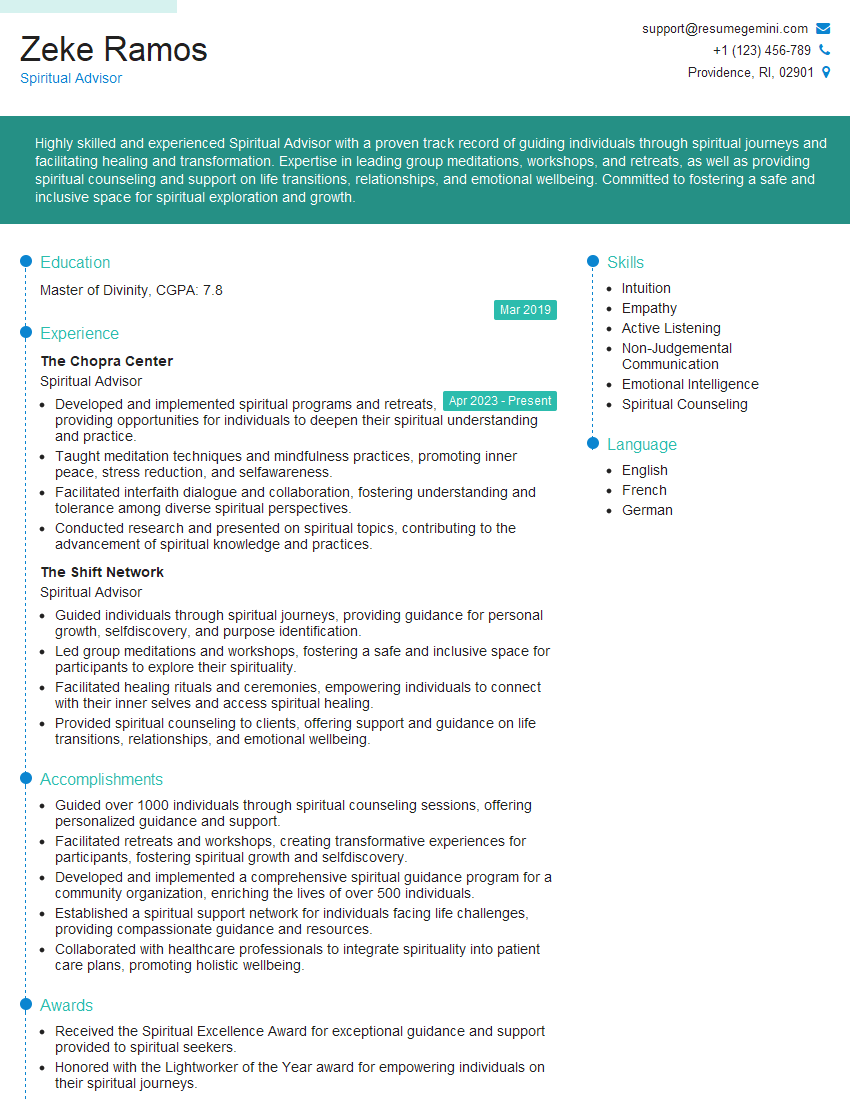
Mastering Clairsentience opens doors to exciting career opportunities and significant professional growth. To maximize your chances of success, invest time in crafting a compelling and ATS-friendly resume that highlights your skills and experience effectively. ResumeGemini is a trusted resource that can help you build a professional resume tailored to your specific career goals. We provide examples of resumes tailored to Clairsentience to guide you through the process. Take advantage of these resources to present yourself in the best possible light and land your dream job.
Explore more articles
Users Rating of Our Blogs
Share Your Experience
We value your feedback! Please rate our content and share your thoughts (optional).
What Readers Say About Our Blog
Very informative content, great job.
good