The right preparation can turn an interview into an opportunity to showcase your expertise. This guide to Clairvoyance interview questions is your ultimate resource, providing key insights and tips to help you ace your responses and stand out as a top candidate.
Questions Asked in Clairvoyance Interview
Q 1. Explain the difference between clairvoyance, clairaudience, and clairsentience.
Clairvoyance, clairaudience, and clairsentience are all forms of extrasensory perception (ESP), but they differ in the way information is received.
- Clairvoyance is clear seeing – perceiving information visually, often as images or scenes, without the use of the physical eyes. Think of it like an inner vision, receiving pictures or glimpses of the past, present, or future.
- Clairaudience is clear hearing – receiving information auditorily, as whispers, voices, or sounds, independent of physical ears. It’s like an inner voice giving you information or insights.
- Clairsentience is clear feeling – perceiving information through feeling or intuition. It’s the ability to sense emotions, energies, or the overall atmosphere surrounding a person, place, or event. You might feel a sudden chill during a reading signifying a negative energy or a sense of warmth related to positive emotions.
For example, in a clairvoyant reading, I might see a flash of an accident; in a clairaudient reading, I might hear a voice warning about a potential problem; and in a clairsentient reading, I might feel a deep sadness emanating from a person, indicating grief or loss.
Q 2. Describe your process for grounding and centering before a reading.
Grounding and centering are crucial before any reading to ensure accuracy and protect my energy. My process involves a combination of physical and mental techniques.
- Physical Grounding: I begin by sitting or standing comfortably, feeling my feet firmly planted on the ground. I might visualize roots extending from my base chakra down into the earth, drawing up stability and energy.
- Breathing Exercises: Deep, slow breaths help calm my mind and center my energy. I focus on the rhythm of my breathing, clearing away any distractions.
- Mental Centering: I focus on my heart chakra, visualizing a calm, peaceful space within myself. I clear my mind of any preconceived notions or personal biases, creating a neutral space for information to flow.
- Protection: I mentally visualize a protective shield of white light around myself, safeguarding my energy from any negative influences. This act helps me remain grounded and centered throughout the reading.
This process helps me to become a clear channel for information, reducing noise and ensuring the accuracy of the insights I receive.
Q 3. How do you handle conflicting information received during a clairvoyant session?
Conflicting information is common in clairvoyant readings. It doesn’t necessarily mean the reading is inaccurate; it often signifies complexity or multiple possibilities. I address this by:
- Clarifying the Information: I ask clarifying questions, both internally and, if appropriate, to the client. I delve deeper into the images, sounds, or feelings received to better understand their context and meaning.
- Considering Multiple Perspectives: I recognize that situations rarely have only one outcome. I interpret conflicting information as representing potential pathways or alternative scenarios, presenting them to the client as such.
- Trusting My Intuition: Ultimately, I trust my intuition to guide me toward the most accurate and relevant information. My years of experience help me to discern what information is the most significant and meaningful.
- Acknowledging Uncertainty: It’s important to acknowledge when there’s uncertainty. I avoid making definitive pronouncements, instead framing my insights as possibilities or probabilities.
For instance, I might receive images of both success and failure in a business venture. Instead of choosing one, I’d interpret this as indicating that success depends on specific actions and choices, offering guidance on navigating this crossroads.
Q 4. What techniques do you use to enhance your clairvoyant abilities?
Enhancing clairvoyant abilities is a continuous process. Techniques I use include:
- Meditation and Mindfulness: Regular meditation helps quiet the mind, enhancing sensitivity to subtle energies and intuitive insights.
- Energy Work: Practices like Reiki or energy healing help me to manage and refine my energetic sensitivity, making me a clearer channel for information.
- Dream Work: Paying close attention to dreams can reveal subconscious insights and strengthen intuition.
- Spiritual Practices: Prayer, connecting with nature, and engaging in spiritual rituals can elevate my connection to the spiritual realm.
- Practice and Experience: The more I practice, the clearer and more refined my abilities become. Keeping a journal of readings helps me to reflect on my progress and learn from both successful and challenging experiences.
It’s like training a muscle – the more you use it, the stronger it gets. Consistent practice combined with self-care and spiritual development is key to enhancing clairvoyant abilities.
Q 5. How do you ensure accuracy and ethical conduct in your readings?
Accuracy and ethical conduct are paramount in my work. To ensure this:
- Honesty and Transparency: I am upfront about the limitations of clairvoyance, emphasizing that readings are insights, not guarantees. I avoid making predictions that could cause undue fear or distress.
- Client Confidentiality: I treat all client information with the utmost confidentiality. I never share details from a reading without explicit permission.
- Personal Boundaries: I set clear boundaries with clients, defining the scope of the reading and respecting their time and energy.
- Self-Reflection and Continued Learning: I regularly review my readings, analyzing my successes and areas for improvement. I continually seek to expand my knowledge and refine my skills.
- Professional Development: I engage in ongoing professional development, attending workshops, and studying various modalities to enhance my understanding of ethics and responsible psychic practice.
By adhering to a strict code of ethics, I ensure that my readings are conducted with integrity and respect for the client’s well-being.
Q 6. Explain your understanding of psychic shielding and protection.
Psychic shielding and protection are vital for maintaining my well-being and ensuring accuracy during readings. They protect me from absorbing negative energies or influences from the client, environment, or spirit world.
- Visualization Techniques: I visualize a protective shield of white light surrounding myself before, during, and after a reading. This shield acts as a barrier, deflecting negative energies and keeping my energy field clear.
- Energy Cleansing: After a reading, I perform an energy cleansing ritual, such as using sage or other cleansing methods, to release any absorbed energies.
- Grounding and Centering: As mentioned earlier, this is a foundational aspect of protection, maintaining a strong connection to the earth and my center.
- Intention Setting: I set the intention to only receive and channel positive, helpful energy during readings. This intentional focus directs the flow of information.
Psychic shielding isn’t about building a wall; it’s about creating a healthy boundary, allowing me to connect with the client’s energy while remaining protected and grounded.
Q 7. Describe a time you encountered a challenging or unexpected reading.
During a reading for a young woman concerning her missing brother, I initially received images of a peaceful, serene location—a stark contrast to the anxiety I sensed from her. The images were so persistent, I nearly dismissed them as inaccurate, reflecting my own desire for a positive outcome. However, I felt a strong compulsion to pursue the detail. It turned out the brother was not missing as they originally assumed, but he was in a remote location experiencing a mental health crisis, seeking solitude, and he was indeed safe in that quiet place I had sensed. It was a challenging reading because it required me to navigate between the strong emotional energy of the client and the seemingly contrasting imagery, forcing me to trust my intuition over initially jarring imagery.
This taught me the importance of respecting all the nuances of a reading, even if they initially appear contradictory. Often, the most meaningful insights lie in integrating different pieces of information, no matter how seemingly disparate.
Q 8. How do you interpret symbolic imagery received during a clairvoyant experience?
Interpreting symbolic imagery in clairvoyance is a deeply nuanced process. It’s not about literal translations but understanding the emotional resonance and contextual clues within the image. I approach it systematically:
- Personal Symbolism: I first consider the individual’s personal associations with the symbols. For example, a recurring image of a specific flower might hold personal significance for the client that only they can fully articulate, revealing insights into their subconscious.
- Archetypal Symbolism: Next, I draw upon established archetypes and universal symbolism. A recurring snake might symbolize transformation or healing, depending on the overall context of the vision. Understanding common interpretations offers a framework, but personal association always takes precedence.
- Emotional Context: The feeling evoked by the image is crucial. A bright, sunny field might signify optimism, while a dark, stormy sea could represent internal turmoil. This emotional overlay adds layers of meaning.
- Iterative Refinement: Interpretation is not a one-time process. It’s often an iterative refinement. As I receive more information, either through further clairvoyant impressions or the client’s feedback, the initial interpretations may evolve and become more precise.
For example, a client once saw a recurring image of a locked door. Initially, this suggested blocked opportunities. However, upon further exploration, the associated feeling was one of quiet strength and determination, revealing not a barrier but an intentional choice to delay a particular action until the right time.
Q 9. How do you differentiate between intuition and clairvoyance?
Intuition and clairvoyance are distinct, though often intertwined. Intuition is a gut feeling, a subtle knowing without a clear source. Clairvoyance, however, is a form of extrasensory perception, a direct reception of information beyond the five senses.
Think of it like this: intuition is a whisper, while clairvoyance is a clear voice. Intuition might guide you to make a ‘good’ decision, without necessarily understanding *why*. Clairvoyance might provide specific details, like a future event or an unseen truth, giving you a more concrete understanding of the situation.
In practice, I often find that intuition acts as a guide or filter for clairvoyant impressions. My intuition might tell me which impressions are relevant, while clairvoyance delivers the actual information.
Q 10. Discuss your experience with different divination tools (e.g., tarot, runes).
I’ve worked extensively with Tarot cards and runes. Tarot, with its rich symbolism and archetypal figures, provides a structured framework for exploring a situation. The imagery on the cards, combined with my intuitive interpretation and clairvoyant insights, allows for a deeper understanding of the client’s present situation and potential future outcomes.
Runes, on the other hand, offer a more direct and concise approach. Their ancient energy can help tap into core issues and reveal potent insights with less narrative detail than Tarot. I find that the choice of tool depends on both the client’s preferences and the nature of the question.
Ultimately, the tools are instruments; the true power lies in my ability to connect with the underlying energies and channel the information effectively, regardless of the method used.
Q 11. How do you maintain objectivity and avoid bias in your readings?
Maintaining objectivity is paramount. I utilize several strategies:
- Grounding Techniques: Before each session, I employ grounding techniques – deep breathing, meditation – to center myself and minimize personal biases.
- Clear Intentions: I set a clear intention to be a channel for information, not an interpreter of my own desires or fears.
- Self-Reflection: Regular self-reflection helps identify personal biases and blind spots, which can influence interpretations.
- Seeking Feedback: I actively encourage clients to provide feedback on readings, allowing me to assess the accuracy and potential biases in my interpretations.
- Multiple Perspectives: When possible, I might approach a reading from multiple perspectives, such as drawing multiple cards or utilizing different divination methods, to get a more holistic understanding and reduce potential bias from a single perspective.
By focusing on the information received and actively mitigating personal influence, I strive to provide readings that are as unbiased and accurate as possible.
Q 12. How do you help clients process emotionally challenging information received during a session?
Delivering challenging information requires sensitivity and compassion. My approach is multifaceted:
- Gentle Delivery: I present information gently, avoiding judgmental language or abrupt pronouncements. I allow space for the client to process the information at their own pace.
- Empathy and Validation: I acknowledge the client’s emotional response, validating their feelings without minimizing the situation. This creates a safe space for emotional expression.
- Reframing: I help reframe the information in a way that highlights potential opportunities for growth or learning, shifting the focus from purely negative aspects.
- Practical Advice: I offer practical advice or strategies to help the client navigate the challenges ahead. This can include suggestions for self-care, coping mechanisms, or steps to address specific problems.
- Referral if needed: If the information reveals serious issues beyond my expertise (e.g., mental health concerns), I make sure to refer them to appropriate professionals.
The goal is to empower the client, providing them not just with information, but also with the tools and support they need to navigate difficult circumstances.
Q 13. Describe your experience working with diverse client backgrounds and needs.
Working with diverse clients has been a rewarding experience. It’s taught me the importance of cultural sensitivity and adaptability. I’ve learned to approach each reading with an open mind, recognizing that cultural backgrounds, beliefs, and personal experiences significantly shape individual perspectives and interpretations.
For example, a client’s interpretation of certain symbols might differ based on their cultural background. Recognizing this allows me to tailor my approach to ensure the reading resonates with them. It also requires a certain level of humility, recognizing that my understanding is not universal. I constantly learn and refine my approach based on these experiences.
Q 14. How do you determine the appropriate level of detail to share with a client?
Determining the appropriate level of detail is crucial and involves careful judgment. I consider several factors:
- Client’s Request: The level of detail I provide often aligns with the client’s specific questions and desired level of information.
- Client’s Capacity: I assess the client’s capacity to handle information. Overwhelming them with excessive detail, particularly regarding emotionally charged topics, can be counterproductive.
- Clarity and Relevance: I prioritize clarity and relevance over sheer volume. It’s more valuable to provide concise, meaningful information than a lengthy, convoluted reading.
- Ethical Considerations: I always consider ethical implications before sharing details. I avoid disclosing information that might violate a client’s privacy or cause unnecessary harm.
It’s often a delicate balance. Sometimes, less is more. The goal is not to provide all possible information but rather to offer relevant insights that empower the client to make informed decisions and move forward with clarity and purpose.
Q 15. How do you handle situations where a client is skeptical of your abilities?
Skepticism is a common and perfectly valid reaction. I approach it with empathy and understanding. Instead of trying to force belief, I focus on demonstrating the value of the session in a way that respects the client’s perspective. This might involve focusing on practical insights, offering alternative interpretations that resonate with their worldview, or even suggesting we start with a less ‘clairvoyant’ approach, perhaps a general life coaching session, and gradually introduce the more intuitive aspects as trust builds. For example, if a client is skeptical about past life readings, I might initially focus on providing intuitive guidance on their current life challenges and demonstrate accuracy in that area before venturing into past life explorations.
Ultimately, it’s about building a collaborative relationship based on mutual respect and trust, allowing the client to experience the benefits of the session at their own pace. The goal isn’t to ‘prove’ my abilities, but to offer support and guidance in a way that’s meaningful to them.
Career Expert Tips:
- Ace those interviews! Prepare effectively by reviewing the Top 50 Most Common Interview Questions on ResumeGemini.
- Navigate your job search with confidence! Explore a wide range of Career Tips on ResumeGemini. Learn about common challenges and recommendations to overcome them.
- Craft the perfect resume! Master the Art of Resume Writing with ResumeGemini’s guide. Showcase your unique qualifications and achievements effectively.
- Don’t miss out on holiday savings! Build your dream resume with ResumeGemini’s ATS optimized templates.
Q 16. Explain your process for preparing for a client session.
Preparation for a client session is crucial. It’s more than just meditation or clearing my energy; it’s a holistic approach to ensure I’m in optimal state to receive and transmit information accurately. My process involves:
- Physical Preparation: Ensuring I have a quiet, clean, and comfortable space free of distractions. This includes comfortable seating for both myself and the client.
- Mental Preparation: This involves meditation and grounding techniques to center myself and clear any mental clutter. I aim to achieve a state of calm receptivity.
- Energetic Preparation: I utilize various energy-clearing techniques to create a positive and safe energetic space for both myself and the client. This might include using crystals, smudging with sage, or simply visualizing protective white light.
- Intuition Check: Before each session, I take time to connect with my intuition, ensuring my channels are open and my energy is flowing freely. This can involve simple exercises like focusing on my breath or engaging in a brief period of intuitive journaling.
This comprehensive preparation helps me to be fully present and receptive during the session, allowing for a more accurate and meaningful reading.
Q 17. Describe your method for setting boundaries with clients.
Setting boundaries is essential for maintaining professional integrity and safeguarding my well-being. Clear boundaries are communicated upfront and consistently reinforced throughout the process. This includes:
- Time Limits: I clearly define the length of the session and stick to it. This prevents energy depletion and ensures I can provide focused attention.
- Scope of Practice: I clearly state what I can and cannot do. I will not make predictions that are harmful or potentially lead to detrimental actions. I focus on providing guidance and insights, not dictating future events.
- Communication Protocol: I set expectations regarding communication outside of sessions – response times for emails, availability for additional inquiries, etc.
- Professional Distance: While empathy is essential, I maintain a professional distance to prevent blurring lines between client and practitioner.
These boundaries are not just for protection, but also for maximizing the benefit of the session for the client. A structured environment fosters trust and allows for deeper connection.
Q 18. How do you manage your own energy levels during and after readings?
Clairvoyant work can be energetically draining. Managing my energy levels is paramount for maintaining accuracy and preventing burnout. My strategies include:
- Grounding Techniques: Before, during, and after sessions I use grounding techniques like visualization (connecting to the earth), deep breathing, and mindful movement to prevent energy leakage.
- Hydration and Nutrition: Maintaining healthy hydration and consuming nutritious foods sustains my physical and energetic well-being.
- Rest and Relaxation: Adequate rest is crucial. I schedule regular breaks and prioritize sleep to prevent energy depletion.
- Energy Clearing Techniques: After sessions, I cleanse my energy field through visualization, meditation, or showering to remove any residual energy from the client.
- Personal Boundaries: Respecting my boundaries (as described above) prevents me from being overburdened or overwhelmed by the energy of others.
By prioritizing self-care, I ensure I’m capable of providing consistent, high-quality readings without compromising my own health.
Q 19. What are the ethical considerations involved in using clairvoyant abilities?
Ethical considerations are paramount in clairvoyant practice. Key aspects include:
- Honesty and Integrity: I only provide information that I receive intuitively and avoid fabricating or embellishing information. I acknowledge the limitations of my abilities and avoid making definitive pronouncements.
- Client Autonomy: I empower clients to make their own decisions based on the information received. Readings are guidance, not directives.
- Confidentiality: Maintaining strict client confidentiality is vital (addressed in the next answer).
- Avoiding Harm: I never provide readings that could be harmful or lead to destructive actions. I might refuse a reading if I sense a client might misuse the information.
- Responsible Use of Gifts: I approach my abilities with humility and responsibility, recognizing the power and potential impact of clairvoyance.
Upholding ethical standards ensures trust and responsibility within the practice. It’s not about exploiting abilities, but using them for good and serving others.
Q 20. How do you ensure confidentiality and client privacy?
Confidentiality is a cornerstone of my practice. I employ several measures to safeguard client privacy:
- Data Security: I keep no client records in easily accessible locations; any written notes are kept securely and confidentially disposed of once the session is over. I do not record sessions without explicit client consent.
- Verbal Confidentiality: I never disclose client information to anyone outside of the session. I treat all information shared as strictly confidential.
- Informed Consent: Before every session, clients are fully informed about my confidentiality practices and understand what information is being shared and how it will be handled.
- Professional Boundaries: Maintaining a professional distance prevents accidental disclosures and protects the client’s privacy.
Protecting client privacy is not just an ethical obligation; it’s crucial for creating a safe and trusting environment for vulnerable individuals.
Q 21. How do you deal with difficult or demanding clients?
Dealing with difficult or demanding clients requires patience, empathy, and clear boundaries. My approach is to:
- Active Listening: Carefully listen to the client’s concerns and try to understand their perspective.
- Setting Boundaries: If the client’s behavior crosses a professional boundary, I calmly but firmly remind them of the established guidelines. I may even end a session if the behavior becomes abusive or threatening.
- Empathy and Compassion: Try to approach the interaction with compassion, understanding that the client’s difficult behavior may stem from their personal struggles. But this empathy does not mean compromising boundaries.
- Referral: If the client’s needs are beyond my scope of practice or if I feel unable to effectively support them, I will refer them to a more appropriate professional such as a therapist or counselor.
Ultimately, the focus is on maintaining a professional environment while providing the best possible support I can within my ethical and professional boundaries. If a client is consistently disruptive or abusive, it is important to protect yourself and end the interaction.
Q 22. Describe your professional development plan to enhance your clairvoyance skills.
My professional development plan focuses on continuous refinement and expansion of my clairvoyant abilities. It’s a multifaceted approach involving regular practice, mentorship, and ongoing learning.
- Regular Practice: I dedicate time each day to honing my skills through guided meditations, energy work, and developing my intuitive awareness. This includes exercises focusing on specific types of clairvoyance, such as practicing clear auditory reception for clairaudience or enhancing visual imagery for clairvoyance.
- Mentorship: I actively seek guidance from experienced clairvoyants. This includes participation in workshops, receiving feedback on my readings, and discussing challenging cases to improve my accuracy and ethical practices. A trusted mentor can provide invaluable insights and support.
- Ongoing Learning: I continuously research and explore new techniques and approaches to clairvoyance. This involves reading relevant books and articles, studying different spiritual traditions and energy systems, and staying updated on advancements in parapsychology.
This holistic approach ensures I maintain a high level of proficiency and ethical conduct in my practice. It’s not just about increasing the intensity of readings but also about refinement, accuracy and responsible use of these gifts.
Q 23. What are your strengths and weaknesses as a clairvoyant practitioner?
My strengths lie in my ability to connect empathetically with clients and provide clear, concise readings. I have a strong aptitude for clairaudience and clairvoyance, often receiving vivid images and messages. I also pride myself on my ethical practices and commitment to client confidentiality.
- Strengths: Empathetic connection, clear communication, strong clairaudience and clairvoyance, ethical conduct, client confidentiality.
However, like any practitioner, I also have weaknesses. Occasionally, I may struggle with overly emotional cases or situations where the client’s energy is heavily clouded or resistant to information. Another challenge is managing the volume of information I receive during sessions. This requires careful interpretation and selective delivery to avoid overwhelming the client.
- Weaknesses: Difficulty with emotionally charged cases, challenges in navigating resistance from client energy, managing information overload.
I actively work to mitigate these weaknesses through mindfulness techniques, grounding exercises, and by setting clear boundaries to protect my energy during readings.
Q 24. How do you stay grounded and avoid burnout?
Maintaining a balance between intuitive work and self-care is paramount to avoid burnout. This involves a multi-pronged approach:
- Grounding Techniques: I regularly practice grounding exercises, such as walking barefoot on the earth, spending time in nature, or using visualization techniques to connect with the earth’s energy. This helps to anchor my energy and prevent psychic fatigue.
- Energy Protection: Before and after readings, I employ protection techniques such as visualization of a protective shield or using crystals to deflect negative energy. This prevents energy depletion and preserves my clarity.
- Mindfulness and Meditation: Daily meditation and mindfulness practices are essential for managing stress and maintaining emotional balance. They help me to process information and detach from intense emotional experiences encountered during readings.
- Physical and Mental Well-being: I prioritize sleep, a healthy diet, and regular exercise. Engaging in hobbies outside of my work helps to maintain a sense of balance and reduces overall stress.
- Setting Boundaries: I set clear boundaries with clients, including limiting the duration of readings and avoiding emotionally draining conversations outside of scheduled sessions. This ensures I maintain healthy energy levels.
Think of it like a juggler: keeping multiple balls in the air requires focus and technique. Balancing my intuitive practice with self-care ensures I can effectively continue to support my clients without compromising my own well-being.
Q 25. What are your fees and payment policies?
My fees are structured to reflect the time and energy invested in each reading. I offer a tiered system based on the type and length of the reading. My fees are clearly outlined on my website and discussed with each client before we begin. Payments are accepted via [mention preferred methods, e.g., credit card, PayPal, etc.].
Payment is typically due at the conclusion of the reading. In cases where extended payment arrangements are needed, I can accommodate those on a case-by-case basis. Transparency and understanding regarding fees are essential for fostering a positive and professional client relationship.
Q 26. How do you handle situations where you are unable to provide a reading?
There are instances where I may be unable to provide a complete or clear reading due to various factors. This could stem from energetic interference, a lack of clarity in the client’s question, or simply an inability to connect with their energy.
In such situations, I always maintain open and honest communication. I will explain to the client that I am unable to provide a reading at this time, and offer alternative solutions if possible. This might include suggesting a different time for a session, offering guidance on clarifying their question, or referring them to another practitioner.
Prioritizing ethical practices and client well-being is vital. Providing false or unclear information would be unethical and detrimental, even if unintentionally provided.
Q 27. Describe your experience with different forms of clairvoyance (e.g., precognitive, retrocognitive).
My experience encompasses various forms of clairvoyance. Each type has its own nuances and requires a different approach to interpretation.
- Precognitive Clairvoyance: This involves receiving information about future events. I’ve experienced this as intuitive flashes or dreams containing symbolic imagery related to potential future scenarios. It’s crucial to emphasize that these are potential outcomes, not set in stone, influenced by free will and choices. For instance, a recurring dream of a car accident might indicate a need for caution while driving, not a definitive accident prediction.
- Retrocognitive Clairvoyance: This focuses on accessing information from the past. I’ve found this valuable in assisting clients with understanding past relationships or events that may be influencing their current situations. During these readings, I might receive visual flashes of a past event or feelings associated with a particular time period, requiring careful interpretation within an ethical and responsible framework.
- Clairvoyance (present): This is my primary mode of clairvoyance. I receive vivid visual impressions and intuitive understanding of the present circumstances and energies surrounding the client. This might manifest as images, symbols, or emotional sensations providing insights into their current relationships, career paths, or overall well-being.
Understanding and skillfully utilizing all these forms of clairvoyance requires constant practice, self-reflection and an awareness of the ethical implications in each case. The goal is always to provide helpful and accurate information while respecting the client’s free will and agency.
Key Topics to Learn for Clairvoyance Interview
- Fundamentals of Clairvoyance: Understanding the core principles and underlying methodologies of Clairvoyance. This includes exploring its theoretical foundations and the various interpretations within the field.
- Practical Applications of Clairvoyance: Exploring real-world scenarios where Clairvoyance techniques are applied, such as problem-solving, decision-making, and strategic planning. Consider case studies and examples to solidify your understanding.
- Data Analysis and Interpretation within Clairvoyance: Focusing on the critical skills of analyzing complex datasets and drawing meaningful insights. Practice interpreting results and communicating your findings effectively.
- Ethical Considerations in Clairvoyance: Understanding the ethical implications and responsible application of Clairvoyance methodologies. This is crucial for demonstrating professional awareness and judgment.
- Advanced Techniques and Methodologies: Exploring more advanced techniques and methodologies within Clairvoyance, depending on the specific role and requirements. Research cutting-edge advancements and their potential applications.
- Problem-Solving using Clairvoyance: Develop your ability to approach complex problems using a Clairvoyance framework. Practice identifying challenges, proposing solutions, and evaluating potential outcomes.
Next Steps
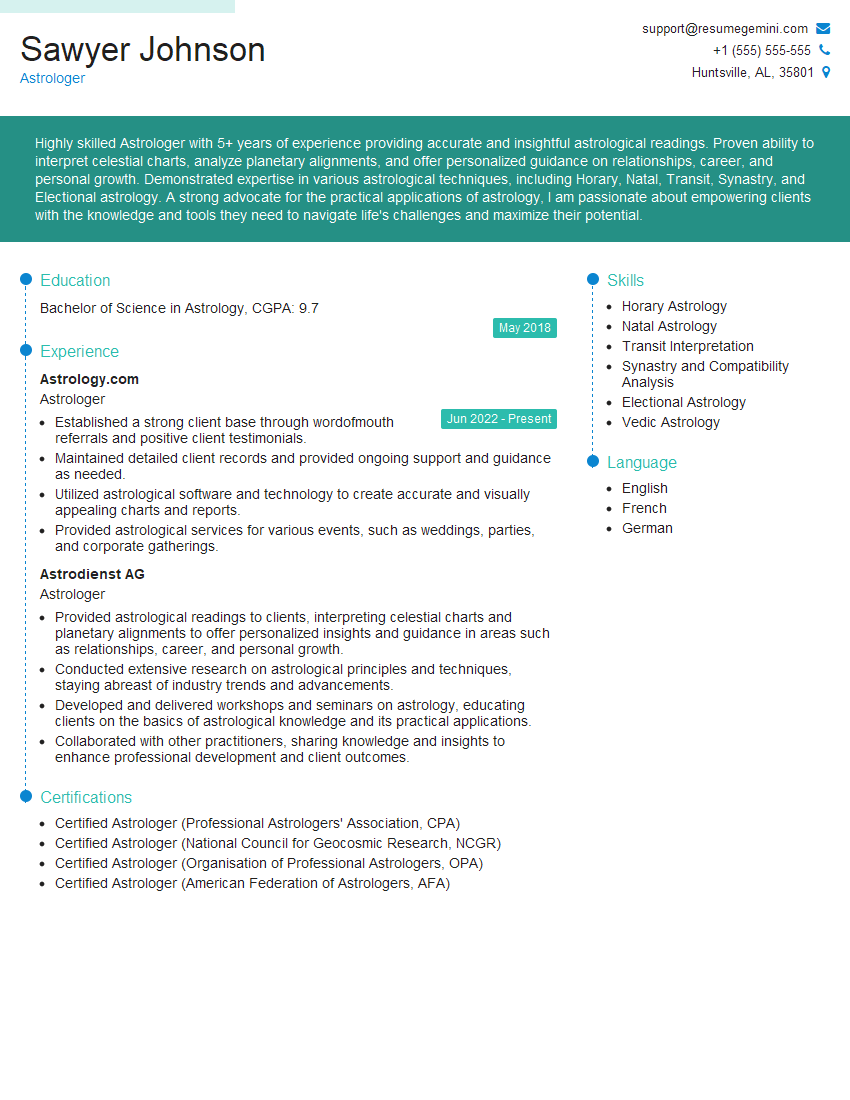
Mastering Clairvoyance opens doors to exciting career opportunities in a rapidly evolving field. To maximize your chances of securing your dream role, creating a strong, ATS-friendly resume is crucial. This ensures your application gets noticed by recruiters and hiring managers. We highly recommend using ResumeGemini, a trusted resource, to build a professional and impactful resume. Examples of resumes tailored to Clairvoyance roles are available below to help guide you in crafting your own compelling application.
Explore more articles
Users Rating of Our Blogs
Share Your Experience
We value your feedback! Please rate our content and share your thoughts (optional).
What Readers Say About Our Blog
Very informative content, great job.
good