Are you ready to stand out in your next interview? Understanding and preparing for Closet Organization interview questions is a game-changer. In this blog, we’ve compiled key questions and expert advice to help you showcase your skills with confidence and precision. Let’s get started on your journey to acing the interview.
Questions Asked in Closet Organization Interview
Q 1. Describe your experience with various closet organization systems (e.g., wire shelving, custom built-ins).
My experience spans a wide range of closet organization systems. I’ve worked extensively with wire shelving, which offers affordability and adjustability, ideal for clients on a budget or needing quick solutions. I’ve also designed and implemented numerous custom built-in systems, providing bespoke solutions for maximizing space and incorporating unique design features. These are perfect for clients who want a more luxurious, integrated look and maximum storage capacity. Finally, I have experience with modular systems, offering a balance between cost-effectiveness and customization. Each system presents unique advantages and challenges. Wire shelving can sometimes feel less sturdy or visually appealing, while custom built-ins require more upfront investment and planning. Modular systems can be a great compromise offering flexibility and a more refined look than wire shelving.
For example, I recently completed a project where a client needed a small closet solution in a rental apartment. The wire shelving solution was perfect as it was budget-friendly, easy to install, and could be easily removed when they moved. In contrast, a large walk-in closet renovation for a high-end client perfectly showcased the benefits of a custom built-in system, transforming the space into a beautifully organized and functional storage haven.
Q 2. How do you assess a client’s needs and preferences before designing a closet organization system?
Assessing a client’s needs begins with a thorough consultation. This includes a detailed walkthrough of their existing closet, noting its dimensions, current contents, and structural limitations. I pay close attention to the types of clothing and items they store, their lifestyle (e.g., frequent traveler, athlete), and their aesthetic preferences. I use questionnaires and visual aids like mood boards to understand their vision and identify their ‘pain points’. The goal is to understand not just what they own, but how they use their closet and what makes them feel organized and at ease.
For instance, one client might prioritize quick access to daily outfits, while another may focus on storing out-of-season items efficiently. Understanding these individual needs informs my design recommendations. I always aim for collaborative decision-making, ensuring that the final design reflects both functionality and the client’s personal style.
Q 3. What software or tools do you use for closet design and planning?
I utilize a combination of software and tools for closet design and planning. My primary tool is SketchUp, which allows me to create detailed 3D models of closets, showcasing the placement of shelves, drawers, and other organizational features. This enables clients to visualize the finished project before any work begins. I also use Excel for creating detailed inventory lists and tracking materials and costs. Measuring tools like laser measures and digital level help with accurate on-site assessment. Finally, I utilize photography and image editing software to document the ‘before’ and ‘after’ transformations, showcasing the project’s successful completion to prospective clients.
Q 4. Explain your process for decluttering and organizing a client’s closet.
My decluttering and organizing process follows a systematic approach. It begins with a thorough removal of all items from the closet. This allows for a clean slate and a thorough assessment of the space. Next, I work with the client to categorize items: keep, donate, discard. This usually involves a thoughtful discussion about the sentimental value and usefulness of each item. We then decide on the most appropriate storage solutions based on the items retained. Once this is done, we carefully place items back into the closet, making sure to maximize vertical space and accessibility. Labeling is a crucial final step for maintaining organization over the long term.
For instance, I’ve helped clients create zones for folded clothes, hanging clothes, shoes, and accessories. The process aims not only for organization but also for a visually appealing and emotionally satisfying outcome.
Q 5. How do you handle difficult clients or situations during the organization process?
Handling difficult clients requires patience, empathy, and excellent communication skills. Active listening is key to understanding their concerns and addressing them effectively. Sometimes, disagreements arise about design choices or budget constraints. In such cases, I offer alternative solutions, emphasizing the benefits and trade-offs of each option. Transparency and clear communication throughout the process help prevent misunderstandings and maintain a positive working relationship. If a complete resolution can’t be reached, I ensure both parties understand each other’s perspectives and may suggest mediation if necessary.
For example, I once worked with a client who had a strong attachment to many items. Instead of forcing decluttering, I helped her categorize and reorganize her possessions in a way that made her feel comfortable and in control.
Q 6. What are the most common challenges you encounter when organizing closets?
The most common challenges I face include limited space, impractical closet configurations (e.g., low ceilings, awkward angles), and client indecision. Lack of sufficient lighting also poses a challenge as clients struggle to see and organize their items effectively. Sometimes, clients underestimate the amount of storage space needed, leading to adjustments during the organization process. Finally, managing expectations about the time it takes to fully declutter and organize is also important.
Q 7. How do you maximize space and functionality in small closets?
Maximizing space and functionality in small closets involves creative solutions. Utilizing vertical space is crucial, with shelves reaching the ceiling. Multi-tiered hanging systems and slimline hangers help maximize hanging capacity. Space-saving drawers and pull-out shelves offer efficient storage for folded items. Using clear storage containers allows for easy identification of contents, further enhancing accessibility. Strategically placed mirrors can make the space appear larger. Finally, implementing specialized solutions such as shoe organizers or jewelry drawers allows for optimization based on the client’s belongings.
For example, in a very small closet, a simple system of vertical shelves with slimline hangers, cascading shelves for shoes, and a few clear storage boxes can dramatically increase storage and functionality.
Q 8. Describe your experience with different types of closet storage solutions (e.g., drawers, shelves, hanging rods).
My experience encompasses a wide range of closet storage solutions, each offering unique advantages. Drawers, for instance, are ideal for storing folded items like sweaters and jeans, keeping them neatly tucked away and protected from dust. They’re especially beneficial in maximizing vertical space. Shelves, on the other hand, offer versatility for displaying folded items, books, or accessories, allowing for customization and easy visual access. The height and depth of shelves can be adjusted based on the client’s needs and item sizes. Hanging rods are essential for garments like dresses, suits, and shirts, maintaining their shape and preventing wrinkles. I’ve worked extensively with various materials – from wood and wire to custom-built systems – choosing the right combination to suit the client’s style, budget, and closet dimensions. For example, a small closet might benefit from slimline wire shelving and a single hanging rod to maximize space, while a walk-in closet could incorporate a mixture of drawers, double hanging rods, and deep shelves for optimal organization.
Q 9. How do you incorporate a client’s style and preferences into their closet design?
Incorporating a client’s style and preferences is paramount. I begin by engaging in a thorough consultation, discussing their lifestyle, clothing style, and organizational habits. Do they prefer a minimalist aesthetic or a more luxurious feel? Are they visual learners who benefit from open shelving, or do they prefer concealed storage? I explore their current wardrobe, understanding how they use their clothes and what items are most important. For example, a client with a large shoe collection might benefit from dedicated shoe storage solutions like pull-out drawers or tiered shelves. A client who travels frequently might need designated space for luggage. By understanding these preferences, I can create a closet that’s both functional and reflects their personal taste, avoiding a generic ‘one-size-fits-all’ approach. I often utilize mood boards and design sketches to visualize these preferences and ensure the client is actively involved in the design process.
Q 10. What is your approach to managing a client’s budget during a closet organization project?
Budget management is crucial. I always provide clients with a detailed breakdown of costs upfront, including materials, labor, and any additional services. We collaboratively explore various options to find a solution that balances their needs and budget. This could involve selecting more affordable materials, optimizing the layout to minimize material usage, or prioritizing key areas of the closet. We might start with a core set of essential components and gradually add more features as the budget allows. For instance, if budget is tight, we might prioritize functional shelving and rods before adding luxury elements like custom-built drawers. Transparency is key; I keep the client informed throughout the process, providing updates on costs and making adjustments as needed.
Q 11. Explain your method for measuring and documenting closet dimensions.
Accurate measurements are foundational. I use a high-quality measuring tape, ensuring accuracy to the nearest 1/8 inch. I meticulously document the closet’s dimensions – height, width, and depth – in addition to any obstructions like pipes or electrical outlets. I create detailed sketches or diagrams, sometimes incorporating photographs, to visually represent the space. These measurements are crucial for designing custom storage solutions or selecting pre-fabricated units that fit precisely. I also note features like ceiling height variations or unusual architectural details, ensuring that the final design accounts for all aspects of the space. This detailed documentation minimizes errors and ensures a seamless installation.
Q 12. How do you create a functional and aesthetically pleasing closet design?
Creating a functional and aesthetically pleasing closet involves a blend of art and science. Functionality comes from strategic placement of storage elements. For instance, frequently used items should be easily accessible, while less frequently used items can be placed higher or further back. Aesthetically pleasing design relies on principles like visual balance, color coordination, and the selection of materials. For example, using natural wood tones alongside soft lighting can create a calm, inviting space. However, functionality is paramount; a beautifully designed closet that’s impractical to use is a failure. I strike a balance by incorporating design features that also enhance usability, such as well-lit interiors, smooth-gliding drawers, and ergonomic shelving heights.
Q 13. What safety precautions do you take while working with closet organization materials?
Safety is always my top priority. I handle tools and materials with care, ensuring they’re used as intended and stored correctly when not in use. When working with heavier items, I utilize appropriate lifting techniques to prevent injuries. I wear safety glasses and gloves when needed. I also clear the work area of any hazards and ensure proper ventilation, especially when using paints or other chemical products. If working in a client’s home, I’m mindful of their property and take steps to protect it from damage. Thorough planning and careful execution minimizes risks and ensures a safe working environment for both myself and the client.
Q 14. How do you educate clients on maintaining an organized closet after the project is complete?
Client education is crucial for long-term success. After completing the project, I provide clear instructions on how to maintain the organized closet. This might include recommendations for folding techniques, strategies for seasonal clothing rotation, and suggestions for ongoing maintenance. I might provide a checklist or a guide detailing how to regularly purge items they no longer need. I often encourage the use of labeling systems, which can be especially helpful in maintaining order over time. I also emphasize the importance of regularly reviewing and adjusting the organization as their needs evolve. By empowering clients with the knowledge and tools to maintain their organized closet, I ensure the longevity of the project’s positive impact.
Q 15. Describe your experience working with various materials used in closet organization (e.g., wood, plastic, fabric).
My experience spans a wide range of materials used in closet organization, each with its own advantages and disadvantages. I’ve worked extensively with wood, plastic, and fabric, understanding their strengths and limitations in different contexts.
- Wood: I appreciate the durability and aesthetic appeal of wood. Custom-built wood shelving and drawer systems offer exceptional longevity and a high-end look. However, wood can be more expensive and susceptible to damage from moisture.
- Plastic: Plastic offers affordability and versatility. It’s lightweight, easy to clean, and comes in various colors and designs. However, lower-quality plastic can be less durable and may not have the same aesthetic appeal as wood.
- Fabric: Fabric storage solutions like bins, drawers, and hanging organizers are great for added flexibility and soft storage for delicate items. They’re often lighter than wood or plastic but may require more careful maintenance and can be less durable. I carefully consider the client’s budget, style preferences, and the items being stored when choosing the right fabric type and construction.
For example, in one project, a client wanted a luxurious, high-end feel, so we opted for custom-built cherry wood shelving. In another, budget constraints led us to use durable, high-quality plastic drawers, achieving a clean and organized look without compromising quality.
Career Expert Tips:
- Ace those interviews! Prepare effectively by reviewing the Top 50 Most Common Interview Questions on ResumeGemini.
- Navigate your job search with confidence! Explore a wide range of Career Tips on ResumeGemini. Learn about common challenges and recommendations to overcome them.
- Craft the perfect resume! Master the Art of Resume Writing with ResumeGemini’s guide. Showcase your unique qualifications and achievements effectively.
- Don’t miss out on holiday savings! Build your dream resume with ResumeGemini’s ATS optimized templates.
Q 16. How do you handle unexpected issues or changes during a closet organization project?
Unexpected issues are part of the job. My approach involves proactive planning and adaptable solutions. I begin with a thorough initial assessment, carefully measuring the space and discussing the client’s needs in detail. This helps to anticipate potential problems. However, changes can still arise. For instance, unexpected plumbing issues or discovering structural limitations during demolition can necessitate adjustments to the original plan.
My strategy involves:
- Open Communication: I immediately inform the client about the issue, explaining the options and potential implications. Transparency builds trust and allows for collaborative decision-making.
- Creative Problem-Solving: I’m adept at finding creative solutions, often involving adjustments to the design or material choices to overcome unforeseen obstacles.
- Contingency Planning: I always have alternative solutions and materials on hand, minimizing disruption to the project timeline.
For instance, during a recent project, we discovered damaged drywall behind the closet wall. We immediately contacted a contractor and adjusted the schedule, ensuring minimal disruption and a beautiful finished product.
Q 17. What is your process for sourcing and selecting closet organization products?
Sourcing and selecting the right products is crucial for a successful closet organization project. It involves careful consideration of several factors, including client needs, budget, and the specific challenges of the closet space.
My process includes:
- Client Consultation: Thorough discussions with clients about their clothing, accessories, and storage needs are paramount.
- Space Assessment: Precise measurements of the closet space, including dimensions, height, and access points, help to determine the best products for the space.
- Product Research: I research and compare various products from different manufacturers, focusing on quality, durability, and aesthetics.
- Budgeting: I present various options to the client within their budget, providing clear explanations of the pros and cons of each.
- Supplier Relationships: Strong relationships with reliable suppliers ensure timely delivery and quality products.
I prioritize products known for their quality and durability, avoiding cheap solutions that may break or become unusable within a short time.
Q 18. How do you manage your time and workload efficiently during multiple projects?
Managing multiple projects effectively requires a robust organizational system. I utilize project management software to track tasks, deadlines, and client communication for each project.
My time management strategies include:
- Prioritization: I prioritize projects based on deadlines and client needs, focusing on the most urgent tasks first.
- Time Blocking: I allocate specific time slots for each project, ensuring focused work and minimizing context switching.
- Delegation: When feasible, I delegate tasks to assistants or subcontractors, maximizing efficiency.
- Regular Reviews: I conduct regular reviews of the progress of each project, identifying and addressing potential delays proactively.
By using a structured approach and leveraging technology, I ensure that all projects are completed on time and within budget.
Q 19. What are your preferred methods for communicating with clients (e.g., email, phone, in-person)?
Effective communication is crucial for building trust and ensuring client satisfaction. My preferred communication methods are a combination of in-person meetings, phone calls, and email, tailored to each client’s preferences and the specific stage of the project.
- In-Person Meetings: These are essential for the initial consultation and final walkthroughs, enabling a more comprehensive understanding of the client’s needs and preferences.
- Phone Calls: Quick updates or discussions are often more efficient via phone calls.
- Email: Email is used for detailed information sharing, scheduling, and follow-up communication.
I aim for clear, concise communication, keeping clients informed at every step of the process.
Q 20. How do you stay up-to-date on the latest trends and best practices in closet organization?
Staying current in closet organization requires ongoing professional development. My strategies include:
- Industry Publications: I subscribe to industry magazines and online resources to keep up with the latest trends and best practices.
- Trade Shows and Conferences: Attending trade shows and conferences provides opportunities to network with other professionals and see new products and designs.
- Continuing Education: I participate in webinars and workshops to enhance my skills and knowledge.
- Online Communities: I actively participate in online communities and forums related to closet organization, sharing ideas and learning from others.
Staying informed ensures I can offer clients the most innovative and effective solutions.
Q 21. Describe a time you had to adapt your approach to meet a client’s specific needs.
One client, an artist, had a unique need: a closet to store not only clothing, but also large art canvases and fragile sculptures. My standard approach wouldn’t suffice. I adapted by:
- Custom Design: Instead of using standard shelving, I designed a combination of adjustable shelving for clothing and dedicated areas with custom-built supports for the art. This involved precise measurements and material selection to ensure the stability and safety of the art pieces.
- Material Selection: I selected acid-free materials for shelving and storage solutions to prevent damage to the artwork.
- Environmental Controls: We discussed options to control temperature and humidity within the closet to prevent damage to the art.
This project required creative problem-solving and a willingness to adapt my standard process. The result was a beautiful and functional closet that perfectly met the client’s unique needs, showcasing the flexibility and adaptability required in this field.
Q 22. What is your experience with installing closet organization systems?
My experience with installing closet organization systems spans over eight years, encompassing a wide range of projects from small reach-in closets to expansive walk-in designs. I’m proficient in installing various systems, including wire shelving, custom built-ins, and modular systems from brands like ClosetMaid and Elfa. This involves everything from initial measurements and design consultations to the precise installation of components, ensuring functionality and aesthetics. I’ve worked with diverse materials, including wood, laminate, and melamine, and understand the nuances of different installation methods for optimal stability and durability. For example, I recently completed a project involving a complex walk-in closet with slanted ceilings, requiring custom-cut shelving and creative solutions to maximize space. My experience allows me to efficiently handle any installation challenges while adhering to safety regulations.
Q 23. What are your strengths and weaknesses as a closet organizer?
My greatest strengths lie in my meticulous attention to detail, my ability to create functional and aesthetically pleasing designs, and my exceptional communication skills. I’m adept at understanding clients’ needs and translating them into practical solutions. I thrive in collaborative environments and can adapt to different project styles and client preferences. For instance, I recently worked with a client who desired a minimalist, modern design, while another preferred a more traditional, ornate style. I successfully delivered on both visions.
One area I’m continuously working on is delegating tasks more efficiently when managing larger projects. While I’m meticulous, it sometimes leads to spending extra time on certain aspects, something I’m actively addressing through better project management techniques. This is improving my overall efficiency without compromising quality.
Q 24. How do you prioritize tasks and manage your time effectively during a project?
My approach to prioritizing tasks and managing time hinges on a structured project management system. I begin by creating a detailed checklist outlining every step, from the initial consultation and measurements to final installation and cleanup. I then prioritize tasks based on their urgency and dependency. For instance, demolition and installation of support structures come before shelving or drawer installation. I allocate specific timeframes to each task, considering potential unforeseen delays. Utilizing project management software allows me to track progress, adjust timelines, and maintain clear communication with the client. Regular check-ins and client communication helps avoid unexpected roadblocks and ensures the project stays on schedule.
Q 25. How do you handle difficult or challenging clients?
Handling challenging clients requires patience, empathy, and strong communication skills. I start by actively listening to their concerns and addressing them directly. I find it helpful to reiterate their needs and preferences to ensure understanding. If disagreements arise, I focus on finding common ground by presenting alternative solutions and demonstrating flexibility. Maintaining a calm and professional demeanor is paramount. For example, if a client is unhappy with a particular design element, I’ll offer alternative layouts or materials to address their concerns. Documentation of all agreed-upon changes helps avoid misunderstandings later on.
Q 26. Describe your experience working with different styles of closets (e.g., walk-in, reach-in).
I have extensive experience working with various closet styles. Reach-in closets often require creative space-saving solutions, such as vertical organizers and pull-out drawers. Walk-in closets provide more flexibility, allowing for customized islands, hanging rods at different heights, and specialized areas for shoes, bags, and accessories. I’ve also worked with smaller closets in bedrooms, hallways, and even under-stair spaces. Each type requires a unique approach; however, the underlying principle remains consistent: maximizing space and functionality to meet the client’s specific needs. I tailor my designs to the available space and the client’s storage requirements, ensuring optimal use of every inch.
Q 27. What are your pricing strategies for closet organization services?
My pricing strategies are transparent and tailored to the scope of each project. I offer both hourly rates and project-based pricing. Hourly rates are ideal for smaller projects or consultations, while project-based pricing is more suitable for larger installations. The final price depends on several factors, including the closet size, complexity of the design, the materials used, and any additional services required (e.g., custom woodwork, demolition). I provide detailed estimates upfront, outlining all costs, ensuring there are no surprises for the client. I believe in providing competitive yet fair pricing while highlighting the value added by my expertise and design skills.
Q 28. How do you ensure client satisfaction and positive reviews?
Client satisfaction is paramount. I achieve this through proactive communication, meticulous attention to detail, and a commitment to exceeding expectations. I maintain open communication throughout the project, providing regular updates and addressing any concerns promptly. Following project completion, I request feedback to gain insights and continuously improve my services. Encouraging clients to leave reviews on platforms like Google or Yelp helps build trust and transparency. I also believe in building long-term relationships with clients, offering maintenance and organization services post-installation, enhancing overall client experience and satisfaction.
Key Topics to Learn for Closet Organization Interview
- Space Planning and Design: Understanding principles of efficient space utilization, maximizing vertical space, and creating functional zones within a closet.
- Storage Solutions: Knowledge of various storage products (shelving, drawers, hanging rods, etc.), their pros and cons, and how to select appropriate solutions based on client needs and budget.
- Organization Systems and Methodologies: Familiarity with different organizational methods (e.g., KonMari, minimalist approaches) and the ability to tailor a system to individual client preferences and lifestyles.
- Clothing and Accessory Management: Understanding how to categorize, sort, and store clothing items and accessories effectively, considering factors like seasonality and frequency of use.
- Client Communication and Consultation: Developing strong client communication skills to understand their needs, preferences, and challenges; providing tailored solutions and managing expectations.
- Project Management and Time Management: Skills in planning and executing closet organization projects efficiently, within budget and time constraints. This includes estimating project duration and managing resources effectively.
- Problem-solving and Adaptability: Ability to troubleshoot unforeseen challenges during a project and adapt solutions as needed. This could involve dealing with unusual closet shapes, difficult-to-access areas, or unexpected client requests.
- Safety and Ergonomics: Understanding and applying safe work practices while organizing closets, considering factors like ladder safety and proper lifting techniques to prevent injury to oneself and clients.
Next Steps
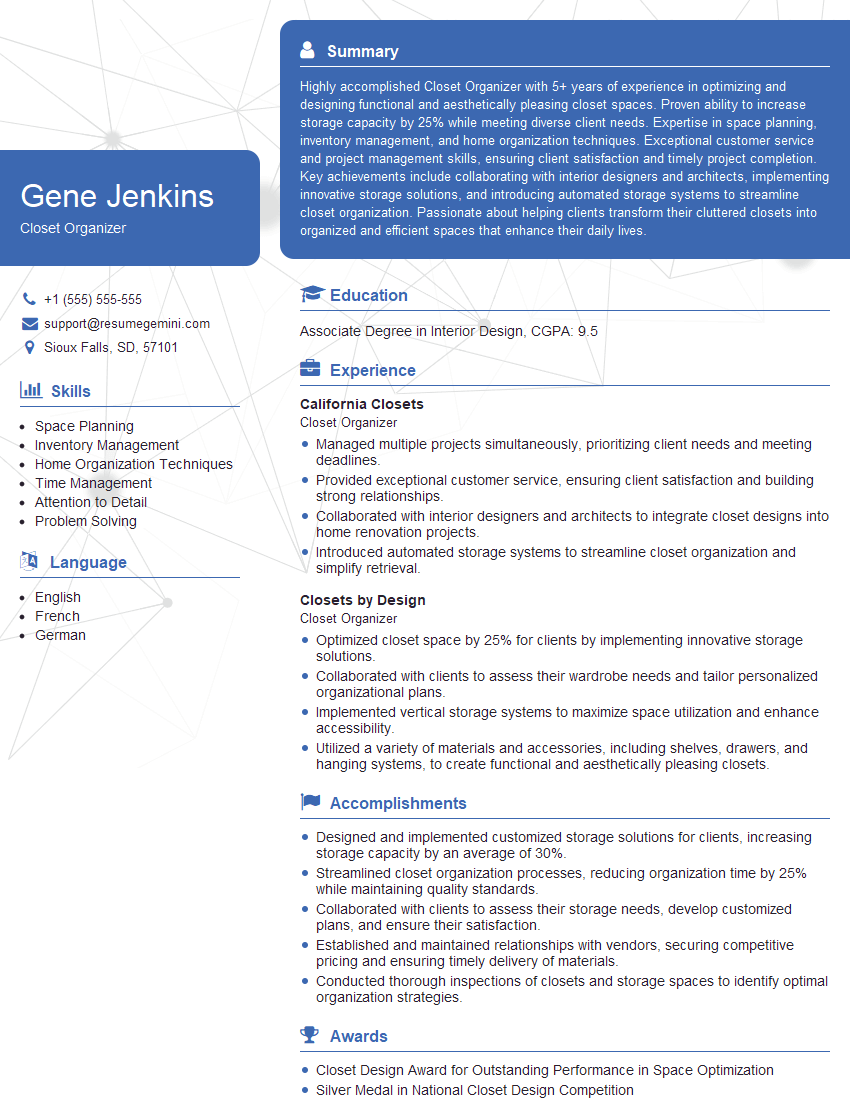
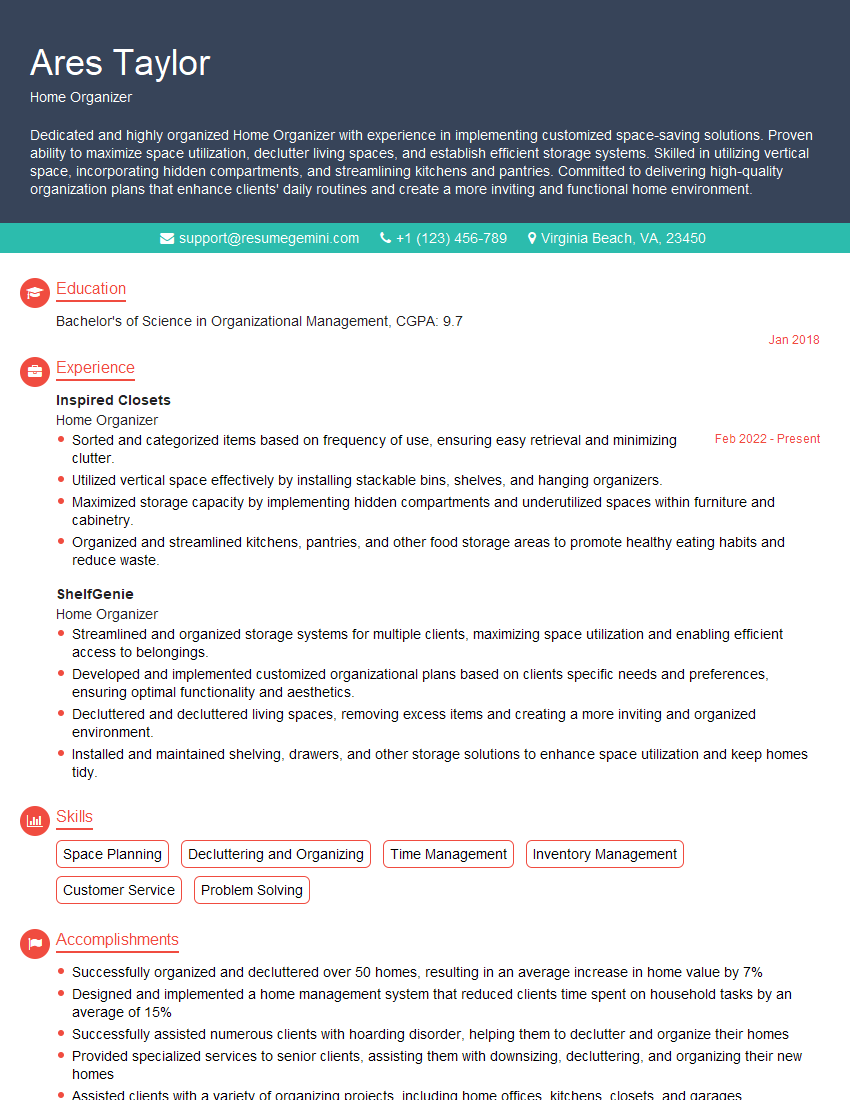
Mastering closet organization opens doors to a fulfilling career offering creative problem-solving, client interaction, and tangible results. A well-crafted resume is key to showcasing these skills effectively to potential employers. Building an ATS-friendly resume is crucial for maximizing your job prospects. We highly recommend using ResumeGemini, a trusted resource, to build a professional and impactful resume that highlights your abilities. Examples of resumes tailored specifically to the closet organization field are available to guide you.
Explore more articles
Users Rating of Our Blogs
Share Your Experience
We value your feedback! Please rate our content and share your thoughts (optional).
What Readers Say About Our Blog
Very informative content, great job.
good