Preparation is the key to success in any interview. In this post, we’ll explore crucial Color Matching and Coordination interview questions and equip you with strategies to craft impactful answers. Whether you’re a beginner or a pro, these tips will elevate your preparation.
Questions Asked in Color Matching and Coordination Interview
Q 1. Explain the difference between additive and subtractive color mixing.
Additive and subtractive color mixing represent two fundamentally different approaches to creating colors. Think of it like this: additive is like adding ingredients to a recipe, while subtractive is like removing ingredients.
Additive color mixing is used with light sources, such as screens or projectors. The primary colors are red, green, and blue (RGB). When you combine these at full intensity, you get white light. As you reduce the intensity of each color, you move towards black. Imagine shining a red, green, and blue flashlight on a white wall; where the beams overlap, you’ll see different colors: red + green = yellow, red + blue = magenta, green + blue = cyan. Combining all three produces white. This system underpins most digital displays.
Subtractive color mixing is used with pigments, inks, or dyes. The primary colors here are cyan, magenta, and yellow (CMY), sometimes with black (CMYK) added for better dark tones. These colors absorb certain wavelengths of light and reflect others. Combining these primaries results in progressively darker colors. For instance, mixing cyan and magenta pigments yields blue because they absorb red and green respectively, leaving only blue light to be reflected. Combining all three CMY colors ideally produces black, but in practice, a deep brown results and thus the use of K for black. This method applies to printing, painting, and many other physical mediums.
Q 2. Describe the CIE color space and its importance in color matching.
The CIE (Commission Internationale de l’Éclairage) color space is an internationally recognized system for specifying and quantifying colors. It’s crucial for color matching because it provides a standardized method to define any color regardless of the device or medium used to display or reproduce it.
The CIE 1931 XYZ color space is a widely used version. It defines colors based on three hypothetical primary colors (X, Y, Z) that can be mathematically combined to represent any visible color. The Y value correlates to luminance (brightness), while X and Z represent chromaticity (color hue and saturation). The advantage is that any color, regardless of its source, can be mapped onto the CIE diagram to be compared and matched objectively. This is why it’s essential for consistent color reproduction across different devices and manufacturing processes. For example, a textile manufacturer might use CIE data to ensure their dye produces a color identical to the design spec, regardless if that spec was created on a monitor or physical swatch.
Q 3. What are metamerism and how does it affect color matching?
Metamerism is a phenomenon where two colors appear identical under one type of light (e.g., daylight) but different under another (e.g., incandescent light). This happens because these colors have different spectral power distributions; they reflect or transmit different amounts of light at different wavelengths but still stimulate the human eye the same way in particular light conditions. The perceptual similarity is only under specific circumstances.
In color matching, metamerism creates significant challenges. Two samples might appear to match perfectly in a showroom under specific lighting, but might look vastly different outdoors under natural sunlight. This can lead to costly errors in manufacturing and quality control. To mitigate this, color matching should always be performed under controlled lighting conditions, and spectrophotometric measurements under multiple light sources are crucial in determining color match consistency across different spectral distribution.
Q 4. How do you measure color accurately using a spectrophotometer?
A spectrophotometer measures the spectral reflectance or transmittance of a material. This means it measures how much light the material reflects or transmits at different wavelengths across the visible spectrum. This data is then used to determine the color’s objective properties.
Here’s how accurate color measurement is performed using a spectrophotometer:
- Sample Preparation: The sample should be clean and free from any imperfections that could affect the measurement. Proper orientation and presentation of the sample is important to minimize measurement errors.
- Instrument Calibration: The spectrophotometer must be calibrated using a standardized white reference tile before each measurement to ensure accuracy.
- Measurement: The sample is placed in the spectrophotometer’s sample port, and the instrument measures the reflectance or transmittance across the visible spectrum (typically 380-730nm). The measurement should be repeated multiple times for statistical accuracy and error reduction.
- Data Analysis: The spectrophotometer generates data in the form of a spectral curve which can be interpreted by relevant software to quantify color differences and determine quality control.
By providing precise spectral data, spectrophotometers enable objective color comparisons and are invaluable for accurate color matching and quality control in various industries.
Q 5. What are the common color difference formulas (e.g., Delta E) and their significance?
Color difference formulas, often expressed as Delta E (ΔE), quantify the perceived difference between two colors. Various formulas exist, each with its own strengths and weaknesses in terms of how well it correlates with human perception.
Some common formulas include:
- ΔE*ab (CIE76): One of the earliest formulas, it’s simple but less accurate at representing small color differences.
- ΔE*94 (CIE94): An improvement over CIE76, it accounts for variations in lightness and chroma, offering better accuracy.
- ΔE*00 (CIE2000): The most sophisticated formula, it incorporates parameters that address metamerism and other perceptual aspects, better correlating with human visual experience.
- ΔE CMC (l:c): Another widely used formula, which takes into account the specific tolerances based on the color space coordinate and correlates better to industry standards.
The significance of these formulas lies in their ability to provide numerical values for color differences. This numerical data is critical for quality control, ensuring consistency in color reproduction across batches and ensuring that variations stay within acceptable tolerances.
Q 6. Explain the concept of color tolerance and its application in quality control.
Color tolerance defines the acceptable range of variation in a color. It’s expressed as a ΔE value, specifying the maximum permissible difference between a standard color and the produced color. The acceptable tolerance value depends on the application and the sensitivity of the human eye to the specific color. A smaller ΔE value means a tighter tolerance, requiring more precise color control.
In quality control, color tolerance ensures that manufactured products meet specified color standards. For example, a car manufacturer might specify a ΔE*00 tolerance of 1.0 or less for the car’s paint. Any batch of paint exceeding this tolerance would be rejected, ensuring consistent color across all vehicles. In the textile industry, this applies to yarn batches, dye-lots, and finished products. Color tolerance specifications are integral part of the purchase order and specifications documents.
Q 7. Describe your experience with different color management systems (CMS).
My experience with Color Management Systems (CMS) is extensive. I’ve worked with several, including Adobe Color Management Modules, Pantone Color Manager, and various proprietary systems used in specific industries, such as the textile and printing industries. These systems manage color profiles, which define the relationship between the color values of a device (e.g., scanner, monitor, printer) and the actual perceived colors. A CMS aims to standardize color across the entire production workflow, enabling consistent color output from design to final product.
I’ve used these CMSs for various tasks, including:
- Profile Creation and Editing: Creating device profiles that accurately represent their color characteristics.
- Color Conversion: Transforming color data between different color spaces (e.g., RGB to CMYK) to ensure accurate color reproduction across devices.
- Color Proofing: Simulating the appearance of printed colors on a monitor for accurate color preview.
- Quality Control: Assessing color accuracy during production, utilizing delta-E analysis for tolerance checks across the manufacturing chain.
Understanding and properly implementing these CMSs are vital for ensuring consistent color in various design and manufacturing workflows. A poorly managed CMS can lead to significant discrepancies in color which can cause massive losses in the design and manufacturing space.
Q 8. How do you handle discrepancies between different color rendering devices?
Discrepancies between color rendering devices arise because each device (monitors, printers, etc.) has its own color gamut – the range of colors it can reproduce. A color that’s perfectly represented on one device might appear duller or completely different on another. This is due to variations in the technology used, such as different types of phosphors in monitors or inks in printers.
To handle these discrepancies, a multi-pronged approach is essential:
- Color Profile Management: This is the cornerstone. Color profiles (ICC profiles) are like ‘dictionaries’ that translate colors between devices. By correctly embedding and utilizing ICC profiles, we ensure a closer approximation of color consistency across different devices. For example, a designer working in Adobe Photoshop with an sRGB profile and printing to a printer with a specific ICC profile will benefit from this process.
- Soft Proofing: Before printing, I always soft proof the design. This simulates the print output on screen, allowing me to see how the colors will translate. Soft proofing is done using the printer’s ICC profile in the design software.
- Calibration and Profiling: Regular calibration of monitors and profiling of printers is crucial. Calibration ensures that the monitor is displaying colors accurately, while profiling creates an ICC profile for the printer, accurately reflecting its capabilities.
- Understanding Color Gamuts: Recognizing that some colors are simply outside the gamut of certain devices is crucial. I avoid designing with colors that cannot be reproduced consistently.
Think of it like baking a cake. Two bakers using the same recipe might get slightly different results depending on their ovens and ingredients. Color management is like having standardized measurements and equipment to ensure consistency.
Q 9. Explain your understanding of color spaces such as sRGB, Adobe RGB, and Pantone.
Color spaces are standardized systems for representing colors numerically. Each color space defines a specific gamut and color coordinates. Let’s compare three common ones:
- sRGB (Standard Red Green Blue): This is the most common color space for the web and many monitors. It has a relatively small gamut, meaning it can’t reproduce as many colors as other spaces. It’s a safe bet for web designs ensuring broad compatibility.
- Adobe RGB (1998): This color space has a wider gamut than sRGB, allowing for a richer range of colors, especially greens and blues. It’s often preferred by photographers and designers working on print projects where color accuracy is paramount.
- Pantone Matching System (PMS): Unlike sRGB and Adobe RGB, Pantone is a spot color system. It uses pre-mixed inks identified by specific numbers (e.g., Pantone 18-1664 TCX). Spot colors are more accurate and consistent across print runs, but they are more expensive than process colors (CMYK) and less flexible for gradients and blends.
Choosing the right color space is critical. Using Adobe RGB for a web design might result in some colors being rendered differently on standard sRGB screens. Conversely, relying solely on sRGB for print projects might limit the vibrancy of your final product. The selection depends entirely on the intended application and output method.
Q 10. How do you ensure consistent color reproduction across various printing methods?
Consistent color reproduction across various printing methods requires careful consideration of several factors:
- Ink Type and Substrate: Different inks (CMYK, specialty inks) behave differently on various substrates (paper types, canvas, etc.). The ink’s absorption and reflection properties need to be considered.
- Color Profile Management (again!): Using appropriate ICC profiles for each printing method and substrate is vital. These profiles characterize how the inks will interact with the specific materials.
- Proofing: Producing color proofs is essential. These are test prints used to validate the color accuracy before a full-scale print run. Different types of proofs exist (soft proofs, hard proofs using different printing methods) to closely match the final output.
- Print Calibration: Printers should be calibrated and maintained regularly to guarantee consistent ink distribution and color accuracy.
- Communication: Clear communication with the printing facility is crucial to ensure that they understand the desired color space and intended results.
For instance, printing a design intended for an sRGB profile on a printer calibrated for Adobe RGB will yield different color results. Utilizing the correct profiles throughout the process resolves such issues.
Q 11. Describe your experience with color formulation and adjustment.
Color formulation and adjustment involve creating and modifying color recipes to achieve specific visual targets. My experience includes working with both digital and physical color formulation:
- Digital Color Formulation: Using software, I adjust color values (e.g., CMYK, RGB, LAB) to match a target color, considering the limitations of the printing or display device. I frequently use spectrophotometer data to guide my adjustments.
- Physical Color Formulation: For inks, paints, or dyes, this involves adjusting the ratios of different pigments or dyes to achieve a specific color. This often requires iterative adjustments, utilizing a colorimeter or spectrophotometer to measure the color differences and refine the formula.
One instance involved matching a client’s corporate blue to a particular fabric. This required several rounds of physical formulation adjustments until we achieved an acceptable color match. Precise measurements using a spectrophotometer and a color difference formula (like Delta E) were critical to reaching the desired outcome.
Q 12. How do you troubleshoot color matching issues?
Troubleshooting color matching issues is a systematic process:
- Identify the Discrepancy: Define the specific color problem – is it too dark, too light, off-hue, etc.? Where is the mismatch occurring—on-screen, in print, or both?
- Review Color Management Settings: Verify that correct color profiles are used throughout the workflow. Check device calibrations and profiles for accuracy.
- Inspect the Color Space: Ensure that the chosen color space is appropriate for the output method. Convert colors to the right space if needed.
- Check Print Settings: Review printer settings (ink levels, paper type, etc.). Incorrect settings can significantly alter color reproduction.
- Analyze the Proof: If available, closely examine the color proof to identify potential issues early on.
- Measure Color Differences: Use a spectrophotometer to quantify the color differences between the target and actual colors. Delta E values help determine the magnitude of the discrepancy.
- Iterative Adjustments: Based on measurements and analysis, iteratively adjust the color values or settings until an acceptable match is achieved.
For example, if a printed design appears duller than expected, I might check the printer’s ICC profile, ink levels, and paper type. If the problem persists, precise color measurement will help identify the source and guide adjustments.
Q 13. Explain your familiarity with various color measurement instruments.
I’m familiar with various color measurement instruments, each with its strengths and applications:
- Spectrophotometers: These instruments measure the spectral reflectance or transmittance of a color sample. They provide highly accurate color data, used for precise color matching and quality control. Different types exist: 0/45°, sphere, and multi-angle.
- Colorimeters: These instruments measure color coordinates (e.g., XYZ, L*a*b*) in a simpler way than spectrophotometers. While less precise, they are more portable and affordable, suitable for many applications.
- Densitometers: These primarily measure the density of inks on printed materials. They are primarily used in print production to control the ink coverage.
The choice depends on the level of accuracy needed. Spectrophotometers are ideal for demanding color critical applications, while colorimeters are suitable for tasks needing less precise measurement.
Q 14. How do you communicate color specifications effectively to clients or manufacturers?
Effective communication of color specifications is crucial for avoiding misunderstandings:
- Precise Numerical Values: Instead of vague terms, I use precise numerical values – providing L*a*b* values or specific Pantone numbers for exact color identification. Color swatches are also useful.
- ICC Profiles: I always include relevant ICC profiles, especially when working with digital files, to ensure consistent color reproduction across different devices.
- Color Standards: Reference industry-standard color systems whenever possible (Pantone, RAL, etc.). These serve as a common language between clients and manufacturers.
- Clear Communication: I provide concise and clear written instructions and communicate in-person or via video calls to clarify any potential ambiguities.
- Proofs: Physical proofs are essential for tangible confirmation of the agreed-upon colors, reducing potential discrepancies and resolving doubts.
For example, rather than saying ‘a dark blue’, I would specify ‘Pantone 294 C’ or provide the L*a*b* values. This approach ensures everyone is working with the same color reference.
Q 15. Describe your experience with color standards and reference materials.
My experience with color standards and reference materials is extensive. I’m intimately familiar with various systems, including Pantone Matching System (PMS), RAL, and CIE L*a*b*, understanding their strengths and limitations in different applications. For instance, PMS is widely used in print design for ensuring consistent color reproduction across different printers and print runs, while CIE L*a*b* provides a more device-independent, scientifically accurate representation of color. I’ve worked extensively with color charts, spectrophotometers, and color libraries, using them to create accurate color recipes and ensure consistency across different production processes. Understanding the nuances of each system and their appropriate applications is crucial for effective color management.
- Pantone Matching System (PMS): Used extensively in print and packaging, PMS provides a standardized system for communicating color. I’ve used PMS books and software to ensure accurate color reproduction in various print projects.
- RAL: Primarily used in the paint and coatings industry, RAL offers a comprehensive system for specifying colors. I’ve utilized RAL color charts to match colors in architectural and industrial projects.
- CIE L*a*b*: A device-independent color space, CIE L*a*b* is crucial for digital color management. I have used this system for color profiling and assessing color differences using Delta E metrics.
Career Expert Tips:
- Ace those interviews! Prepare effectively by reviewing the Top 50 Most Common Interview Questions on ResumeGemini.
- Navigate your job search with confidence! Explore a wide range of Career Tips on ResumeGemini. Learn about common challenges and recommendations to overcome them.
- Craft the perfect resume! Master the Art of Resume Writing with ResumeGemini’s guide. Showcase your unique qualifications and achievements effectively.
- Don’t miss out on holiday savings! Build your dream resume with ResumeGemini’s ATS optimized templates.
Q 16. What software are you proficient in for color management (e.g., X-Rite i1Profiler, Datacolor)?
My proficiency in color management software is considerable. I’m highly skilled in using X-Rite i1Profiler for creating custom ICC profiles for various devices like monitors, printers, and scanners. This ensures accurate color representation across the entire workflow. I also have experience with Datacolor’s software, leveraging its features for accurate color formulation and quality control in various applications. My expertise extends to using these tools for both spot color and process color matching. I’m familiar with their functionalities including spectrophotometer integration, color difference calculations, and report generation. This allows for efficient and precise color management in different environments.
Q 17. How do you stay updated with the latest trends and technologies in color management?
Staying current in color management requires continuous learning. I regularly attend industry conferences and workshops, such as those hosted by organizations like X-Rite and Datacolor. I subscribe to relevant industry publications and journals, keeping abreast of the latest research and technological advancements. I actively participate in online forums and communities dedicated to color management, exchanging knowledge and insights with other professionals. Furthermore, I actively explore new software updates and explore emerging technologies within the color science field, allowing me to stay at the forefront of color management best practices.
Q 18. Explain your experience with color quality control in a manufacturing setting.
In a manufacturing setting, color quality control is paramount. My experience includes implementing and overseeing color quality control processes for various products. This involves establishing color standards, utilizing spectrophotometers for objective color measurement, and setting acceptable color difference tolerances (Delta E). I’ve trained manufacturing personnel on proper color measurement techniques and the importance of maintaining consistent color throughout the production process. I’ve created and implemented detailed SOPs (Standard Operating Procedures) for color quality control, reducing errors and improving efficiency. A key aspect of my role was analyzing data from spectrophotometer readings, identifying potential color deviations early, and providing feedback to adjust the manufacturing process to maintain color consistency.
Q 19. Describe a situation where you had to resolve a color matching discrepancy.
In one instance, a client’s printed materials showed a significant color shift compared to the approved Pantone color. Through systematic investigation, using a spectrophotometer and comparing readings to the original Pantone standard, we identified the issue to be a combination of ink density variations and slight differences in paper stock. This resulted in a Delta E value exceeding acceptable limits. We systematically addressed the problem. First, we recalibrated the printing press, ensuring accurate ink delivery. Second, we conducted a comprehensive analysis of the paper stock, ensuring consistency in batch materials. Finally, we refined the color profile used in the printing process, significantly reducing the color deviation and bringing the Delta E value within the acceptable range. This required collaboration with the print vendor, showing the value of clear communication and collaborative problem-solving. The final product met the client’s expectations and reinforced the importance of a robust quality control process.
Q 20. How do you ensure accuracy and consistency in your color matching process?
Accuracy and consistency are cornerstones of my color matching process. I rely on objective measurements using spectrophotometers to quantify color differences, instead of solely relying on visual assessment which can be subjective and influenced by lighting conditions. This involves using consistent lighting conditions during color evaluation, utilizing calibrated instruments, and adhering to established standards and tolerances (e.g., Delta E). I meticulously document all color measurements and adjustments, ensuring traceability and accountability. This detailed record-keeping allows for quick identification of the root cause of any color discrepancies, improving efficiency and minimizing future errors. Regularly scheduled calibration and maintenance of equipment are vital aspects of my workflow.
Q 21. What are the limitations of visual color matching?
Visual color matching, while seemingly straightforward, has limitations. Human perception of color is subjective and affected by factors like ambient lighting, individual variations in color vision, and even fatigue. Lighting sources, both natural and artificial, can significantly alter how we perceive color, making visual comparisons unreliable. For example, a color appearing accurate under one type of lighting might appear drastically different under another. This is why relying solely on visual assessment for color matching is insufficient, especially in professional settings where precise color reproduction is critical. Objective measurement using instruments like spectrophotometers is essential to ensure accurate and consistent color reproduction, surpassing the inherent limitations of human perception.
Q 22. How do you account for variations in lighting conditions when matching colors?
Accurately matching colors requires understanding that lighting significantly impacts how we perceive them. The same color can appear drastically different under incandescent, fluorescent, or natural daylight. To account for this, we use standardized lighting conditions. This often involves using light booths that mimic specific light sources defined by standards like D65 (simulating average daylight) or CIE illuminants.
For instance, imagine trying to match a deep blue fabric. Under a warm incandescent light, it might appear darker and slightly more purplish, while under cool fluorescent light, it might look brighter and bluer. By using a calibrated light booth, we eliminate this variability and ensure consistent color evaluation. We also use spectrophotometers to measure the spectral reflectance of the color, providing objective data independent of lighting conditions. This allows us to precisely define the color regardless of the ambient light.
In practical terms, we might use a color management system (CMS) that profiles the light source in the booth and the display device we’re using, ensuring accurate representation. The process often involves creating color profiles for different lighting environments to allow for accurate color reproduction in various contexts.
Q 23. What are the environmental factors that influence color stability?
Color stability, meaning how well a color resists change over time, is affected by numerous environmental factors. These can be broadly categorized into light exposure, temperature, and humidity.
- Light Exposure: UV rays in sunlight are notorious for causing color fading and degradation. This is especially true for dyes and pigments that aren’t UV-resistant. Darker colors, with their higher concentration of pigments, tend to be more resistant than lighter shades.
- Temperature: Extreme temperatures, both high and low, can affect the chemical structure of dyes and pigments, leading to discoloration. Rapid temperature changes can also be detrimental.
- Humidity: High humidity can contribute to mold and mildew growth, which can stain and alter the appearance of materials. It can also affect the chemical stability of certain dyes and lead to color shifts.
For example, a vibrant red car left outdoors in direct sunlight will fade significantly faster than one parked in a garage. Similarly, a delicate pastel-colored painting stored in a damp basement may experience color degradation due to moisture. Understanding these factors is crucial in choosing materials and finishes that will maintain their color integrity over time. Proper storage and handling are key aspects of ensuring color stability.
Q 24. How do you manage color data and maintain accurate records?
Maintaining accurate color records is paramount. We utilize a combination of digital and physical methods. Digital tools include dedicated color management software, databases, and spectral data storage. We use spectrophotometers to measure and record the spectral data of each color, providing objective and repeatable measurements. These digital records allow for precise color reproduction, even across different production batches or locations.
Physical samples, known as color standards, play a crucial role. We store these in controlled environmental conditions to prevent degradation. These samples serve as benchmarks for comparison and verification. They’re especially vital in cases where digital data may be lost or compromised.
An effective system involves linking digital spectral data with physical samples. This allows for retrieval of both types of information, providing a complete and reliable color record for each project. Version control within the digital system is also essential to track changes and revisions over time.
Q 25. Describe your understanding of different color rendering indices (CRIs).
The Color Rendering Index (CRI) quantifies how well a light source renders the colors of objects compared to a reference source (typically incandescent light). A CRI of 100 indicates perfect color rendering – the colors appear exactly as they would under the reference source. Lower CRI values indicate a poorer ability to render colors accurately.
For example, a CRI of 80 is considered acceptable for many applications, but a CRI of 90 or higher is preferred for applications where accurate color perception is essential, such as museums, art galleries, or textile design. Different light sources, such as LEDs, halogen, or fluorescent lamps, have different CRIs, and selecting the appropriate light source is crucial for consistent color evaluation and matching. When comparing colors, knowing the CRI of the light source used during measurement is essential for avoiding inaccurate assessments. A lower CRI might make colors appear dull or unnatural, leading to incorrect color matching.
Q 26. How would you approach matching a specific Pantone color?
Matching a Pantone color requires precision and attention to detail. Pantone provides standardized color formulas, but achieving an exact match depends on the substrate (material) and the printing or dyeing method.
My approach involves first consulting the Pantone Color Bridge, which provides the CMYK, RGB, and spectral data for the target Pantone color. I then use a spectrophotometer to measure the spectral reflectance of the material I’m trying to match. This provides objective data to compare against the Pantone spectral data. If necessary, I’d adjust the ink formulation or dye concentration to minimize the color difference (Delta E) between the target and the actual sample. This process may involve multiple iterations of measurement and adjustment.
I also consider the metamerism effect, where two colors may appear identical under one light source but different under another. To mitigate this, I’d measure the color under multiple light sources, ensuring consistency across different lighting conditions. Finally, I’d perform a visual comparison under standardized lighting to validate the color match.
Q 27. Explain the principles of color psychology and how they relate to your work.
Color psychology explores the impact of colors on human emotions, behavior, and perceptions. Understanding these principles is essential for color coordination, particularly in design and branding.
For example, warm colors like red and orange evoke feelings of energy, excitement, and sometimes even aggression. Cool colors like blue and green often communicate calmness, serenity, and trustworthiness. Knowing this helps me select colors that achieve the desired emotional response. When designing a website, for instance, I might use a calming blue for a healthcare provider to inspire trust, whereas a vibrant red might be used to highlight a call to action on an e-commerce site.
In product design, color selection influences consumer perception and purchasing decisions. A high-end brand may use sophisticated and elegant colors, while a fun, youthful brand might opt for brighter, bolder shades. This understanding, combined with technical expertise in color matching, ensures that the aesthetic choices align with the brand’s identity and message, ultimately improving its impact and effectiveness.
Key Topics to Learn for Color Matching and Coordination Interview
- Color Theory Fundamentals: Understanding the color wheel, color harmonies (complementary, analogous, triadic, etc.), and color temperature (warm vs. cool).
- Color Perception and Psychology: How different colors evoke emotions and influence perception; considering cultural and individual differences in color preferences.
- Practical Application in Different Industries: Exploring color matching in fields like graphic design, fashion, interior design, printing, and paint manufacturing.
- Color Measurement and Specification Systems: Familiarity with systems like Pantone, RAL, and CMYK; understanding color spaces and profiles (e.g., sRGB, Adobe RGB).
- Digital Color Matching Techniques: Proficiency in using color management software and tools for accurate color reproduction across different media.
- Problem-Solving Approaches: Troubleshooting color discrepancies, identifying and resolving color inconsistencies, and adapting to different color standards and workflows.
- Color Communication and Collaboration: Effectively communicating color specifications to clients, colleagues, and manufacturers; understanding and utilizing industry-standard color communication methods.
- Advanced Color Concepts (Optional): Metamerism, color constancy, and color vision deficiencies.
Next Steps
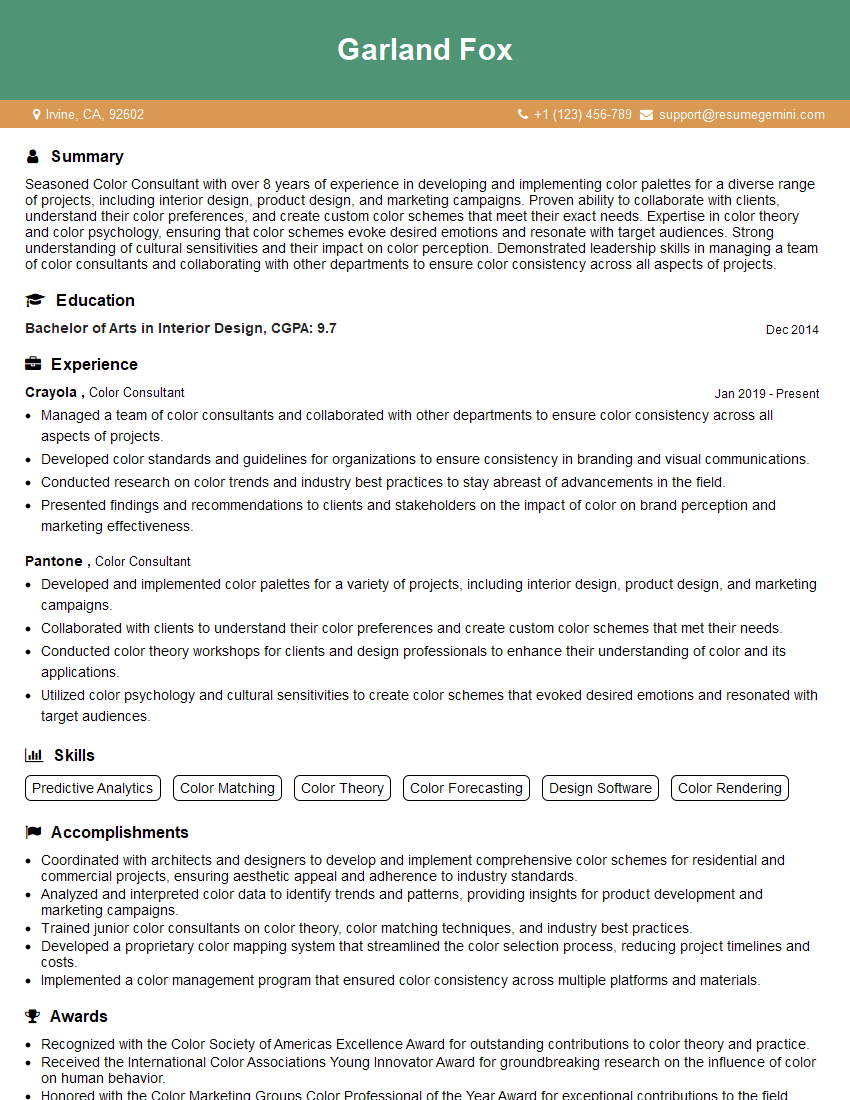
Mastering color matching and coordination is crucial for career advancement in many creative and technical fields. A strong understanding of color theory and practical application opens doors to exciting opportunities and higher earning potential. To maximize your job prospects, crafting an ATS-friendly resume is essential. ResumeGemini is a trusted resource that can help you build a professional and impactful resume, showcasing your skills and experience effectively. We provide examples of resumes tailored to Color Matching and Coordination to help you get started. Invest in your future; build a standout resume today with ResumeGemini.
Explore more articles
Users Rating of Our Blogs
Share Your Experience
We value your feedback! Please rate our content and share your thoughts (optional).
What Readers Say About Our Blog
Hello,
we currently offer a complimentary backlink and URL indexing test for search engine optimization professionals.
You can get complimentary indexing credits to test how link discovery works in practice.
No credit card is required and there is no recurring fee.
You can find details here:
https://wikipedia-backlinks.com/indexing/
Regards
NICE RESPONSE TO Q & A
hi
The aim of this message is regarding an unclaimed deposit of a deceased nationale that bears the same name as you. You are not relate to him as there are millions of people answering the names across around the world. But i will use my position to influence the release of the deposit to you for our mutual benefit.
Respond for full details and how to claim the deposit. This is 100% risk free. Send hello to my email id: [email protected]
Luka Chachibaialuka
Hey interviewgemini.com, just wanted to follow up on my last email.
We just launched Call the Monster, an parenting app that lets you summon friendly ‘monsters’ kids actually listen to.
We’re also running a giveaway for everyone who downloads the app. Since it’s brand new, there aren’t many users yet, which means you’ve got a much better chance of winning some great prizes.
You can check it out here: https://bit.ly/callamonsterapp
Or follow us on Instagram: https://www.instagram.com/callamonsterapp
Thanks,
Ryan
CEO – Call the Monster App
Hey interviewgemini.com, I saw your website and love your approach.
I just want this to look like spam email, but want to share something important to you. We just launched Call the Monster, a parenting app that lets you summon friendly ‘monsters’ kids actually listen to.
Parents are loving it for calming chaos before bedtime. Thought you might want to try it: https://bit.ly/callamonsterapp or just follow our fun monster lore on Instagram: https://www.instagram.com/callamonsterapp
Thanks,
Ryan
CEO – Call A Monster APP
To the interviewgemini.com Owner.
Dear interviewgemini.com Webmaster!
Hi interviewgemini.com Webmaster!
Dear interviewgemini.com Webmaster!
excellent
Hello,
We found issues with your domain’s email setup that may be sending your messages to spam or blocking them completely. InboxShield Mini shows you how to fix it in minutes — no tech skills required.
Scan your domain now for details: https://inboxshield-mini.com/
— Adam @ InboxShield Mini
Reply STOP to unsubscribe
Hi, are you owner of interviewgemini.com? What if I told you I could help you find extra time in your schedule, reconnect with leads you didn’t even realize you missed, and bring in more “I want to work with you” conversations, without increasing your ad spend or hiring a full-time employee?
All with a flexible, budget-friendly service that could easily pay for itself. Sounds good?
Would it be nice to jump on a quick 10-minute call so I can show you exactly how we make this work?
Best,
Hapei
Marketing Director
Hey, I know you’re the owner of interviewgemini.com. I’ll be quick.
Fundraising for your business is tough and time-consuming. We make it easier by guaranteeing two private investor meetings each month, for six months. No demos, no pitch events – just direct introductions to active investors matched to your startup.
If youR17;re raising, this could help you build real momentum. Want me to send more info?
Hi, I represent an SEO company that specialises in getting you AI citations and higher rankings on Google. I’d like to offer you a 100% free SEO audit for your website. Would you be interested?
Hi, I represent an SEO company that specialises in getting you AI citations and higher rankings on Google. I’d like to offer you a 100% free SEO audit for your website. Would you be interested?
good